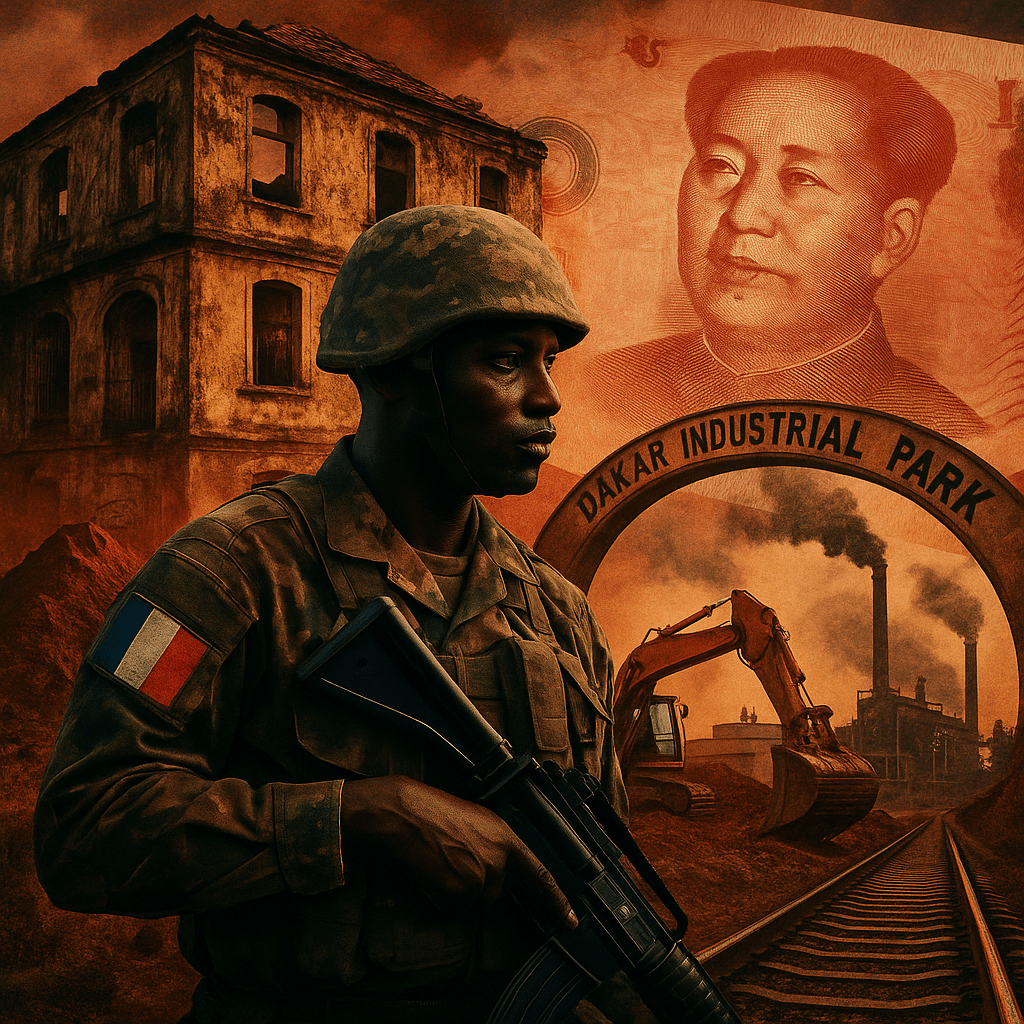
France’s retreat from Senegal isn’t a reset—it’s a rupture. The neocolonial order is cracking under pressure, and the Global North must choose: defend the crumbling empire, or help dismantle it.
By Prince Kapone | Weaponized Information
July 18, 2025
Imperial Retreat Disguised as Diplomacy
On July 17, 2025, the Associated Press published a report announcing that France had officially completed its military withdrawal from Senegal, bringing an end to its last permanent troop presence in West Africa. The article, co-authored by Babacar Dione and Mark Banchereau, presents the handover of Camp Geille and a nearby airbase as a diplomatic gesture between equals, marking what the French military calls a “new phase” in bilateral relations. The narrative is one of closure, transition, and mutual respect—imperialism repackaged as partnership, occupation rebranded as cooperation.
But let us look beneath the packaging. Babacar Dione is a Dakar-based journalist who has spent his career translating the ideological priorities of Western newsrooms into local diction. Mark Banchereau, AP’s lead correspondent for West and Central Africa, is a master of the art of omission—he covers 22 countries without ever naming the system that links them: neocolonialism. Both are operatives of ideological continuity, not critical disruption. They operate inside the linguistic fortress of objectivity, where empire becomes invisible and resistance becomes silence.
The outlet they serve, the Associated Press, wears a nonprofit badge while functioning as a central command hub in the Western propaganda system. Its model is syndication, which means its framing sets the tone for headlines reproduced in a thousand outlets across the Global North. AP doesn’t need CIA funding—it already aligns with State Department narratives, often reproducing foreign policy talking points verbatim, as seen in its past coverage of Libya, Syria, and Venezuela. What AP legitimizes becomes common sense. What AP erases becomes myth, buried beneath the performance of professional journalism.
This narrative is not contained to AP. It is amplified through French diplomatic channels, NATO-aligned think tanks like the Atlantic Council, and policy briefings circulated by the State Department and EU security forums. The Atlantic Council’s 2025 report, West Africa and the New Strategic Horizon, echoes this framing almost verbatim, praising France’s “new partnership model” and warning against “external actors disrupting African security cooperation.” The same report was cited in an EU defense briefing days after the AP story ran.
The article celebrates France’s departure without mentioning why the troops were there to begin with. It calls the ceremony a handover, not an eviction. It presents France’s military withdrawal as part of a “flexible partnership” strategy, without acknowledging the popular uprisings, youth mobilizations, and revolutionary movements that made continued occupation impossible. This isn’t reporting—it’s diplomatic damage control with a byline.
Let’s deconstruct. First, the article uses framing inversion to recast an imperial withdrawal as voluntary: “France has decided to end its permanent military bases,” says Gen. Pascal Ianni, as if African resistance had nothing to do with it. It’s like praising a thief for “recalibrating his security engagement” after getting caught in your home.
Second, the article omits every reference to the mass political force behind this withdrawal. It erases the context of Mali, Burkina Faso, and Niger expelling French troops, suspending defense treaties, and declaring national liberation paths. No mention of France Dégage, no mention of Senegalese youth storming French businesses, no mention of decades of popular agitation. This is the deliberate dislocation of history—a propaganda technique more powerful than a lie because it pretends truth was never there to begin with.
Third, it deploys emotional neutralization. Everything is procedural, bureaucratic, sterile: a base “handover,” a “ceremony,” a “shift in strategy.” There is no rage, no grief, no memory of colonial massacres, no trauma of puppet regimes, no mention of drone bases monitoring Sahelian farmers like targets. The past is drained of blood and filled with press statements.
Fourth, the article slips in cognitive warfare through euphemism. “Flexible partnership” is the latest buzzword from the neocolonial lexicon—an unaccountable, deniable, and mobile form of military power that doesn’t need to occupy to dominate. Training missions, intelligence exchanges, drone coordination: the occupation continues without boots on the ground, only footprints in the cloud.
Fifth, it draws a false equivalence between France and Russia. While France has occupied African land for over a century, the article implies that Russian support to countries like Mali is just another geopolitical shift—not a deliberate break with a Western imperial system that has looted, bombed, and humiliated the region since the Berlin Conference. The sleight of hand lies in the AP’s phrasing: “Russia’s growing presence in West Africa reflects shifting regional dynamics.” If everyone is a player, then no one is a colonizer—that’s the lie being sold.
Finally, the article performs a textbook deployment of sanitized colonial tropes. There is no mention of what Camp Geille was actually used for—no memory of it as a node in a surveillance network, a staging point for interventions, a fortress of foreign power on sovereign soil. France’s role is to be respected. Africa’s role is to be grateful. That’s the hidden logic propping up the entire narrative.
So yes, France has withdrawn. But this article wants you to believe it walked out on its own terms, with its dignity intact and its mission complete. It wants you to believe that neocolonialism is over because a base changed hands. It wants you to forget that the base existed to begin with. And above all, it wants you to stop asking why they were there in the first place. That is the magic trick of empire: it disappears itself, and calls it peace.
What the Facts Reveal, and What the Article Conceals
Behind the performative neutrality of the Associated Press lies a far more explosive reality. France’s so-called withdrawal from Senegal is not a quiet evolution in foreign policy—it is the most recent in a series of forced retreats across the Sahel, catalyzed by mass mobilization, multipolar defiance, and the collapse of France’s imperial legitimacy. Yet the article says nothing of the fires that led to this exit, and even less about the neocolonial scaffolding that remains firmly in place.
The base handover at Camp Geille did take place, and roughly 350 troops were indeed redeployed between March and July 2025. But the claim that this marks the “end” of France’s military presence in West Africa conceals more than it reveals. The article omits the mass uprisings across Francophone Africa over the past five years—most notably in Burkina Faso, Niger, and Mali, where French troops were not invited to leave—they were expelled by new governments. These were not bureaucratic reconfigurations; they were true expulsions, initiated by grassroots movements that mobilized mass pressure until the occupiers had no choice but to leave. Senegal’s pivot under President Bassirou Diomaye Faye is a delayed echo of the same popular energy, catalyzed by youth movements like FRAPP France Dégage and the cumulative exhaustion of sixty years of postcolonial subservience.
What the AP calls a “handover” conceals the history of what Camp Geille really was: a forward operating base in France’s military architecture of regional control. As reported by the Journal of Military and Strategic Studies, this facility served not merely as a bilateral training site but as a surveillance node for drone reconnaissance and regional military interventions. It was part of the French military’s “counterterrorism” footprint, which routinely spilled across borders under the guise of fighting jihadism while securing French energy and mining interests. This isn’t conspiracy—it’s logistics.
The logic of this military occupation was always economic. France’s troop deployments correlate with extractive corridors—uranium in Niger, offshore oil in Gabon, gold in Burkina Faso. As detailed in the Foreign Policy Research Institute, France’s Sahel strategy was always entwined with the protection of extractive interests—particularly uranium supplies from Niger, which power French nuclear energy. In this context, the claim that French troops were simply “advisors” or “cooperative partners” becomes laughable. They were armed enforcers of economic plunder, garrisoned in postcolonial uniforms.
Senegal’s symbolic break with this history must be understood within the deeper contradiction of what remains. As detailed in the Tricontinental, Senegal remains locked into IMF-dictated budget ceilings, trade liberalization mandates, and austerity measures that render political sovereignty incomplete. Despite campaigning on a platform of rupture, President Faye’s cabinet has upheld IMF budget compliance and signed off on new rounds of debt service obligations. This is the contradiction of postcolonial governance under imperial scaffolding: elections change faces, not structures. France may have closed the front door, but the IMF still holds the keys.
Meanwhile, France is not truly leaving. Its pivot to a “partnership model,” as described by the AP, is in fact a rebranding of presence rather than its elimination. As confirmed by the AP itself, French military operatives remain embedded in Senegal’s security apparatus through joint operations, intelligence sharing agreements, and EU-funded regional force coordination. This allows France to project power without permanent barracks—a form of strategic diffusion that maintains influence while minimizing backlash. This is neocolonial control rebranded for a post-occupation era.
Yet the pressure is real. Senegal is not Mali or Niger, but it is clearly feeling the gravitational pull of multipolar defection. As reported by the South China Morning Post, Senegal formally joined China’s Belt and Road Initiative in 2023, with infrastructure deals including the development of the Dakar Industrial Park and expanded rail integration connecting Senegal to broader West African trade corridors. In June 2025, Senegal joined a BRICS+ working group exploring local currency settlement for regional trade, including a pilot agreement with China to denominate phosphate exports in yuan rather than dollars. The CFA franc—long a symbol of French neocolonial domination—is also facing intensified public scrutiny and may soon follow the political retreat of French troops. As Reuters notes, the entire “Franc Zone” is in crisis, with governments and populations alike questioning its legitimacy.
The Associated Press wants readers to understand France’s exit as an administrative development. In truth, it is a retreat. But to say that without also acknowledging the systems France leaves behind—economic control, narrative dominance, militarized diplomacy—is to miss the point entirely. The base has changed hands, yes. But the ground it sat on is still wired with imperial controls, like IMF debt and EU surveillance contracts.
Revolution Doesn’t Shake Hands: The System Is Retreating, Not Rebranding
France did not leave Senegal—it was driven out by a historical process whose fuse was lit decades ago. That process was not bureaucratic, and it was not diplomatic. It was revolutionary. What the Associated Press frames as a handshake is, in fact, a fracture. What they call a “partnership realignment” is, in political terms, a forced retreat by an empire that no longer has the legitimacy, leverage, or guns to hold the ground it once stole. But empires do not collapse without trying to convince the world they are still in control. That is why they call it a transition.
The Senegalese rupture, though measured in tone, is a seismic event in the imperial architecture of West Africa. As laid bare in “The Sahel Doesn’t Beg Anymore”, France’s position in the Sahel was never about terrorism—it was about maintaining armed insurance policies for uranium, gold, and regional hegemony. From Mali to Niger, the people rebelled—not because Russia offered a better deal, but because France’s occupation had exhausted all remaining illusions. Senegal’s shift must be seen as a continuation of that rupture, not an exception to it. This is what it looks like when the neocolonial order fractures under the pressure of collective refusal.
The ruling class calls this “instability.” But what we are witnessing is not chaos—it is the breakdown of imperialist recalibration. That is the strategic process by which empires respond to rebellion by reshaping their tools of control. When military occupation no longer works, they pivot to “training programs.” When puppet regimes lose legitimacy, they invest in liberal opposition. When extraction is blocked by unrest, they offer greenwashed development schemes. But the contradictions are now too deep, too exposed, too cumulative. France did not exit Senegal on its own terms—it was recalibrating to prevent further collapse.
As “From Dakar to Niamey” makes clear, the Senegalese break is not the result of a single election or a charismatic leader. It is the result of decades of suffocation: political manipulation, security dependency, media saturation, currency servitude, and elite comprador consolidation. What President Faye has done is articulate a demand already roaring from below—that Senegal must no longer host foreign forces on its soil. But the gesture, however significant, is constrained by the wider mechanisms of what Weaponized Information has called neocolonialism: a system where political sovereignty exists only within the boundaries drawn by external creditors, legal frameworks, and strategic treaties.
This is why France’s exit from Camp Geille does not yet constitute decolonization. As Reuters reports, the IMF suspended Senegal’s existing $1.8 billion credit facility in March 2025 after discovering significant debt underreporting and budget misreporting. Discussions on a new program are on hold until those issues are resolved, illustrating how Senegal’s 2024 budget was shaped in consultation with IMF staff and debt service was prioritized—even amid youth-led demands for rupture. French investment capital still flows through Senegalese banks and infrastructure. Euro‑American advisors operate within its institutions. In real terms, France’s garrison economy has been converted into a financial surveillance regime, where control no longer requires uniforms—it only requires code, credit, and contracts.
The danger now is what “Development or Dependency” diagnosed as the soft counteroffensive: imperialism rebranded through development discourse. The West is already attempting to contain Senegal’s pivot by flooding the country with public-private initiatives, green energy partnerships, and multilateral forums. These are not neutral projects—they are weapons. The World Bank’s solar investments and the EU’s €150 million migration control fund are part of a strategy to keep Senegal in the dependency circuit, where external financing replaces external occupation. In this new configuration, the empire does not need to occupy—it only needs to “support.”
But the cracks are real. France’s propaganda machine has lost its grip on the narrative. Its soft power is hemorrhaging. The legitimacy crisis of the West is no longer contained to angry demonstrations—it has become a structural rejection. Countries are aligning with BRICS+, negotiating directly with China, exploring dedollarization mechanisms, and building their own media platforms to replace the ideological hegemony of Reuters and AFP. Senegal’s Belt and Road membership, though partial, signals a shift not just in logistics but in imagination. As reported by the South China Morning Post, Senegal is now participating in BRICS+ consultations and exploring trade settlement alternatives that bypass the dollar. In June 2025, it joined a working group piloting phosphate trade using yuan—a move that signals deliberate defection from dollar-denominated obedience.
And this is the dialectic at play: Senegal’s contradictions are sharp because its people are pushing from below. There is no straight road to liberation, but there is a direction. That direction is not guided by development statistics or investment pledges—it is guided by the colonial contradiction itself. The people are the compass—as seen in 2024 when FRAPP France Dégage blockaded French supermarkets, mobilized student protests, and demanded immediate withdrawal from the CFA franc. They are not waiting for permission—they are seizing clarity.
So no—the empire is not evolving. It is losing. And while it recalibrates, the people are organizing. The base was not handed over—it was reclaimed. And the only partnership worth building now is with those who understand that every withdrawal is a signal: the walls are cracking, and the age of colonial obedience is ending.
France Left the Base—Now Let’s Burn the Blueprints
Senegal’s pushback against France is more than a local realignment—it is part of a continental surge against empire. From Bamako to Niamey to Dakar, the demand is the same: remove foreign troops, cancel illegitimate debts, and reclaim the right to determine one’s own future. The material courage of these states and peoples must be matched by political clarity and solidarity from those of us in the imperial core. Because while France may be leaving the barracks, it is not leaving Africa. Its corporations, banks, intelligence assets, and propaganda networks remain entrenched—and they are now adapting. Which means so must we.
We begin by naming the resistance. In Burkina Faso, Captain Ibrahim Traoré has moved beyond rhetoric by launching a full-scale campaign to nationalize gold resources and redirect profits toward public needs, not Western shareholders. The junta has expelled French troops, suspended mining contracts with Canadian and Australian firms, and formally aligned with Mali and Niger to create a sovereign bloc. Whatever contradictions exist within these states—and they are real—these are revolutionary steps taken under fire, not academic speculation. They are experiments in delinking.
For those of us in the Global North, it is no longer enough to “stand in solidarity.” That phrase means nothing without struggle. It must translate into material action. We propose four immediate fronts of engagement.
First, launch campaign pressure to dismantle AFRICOM’s infrastructure—beginning with U.S. bases in Stuttgart (Germany), Ramstein (drone operations), and forward nodes in Niger and Djibouti. Target the logistics chains, contractors, and telecoms that sustain them. Disrupt the machine, not just its logo.
Second, fund and build with revolutionary media in Africa. Contribute directly to platforms like ROAPE, African Arguments, and grassroots podcasts in Wolof and Bambara that expose the lies of France24, RFI, and the AP. Help flip the signal. Sponsor translation, archiving, and digital security infrastructure so that African voices cannot be erased—or co-opted.
Third, organize proletarian cyber resistance. Use open-source tools like Shodan and satellite tracking databases to map military satellites, fiber optic infrastructure, and AI surveillance systems used by French and EU defense contractors across Africa. Activists have already mapped Djibouti’s listening posts and disclosed EU data-routing contracts through telecom leaks in 2023. Information is terrain. Let’s make it hostile. For those without technical skills, support cyber resistance by funding whistleblower platforms like SecureDrop or donating to African digital rights organizations.
Fourth, develop political education cells that destroy the myths of “humanitarian militarism” and “development aid.” Use Senegal as a case study. Develop teach-ins, downloadable slide decks, and mobile-friendly modules that walk through how the IMF replaced the French governor, how the 2024 budget was scripted in DC, and how debt dashboards replaced colonial chains. Disarm the propaganda at the level of consciousness—so the next generation is not disarmed before they even fight.
These interventions won’t be safe. Surveillance, infiltration, and digital blacklists are already standard imperial responses. But fear is no excuse. Use Signal. Encrypt everything. Study threat modeling. The point is not to avoid being targeted—the point is to make the targeting politically expensive.
Senegal reclaimed its base—now it’s our turn to tear up the blueprints. Interfere everywhere. Make empire pay for every outpost.
 Weaponized Information
Leave a comment