By Prince Kapone | Weaponized Information | July 15, 2025
When the Empire Writes Its Own Obituary
In March 2025, the imperial think tank Chatham House quietly published a confession it never intended to be read as such. Beneath the polite language of “fracture,” “decline,” and “reform,” the paper lays bare the reality that the U.S.-led so-called “liberal international order” is coming undone—not from external pressure alone, but from the contradictions of empire itself. And what’s more: they know it.
This is not the work of some radical fringe or rogue analyst. The report was developed with funding from the U.S. National Intelligence Council, the same apparatus that feeds the CIA, Pentagon, and State Department. This is empire thinking to itself out loud, wringing its hands as the very architecture it built after World War II begins to rot from the inside out. And with Donald Trump back in the White House, the façade of multilateralism has crumbled completely. Biden-era theatrics about “restoring alliances” and “rebuilding trust” have given way to what the authors call a U.S. posture that now “disrupts and, in some cases, rejects outright the most essential tenets of the very system it helped to forge.”
What’s striking is not their handwringing over China or Russia—that’s standard imperial boilerplate—but the way they describe their own allies. France and Germany are no longer trusted deputies; they’re defectors seeking “strategic autonomy.” Japan, South Korea, even Saudi Arabia are increasingly described not as partners, but as unpredictable liabilities. The empire’s own court scribes are admitting that nobody wants to go down with a sinking ship—even the rats are jumping.
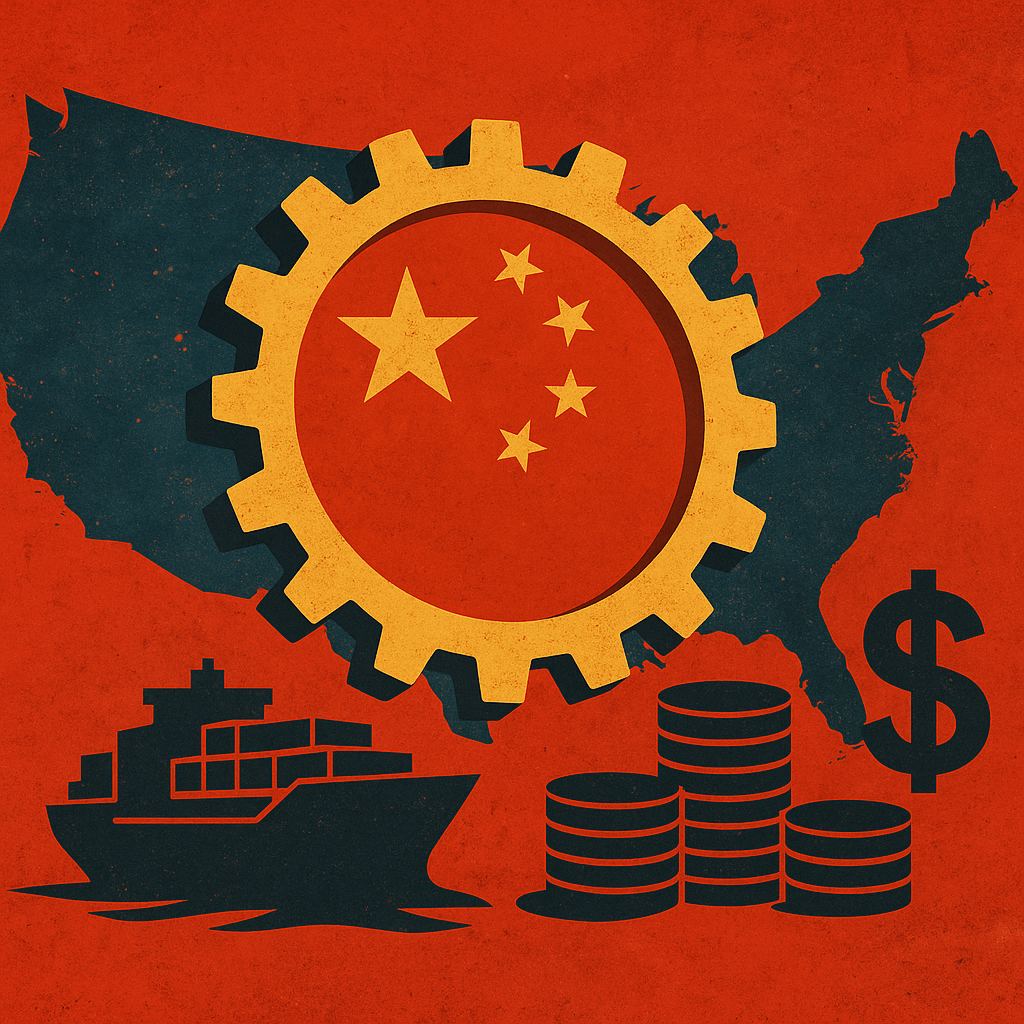
But the real giveaway comes in a quiet euphemism buried halfway through the report: “China’s integration into the liberal international order has yielded uneven returns… and China has failed to play by the rules.” Let’s translate that into plain proletarian speech: China didn’t want to play ball. It refused to accept permanent subordination within a U.S.-written rulebook. Beijing was expected to liberalize its economy, crack open its markets, dismantle state-owned industries, and pledge allegiance to Washington’s trade courts and banking cartel. It didn’t. That’s the real crime. Not “rule-breaking,” but disobedience. Not “unfair advantage,” but refusal to kneel.
And so, what Chatham House frames as a crisis of order is, in reality, a crisis of obedience. The empire is not suffering because others are breaking rules—it’s suffering because others are making their own. And as the U.S. doubles down with tariffs, sanctions, military threats, and economic sabotage, it reveals its core principle: it never wanted an international order. It wanted a monopoly. Now that the monopoly is being challenged—from BRICS to the Belt and Road to the Sahel uprisings—it calls the rebellion “chaos” and the rebellion’s leaders “autocrats.”
But the world sees through it. The rules-based order was never rules-based and never orderly. It was liberal only for the landlords and international only for the monopolists. What’s fracturing now is not peace—but the illusion that empire was peace. The empire’s own think tanks are documenting their descent. And we, the exploited and opprssed workers of the world, are writing the prologue to something else.
Liberal Order, Imperial Core
Let’s stop calling it by the name it gave itself. The “liberal international order” was never liberal, never international, and never about order. It was an imperial operating system—written in Washington, installed through NATO and the Bretton Woods twins, and enforced through coups, debt, sanctions, and the dollar. What Chatham House politely calls a “rules-based order” was in fact a global management regime for U.S. monopolies: finance capital, military dominance, digital platforms, energy corridors, and intellectual property. And the so-called rules? Flexible guidelines for vassals. Shackles for the colonized. Suggestions for the powerful.
The architects of this order didn’t design it for multilateral equality. They designed it to enshrine U.S. dominance at the apex of every global system: trade (WTO), finance (IMF, World Bank), law (ICC for you, veto for us), and security (NATO as police, AFRICOM as enforcer). That’s why the U.S. never ratified core treaties like UNCLOS. That’s why it ignores the ICJ. That’s why it calls genocide rulings against Israel “unhelpful.” Because empire never intended to follow the rules—it intended to write them, bend them, and shred them when necessary.
Chatham House tries to disguise this legacy as accidental: a noble system threatened by rising powers. But it was never noble. It was a system forged through genocidal warfare, Hiroshima and Nagasaki, Operation Condor, Vietnam, Iraq, Libya, the CIA’s dirty wars, and the global architecture of debt strangulation. Every time a country tried to build autonomy—Chile under Allende, Congo under Lumumba, Indonesia under Sukarno, Grenada under Bishop—the order responded not with dialogue, but death squads. That was the real international order: dollar first, discipline second, and development only for those willing to submit.
And that’s why multipolarity terrifies them. Not because it threatens peace—but because it threatens hierarchy. Not because it breaks rules—but because it builds new ones. For the first time since 1492, a serious threat has emerged to the global structure of white capitalist supremacy. China builds infrastructure without occupying countries. Russia defies dollar monopolies in arms and energy. Iran trades in gold, not greenbacks. Cuba sends doctors, not bombs. And the Sahel, after centuries of imperial plunder, is kicking out the French and raising the flag of sovereignty.
The empire’s scribes call this “revisionism.” They say it “undermines the international order.” But what they really mean is: the world’s majority no longer consents to be ruled. The old system wasn’t some neutral framework for peace and prosperity. It was a planetary plantation, and its overseers are now panicking as the fences are torn down.
So let’s not mourn the fracture of the liberal order. Let’s mark it as a turning point. What’s collapsing isn’t cooperation—it’s coercion. What’s dissolving isn’t diplomacy—it’s domination. The empire may not say it out loud, but its most prestigious think tank just did: the old rules don’t work anymore, and the old rulers don’t know what comes next.
The Center Cannot Hold: Allies Drift, Empire Splinters
The great fear isn’t that the Global South is rising. It’s that the imperial core itself is falling apart. That’s the dirty secret buried in the Chatham House report—beneath the section headings and polite tone is a mounting anxiety: the U.S. can no longer keep its own camp in line. France flirts with BRICS. Germany talks “strategic autonomy.” Japan hedges its bets between Washington and Beijing. Even traditional lapdogs like the UK and South Korea are expressing what the report calls “quiet doubts.” The empire’s alliances—once unshakable—are showing cracks so wide you can drive Belt and Road through them.
This isn’t just diplomatic drift. It’s a structural unraveling. For seventy-five years, the U.S. could enforce ideological discipline with a carrot (access to capital) and a stick (threat of exclusion or war). But that carrot is shriveled by inflation and overextension, and the stick doesn’t hit the same when other markets, currencies, and trade blocs are on the table. The report concedes this, noting a global shift toward “transactionalism,” where countries like Saudi Arabia, India, and Brazil are “increasingly acting as autonomous actors.” Translation: even loyal clients are going freelance.
But it’s more than just freelance diplomacy. It’s rebellion in slow motion. Take Saudi Arabia—long the oil spine of U.S. hegemony. Riyadh now hosts Chinese diplomats, sells crude in yuan, and invites Iran to regional summits. Brazil, under Lula, openly questions IMF discipline and meets with Xi as a strategic peer. ASEAN countries join Chinese infrastructure deals while attending U.S.-led war games. This isn’t indecision. It’s triangulation. They see the writing on the wall and are betting that Washington is no longer the only game in town.
And then there’s Africa. The report tiptoes around it, but the truth is seismic: France is being expelled from West Africa. The CFA franc is being challenged. ECOWAS is breaking under pressure from U.S.-backed elites and the grassroots insurgency against neocolonial control. From Mali to Burkina Faso, entire regions are rejecting the liberal order wholesale—not because it failed to deliver, but because it succeeded in delivering exploitation, extraction, and endless poverty.
Chatham House warns that this multipolar shift could produce “fragmentation” and “global disorder.” But disorder for whom? For Wall Street? For the Pentagon? For the think tank class who believed that history ended in 1991 and forgot that the colonized never signed that deal? What’s disorder to the imperialist is liberation to the rest of us. What looks like chaos from Washington is clarity from the Global South: we don’t need your permission anymore. We have options. We have leverage. We have each other.
The liberal order is collapsing, not because others are being irrational, but because it was never built on consent. It was built on coercion, on debt peonage, on military encirclement and media control. Now that the lies are transparent, and the alternatives are tangible, even Washington’s friends are moving sideways. The empire is learning—too late—that loyalty bought with fear and finance doesn’t last forever. And now the world’s chessboard is being reset. Not by U.S. grand strategy, but by mass defection from its game.
Trump 2.0: When the Mask of Liberalism Finally Slips
Chatham House tries to lay the blame gently at Trump’s feet—calling him an “accelerant” of global disorder. But let’s be clear: Trump 2.0 isn’t a rupture from the U.S. imperial tradition. He’s its logical continuation. What makes the technofascist regime of Trump’s second presidency different is not its goals—it’s that it no longer bothers to lie. Gone are the days of multilateral pretense, of human rights window dressing, of lofty rhetoric about “rules-based order.” In its place: raw coercion, trade wars as gospel, and open declarations that might makes right.
In some ways, Chatham House is correct—Trump has abandoned the mythology. But they get the causality backward. Trump didn’t cause the collapse of the liberal order. The collapse gave birth to Trumpism. His rise is a symptom of imperial decay, not its cause. He represents what happens when the ruling class can no longer secure consent at home or abroad. He is the executive expression of crisis: rule by decree, foreign policy by threat, and an economy of tariffs, sanctions, and speculative violence. This is not a break from U.S. history. It is its naked form.
The shift toward Trump’s hardline posturing—open economic nationalism, racist anti-China mobilization, militarized deterrence—isn’t an anomaly. It’s the strategic recalibration of empire in crisis. A liberal face could no longer manage the contradictions: the loss of industrial supremacy, the rebellion of the periphery, the disillusionment of allies, and the collapse of ideological legitimacy. Trump’s return is the ruling class response: throw out the rules, consolidate the base, use cognitive warfare and domestic repression to discipline the population, and double down on imperial bluster abroad.
This is what technofascism looks like. It’s not jackboots in the street—it’s artificial intelligence tracking protests. It’s border drones and algorithmic redlining. It’s billionaires like Elon Musk fronting the police state with tech utopianism. And it’s enforced by a media system that now mixes QAnon with Raytheon, TikTok bans with Treasury sanctions, and evangelical nationalism with supply chain fascism. Trump 2.0 is not a break from Obama or Biden—it’s the endpoint of the trajectory they set. A trajectory rooted in empire’s refusal to reform, even as the world moved on.
What terrifies Chatham House isn’t just that Trump has no use for their think pieces. It’s that their entire ideological apparatus—Atlanticism, liberal consensus, elite diplomacy—has no purchase in the world that’s emerging. The Global South isn’t waiting for permission. BRICS is expanding. New Development Banks are rising. The U.S. is no longer seen as the guarantor of order—it is seen as a destabilizing force. And Trump doesn’t deny it—he brags about it. He tells the world the U.S. is exceptional, not because it uplifts, but because it dominates. And that’s the final fracture: the emperor no longer wears the mask.
In this sense, Trump is useful—not to the world, but to history. He shows the truth that Clinton and Biden tried to smother. That Obama tried to narrate into oblivion. That Bush tried to bomb into submission. Trump says the quiet part loud. And when he screams “America First,” the rest of the world hears: “Time to move on.” That’s why the order is collapsing—not because of chaos, but because of clarity. And the louder Trump shouts, the clearer that clarity becomes.
The Future Is Multipolar—But Not Yet Decolonized
As the U.S.-led liberal order fractures and the technofascist Trump regime scrambles to reassert control through force, sanctions, and spectacle, a new reality is emerging: the world is becoming irreversibly multipolar. But multipolarity is not a synonym for justice. It is a battlefield—a contested and uneven terrain where new powers rise, old empires lash out, and the masses search for sovereignty in a storm of shifting alliances. What comes next is not guaranteed. It must be fought for.
Chatham House describes this moment as “disorder,” “uncertainty,” and “fragmentation.” They fear a world where U.S. monopoly rule is no longer secure, where regions defy consensus, where blocs like BRICS, the African Union, CELAC, and the SCO operate on their own terms. But from below, this is not chaos. It is rupture. And in that rupture lies opportunity. Not just for national development, but for a global insurgency of the colonized and exploited—to write a new order, one that abolishes the imperial grammar of the last 500 years.
The old rules were written in the boardrooms of Wall Street, the bunkers of the Pentagon, and the marble halls of postwar Europe. They enshrined private property, corporate monopolies, and permanent debt dependency as “freedom.” They enforced unequal exchange as “free trade.” They criminalized sovereign development as “authoritarianism.” They made the dollar the whip and called it the world’s anchor. Multipolarity shatters that illusion. But it does not, in itself, promise liberation. Only struggle can do that.
The future will not be decided in Geneva or Brussels or Foggy Bottom. It will be decided in Havana and Harare, in Caracas and Niamey, in Gaza, in Manila, in Johannesburg and Jakarta—in the neighborhoods and countryside where the imperial order made its profits, waged its wars, and buried its dead. The new order, if it is to be just, must emerge not from the polite negotiations of states, but from the revolutionary demands of peoples. Multipolarity must not become a game of new empires—it must be a project of planetary emancipation.
This is where the Other Side begins—not as counterweight but as counterworld. A vision where rules are forged from the experience of the ruled. Where sovereignty means food, medicine, and land—not IMF loan agreements. Where international law is not a cudgel, but a shield for the vulnerable. Where the right to self-determination is not a talking point but a practice. This is not naïve. It is necessary. Because the death of the liberal order opens a rare space—a crack in the empire’s concrete—where new futures can take root.
The Chatham House crowd will call it dangerous. The White House will call it destabilizing. The Wall Street Journal will call it a “global populist revolt.” And they will be right. It is dangerous—to empire. It is destabilizing—to capital. It is a revolt—against the historical lie that the world belonged to Washington. In truth, it never did. And now, for the first time in centuries, the world is daring to remember that.
 Weaponized Information
Leave a comment