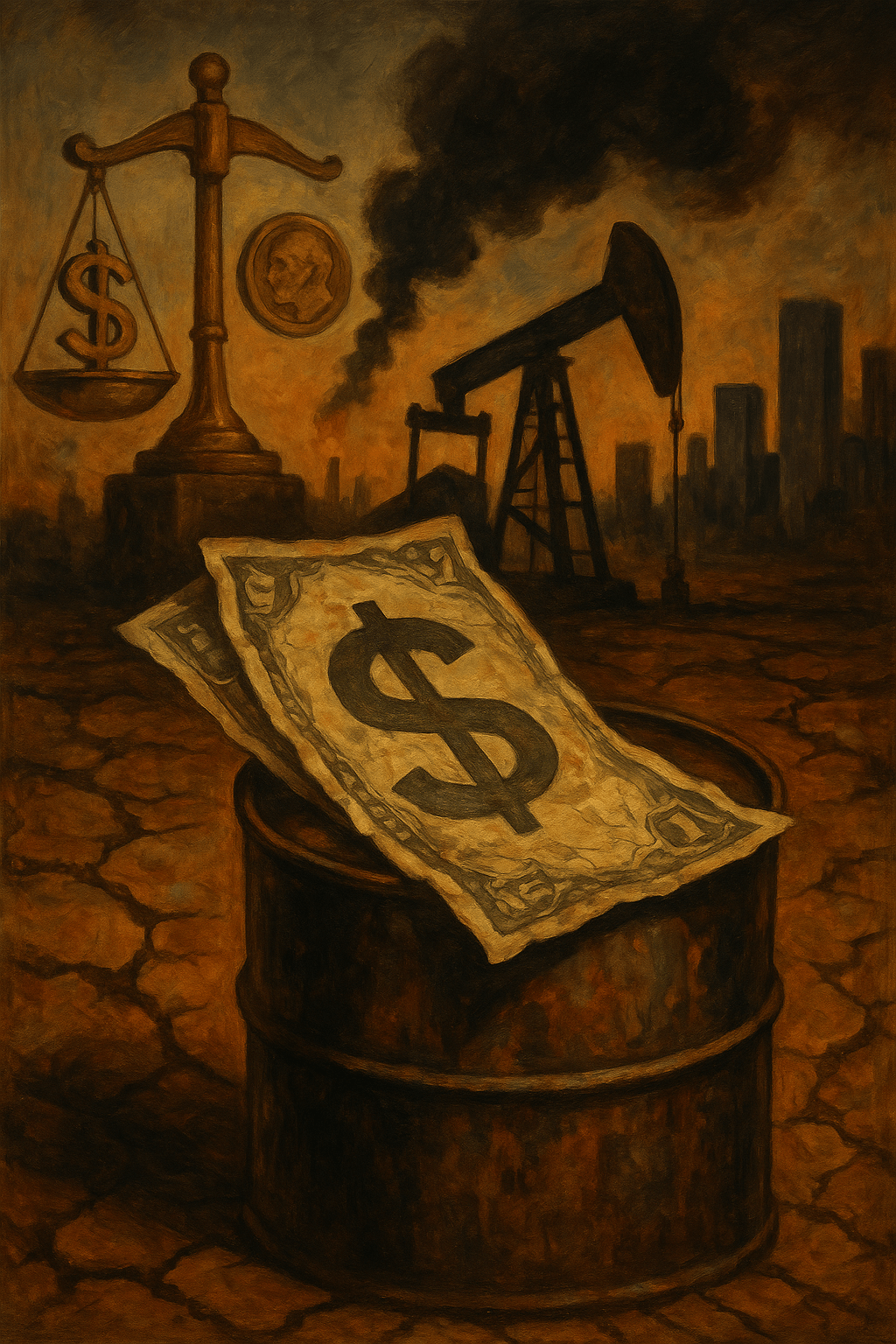
From Bretton Woods to BRICS+, how imperial finance built a global trap—and why the world is breaking free
By Prince Kapone | Weaponized Information | July 10, 2025
The Dollar Didn’t Rise—It Was Forced on the World
You ever notice how they always say the U.S. dollar “rose to power”? Like it was elected. Like the whole world just happened to choose the green paper with slave owners’ faces on it because it was the best currency around. As if it earned its crown. That’s the first lie. The dollar didn’t rise. It was imposed. With bombs, backroom deals, and institutions dressed up to look like global democracy.
After World War II, the U.S. stood tall over the ruins of Europe and Asia. But instead of using that position to help rebuild a more equal world, Washington used it to rewrite the global financial rulebook—line by line, for its own benefit. In 1944, at a quiet little town in New Hampshire called Bretton Woods, the U.S. called a meeting. But it wasn’t a roundtable. It was a chessboard. And America came with all the pieces.
The British economist John Maynard Keynes came to the conference with a proposal: let’s build a fair system. A shared international currency for global trade—a “Bancor”—backed by a neutral clearing union. That way, no one country’s currency would dominate the rest. Trade would be balanced. Countries could develop without being chained to another’s economy. Keynes, for all his flaws, understood that unipolar money meant unipolar power.
But the U.S. wasn’t interested in fairness. It was interested in control. Harry Dexter White, representing the U.S. Treasury, shut down Keynes’ plan and pushed through a dollar-dominated system. The dollar would be fixed to gold, and every other currency would be fixed to the dollar. Just like that, the dollar was installed at the center of global trade—not because the world wanted it, but because the U.S. could force it. The so-called “international monetary system” was born—but it was American by design.
And that international clearing house Keynes imagined? The one that could’ve kept trade fair and prevented empire through finance? That dream was killed on arrival. The Clearing House That Never WasAs we wrote before, it was the clearing house that never was. A system that might’ve let newly decolonized nations develop on their own terms was buried before it even breathed. In its place came the IMF and World Bank, dollar-denominated enforcers with polite smiles and predatory terms.
So while they tell you the dollar’s dominance was about strength, let’s be honest—it was about sabotage. The U.S. sabotaged any plan that might’ve put Global South nations on an equal financial footing. Bretton Woods wasn’t a compromise between empires. It was a financial coup. One empire won, and the rest of the world paid the price.
From the beginning, the U.S. used the dollar like a crowbar. It pried open markets, locked countries into debt, and made sure every major financial decision passed through Washington. And it worked. For a while. But it worked the way empire always does—through pressure, not partnership.
So no, the dollar didn’t win. It wasn’t chosen by the world’s people. It was forced on them—by the most powerful capitalist empire in history. And for the next eight decades, that currency became the backbone of a global system built not on justice, but on extraction. Not on mutual growth, but on imperial theft—well-dressed, interest-bearing, and backed by the Pentagon.
From Gold to Oil: The Empire Switches Its Backing
The dollar started out strapped to gold like a seatbelt. Every greenback was supposed to be worth a fixed amount of bullion tucked away at Fort Knox. But that setup didn’t last. By the late 1960s, the U.S. was spending like an empire at war—which it was. Vietnam, military bases, coups, and the usual under-the-table bribes to keep client states in line. Problem was, it didn’t have the gold to back it all up. So in 1971, Nixon cut the cord. Just like that, the dollar floated free.
Most countries would’ve panicked. A fiat currency with no hard backing? In a sane world, the dollar would’ve collapsed. But the U.S. isn’t most countries. It has something better than gold: military power, media control, and a Rolodex full of loyal dictators. So the empire made a new arrangement. If the dollar couldn’t be backed by gold, it would be backed by oil—and the threat of violence.
Enter the 1973 deal between the U.S. and Saudi Arabia. Washington guaranteed the Saudi royal family its survival—military aid, arms sales, political cover. In return, the Saudis agreed to sell oil exclusively in dollars and to recycle those dollars into U.S. banks and Treasuries. This was the birth of the petrodollar system: a devil’s pact between empire and monarchy that turned oil into the new anchor of U.S. financial supremacy.
From then on, if you wanted to buy oil—whether you were Germany, Ghana, or Guatemala—you had to get your hands on dollars first. That meant exporting goods to the U.S., holding U.S. debt, or crawling to the IMF. It also meant that even poor nations, already strangled by colonial legacies, had to accumulate the currency of their oppressor just to keep the lights on. The dollar became the tollbooth on the road to modern life. You paid in dollars—or you got left behind.
This was dollar hegemony 2.0. It no longer needed gold because it had something better: global energy dependency, enforced through geopolitics. The U.S. had effectively privatized the planet’s fuel supply—and put it on lease in its own currency. The oil-for-dollars-for-debt cycle locked the world into a rigged game where the U.S. could print its own privilege while the rest of the world paid real resources and labor to play catch-up.
And just like before, the institutions came marching in behind it. The World Bank, now flushed with petrodollars, issued “development” loans that were really just baited traps. The IMF imposed austerity packages that gutted public services and sold off national industries. It wasn’t enough to own the pipes—they had to own the politics too. Dollar loans came with fine print: privatize, liberalize, open up your markets, deregulate. In short: hand over your economy, or go broke.
As we laid out in Currency of the Colonized, Currency of the Free, the petrodollar didn’t just change economics—it chained the Global South to a currency it didn’t control, backed by a state that never had its interests in mind. It made the dollar the oxygen of the global economy—and the U.S. the one holding the air valve.
This wasn’t some natural evolution of a neutral global system. It was the rebranding of imperialism in financial form. The dollar wasn’t “trusted” because of free markets or stability. It was obeyed because to defy it meant sanctions, coups, embargoes, or invasion. You either bowed to the dollar—or bled trying to escape it.
Weaponized Finance: When a Currency Becomes a Gun
The U.S. doesn’t need to invade every country it wants to control. It just needs to control the money. That’s the beauty—and the brutality—of dollar hegemony in its mature form. Once the dollar was locked in as the world’s trade and reserve currency, it stopped being just a medium of exchange. It became a weapon. A weapon that could starve whole nations, cripple industries, collapse currencies, and punish any government that dared walk off the imperial plantation.
Start with sanctions. These aren’t just diplomatic slaps on the wrist—they’re economic warfare by other means. The U.S. has sanctioned over 30% of the world’s population. That’s not a typo. One-third of humanity lives under some form of U.S. financial restriction. And why? Because their governments tried to build sovereign alternatives—public healthcare, food subsidies, nationalized oil, multipolar trade. Or because they refused to bow to NATO, Wall Street, or Washington’s fantasies of regime change.
If you’re outside the dollar system, you’re cut off from international banking. No SWIFT, no trade, no basic economic survival. Cuba, Iran, Venezuela, Zimbabwe, Russia, Syria—the list gets longer every time a country asserts its right to exist on its own terms. And when sanctions don’t work fast enough, the U.S. doubles down with blockades, asset seizures, and the theft of national reserves. It’s gangsterism in the form of asset freezes—over $300 billion of Russian reserves were frozen in 2022, sending shockwaves through central banks worldwide.
But the real carnage isn’t always in the headlines. It’s in the loan documents, the structural adjustment plans, the backroom deals with finance ministers under duress. The IMF and World Bank don’t have tanks, but they’ve done more to destroy public services, displace farmers, and derail socialist projects than most militaries ever could. Countries deep in debt are told to cut subsidies, slash pensions, privatize water, sell off land, and “open up” to foreign investors—meaning Western monopolies.
Take Bolivia in 2000. The World Bank insisted that water infrastructure in Cochabamba be privatized as a loan condition. When Bechtel—a U.S. corporation—took over, water prices tripled. Poor families couldn’t afford to bathe or drink. People rose up, organized, and were met with state violence. The same playbook showed up in Argentina in 2001, where IMF-imposed austerity drove the country into one of the worst financial collapses in Latin American history—an implosion that led to riots, mass poverty, and the fall of five presidents in two weeks.
And in Venezuela, when the U.S. cut off access to global dollar markets in 2017 and seized billions in reserves, the result was hyperinflation, import shortages, and mass hardship. The goal wasn’t democracy. The goal was collapse—death by economic suffocation.
These institutions act like neutral technocrats, but they’re enforcers. Loan sharks in suits. They lend in dollars, demand repayment in dollars, and then dictate your entire economic policy based on keeping your credit score high with New York and London. You think you’re borrowing for development—but what you’re really doing is signing over the keys to your national future.
Of course, defenders of the U.S. dollar system—usually economists who’ve never missed a meal—will tell you this global setup brings “stability,” “liquidity,” and “efficient markets.” But what they call stability is just predictability for investors. What they call liquidity is just cheap access to your labor, your land, your resources. And what they call efficiency is really about bypassing democracy and bypassing the people. Even UNCTAD now admits that the global financial system systematically disadvantages the Global South—locking in inequality, draining reserves, and rewarding extraction.
As we broke down in Currency of the Colonized, this is not just about economics. It’s a global class war being fought with interest rates instead of bullets. And make no mistake: the dollar is not neutral. It is a colonial instrument. A contract of dependence dressed up in financial jargon. The value of the dollar is propped up by the forced underdevelopment of the Global South—by cheap labor, stolen commodities, and captive markets. This is what imperialism looks like in a business suit.
You don’t need to believe in conspiracy to see the structure. The dollar is the software of the empire. It runs on the hardware of U.S. military supremacy and is serviced by the cloud of Western institutions—from the IMF to the ratings agencies, from the corporate media to Harvard-trained technocrats. And every time a country tries to reboot the system, the U.S. pulls the plug.
That’s why we say dollar hegemony isn’t just a currency regime—it’s a global control grid. One that disciplines whole nations, strangles liberation movements, and rewards comprador elites who sell out their people for a seat at the imperial table. It’s not about free markets. It’s about control. And control, when threatened, always turns violent.
Crisis in the Core: When the Dollar Turns on Itself
Empires rot from within long before they fall from without. The dollar’s grip on the world is no exception. After decades of running the table, the U.S. is now facing the bitter harvest of its own supremacy. The very system it built to dominate the world is now collapsing under its weight—and no amount of spin from Wall Street or the Washington Post can hide the smell.
The first crack came from greed. The U.S. didn’t just use dollar hegemony to extract tribute—it used it to hollow out its own productive base. Why make things when you can print money and buy the world’s labor on the cheap? Why invest in workers at home when sweatshops abroad will do it for less? The U.S. economy turned from manufacturing to financial speculation. Industrial muscle was swapped for hedge funds and tech monopolies. The dollar became a symbol of dominance detached from actual economic substance—a fiat empire backed by debt, not production.
Then came the blowback. By weaponizing the dollar—freezing reserves, imposing sanctions, manipulating credit ratings—the U.S. taught the world a lesson: don’t trust us. Every time Washington cut a nation off from SWIFT, or stole billions in foreign assets, or used the IMF to push austerity, it sent a message: this currency is not a neutral medium. It’s a loaded gun pointed at your sovereignty.
Of course, defenders of the dollar system still parrot the same tired lines: “It’s the most stable reserve currency.” “It’s liquid and trusted.” “There’s no alternative.” These are not arguments—they’re delusions. The dollar has only been stable for those who control it. For everyone else, it’s been a volatile tool of debt, inflation, and blackmail. And even that illusion of stability is starting to crack. A July 2025 UBS survey of central bank reserve managers revealed that two‑thirds fear for the Federal Reserve’s independence and nearly half are uneasy about the strength of U.S. “rule of law.”
Countries began to diversify. Slowly at first—buying gold, holding euros, signing local currency trade deals with China or Russia. Then faster. As even Western financial outlets now admit, central banks across the Global South are dumping dollars, cutting exposure, and hedging against the next U.S.-engineered crisis. Not out of ideology—but out of survival.
According to the UNCTAD Trade and Development Report (2023), “overreliance on a single currency has increased vulnerability across developing economies,” calling for a shift to a more democratic, plural global financial system. The World Gold Council confirms that central bank gold purchases reached record highs in 2023–2024, with nations seeking to build reserves that aren’t subject to Washington’s threats. Even the Bank for International Settlements is warning of a possible “dollar scramble” in global derivatives markets—a house of cards waiting for a gust of wind.
Even Europe, supposedly America’s closest ally, has grown tired of dollar dictatorship. After the U.S. threatened European banks over trade with Iran, the EU launched its own payment mechanism—the Special Purpose Vehicle (INSTEX)—to try (and mostly fail) to bypass U.S. sanctions. It was a clumsy move, but the message was clear: the dollar is no longer a trusted public utility. It’s a private club run by an erratic landlord. You don’t know when you’ll get evicted.
And all of this is happening while the U.S. debt spirals out of control. As of this writing, the federal government is juggling over $36.2 trillion in debt. The Fed prints, the Treasury borrows, and the world is expected to keep buying the lie. But confidence is cracking. The more dollars the U.S. prints to fund wars, tax cuts, and bailouts, the more inflation it exports to the world. The more it weaponizes the system, the more the system decays. This is the imperial contradiction: the dollar can’t be both a tool of domination and a store of trust. Eventually, the world stops playing along.
Keynes warned about this back in 1944. He said no country should be allowed to run a permanent surplus or impose its currency as the global medium. If it did, it would create instability, resentment, and economic war. As he emphasized, “if an attempt were made to recommend the use of the dollar as the international unit of account, there would unquestionably be some opposition…” The U.S. ignored him then, and we are living the consequences now. The financial clearing house that never was is now giving way to the clearing houses that are—regional, sovereign, multipolar, and increasingly outside the dollar’s grasp.
The empire is still dangerous, but the cracks are showing. You can only squeeze the world for so long before the world squeezes back. The dollar isn’t collapsing overnight—but the aura is gone. The mythology is dead. And the rest of the planet is no longer waiting for permission to walk away.
The Multipolar Counteroffensive: Breaking the Dollar’s Grip
The collapse of dollar supremacy isn’t just a passive decline. It’s being pushed. Brick by brick, bloc by bloc, the Global South—and increasingly, large swaths of the Global East—are building new financial architecture from the ruins of empire. They’re not just escaping the dollar’s grip; they’re replacing it with something else. Something rooted in sovereignty, mutual interest, and—at least in theory—a refusal to be disciplined by Wall Street ever again.
BRICS is leading the charge, but they’re not alone. Russia, sanctioned and frozen out of Western banking, has turned necessity into invention—developing a multi-currency trade settlement platform that bypasses the dollar entirely. China has accelerated its push to internationalize the yuan, building digital payment systems and bilateral trade agreements that don’t even look at Washington. Brazil is deepening currency swaps with Argentina. India is settling oil payments in rupees. And the African Union is quietly exploring a continental payment system that uses neither euro nor dollar.
What’s happening here isn’t just economic de-linking. It’s decolonization. For decades, dollar dependence has functioned like invisible shackles. As OMFIF wrote in “Brics’ daringly autonomous model for financial sovereignty”, imperial finance isn’t neutral—it’s an instrument of control. And BRICS+ is now spearheading an effort to reclaim the fundamental precondition of all sovereignty: the right to issue, manage, and transact in your own currency, on your own terms.
This is not some utopian project. These countries are not saints. BRICS is full of contradictions—socialist states forced to engage with the law of international value, capitalist states with uneven development, rival national interests, and internal ruling classes who are often more comprador than revolutionary. But in this case, their strategic interests align: they all need to escape the dollar trap. They’ve all been burned by sanctions, blackmail, or inflation exported from the U.S. printing press. And they all understand that if they don’t build something new, they’ll remain forever chained to an empire in decline that grows more violent as it loses control.
That’s why we’re seeing real-world moves: gold purchases are surging. Dollar-denominated debt is being quietly retired. Local currency trade is accelerating, as even Western financial media now concedes. And parallel institutions—like the BRICS Bank (NDB), the Eurasian Economic Union, and the Pan-African Payment and Settlement System—are becoming operational alternatives, not just ideas.
The movement isn’t perfect, but it’s real. And it has momentum. Because the dollar system isn’t just a currency regime—it’s a colonial infrastructure. It’s the scaffolding of empire. Tear it down, and new possibilities emerge: debt cancellation, capital controls, national development, food and energy sovereignty, cooperative regional trade. In short: the freedom to choose a different path.
The U.S. calls this “de-risking.” But the real risk lies with clinging to a system that’s collapsing. The rest of the world is simply refusing to be dragged down with it. They’ve seen what happens to countries caught in the blast radius of American decline. Iraq. Libya. Lebanon. Haiti. Ukraine. And they’ve decided: never again.
Multipolarity isn’t utopia. It’s struggle. It’s uneven, incomplete, and still operating within the boundaries of capitalism. But it’s a rupture. And for the first time in decades, the dollar isn’t the only game in town. The empire is losing its monopoly—and the world is learning how to breathe without it.
Building the Future: Toward a Post-Dollar World
So what comes next? If the dollar is losing its grip, what takes its place? That question makes Western economists break out in a cold sweat. For decades, they’ve acted like the dollar is oxygen—as if the world simply can’t breathe without it. But the Global South is proving otherwise. People are finding ways to breathe again. The air is thin, yes—but it’s theirs. And that makes all the difference.
We’re not talking about a single new global currency rising to take the dollar’s place. That’s not what multipolarity means. The world isn’t trying to crown a new king—it’s trying to break the throne. What’s emerging instead is a patchwork of systems: regional clearinghouses, multi-currency trade agreements, digital settlement platforms, and commodity-backed contracts that bypass the need for Washington’s permission. This isn’t a clean break—it’s a strategic withdrawal from empire’s plumbing.
Across the Global South, new institutions are beginning to do what the IMF and World Bank never would: finance development without demanding self-destruction. The BRICS Bank is lending in local currencies. The Pan-African Payment and Settlement System is linking African economies without going through Paris or New York. The Eurasian Economic Union is transacting in rubles, yuan, and gold. Even central banks once addicted to U.S. debt are hedging their bets—swapping out Treasuries for physical reserves, and diversifying their exposure to a collapsing empire.
But these are just the building blocks. The real fight is political. It’s about whose interests these new systems will serve. Will they be tools for real sovereignty—or just new channels for regional elites to cut their own deals while keeping the masses in chains? Multipolarity opens a door, but it doesn’t tell us where to go. That part is up to us. Because finance is never neutral. Every currency regime reflects a class regime. The challenge is not just to escape the dollar—it’s to build something that doesn’t reproduce it in another form.
That’s why, as we argued in The Contradiction Is the Compass, the cracks in the imperial system must be seized—not just observed. The revolutionary task is to intervene in this transition, to fight for a global economy that’s not just less Western, but less capitalist. That doesn’t just redistribute who holds the whip, but abolishes the plantation altogether.
Imagine regional development banks run by workers, peasants, and public servants—not financiers. Imagine trade systems that reward ecological sustainability and food sovereignty, not just export volumes. Imagine cross-border planning grounded in solidarity, not competition. These aren’t dreams. They’re political projects. And the collapse of dollar hegemony makes them imaginable again.
The dollar was never just money. It was a system of control—a software of subjugation installed in every central bank, enforced by every loan officer, and blessed by every Ivy League economist who couldn’t tell the difference between coercion and consent. The future has to be more than a reboot. It has to be a rewrite.
The end of dollar hegemony won’t fix the world. But it creates space. And in that space, we can build. Not just new currencies—but new relations, new alliances, new ways of valuing labor, land, and life. That’s what scares the empire most. Not losing control of the world’s money—but losing the ability to define what money is for.
Empire in Retreat, Opportunity on the Rise
The dollar’s decline isn’t just a technical adjustment in the spreadsheets of central bankers. It’s a sign. A crack in the foundation. A signal that the world we’ve lived under since 1944—that rigged casino of imperial finance—is coming apart. But decay is not the same as deliverance. History doesn’t liberate us on its own. We have to seize the moment, or empire will reinvent itself under a different flag, with a different app, and a new currency symbol stamped on the same old chains.
What’s collapsing isn’t just dollar hegemony. It’s the illusion that a handful of nations can govern the world by controlling its money. That illusion held for decades because it was backed by force—by coups and credit ratings, by media lies and IMF contracts. But the tide is turning. Sanctioned countries are building their own systems. Colonized nations are reclaiming their right to issue and use their own currency. Regional powers are breaking out of the U.S. orbit—not just militarily, but financially. And the masses are watching.
We are living through the slow but certain unraveling of what the U.S. ruling class once believed was eternal. The almighty dollar is no longer almighty. Its aura of invincibility is fading. And with it, the empire’s ability to control the tempo of global development, the direction of investment, and the conditions of life for billions of people.
But this transition is not automatic. It can lead to something better—or to something just as brutal under new management. The challenge isn’t just to cheer for de-dollarization. It’s to fight for a world where money serves the people—not the other way around. Where financial systems are tools of liberation, not levers of extraction. Where sovereignty is measured not in GDP, but in how well a society can feed, house, heal, and uplift its people without asking permission from foreign creditors.
That’s why we can’t afford to be passive observers of multipolarity. We must be protagonists. The contradictions of dollar decline open the door—but revolution walks through it. The more the empire falters, the more ruthless it becomes. The more desperate its ruling class grows, the more violently it will try to cling to its privileges. But the more organized we are—workers, farmers, thinkers, fighters—the more we can shape what comes next.
The post-dollar world is not guaranteed to be just. But it is a battlefield where justice can be won. That’s our task. Not to mourn the empire’s retreat, but to prepare the ground for what replaces it. Because if we don’t, the next empire will simply speak Mandarin or Portuguese or Hindi—but it will still be an empire.
So let the dollar fall. Let the system shake. Let the ruling class panic. Our job is to stay grounded, stay principled, and stay building. Because what comes after empire is not yet written—and we intend to write it ourselves.
 Weaponized Information
Leave a comment