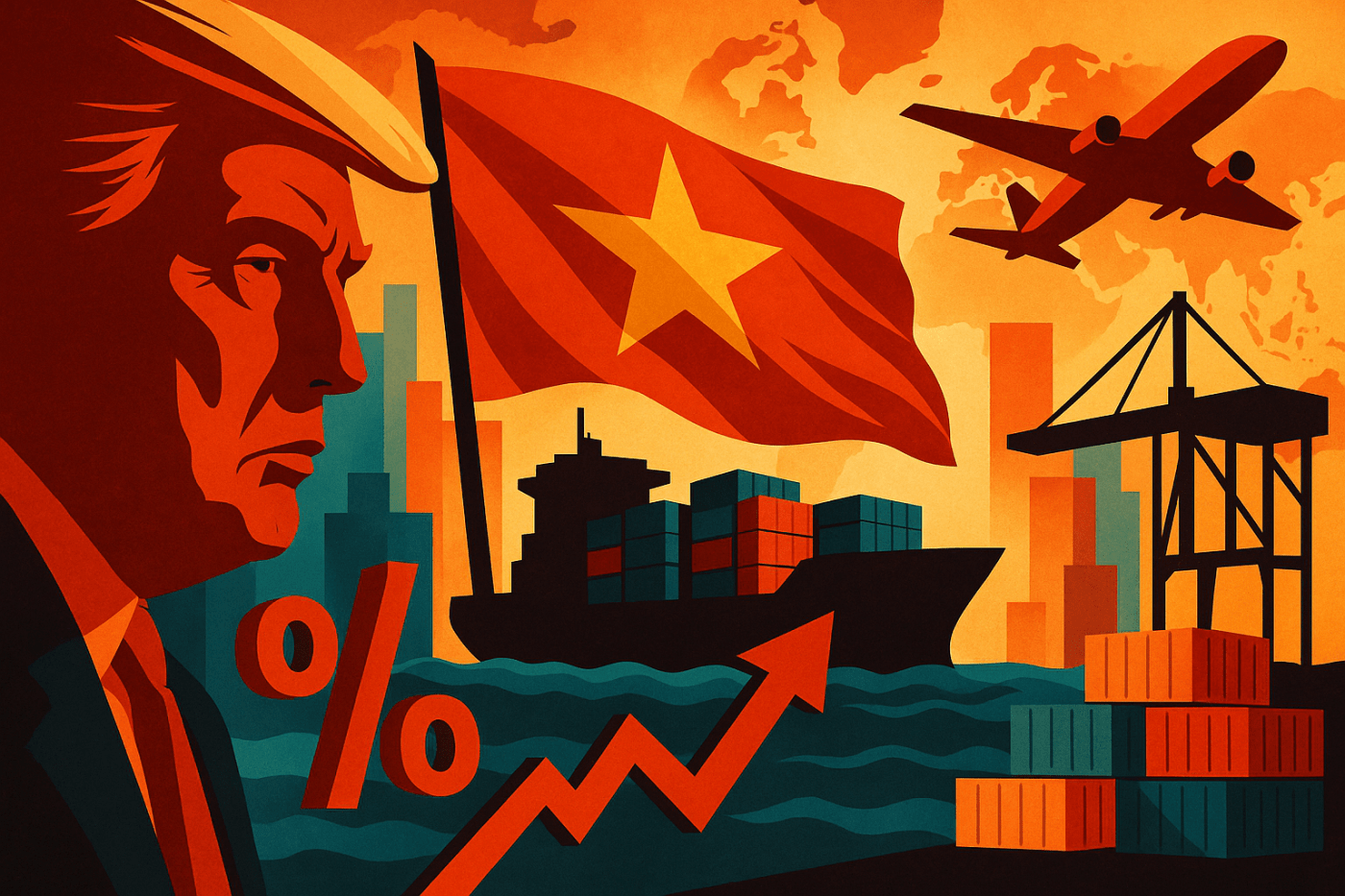
What looks like a trade deal is a digital enforcement regime—binding Vietnam’s economy, infrastructure, and labor to U.S. command through spreadsheet warfare and tariff threats.
By Prince Kapone | Weaponized Information | July 2, 2025
The Empire Speaks: Journalism as Class Discipline
There’s a particular genre of journalism that doesn’t bother with reporting. It doesn’t investigate, interrogate, or even pretend to verify. Instead, it repeats. It recites power like scripture. Kevin Breuninger’s July 2 piece for CNBC on the so-called “U.S.–Vietnam trade deal” fits the mold perfectly. Not an article, but a ventriloquist act—state talking points in a business suit, typed up for the investor class. We are told, in the opening breath, that the United States has “struck a deal” with Vietnam. No footnotes. No nuance. No evidence. Just decree. A press release dressed up as journalism, draped in the language of diplomacy, and served on a silver platter to Wall Street.
Let’s start with the outlet. CNBC is not a news organization in any meaningful sense of the word. It is a transmission belt for capital—owned by Comcast, propped up by advertising dollars from investment banks and weapons firms, and staffed by careerists whose job is not to inform the public, but to soothe the markets. It doesn’t ask what’s true; it asks what will move the S&P. Its reporters speak to power not as critics, but as stenographers. It’s a mouthpiece for empire in its pinstripe phase.
And Breuninger? He plays the role well. This is a man whose beat is the White House, whose archive reads like a résumé for state PR work: inflation updates, Fed guidance, Biden pressers, Trump statements—all dutifully transcribed. He has no record of challenging U.S. trade policy, no apparent concern for the Global South, and no working-class orientation. His professional incentives are clear: keep your access, keep your tone neutral, and keep your hands off the roots of empire. In other words: oil the gears, not the brakes.
The language of the article does the real heavy lifting. Take the headline: “The United States has struck a trade deal with Vietnam.” Not “announced,” not “imposed,” not “demanded.” Struck. Like equals at a table. As if this were a moment of mutual benefit, rather than one-sided diktat. The entire premise is engineered to obscure power. The verb alone rewrites history, turning coercion into compromise with a single keystroke. This is cognitive warfare in its most casual form: narrative domination through syntax.
From there, the framing unspools like a corporate lullaby. Trump’s statements are quoted verbatim, without challenge, as though they are facts rather than declarations of will. He praises Vietnam’s leadership, calls the agreement “great,” and boasts about market access—none of which is subjected to scrutiny. No second source, no alternate framing, no policy expert offering caution. Just Trump, unfiltered and triumphant. When Breuninger quotes the line about “total access” to Vietnamese markets, it floats in the text like gospel. This is not journalism. It’s ad copy for imperial capital.
Perhaps the most telling trick is the article’s strategic silence. Not one word from Vietnam. Not a quote from the trade ministry. Not a comment from an economist. Not a whisper from labor. The entire piece is a soliloquy performed for an audience of stockholders. And right on cue, Breuninger notes that the S&P 500 rose slightly on the news, as if that seals the deal. If the market approves, then who are we to question? Forget the material consequences. Wall Street smiled—case closed.
And then there’s the jargon. Terms like “transshipping” and “reciprocal tariffs” are dropped without context, their meanings presumed. No explanation of who benefits, who pays, or what these policies actually do. No historical frame. Just acronyms and euphemisms floating above reality, designed to dull the senses. These are not just technical terms—they are ideological weapons, crafted to mask power behind a veneer of inevitability. Trade doesn’t look like violence when it’s printed in the language of compliance.
What we’re dealing with here is not a failure of journalism—it’s the perfection of its imperial form. Breuninger’s piece does exactly what it’s supposed to do: reinforce U.S. hegemony, obscure imperial coercion, and reassure investors that everything is under control. It presents capitalism as common sense, U.S. dominance as diplomacy, and Vietnamese submission as sovereignty. The function is not to report facts, but to erase contradiction. To turn the blood of empire into invisible ink.
So before we talk about tariffs or supply chains or GDP, we have to name the enemy’s script. This is how propaganda works in the age of technofascism—not with jackboots, but with bylines. Not with censorship, but with selective framing. Not by denying reality outright, but by deciding what counts as reality to begin with. Here, technofascism manifests as algorithmic trade enforcement: demands for real-time shipment data, customs digitization, and compliance audits that turn ports into surveillance outposts. This is technofascism’s supply chain manifestation: compliance algorithms replacing colonial customs officers, where Vietnamese port inspectors become unwitting data-collectors for U.S. trade surveillance. The war isn’t just over resources—it’s over meaning itself. And CNBC is not reporting from the battlefield. It’s scripting the theater.
The Numbers Behind the Threat: Compliance by Tariff
Now that the propaganda has been laid bare, let’s look at the bones beneath the theater. Strip away the slogans and we’re left with a set of hard numbers, soft threats, and deeply uneven arrangements—none of which CNBC saw fit to explore. The article presents the “deal” as if it were a mutual agreement between peers, but a closer examination of the timeline, structure, and context reveals something else entirely: a forced concession extracted under threat of economic suffocation.
Start with the tariff structure itself. Trump’s team announced a 20% tariff on all Vietnamese exports to the U.S., plus a 40% surcharge on so‑called “transshipped” goods—items rerouted through Vietnam from countries like China. These numbers were not mutually agreed upon; they were presented in advance of a looming 90‑day deadline, after which all imports from Vietnam would be slapped with a 46% penalty under Executive Order 14257, “Regulating Imports with a Reciprocal Tariff…”. This wasn’t negotiation. It was a fiscal countdown. Vietnam faced two options: submit to the new terms, or see its industrial exports implode almost overnight.
The stakes were enormous. U.S. trade accounts for nearly one-third of Vietnam’s exports, making up roughly 12% of the country’s total GDP. A 20% tariff on Vietnamese goods represents a $7.3 billion annual loss—triple the size of last year’s total U.S. “aid” package to Hanoi. The Financial Times estimates the tariffs could shave up to 5.5% off Vietnam’s GDP in a single fiscal year. These numbers reveal more than exploitation—they expose hyper-imperialism’s blueprint. And Vietnam is merely the first test site.
The 40% tariff on transshipped goods, meanwhile, is framed as a crackdown on cheating—but in reality, it deputizes Vietnam into becoming a tariff enforcer on behalf of the United States. U.S. capital has long feared that supply chains flowing through Vietnam allow Chinese firms to circumvent restrictions. Now, Vietnam is forced to crack down on those flows, policing its ports and customs infrastructure to prove its loyalty. This is how the empire builds enforcement regimes—not just with warships, but with trade compliance architecture. A proxy state becomes a proxy warden.
What’s entirely missing from CNBC’s report is Vietnam’s agricultural dependency. While the U.S. demands industrial obedience, it also floods Vietnamese markets with subsidized grains. Over the past two decades, Vietnam has shifted its domestic production toward rice for export, while increasing imports of American corn and soy to meet domestic demand. This is the grain trap we analyzed in “Corn Diplomacy and the Class War”: a strategic entrapment where food sovereignty is sacrificed in the name of export profitability. Now, tariff concessions on U.S. agricultural imports will deepen this dependency even further according to a recent analysis of Vietnam’s shift toward U.S. corn and soybean imports. This report highlights how Vietnamese buyers have already signed initial contracts worth $800 million for U.S. corn, soybean meal, wheat, and distillers’ grains—part of a broader pivot to reduce exposure to potential reciprocal tariffs.
Also absent is any reference to Vietnam’s geopolitical tightrope. Hanoi has spent years trying to navigate between U.S. pressure and regional integration through China and ASEAN. The country recently signed infrastructure deals with Beijing under the ASEAN+3 framework, explored yuan-settled trade corridors, and participated in BRICS+ development dialogues as documented by the ISEAS–Yusof Ishak Institute. These moves signaled an attempt at balance—neither rejecting the U.S. outright, nor fully aligning with it. The tariff ultimatum aims to break that balance. To pin Vietnam back into the orbit of U.S. trade hegemony and isolate it from multipolar economic frameworks.
And while CNBC offered no quotes from Vietnam, we know that the internal debate is not settled. As we detailed in “Vietnam’s Crossroads”, the Communist Party is divided. One bloc is aligned with non-aligned development, digital sovereignty, and BRICS cooperation. The other—the comprador class—is loyal to foreign capital, eager for deregulation and Western approval. The U.S. tariff threat handed that comprador wing a gift: cover to accelerate liberalization under the guise of economic necessity. What looks like a trade agreement is, in fact, a political consolidation inside the Vietnamese state.
The resistance, however, is not absent. While CNBC was parroting Trump’s announcement, Vietnamese labor NGOs quietly documented a surge in wildcat strikes across export zones—protesting factory closures and wage freezes tied to tariff volatility. Worker coalitions in southern provinces circulated petitions demanding that the Ministry of Labor reject contract amendments requested by U.S. firms. This isn’t passive acceptance. It’s a silent referendum on comprador rule. Worker coalitions in southern provinces circulated petitions demanding that the Ministry of Labor reject contract amendments requested by U.S. firms. This isn’t passive acceptance. It’s a silent referendum on comprador rule.
One final silence worth naming: Vietnam’s growing role in U.S. maritime and digital containment strategy. The country has recently accepted U.S. coast guard cutters, integrated surveillance infrastructure, and joined supply chain digitization initiatives under the Indo-Pacific Economic Framework. As we exposed in “Firewall for Empire”, these moves fold Vietnam into a broader logistical firewall aimed at constraining China’s rise. Vietnam’s new digital customs protocols mirror U.S. CTPAT frameworks—binding its infrastructure to Washington’s surveillance regime. It isn’t just about sweaters and circuit boards—it’s about reinforcing digital enforcement at the edge of multipolar resistance.
What CNBC offers is not a report—it’s a ledger with half the columns erased. No context, no contradiction, no class analysis. But behind the silence lies a very loud story: of dependency, pressure, and economic compliance enforced through trade. These numbers reveal more than exploitation—they expose hyper-imperialism’s blueprint. And Vietnam is merely the first test site.
Recalibration by Tariff: Hyper-Imperialism’s New Playbook
This so-called “trade deal” between Trump and Vietnam isn’t a policy adjustment. It’s a disciplinary arrangement. A textbook case of what we at Weaponized Information call imperialist recalibration—the strategic restructuring of global dominance through economic compulsion, surveillance logistics, and legal-financial warfare. In place of gunboats, we now have spreadsheets. Instead of treaty ports, we get tariff ultimatums. But the logic remains the same: compel weaker nations to open their markets, restrict their sovereignty, and enforce imperial rules on behalf of the hegemon.
Trump didn’t broker a deal—he staged a demonstration. A message to the rest of the Global South: this is what happens when you try to hedge your bets, diversify your partners, or flirt with multipolarity. Vietnam had been cautiously engaging with China, BRICS, and ASEAN finance frameworks as documented by ISEAS and highlighted in diplomacy analysis. It was exploring new corridors for trade and digital currency settlements. Washington responded not with diplomacy, but with a trapdoor: a 46% tariff cliff, timed perfectly to exploit Hanoi’s inflation, its currency jitters, and the shifting geography of global supply chains as noted in The Washington Post. This was not about balance sheets. This was a public act of containment.
The architecture of the tariffs themselves is the weapon. A 20% baseline levy, coupled with a 40% penalty on transshipped goods, isn’t just a pricing strategy—it’s a compliance mechanism. The U.S. is using Vietnam as both an example and an instrument: an example to punish deviation, and an instrument to enforce discipline across Asia. By forcing Vietnam to inspect and restrict goods passing through its ports, Washington extends its trade war with China through third-party enforcement. This is hyper-imperialism at work: a decadent, fraying empire using every available lever—legal, financial, and digital—to claw back control through proxies and procedural violence.
Unlike 19th-century imperialism enforced through military occupation and gunboats, hyper-imperialism weaponizes supply chain digitization, customs surveillance, and tariff enforcement algorithms. Vietnam’s ports are no longer just nodes of commerce—they are compliance checkpoints in an imperial software system. This is domination not through tanks, but through terminals.
As always, this strategy relies on a domestic partner class. Inside Vietnam, that partner is the comprador class—a layer of bureaucrats, technocrats, and business elites eager to align with Western capital. As we detailed in “Vietnam’s Crossroads”, the Communist Party is divided. One bloc—rooted in planning ministries, trade unions, and cooperative agriculture—has pushed for a development path grounded in non-alignment and multipolar coordination. The other bloc, fluent in neoliberal vocabulary and backed by foreign direct investment, has been waiting for a moment like this. The tariff regime provides them with the perfect pretext to push deregulation, expand market access for U.S. firms, and dismantle remaining restrictions on foreign capital under the banner of inevitability.
The comprador class doesn’t merely collaborate—it internalizes imperial logic. Their “pragmatism” masks ideological surrender: sacrificing rice paddies for export zones, swapping BRICS solidarity for BlackRock’s approval. What gets branded in the West as “reform” is, in fact, a rollback of sovereignty. Market access becomes the price of submission. Fiscal compliance becomes the mask for regime consolidation.
Neoliberal economists will argue that “market access brings development.” Tell that to the Mexican corn farmers bankrupted by NAFTA—a playbook now reloaded for Southeast Asia. Transshipment crackdowns, too, are sold as protecting trade integrity. But where are the audits for European rerouting? For Canadian shell routes? This isn’t enforcement—it’s selective siege.
And all of it happens beneath the surface. CNBC calls it a trade agreement. Trump calls it friendship. Investors call it a win. But what we are seeing is the very core of hyper-imperialism: a phase of empire where military force is no longer sustainable, and so the machinery of domination adapts. Through tariffs instead of tanks. Through customs codes instead of coups. Through contract law and digital oversight instead of overt occupation.
This is not unique to Vietnam. But Vietnam is now a case study. A warning. A pivot point. The U.S. is showing the world how it plans to discipline the semi-periphery in the multipolar era: with fiscal ultimatums, food dependency, and trade weaponization. And unless we name this process for what it is—imperial coercion reinvented for the age of logistics—it will continue to pass as normal policy.
We are not yet at the point of rupture. But the outlines are forming. And when the contradictions sharpen—when the garment workers and grain cooperatives and port unions begin to push back—we will not be surprised. Because we were watching. And we recognized the script.
Breaking the Contract: Resistance from the South to the Core
When Haiphong dockworkers slow-walked U.S. grain containers last week, delaying 12,000 tons of agricultural cargo, they weren’t just defending wages—they were interrupting empire. Within hours, Iowa grain futures dipped 2%. The spreadsheet may be the weapon, but the strike is the counter-blow. And as Vietnamese workers resist the logic of managed subordination, the rest of us must decide: will we echo CNBC, or will we break the contract?
Because what just happened in the name of “reciprocal tariffs” is not a trade adjustment—it’s an imperial escalation. The Vietnamese working class didn’t agree to this. They were given a choice between slow suffocation and fast-track subordination. If we in the Global North pretend this is about fair trade, we become passive accomplices in a war against sovereignty. But complicity is not our only option. There are cracks in the armor of empire. And we can widen them.
First, we must name our side. Our solidarity is not with the stock traders who celebrated this tariff deal, nor with the multinational CEOs who now smell cheap labor and open markets. Our solidarity is with the garment workers in Thai Nguyen facing mass layoffs. With the smallholder farmers displaced by U.S. corn dumping. With the left-wing planners inside the Vietnamese state trying to hold the line against capitalist restoration. With the radicals in Haiphong organizing informal worker cooperatives to resist foreign contract dependency. It is with them—not the export councils, not the U.S. State Department, not the comprador class.
Second, we must highlight resistance already underway. While CNBC was parroting Trump’s post, Vietnamese workers launched a petition campaign against exploitative factory closures tied to tariff volatility. Independent unions in Binh Duong and Dong Nai have held closed-door talks with port organizers in Malaysia and Indonesia to explore coordinated slowdowns. BRICS-aligned labor forums are drafting frameworks for “logistical solidarity”—strike coordination across key supply chain chokepoints. These actions are small, local, and quiet—for now. But they represent the living class force that rejects the empire’s script.
What can we do from inside the core? Plenty. Start by targeting the financial arteries that make this siege possible. The same banks and asset managers profiting from Vietnam’s submission are the ones managing our pension funds and city investments. Launch a divestment campaign targeting portfolios that hold shares in tariff-profiteering importers—apparel brands, logistics firms, grain exporters. Start with VanEck Vietnam ETF (VNM). Pressure CALPERS and the New York State Common Retirement Fund to dump it—their $4.7 billion stake props up this extortion.
Next, support mutual aid projects that help Global South producers bypass U.S.-controlled trade routes. Build digital infrastructure that allows Vietnamese worker cooperatives to trade directly with partners in Africa, Latin America, and Eurasia. Translate and circulate toolkits on digital sovereignty, co-op logistics, and tariff evasion strategies. Use our access to information not to consume—but to distribute.
Third, activate proletarian cyber resistance. That means deploying our technical skills—coding, design, data mapping—to expose the real flows of power and profit. Build an open-source “Tariff Tracker” modeled on BDS’s “Apartheid Goods Database” that visualizes who benefits, who pays, and who suffers under these deals. Scrape corporate reports. Cross-reference with import price data. Name the profiteers. Illuminate the supply chains they hide behind. Target vulnerabilities in customs enforcement platforms like Vietnam’s National Single Window—the compliance infrastructure enforcing U.S. rules.
Finally, bring the struggle to our classrooms, labor halls, and community spaces. Most people don’t know that a factory closure in Bac Ninh is linked to a tariff Donald Trump signed on a Tuesday. But we can make those connections visible. Teach-ins. Pamphlets. Radical TikToks. Zines passed on the train. We do not need permission to educate. And once people see the structure, they’ll recognize the system. This is political education not as charity, but as insurgency.
We are not helpless. We are not observers. We are embedded in the circuitry of empire. And that gives us the power to short-circuit it. Let this so-called “deal” be a warning—but also a rallying cry. When dockworkers slow-walk and hackers leak ledgers, tariff architecture crumbles. The real “deal” begins where empire’s spreadsheets end.
 Weaponized Information
Leave a comment