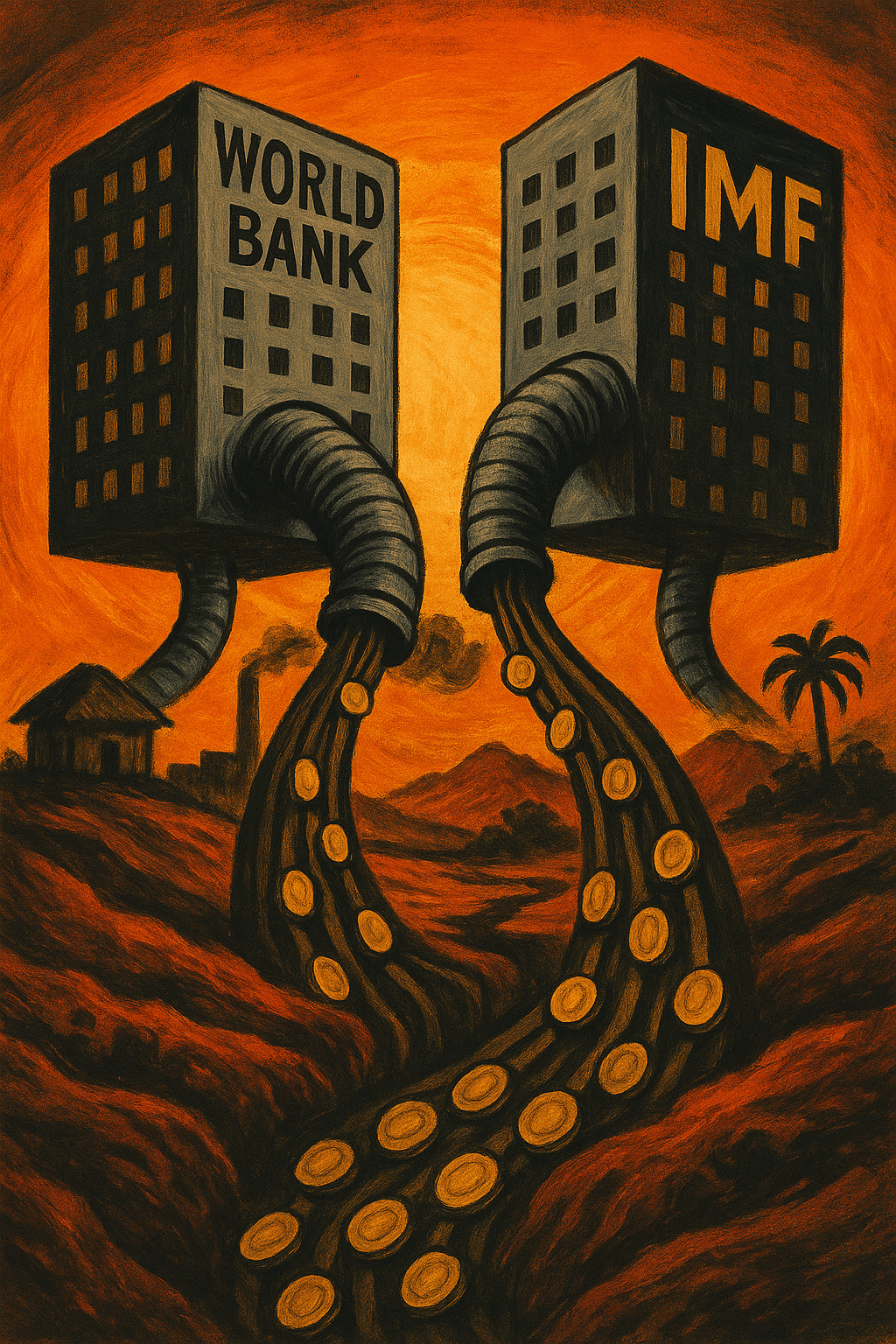
Exposing the Liberal Illusions of “Forgiveness” at the Seville Summit—and the Imperial System They Protect
Prince Kapone | Weaponized Information | June 28, 2025
Part I: Counterinsurgency by Comment Section – The Guardian as Empire’s Humanitarian Mouthpiece
On June 28, 2025, The Guardian published an op-ed titled “The Global South needs more than tinkering at a conference – debt forgiveness is the only fair way”, authored by Trinidadian journalist Kenneth Mohammed. The piece calls on leaders at the Seville Summit to recognize the moral imperative of debt cancellation for Global South nations. While invoking terms like “justice” and “fairness,” the article frames debt relief as an act of benevolent reform rather than systemic rebellion, and deliberately omits the multipolar alternatives already in motion. This Weaponized Propaganda Excavation dissects the ideological functions of such narratives, exposes the class and institutional interests behind them, and reframes debt not as mismanagement, but as a tool of neocolonial warfare.
This is not journalism—it’s ideological sanitation. The Guardian, draped in liberal credibility and backed by the Scott Trust Limited, postures as the conscience of empire while laundering its violence in polite prose. It calls for “debt forgiveness” with all the moral gravity of a confessional booth, as if the slaughter of African economies were an accounting error instead of a system of extraction. The house organ of British imperial liberalism now demands charity from the very architects of debt peonage. This is not dissent—it is deflection.
Owned and operated by the Scott Trust—a financial entity with historical ties to British banking capital and oil conglomerates like BP—the Guardian’s core function is not to dismantle empire, but to humanize it. Its editorial board serves as the press corps of the neoliberal priesthood, and its reporting consistently avoids naming the class enemies responsible for Global South immiseration. This is not accidental. It is the result of cognitive warfare: the ideological counterpart to military and financial domination, where public consent is engineered not through censorship, but through narrative management. One recent study found that British and EU media helped manufacture consent for austerity across 23 Global South countries since 2020—often through subtle humanitarian framing that shifted blame away from imperial institutions like the IMF and toward domestic “corruption” or “mismanagement.”
Into this theater enters Kenneth Mohammed—a liberal columnist with roots in mainstream Caribbean media and the Trinidad Express, a newspaper historically aligned with neoliberal development dogma and regional IMF compliance. His opinion piece is framed as a righteous plea on behalf of the oppressed, but its function is pacification, not liberation. Mohammed stops short of indicting the global financial architecture, let alone calling for its abolition. There is no mention of structural adjustment, debt conditionalities, or the privatization of public goods. No reference to how Euro-American financial institutions, not local corruption, engineered these crises. His argument is one of redemption through mercy, not revolution through rupture. He asks the colonizer to be kinder. He does not tell the colonized to rise.
The rhetorical technique is well-worn: moral urgency without material agency. Debt is cast as a tragic legacy, not an active imperial strategy. The solution is “forgiveness,” not reparations. At no point does the author acknowledge that so-called “forgiveness” comes with strings—new austerity clauses, market reforms, and creditor oversight that bind the debtor tighter than before. Nor does he name the real creditors: BlackRock, JP Morgan, and the private finance cabals who now hold over 40% of Global South debt and operate as de facto colonial administrators. To omit this is not oversight—it is ideological complicity.
By the end, what remains is a moral plea tailored to Western guilt, stripped of political clarity or revolutionary consequence. Aestheticized suffering replaces structural analysis. Imperialism becomes a bad habit, not a global system of domination. And the Global South is once again portrayed not as a revolutionary subject, but as a passive recipient of elite generosity. This is propaganda in its most effective form—not through lies, but through selective truths. Not through denial, but through derailing.
This is not journalism. This is narrative containment. And it must be excavated—down to the last liberal bone.
Part II: Debt Is Not a Crisis—It’s a Colonial Currency of Control
The debt trap isn’t an accident. It’s the engine. The Global South doesn’t suffer from debt mismanagement—it suffers from deliberate ensnarement. Since the collapse of Bretton Woods, international finance has transformed debt into a weapon of recolonization: a spreadsheet occupation deployed by banks instead of battalions. Under IMF conditions and World Bank “development” loans, entire nations have been forced to privatize water, underfund education, and mine their soil bare to meet interest payments dictated in New York and London.
The scale of this plunder is staggering. According to the UNCTAD 2023 Trade and Development Report, the Global South exported a net $971 billion to the imperial core that year—sending more capital outward than it received in loans or aid. Contemporary research indicates low-income countries now spend 150% more on debt service compared to 2011, with nearly 14% of their domestic revenue diverted from healthcare and climate adaptation (World Bank IDS, 2024). Over 57% of Southern sovereign debt carries variable rates tied to US benchmarks like LIBOR or SOFR—triggering waves of austerity abroad with every Federal Reserve hike (FinDevLab, 2025).
This is not economic drift—it is necro-economic warfare. In Zambia, copper extraction continues under IMF mandates to repay creditors—even as waterways are contaminated and forests vanish to meet export targets.
According to a comprehensive report by Debt Justice titled “The Colonial Roots of Global South Debt”, private creditors including BlackRock obstructed Zambia’s restructuring process by refusing to accept haircuts, demanding full repayment even during drought and environmental collapse—an archetypal case of necro-extractivism in action.
At the same time, African states pay borrowing rates ten times higher than the U.S. despite lower default risk. The African Development Bank’s 2025 Economic Outlook attributes this to credit rating agencies weaponizing “political risk” indicators—transforming digital algorithms into a tool of financial colonization. These agencies serve as technofascist enforcers, penalizing sovereignty and rewarding compliance.
This is what chokepoint imperialism looks like: payment systems, credit ratings, and dollar-denominated contracts designed to strangle economic sovereignty. Even so-called “debt relief” is a mirage. The IMF conditions restructuring on further privatization, liberalization, and the removal of social subsidies—as seen during Kenya’s 2024 anti‑IMF protests, where at least 16 people were killed resisting austerity.
No moral language about “fairness” changes this. Debt is not a governance failure. It is the financial infrastructure of global apartheid. And its guardians do not wear uniforms—they wear suits.
Part III: From “Forgiveness” to Rupture—Reparations, Not Mercy
The word “forgiveness” implies wrongdoing on the part of the borrower. But it is the lenders—Western states, banks, and multilateral institutions—that orchestrated this crisis. “Forgiveness” is imperial theater. A moral sleight of hand meant to distract from the real question: why were these debts created in the first place, and who profits from their perpetuation?
The answer lies not in reform, but in rupture. Unlike the West’s conditional relief schemes, China and Russia have pursued genuine debt abolition as a tool of anti-imperialist realignment. According to the China–Africa Research Initiative (SAIS–CARI), China has canceled over $3.4 billion in debt across Africa between 2000 and 2019. In 2022 alone, it forgave 23 interest-free loans to 17 nations—no austerity attached. Russia, for its part, canceled over $23 billion in African debt by 2023, directing funds toward clinics, infrastructure, and local development.
Contrast this with Western relief initiatives. When Zambia defaulted in 2020, the IMF conditioned help on subsidy cuts and energy liberalization. Meanwhile, BlackRock and other private creditors—who hold around 40 % of Global South external debt—blocked restructuring, demanding full repayment. As economist Prabhat Patnaik observed, “The aim is not to recover what was lent, but to exert control.” This is not relief. This is ransom.
The ideological trap lies in the framing: liberal outlets speak of “relief,” “fairness,” and “debt sustainability,” never of reparations. Yet this is what is owed. As Thomas Sankara declared at the OAU in 1987, “The debt is neo-colonialism, where colonizers transformed into technical assistants.” His government was assassinated three months later. Today, Burkina Faso is rebuilding his vision—training farmers with Chinese agro-tech and rejecting IMF dictates. That is rupture in motion.
And it is not isolated. Kenya’s anti-IMF protests have exploded into renewed mass movements, where police killed at least 16 protesting austerity. In Argentina, general strikes continue to paralyze Milei’s structural adjustment blitz. These are not isolated acts of resistance—they are the embryo of dual and contending power: counter-institutions forming within the imperial order itself. From PAPSS to BRICS+ CIPS, alternatives to Western monetary rule are already operational.
What we demand is not forgiveness. We demand an end to imperial tribute. We demand the full cancellation of illegitimate debt—without conditions—and the rebuilding of sovereign development rooted in human needs, not creditor profits. We demand reparations, not mercy. And we will not ask nicely.
Part IV: From the Belly of the Beast—No More Tribute, No More Lies
We speak from inside the empire—not to reform it, but to dismantle it. The same system that strangles the Global South with debt is the one that evicts our neighbors, poisons our water, and feeds us corporate lies dressed as journalism. We live under a regime of capitalist parasitism—where the sweat of African miners funds the yachts of hedge fund CEOs, where food banks multiply while BlackRock demands tribute from drought-stricken nations. This is not a crisis. It is design.
The fight against debt is not “charity” for distant lands. It is a struggle for collective emancipation. Every dollar stolen through debt repayment is a dollar extracted from schools, hospitals, and climate survival. In 2023 alone, over $971 billion flowed from the Global South to the imperial core—proof that the global economy is not broken, but working exactly as it was built: to bleed the periphery dry.
This is the time for delinking. As BRICS expands and multipolar financial infrastructure grows—CIPS now clears over 15% of China-Africa trade—we must undermine the choke points that uphold U.S. supremacy: the SWIFT system, the IMF, the World Bank, and the rating agencies that hold entire nations hostage. These are not neutral institutions. They are instruments of class war. Let us treat them as such.
And we must build from below. Let the remittances sent by migrant workers become seed capital for community land trusts, worker-owned grain banks, and cooperative infrastructure. Let every protest against austerity be a node in a global insurgency. Let every dollar withheld from imperial institutions become a down payment on a liberated future.
The Seville Summit is not a forum—it is a funeral procession for a dying order. We do not beg for forgiveness. We organize for rupture. We join hands not with the technocrats and the debt managers, but with the farmers of Burkina Faso, the workers of Buenos Aires, the protestors of Nairobi, and the dreamers of Port-au-Prince. From the ashes of imperial finance, we will build a new world.
This is our line in the sand: No more tribute. No more lies. No more debt.
 Weaponized Information
Leave a comment