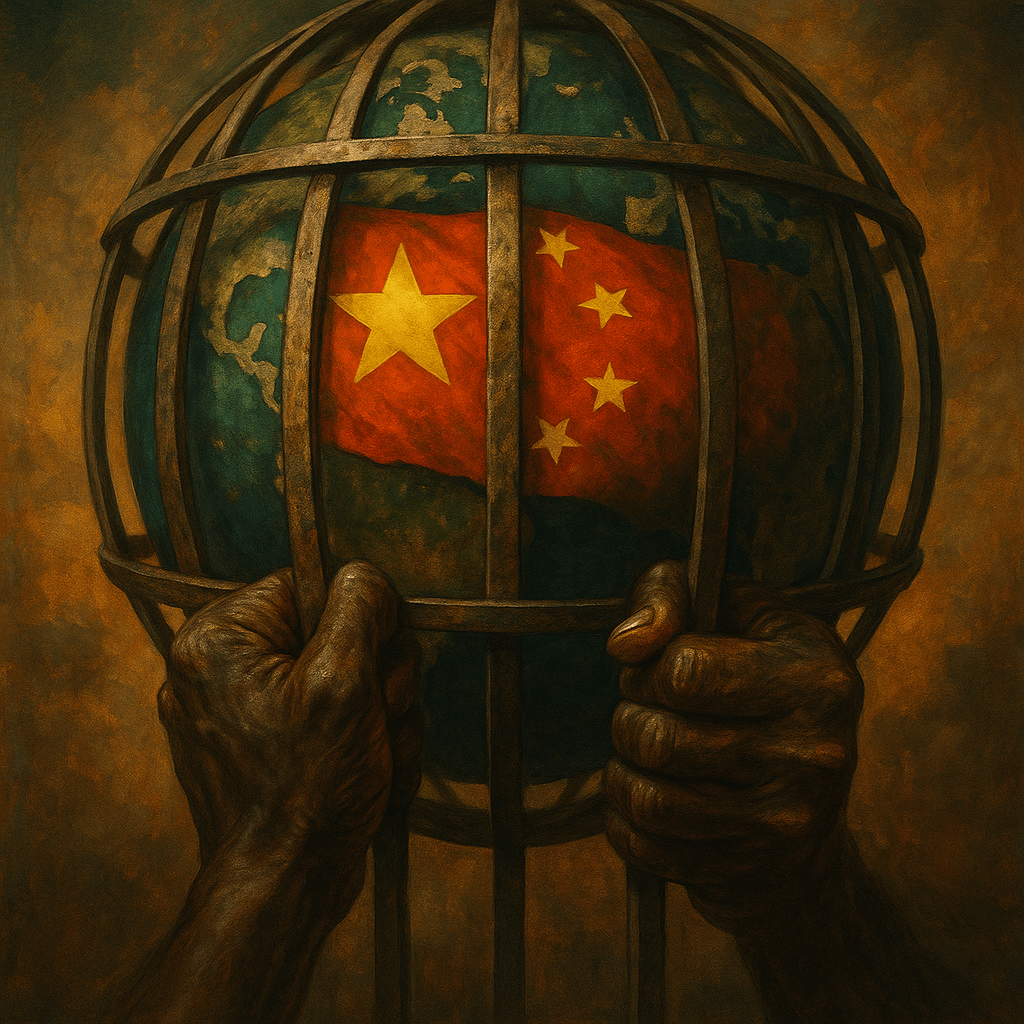
China’s payment network isn’t mimicking dollar supremacy—it’s rerouting the Global South’s escape from it.
By Prine Kapone | Weaponized Information | June 23, 2025
The Exit Wound in the Dollar’s Armor
The article under excavation, “China closes gap with U.S. as African countries, others join yuan payment system”, was published on June 22, 2025 by Business Insider Africa. It reports that six major financial institutions—including Standard Bank, Afreximbank, and First Abu Dhabi Bank—have formally joined China’s Cross-border Interbank Payment System (CIPS) as direct participants. The move, framed as a step in China’s bid to “close the gap” with the U.S. in global finance, marks a notable expansion of yuan-based international transactions. Yet while the article gestures toward geopolitical significance, it treats the development as a routine logistical update—stripped of its deeper implications for dollar hegemony, multipolar realignment, and the mounting revolt against Western financial control.
The article bears no individual byline—only the sanitized label “BI Contributor,” a corporate placeholder designed to obscure the structural role of the author: a mouthpiece for capital, not a witness to history. Business Insider Africa, far from being an organic platform of African journalism, is a media appendage of Axel Springer SE, the German publishing empire that openly aligns itself with NATO, the Atlantic Council, and the interests of the Western imperial bloc. Its editorial charter includes a formal pledge of loyalty to the “transatlantic alliance.” That alone should end the debate about where its class allegiance lies.
The “Africa” in Business Insider Africa is branding camouflage—a marketing function meant to mask the fact that its political economy, ownership structure, and editorial line are all rooted in the metropoles of empire. It is a colonial communications relay disguised as a continental outlet. What it exports is not knowledge, but compliance—packaged as market-friendly news, narrated in the voice of investors, and curated to reframe imperial decline as market risk. In this sense, it does not misreport. It reports precisely what empire needs its subjects to understand.
Take the headline: “China closes gap with U.S. as African countries, others join yuan payment system.” The phrase “closes gap” reveals everything. It frames the development as a race—two empires sprinting for financial dominance—when in reality, what is unfolding is something far more threatening to the Western order: a global subtraction. A quiet but decisive exit from empire’s financial circuitry. But this headline, like the article itself, doesn’t name the leak. It covers it.
What follows is a careful, polite account of a profound structural rupture. Six major financial institutions, including banks from Africa, Central Asia, and the Gulf, have joined an alternative global payment system. But the article refuses to interrogate the meaning of this. It describes “participation” as if this were a networking event, not a break in the circuitry of Western domination. It throws around phrases like “yuan ambition,” subtly coding Chinese financial strategy as irrational, excessive, or dangerous—while never applying the same framing to the dollar’s global monopoly. These are not just word choices. They are ideological weapons.
And yet, despite itself, the article can’t conceal the fault lines. You can feel the unease between the lines—the empire’s trembling awareness that something irreversible is happening. But where the outlet responds with minimization and euphemism, we respond with precision: what is happening is a leak in the foundations of empire’s monetary cage. It isn’t a threat to the dollar’s monopoly. It’s the exit wound.
Clearing Routes Through a Chokepoint World
Hidden beneath the neutral tone of the article is a set of hard, unignorable facts. In June 2025, six new direct participants joined China’s Cross-border Interbank Payment System (CIPS): the African Export‑Import Bank, Standard Bank of South Africa, First Abu Dhabi Bank, United Overseas Bank of Singapore, Eldik Bank of Kyrgyzstan, and Chongwa (Macau) Financial Asset Exchange. This move elevated CIPS’ total direct participants to over 174 and its indirect participants to more than 1,500, spanning 119 countries. As of late 2023, CIPS had already cleared over 123 trillion yuan in cross-border transactions—more than $17 trillion USD in value. But this isn’t just about scale. It’s about sovereignty.
These banks weren’t selected at random. They represent critical nodes in the regional architectures of Africa, Central Asia, the Gulf, and Southeast Asia—regions long subordinated to Western financial dictates. With direct access to CIPS, these institutions no longer require SWIFT mediation to process international transactions. This isn’t a new app. It’s a new map. A cartography of financial decolonization drawn not in treaties but in transaction flows. And yet the article presents this as little more than strategic diversification, as if these moves were market optimizations instead of acts of institutional resistance.
The omission of sanctions architecture is telling. Not once does the article mention how SWIFT has been used to isolate nations, starve economies, and discipline political dissent. SWIFT is not a neutral conduit—it is a chokepoint governed from Brussels but operationalized through Washington. When the U.S. wants to freeze a central bank’s reserves, it doesn’t need a military—it needs a spreadsheet. SWIFT itself openly complies with U.S. and EU sanctions regimes, enforcing what the Tricontinental Institute has identified as the economic straitjackets of hyper‑imperialism.
CIPS, by contrast, is a tool of financial disobedience. It doesn’t just offer speed and efficiency—it offers opacity from empire. That is its threat. And that’s why Western policymakers routinely smear such systems as opaque, dangerous, or destabilizing. But the real destabilizer is the dollar. In Africa alone, the IMF and World Bank’s debt regimes have left countries exposed to external volatility. Regional resilience reports such as UNCTAD’s Economic Development in Africa 2024 have highlighted how foreign-denominated debt and currency misalignment trigger capital flight and austerity. CIPS doesn’t eliminate that system—but it does offer a detour.
This move also aligns with a broader geopolitical offensive to bypass imperial financial infrastructure: Russia has expanded its SPFS network; Iran has developed its own interbank messaging system; and BRICS+ is moving toward de-dollarized settlement mechanisms. In this context, CIPS isn’t an isolated tool—it’s a corridor. A concrete manifestation of multipolarity in financial form. What makes it revolutionary is not that it is Chinese—but that it is not American.
The article never mentions the real stakes: if a sovereign state can move money without Western approval, it can also trade resources, finance development, and defend its population without U.S. oversight. This is what terrifies the empire—not just China’s rise, but the Global South’s exit. A strategic decoupling is unfolding—not in headlines, but in code, in transactions, in rewired protocols of value. And for every African, Asian, or Latin American nation that joins this network, the global coercive reach of dollar supremacy weakens. SWIFT is still dominant, but CIPS is functional—and in this age of siege, function is freedom.
Building the Currency of Defiance
CIPS is not simply a Chinese payment system—it is the infrastructural embryo of a new world. A world where capital can flow without the permission of Wall Street, where states can trade without submitting to the dictates of the U.S. Treasury, and where the very machinery of coercion that sustains Western empire begins to seize and sputter. This is not a “challenge” to the dollar. It is a strategic delinking from it. And for that reason, it is treated by the imperial core not as a curiosity, but as an existential threat.
This is the critical theoretical shift: CIPS must be understood as an embryonic structure of dual and contending power within the global financial system. It does not yet replace the dollar. But it begins to materially negate it. It is a prototype—not of a rival empire, but of a post-imperial architecture where sovereignty is measured not in slogans, but in settlement flows. This is why its expansion triggers such coordinated hysteria in the Western ruling class: it signals that the South is no longer merely resisting—it’s rerouting.
And behind the hysteria lies the most dangerous contradiction of all: the empire’s own financial institutions are defecting in slow motion. JPMorgan, Citibank, HSBC—they are all participants in CIPS. Not because they reject U.S. dominance, but because they know it is failing. This is the real face of imperialist recalibration: capital no longer aligns itself neatly with empire. It aligns with profitability. And profitability is shifting eastward.
This fracture between capital and empire is not evidence of multipolar maturity—it is evidence of crisis. Empire still has the gun, but its bankers are slipping through the backdoor. The dollar remains the most-used currency, but it is now the most-feared liability. Every asset it touches risks seizure. Every nation it dominates plots an exit. Every time it is weaponized, a new node of resistance lights up on the global grid. This is not theoretical. In 2022, the U.S. and its allies froze about $300 billion of Russia’s sovereign reserves. That wasn’t just theft—it was a signal to the rest of the world: your money is never yours if it moves through our wires.
For colonized nations, the implications are clear. Every transaction routed through SWIFT is a leash. Every reserve held in dollars is a hostage. Every debt payment in foreign currency is a subsidy to imperial power. What CIPS offers is not liberation—but leverage. A tool to reconfigure the field. And as these tools proliferate—from BRICS+ currency baskets to local settlement mechanisms—what emerges is not just a counterweight to the West, but a prefiguration of a different global economy. One not built on the bones of empire, but on the ruins of its authority.
This is why CIPS, and by extension China, is vilified across the Western press. It’s not because of ideology. It’s because CIPS disrupts the empire’s most powerful weapon: control over liquidity. The West can live with China building ships. It can tolerate China building trains. But a system that lets Iran, Zimbabwe, or Venezuela move money without exposure to U.S. seizure? That is heresy. That is rebellion. That is the financial form of anti-imperialist sovereignty.
Let us be clear: this revolt is not without contradiction. CIPS does not yet sever the umbilical cord of global finance. China’s own central bank maintains vast dollar reserves. Many Global South elites are still beholden to Western finance. But what has changed—decisively—is that the floor is cracking. The monopoly is weakening. The spell is breaking. And with every transaction routed through Shanghai instead of New York, another blow is landed against the colonial circuitry of the modern world.
Wiring the Revolt, One Transaction at a Time
We affirm unconditional ideological solidarity with the revolutionary processes of financial delinking taking place across Africa, Asia, Latin America, and the non-aligned South. These developments are not abstract shifts in liquidity—they are operational insurgencies against empire’s most disciplined form of violence: economic enclosure. When Afreximbank clears a transaction through CIPS, it isn’t just moving money—it is practicing sovereignty. When Kyrgyzstan bypasses SWIFT, it isn’t being “risky”—it is severing a leash. This is not just statecraft. It is class struggle routed through circuitry.
Material solidarities are already in motion: BRICS+’s Contingent Reserve Arrangement provides a direct alternative to the IMF. Venezuela and Cuba’s PetroCaribe project laid early groundwork for energy-finance sovereignty. Russia and Iran have experimented with bilateral trade systems bypassing the dollar altogether. These aren’t utopias. They are prototypes—material evidence that a world beyond dollar apartheid is not only possible, but already blinking online.
Our task is to organize around these openings. Educators must politicize the infrastructure—run workshops on SWIFT as a colonial weapon, produce infographics that map how sanctions kill. Unions should launch campaigns to demand the right to be paid in local or regional currency denominations, especially in sectors entangled with cross-border finance. Fintech cadres must code for liberation: build open-source, encrypted, peer-to-peer platforms compatible with systems like CIPS, outside the surveillance architecture of Silicon Valley. What we call Proletarian Cyber Resistance is not a metaphor. It is a mandate.
Capital’s infrastructure must be matched by ours. This means popularizing revolutionary economic literacy: understanding how financial piracy and lawfare operate, how asset seizures work, how $40 billion of Iranian wealth is frozen not by soldiers but by keystrokes. The empire’s dominance is infrastructural—not just military. Therefore, our resistance must be infrastructural—not just rhetorical.
Every class-conscious worker in the imperial core must come to understand that when the South moves money without the dollar, it is waging war—war on dependency, war on looting, war on the enforced underdevelopment of entire continents. The so-called “free market” is not free. It is a battlefield. And CIPS is a tool of maneuver within that terrain. Every yuan cleared through it is a defection. A refusal. A rupture.
So let us be precise in our conclusion. Every yuan cleared through CIPS is a material “no” to necro-capitalism. A signal that the South will not be strangled by financial chokepoints without fighting back. The circuits are open. The revolt is live. And the next phase of global struggle may very well be wired.
 Weaponized Information
Leave a comment