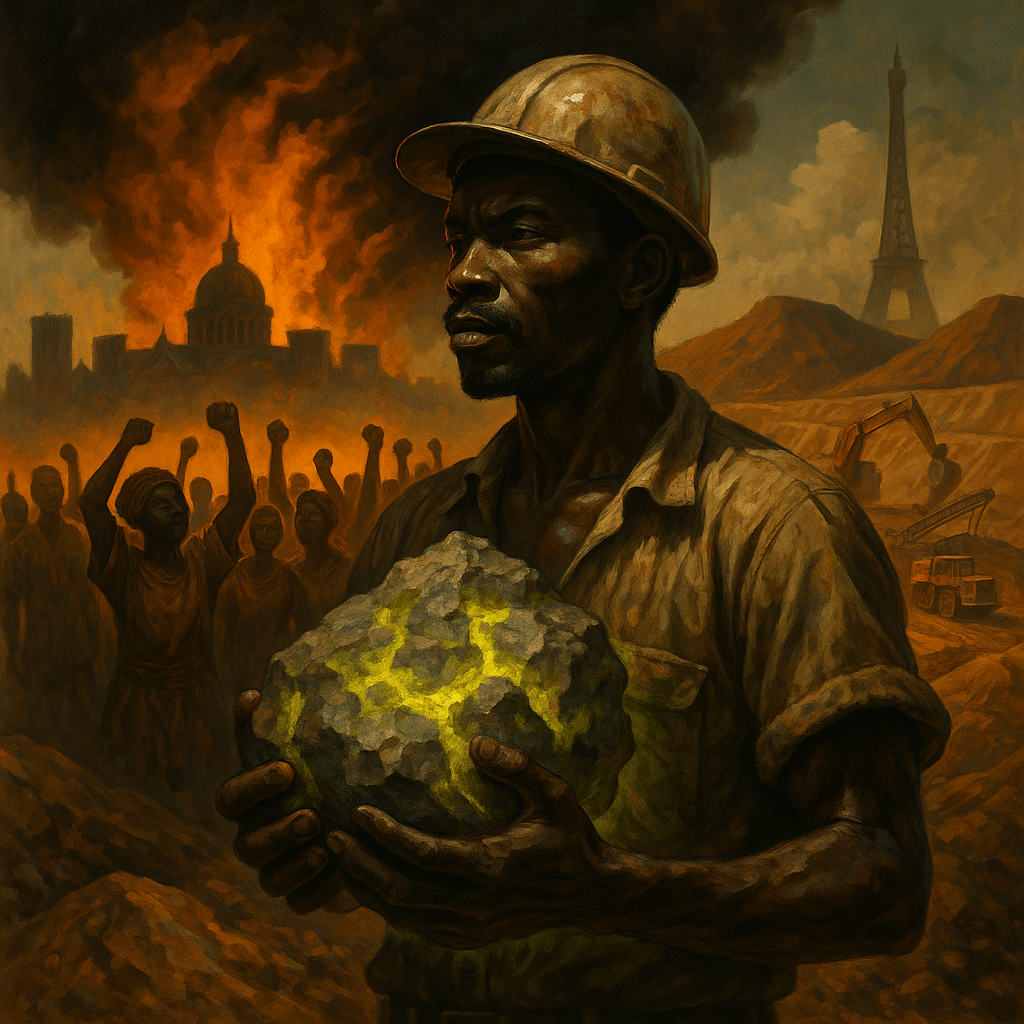
As Niger reclaims its uranium from French control, the West cries foul. But beneath the noise lies a deeper truth: hyper-imperialism is in retreat, and a new anti-colonial front is rising in the Sahel.
By Prince Kapone | Weaponized Information | June 20, 2025
Radioactive Theft and Cognitive Combat: Al Jazeera’s Neocolonial Script
On June 20, 2025, Al Jazeera English reported that Niger’s military government would nationalize Somair, the flagship uranium mine long operated by French nuclear firm Orano. The article appears balanced on the surface—quoting both parties, listing historical timelines, invoking arbitration. But beneath this sheen of objectivity lies a carefully engineered narrative. What we are witnessing is not journalism. It is Cognitive Warfare—a strategic information assault that sanitizes empire and criminalizes decolonization.
Al Jazeera’s framing performs a textbook inversion: the thief howls “robbery” when the colonized reclaim their stolen goods. Orano, 90 percent owned by the French state, has extracted over 86 percent of Somair’s uranium production since 1971, yet the article paints France as the aggrieved party and Niger as the aggressor. The Qatari state-owned outlet—run by the Qatar Investment Authority and staffed by alumni of Western media powerhouses like the BBC and CNN—omits this entire history. Readers are never told that Nigeriens live and die in irradiated poverty while Orano lights up French cities and bankrolls Paris’s nuclear arsenal.
This is silence as strategy. The article never mentions that arbitration tribunals like ICSID are not neutral bodies, but instruments of Lawfare: mechanisms of recolonization masquerading as international law. Le Monde has documented that multinationals win roughly 70 percent of these cases. But Al Jazeera gives Orano CEO Nicolas Maes a platform to plead victimhood—without once interrogating the legitimacy of these corporate tribunals or the structural violence of investor-state dispute systems.
Nor are readers told who benefits. France sources nearly 70 percent of its electricity from nuclear power, much of it fueled by Nigerien uranium. Orano’s operations are underwritten by global finance—banks like BNP Paribas, Société Générale, and Crédit Agricole—and legitimized by legal arms like White & Case LLP. None of them are named. Yet Al Jazeera quotes the CEO as if he were a neutral technocrat, not a high-ranking functionary in the apparatus of Financial Piracy.
The language used is equally telling. Niger’s government is reduced to “rulers” or a “military junta”—a delegitimizing tactic echoed across Western reporting. Its actions are deemed “hostile,” while France is portrayed as a reasonable actor simply “protecting its assets.” The word “colonialism” never appears. Neither do the radiation deaths, poisoned aquifers, or the AES bloc’s coordinated sovereignty strategy. The real map—surveilled by NATO drones and ringed by French special forces—is made invisible.
We’ve seen this script before. In “Gold and the Guillotine,” we tracked the same disinformation template used against Burkina Faso. In “Furnace of Sovereignty,” we exposed how Mali’s refinery triggered financial panic in Brussels. Now, in Niger, the story repeats: another sovereign state wrests control from empire, and the media machine rushes to criminalize it. Al Jazeera isn’t reporting news. It’s issuing press releases for a decaying hyper-imperial order.
Our task here is surgical: extract the ideological blade hidden in Al Jazeera’s reporting. Expose the structural alliances, map the silences, and name the class forces hiding behind neutral phrases. The uranium is glowing; so is the truth.
Uranium Chains: Necro-Extractivism and the Sahelian Rebellion
Uranium is the ghost mineral of the French economy—glowing in the background, invisible in the headlines. While Paris basks in nuclear-powered lights, Arlit—Niger’s mining town at the source—lives in radioactive shadow. Since 1971, over 86 percent of the uranium extracted from Somair has been shipped north to fuel French power plants and warheads. Niger, despite holding a nominal 37 percent stake through its state firm SOPAMIN, has remained trapped in a colonial labor division: the South digs, the North detonates and illuminates. But now, that chain is breaking.
This is the anatomy of what we define as Necro-Extractivism—the systematic pillaging of natural wealth under conditions that deliver death and underdevelopment to the colonized. The scale of violence is staggering. According to a 2019 report by the World Health Organization’s Niger office, radiation-linked illnesses have disproportionately impacted mine workers and residents in Arlit. Investigations by Greenpeace confirmed the presence of radioactive contamination in the soil and water surrounding Orano’s mines, including dangerously high radon levels near open waste pits.
Meanwhile, Orano’s balance sheet booms. The company—formerly Areva—earned $4.3 billion in revenue in 2023 alone, powered in part by Niger’s ore. France relies on nuclear energy for over 70 percent of its electricity and maintains a stockpile of more than 300 nuclear warheads. The uranium fueling this arsenal doesn’t come from Normandy—it comes from Niger. Paris lights its monuments with stolen minerals, then drafts op-eds about “stability.”
But the desert is shifting. Niger’s decision to nationalize Somair is not a bureaucratic shuffle—it is part of a regional rupture. In 2024, the country expelled French troops, revoked colonial-era mining contracts, and aligned with neighbors Mali and Burkina Faso in forming the Alliance of Sahel States (AES). This bloc is not just a security pact—it is a political and economic break with Françafrique. As documented in WI’s “The Sahel Doesn’t Beg Anymore,” the AES is asserting postcolonial coordination through national resource control, currency de-linking, and anti-imperialist diplomacy. AES was officially inaugurated on July 6, 2024, following the September 2023 declaration by Mali, Niger, and Burkina Faso.
Niger’s turn toward multipolar alternatives is already in motion. Though Rosatom and Orano denied negotiation reports in mid-2024, the Sahelian bloc’s alignment with Russia signals more than post-colonial rhetoric—it demonstrates strategic diversification. As argued in “Niger Didn’t Expel China—It Recalibrated the Terms of Struggle,” the shift is about leveraging multipolar pressure, not shifting allegiance.
Predictably, imperialism is retaliating. France and its EU allies have responded not only with media slander and economic threats, but with Hybrid Warfare: financial sanctions, legal intimidation, and diplomatic isolation. Arbitration courts are being mobilized. The European Commission is drafting sanctions. The aim is clear—discipline Niger back into the mining matrix through Lawfare and Sanctions Architecture. When bombs can’t be dropped, contracts become weapons.
Still, the region is not folding. In Burkina Faso, a sovereign gold refinery now challenges French intermediaries. In Mali, land-reform and food-sovereignty programs are taking root. In Niger, uranium is no longer a free gift to empire. This is not regression. It is rebellion. A rebellion against the necropolitics of extraction and the soft tyranny of IMF “reform packages.” A rebellion that glows underground and marches above it.
Hyper-Imperialism in Retreat: The Sahel’s Revolutionary Reclamation
The West calls it regression. We call it reclamation. When Niger nationalized the Somair uranium mine, France and its corporate-media chorus erupted with alarms about “legal violations,” “military adventurism,” and “investor risk.” But beyond this imperial tantrum lies a different story: a historic rupture in the structure of hyper-imperial control. What we are witnessing is not disorder—it is the deliberate unmaking of neocolonial power arrangements long imposed on the Sahel.
For decades, Orano acted as Paris’s proxy in Niger, extracting uranium while laundering the theft through contracts and “joint ventures.” Orano’s profits propped up French infrastructure and energy systems. But now, with Somair nationalized and French troops expelled, Niger’s transitional government is asserting a principle the West refuses to recognize: that a nation owns the wealth beneath its feet. This assertion is not unilateral. It is part of the Constitutive Act of the AES—a shared political program forged between Niger, Mali, and Burkina Faso to coordinate sovereignty, control strategic resources, and dismantle the neocolonial economy.
The imperial counteroffensive has been swift and layered. Legal threats from Orano. Sanctions proposals from Brussels. Asset freezes drafted under the guise of “human rights” protection. This is not diplomacy—it is Lawfare, backed by Sanctions Architecture. Western capital, when challenged, defaults to siege tactics. These are not responses to violations of law, but to violations of imperial order.
But unlike past uprisings crushed in isolation, this one is coordinated. The Sahel is not a lone actor—it is a bloc. Mali is building food sovereignty and public control over gold revenues. Burkina Faso is rejecting debt traps and formalizing its national refinery. Niger is recalibrating uranium flows away from Europe and toward multipolar partnerships. Together, they represent a collective movement to displace the comprador model and construct what we at WI identify as dual power formations: state projects rooted in popular support and defined by anti-imperialist orientation.
Western media narratives cling to the Cold War playbook—labeling the AES states as “isolated,” “irrational,” or “Russian puppets.” But this framing collapses under scrutiny. The real driver here is not ideology—it’s leverage. Niger’s new cooperation with Rosatom, and the broader AES engagement with BRICS+, reflect a strategic turn toward multipolarity, not East‑bloc dependency. As WI has argued in prior analyses, the goal is not to trade one empire for another—it is to force imperialism into retreat by multiplying the options for sovereignty.
What the West interprets as collapse is in fact the emergence of a new contradiction: a fractured hyper‑imperial system that can no longer enforce discipline without exposing its illegitimacy. If the AES experiments stumble, they stumble forward—toward a future where sovereignty is wrestled, not gifted; where resources serve the people, not the Paris stock exchange. These are not rogue generals—they are the advanced detachment of a deeper struggle.
From the Mines to the Metropole: Break the Chokepoints, Build the Front
We are not neutral. In the struggle between sovereignty and empire, between uranium-fed death and uranium-fueled dignity, our allegiance lies with the people reclaiming their land, not with the shareholders clenching their contracts. Niger’s nationalization of the Somair mine is not a paperwork dispute—it is a revolutionary rupture in the circuitry of global extraction. And as the empire escalates its counterattack through lawfare, sanctions, and slander, solidarity must become a weapon, not a sentiment.
France will not retreat politely. Orano has already filed legal warnings. Investor-state tribunals in The Hague prepare for battle. Brussels floats asset freezes while editorial boards in Paris cry about “instability.” But what is truly unstable is a global system that relies on extracting radioactive wealth from one of the poorest regions on earth to light luxury condos in Lyon. This is not a crisis of Niger. It is a crisis of imperial logistics.
To confront that logistics, solidarity must be organized along its arteries. This means naming the nodes, targeting the terminals, and disrupting the flows. Here is what concrete internationalism looks like in the age of hyper-imperialism:
- Expose the Structure: Map and publicize Orano’s global operations and its links to the French state, naming the banks (e.g., BNP Paribas, Société Générale), law firms (e.g., White & Case LLP), and investment funds underwriting its uranium empire.
- Target the Nodes: Organize coordinated demonstrations, occupations, and blockades at key European extraction chokepoints—especially the uranium transit terminals in Rotterdam’s EMO terminal and Marseille’s Fos-sur-Mer docks.
- Disrupt the Legitimacy: Launch educational campaigns exposing the colonial role of ISDS courts, demand government withdrawals from investor-state arbitration treaties, and elevate calls to abolish the ICSID system entirely.
- Build Sahelian Infrastructure: Channel resources directly to Sahel-based mutual aid networks, independent media collectives, and grassroots development cooperatives—circumventing Western aid filters and SWIFT financial surveillance. Support initiatives via networks like the Sahel Solidarity Fund or the BRICS Contingent Reserve Arrangement.
- Link the Fronts: Connect the Sahel’s uranium struggle to other global anti-extraction battles—organize joint teach-ins, publish cross-border dispatches, and coordinate solidarity campaigns alongside Indigenous land defenders, Palestinian resistance networks, and anti-colonial movements worldwide.
This is not charity work. This is insurgent logistics. Because what is being fought over in Arlit is not just uranium—it is the right of a people to define the future on their own terms. The AES bloc has drawn a radioactive line in the sand. And the question facing every worker, organizer, and revolutionary in the imperial core is this: will we cross that line in solidarity—or remain on the other side of history with the looters?
Weaponized Information stands on the side of the looted who fight back. We will continue to expose the pipelines of plunder, the language of legal conquest, and the structure of imperial dominance. We will amplify the voices of those breaking free and arm others with the clarity to join them. The Somair nationalization is not a spectacle. It is a signal. And we answer it with action.
 Weaponized Information
Leave a comment