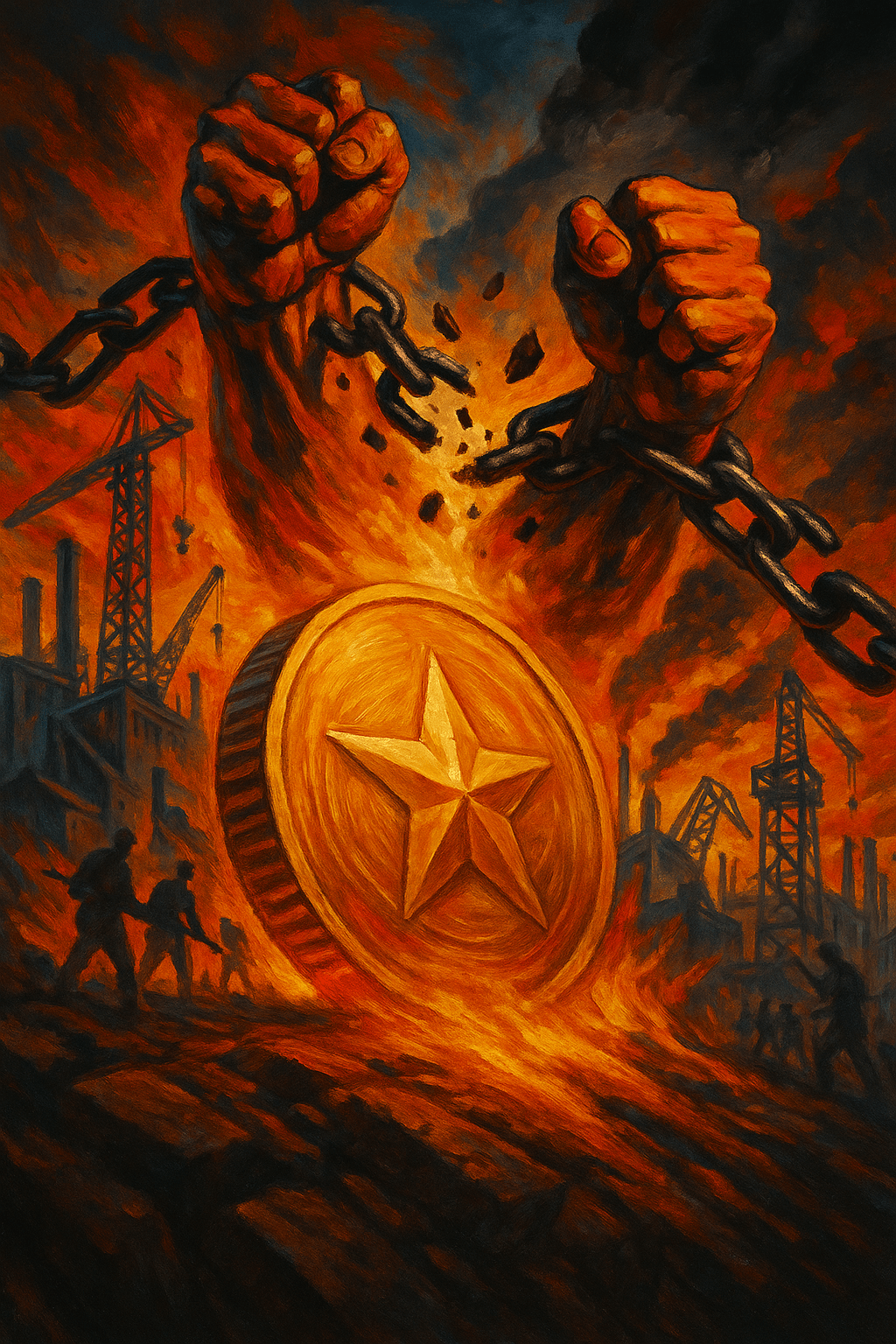
How Keynes’s plan to prevent another world war was buried by the dollar—and why the Global South must resurrect its core logic to dismantle U.S. monetary imperialism today.
By Prince Kapone | Weaponized Information | June 2025
Part I: The Clearing House That Never Was
In the dying embers of World War II, the Allied victors gathered at Bretton Woods, determined to stitch together an international economic order sturdy enough to outlive the wreckage of depression and war. On the table lay the audacious scheme of British economist John Maynard Keynes: a worldwide International Clearing Union (ICU) anchored by a supranational currency, the Bancor. Keynes was not tinkering at the margins. He was out to re-wire the global circuitry—curbing imperial plunder, handcuffing surplus-hoarding states, and carving breathing space for colonized nations so they wouldn’t be dragged into the debtor’s shackles.
The ICU, of course, never saw daylight. The U.S. delegation—fronted by Treasury tactician Harry Dexter White—sank it, swapping Keynes’s balance-of-payments solidarity for a system soldered to the U.S. dollar. Backed by bombers and greased by the Marshall Plan, Washington guaranteed a post-war order that crowned Wall Street as banker-in-chief while preaching “free markets” to the rest of us. Europe was rebuilt—on condition it bought American goods and knelt to American credit.
Keynes himself understood the stakes. He warned in The Economic Consequences of the Peace (1919): “If we aim deliberately at the impoverishment of Central Europe, vengeance, I dare predict, will not limp. It will come with the speed of a rocket.” He was referring to the Versailles reparations—but the lesson applied equally to post-war financial imbalance. His ICU wasn’t a peace treaty—it was an economic ceasefire, designed to stop capital from turning war into permanent business.
Now, as BRICS and a host of Global South alliances hunt for an exit from dollar dominion, Keynes’s long-buried ICU deserves another look—not as a liberal nostalgia trip, but as raw material for a multipolar, socialist, anti-imperial horizon.
1.1 The Keynes Plan: ICU and Bancor Explained
At its heart, Keynes’s proposal was a clearinghouse—a supranational ledger that would settle trade accounts in Bancor. Nations could no longer stash endless surpluses or deficits; the ICU would credit or debit balances automatically, keeping the books honest.
Crucially, it imposed responsibility on both surplus and deficit countries. A state running chronic surpluses—like the U.S. in 1944—would be required to import more, invest abroad, or raise domestic wages. Deficit nations would not be punished with austerity but supported in recalibrating their trade flows. The system wasn’t moral—it was mechanical. But it forced imperial powers to stop hoarding at the expense of global demand.
Keynes called it “the euthanasia of the rentier”—not the death of capitalism, but a constraint on its worst imperial instincts. The goal was to bury beggar-thy-neighbor economics and construct a system that prevented financial imbalance from metastasizing into geopolitical war.
1.2 The White Plan and U.S. Financial Imperialism
Harry Dexter White, speaking for an ascendant American empire, made sure that vision died in the conference room. He rejected the ICU and Bancor in favor of a gold-convertible dollar regime, with the U.S. Federal Reserve at the center of the global monetary universe. All other nations would hold dollars in reserve—ensuring endless demand for U.S. currency and giving Washington license to run deficits without consequence.
The arrangement had nothing to do with justice. It was about power. The dollar would replace the pound as the world’s imperial unit—not by merit, but by force. Gold would back the dollar, and American bombs would back the gold. Under this system, control was no longer exercised through colonial governors—it was enforced through balance sheets, interest rates, and conditional loans.
Thus, the institutions of U.S.-led capitalism were born—not to stabilize the world, but to stabilize American hegemony. The World Bank and IMF were not referees—they were collection agencies for a global credit racket, created to lock the Global South into permanent dependency while dressing it up as development. What Keynes proposed as a circuit-breaker became, in White’s hands, a fuse box for imperial finance.
Part II: Keynesianism Was Never Enough
2.1 The Colonial Contradiction
Keynes’s grand design treated nations as if they all lined up at the same starting block. In reality, the colonial powers were already halfway around the track—carrying loot. The International Clearing Union spoke of balance—surplus and deficit countries sharing the burden—but never asked how those surpluses were produced: through slavery, colonial extraction, and enforced underdevelopment. By ignoring that history, the ICU threatened to whitewash centuries of imperial plunder into polite monetary arithmetic.
Britain alone extracted an estimated £45 trillion from India during its colonial occupation. That wasn’t trade—it was theft institutionalized. Yet Keynes’s model treated India and Britain as equals, applying the same penalties and obligations to both. To pretend that a deficit in Delhi equaled a deficit in Detroit was to reduce structural looting to a spreadsheet error. It masked imperial domination under the illusion of fair play. Any clearing house that ignores reparations merely replaces bayonets with balance sheets.
The flaw wasn’t in the mechanics—it was in the morality. Keynes imagined the ICU as a way to prevent another Great Depression or global war. But by ignoring the structural violence that underwrote capitalist “surpluses,” he risked locking the colonized world into a softer, more bureaucratic dependency. “Peaceful coexistence” without redistribution was imperialism in a blazer, not a uniform.
2.2 Why the British Backed Keynes Anyway
By 1944, the British Empire was stumbling. Its war debt was staggering, its colonies restless, and its economy bleeding. Keynes’s ICU wasn’t a radical break—it was a lifeline. The British ruling class saw in the Bancor system a way to cushion its fall, a kind of slow-motion retreat from financial dominance that might delay the full eclipse of empire. A multilateral clearing union gave London the illusion of influence even as it ceded control.
But this was survival, not generosity. The same year Bretton Woods convened, the UK quietly signed the Anglo-American Loan Agreement with Washington—a $3.75 billion bailout to keep the pound from collapsing. In exchange, Britain had to liberalize trade and dissolve the imperial preference system. Keynes’s Bancor was a strategy to contain American ascendancy, not challenge capitalist rule itself.
Keynes offered the British elite a veneer of multilateralism—shared rules without surrendering class power. It was a plan for managing imperial decline without inviting revolution. The colonies would remain in chains, but the terms would be negotiated in Geneva instead of dictated from Whitehall. It wasn’t justice—it was damage control.
Even that was too much for Washington. White wanted no limits on U.S. surpluses, no constraints on dollar issuance, and no international oversight. The ICU was killed not because it was socialist—but because it might have slowed the American empire’s sprint to global supremacy. The British were left defending a flawed compromise. The Americans walked off with the world.
Part III: Imperialism Triumphant – The Dollar Replaces the Bancor
3.1 Bretton Woods Aftermath
Keynes was barely in the ground when the Marshall Plan rolled out—$13 billion in “aid” from the U.S. to rebuild war-torn Europe. But this wasn’t charity. It was the down payment on dollar empire. Every dollar spent in Paris or Frankfurt came with strings: buy American goods, open your markets, and settle your debts in greenbacks. Europe was rebuilt—on the condition it became a client of U.S. credit and consumption.
These funds didn’t just circulate—they recycled. The newly resurgent European economies deposited their dollar reserves in American banks, fueling the rise of offshore Eurodollar markets. These banks, in turn, bought U.S. Treasury bonds, financing American deficits and deepening global dependence on the dollar. The imperial loop was complete: aid out, profit back. The world needed dollars, and Washington printed them with impunity.
Meanwhile, the Pentagon planted permanent military bases across Europe, Asia, and the Pacific. These outposts—Ramstein, Okinawa, Diego Garcia—became enforcers of dollar hegemony. Countries hosting U.S. troops were required to pay in dollars, further entrenching demand. The IMF and World Bank, founded under Bretton Woods, took on their new role: collecting agents for empire. They offered loans to the Global South with “conditions”—austerity, deregulation, privatization—locking nations into dependency under the guise of development.
By the 1960s, the dollar was not just currency—it was infrastructure. A universal medium of trade. A store of value. A disciplinary tool. The Bancor was dead. In its place stood a dollar machine powered by Wall Street, guarded by the Pentagon, and laundered through multilateral institutions wearing UN blue.
3.2 Collapse of Bretton Woods and Rise of the Petrodollar
By the early 1970s, the contradictions of this system began to rupture. The U.S. was running massive trade and budget deficits—fueled by the Vietnam War and bloated domestic spending—while countries like France and West Germany began demanding gold in exchange for their swelling dollar reserves. In 1971, President Nixon closed the gold window, breaking the last link between the dollar and anything tangible.
Pundits screamed collapse. But empire is adaptable. In 1974, U.S. officials struck a deal with Saudi Arabia: Riyadh would sell oil exclusively in dollars, and Washington would provide military support and weapons contracts in return. Other OPEC nations followed suit. This was the birth of the petrodollar system. Every country now needed dollars to fuel its economy—cementing global demand for U.S. currency regardless of American productivity.
Petrodollar revenues were reinvested in U.S. financial markets, creating massive capital inflows to Wall Street. This surplus liquidity was then loaned—via the IMF and private banks—back to the Global South, often at crushing interest rates. The same dollar that bought oil in Riyadh financed coups in Santiago and austerity in Accra. Dollar imperialism had entered its financialized phase.
Permanent U.S. deficits became the engine, not the flaw. The dollar’s unmoored status allowed Washington to finance endless war, expand NATO, and weaponize sanctions. To cut a country off from SWIFT—the U.S.-controlled payment messaging system—was to throttle its economy. In Keynes’s world, balance was the goal. In White’s world, imbalance was strategy. The dollar didn’t just survive the fall of Bretton Woods. It became a gun with global reach.
Part IV: What Could Have Been – Alternative Socialist Proposals
4.1 Che Guevara’s Vision at Punta del Este and Algiers
In 1961, at the Inter-American Economic Conference in Punta del Este, Che Guevara stood before a room of U.S.-aligned finance ministers and cut through the rhetoric. He called the IMF what it was: an instrument of dependency. He rejected the notion that “aid” came without domination. And he demanded that Latin America break from the economic tutelage of Washington. For Che, independence meant more than flags—it meant autonomy over trade, currency, and development planning.
In 1964, Che proposed a Latin American payments union to facilitate intra-regional trade without dollars, modeled in part on the European Payments Union. It was an embryonic clearing system, designed to keep hard currency within the region and allow socialist states like Cuba to trade with others without begging for Western credit. By 1965, at the Afro-Asian solidarity conference in Algiers, Che went further: he called for a new international monetary order that would reject the imperialist architecture entirely. “Let the flag of national liberation be raised,” he declared, not just against U.S. troops but against U.S. finance.
4.2 Samir Amin and the Delinking Strategy
Egyptian Marxist Samir Amin sharpened this vision into theory. “Delinking” was not isolation—it was strategic disobedience. For Amin, the global capitalist system worked precisely because the periphery was linked into it on exploitative terms. Delinking meant building autonomous circuits of production, trade, and finance—not to wall off from the world, but to break the command of imperial capital over national economies.
Amin called for regional clearing houses, shared industrial plans, and development strategies built around domestic needs. He envisioned an economic architecture where Global South states could settle accounts in regional currencies or resource-based units of account—backed by mutual agreements rather than IMF discipline. He argued, “Either the South delinks, or it is devoured”. The enemy was not trade—it was unequal exchange.
4.3 China’s Bandung Era Proposals
Before neoliberal globalization and capitalist restoration, China offered another path. Under Zhou Enlai’s leadership, the People’s Republic pushed for genuine multipolarism at the 1955 Bandung Conference. China proposed economic relations among newly independent nations based on equality, reciprocity, and mutual development—not IMF strings or Cold War alignment.
Beijing backed this rhetoric with action. In the 1950s and 60s, China signed barter agreements with countries like Egypt, Burma, and Indonesia—exchanging machinery, medicine, and expertise for oil, rice, or rubber. No dollars. No interest rates. No subordination. Zhou’s diplomacy prefigured the logic of a sovereign clearing house: South-South economic cooperation grounded in political solidarity and material needs, not speculative profit.
These efforts weren’t perfect. But they planted seeds for what multipolarism could look like in practice—not just as geopolitical realignment, but as a new material foundation for economic liberation.
Part V: A Multipolar ICU – Revolutionary Revision
5.1 Why Keynes’s Model Still Offers Strategic Utility
In the twilight of dollar hegemony, Keynes’s International Clearing Union still carries strategic weight—not because it offers justice, but because it offers structure. The ICU was a blueprint to balance trade without enforcing debt servitude. It aimed to stabilize global exchange through a neutral clearing mechanism and reduce the need for nations to stockpile foreign reserves or rely on imperial currencies. In the current phase—where U.S. power is fractured but not finished—such a mechanism could be weaponized against the empire’s monetary chokehold.
This does not mean reviving the Bancor as Keynes conceived it. It means treating the ICU model as a transitional weapon—a tool for economic coordination among semi-sovereign blocs still operating within, but increasingly resistant to, the imperial system. For BRICS, CELAC, or the African Union, a clearing union could help reduce dollar exposure, settle accounts in regional units, and facilitate resource-for-infrastructure swaps. It would not abolish imperialism, but it would crack its monetary scaffolding—and that is no small feat.
5.2 What Must Change: A Revolutionary Correction
But let’s be clear: Keynes’s framework must be politically rearmed. The principle of symmetrical adjustment—the idea that surplus and deficit nations should be treated equally—was always a liberal fantasy. Surpluses in the imperial core were built on enslaved labor, colonial drains, and rigged markets. A revised clearing system must apply historical-justice weighting: holding surplus states accountable for centuries of extraction, while giving breathing room to the formerly colonized.
This means rewriting the formula. For example: for every 2% of GDP historically drained by colonial trade, a nation earns 1% surplus buffer within the clearing zone. Credit ceilings and balance penalties must reflect stolen wealth, not abstract parity. Deficit states in the Global South should be credited—not punished—with allowances based on reparative logic, not fiscal orthodoxy.
The new Bancor—call it Bancor 2.0—need not be a currency. It could function as a digital clearing token, backed by a basket of key commodities: energy, grain, lithium, and labor. Transactions could be settled via BRICS Pay or CIPS infrastructure—bypassing SWIFT and U.S. surveillance. Such a system could anchor trade in material reality while insulating bloc economies from financial warfare.
Administration must be equally transformed. A People’s Monetary Assembly—composed of development banks, public sector economists, labor representatives, and sovereign governments—must oversee the clearing system. Not technocrats. Not rating agencies. Its mission: to build a trade architecture that serves decolonization, not creditworthiness. The ICU is not a socialist endpoint—but in this conjuncture, it could be a trench from which to fight.
5.3 Already Breaking the Chains: Sanctions Evasion and Parallel Circuits
The future of financial sovereignty is already taking shape in resistance economies:
- Iran, expelled from SWIFT in 2012, built a network of over 250 “ghost tankers” and a $80 billion per year oil black market, facilitated by hawala brokers and yuan-crypto swaps.
- Russia, cut off in 2022, expanded SPFS and linked it with China’s CIPS, now settling over 90% of trade with China in rubles or yuan.
- Venezuela, under sanctions since 2017, turned to Tether (USDT) for essential imports, using peer-to-peer crypto platforms to bypass U.S.-controlled banks.
These are not hypothetical experiments. They are living proof that the Global South is already forging the pathways Keynes only imagined—without permission, without apology.
Part VI: The Strategic Road Ahead
6.1 BRICS+, CELAC, and ALBA as Pillars
The architecture for a new clearing union does not need to be invented from scratch. It can be built on the foundations already laid by multipolar blocs—especially BRICS+, CELAC, and ALBA. These coalitions were born out of resistance: resistance to sanctions, to neoliberalism, to dollar tyranny. What they now require is an infrastructural leap. If Keynes gave us the scaffold, these blocs must now build the house.
BRICS, in particular, must go beyond slogans. It must build the plumbing: pilot a commodity-backed digital clearing token operating on CIPS or BRICS Pay infrastructure. Such a unit of account could be used for settling bilateral or multilateral trade—without relying on dollars, euros, or IMF conditionality. Imagine: Mozambican LNG exchanged for Brazilian tractors, settled in a digital token backed by natural gas and soybeans. Not a single dollar changes hands. No New York bank takes a cut.
This requires more than central banks. It demands revolutionary commissions—composed of public sector economists, trade unions, development banks, and sovereign states. Their task is not just to design the technical mechanism, but to embed it within popular struggles for sovereignty. The goal is not liquidity—it is liberation. Not efficiency—but autonomy. A multipolar ICU must be accountable to the peoples of the South, not the portfolios of their elites.
6.2 Toward a Reparative Internationalism
At its core, this project is about more than trade. It is about reparative internationalism. That means placing historical justice at the center of economic design—not as a gesture, but as policy. Debt cancellation must become standard. Preferential trade terms must favor the poorest. Resource-sharing agreements must be governed by principles of ecological balance and self-determination—not foreign investment metrics.
A properly designed clearing house could enable horizontal linkages between nations that have long been pitted against each other in global value chains. African agriculture for Caribbean energy. Southeast Asian electronics for South American fertilizer. Regional development zones, financed by public banks and accountable to local needs—not to capital flows. This is not charity. It is justice by design.
The moment is fragile—but it is real. The dollar no longer commands unchallenged authority. The empire is overstretched, fractured, and exposed. What remains is to seize this instability and convert it into structure. Not to replace one hegemon with another—but to shatter the unipolar order and erect, in its place, a world economy rooted in sovereignty, coordination, and collective repair.
6.3 Technological Delinking: The Other Front
Payment sovereignty means nothing without technological sovereignty. When the U.S. blacklisted Huawei in 2019, it aimed to freeze China’s digital future. But by 2023, Huawei released a phone powered by a 7nm chip made by SMIC—an achievement long deemed impossible under sanctions.
This was not just a product launch. It was proof of delinking. With RISC-V—an open-source chip architecture—and nationalized chip fabs, the Global South can now build alternatives to U.S. tech monopolies, just as it must build alternatives to SWIFT, Visa, and the dollar. Technological delinking is no longer a dream. It’s a trench of the present war.
Conclusion: From Keynes to Liberation
The International Clearing Union was never a revolutionary project. It was an attempt by a dying empire to manage its decline without dismantling the system that enriched it. Keynes was no Marxist—he sought not to end capitalism, but to stabilize it. Yet within his proposal lay a rare admission: that unregulated global finance, left to the mercies of empire and profit, would devour the world.
The ICU was torpedoed not because it failed, but because it threatened. It threatened the United States’ ambition to turn the dollar into a global scepter—wielded not through cooperation, but through coercion. White’s victory at Bretton Woods wasn’t just a technical decision—it was a geopolitical conquest. It secured a world where every trade, every loan, every barrel of oil was another notch in the empire’s balance sheet.
And yet, as the imperial center fractures and the periphery gathers strength, the ghost of Keynes’s proposal lingers. Not as a blueprint to copy, but as a scaffold to seize and reconstruct. What the empire buried in 1944 can be resurrected—not by liberal technocrats, but by revolutionary internationalists. Not as a return to balance, but as a leap toward justice.
The clearing house haunts the empire still. It’s time we give it walls, servers, and a people’s ledger.
 Weaponized Information
Leave a comment