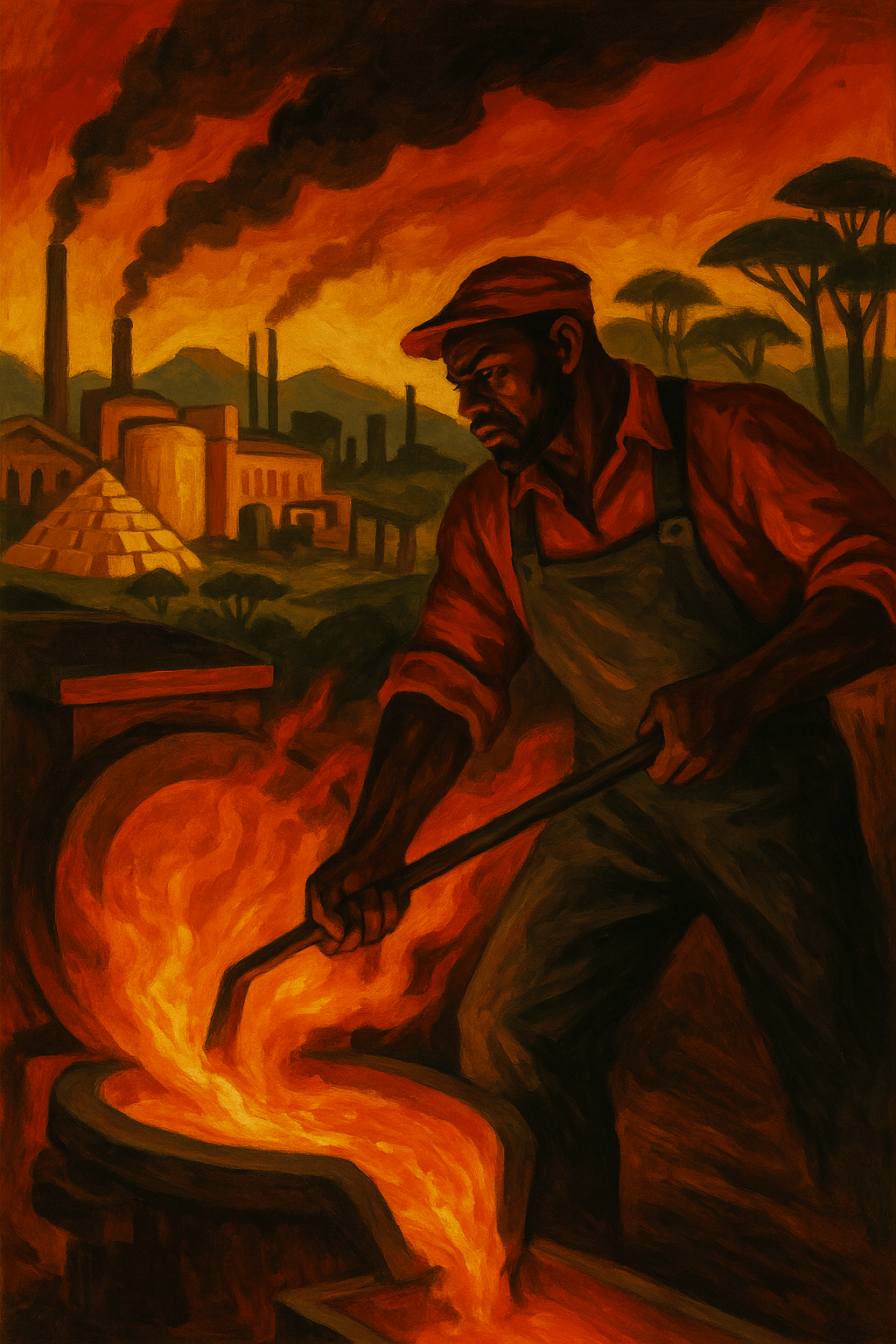
From colonial chains to smelting flames, Mali’s gold refinery is more than infrastructure—it’s insurgent architecture in the long war for African self-determination.
By Prince Kapone | Weaponized Information
June 14, 2025
When the Furnace Burns on African Soil
On June 13, 2025, Business Insider Africa published a news article titled “Mali strikes gold refining deal with Russia to curb export losses”. At first glance, it reads like a standard piece of development journalism—technocratic, restrained, and unthreatening. There are no sharp ideological claims, no overt Cold War rhetoric, no dramatic alarmism. Instead, the article offers a polished summary of recent economic policy: a joint venture between the Malian state and a Russian firm, framed as a bid to reduce fiscal leakage and improve national earnings. On the surface, it appears neutral—perhaps even supportive. But beneath its clean prose and development jargon lies a familiar silence, one that speaks volumes about the limits of reformist reporting under the reign of global capital.
This is what we call fraternal propaganda. It’s not imperialist slander, nor is it a tool of disinformation. Rather, it is the language of polite policy reform—the managerial voice of the postcolonial middle class. It names the facts, but not the forces. It cites the policy, but not the politics. It outlines the shift, but avoids the rupture. It gives you the play-by-play, but not the stakes of the game. The article doesn’t hide the truth—it simply doesn’t know how to name it. It is constrained not by lies, but by the narrow bandwidth of bourgeois development theory.
Take the framing. The story is introduced through the lens of “export losses,” “earnings,” and “compliance.” It describes the refinery project as a strategy to plug fiscal leaks and meet revised mining codes. This may be true on the surface, but the language reduces a seismic geopolitical shift to a budgetary tweak. The reliance on technocratic terms like “maximize,” “mandate,” and “certify” subtly disciplines the reader to view the move not as an act of sovereignty but as a bureaucratic correction. There is no room in this lexicon for words like liberation, expropriation, or decolonization. The struggle becomes a statistic.
The article mentions Russia, but only in passing—carefully avoiding any discussion of the deeper realignment underway across the Sahel. It refrains from invoking the words “anti-imperialism,” “post-French sovereignty,” or “multipolarity.” This omission is not malicious. It is simply typical of a media form that sees geopolitical autonomy as a curiosity, not a necessity. By rendering Africa’s political rebellion as a business decision, the piece preserves the illusion that history can be managed through investment strategy. It’s not censorship—it’s containment.
Yet there is value in this containment—because even within its limits, the article provides the raw material for revolutionary analysis. It documents the emergence of a new economic infrastructure: a state-backed refinery, a sovereign industrial project, a rupture with the raw-export model. It acknowledges regional trends toward localization. It notes that mining code reforms are underway across several West African states. What it cannot do—and what we must do—is historicize these facts, politicize these shifts, and connect them to the broader movements of class, capital, and colonial contradiction.
In that sense, we approach this article not as an opponent but as a comrade in need of ideological sharpening. Fraternal propaganda gestures toward truth, but lacks the tools to extract it fully. It presents the spark—we must strike the match. The task of revolutionary media is not only to expose imperialist lies, but also to complete partial truths. And the truth is this: Mali’s refinery is not a business innovation. It is a material front in a long war for African sovereignty. The article speaks of infrastructure. We must speak of struggle.
Gold Chains and the Ghosts of Extraction
Mali is the second-largest gold producer in Africa. Every year, more than 70 tons of gold are extracted from its soil. But until now, the vast majority of that wealth has left the country in raw form—unrefined, undervalued, and ultimately hijacked by foreign refineries in Switzerland, the United Arab Emirates, and South Africa. What Business Insider notes—without naming the systemic violence beneath it—is that Mali has lacked a single internationally certified refinery. That’s not an oversight. That’s a colonial feature of the global economy.
This new facility—SOROMA-SA—isn’t just about gold. It’s about value sovereignty. Scheduled to process 200 metric tons annually, it quadruples Mali’s existing capacity of roughly 50 tons, according to Reuters. The refinery, majority-owned by the Malian state, is designed to meet the LBMA’s 99.5% purity standard—not because Mali seeks Western approval, but because it seeks autonomous entry into global markets without having to beg Western gatekeepers for access. Crucially, Mali’s Russian partner Yadran is responsible for securing LBMA certification, exposing the paradox of postcolonial sovereignty: to break imperial dependency, one must first be credentialed by its institutions.
The article gestures toward regional momentum. It mentions that countries like Burkina Faso, Niger, and Guinea are implementing similar reforms. What it fails to clarify is that all three nations are now governed by military transitional governments that have rejected French military occupation, renounced neocolonial mining contracts, and begun redirecting extraction revenues into national development. These are not isolated policy tweaks. They are coordinated movements toward anti-imperialist sovereignty. In June 2025, Burkina Faso nationalized five gold mines into its state-owned SOPAMIB. Meanwhile, Tanzania now mandates that 20 percent of all gold be refined and sold through its central bank. Together, these policies embody economist Samir Amin’s thesis of “delinking” from imperialist circuits through state-led resource reclamation.
The deeper context is clear: Mali’s revised mining code is not simply about increasing royalties. It’s about breaking from the model imposed by the World Bank and IMF in the 1980s and 1990s—a model that handed control of Mali’s gold sector to multinationals like AngloGold Ashanti, B2Gold, and Barrick. For decades, these firms operated behind a façade of “foreign direct investment,” extracting value while Mali remained dependent on the export of raw materials, with little reinvestment, no industrial base, and no control over pricing.
Today’s reforms are part of a broader geopolitical shift. Since the 2020 coup, Mali has expelled French troops, severed defense ties with Paris, deepened cooperation with Russia, and joined a growing chorus of African nations pursuing formal alignment with Moscow. In April 2025, the foreign ministers of Mali, Niger, and Burkina Faso visited Moscow for the first AES–Russia consultations after expelling Western forces, according to Reuters. The refinery is a small but potent piece of this realignment: reclaiming the capacity to refine, certify, and circulate wealth on Malian terms.
This is also a challenge to global financial chokepoints. By refining gold domestically, Mali reduces reliance on Western logistics, cuts fees to foreign entities, and potentially opens the door to trading outside the SWIFT‑dominated dollar system. In other words, this is not just economic policy—it’s counter‑hegemonic infrastructure. Mali’s move is also a hedge against financial encirclement: African countries now face average borrowing costs of 11.6 percent—8.5 points above the global average, according to UNCTAD. Domestic refining enables states to retain value and explore bullion-backed credit options, potentially circumventing IMF and World Bank constraints.
The facts are simple: Mali is building a refinery. The reality is seismic: a colonized country is reclaiming the means to define and distribute its own wealth. What remains is to sharpen this into revolutionary strategy.
The new furnace is not symbolic; it is material power. At full throttle the plant will refine 200 metric tons per year—quadrupling Mali’s previous output of roughly 50 tons, according to Reuters. That scale finally lets Bamako control—rather than merely excavate—the flow of bullion.
Control, however, still runs through the imperial tollbooth of the London Bullion Market Association (LBMA). LBMA’s “Good Delivery” list determines whose bars can circulate freely in global trade—setting purity, weight, and sourcing standards, and effectively policing financial borders. By building a refinery capable of meeting the 99.5% standard, Mali isn’t chasing Western validation—it is breaking the monopoly that forced raw‑ore exports.
These industrial pivots double as a shield against the continent’s debt trap. Africa’s average cost of financing now stands at 11.6 percent—8.5 points higher than the global norm, according to UNCTAD. By internalising refining and pricing, Mali can keep more value on-shore and even explore bullion-backed credit systems outside the dollar orbit.
For a fuller picture of this continental realignment, see WI’s recent dispatches:
“The Sahel Rises” unpacks how Captain Ibrahim Traoré’s Burkina Faso pivoted from French tutelage to grassroots mobilization, using state power to claw back mineral wealth.
“The Sahel Doesn’t Beg Anymore” traces how Mali and Niger—once treated as raw-export appendages—are now fracturing the neocolonial order through coordinated mining-code revolts and regional security pacts. These pieces situate Mali’s refinery not as a lone policy experiment but as one link in a fast-solidifying chain of Sahelian sovereignty. Together, they reveal that what Business Insider frames as a fiscal tweak is, in fact, the economic front of a budding anti-imperialist bloc.
From Commodity to Command: Refining Gold, Refining Power
This isn’t just about metallurgy. It’s about memory. Mali remembers. It remembers how French colonizers built railroads not to connect African villages, but to carry gold, cotton, and bodies to the coast. It remembers how Bretton Woods institutions in the 1980s carved up its state sector, privatized its mines, and called it “reform.” It remembers how multinational firms drilled deep into its soil while Malian children went hungry, its currency pegged to the euro, its economy chained to extraction. The refinery at Bamako is not just about processing ore—it’s about breaking those chains.
Business Insider tells us that SOROMA-SA will produce gold to international standards, help Mali meet its new mining code, and reduce export losses. All true. But here’s what it can’t say, or won’t: this is class war in mineral form. Mali is no longer content to play mule for the world market—hauling value outward while wealth accumulates elsewhere. It is now attempting to govern the gold it digs, to command the commodity rather than be commanded by it.
When the state demands domestic refining, it is not “nationalizing industry” in the old statist sense—it is decolonizing the value chain. The refinery is a factory, yes. But it’s also a front in a larger rebellion: against the London Bullion Market Association, which acts as a cartel of imperial certification; against transnational mining firms whose contracts were never voted on by the people whose lands they ravage; against the whole system of financial piracy that demands raw exports and rewards underdevelopment.
This is not a perfect revolution. Russia’s Yadran owns 38% of the project—its capital and influence are backed by Moscow’s strategic gold buying to evade dollar sanctions. Reports confirm that central banks are building record gold reserves—driven by geopolitical risk and Western sanctions—having purchased over 1,000 tonnes in 2024 alone, according to Reuters. The contradiction is clear: sovereignty must mean popular control, not just non-Western ownership.
As Walter Rodney memorably wrote, “The petty bourgeoisie were reformers, not revolutionaries. Their class limitations were stamped upon the character of the independence which they negotiated.” [Rodney, “Aspects of the International Class Struggle in Africa”]. Mali’s military-bureaucratic leadership is advancing state control, but the battle is far from over. True liberation must involve miners, workers, peasants, and communities in democratic oversight—not only expropriation. A 62% state share is an advance over foreign monopoly, but if labor and the people are not sovereign, then sovereignty remains elite property.
Frantz Fanon warned that post-colonial militaries often replicate the administrative violence of colonialism—replacing white functionaries with native officers while preserving the architecture of repression. The Alliance of Sahel States expelled imperial troops, yes—but it also dissolved political parties and suppressed dissent. The contradiction is alive: liberation through the military may entrench the military as a new ruling class. As Rodney cautioned, narrow class welfare risks suffocating pan-African unity from within.
Finally, remember the ecological ledger. Gold refining involves cyanide leaching, heavy water use, and tailings storage that poses serious environmental risk. Bamako suffers from electricity shortfalls—averaging just eight hours per day in some districts. Without miners’ committees policing toxic runoff, wage theft, and refinery hazards, this project risks replicating the same extractive logic under new management. Unless those who live beside the refinery are empowered with real protection and decision-making power, this project could become yet another site of sacrifice—sacrificed to state-led extraction under the banner of progress.
For a deeper dive into the propaganda war that will accompany this material struggle, revisit WI’s “Gold and the Guillotine”, which maps the narrative trench lines we are certain to face next.
Stoking the Furnace, Forging the Frontline
Mali’s refinery isn’t just infrastructure—it’s the spark of a wider front. Across the Sahel, military-led regimes in Mali, Niger, and Burkina Faso have coalesced under the Alliance of Sahel States, severing Western military ties, expelling foreign troops, and aligning regional defense with Russia’s Wagner Group. This bloc is not merely strategic—it is ideological and material: pooling strength against imperial sanctification under the CFA franc regime.
This revolutionary moment demands international solidarity rooted in context and not rhetoric. Mali’s decisive actions—like seizing three metric tons of gold from Barrick and suspending Loulo‑Gounkoto operations in January 2025—follow from entrenched injustice and the new mining code, as reported by Reuters. Meanwhile, foreign companies have appealed to the World Bank’s ICSID tribunal—an extraterritorial court designed to defend imperial capital under the guise of “investment stability.”
Our comrades must recognize this: the struggle isn’t solely on Malian soil. Supporting the miners, bankers, and workers detained by Barrick and Resolute is fundamental. In November 2024, Mali’s military placed Resolute’s CEO and two executives under arrest during meetings in Bamako amid negotiations over a $100 million tax dispute, according to Reuters. These are not incidents—they are insurgent acts aimed at reclaiming national surplus. Global trade union federations, anti-imperial networks, and earth-rights groups must build campaigns demanding accountability for mining labor conditions, reparations for displaced communities, and transparency around refinery environmental impact.
Here’s the strategic directive:
- Expose the ICSID smokescreen: Mobilize international activists to pressure the IMF, European parliaments, and UN bodies to reject ICSID jurisdiction over Mali’s sovereign reforms. This includes challenging LBMA’s monopoly over gold certification as a form of financial border control.
- Build solidarity unions: Engage labor movements in Canada and Australia—home to Barrick and Resolute—with leaflets, protests, and pickets linking mine closures in Mali with worker exploitation abroad.
- Create dual-power oversight: Support the Malian National Workers’ Union (UNTM) in forming joint committees with refinery management to monitor worker safety, gold traceability, and environmental standards. UNTM has a history of mobilizing gold-mine workers—for instance, in 2020 it led a 72-hour strike demanding better pay and conditions according to Reuters. These committees must include peasant voices to prevent ecological devastation in surrounding communities.
- Scale a Sahelian bullion bloc: Urge the Alliance of Sahel States to create a regional bullion exchange that uses refined gold to back cross-border trade and eventually replace the CFA franc system. This would align with BRICS’ de-dollarization strategy and diminish imperial leverage over African currencies.
- Break LBMA dependency: Launch solidarity campaigns demanding an alternative certification mechanism through BRICS’ New Development Bank or an African continental monetary institution—free from Euro-American financial gatekeeping.
This is not idealism—it is strategy. Mali’s forging of a refinery is a template for a new economy: sovereign, controlled, regionally integrated, and worker-accountable. This furnace is not intended for export. It is designed to burn the chains that held us—and light the path toward a Sahelian revolution capable of shaking the foundations of imperial rule.
 Weaponized Information
Leave a comment