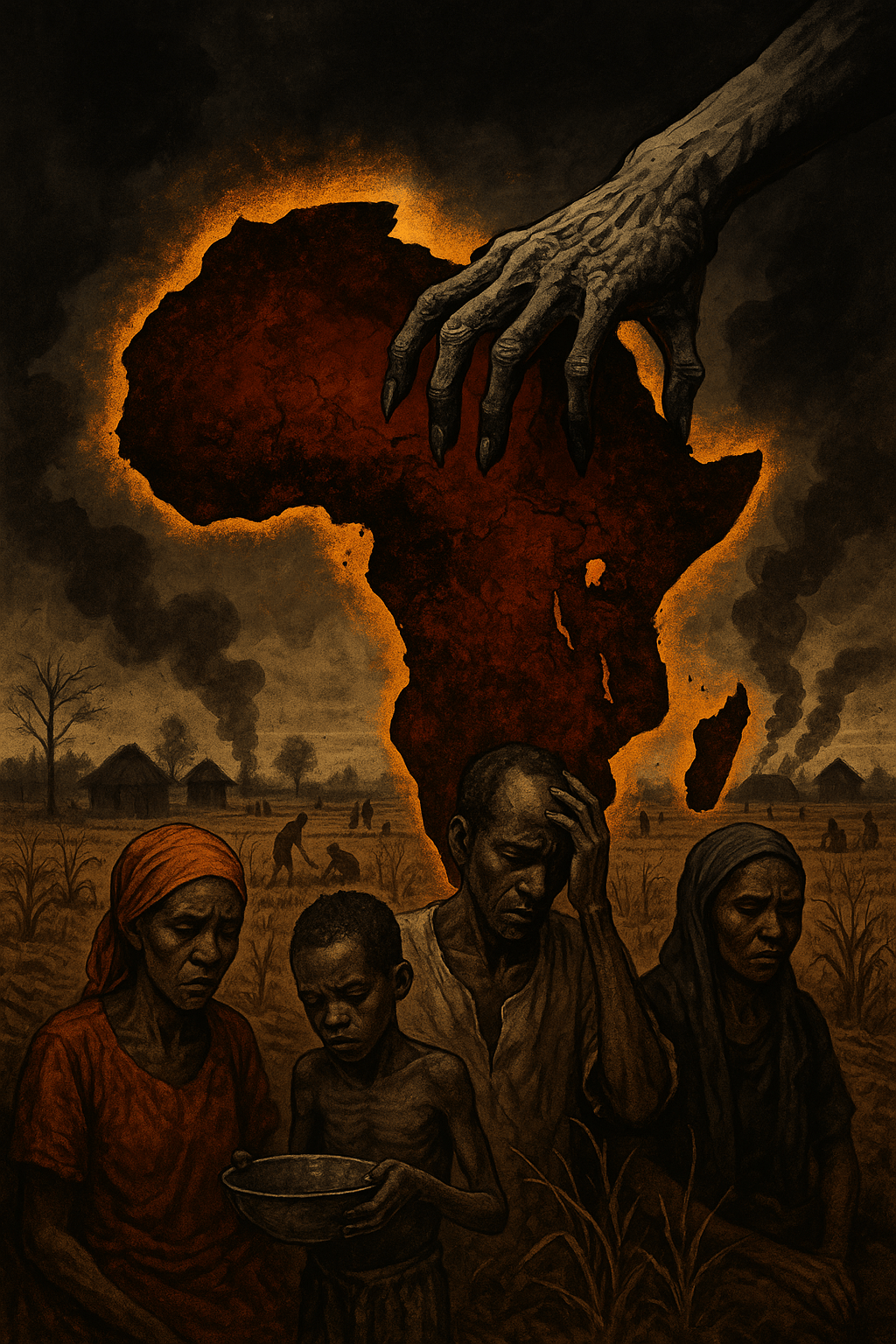
33 million Nigerians face famine not from fate, but from finance. What Yahoo buries beneath bureaucratic jargon, we expose for what it is: a war against the peasantry, waged by policy, enforced by violence, and sanctioned by silence.
By Prince Kapone | Weaponized Information | June 12, 2025
I. Famine by Design: Manufacturing Hunger, Masking Power
On June 10, 2025, Yahoo News ran a quiet little piece warning that over 33 million Nigerians are about to go hungry this summer. The original report comes from Aljazirah News, quoting the usual suspects—FAO, WFP, and Nigeria’s Ministry of Agriculture—who say it’s all due to “economic hardship,” “climate,” and “violence.” On the surface, it reads like another technocratic weather report: crisis forecast, humanitarian alert, hope in global partnerships. But if you squint past the acronyms and the passive verbs, you’ll see it for what it really is—a eulogy without a killer, a crime scene report that never calls the police. The story counts bodies and plots misery on a graph, but never asks who’s pulling the trigger.
The byline on this one goes to Leslie Sattler, a writer whose job, it seems, is to copy and paste institutional press releases and republish them with the tone of a concerned bureaucrat. She’s not alone—most Western journalists today don’t write, they transcribe. And the media outlet she works for, Aljazirah News, may carry a Nigerian name, but through its syndication by Yahoo—a Silicon Valley darling built on ad surveillance and investor profit—it does the ideological work of empire. Behind the headline lies the same old pipeline: extract the story, sanitize it, and feed it to a global audience with just enough grief to feel something, but never enough to question anything.
The people quoted in the article—Kouacou Koffy from the FAO, World Bank economists, WFP spokespersons—are presented as saviors. But let’s be real. These aren’t just technocrats with PowerPoints; they are the managers of catastrophe. They show up with bar graphs and budget appeals long after the damage is done—and too often, they helped write the policy scripts that caused it in the first place. These institutions don’t fight hunger. They govern it. They don’t resist disaster. They schedule and administer it.
Look at how the article frames it all. First, it builds trust by quoting experts and UN agencies, but never asks how these same agencies kept silent when IMF structural adjustments gutted Nigerian agriculture in the 1980s—or how today’s World Bank calls for “market-based reforms” that jack up food prices while cutting public subsidies. Second, the violence in places like Benue, Plateau, and Borno is presented like a natural occurrence—something that just happens in poor Black countries. There’s no mention of how the Nigerian state disarmed farmers, let herders militarize, and opened the gates for corporate land grabs in the name of “modernization.” The violence isn’t spontaneous. It’s strategic.
And then there’s the lone voice they quote—a farmer from Niger State. One man, one quote, no context. No union, no organizing, no fightback. Just a sad anecdote in a sea of statistics. This is how propaganda works: humanize the suffering just enough to make it legible, but never enough to make it political. Don’t show us the peasant organizations, the rural women’s cooperatives, the people resisting. Show us a victim, not a class.
Even climate change gets sterilized. It’s described as a “challenge,” like a crossword puzzle, instead of what it really is: the ecological fallout of 500 years of imperial plunder and fossil-fueled capital. The rains came, they say, but the hunger stayed. No mention that Nigeria’s food systems were deliberately dismantled to make room for rice imports, Monsanto contracts, and structural dependency. No mention that the same floods wouldn’t have destroyed so much land if the dams weren’t crumbling, if reforestation hadn’t been sabotaged, if local farmers had a say in anything.
And just when the article might begin to connect the dots, it pivots to you. The reader. “You may notice higher prices at your grocery store.” See how that works? Millions of Africans on the verge of starvation, and the takeaway is that you might pay more for quinoa. Hunger, now sold as a supply chain inconvenience.
As for solutions, the article tosses out words like “coordination” and “unified response”—the soft vocabulary of NGOs and development banks. What you won’t find is any mention of reparations, land redistribution, agroecological sovereignty, or the end of neocolonial debt traps. Because those things aren’t allowed in the grammar of humanitarianism. They would turn the victims into agents. They would imply accountability. And empire can’t have that.
Let’s be clear: this isn’t a food crisis. It’s a war waged by other means. It’s counterinsurgency by hunger—a slow violence that starves farmers off their land, pushes youth into cities and prisons, and makes foreign aid look like generosity instead of cleanup. And this article? It’s not neutral. It’s not naive. It’s part of the machinery. It doesn’t name the guilty. It helps them disappear.
II. The Arithmetic of Starvation: Situating Nigeria’s Crisis
Strip away the buzzwords and institutional jargon, and what you find in the fields of Nigeria isn’t just a food crisis—it’s an economic siege with a human toll measured in empty stomachs and shallow graves. According to the World Food Programme, over 33 million Nigerians are expected to face acute hunger between June and August 2025. That’s not a weather forecast—it’s a death sentence, crafted by policy, enforced by violence, and legitimized by silence.
Floods—called “natural disasters” by the same folks who helped deregulate Nigeria’s ecological protections—have washed away over 1.5 million hectares of farmland across 29 states, impacting more than nine million people. In some places, food inflation has already shot past 39% as families are priced out of survival. Reuters and Bloomberg have the stats, but not the politics: these weren’t just storms. They were the compounded result of colonial-era drainage systems, neglected dams, deforested watersheds, and a state too captured to act.
Meanwhile, President Tinubu’s government didn’t just let this crisis happen—it helped engineer it. The removal of fuel subsidies and floating of the naira—described by international finance as “courageous reforms”—triggered a wave of inflation that sent basic food prices into the stratosphere. The Modern Ghana analysis is clear: more than 40% of household income now goes to food. This wasn’t a miscalculation—it was a textbook example of neoliberal shock therapy, where poor people are the test subjects and rich investors walk off with the profits.
And if you think the violence is separate from all this, think again. In Benue—the so-called “food basket of the nation”—a recent academic study shows that for every 1% increase in insecurity, agricultural production drops sharply: 0.211% for crops, 0.311% for livestock. Farmers are being driven from their land—not by chance, but by deliberate counterinsurgency. Behind every gunman is a policy, and behind every policy is a profit motive.
This isn’t just happening in Nigeria. Across West and Central Africa, more than 52 million people are staring hunger in the face this lean season, according to a recent Reuters report. Over 10 million are already displaced. Aid agencies like WFP are raising alarms, warning that programs will collapse without new funding by April—meanwhile the same donor countries funnel weapons into the region through backdoor deals and train counterterrorism units that end up protecting mining interests, not people.
The original article doesn’t mention any of this. No talk of how “development” has turned into demolition. No reflection on how climate shocks are made worse by dependency on fossil fuel exports and foreign agro-inputs. No history of how IMF conditionalities gutted state grain reserves, or how SAP-era land reforms left farmers exposed. Instead, we get statistics served cold and decontextualized.
But we know better. This isn’t a perfect storm—it’s a premeditated one. What we’re witnessing is a colonial relay race: British looting handed off to Bretton Woods technocrats, who passed the baton to Nigerian comprador elites, who now outsource food sovereignty to foreign investors and aid bureaucrats. The Cadre Harmonisé reports aren’t neutral assessments—they’re maps of engineered disaster. They quantify how much hunger the system allows before it considers things “unstable.”
To isolate the floods from the inflation, or the violence from the policy reforms, is to fall into the trap they set. This isn’t about disconnected problems—it’s about a coherent structure of extraction. A system where starvation is collateral, and food insecurity is just another spreadsheet in a World Bank office. What we’re seeing is the arithmetic of empire. And it doesn’t just add up. It devours.
III. Rewriting the Story—From Crisis to Class Struggle
Let’s stop pretending this crisis is a mystery. Hunger doesn’t just descend from the skies. It’s not a divine punishment, a statistical anomaly, or some tragic accident of geography. It’s a policy outcome. It’s a class war strategy. When President Tinubu floated the naira and axed fuel subsidies, the World Bank cheered while poor Nigerians paid the price. Food prices surged by more than 40%, wiping out entire family budgets and turning everyday meals into unattainable luxuries. As Reuters quietly confirmed, this wasn’t mismanagement—it was a structural adjustment in real time.
And then came the floods. They didn’t just wreck crops—they drowned futures. Across 29 states, over 1.5 million hectares of farmland vanished beneath rising water. That’s enough to feed over 13 million people. This is not “bad luck.” It’s what happens when a post-colonial state fails to maintain public infrastructure, slashes environmental protections, and lets foreign-backed agribusiness dominate local agriculture. Reuters and Bloomberg tracked the damage, but they left out the names of those responsible.
Meanwhile, the violence continues. Not random. Not tribal. Strategic. In Benue State—the agricultural heart of Nigeria—a recent study laid it bare: every 1% uptick in insecurity leads to a 0.211% drop in crops and 0.311% loss in livestock. Farmers aren’t just caught in the crossfire. They are being pushed off their land. This is counterinsurgency dressed up as conflict. Drive the farmers out, let the land sit, and wait for private capital to swoop in under the banner of “public-private partnerships.”
Put it all together—floods, reforms, violence, inflation—and what you see isn’t chaos. You see choreography. This is structural starvation. A machine of dispossession fine-tuned over decades. It wears different masks: SAPs in the 1980s, green revolutions in the 2000s, ESG investment today. But the goal is the same: clear the land, break the people, extract the value. That’s why the WFP’s projections don’t sound alarms. They set baselines. They define how many hungry people the system can tolerate without sparking revolt.
And through it all, what do we hear from the “international community”? More aid, more metrics, more appeals. What we don’t hear is what’s already happening on the ground: peasant resistance. Cooperatives in Ebonyi building agroecological models. Women’s collectives in Sokoto defending seed sovereignty. Youth in Kaduna running underground food redistribution. These are the real frontline defenders of food sovereignty—but you won’t see them on NGO brochures. They don’t fit the donor script.
The dominant narrative erases their existence. It renders Nigerians either passive victims or chaotic mobs, never organized agents. But in truth, the Nigerian peasantry has been fighting back for generations—from the Agbekoya revolts to today’s community-led food programs. The land remembers. The people remember.
So let’s call this what it is. This is not about scarcity. This is about sabotage. The 33 million people facing hunger are not a humanitarian problem to be managed. They are a revolutionary force waiting to be organized. And when they rise—not with rice bowls, but with machetes and manifestos—they won’t just demand food. They’ll demand power.
IV. Solidarity in Struggle: From Awareness to Action
This is not the time for despair. This is the time to choose a side. Nigeria’s hunger crisis isn’t a humanitarian problem—it’s a frontline in the global war between empire and the people. And the people are not waiting for permission to fight back. Across the country, farmers, youth, and workers are already building the foundations of food sovereignty, land reclamation, and people’s power. Our task is not to speak for them—but to join them.
Organizations like La Vía Campesina have long understood that hunger is not about production—it’s about control. They remind us that food is not a commodity; it is a right. And in Nigeria, peasant cooperatives—especially among rural women—are reviving communal agriculture, saving native seeds, and fighting to reclaim ancestral land stolen by corporate agriculture and state elites. They are not waiting for the FAO. They are building a new society in the shell of the old.
In Kwara State, the Shonga Farms project was sold as a model of modernization. But in reality, it handed over communal land to foreign agribusiness and saddled farmers with debt they didn’t ask for. Shonga didn’t feed the people—it fed the market. Meanwhile, the Lagos Food Bank Initiative does more with grassroots donations than most UN programs do with a million-dollar budget. And the legacy of the Agbekoya Revolt of 1968 still echoes across the Yoruba countryside—a reminder that when farmers organize, governments tremble.
The international left must do more than nod sympathetically. We must act. That means direct material solidarity—funding local seed cooperatives, sending agroecological tools, supporting land defense campaigns, and disrupting the global supply chains that profit from this starvation. It means using platforms to expose food price speculation, calling out BlackRock and Goldman Sachs for turning hunger into investment strategy, and waging cyber campaigns that make their blood profits visible.
It also means organizing where we are. The same corporations looting Nigerian land are gutting our neighborhoods. The same banks denying loans to Nigerian farmers are evicting working-class tenants in Detroit, Manchester, and São Paulo. This is one fight. The same global class war. We don’t need saviors. We need accomplices.
Support campaigns like Occupy Nigeria, which in 2012 forced the government to partially reverse subsidy cuts through mass strike actions and popular uprisings. Learn from their tactics. Expand their networks. Build dual and contending power. Refuse to play the NGO game of charity without change.
We must also amplify the call for a legally binding global treaty on food sovereignty—led by peasant movements, not corporate NGOs. The UN Declaration on the Rights of Peasants exists. Now it must be enforced from below—by blockades, occupations, and food strikes if necessary.
Revolutionary rupture is not a slogan. It’s already happening—in the stolen harvests reclaimed, in the seeds saved from Monsanto, in the collective kitchens feeding the people when the market walks away. We’re not witnessing collapse. We’re witnessing counterpower. And it’s time we fought to expand it.
The world we’re fighting for won’t be handed down from a conference room. It will be dug out of the earth by calloused hands. It will be watered with struggle. And it will feed us all. But only if we rise together—against empire, against technocrats, against hunger—and win.
 Weaponized Information
Leave a comment