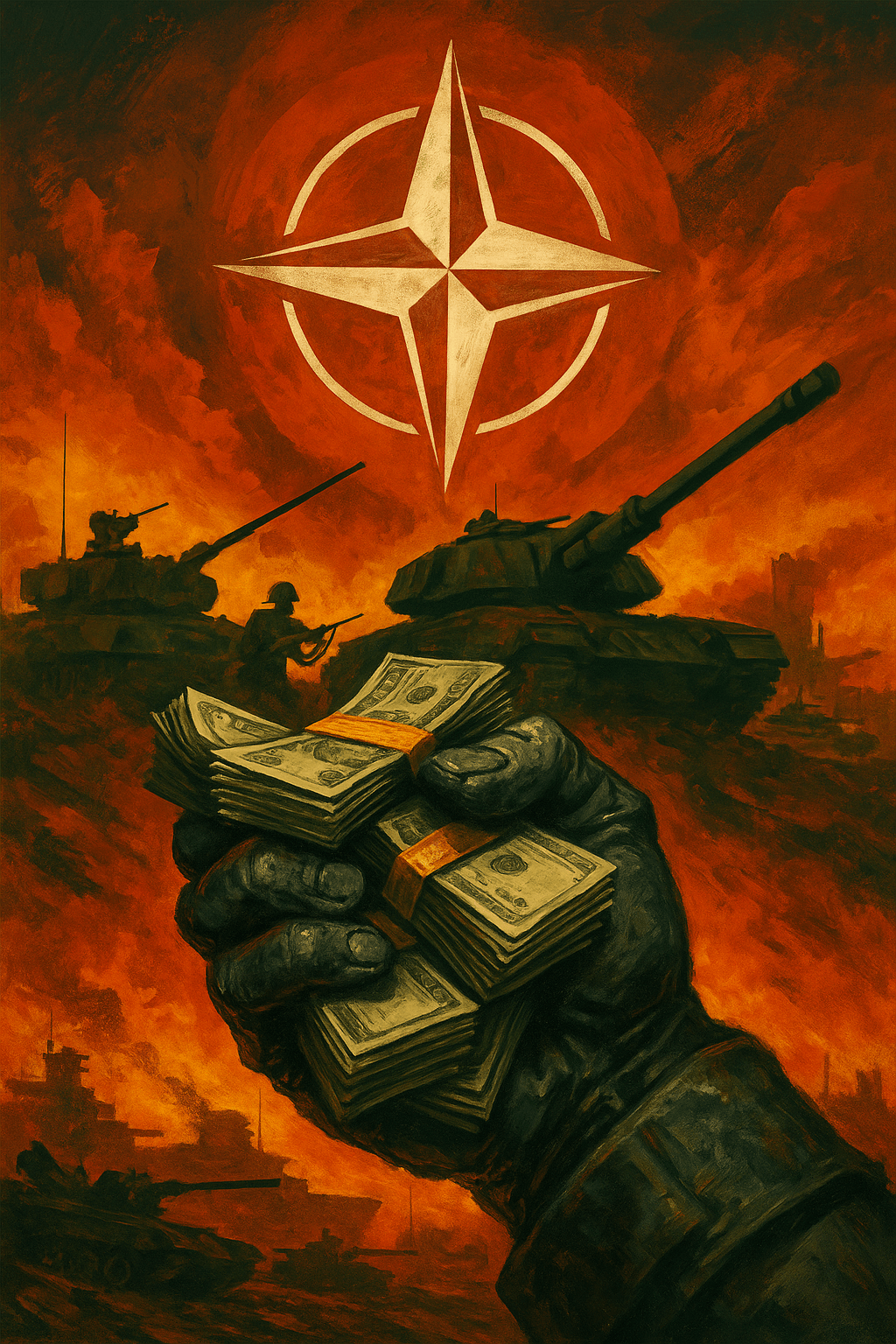
It’s not defense—it’s tribute. The U.S. empire demands 5% of every NATO member’s GDP for permanent war, digital militarism, and capitalist stabilization. This isn’t about security—it’s the fiscal logic of collapse.
By Prince Kapone | Weaponized Information
June 5, 2025
I. War by Default: Excavating the Media Script Behind NATO’s 5% Tribute
This CNBC article by Holly Ellyatt reads like a memo from NATO’s accounting department, not a piece of journalism. It reports that NATO countries are lining up behind a new plan to spend 5% of their GDP on “defense,” with U.S. Defense Secretary Pete Hegseth insisting the hike “will happen.” It’s written in the flat, sterile tone of managerial consensus—but make no mistake, this is not some boring budget story. This is about burying democracy under the weight of bombs and calling it security. This is the empire’s bill—and they want the people of Europe to pay it, whether they eat or not.
The author, Holly Ellyatt, isn’t some rogue voice. She’s a career stenographer for capital, writing for CNBC, one of the flagship mouthpieces of the transatlantic investor class. CNBC doesn’t speak for the people who drive buses or clean hospitals. It speaks for the people who move money and manufacture war. Its job is to normalize crisis for the rich and deliver orders to the rest of us dressed up as common sense. In this case, the order is: give up your pensions, your services, your children’s futures—because Raytheon needs a raise.
The article quotes all the usual suspects: Pete Hegseth, barking from Brussels like a corporate debt collector; Mark Rutte, NATO’s unelected foreman; German Chancellor Friedrich Merz; and Trump’s NATO ambassador Matthew Whitaker. These aren’t diplomats—they’re managers of militarized capitalism. They don’t speak in the language of life, but in spreadsheets and supply chains. Every sentence they utter has a price tag attached to it, and that price is always paid in someone else’s blood.
From the jump, the piece sets the tone: this is happening, whether you like it or not. There’s no debate. No room for public input. Just bureaucrats reporting back from a private meeting about how much more of your paycheck needs to go to guns instead of groceries. NATO wants 5%, and the message is clear—if you’re hungry, go ask the Pentagon for food.
What the article never admits is that this isn’t about Russia, or Ukraine, or even “defense.” This is about locking the people of Europe into a permanent war economy—where social services are gutted to fund an arms race nobody voted for. It doesn’t say that this 5% is going straight into the pockets of weapons contractors, intelligence firms, and digital surveillance companies. And it sure doesn’t say what gets cut to pay for all this. Spoiler: it’s not corporate tax breaks or stock buybacks.
And let’s deal with the Russia part, because the article doesn’t. The implication is that NATO’s only sin is being too slow to react to Moscow’s aggression. But this ignores everything. Russia is not an imperialist power. It doesn’t own the system. It’s not part of the club. Ever since the Soviet Union collapsed, the West has tried to reduce Russia to a subordinate gas station with nukes—good for extraction, bad for independence. And when Moscow refused to crawl, it got sanctioned, encircled, and threatened. The war in Ukraine is not a clash of equals—it’s the result of decades of NATO expansion, broken promises, and U.S. domination. Russia didn’t start the fire—it just refused to burn quietly.
And still, the article has the audacity to present this 5% target as though it’s being shared fairly. But look at where the money goes. The U.S. sets the standard, the U.S. sells the weapons, the U.S. runs the command structure—and its corporations walk away with the contracts. NATO members may all sign the checks, but Washington cashes them. That’s not burden-sharing. That’s tribute with better branding.
There’s not one word in the article about what 5% of GDP means for the people. It doesn’t mention the rising cost of living, the hospital closures, the collapsing infrastructure. It doesn’t mention how teachers are being laid off while drones are being upgraded. There’s no space for the working-class voice, no quote from a nurse in Naples or a rail worker in Berlin. Just cold numbers and warmongering platitudes. Because to these people, ordinary life is collateral damage.
But that’s how empire writes its story. It doesn’t shout—it whispers policy. It doesn’t force you—it budgets you. It doesn’t even try to justify itself anymore. It just tells you, “This is how it is.” And the media? They don’t ask why. They just make sure you don’t.
II. What 5% Buys—and What It Destroys: Unpacking the War Budget Beneath the Numbers
Let’s get down to brass tacks. What does this 5% of GDP actually mean? It means that in every NATO country—from Canada to Croatia—governments are being told to carve off an even bigger chunk of the public budget for war and surveillance. The article says this is for “defense,” for “resilience,” for “security infrastructure.” But those are just new words for old theft. Because what that 5% really buys is not safety—it buys tanks instead of transit. It buys F-35s instead of food. It buys border walls instead of housing. And it buys silence from every liberal who still thinks war is just a foreign policy.
According to the article, the U.S. wants 3.5% of GDP to go to what they call “pure defense” and another 1.5% for “defense enablers”—which means cyberwarfare, intelligence systems, and what they like to call “resilience infrastructure.” Translation: bombs and biometrics. It’s not just about missiles anymore—it’s about the cloud, the cables, the facial recognition at airports, and the predictive policing in your city. This is how NATO militarizes daily life. It’s not just an army—it’s an operating system.
The article never questions this. It acts like it’s all perfectly normal. It even gives a platform to think tank functionaries like the Foundation for Defense of Democracies, treating them like neutral experts instead of the paid lobbyists they are. These are the same people who never fought a war, but never met one they couldn’t monetize. And now they’re designing your future: less pay, fewer services, more surveillance—and a fresh military base in your backyard.
But here’s what the article doesn’t say. It doesn’t say what 5% means for a country like Spain, where youth unemployment is still double digits. It doesn’t say what it means in Italy, where hospitals in the south are collapsing. It doesn’t say what it means in Canada, where Indigenous communities don’t have clean drinking water. It just talks about “meeting targets” and “closing capability gaps”—as if that’s more important than keeping people alive.
Let’s be clear: this is not about defending Europe. This is about disciplining it. This is how the U.S. enforces loyalty—by setting budget mandates instead of treaties. If you don’t fall in line, there are consequences. Tariffs. Trade pressure. Diplomatic freezing. This is imperialism 2.0—less about boots, more about budgets. They don’t need to invade you when they already own your procurement process.
And let’s talk about where this spending really goes. The article makes it sound like the money’s staying local. But look deeper. The big defense contracts? They go to U.S. corporations. The tech platforms managing NATO communications? U.S.-based. The cloud infrastructure for “cyber defense”? Amazon Web Services. Even the training exercises are designed to funnel money back to American arms manufacturers. You might sign the check in Berlin or Ottawa—but Washington cashes it.
Meanwhile, NATO frames all this as “resilience.” But resilience for whom? Not for the single mother trying to find childcare while her local clinic is being shut down. Not for the refugee being tracked, scanned, and detained by NATO-funded border drones. Not for the working class who are told to tighten their belts while the defense budget bloats like a corpse in the sun. “Resilience” in NATO-speak means: we will survive—even if you don’t.
The article also avoids the question of how long this is supposed to last. Spoiler: forever. This isn’t a temporary measure—it’s the new normal. They’re not building a military for one war—they’re building an economy where war is the business model. It’s not a spending hike—it’s a restructuring. A turn away from the social contract and toward the security state.
But if you’re wondering where the resistance is—don’t worry. It’s coming. Across Europe, people are already waking up. Workers are striking. Students are mobilizing. Refugees are tearing down the walls they’re caged behind. Because the more money they pour into missiles, the more we remember that our real enemy doesn’t speak Russian or Mandarin. It speaks fluent finance, wears a suit in Brussels, and calls it freedom when you can’t afford rent.
III. The Fiscal Logic of Empire: From Permanent War to Military Keynesianism
NATO’s 5% GDP target isn’t just a military ambition—it’s a political-economic project. It’s the imperial core’s plan to stabilize a system in decline through permanent war financing. They call it deterrence. We call it Military Keynesianism. When the capitalist system can no longer generate stable growth through production, it turns to destruction. And in this case, war becomes the stimulus. The Pentagon becomes the planner. Raytheon becomes the jobs program. And your country becomes the collateral.
Let’s look at the bigger picture. The article frames this spending hike as a response to “security threats”—Russia, China, Iran. But none of these countries are invading NATO territory. What they threaten is something much deeper: the unipolar order itself. Russia didn’t start this war—it resisted being absorbed into the neoliberal West on colonial terms. China didn’t destabilize the world economy—it challenged dollar supremacy. The real threat isn’t tanks in Poland—it’s alternatives to U.S. hegemony. And NATO’s 5% is about making sure those alternatives don’t stand a chance.
This is what we mean when we say “hyper-imperialism.” It’s not just about expanding territory—it’s about enforcing a planetary budget logic. A logic that says: if you’re not spending your people’s money on war, you’re not a serious country. A logic that makes fiscal discipline synonymous with military obedience. A logic that punishes any deviation from the imperial script with sanctions, isolation, or regime change. And that’s the logic this 5% demand locks in.
And here’s the kicker: this isn’t just a U.S. export. It’s an internal restructuring of Europe. Germany, France, and the UK aren’t just responding to Washington—they’re using this moment to consolidate their own militarized political economies. German rearmament. French defense subsidies. EU-wide military research grants. This isn’t Atlanticism imposed from above—it’s Atlanticism as a shared strategy among collapsing capitalist cores. Fortress Europe is real. And NATO is its backbone.
What’s being rolled out here is a regional version of what the U.S. already perfected: a war economy that displaces social reproduction. Need housing? Build barracks. Need schools? Train cyber-soldiers. Need jobs? Manufacture drones. From Baltimore to Berlin, from Naples to Norfolk, the state is no longer a provider—it’s a predator. And NATO is the administrative body of that shift.
We’ve seen this before. Reagan used military spending to cover up deindustrialization. Clinton used NATO expansion to open new markets. Obama waged covert war while cutting welfare. Trump simply dropped the mask—and now he and Rubio have institutionalized it. This 5% is not an anomaly—it’s the continuation of empire by budgetary means.
And let’s not forget: these are not abstract numbers. A 5% GDP commitment will mean hundreds of billions in cuts from somewhere. Health systems will be cannibalized. Public transit stalled. Energy transitions delayed. And for what? So that military contractors can post quarterly profits. So that NATO can expand into Africa and the Indo-Pacific. So that the empire doesn’t have to die with dignity.
We call this imperialist recalibration. It’s not the end of empire—it’s its mutation. From direct colonialism to financialization to militarized austerity. NATO’s 5% is a budgetary gun held to the heads of its members. And like all imperial projects, it will fail. But not before it tries to take the world down with it.
IV. Burn the Ledger, Break the Alliance: Toward a Revolutionary Anti-Militarist Front
The 5% NATO tax isn’t just a policy proposal—it’s a theft in progress. Not just of public funds, but of possibility itself. It turns every national budget into a war chest, every worker into a financier of empire, and every crisis into a growth opportunity for defense contractors. They call it “security.” We call it what it is: militarized capitalism on life support. When they can’t build homes, they build tanks. When they can’t deliver healthcare, they deliver missiles. When their system begins to collapse, they don’t fix it—they declare war.
But let’s stop pretending this is about “defense.” NATO is not a shield—it’s a collection agency. It doesn’t protect its members; it extorts them. Its bullets are paid for with shuttered hospitals. Its fighter jets are funded by stolen pensions. Its bases sit on the ruins of burned-out public housing. NATO is empire in acronym form—and it demands payment in GDP.
So what do we do? First, we stand with the ones already in motion. From striking transport workers in France to peace coalitions in Germany and Italy, to mass anti-war marches in Spain—people are already resisting. These aren’t “issue movements” on the margins of society. They are the frontlines of class war in an age of militarized neoliberalism. Every rent strike, every labor stoppage, every street protest against austerity is a crack in the NATO consensus.
Second, we name the real infrastructure of war: the media outlets like CNBC that echo Pentagon talking points, the think tanks like CSIS and FDD that script foreign policy for weapons contractors, and the politicians who speak in the tongues of empire while kneeling at the altar of Raytheon. This is the ideological front. We counter it not just with fact-checking, but with historical clarity and revolutionary theory. This is guerrilla intellectual warfare—our words are weapons, our stories are shields.
Third, we intervene at the site of production. The defense industry is not abstract. It’s staffed by workers—engineers, coders, machinists, truck drivers—people with names and lives. If you work on that line, you are part of the war machine. But you don’t have to be. Refuse. Leak the documents. Jam the systems. Sabotage the silence. Organize your shop floor not for output—but for refusal. Our demand is simple and absolute: disarm the economy or there is no future to inherit.
Fourth, we act in solidarity with those who bear the brunt of NATO’s bombs. From Mali to Gaza, from Venezuela to Yemen—the enemy has always known the real frontlines. NATO doesn’t fight for peace, it fights to crush any government, movement, or people that dares to delink from empire. If you want to fight militarism in Brussels, you have to defend the right of resistance in the Sahel. This is one struggle. One system. One enemy. And one fight.
Finally, we organize for rupture—not reform. You cannot vote the war machine into retirement. It must be dismantled. Its generals must be discredited. Its budget must be seized and reallocated by the people. Its alliances must be broken and its ideology exposed as a colonial relic draped in liberal rhetoric. As Chairman Omali Yeshitela reminds us: we don’t want inclusion in a dying empire—we want power in a liberated world. That means dual power. That means organized, militant resistance from below. That means building the capacity to govern ourselves, not just protest the ones who rule us.
This is our moment—not to protest politely but to mobilize militantly. Not to slow the war machine but to bring it to a screeching halt. To stop paying the empire to bomb us in our sleep. To break the fiscal chokehold. To torch the ledger. And to collapse the command.
The 5% target is not destiny. It is a demand made by thieves. The war is not eternal. The empire is not invincible. But only if we organize like we mean it—to win.
From Brussels to Baltimore, from Berlin to Buenos Aires—disarm the empire, or be devoured by it.
 Weaponized Information
Leave a comment