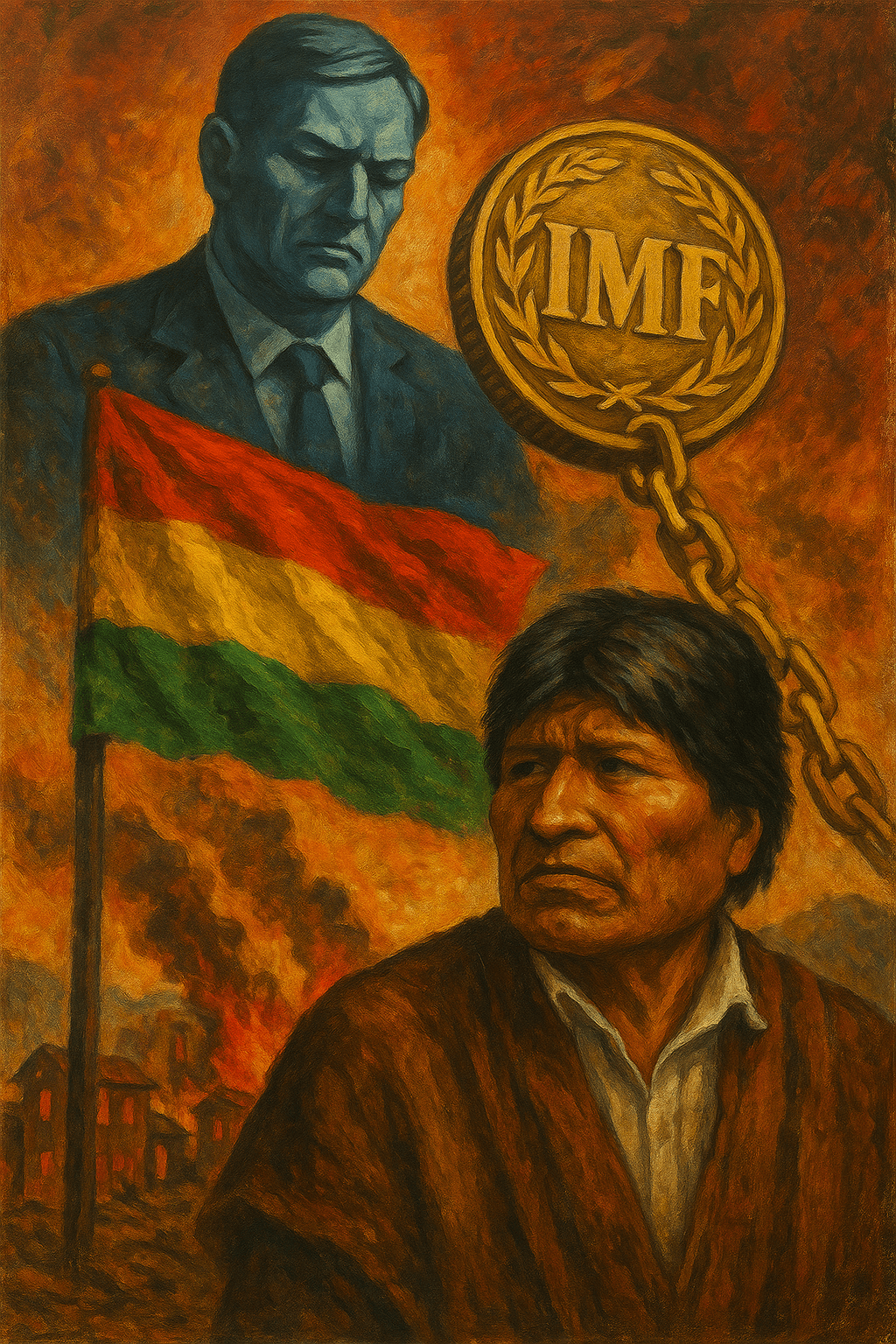
The post-coup technocracy is back—only now it speaks in the name of socialism
By Prince Kapone | Weaponized InformationMay 30, 2025 What masquerades as an “economic consultation” is, in truth, a re-colonization memorandum. The article under excavation—titled “IMF Wraps Up 2025 Article IV Talks With Bolivia”—was published by Mirage News, an Australian-based content aggregator that recycles press releases from Western institutions without editorial critique or analysis. It is not journalism—it is stenography for empire. The original document comes directly from the International Monetary Fund (IMF), the fiscal enforcement arm of Western hyper-imperialism. Its authors are unnamed IMF technocrats—career functionaries of finance capital whose academic pedigrees and institutional loyalty render them both unelected and unaccountable. Their job is not to understand Bolivia—it is to discipline it. These are the new viceroys: their offices may be in Washington, but their decrees reach into every Bolivian village, factory, school, and fuel station. This IMF dispatch was then amplified by the Bolivian Central Bank (BCB), the Ministry of Economy and Public Finance, and the Ministry of Planning—bodies which now function less like sovereign state institutions and more like transmission belts for foreign capital. At the helm is the Executive Board of the IMF itself—a collection of emissaries from the U.S. Treasury, European Central Bank, and Japan’s Finance Ministry—declaring what Bolivia must do, and what it must give up, to be considered “responsible.” The article’s framing is cold and technical—macroeconomic indicators, monetary policy frameworks, fiscal deficits. But the language is the knife. It doesn’t say “cut off fuel to Indigenous communities”; it says “phase out subsidies.” It doesn’t say “make the poor pay for a crisis they didn’t create”; it says “front-loaded fiscal consolidation.” It doesn’t say “break the currency peg and trigger hyperinflation”; it says “realign with market fundamentals.” This is the language of cognitive warfare—where imperialism doesn’t need soldiers, only spreadsheets. And beneath that spreadsheet is a ledger of betrayal. Because this economic program is not the ghost of the Áñez coup regime—it is the living policy of the Luis Arce government. A government that rode the backs of poor and Indigenous workers to power in 2020, promising the restoration of Morales-era sovereignty and redistribution, now finds itself executing the demands of the same institutions that greenlit the 2019 coup. The Arce administration did not inherit this program—it chose it. It presented itself as a steward of the Movement for Socialism (MAS), but governs like an accountant for the IMF. This is the contradiction at the heart of the Bolivian state today: the political movement that once expelled the IMF now carries out its orders. The government that rose from the ashes of a U.S.-backed coup now disciplines the Morales faction, silences its mass base, and steers the country back into the arms of global finance. And this article—sterile, quiet, apolitical on the surface—is the imperialist media apparatus doing its job: laundering recolonization as responsible policy. What the IMF wants, Arce delivers. But the people who marched, blocked roads, and defied bullets to restore a revolutionary process—they know the truth. And they are watching. Let’s start with the facts the IMF does give us. Bolivia’s real GDP growth has slowed to just 1.3% in 2024. Inflation is projected to hit 15.6% by the end of 2025. The fiscal deficit has breached 10% of GDP, while foreign reserves have sunk to a meager 2.1 months of import coverage. Fuel shortages are spreading, road blockades have intensified, and there’s a widening gap between the official and parallel exchange rates. Meanwhile, public debt has ballooned to over 95% of GDP. From the outside, it looks like a crisis of policy. But from the inside—from the point of view of the Bolivian working class—it is the fallout of a broken political project. This is not just a fiscal crisis—it is the long tail of a counterrevolution. The 2019 U.S.-backed coup that ousted Evo Morales set into motion a cascade of economic sabotage, institutional purging, and policy reversals. Under the Áñez regime, Bolivia’s economy was looted: public coffers raided, state companies gutted, foreign debt accelerated. Arce and the MAS returned to power in 2020 on the back of mass rebellion against this counterrevolution. But once in power, the Arce government made a fateful choice: to restore macroeconomic “credibility” not by confronting imperialism, but by appeasing it. That decision now haunts every statistic in the IMF report. The IMF claims Bolivia must cut subsidies to restore fiscal balance. What it doesn’t say is that fuel subsidies were the only mechanism keeping rural mobility and agricultural production afloat during a period of soaring global energy costs. It calls for exchange rate “realignment”—a euphemism for devaluation that would annihilate the purchasing power of urban workers and deepen inflation in a country already suffering from high import dependency. It demands the removal of interest rate ceilings, but says nothing of how this would inflate debt burdens on small farmers and cooperatives. And it praises the profitability of banks from foreign exchange trading, without mentioning that these profits come precisely from the collapse of the Boliviano’s stability. What’s missing in the IMF’s sterilized account is the class character of this crisis. The Bolivian economy is being squeezed from both sides: externally by hyper-imperial financial discipline, and internally by the contradictions of a government that wears the mask of socialism but governs through neoliberal austerity. The road blockades, fuel lines, and inflation protests aren’t just symptoms of economic mismanagement—they are signs of a political rupture. The state is losing its legitimacy not because it has failed to follow IMF instructions, but because it has. And here’s the deeper contradiction. The MAS was built as a vehicle of anti-imperialist sovereignty. Under Morales, Bolivia nationalized its hydrocarbon sector, expelled the IMF, and redistributed wealth on a scale rarely seen in Latin America. Poverty fell from 60% to 36% between 2005 and 2018. Indigenous communities that had been structurally excluded for centuries became the backbone of a new economic model rooted in state-led development, plurinational identity, and popular participation. Arce, as Morales’s finance minister, was an architect of that process. But today, as president, he is presiding over its erosion. The contradiction is sharp: the same man who helped build a sovereign economic model is now implementing its undoing. Arce’s decision not to seek re-election in 2025 was framed as a move to “preserve unity,” but in reality it reflects the deep fracture between the government and its revolutionary base. The Morales faction—blocked from running, targeted by lawfare, and isolated by the state apparatus—represents the unresolved tension between the MAS as a movement and the MAS as a party of governance. The IMF report makes clear which side Arce has chosen. But the data alone doesn’t explain why Bolivia is being forced down this road. The missing variable is imperialism. The U.S., through the IMF and its regional allies, has made Bolivia a target precisely because it dared to defy the rules of Western finance. Morales’s alliances with Venezuela, Cuba, Iran, and later BRICS+ were not symbolic—they were structural threats to dollar hegemony and resource control. Bolivia’s lithium reserves, nationalized under Morales, were the centerpiece of a model that could have created Indigenous-led industrial sovereignty. That model had to be destroyed. Arce’s government inherited that destruction—and instead of reversing it, chose to manage it. The IMF’s article is not a warning—it is a blueprint. It maps out the new economic order that Arce has agreed to enforce. And it warns: if Bolivia does not comply, it will face further isolation, scarcity, and destabilization. In this sense, the Article IV consultation is not a report. It is a coded threat. What remains unspoken in the report is that the real crisis is not just fiscal—it is a crisis of revolutionary continuity. And unless Bolivia’s popular forces reclaim the project that brought them to power, the IMF will not just write the reports. It will write the future. What the IMF sees as policy, we recognize as warfare. Behind every recommendation in that Article IV report lies a class interest, a colonial motive, and a strategic calculation. The imperialist mind dresses up recolonization in the language of “structural reform.” But what’s really at stake is the survival of Bolivia’s sovereign project—one built not by technocrats in Washington, but by Indigenous peasants, street vendors, miners, and teachers who put their bodies on the line to overthrow neoliberalism and reclaim their nation. The struggle in Bolivia is not about GDP growth or fiscal balance sheets. It’s about who decides. The working class and peasantry of Bolivia once made that decision in the streets and ballot boxes alike: they chose sovereignty, nationalization, redistribution, and plurinational identity. They chose Evo Morales not because he was a messiah, but because he represented their own power—expressed through the Movement for Socialism, forged in mass resistance, and encoded in a constitution that recognized the Indigenous majority as the foundation of the state. But that power has been usurped—not just by imperialist institutions, but by their allies within the Bolivian state itself. Arce’s government claims continuity with the Morales era, but functions as its undoing. The IMF blueprint is not being imposed from outside alone—it is being carried out from within. What we’re witnessing is a textbook case of imperialist recalibration: the overt coup of 2019 failed to break the Bolivian revolution, so now comes the slow coup—driven by balance sheets, legalistic suppression, and political fragmentation. Let’s call it by its real name: this is not just economic policy. This is lawfare against Evo Morales. It is counterinsurgency against the Indigenous proletariat. It is neocolonial extraction disguised as “market realignment.” And it is being orchestrated through the political shell of a once-revolutionary party, hollowed out by technocrats and neutralized by fear of confrontation. MAS, once a movement that stood toe-to-toe with empire, has become a divided house—one side fighting for the restoration of revolutionary principles, the other clinging to power by appeasing the IMF. Arce’s refusal to seek re-election is not an act of humility—it is a signal of crisis. His faction cannot face the base it once represented. The Morales wing, blocked from candidacy and criminalized by judicial maneuvering, is the victim of a quiet purge. The prohibition of Evo from the 2025 ballot—on the grounds of constitutional term limits—conveniently ignores that the coup regime was never legal, that Morales’s exile was forced, and that his base remains undefeated in spirit. The electoral system has become a tool to erase the revolutionary memory of 2006–2019. But the people haven’t forgotten. They remember the Gas Wars, when mass blockades paralyzed the country to prevent the giveaway of Bolivia’s natural gas to U.S. multinationals. They remember the Water Wars, when Cochabamba rose up against the privatization of water by Bechtel. They remember the Indigenous marchers from the TIPNIS who walked for weeks to defend their territory. And they remember the October rebellion of 2020, when the people overturned a coup regime not through courts or IMF consultations, but through roadblocks, mass mobilization, and disciplined popular power. This is the real terrain of struggle—not the halls of the IMF, but the streets of El Alto. And it is here that Bolivia’s future will be decided. Not by technocrats, not by electoral lawyers, and certainly not by foreign creditors—but by the capacity of the masses to reclaim the MAS from above and rebuild the revolutionary project from below. That means reasserting anti-imperialist sovereignty: breaking with the IMF, re-nationalizing critical sectors, enforcing capital controls, and asserting the dignity of Bolivia’s laboring classes against the full weight of financial piracy. It means returning to dual and contending power—where popular organizations reclaim the authority to dictate the direction of the state, not the other way around. And it means forging deeper integration with multipolar alliances—BRICS+, ALBA, and other formations that resist dollar dependency and carve space for sovereign development. Bolivia is not a “failing economy.” It is a battlefield. And what is being fought over is not just fuel subsidies or currency pegs—it is the soul of the Plurinational State. Will it be governed by the masses who birthed it? Or by the technocrats who are now burying it in spreadsheets and promises to creditors? The answer will not be found in an IMF forecast. It will be found in the streets, in the unions, in the ayllus, in the syndicates, and in the collective memory of a people who have already made revolution once—and who may soon have to do it again. Comrades in the imperial core—this is your fight too. The IMF doesn’t operate in a vacuum. It operates with your tax dollars, through your banks, your governments, and your silence. Bolivia’s struggle is not a distant crisis—it is the frontline of the same system that exploits, surveils, and disciplines workers and colonized people across the globe. The same class that chokes Bolivia’s economy with conditional loans is foreclosing your homes, privatizing your water, and criminalizing your labor. The task before us is not charity. It is revolutionary duty. First, we must expose and disrupt the institutions of hyper-imperialism in our own backyards. That means organizing direct actions, occupations, and shutdowns at IMF offices, World Bank branches, U.S. Treasury subsidiaries, and private equity firms that bankroll economic strangulation. Institutions like Citibank, JP Morgan, and BlackRock are not just abstract entities—they are war machines in suits. Protest them, name them, interrupt their events, and flood their public spaces with the names of the Bolivian communities they’re destroying. Second, we must launch targeted counter-propaganda campaigns across all major platforms. This includes writing public letters, running teach-ins, disrupting speaking tours, and producing media content that unearths the role of the IMF in recolonizing the Global South. Bolivia should not be a sidebar in your anti-capitalist analysis—it must be front and center. We must bury the liberal illusion that the IMF is a neutral actor, and expose it for what it is: the financial wing of U.S. empire. Third, we must build and fund material solidarity infrastructure. That means organizing fundraisers to support Bolivian workers’ unions, Indigenous media collectives, and peasant cooperatives resisting neoliberal policy. Help them establish independent digital infrastructure, secure communication platforms, and mutual aid systems to resist the economic siege. Connect with grassroots organizations on the ground—not NGOs, not party functionaries, but the syndicates, federations, and territorial assemblies who hold the line. Fourth, we must develop legal defense and international monitoring networks to protect Bolivian revolutionaries from persecution. Morales’s exclusion from the ballot is only the beginning. Lawfare will intensify. Repression will escalate. Build rapid response teams to document abuses, amplify testimonies, and challenge the legal scaffolding of the recolonization project in international courts, press outlets, and digital channels. Fifth, we must commit to building anti-imperialist ideological unity. That means integrating the Bolivian contradiction into our political education work, into our cadres’ training, and into our broader worldview. It means rejecting social chauvinism, anti-Indigenous erasure, and leftist economism that pretends Bolivia’s fight is just another “Latin American issue.” It’s not. It’s a mirror of your own future under imperialist decay and technofascist stabilization. Sixth—and this is essential—we must break the isolation of anti-imperialist states. That means defending Bolivia’s right to rejoin and deepen its participation in multipolar blocs like BRICS+, ALBA, and CELAC. It means supporting energy sovereignty, food sovereignty, and the right to nationalize strategic resources. It means fighting to dismantle the U.S. sanctions architecture, the dollar stranglehold, and the colonial terms of trade. Finally, we must fight to de-IMF our own countries. The United States, the EU, Canada, and Australia are not just backers of the IMF—they are its incubators. The working class here must not just be in solidarity with Bolivia. We must help burn down the house of the master from the inside. That means targeting the policies and parties that uphold IMF rule—left, center, or right. That means building revolutionary opposition rooted in decolonization, socialism, and internationalism. Weaponized Information will continue to expose, excavate, and reframe the propaganda of empire. But solidarity must go beyond the page. Take action. Build networks. Forge alliances. Coordinate struggle. Let Bolivia know: they are not alone. ¡Abajo el FMI!
The IMF’s New Viceroys in La Paz
Behind the Numbers: What the IMF Didn’t Say About Bolivia’s Crisis
From Fiscal Discipline to Revolutionary Betrayal: Reframing Bolivia’s Economic Crisis
Imperialism Starts at Home: What the Global North Must Do for Bolivia
¡Solidaridad con el pueblo boliviano!
¡El internacionalismo proletario es nuestra arma más poderosa!
 Weaponized Information
Leave a comment