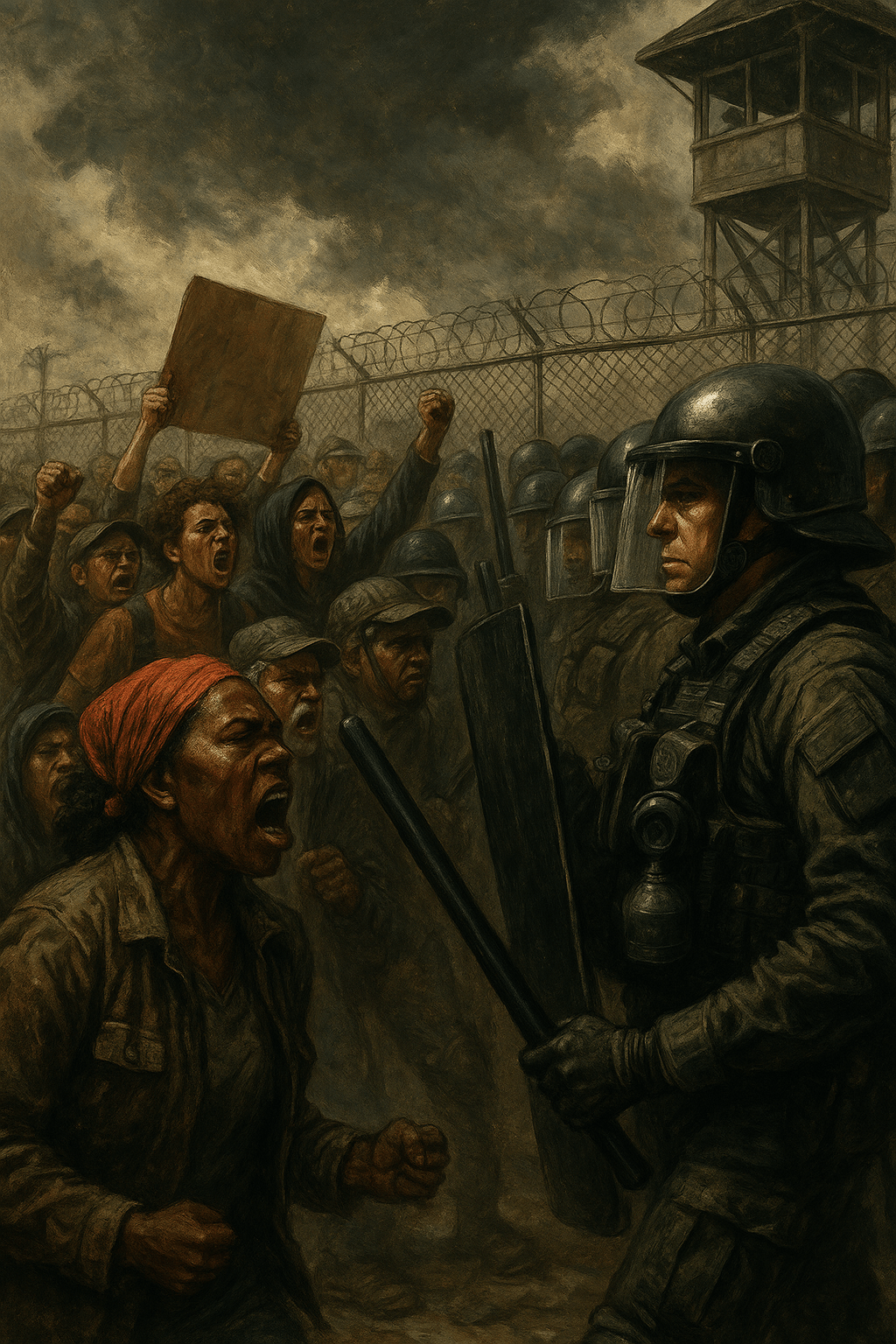
The Supreme Court temporarily stalled Trump’s deportation plan, but this isn’t democracy in action—it’s a pause in a war against migrants and workers. MSNBC calls it constitutional conflict. We call it settler-colonial theater.
By Prince Kapone | Weaponized Information
May 16, 2025
I. MSNBC’s Legal Theater: The Empire Negotiates Its Own Repression
Lisa Rubin, MSNBC’s legal correspondent and former litigator, occupies a very specific role: translating the empire’s internal contradictions into digestible liberal narratives. MSNBC, an ideological apparatus owned by Comcast-NBCUniversal, frames judicial confrontations as tense dramas, spotlighting institutional friction without challenging systemic violence. Rubin herself is not malicious; she is disciplined. Her role is to manage outrage and redirect anger into procedural illusions—convincing us that democracy still breathes when it merely gasps.
Consider Rubin’s reporting of Trump’s latest deportation scheme. She describes Solicitor General D. John Sauer’s open admission that the Trump administration only “generally” follows lower court rulings as a “troubling sign” of executive overreach. But Rubin avoids naming the victims of Trump’s policy or exploring its deeper implications for labor. Her reporting is meticulous, technical, yet systematically stripped of human consequences. Sauer’s words are quoted carefully, but the migrants whose lives hang in the balance are nowhere to be found. In Rubin’s narrative, deportation becomes a debate about procedure rather than a weapon of racialized class warfare.
MSNBC’s strategy isn’t outright deception—it’s careful omission. By focusing narrowly on judicial dynamics between Supreme Court Justice Amy Coney Barrett and Solicitor General Sauer, Rubin obscures the structural function of the courts themselves. Barrett’s mild questioning of Sauer is portrayed as principled resistance. But Barrett, a Trump appointee herself, is merely negotiating the pace and scope of repression, not challenging it fundamentally. MSNBC’s coverage never questions the court’s historical role in sanctioning slavery, upholding segregation, legitimizing mass incarceration, or facilitating imperial wars. Instead, it portrays Trump’s deportation drive as unprecedented, implying that empire typically respects human rights and law—historically false and politically dangerous.
Rubin’s exact words matter here. She carefully notes Barrett confronting Sauer: “I’m talking about this week, the Second Circuit holds that the executive order is unconstitutional, and then what do you do the next day or the next week?” Sauer responds that the administration only “generally” respects lower courts. Rubin calls this shocking, unprecedented. But such executive defiance has historical precedent—Bush’s post-9/11 disregard for habeas corpus rulings, Obama’s selective compliance with injunctions against drone warfare. Rubin’s shock is either historically naïve or deliberately performative. Either way, it feeds the dangerous liberal illusion that Trump’s regime is a deviation, rather than an escalation within a continuous imperial trajectory.
Rubin and MSNBC do occasionally spotlight voices critical of ICE and Trump’s immigration policies—figures like Alexandria Ocasio-Cortez or Bernie Sanders—but only within strictly policed ideological boundaries. Radical critiques naming capitalism, colonialism, or imperialism are systematically excluded. The function of MSNBC isn’t to suppress dissent entirely, but to manage it, channeling popular rage into acceptable reformist avenues. Thus, Rubin never quotes grassroots migrant organizations, community organizers, or radical labor groups actively resisting deportations—voices MSNBC deems too dangerous, too transformative.
Let’s not be confused: the empire isn’t experiencing a crisis of democracy—it’s negotiating its own methods of repression. MSNBC’s role isn’t truth-telling; it’s ideological crowd-control, presenting constitutional procedure as if it’s resistance. But empire isn’t restrained by legal nuance—it’s disciplined by collective struggle. To see clearly through Rubin’s careful narratives, we must reject media-driven illusions, recognizing that the courts have always managed the scope and speed of empire’s violence, never fundamentally opposing it.
Our task isn’t simply to critique media complicity, but to expose its mechanisms, name its omissions, and sharpen our revolutionary analysis. Empire’s contradictions cannot be resolved by liberal institutions, only by revolutionary consciousness rooted in historical clarity and sustained organizing.
II. From Border Crisis to Class Warfare: Trump’s Deportation Doctrine Unmasked
Let’s strip away MSNBC’s liberal handwringing and face the facts squarely. Trump’s regime has invoked a Cold War-era “wartime authority” from the 1950s, openly signaling its intent to mass-deport migrants without judicial oversight. Solicitor General Sauer’s brazen admission—stating the administration “generally” respects court rulings—reveals not an anomaly, but the normal functioning of imperial statecraft. Sauer isn’t going rogue; he’s articulating the logic of empire clearly: laws exist to discipline the population, not to constrain ruling-class power. MSNBC’s astonishment at such executive defiance ignores decades of similar maneuvers by presidents, Democrat and Republican alike. There is nothing novel here, only the clarity of an empire dropping its mask.
But let’s dig deeper, beyond the spectacle of courtroom drama. Trump’s deportation push isn’t primarily about immigration or even race, though it weaponizes both. At its core, this policy is about class. It’s about reorganizing and recalibrating labor within a declining empire—what we precisely call technofascist labor recalibration. By deporting undocumented workers, Trump isn’t trying to eliminate cheap labor entirely; he’s purging the sector of the working class that operates somewhat independently, outside direct control. These are workers in agriculture, construction, hospitality—industries dependent on undocumented labor, where informal organization and grassroots resistance often flourish. Removing these workers sends a message: organize, resist, or challenge authority, and the state will crush you. Deportation is discipline, a lesson delivered not just to migrants, but to every working person watching from the sidelines.
Meanwhile, Trump expands legal migrant-labor schemes—guest-worker visas, H-2A and H-2B programs—precisely because they produce hyper-exploitable labor pools. Workers on these visas are utterly disposable, unable to organize without risking immediate deportation. Surveillance technology—biometric tracking, mandatory e-verify, digital workplace monitoring—becomes the new overseer’s whip, transforming workplaces into digital plantations. These migrants aren’t being removed—they’re being digitally chained, rendered docile and controlled. Trump’s model isn’t less migrant labor; it’s migrant labor stripped of autonomy, rights, and humanity.
Most crucially, the regime’s long-term strategy doesn’t stop at migrants. It intends to impose these hyper-exploitative conditions universally—to restructure all U.S. labor markets along the lines familiar in maquiladoras, sweatshops, and plantations across the Global South. Why? Because global capitalism’s profits are shrinking, and imperial privilege can no longer be sustained at home. Even white settler workers—historically shielded from extreme exploitation—now face precarious work, collapsing wages, vanishing benefits, and intensified workplace surveillance. Trump’s technofascist recalibration aims to bring first-world labor conditions down to the third-world standard, turning every worker into a disposable migrant laborer, documented or not.
This is not theoretical conjecture; it is observable reality. Look at Amazon warehouses, Uber gig workers, delivery drivers—labor stripped of stability, regulated by algorithms, denied unions, controlled digitally. This isn’t accidental; it’s the deliberate reshaping of labor into flexible, frightened, fragmented units. Trump’s deportation regime extends that model, sending a stark message: resist, and you’ll face violence, deportation, and starvation. Accept it, and you’ll face exploitation, humiliation, and economic servitude.
Let’s be clear: MSNBC and Rubin’s reporting focus on judicial procedure precisely to obscure this larger strategy. They present the Trump administration’s defiance as shocking constitutional rupture, not as a logical escalation within the long trajectory of American empire. Courts historically legitimize oppression as often as they limit it—sometimes slowing repression, sometimes accelerating it, but never fundamentally opposing it. Rubin’s confusion (real or feigned) over Trump’s actions masks this uncomfortable historical fact.
We, however, refuse to be confused. Trump’s deportation policy isn’t about legality, national security, or border control—it’s about maintaining capitalist power by recalibrating labor through violence. Empire isn’t malfunctioning; it’s functioning exactly as intended. Our task is to name this reality clearly, expose its mechanisms, and unite the working class in revolutionary solidarity. Understanding this truth isn’t just theoretical clarity—it’s strategic preparation for resistance.
III. Borders Are Weapons: Reframing Trump’s Deportation as Class Counterinsurgency
Let’s stop pretending this is a debate about immigration policy. Trump’s invocation of Cold War-era wartime powers for mass deportation is neither an aberration nor a constitutional crisis. It is an imperial strategy, plain and simple. What MSNBC and liberal pundits frame as “constitutional overreach” is, in fact, settler-colonial pacification disguised in nationalist clothing. Borders, like prisons and police, aren’t there to ensure public safety—they’re weapons used to control labor, discipline populations, and fragment solidarity.
Trump’s regime weaponizes deportation as domestic counterinsurgency. By targeting undocumented workers—those least protected by law yet most vital to entire industries—Trump’s policy doesn’t aim to eradicate migrant labor altogether; instead, it seeks to reshape the working class through intimidation, violence, and digital surveillance. This is the essence of technofascist labor recalibration: the restructuring of labor markets through state terror and legal coercion to drive wages down, break union power, and eliminate resistance.
The liberal media, MSNBC chief among them, obsesses over courtroom theatrics, presenting minor judicial delays as profound institutional resistance. Justice Barrett’s mild interrogation of Solicitor General Sauer is depicted as courageous constitutional defense. But the courts have historically operated precisely to legitimize empire, occasionally tempering its violence, but never fundamentally challenging it. Remember, it was the courts that codified slavery, upheld Jim Crow, rubber-stamped endless imperial wars, and continue today to approve mass incarceration and surveillance. Expecting the Supreme Court to save us from Trump’s deportations is like expecting your landlord to abolish rent: foolish optimism at best, political malpractice at worst.
Trump’s goal isn’t mere xenophobia—though racism fuels his rhetoric. His true ambition is structural: purging undocumented workers to send a message, imposing hyper-exploitative conditions on legal migrants through guest-worker programs, and finally extending these conditions to the entire American workforce. From Uber drivers in Los Angeles to Amazon warehouse workers in Alabama, precarious employment—stripped of unions, dignity, and stability—is the future Trump’s regime desires. Deportation is not just about removing migrants; it’s about imposing new discipline on all labor. It’s class war masquerading as border policy.
And let’s be blunt: Trump is not deviating from the historical path of U.S. empire—he’s refining it. Clinton’s 1996 immigration “reforms,” Bush’s ICE creation post-9/11, Obama’s record deportations—all paved the road Trump now walks. Each administration calibrated repression differently, but all maintained empire’s fundamental logic: racialized labor exploitation, corporate profit extraction, and domestic repression justified by manufactured border crises. MSNBC’s liberal narrative insists on portraying Trump’s regime as uniquely dangerous, thus obscuring the continuity of imperial policy across party lines.
We must reframe this clearly and sharply: Trump’s deportation plan is neither accidental nor unique—it’s the logical outcome of an empire in decline, desperately recalibrating its labor markets through state violence. The ruling class understands precisely what it’s doing. It is our duty, then, to discard liberal illusions about courts and constitutions, clearly name the enemy’s strategy, and unify the fragmented segments of our class into one revolutionary movement. Solidarity isn’t charity—it’s survival. Borders aren’t natural—they’re battle lines. The choice before us isn’t between judicial intervention and executive overreach; it’s between imperial pacification and revolutionary resistance.
We choose resistance.
IV. No Human is Illegal, No Empire is Eternal: Toward Revolutionary Solidarity Beyond Borders
Enough illusions. The Supreme Court’s temporary pause on Trump’s deportation drive isn’t victory—it’s breathing room. Empire does not relent willingly; it recalibrates, adjusts its methods, and continues its assault. Our clarity on this point isn’t cynicism; it’s revolutionary realism. The courts may hesitate briefly, but they have never fundamentally opposed settler-colonial violence or capitalist exploitation. If liberation could be found within the empire’s legal chambers, we’d have found it long ago.
Our strength lies not in courts but in solidarity. Migrants aren’t passive victims—they’re frontline warriors in a struggle against imperialism. When we defend migrants, we defend our class, our communities, and ultimately ourselves. ICE raids, detention centers, biometric tracking—these are not isolated threats; they’re interconnected methods of class warfare. Solidarity isn’t charity or sympathy; it’s strategic necessity. If empire’s attacks are unified, our resistance must be even more so.
Practically, solidarity means building and expanding our own institutions—what revolutionaries call dual and contending power—outside the reach of the imperial state. Sanctuary networks, mutual-aid societies, tenant unions, workplace defense committees, and grassroots legal organizations aren’t just short-term solutions; they’re the embryo of a revolutionary alternative. When we shelter migrants from ICE, defend workers from wage theft, or resist evictions collectively, we demonstrate concretely that working-class power can exist beyond capitalist exploitation.
But solidarity also means direct confrontation with the infrastructures enabling deportation. Palantir, Amazon, CoreCivic, GEO Group—these corporations profit directly from migrant suffering. They should be named, exposed, disrupted, and targeted through coordinated direct actions, boycotts, and community pressure campaigns. Disrupting their operations isn’t symbolic protest; it’s strategic intervention against the financial and technological pillars of technofascist labor recalibration.
Revolutionary education is equally essential. Empire rules not just through force but through manufactured ignorance. Workshops, teach-ins, community meetings—these must illuminate how immigration policies reinforce capitalist exploitation, how borders serve as mechanisms of labor discipline, and how colonial logic continues to structure every workplace and community today. Clarity isn’t a luxury; it’s a weapon. Political consciousness is ammunition against ruling-class propaganda.
Finally, our struggle transcends national borders. Trump’s attacks on migrants in the U.S. mirror imperialist assaults abroad—from Haiti to Palestine, from Chiapas to the Philippines. Our enemies are coordinated across continents, and our resistance must be just as global. Internationalist solidarity isn’t abstract; it’s rooted in shared experiences of oppression and exploitation. Empire has globalized precarity; we must globalize solidarity. Every victory in Gaza strengthens organizing in Baltimore; every triumph in Chiapas resonates in Detroit.
Let’s be clear: our task isn’t reforming empire—it’s dismantling it. Solidarity is our path; collective resistance our method; revolutionary unity our strength. The Supreme Court may slow Trump’s deportations briefly, but true liberation lies beyond its halls, in organized communities, united workplaces, and cross-border solidarity. Empire wants isolated individuals, fragmented workers, fearful migrants. We answer with revolutionary unity, unbreakable solidarity, and the determination to dismantle empire, not manage it.
No human is illegal. No empire is eternal. Our revolutionary task is to make both these truths into realities.
 Weaponized Information
Leave a comment