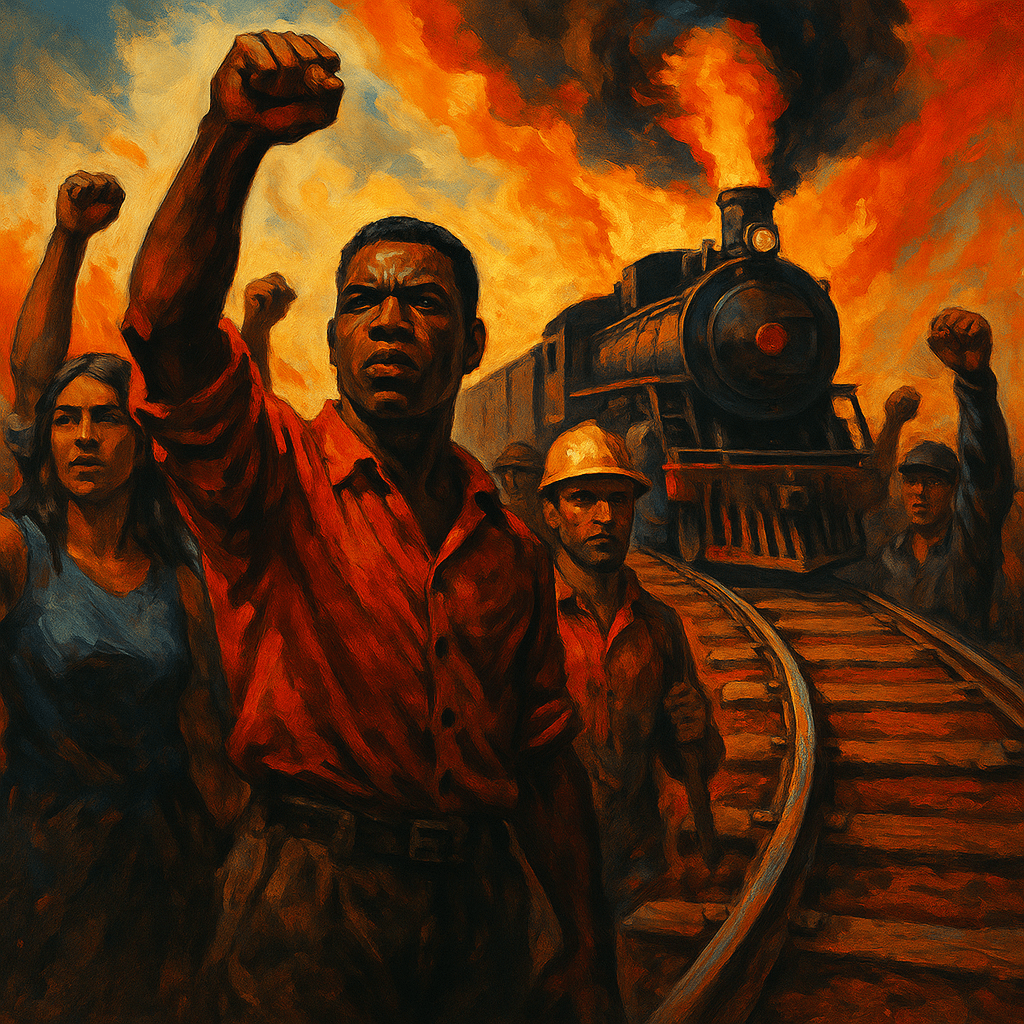
Washington builds warships. Beijing builds railroads. This isn’t just infrastructure—it’s a logistical insurgency against imperial maritime control. The empire sees the tracks. And it smells defeat.
By Prince Kapone | Weaponized Information | May 10, 2025
When the Empire Can’t Ignore You: China’s Railway and the Media’s Panic Mode
When the Bioceanic Corridor broke ground in South America, Western media responded with silence. But when China joined Brazil in talks to construct a 3,000-kilometer transcontinental railway from the Atlantic to the Pacific, the reaction changed—from erasure to panic. Outlets like Reuters and The Financial Times ran instant dispatches. The framing? “Debt trap diplomacy,” “strategic risk,” “China encroaches.” Same continent. Different financier. Very different tone.
The author of the Reuters piece is not worth individual dissection. They are a conduit—well-trained, discreet, and reliable. Their role is not to lie outright, but to frame Chinese-backed infrastructure as a geopolitical hazard, while treating U.S.-funded projects (when they exist) as routine development. There’s no mention of U.S. control over Latin American ports, no reference to decades of coup-backed privatization, no discussion of the Panama Canal’s chokepoint status. Just subtle alarm: China is building things again, and the backyard is slipping.
The outlet itself—Reuters—is less a news agency than a strategic node in the imperialist media apparatus. With historical ties to British intelligence and contemporary partnerships with NATO-aligned think tanks, it functions as a communications backbone for capital in crisis. Its coverage of infrastructure, particularly Chinese-funded infrastructure, follows a predictable script: spotlight “rising debt,” highlight “lack of transparency,” and quote “Western analysts” warning of sovereignty erosion. What’s never interrogated is the structural sovereignty already erased by IMF dictates, World Bank mandates, and Washington’s Monroe Doctrine.
And who echoes the alarm? Enter names without labels: General Laura Richardson of SOUTHCOM, whose congressional testimony explicitly warned of “China’s creeping control of Latin America’s logistics grid”; Bloomberg Economics, which called the railway a “Trojan Horse for Pacific access”; and the Atlantic Council, which has long lobbied for counter-infrastructure policy to “protect hemispheric alignment.” These aren’t analysts. They’re managers of unipolar logistics—defenders of the arterial system that feeds empire.
But the real propaganda isn’t just in what they say—it’s in how they say it. The language is managerial: “strategic corridors,” “supply chain influence,” “connectivity risk.” It’s not overt Sinophobia—it’s cognitive warfare, laundering paranoia through policy jargon. The railway is never framed as a sovereign decision made by Brazil and Peru. It’s depicted as infiltration. The South is not acting—it is being acted upon. The subjects are erased; only the threat remains.
And yet, buried in this enemy narrative are the very details we need. The railway will run from Brazil’s soy heartland through the Andes and terminate on Peru’s Pacific coast—bypassing both the Panama Canal and U.S.-controlled Atlantic shipping lanes. It’s not just a logistics project. It’s a rupture in hemispheric dependency. And Reuters knows it. That’s why they wrote the piece.
The empire didn’t react this way when Chile and Paraguay broke ground on the Bioceanic Corridor. It barely noticed. But when China steps in with capital, rail steel, and long-term transport vision, Washington scrambles the alarm. Because this isn’t just about exports. It’s about logistical sovereignty. About losing command over the arteries of global trade that kept the South subordinated. It’s about the threat of a rail line that doesn’t end in Wall Street.
So yes comrades, the propaganda here is more active than silent. But that only confirms what we already know: the steel is real, and empire smells smoke.
Steel Tracks Through the Monroe Doctrine: From the Andes to the Pacific
The proposed China-Brazil-Peru railway isn’t just a construction project—it’s a direct assault on the logistics architecture that sustains U.S. dominance in the Western Hemisphere. The route would run from Brazil’s agricultural interior—Mato Grosso and Rondônia—across Bolivia or through the Andes in Peru, terminating at Pacific ports like Ilo or Callao. If completed, it would create a high-speed, transcontinental corridor linking the Atlantic and Pacific without a single U.S.-controlled port, naval base, or shipping lane. That’s not infrastructure. That’s geopolitical exorcism.
The U.S. has never tolerated autonomous trade routes in Latin America. From the seizure of Panama from Colombia in 1903 to the decades of port privatizations under structural adjustment, the empire has always pursued logistics as domination. The Panama Canal, the U.S. Southern Command’s control of chokepoints, the neoliberalization of port labor—these were not random moves. They were designed to ensure that nothing leaves the continent, or arrives, without imperial permission. That’s what made the Monroe Doctrine more than a doctrine—it made it an operating system.
In this context, a Chinese-financed railway is a rupture. Not just because it shifts trade patterns, but because it displaces imperial command. It challenges the long-standing dependency on East Coast ports, on U.S.-flagged shipping lines, and on Atlantic maritime insurance systems rooted in London and New York. It also threatens the secondary architecture: dollar-based trade settlements, U.S.-controlled customs platforms, and logistics software tied to Western surveillance contracts. In short, the railway puts a crack in the colonial supply chain.
What’s more, it complements other multipolar infrastructure: Brazil’s collaboration with Argentina on electrical grid integration; Bolivia and China’s joint lithium processing deals; Venezuela’s port development with Iran and Turkey; and China’s deepening presence in Chilean copper transport. These aren’t isolated moves—they are the gradual reconfiguration of hemispheric flow around non-Western anchors. The belt of empire is being loosened. And Washington feels it.
That’s why U.S. officials and analysts frame the project as “risky” or “opaque.” Not because they care about transparency—but because they fear irrelevance. A logistics corridor that bypasses Wall Street’s financiers, Washington’s trade envoys, and NATO’s security doctrine is not just an economic problem. It’s an ideological insult. It says: we don’t need you anymore. We can move grain, copper, and electronics without sending a dime through your ports, a request through your embassies, or a bribe through your contractors.
The irony, of course, is that the U.S. had every opportunity to build this corridor decades ago. It had the capital, the regional alliances, and the influence. But it never did. Because it didn’t want to. The goal was never South American integration—it was fragmentation. Every railway killed, every port privatized, every canal sabotaged was part of a deliberate strategy: keep the continent divided, its logistics disjointed, and its sovereignty sold off in pieces. Now that China is offering steel where the U.S. offered shackles, the crisis is not technical. It is existential.
And the deeper truth? Even China’s involvement is not the determining factor. The real shift is that Latin American states—especially Brazil—are beginning to see logistics not just as infrastructure, but as power. Lula’s government, while still mired in contradictions, understands what the Pentagon already knows: a nation that cannot move its goods without imperial permission is not sovereign. That’s why the railway matters—not because it guarantees liberation, but because it opens the door to it.
The U.S. once ruled the hemisphere with shipping lanes, coups, and IMF infrastructure loans. Now, with its hands full in Ukraine, Gaza, and the Taiwan Strait, it cannot close every breach. And each mile of steel laid between Brazil and Peru is another sign that the breach is becoming a corridor. Not of commerce alone—but of history breaking through.
Infrastructure as Insurgency: Rails Against the Empire
The Atlantic powers call it a railway. We call it a breach in the empire’s logistical skin. For centuries, infrastructure in Latin America has been designed to extract, not to connect. From colonial ports shipping gold to Lisbon, to Cold War highways that brought tanks to resistance zones, to the privatized ports of neoliberalism, logistics was never neutral—it was a weapon. The China-Brazil railway signals something different: a transport corridor not engineered by empire, but in spite of it. That alone makes it dangerous.
In the hands of the colonizer, a railroad is a tether. In the hands of the people, it can be a weapon. This project is not revolutionary in design—it still facilitates commodity flow and export dependency—but it opens the door to what we call anti-imperialist sovereignty: the material ability to break with U.S. control over trade, infrastructure, and circulation. It creates the possibility for coordinated South-South planning. For multipolar resilience. For logistics that serve the periphery, not police it.
The ruling class understands logistics better than most radicals. They know control over movement—of people, goods, energy, information—is control over power. That’s why they react so viscerally to this railway. Because it doesn’t just transport commodities—it transports the threat of a world they can’t govern. A world where South American steel is laid without World Bank terms. Where Andean mountains are pierced by trains not controlled by IMF strings. A world where ports connect to other continents—not to Washington, but to Beijing, Tehran, and Johannesburg.
We are not romanticizing China’s role. China is a state with interests, contradictions, and capital. But it is not an empire. It has not colonized Latin America, installed military bases across its territory, or funded death squads to sabotage land reform. The U.S. has. And so when Western media warns of Chinese “influence,” we should ask: influence compared to what? Compared to 40 years of imposed austerity? Compared to generations of railroads that led to IMF checkpoints and CIA airfields? Compared to NAFTA supply chains soaked in the blood of maquiladora workers?
The true meaning of this railway is not in its engineering, but in its direction. It moves West—not to Wall Street, but to the Pacific. Not to empire, but to sovereignty. It reroutes geography, breaks dependency on maritime chokepoints, and weakens the grip of Atlanticist monopolies. And that’s why it terrifies the empire. Because he who controls the corridor controls the future. And for once, the corridor does not lead to them.
Infrastructure is the skeleton of any empire. But it can also be the anatomy of resistance. The task ahead is to ensure that this railway does not become another tool of extraction, but a trench in the war for multipolar liberation. That it links not just economies, but movements. That it carries not just soy and steel, but the hopes of a continent clawing back its autonomy.
This is not just rail. This is realignment. Not just trade, but trajectory. The train is moving, and the question for revolutionaries is simple: will we ride it toward sovereignty—or allow it to be captured by capital?
From Rail to Revolution: Organizing the Infrastructure of Sovereignty
The empire does not fear locomotives. It fears the people who own them. That’s why every stretch of railway, every port, every bridge must be understood as terrain—either a weapon in the hands of capital, or a tool of revolutionary planning. This China–Brazil–Peru corridor is not yet determined. It is contested. And if left unchallenged, it will be claimed by regional elites, comprador technocrats, and global capital. But it doesn’t have to be.
We declare total ideological unity with the landless workers’ movements in Brazil, the dockworkers’ unions of Peru, the campesino federations of Bolivia, and the pan-Amazonian Indigenous blocs resisting logistical enclosure. Their struggles—though local—are the frontlines of a hemispheric war over who controls the infrastructure of the future. Will the steel tracks deliver sovereignty—or servitude? The answer depends not on the project’s blueprint, but on the balance of forces fighting to define it.
For those of us in the imperial core, the task is also clear. We must rupture the narrative that Chinese-backed infrastructure is inherently predatory, while exposing the real violence of U.S.-engineered logistics. That means:
- Disrupt the propaganda pipeline: Call out “debt trap” discourse for what it is—cognitive warfare designed to protect U.S. control over regional flow. Translate and circulate counter-analysis from Latin American media, movements, and infrastructure workers themselves.
- Expose U.S. logistical sabotage: Document and disseminate the history of port privatizations, coup-backed construction firms, and “security corridor” militarization imposed through USAID and IMF conditionalities.
- Build transnational labor solidarity: Coordinate campaigns between Latin American transport unions and North American dock, rail, and truck workers resisting algorithmic precaritization under technofascist logistics regimes.
- Defend contested nodes: Support Indigenous and peasant resistance to corridor segments that violate sacred lands, water systems, or communal governance. Not all rail is liberation. Material sovereignty begins with material consultation.
- Construct dual and contending power: Where possible, help build parallel logistics systems—cooperatively owned truck fleets, community-run storage hubs, and digital mapping tools not governed by corporate surveillance platforms. This is infrastructure for liberation.
This corridor will be built. That is not in question. What is in question is its meaning. It can become a Pacific artery for imperial trade, guarded by customs agents and free trade zones, monitored by biometric gates and smart freight software. Or it can become a rebel road—a vehicle for South-South cooperation, food sovereignty, worker-led development, and continental unity. The steel is neutral. The struggle is not.
And so, we say: let the rail run red—not in blood, but in politics. Let it carry not just soy, but sovereignty. Let it be occupied, governed, and directed by those who labor on its tracks, live on its lands, and resist its capture. Let this artery connect not capital to capital, but people to people. Region to region. Struggle to struggle.
Empire built the railroads to move troops. Let us build them to move revolution.
 Weaponized Information
Leave a comment