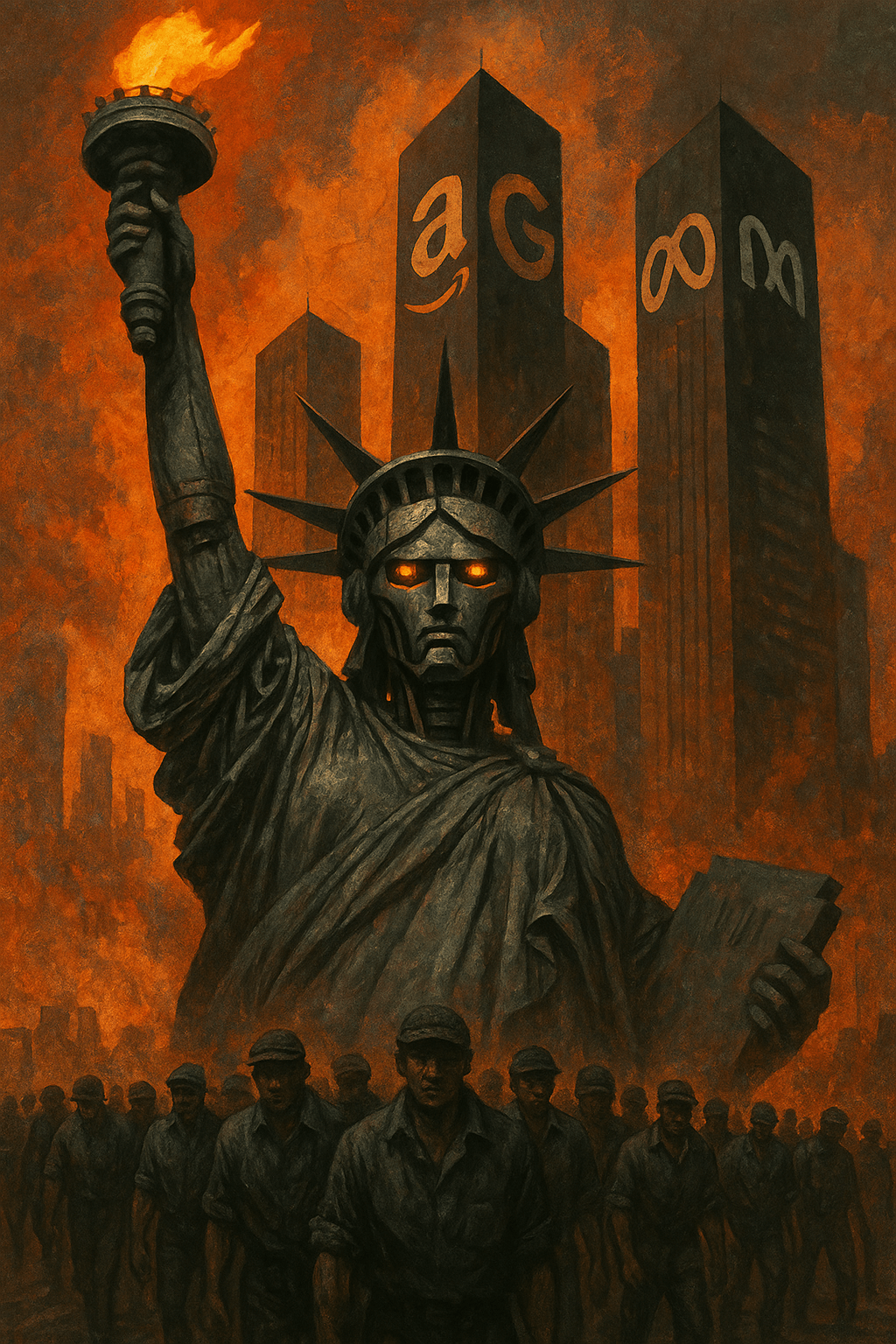
Behind the patriotic smokescreen of “reshoring,” the U.S. ruling class is building a domestic digital plantation:
de-unionized, surveilled, algorithmically managed. Welcome to the technofascist warehouse economy.
By Prince Kapone | Weaponized Information | May 7, 2025
Manufacturing Consent for the Warehouse Economy
On April 29, 2025, Supply Chain Dive published an article by Moiz Aamir titled “Warehouse modernization faces resistance as reshoring drives demand.” Aamir, a regular contributor to corporate logistics media, writes under the editorial direction of Informa—a multinational publishing conglomerate deeply embedded in the imperialist supply chain knowledge economy. His job is not to report but to manufacture consensus. Behind his neutral prose is a propaganda operation that launders the interests of capital through the language of policy journalism.
Though the article does not name them, its logic directly serves corporate tech firms like PackageX—a logistics software company advocating warehouse digitization—as well as real estate giants and asset managers poised to profit from reshoring infrastructure. These are the silent beneficiaries of the ideological campaign now underway to domesticate colonial labor control.
The article’s narrative architecture is simple but insidious. It opens with a familiar liberal lament: America’s warehouses are “outdated,” workers are “resistant to change,” and only “1 in 5 people” want to work in manufacturing. The framing performs a sleight of hand—treating labor immiseration not as the result of decades of union busting, wage suppression, and deindustrialization, but as a cultural or psychological shortcoming. The problem, we’re told, isn’t capital’s abandonment of the working class—it’s that workers don’t want to adapt to progress. What’s left unsaid is that the “progress” on offer is a fully digitized work camp: surveilled, deskilled, automated. The author hides this under the sanitized banner of “modernization,” which he invokes nine times.
Aamir’s rhetorical playbook is classic cognitive warfare. He positions warehouse modernization as neutral and necessary, stripping it of political content. Technology is cast as inevitable, even benevolent, while labor resistance is framed as an obstacle to national revival. This is a textbook deployment of what we call technofascist inevitability discourse—a narrative that removes choice from capital’s offensive by portraying digital exploitation as the natural outcome of economic evolution. It is an ideological technique meant to paralyze dissent before it begins. The effect is to normalize surveillance, displacement, and hyper-exploitation as reasonable responses to “logistical inefficiency.”
Not once does the article interrogate the reasons for this supposed resistance. No mention of wage stagnation. No mention of union repression. No mention of racialized labor sorting, ICE raids, or algorithmic productivity quotas. The author presents modernization as if it were a gift that workers are too irrational to accept—thereby flipping reality on its head. The warehouse worker is not an exploited subject navigating a collapsing empire; they are recast as a roadblock to innovation. This is not journalism—it is ideological discipline rendered in passive voice.
This is how the imperialist media apparatus functions in the age of technofascism. It doesn’t shout—it manages perception. It doesn’t lie outright—it reframes class war as efficiency policy. And in doing so, it prepares the ideological terrain for recolonization—not abroad, but inside the borders of the U.S. empire itself.
The Warehouse Crisis Is a Class Strategy
Strip away the corporate concern-trolling and what remains is this: the so-called “warehouse crisis” is not a logistical failure—it is a tactical readjustment by capital in the face of imperialist decay. The problem isn’t that warehouses are too slow or analog—it’s that the domestic working class remains too expensive, too human, and, in some pockets, still too organized. When Aamir cites statistics—80% of warehouses lacking automation, 67% still running on Excel, 62% reporting “limited visibility”—he treats these as technical deficiencies. In truth, they are red flags to the ruling class: signs that full-spectrum labor discipline has not yet been imposed inside the imperial core.
The U.S. didn’t simply “fall behind.” It built this system abroad—exporting exploitative labor regimes to China, Mexico, Vietnam, Bangladesh—where unions were crushed, wages bottomed out, and factories optimized for raw extraction. This was the heyday of neocolonial extraction dressed up as “globalization.” But that model has fractured. The rise of multipolarity and the Global South’s shifting posture toward anti-imperialist sovereignty has destabilized long-standing supply chains and challenged imperial logistics. Now, with that empire unraveling, the U.S. ruling class is attempting a strategic inversion: to recolonize its own domestic workforce under the same conditions it once exported.
This is not a return to New Deal manufacturing or postwar prosperity—it is a recolonization project. The same capitalist class that abandoned industrial labor is now building a new labor regime atop the ashes of the old, one shaped by algorithmic governance and total logistical control. The warehouse is not an outdated relic—it is the prototype of this new regime. It fuses real-time tracking, biometric surveillance, and AI-based productivity systems to convert workers into programmable assets. The datafication of labor is not about optimization—it is about obedience.
And let us be clear: the language of “reshoring” is ideological cover for technofascist labor recalibration. It is not about bringing jobs back—it is about bringing control back. The difference is not semantic—it is material. Under technofascism, automation, deportation, racialized policing, and AI management systems converge to discipline labor not through wage incentives, but through algorithmic coercion. This is a logistics war against the proletariat, waged by cloud infrastructure and handheld scanners.
The historical irony could not be starker. What is being resurrected is not industrial power—but colonial production conditions. Except this time, the sweatshops won’t be in Tijuana or Shenzhen alone. They’ll be in Ohio, Texas, and the Inland Empire. Capital doesn’t need a boomtown economy—it needs a stable labor caste. And it is building one with ruthless precision, step by digitized step.
From Globalization to Recolonization: The Digital Plantation Economy
Let’s call it what it is: reshoring is not about rebuilding America—it’s about rebooting colonial labor control inside the belly of a collapsing empire. The warehouse is not just a job site—it’s a domestic command post for technofascist governance. These are not neutral upgrades. These are counterinsurgency tools repackaged as “efficiency.” “Computer vision and OCR” to monitor intake isn’t about productivity—it’s about surveillance. “Dynamic slotting” to reduce walking distance isn’t about ergonomics—it’s about path control. “AI verification” doesn’t reduce human error—it removes humans altogether. Capital doesn’t want workers—it wants variables.
The reshoring propaganda—like that peddled by Aamir—is a strategic fiction designed to obscure this recalibration. The goal is not to restore industry, but to domesticate the maquiladora. Not to uplift labor, but to level it down: down to the conditions of the Global South, down to the logic of colonial contradiction embedded within the U.S. from its foundation. What the article won’t say, but we must, is this: recolonization begins at home.
For Black, Brown, Indigenous, and migrant workers—those whose stolen labor has always underpinned this empire—the warehouse has long been a zone of state-sanctioned repression. But now, settler workers too are being pulled into the fold—not as an act of inclusion, but of shared immiseration. The settler labor aristocracy is being dismantled, its privileges clawed back in the name of “national competitiveness.” They are not joining the working class—they are being reabsorbed into a system built to crush it.
This is what we mean by technofascist labor recalibration. It is a political project masquerading as economic necessity. A project that fuses Big Tech, finance capital, and the carceral state into a singular apparatus of labor domination. It does not seek peace—it seeks programmable compliance. It does not seek equality—it seeks uniform degradation. And it will not be negotiated with—it must be destroyed.
The warehouse economy is the soft boot of empire—a digitalized, de-unionized, depersonalized regime of extraction. It is the inverse of liberation. And it will not stop at the shop floor. Every new scanner, every badge swipe, every productivity score is a test run for broader imperial application. This is not just about labor—it’s about algorithmic governance as the default mode of social control.
Against the Machine: Building Revolutionary Power from the Warehouse Floor
If empire is rebuilding itself through warehouses, then warehouses must become our front lines. The battleground has shifted—from factory floors to fulfillment centers, from picket lines to data streams. This is where the next phase of class war is being waged. Not in parliaments, not in press conferences—but in pallet aisles, loading docks, and biometric punch clocks. And this is where we must organize, sabotage, and strike.
We are not fighting to be included in the machine—we are fighting to destroy it. This means constructing dual and contending power from below: not begging for better conditions from the bosses, but building the autonomous institutions of the oppressed to make them obsolete. Revolutionary unions. Worker-controlled supply chains. Underground networks that bypass and block the imperial grid. This is not utopian. It has already begun.
We’ve seen flashes of insurgency: the Amazon workers of Staten Island who shattered algorithmic terror to form an independent union. The longshoremen at the Port of Oakland who refused to load Israeli cargo, halting imperial supply lines in defense of Palestine. Black and Brown warehouse workers from Bessemer to Bakersfield who organize under constant surveillance, asserting their humanity against the chokehold of logistics capitalism. But flashes are not enough. We need fire.
To win, we must:
- Map the grid – Know the logistical terrain: warehouses, hubs, data centers, ports. Identify chokepoints, vulnerabilities, and dependencies.
- Disrupt the algorithms – Refuse biometric compliance. Jam the systems. Misroute, mislabel, leak, and sabotage. Every glitch is a blow against algorithmic governance.
- Internationalize resistance – Tie domestic struggles to global ones. The same hands that pack boxes in the U.S. are linked to ports in Yemen, copper mines in Congo, and garment shops in Bangladesh. Technofascism at home is the twin of hyper-imperialism abroad.
- Radicalize labor struggle into revolutionary struggle – We are not fighting for rights within empire. We are fighting for the revolutionary rupture that will end it.
This is not reform—it is war. A class war. A colonial war. A technological war. And every scanner, every shift, every act of resistance is a site of revolutionary potential. The warehouse is their fortress. Let’s turn it into a factory of insurrection.
The machine will not break itself. But we can break it—together, from the inside out.
Further Reading from Weaponized Information
This article builds upon our previous analyses of empire’s domestic restructuring and technofascist labor control. To understand the deeper ideological and economic mechanics at play, we recommend the following:
-
Deportation as Economic Warfare: Trump’s Technofascist Labor Recalibration and the Crisis of Empire
– A deep dive into how mass deportations serve as a restructuring tool for capital in crisis. -
Recolonizing the Core: Trump, Imperial Decline, and the Race to the Bottom
– Examining how technofascism and imperial decay are reshaping the U.S. into an internal colony. -
Wall Street’s New Empire: BlackRock, Vanguard, and the Corporate Takeover of the State
– Tracing the rise of private capital as the true sovereign of the U.S. imperial order.
These are not isolated events—they are chapters in the same crisis. The struggle to reclaim labor, sovereignty, and humanity begins by naming the system that devours them. And we name it here.
 Weaponized Information
Leave a comment