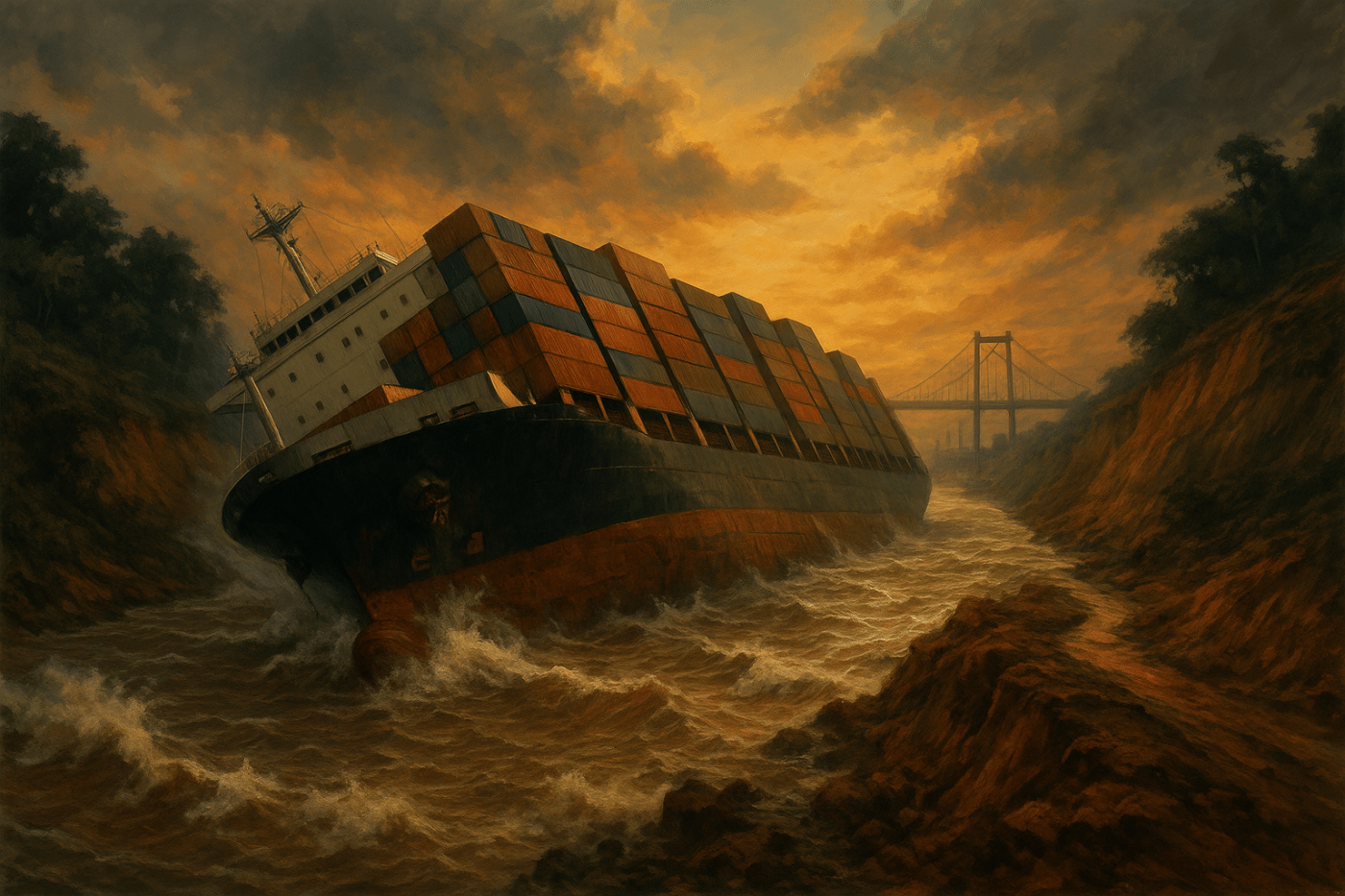
The struggle to build an alternative canal wasn’t insanity—it was insurgency. Empire drowned the project because it couldn’t control it. But the current still flows beneath imperial sabotage.
Written By: Prince Kapone | Weaponized Information | May 1, 2025
I. Unmasking MSN’s Propaganda on Nicaragua’s Canal
The piece we’re examining comes from MSN, published under the sensational headline: “The Insane Chinese Plan to Build a Canal Across Nicaragua.” No author is credited—a classic tactic when a narrative needs to circulate without personal accountability. Instead, the piece functions as aggregated content, amplifying pre-scripted talking points from the imperial media ecosystem.
Let’s start by naming the amplifier: MSN isn’t an independent outlet. It’s a distribution arm of Microsoft’s media partnerships, recycling wire stories, corporate press releases, and Western news feeds. In other words, the article isn’t original reporting—it’s an ideological echo chamber channeling imperial consensus through sanitized packaging for a mass audience. And that audience? Global, English-speaking, middle class consumers whose geopolitical imaginations are shaped by the digital portals of empire.
By calling the Nicaragua canal plan “insane” in the very headline, the article doesn’t merely question its feasibility—it preempts rational discussion by framing the idea itself as irrational, reckless, delusional. From the outset, the project isn’t a policy proposal or geopolitical move—it’s madness incarnate, a fever dream from the periphery daring to challenge imperial logistics.
The piece deploys classic colonial tropes: describing the Chinese investor, Wang Jing, as a “mysterious billionaire,” invoking secrecy and suspicion; portraying the Nicaraguan government as a naive pawn; and highlighting speculative environmental catastrophe while ignoring environmental disasters caused by U.S. and European mining, oil, and infrastructure megaprojects across the region.
Even the technical challenges are framed not as engineering puzzles but as evidence of Nicaraguan incompetence. The article cites cost overruns, feasibility doubts, and protests without ever contextualizing these challenges against the systemic hurdles every major canal has faced—including the U.S.-built Panama Canal, completed with genocidal labor conditions, malaria, and immense ecological damage.
Notice what’s missing: no discussion of Nicaragua’s motives for pursuing the canal. No acknowledgment of the structural chokehold U.S. imperialism maintains through control of the Panama Canal and maritime routes. No exploration of the economic sovereignty a second canal might offer for Nicaragua or the region. Instead, every paragraph is curated to paint the project as a foolish bid that must inevitably fail—because, in the imperial narrative, no project outside U.S. blessing should succeed.
The author—hidden behind the anonymity of MSN’s aggregation model—functions as a non-person in the ideological machine. But the narrative has fingerprints: it reflects the anxieties of Washington think tanks, U.S. naval strategists, corporate shipping interests, and the Monroe Doctrine’s digital descendants. And MSN, through its seamless integration with Microsoft’s platform dominance, becomes a conveyor belt of ideological messaging disguised as viral infotainment.
This article isn’t journalism. It’s narrative warfare. Every word works to delegitimize Nicaragua’s sovereignty, demonize Chinese involvement, and close the window of political imagination around building an alternative to imperial maritime monopolies. And its anonymity is strategic: no author to challenge, no editor to debate—just an algorithmic voice delivering empire’s gospel under the guise of viral news.
II. Nicaragua’s Canal in the Crosshairs of Imperial Chokepoints
Strip away the imperial noise, and the facts remain clear: Nicaragua’s proposed interoceanic canal wasn’t just a local infrastructure gamble—it was a geopolitical bid to realign trade routes, challenge the Panama Canal’s monopoly, and assert sovereign economic agency in a region long subordinated under U.S. imperial command. And that, more than any engineering challenge, made it unacceptable to Washington.
The canal project was formally granted to the Hong Kong Nicaragua Canal Development Investment Co. (HKND), led by Chinese businessman Wang Jing, in 2013. The plan aimed to construct a 276-kilometer shipping route connecting the Caribbean and Pacific, capable of accommodating post-Panamax vessels too large for the current Panama Canal. It promised jobs, revenue, and strategic leverage for Nicaragua—a country still reeling from U.S.-backed Contra terror and neoliberal extraction.
Yet from the outset, the empire deployed a multi-pronged attack: financial sabotage, diplomatic isolation, media demonization, and legal challenges. The U.S. pressured international investors and multilateral banks to withhold support. Environmental NGOs, many funded by Western foundations, became foot soldiers in delegitimizing the project—valid ecological concerns weaponized to align with imperial containment. Every headline amplifying failure, corruption, and “insanity” fed the imperial narrative machine.
Why such ferocity? Because a Nicaraguan canal built with Chinese financing and expertise would represent more than competition. It would fracture Washington’s monopoly over maritime chokepoints in the Americas—a monopoly critical to enforcing the global chain of imperial logistics. As we analyzed in our previous WPE investigation, the Trump 2.0 regime has escalated imperialist recalibration by intensifying control over global choke points: canals, straits, shipping lanes, and data cables. The canal wasn’t just a Nicaraguan project; it was a strategic front in this recalibration.
Under Trump 2.0’s doctrine, Latin America is once again an imperial battlefield. Any infrastructure project not under U.S. corporate and military dominance is framed as a Chinese “beachhead,” a Trojan horse for Communist influence, an existential threat to Monroe Doctrine hegemony. Nicaragua’s canal dared to slip outside the empire’s grip—and so the full spectrum of imperial opposition was mobilized to crush it before it could materialize.
We must also contextualize Nicaragua’s move historically. This isn’t a random flirtation with China—it’s the continuation of a long anti-imperialist trajectory, from the Sandinista Revolution’s overthrow of Somoza’s U.S.-backed dictatorship, to surviving the U.S.-orchestrated Contra war, to enduring decades of imperial economic warfare. Aligning with China wasn’t betrayal of sovereignty; it was an assertion of sovereignty in a world where sovereignty is punished if it deviates from imperial command.
China’s role here is similarly complex. It seeks global partnerships under its Belt and Road Initiative (BRI), offering infrastructure investment as an alternative to IMF debt traps and U.S. conditionality. Nicaragua saw in this partnership a chance to break dependency, diversify alliances, and reposition itself as more than a geopolitical afterthought. China, in turn, saw a chance to secure a logistical corridor outside U.S.-controlled waters—a potential counterbalance to the Panama Canal’s strategic chokepoint.
But imperialism tolerates no parallel routes. Every canal, every bridge, every fiber-optic cable outside Washington’s leash is seen as a threat. And so Nicaragua’s canal was never allowed to stand as a sovereign project—it was smeared, undermined, financially starved, and legally entangled until its formal cancellation. Yet even in cancellation, the specter of a rival canal haunts imperial strategists, because the geopolitical pressures that birthed the idea remain: a world shifting toward multipolarity, a hemisphere questioning U.S. tutelage, and an empire whose chokehold grows harder to maintain.
What the MSN article refuses to say outright—but implies through every smear—is that imperial control over trade routes is non-negotiable. Any attempt to reroute capital’s arteries without imperial authorization must be crushed. Nicaragua’s canal wasn’t insane; it was insurgent. And that’s why it had to be delegitimized before a single ship could pass through its imagined waters.
III. The Canal That Terrified Empire—and Why It Must Rise Again
On the surface, the Nicaragua canal project seems dead. After years of delays, protests, financing hurdles, and relentless imperial sabotage, the Nicaraguan government formally canceled the concession in 2024. The imperial press was quick to declare victory. “Insane,” they said. “A failed dream.” “A Chinese fantasy drowned under its own weight.”
But beneath the headlines, a deeper story runs: this canal didn’t fail because it was unworkable. It was drowned because it was unallowable. It wasn’t killed by environmental risks or engineering challenges—though both were real. It was killed by imperial sabotage, by coordinated financial asphyxiation, by the refusal of global capital to underwrite a project that threatened U.S. logistical hegemony in the Americas. In other words, it was killed precisely because it posed a real, material challenge to empire’s grip over the hemisphere.
And herein lies the revolutionary lesson: a project whose very existence provoked this level of imperial panic is a project worth reviving—not despite the obstacles, but because of them.
For Nicaragua, the canal represents more than a shipping route. It represents a pathway out of centuries of imperial subjugation. Since the U.S. Marines occupied Nicaragua in 1912, since Somoza’s dictatorship served as Washington’s satrapy, since the Contra terror destabilized the Sandinista revolution, Nicaragua has been forced to navigate a narrow corridor of dependency and underdevelopment imposed by the imperial core. The Panama Canal became a physical symbol of that dependency: every major trade artery moving through the hemisphere passed through a U.S.-controlled bottleneck. The Nicaragua canal would have been a rupture in that system—a corridor of sovereign movement, under sovereign terms.
For China, the project wasn’t just economic. It was geopolitical. It aligned with Beijing’s broader efforts under the Belt and Road Initiative to secure alternative trade routes, diversify logistical chokepoints, and reduce reliance on U.S.-controlled maritime passages. A successful canal in Nicaragua would not only break the U.S. monopoly over Central American shipping—it would extend a multipolar lifeline into the imperial core’s hemisphere, forcing Washington to contend with infrastructural sovereignty at its doorstep.
The MSN article paints the canal as madness, but in truth, it was one of the most rational moves Nicaragua could make in a world still shackled by colonial trade routes. The only “insanity” from the imperial vantage point was that a small, poor, Global South nation dared to act as a subject of history rather than a subordinate object. It dared to draw new lines on the logistical map, without imperial permission. And for that, it had to be crushed.
Yet history is stubborn. The geopolitical conditions that inspired the canal’s conception have not disappeared. In fact, they’ve deepened. Under the Trump 2.0 regime, the empire’s recalibration toward militarizing chokepoints, weaponizing trade routes, and tightening naval dominance has only accelerated. U.S. control over the Panama Canal remains a critical node in that strategy. Every imperial blockade, every sanction, every trade war has reminded the Global South that dependence on U.S.-controlled routes is a structural vulnerability.
For Nicaragua, the incentive to revive the canal grows stronger, not weaker, as imperial aggression intensifies. For China, the incentive to back alternative routes becomes existential as U.S. naval encirclement tightens. And for the broader multipolar project, the canal remains a symbol and material instrument of a world no longer ruled from Washington’s command centers.
We must also reframe the environmental critique levied against the canal. Genuine concerns about deforestation, displacement, and ecological risk deserve serious treatment. But those critiques cannot be wielded selectively by an imperial bloc that greenwashes its own extractivism while sabotaging sovereign infrastructure in the Global South. The challenge is not to abandon the project, but to build it differently—to center environmental stewardship under sovereign control, to integrate Indigenous and peasant rights into its governance, to make it a people’s project rather than a comprador contract. Revolutionary infrastructure is possible. But it will never be allowed under the rules of imperial capitalism—it must be fought for, seized, defended.
The Nicaragua canal is not dead. It is dormant. It is buried under sabotage, awaiting excavation by a new conjuncture of political will, international solidarity, and revolutionary resolve. Its failure is not proof of impossibility. It is proof of how far imperialism will go to block sovereignty, how deeply it fears even the possibility of rupture.
In that sense, the canal stands alongside Cuba’s resistance, Venezuela’s Bolivarian experiment, Bolivia’s nationalizations, Burkina Faso’s revolutionary reorientation, and every act of anti-imperialist sovereignty under siege. It reminds us that the fight is not only over armies and elections—it is over infrastructure, logistics, movement. Empire rules by controlling the routes. Liberation means reclaiming them.
The imperial press may have buried the canal under ridicule. But for the oppressed, it remains an unfinished chapter in the long war for economic emancipation. Its waters may not yet flow—but the current runs underground, waiting for the next surge.
IV. Mobilizing for Multipolar Sovereignty: From Chokepoints to Liberation Corridors
What do we take from this struggle, comrades? First, we must understand: Nicaragua’s canal isn’t just a dead project on a dusty blueprint. It’s a battlefield. A site where the empire fought to preserve its chokehold over global movement. A site where the Global South dared to redraw the map. And a site where the unfinished fight for logistical sovereignty continues—whether the canal is built tomorrow or ten years from now.
Our task is not to simply observe this struggle, but to join it. To connect the dots between maritime routes, supply chains, sanctions regimes, and imperial militarization. The empire doesn’t just rule with bombs and banks—it rules with routes. And every chokepoint it controls is a noose around the Global South’s development, autonomy, and dignity.
We call on revolutionaries, anti-imperialists, and solidarity networks across the world to raise political education around imperial control of logistics. Study the chokepoints: the Panama Canal, the Strait of Malacca, the Suez Canal, the Straits of Hormuz, the fiber-optic cables, the undersea pipelines. Study how empire enforces dependency through these arteries. And study how the oppressed have historically broken blockades, built alternatives, forged new corridors of movement.
We must build solidarity with Nicaragua’s sovereignty struggle—not simply as a struggle for infrastructure, but as a struggle against a global system that denies poor nations the right to chart their own development paths. We must resist the weaponization of environmental and human rights discourse by imperial actors who greenwash their own extractivism while blocking Global South autonomy. We must amplify the voices of Nicaraguan peasants, Indigenous communities, workers, and revolutionaries whose input must guide—not be erased from—the struggle for sovereign development.
We call on anti-imperialist movements across the Americas to connect Nicaragua’s canal struggle with parallel fights: Puerto Rico’s debt rebellion, Haiti’s anti-occupation resistance, Venezuela’s sanctions defiance, Cuba’s blockade survival, Bolivia’s Indigenous socialism, Colombia’s peace process under U.S. destabilization. The canal is not an isolated episode—it is a chapter in the ongoing war against the Monroe Doctrine and imperial recolonization under the Trump 2.0 regime’s recalibration strategy.
And to comrades inside the imperial core: understand that the same system strangling Nicaragua’s sovereignty is strangling workers at home. The same logistics monopolies that choke the Global South’s exports also crush Amazon warehouse workers. The same naval networks that blockade Cuba are the same Pentagon supply chains fortifying police militarization in U.S. cities. The struggle for sovereign logistics is a global class war that binds the oppressed everywhere. Every imperial chokepoint is both a physical bottleneck and a political battlefield.
We must also build the ideological foundation for alternative infrastructure. A canal, a railway, a port—under capitalism, they serve monopoly capital. Under revolutionary leadership, they can serve the people. The question is not only whether Nicaragua’s canal will be built, but how and for whom it will function. Our solidarity must include technical, environmental, financial, and political support for building sovereign, sustainable, socialist infrastructure outside imperial domination.
The imperial press wants us to forget the canal. They want us to accept that only empire can build, only empire can maintain, only empire can control the flows of goods, people, and capital. But history tells a different story. The oppressed have always built under siege, under blockade, under sabotage. And we will build again.
We close by reaffirming: Nicaragua’s canal is not madness. It is a dream interrupted by imperial terror—a dream whose very suppression proves its revolutionary potential. Let us carry that dream forward. Let us connect its struggle to every frontline against imperial recalibration. Let us turn every chokepoint into a corridor of liberation. And let us prepare—not only to explain, not only to critique—but to overthrow.
As we always remind you, in the spirit of Marx: the masses are not passive. They are the makers of history. And the route to liberation runs not through empire’s gates, but around them—by forging new paths, new routes, new worlds.
 Weaponized Information
Leave a comment