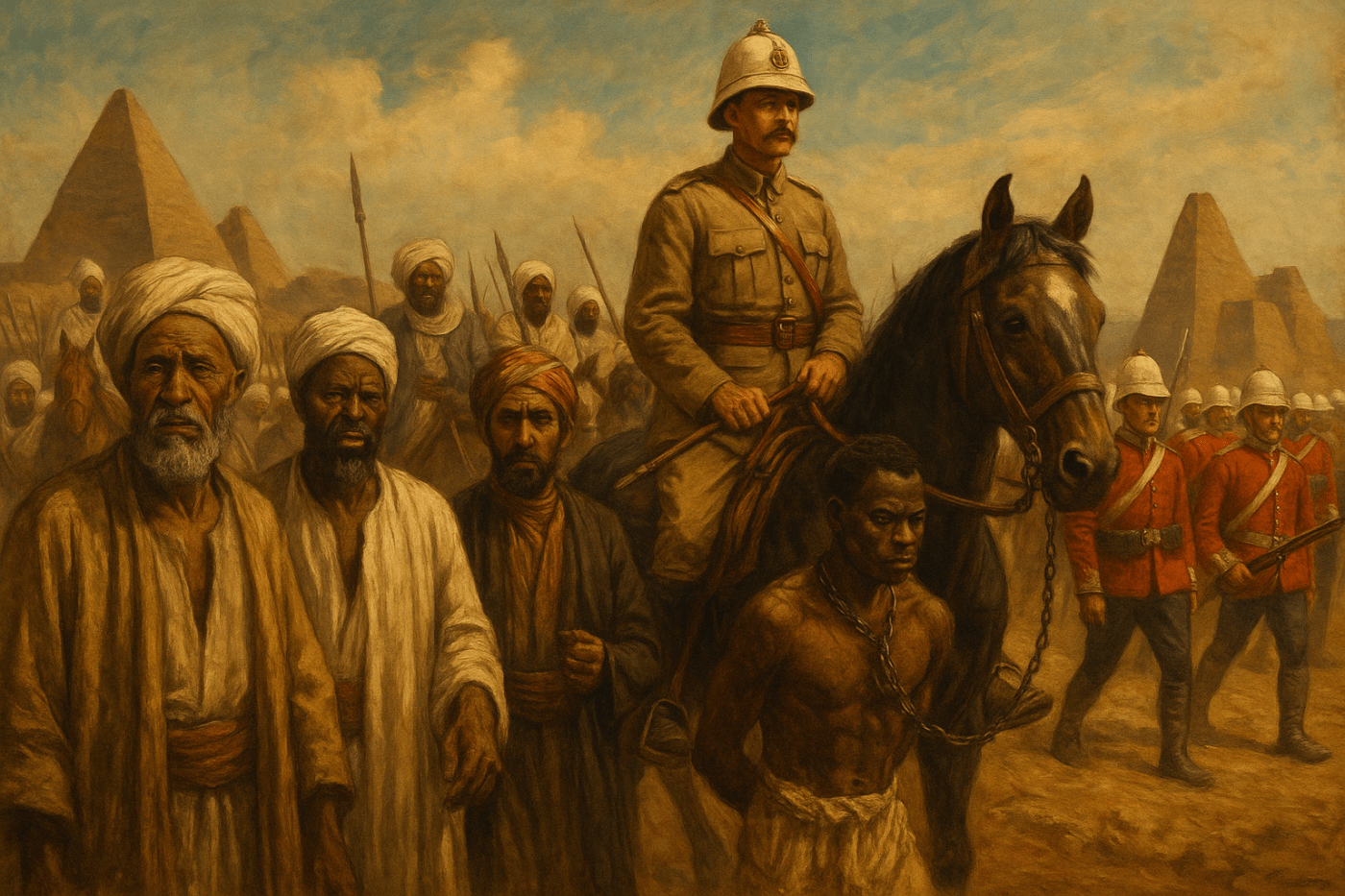
Weaponized Information | By Prince Kapone
This Was No Accident
They want us to believe Sudan is a mess of its own making. That it’s all about tribes, religion, and “ancient hatreds.” That the chaos is natural, inevitable, and internal. But pull back the curtain, and you’ll see something else entirely: a country deliberately broken by empire, dissected and divided by foreign rulers who came not to bring peace but to plunder. What’s happening in Sudan today isn’t some tragic accident of African history—it’s the logical outcome of a long imperial project. And if we’re going to talk about genocide, we’d better start with the real architects of violence.
I. Before the Wrecking Ball: What Sudan Was
Sudan wasn’t a single state before colonialism—and that’s exactly the point. It was a land of kingdoms and sultanates, trade networks and farming societies, Islamic scholars and Christian kings. The Kingdom of Kush, the Christian Nubian states, and later the Funj Sultanate weren’t perfect, but they weren’t puppets either. There was no central authority trying to impose uniformity from above. People found ways to coexist through exchange, negotiation, and local autonomy.
In other words: Sudan had contradictions, but not crises. Not until the imperialists arrived with their maps, guns, and ledgers.
II. Egypt Comes First: The Prequel to British Colonialism (1821–1885)
The first wave of colonial violence came in 1821, when Muhammad Ali of Egypt invaded Sudan. He wanted soldiers, slaves, and gold. He needed bodies to fill his modernizing army and wealth to fill his treasury. So he turned Sudan into a human hunting ground.
The South was raided for slaves. The North was taxed to death. Local elites were pulled into the administration to help grease the wheels of empire. This was neocolonialism before the term existed: Egypt was technically under the Ottoman Empire, but acted as a junior partner of European capital. Sudan, in turn, was at the bottom of this hierarchy—a colony of a colony.
III. The Mahdist Revolt: Sudan Rises Up (1881–1898)
But Sudan fought back. In 1881, a Sufi teacher named Muhammad Ahmad declared himself the Mahdi—the divinely guided one—and launched a revolutionary movement. Not just a spiritual revival, but a full-scale anti-colonial insurrection. His army included the poor, the landless, the enslaved, and the exiled. They weren’t fighting for an Islamic empire. They were fighting to take their country back.
- 1883: The Mahdists wiped out a British-led Egyptian army at El Obeid.
- 1885: They took Khartoum, killing British General Charles Gordon—a saint of the empire—and sent shockwaves through Europe.
- 1885–1898: The Mahdist State held power in Omdurman, running its own affairs and fighting off external threats.
It wasn’t utopia. But it was theirs. And that made it intolerable to the British.
IV. The Return of Empire: Guns, Railroads, and Divide-and-Rule (1898–1956)
The empire struck back in 1898, when Herbert Kitchener marched south with Maxim guns and artillery to retake Sudan. At Omdurman, they massacred over 10,000 Mahdist fighters in a single day. This was a one-sided slaughter disguised as civilization.
By 1899, Sudan was under the so-called Anglo-Egyptian Condominium—a colonial shell game where Britain called the shots while pretending Egypt had a say. But Egypt was itself under British control. So this was a colony ruled through another colony. A Russian doll of imperialism.
Then came the classic toolkit:
- The North got investment, irrigation, and schools—to train bureaucrats and cotton farmers who’d serve empire.
- The South was sealed off—kept \”primitive\” on purpose, governed by missionary schools and military patrols.
- Darfur and the western regions were ignored—until they became security threats, and then they were crushed.
The British mapped Sudan not just in terms of territory, but in terms of who was useful and who was expendable.
V. Independence with No Sovereignty (1956)
By the time Sudan got formal independence in 1956, the damage was done. The North had been turned into a comprador class, fluent in the language of empire. The South had been excluded from the nation-building process entirely. And Darfur had been left to rot.
The state that was born in 1956 wasn’t a nation—it was a patchwork of contradictions held together by British railroads, imported ideologies, and foreign-trained elites. It took less than a year for the first civil war to begin. Because it was never really peace to begin with.
It Was Never an Accident
So no—Sudan didn’t “fail.” It was made to fail. Piece by piece, region by region, identity by identity. What empire couldn’t conquer, it fragmented. What it couldn’t exploit, it isolated. And when people resisted, they were branded fanatics and crushed.
This is how empire works. It doesn’t just invade. It reorganizes, repackages, and recolonizes. Sudan is not an exception. It’s a case study.
In Part II, we’ll trace how this legacy of underdevelopment and division was carried into the postcolonial period—how U.S., Gulf, and Israeli capital stepped in where Britain left off, how oil became a curse, and how today’s so-called civil war is in fact a counterinsurgency war waged against the Sudanese people by imperial proxies.
To be continued.
 Weaponized Information
Leave a comment