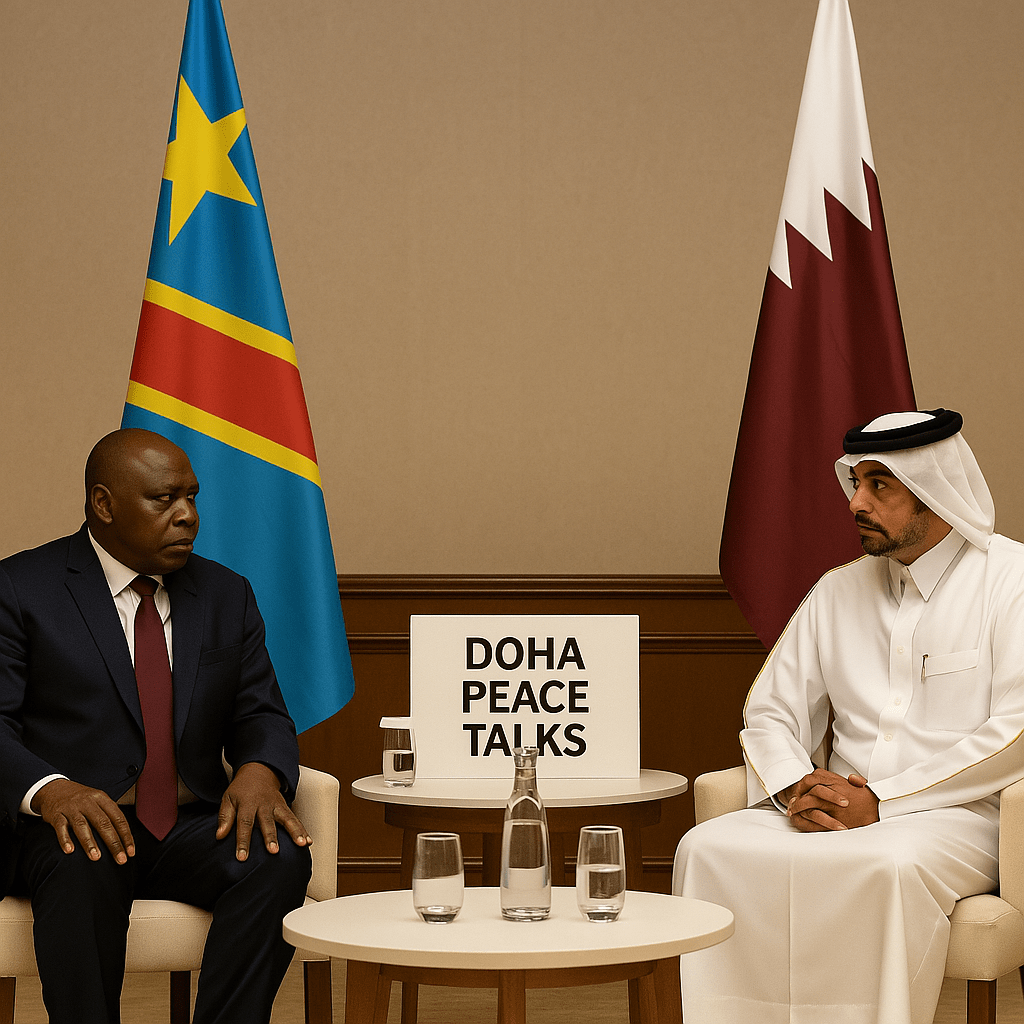
While Congo bleeds for cobalt, the empire negotiates its future in five-star exile—repackaging resource war as peacebuilding in the heart of hyper-imperialist capital.
Redline | April 10, 2025 | AFRICA
Somewhere between the bombed-out streets of Bunagana and the polished lobbies of Doha’s business hotels, the idea of peace was rebranded as a luxury commodity. On one end, families bury the dead and sleep in plastic sheeting; on the other, negotiators sip espresso and talk conflict metrics. This month, the Democratic Republic of Congo and the M23 rebel group sat down in Qatar—not to end war, but to restructure it.
No one should mistake this setting for neutral ground. Doha is many things—an imperial outpost, a vault for capital, a hub for multinational diplomacy—but it is not a place untouched by empire. The same Qatar that hosts U.S. CENTCOM and bankrolls strategic infrastructure projects across Africa now wants to mediate Congo’s war. The irony? They’re mediating a conflict whose blood flows from the veins of cobalt mines, lithium pits, and mineral smuggling routes—precisely the arteries of capital in which Gulf investors are expanding their stakes.
What’s happening here isn’t diplomacy. It’s a merger. M23 clears the land, and empire builds on it. The talks in Doha aren’t resolving contradictions—they’re managing them. They’re creating predictability for logistics firms and clean energy portfolios, not safety for the people of North Kivu. M23, backed by Rwanda and tolerated by the transnational elite, continues its operations while wearing the polite face of negotiators. Their real currency isn’t ceasefire—it’s control over cobalt corridors.
Meanwhile, Congo’s official delegation isn’t exactly representing the people either. Comprador elites who long ago traded public welfare for mineral concessions are in the room. No representatives from civil society. No unions. No refugees. The people of Congo are, once again, the ghosts at the table—spoken about, never spoken for.
So why Qatar? Because it’s where capital and counterinsurgency shake hands without the mess of local resistance. It’s convenient, insulated, photogenic. And in a world of accelerating multipolar crisis, Gulf states like Qatar have perfected the role of neutral broker. But neutrality here means only one thing: both the U.S. and China trust you to protect their assets.
This is the future of imperial recalibration: outsourced sovereignty, privatized diplomacy, weaponized negotiations. Empire doesn’t need to govern anymore—it just needs to stabilize. And if a few million Congolese are displaced in the process? That’s a cost already priced into the futures market.
Doha is not an accident. It is infrastructure. It is where technofascism and green capitalism intersect. As the West scrambles to secure its post-oil energy supply, the Congo becomes ground zero for the battle over the global battery. This isn’t about peace—it’s about keeping cobalt flowing and revolts contained.
In the end, there is no peace process in Doha. There is only crisis management—of empire, of capital, of optics. The real peace is elsewhere: in the resistance of Congolese workers, in the grassroots networks of care and survival, in the memory of Lumumba and the lessons of Sankara.
What we are witnessing is not a peace summit—it’s a board meeting. And Congo, once again, is on the menu.
 Weaponized Information
Leave a comment