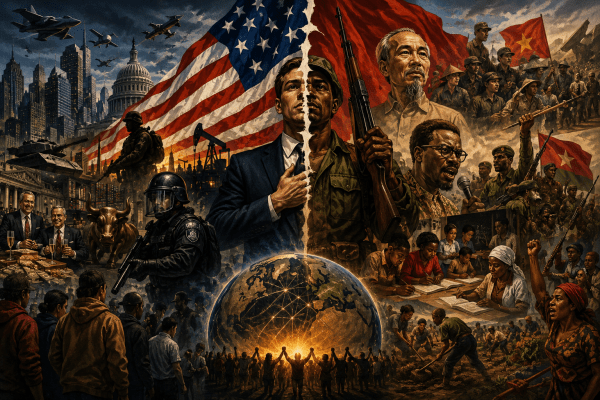
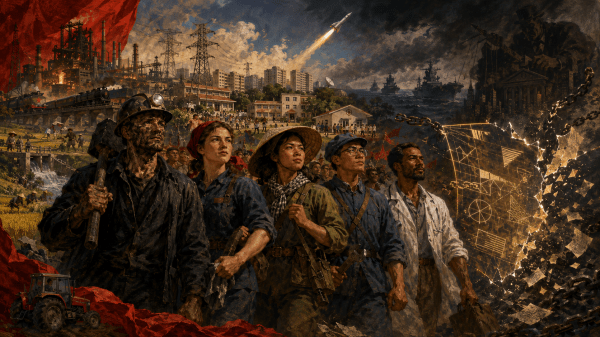
Hundreds of economists warn that artificial intelligence could displace millions of workers, but their petition mistakes a ruling-class offensive for a technical oversight. AI is already being used to reduce workforces, intensify surveillance, automate discipline, exclude applicants, restrict public benefits, and strengthen military and counterinsurgency systems. The real danger is not that machines may escape human control, but that monopoly capital is using them to reduce its dependence on labor while expanding the apparatus needed to manage those it renders surplus. Against this technofascist future, workers are organizing to seize control over deployment, data, productivity, and power.
The Market Came Armed: Sven Beckert and the World Capital Built by Conquest
Sven Beckert demolishes capitalism’s favorite myth: that it emerged from free markets, innovation, and peaceful exchange. His global history shows a system built through conquest, slavery, colonial dispossession, state power, coerced labor, and repeated counterrevolution. Yet Beckert repeatedly turns rebellions, socialist revolutions, and anticolonial victories into episodes in capitalism’s adaptation. This review seizes his historical arsenal while rejecting that retreat, arguing that a world made through organized class and colonial power can be remade only through the organized power of workers and oppressed peoples.
Communists and Patriots: The Flag, the Class, and the Lie of Imperial Nationalism
Trump says you can be a communist or a patriot—but not both. This essay exposes the historical fraud buried inside that slogan. By reconstructing the nation through historical materialism, it shows that nationalism has never possessed a fixed political content. In oppressed nations, communists repeatedly became the truest patriots because the struggle for national liberation demanded the overthrow of colonialism, imperialism, and comprador rule. In imperialist nations, however, nationalism serves the opposite function: binding workers to the ruling class and its global system of domination. The real contradiction is not between communism and patriotism, but between imperial patriotism and the liberation of the people.
Socialism Without Revolution: Jacobin’s Market Fantasy Against the Socialist World
Bhaskar Sunkara’s market socialism is a bold yet flawed vision that naively overlooks the burdens of imperialism. He critiques past socialist models while proposing that worker-run firms can flourish within a system still embedded in capitalist exploitation. However, the reality is that these worker enterprises would still rely on the global hierarchy that upholds imperial advantages. A true socialist awakening must reject these inherited structures and demands an anti-imperialist framework instead. Without confronting the realities of colonial legacies and ensuring reparative relations, Sunkara’s proposal risks socializing the benefits of imperialism while maintaining its oppressive mechanisms intact.
U.S. Empire, Somaliland, and the Sale of Sovereignty at the Red Sea Chokepoint
A Military.com analysis presents U.S. recognition of Somaliland as pragmatic strategy, disguising a deeper imperial project. The colonial fracture between British and Italian Somaliland, combined with postcolonial crisis, has been repurposed into an opening for external intervention. What appears as diplomacy is in fact the conversion of territory into infrastructure—Berbera as port, base, and extractive... Continue Reading →
After the Empire — Before the Collapse
When Emmanuel Todd wrote After the Empire, Washington still believed it ruled a permanent unipolar world. Todd saw something different: an empire sustained less by production than by financial tribute and military spectacle. Two decades later the contradictions he described—economic dependency, micromilitarism, and ideological decay—have matured into the turbulent transition now reshaping global power.By Prince... Continue Reading →
White Guilt or White Pride? The False Choice That Preserves Empire
“White guilt” shrinks a global system of power into a private mood. Liberal confession mourns history while preserving the machinery of dominance. Reactionary pride weaponizes heritage to harden bloc discipline under multipolar pressure. Beyond shame and nostalgia lies defection from empire and alignment with global liberation.By Prince Kapone | Weaponized Information | February 20, 2026History... Continue Reading →
Marx’s Grundrisse: Capital’s Global Empire, Labor’s Stolen Time, and the Crisis It Cannot Escape
Marx dismantles liberal political economy and rebuilds the totality from production outward. Exchange and money reveal separation as the architecture of domination. Machinery and the general intellect expose capital’s war against its own measure of value. The world market universalizes crisis while pointing beyond labor time toward free development. By Prince Kapone | Weaponized Information... Continue Reading →
Berlin’s Boardrooms, NATO’s Generals, and Beijing’s Factories: Germany’s Trade Deficit and the Crisis of Imperial Supremacy
A romance metaphor conceals structural strain. The trade ledger exposes export contraction and rising militarization. Industrial rivalry is recoded as security doctrine. Workers and colonized nations confront the costs—and the opening.By Prince Kapone | Weaponized Information | February 19, 2026When the Empire Calls It Heartbreak Our excavation begins with a February 19, 2026 piece from... Continue Reading →
Empire Recruits, China Consolidates: The CIA Video and the Crisis of Unipolar Power
A CIA recruitment campaign is framed as opportunity while containment intensifies. Behind the video lies a shattered U.S. intelligence network and a decade of Chinese military reform. Export controls and Indo-Pacific encirclement reveal a deeper structural recalibration. As multipolarity widens the field, the real struggle is over who shapes the emerging order.By: Prince Kapone |... Continue Reading →