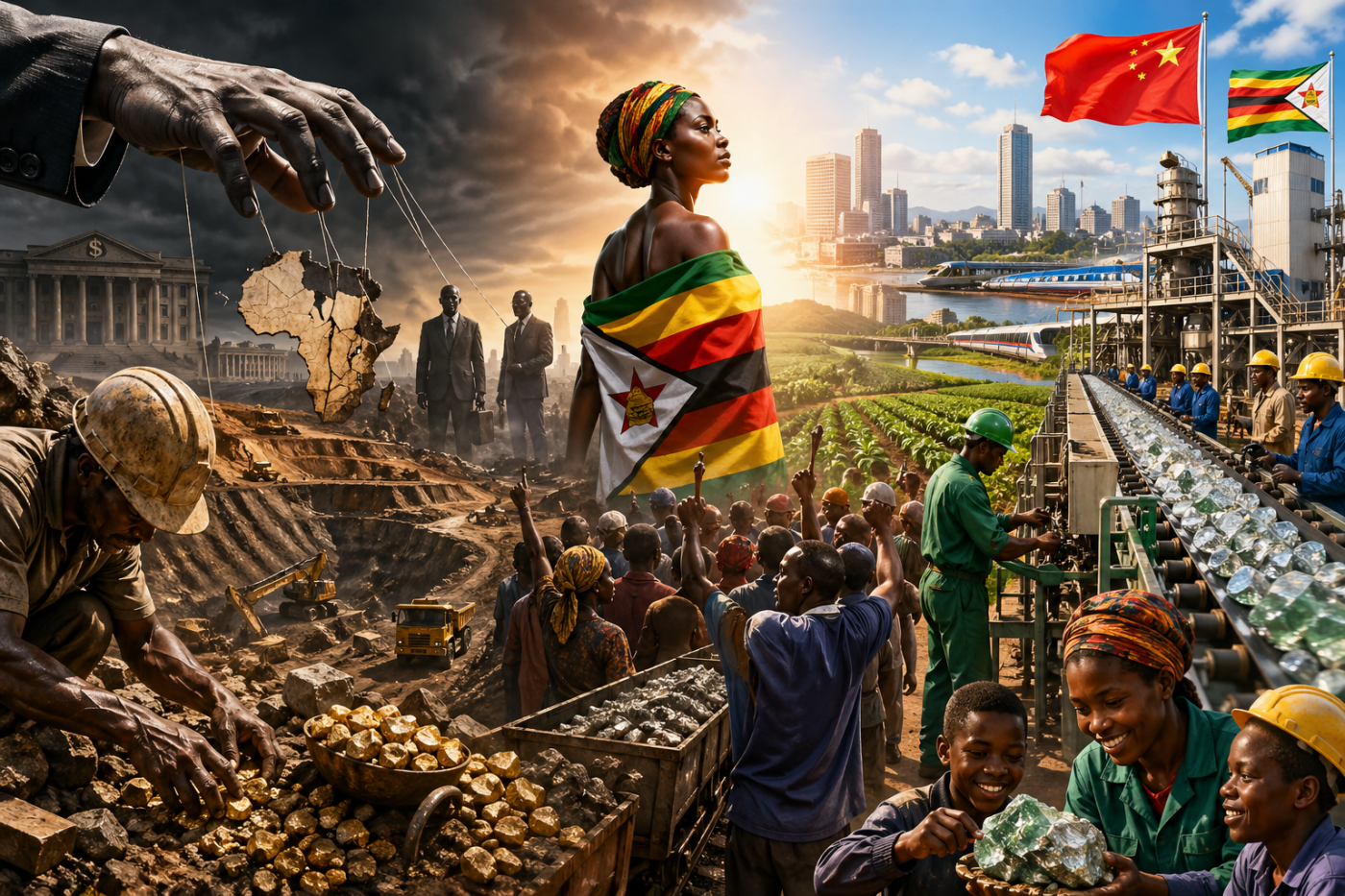
The imperial press calls Zimbabwe’s recovery “bizarre,” revealing more about empire’s ideology than Africa’s reality. Beneath the headlines lies a material transformation driven by gold, lithium, labor, and survival within a system built to constrain it. As Zimbabwe pushes toward beneficiation and partners with China, it enters a global struggle over who controls resources, industry, and development. What unfolds is not an anomaly, but a frontline battle between imperial discipline, national sovereignty, and the working masses who sustain it all.
By Prince Kapone | Weaponized Information | April 27, 2026
When the Empire Calls Survival Strange
The Economist’s “Zimbabwe’s bizarre economic boom”, published on April 15, 2026, arrives from Mazowe with the polished sneer of metropolitan common sense. The article reports that Zimbabwe is experiencing an unusual economic upswing driven by gold, tobacco, lithium, platinum, remittances, and a measure of currency stabilization, while President Emmerson Mnangagwa and ZANU-PF tighten their grip on political power. That is the story on paper. But the deeper operation of the article is not simply to report Zimbabwe’s boom; it is to discipline how the reader is supposed to understand it. The economy may be growing, gold may be flowing, inflation may be falling, and money may be moving through the hands of miners, traders, migrants, and households—but The Economist’s task is to make sure none of this appears as a serious attempt by a postcolonial country to maneuver inside hostile conditions. It must appear strange, suspicious, criminal, and vaguely comic. In other words, Zimbabwe is allowed to have a boom, but only if the imperial press gets to call it bizarre.
The outlet matters. The Economist does not speak from nowhere. It is not a village newspaper, a workers’ bulletin, or a miner’s testimony from the banks of the Mazowe. It is a publication of the British ruling-class mind, written for financiers, diplomats, managers, policy people, investors, and the respectable clerks of global capital. Its voice is calm because its class position is secure. Its sarcasm is polite because its violence is institutional. The article is not individually bylined in the supplied text, so what we get is not the distinctive voice of a named reporter so much as the institutional voice of The Economist itself: the old imperial notebook updated for the age of lithium, gold-backed currency, Chinese investment, and multipolar anxiety.
The first propaganda move is narrative framing. Zimbabwe’s economy is described as “bizarre,” “idiosyncratic,” and abnormal before the reader is given the full material terrain. This language does ideological work. It tells the reader that an African country recovering through gold, minerals, remittances, informal trade, and non-Western partnerships is not participating in political economy but violating polite economic taste. When Europe hoards gold, it is prudence. When Wall Street speculates, it is liquidity. When Zimbabwe digs wealth from its own soil and tries to stabilize a currency with it, suddenly the whole affair becomes exotic, comic, and strange. Capitalism, that old magician with blood under its fingernails, is only “normal” when the profits travel north.
The second device is card stacking. The article carefully piles up smuggling, patronage, black markets, private vaults, contaminated rivers, political repression, currency distrust, and elite corruption. These are not imaginary issues, and no serious analysis should pretend otherwise. But the pile is arranged so that the reader sees disorder without structure, corruption without history, and informal survival without the system that made informality necessary. The article gives us the smoke, the dust, the mercury, the safes, the motorcycles, the cash houses, and the ruling-party joke. What it withholds is the larger machinery that made Zimbabwe’s economy so dependent on mineral export, migrant remittances, dollarized exchange, and external finance in the first place.
The third device is source hierarchy. The article’s authority comes largely from investors, bankers, retailers, financiers, businesspeople, analysts, and unnamed officials. These are the respectable witnesses of bourgeois journalism. The miners are visible mainly as scenery. The workers appear as spending bodies, not thinking subjects. The diaspora appears as a remittance machine, not as displaced labor. The peasantry appears through tobacco output, not through land, history, or class struggle. The result is a familiar trick: the people who move the economy with their hands and backs are treated as evidence, while the people who circulate capital are treated as interpreters.
The fourth device is omission. The article invokes Cecil Rhodes, Rhodesia, and the colonial hunt for gold, but it does not allow that history to become an explanation. Rhodes appears like a decorative ghost, useful for atmosphere but not for indictment. The settler-colonial structure of land theft, mineral extraction, racial labor discipline, and postcolonial constraint remains outside the frame. That omission is not accidental. To reconstruct that history would force the reader to see Zimbabwe not as a failed African curiosity, but as a country still wrestling with the long afterlife of British imperial robbery. And The Economist, being what it is, cannot follow Cecil Rhodes too far down the mine shaft. It might find its own family portrait hanging there.
The fifth device is poisoning the well through political code words. “Basket-case,” “Congo-fication,” “Chinese friends,” and the closing joke about the ruling party as “the biggest gang” all guide the reader toward contempt. Again, the issue is not that Zimbabwe’s ruling class should be spared criticism. It should not. The issue is that The Economist’s ridicule is not aimed at liberation. It is aimed at restoring imperial common sense. The reader is invited to laugh at African corruption while forgetting that imperial capitalism has always preferred its theft with a bank charter, a mining concession, a legal opinion, and a clean suit.
So the article performs a double movement. It admits that Zimbabwe is growing, stabilizing, exporting, mining, receiving remittances, and attracting non-Western capital. But it immediately wraps those facts in a frame of criminality, absurdity, authoritarian decay, and Chinese dependence. This is propaganda with a velvet glove: not crude lying, but organized emphasis; not total fabrication, but disciplined distortion. The article tells part of the truth in order to prevent the whole truth from coming into view.
The Gold Beneath the Narrative: What Is Happening and What Is Hidden
Strip away the tone, the sarcasm, the imperial smirk—and the first thing that becomes clear is this: Zimbabwe’s economic movement is real. It is not imagined, not fabricated, not a statistical illusion. The country’s gold output reached a record 46.7 tonnes in 2025, the highest ever recorded, confirming that gold is not just present in the economy—it is structuring it. This surge is part of a broader recovery, where macroeconomic growth accelerated in 2025, driven by mining, agriculture, and favorable commodity prices. At the same time, inflation sharply declined by early 2026 due to tighter monetary policy and exchange-rate stabilization tied to the introduction of the ZiG currency. These are not trivial developments. They signal a state attempting to reassert control over currency, price stability, and macroeconomic credibility after decades of crisis.
Institutionally, this movement has drawn cautious recognition from global finance. In April 2026, the IMF approved a Staff-Monitored Program, marking renewed engagement—but crucially, without direct lending. Meanwhile, the productive base shows life beyond gold alone. Tobacco output hit a historic high of 355 million kilograms in 2025, generating roughly $1.2 billion in earnings. And beneath the surface, holding households together, is the diaspora: about $2.45 billion in remittances flowed back into Zimbabwe in the same year. Gold, tobacco, remittances, and currency discipline—these are the visible pillars. But they are only the front layer of a deeper structure.
What the article refuses to show is that Zimbabwe is not drifting through a gold rush—it is actively restructuring its economic position. The state has moved to restrict raw lithium exports and push local beneficiation, including plans to ban lithium concentrate exports once domestic processing capacity is established. This is not improvisation; it is industrial policy. It aligns directly with the country’s stated development trajectory under Vision 2030, which centers industrialization, infrastructure, and economic transformation. Mineral wealth itself is expanding: exports reached $3.4 billion in 2025, driven by gold, platinum-group metals, and diversified mining output. The boom, in other words, is not simply happening to Zimbabwe—it is being contested, shaped, and redirected by the state.
At the same time, Zimbabwe’s integration into the global economy is being reorganized through new relationships. The lithium extracted from its soil is feeding directly into global industrial supply chains, with over 1.1 million tonnes exported in 2025, largely to China. But this is not a one-way pipeline. Chinese firms are building processing capacity inside Zimbabwe itself, linking extraction to industrialization. The relationship is not recent or opportunistic. It rests on decades of diplomatic engagement, with Zimbabwe and China marking 45 years of formal relations and upgrading ties to an “all-weather community with a shared future”. Chinese officials explicitly frame this cooperation in terms of development, infrastructure, and long-term coordination, calling for expanded production-line investment inside Zimbabwe. What is being built here is not merely trade—it is an industrial linkage.
Meanwhile, the pressures bearing down on Zimbabwe are not accidental. The country remains constrained by a financial architecture that allows monitoring without support. Its IMF program exists to prove credibility, not to provide capital. Its debt arrears still block full access to international finance, tying economic normalization to external approval. Even where sanctions have been formally restructured, they persist in targeted form, with the United States maintaining pressure through legal redesignation mechanisms. This is the quiet discipline behind the headlines: Zimbabwe is permitted to stabilize, but only under supervision.
Internally, the economy carries the marks of its own history. The Reserve Bank acknowledges that Zimbabwe’s system is shaped by dollarization, informalization, and deep monetary distrust rooted in past crises. What appears as a “black market” is, in reality, a survival system built in response to instability. Regionally, the economy extends beyond its borders. Zimbabwean workers abroad—especially in South Africa—form a labor circuit that feeds the domestic economy through remittances, stabilizing households even as it reflects uneven development across the region.
And beneath all of this lies the long shadow the article refuses to illuminate. Zimbabwe’s economic structure did not emerge in 2026, or 2008, or even 1980. It was built under settler colonial rule, where land, labor, and minerals were organized for extraction. The transition to independence, shaped by agreements like Lancaster House, did not erase those structures—it constrained how they could be transformed. What Zimbabwe faces today is not simply economic difficulty. It is the unresolved inheritance of a colonial economy, now operating inside a global system that continues to discipline attempts at sovereignty.
Seen in full, the so-called “bizarre boom” dissolves. What remains is something far more legible: a country extracting value from its soil, stabilizing its currency, relying on its people at home and abroad, negotiating with global capital, and attempting—within limits—to reconfigure its place in the world economy. The facts are not strange. Only the lens is.
Breaking the Monopoly: Zimbabwe, China, and the Struggle to Escape the Colonial Economy
What appears in the imperial press as a “bizarre boom” is, in reality, a familiar scene in the long history of the Global South: a people attempting to reorganize their economic life inside a world system designed to prevent exactly that. Zimbabwe is not behaving strangely. It is behaving historically. It is digging, exporting, stabilizing, restricting, negotiating, and improvising within a structure that has, for more than a century, assigned it a singular role—to extract and export, to labor and remit, to supply and submit. What we are witnessing is not an anomaly, but a rupture—partial, uneven, and contested—in that colonial division of labor.
The gold beneath Zimbabwe’s soil is not simply a commodity. It is a lever. It is being used to stabilize a currency that once collapsed under the combined weight of internal contradiction and external coercion. The move to anchor the ZiG in gold reserves is not a technical fix; it is an assertion, however fragile, of monetary sovereignty. But sovereignty, in this system, is never granted—it is negotiated, constrained, and disciplined. The same global architecture that once enabled the plunder of Rhodesia now reappears in new form: debt arrears, IMF supervision, conditional re-entry into finance. Zimbabwe is told it may stabilize, but only under watch. This is not assistance. It is imperialist recalibration—the old power adjusting its methods while preserving its position.
At the level of production, the struggle sharpens. Zimbabwe’s push to restrict raw lithium exports and force domestic processing is a direct challenge to the logic of neocolonial extraction. Under that logic, Africa digs, the world processes, and value is captured elsewhere. Zimbabwe’s policy interrupts this chain. It says: if the mineral leaves, it must leave differently; if value is created, it must be created here. This is not merely economic policy—it is a confrontation over accumulation itself. Who transforms raw material into industrial output? Who captures the surplus? Who determines the trajectory of development?
This is where the relationship with China enters—not as a moral question, but as a structural one. China does not arrive as a charity, but neither does it arrive as a colonial gunboat or an IMF bailiff. Its engagement is mediated through state institutions, infrastructure financing, industrial investment, and long-term planning. It does not require Zimbabwe to dismantle its state, privatize its land, or surrender its currency. It builds processing capacity, extends credit tied to production, and integrates Zimbabwe into industrial supply chains. This does not eliminate contradiction—no relationship under global capitalism does—but it marks a qualitative difference. It widens the field of maneuver. It breaks, even if partially, the monopoly that Western capital once held over development pathways.
This is precisely why the imperialist media apparatus reacts the way it does. The language of “Chinese friends,” “dependency,” and quiet suspicion is not neutral description—it is ideological warfare. It is the projection of a historical memory the West cannot escape. When Western powers speak of extraction, they are speaking from experience. When they warn of dependency, they are recalling the systems they themselves constructed. China is accused not because it reproduces the same structure, but because it disrupts it. It offers an alternative channel—imperfect, uneven, but materially real—through which countries like Zimbabwe can pursue development outside the full control of Western finance capital.
But this does not resolve the contradiction inside Zimbabwe itself. The struggle for sovereignty at the national level coexists with class struggle within. The state moves to assert control over minerals, yet accumulation remains uneven. Political authority consolidates even as economic policy seeks transformation. The same gold that stabilizes the currency passes through networks of power that do not distribute its benefits equally. The same lithium that promises industrialization is embedded in global supply chains that Zimbabwe does not fully control. This is the condition of postcolonial development: the battle against external domination does not automatically dissolve internal hierarchy.
And beneath both levels—external pressure and internal contradiction—stand the people. The miners, whose labor makes the gold real. The farmers, whose crops sustain the economy. The migrants, whose remittances bridge the gap between collapse and continuity. The traders, who navigate informal markets not out of preference but necessity. These are not peripheral actors. They are the foundation. What appears to outsiders as informality or disorder is, in fact, a system of survival—a parallel economy built by those excluded from formal structures that have repeatedly failed them.
Zimbabwe, then, is not a closed case. It is an open struggle. It sits at the intersection of multiple forces: an imperial system seeking to maintain control through finance and discipline; a state attempting to reclaim space through policy and partnership; a rising multipolar configuration that weakens old monopolies; and a population whose labor sustains the entire structure while demanding a greater share of its outcomes. This is what makes the moment significant. Not the “boom,” but the contradiction it reveals.
Across Africa, the same pattern emerges. From lithium in Zimbabwe to cobalt in the Congo, from oil in Nigeria to rare earths across the continent, the question is being asked again: will Africa remain a quarry, or will it become a site of transformation? Zimbabwe’s policies, its partnerships, its struggles—these are one front in that larger continental battle. The outcome is not predetermined. It depends on how power is organized, how resources are controlled, and how the working masses intervene in the process.
There is nothing bizarre here. There is only a familiar story reaching a new stage: a people confronting the afterlife of colonialism, the discipline of imperial finance, and the possibilities opened by a changing world order. The real question is not whether Zimbabwe can grow. It is whether that growth can be transformed into sovereignty—economic, political, and social—and whether the forces that produce the wealth of the country can ultimately claim it as their own.
From Extraction to Organization: Where the Struggle Moves Next
If Zimbabwe’s economy is being held together by miners, farmers, migrants, and informal traders, then any serious response to this moment must begin from the same ground: the people who produce, who move, who survive. Not the financiers, not the policy technocrats, not the editorial boards in London—but the workers at the pit face, the small-scale miners organizing for recognition, the communities fighting for land, the migrants wiring wages back home, the regional and continental forces beginning to link these struggles together. The question is no longer what Zimbabwe is doing. The question is who will shape what comes next.
At the base of the mining economy, organization already exists. The Associated Mine Workers Union of Zimbabwe (AMWUZ) is a worker-led structure built on collective bargaining, safety, wages, and workplace power, grounded in the simple principle that “unity is strength” and that workers themselves must determine the conditions under which they labor. Alongside this, formations such as the National Mine Workers Union of Zimbabwe operate within the broader labor movement, linking mining struggles to national worker organization. These are not abstract entities—they are the frontline institutions through which miners can challenge unsafe conditions, wage exploitation, and the uneven distribution of mineral wealth.
Beyond the mine, the struggle extends into land and community. The Community Alliance for Human Settlements in Zimbabwe (CAHSZ) organizes across multiple provinces to secure access to land, housing, and productive resources, building grassroots power among communities in informal settlements, resettlement zones, and former mining areas. This is where the question of sovereignty becomes concrete—not as a slogan, but as access to land, water, housing, and livelihood. Without this layer of organization, any talk of national development remains trapped above the heads of the people who actually live its consequences.
At the level of indigenous production, the Zimbabwe Miners Federation (ZMF) represents small-scale and artisanal miners, advocating for formalization, access to finance, and policy protection for local producers. This is a critical terrain. The same miners dismissed as informal or illegal are, in reality, a backbone of gold production. Organizing here means transforming survival labor into recognized economic power—turning the margins of the economy into a site of political leverage.
But Zimbabwe does not stand alone. Across the continent, the fight over minerals, debt, and sovereignty is intensifying. Emerging formations like the Pan-Africanism Summit against Imperialism, bringing together trade unions, parties, and grassroots movements, are beginning to coordinate resistance to what is openly described as a new phase of resource-driven recolonization. This is not symbolic. It signals the early stages of a continental front—linking struggles over lithium, gold, land, debt, and industrialization into a shared political project.
So what is to be done—not in theory, but in practice?
First, political work must begin with worker-centered analysis and communication. Every discussion of Zimbabwe’s “boom” must be redirected to the conditions of miners, farmers, and migrants. That means amplifying union voices, circulating reports from worker organizations, and grounding analysis in labor realities rather than investor narratives.
Second, there must be direct solidarity with grassroots formations. This is not charity—it is alignment. Support the campaigns of mining unions, land-rights alliances, and small-scale producer organizations. Share their demands, fundraise where appropriate, and connect their struggles to parallel fights in other countries.
Third, build transnational political education networks that link Zimbabwe to the broader Global South. The same forces shaping Zimbabwe—resource extraction, debt discipline, industrial dependency—are operating across Africa, Latin America, and Asia. Coordinated study, media production, and organizing can turn isolated struggles into a shared front.
Fourth, intervene in the narrative terrain. The imperial press thrives because it defines the language of debate. That must be contested. Produce counter-analysis, circulate alternative reporting, and expose the material realities behind the language of “bizarre,” “corrupt,” and “failed.” This is not secondary work—it is part of the struggle itself.
And finally, understand that this is a long fight. Zimbabwe’s path will not be linear. Gains will coexist with contradictions. Progress will be uneven. But beneath the noise, something fundamental is happening: a society is attempting to reorganize itself in the shadow of empire. The task is not to observe this from a distance, nor to romanticize it, nor to dismiss it. The task is to enter the struggle on the side of those who produce, who resist, and who insist—quietly, stubbornly, collectively—that the wealth beneath their feet must one day belong to them.


Leave a Reply