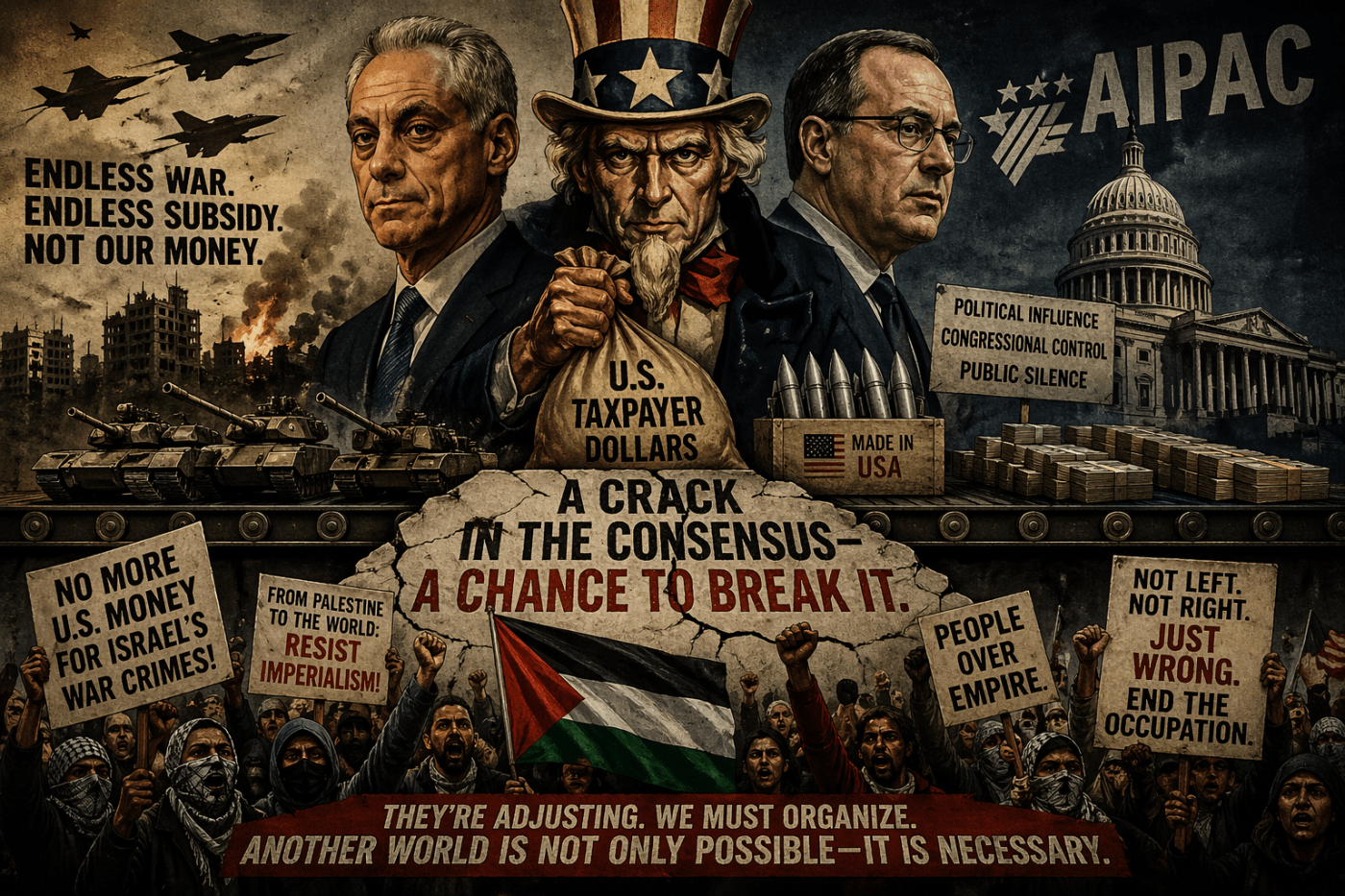
When a man of the system starts changing his tune, it’s not because he found his conscience—it’s because the system itself is under strain, and the machinery that bankrolls and justifies this violence is starting to grind and show its cracks. Look past the campaign chatter and you see the real thing: U.S. power, public money, and pro-Israel lobbying all tied together in one structure that is no longer holding as smoothly as it once did. What they call “moderation” is just adjustment—those at the top trying to keep the same system running while dressing it in language people can still stomach. The real question is whether they’ll manage to patch it up again—or whether people will push these cracks wide open and force something deeper to break.
By Prince Kapone | Weaponized Information | April 21, 2026
When Empire’s Clerk Tries On the Costume of Dissent
“Rahm Emanuel moves to the left on Israel”, published by NBC News on April 20, 2026 and written by senior national political reporter Natasha Korecki, is not really a story about Palestine, nor even finally about Israel. It is a story about an old servant of empire discovering that the political weather has changed and that the costume closet may require a new outfit. The article tells us that Rahm Emanuel, once firmly lodged inside the machinery that helped underwrite Israel’s military shield, now says U.S. taxpayers should stop subsidizing Israeli military aid. But notice how the piece handles this turn. It does not treat the matter first as a question of colonial violence, imperial subsidy, or moral complicity. It treats it as a fascinating tremor inside Democratic Party strategy, as though the real suffering here lies in the challenge of recalibrating a 2028 message. The dead, the displaced, the besieged, the bombed-out, the orphaned—these never enter as historical subjects. They appear only as the silent backdrop against which American politicians audition new lines.
That is the first trick of the article: it turns a question of empire into a question of campaign positioning. The blood is backstage; the consultants are center stage. What NBC offers is not crude propaganda in the loud, flag-waving sense. It is the smoother and more respectable kind, the kind that wears a tie, clears its throat, and invites the reader to admire a shift in elite mood as though this were the substance of political life itself. The article’s frame is built around the supposed surprise of Emanuel’s move because Emanuel is presented as a “moderate,” an insider, a figure who once occupied the room where the checks were signed and the priorities were arranged. In other words, the article quietly tells the reader that opposition becomes politically meaningful not when the oppressed cry out, not when the world documents horror, not when the structure itself stands exposed, but when one of the old house servants finally mutters that perhaps the bill has grown a little too expensive.
The article also relies on the old priesthood of approved voices. Emanuel speaks. AOC speaks. Ro Khanna speaks. AIPAC speaks. Norman Solomon is allowed in for one short measure of skepticism. The Democratic National Committee is invoked. Jewish Democrats worried about their place in the party are noted. But the people most materially bound up in the issue are nowhere granted political centrality. There is no Palestinian institution, no Gaza voice, no legal body centered as a moral authority, no sustained attention to the actual recipients of the weapons and the policy. This is source hierarchy doing its quiet work. The empire speaks to itself about its own discomfort, and the article presents that closed conversation as public reality. The colonized, meanwhile, remain spectral—present only as the condition producing debate among their managers.
Then comes the careful laundering of significance through the language of shock. Emanuel “stands out,” we are told, because he was no campus radical, no left-edge dissenter, no backbench moralist. He was a man of the center, a practitioner of the possible, a veteran of disciplined power. But that is precisely how the article flatters the political class. It implies that the issue gains seriousness only when uttered by someone with imperial credentials. The masses can rage, march, boycott, mourn, and denounce for years, and still be treated as noise. But let one veteran bookkeeper of state power clear his throat on television, and suddenly we have a “wave.” This is not journalism innocently reporting change. It is journalism reproducing a pecking order of legitimacy in which truth becomes real only after it passes through elite mouths.
There is also the matter of omission, that old reliable servant of ideological cleanliness. The article tells us there is a “prolonged war with Gaza.” That little phrase does a mountain of dishonest labor. A prolonged war. As if history had simply wandered into a storm. As if policy had not financed it, excused it, armed it, narrated it, and shielded it. The article mentions that Trump’s war with Iran, launched in partnership with Israel, has proven unpopular. Again the wording performs a cleansing function. Unpopular with whom? And why? Because of strategic overreach? Because of taxpayer fatigue? Because a widening section of the population is sick of underwriting a permanent architecture of death? The article leaves these questions floating in the air, giving the reader just enough atmosphere to feel tension but not enough structure to see the machine.
NBC’s own institutional location sharpens the meaning of this presentation. NBC News describes itself as part of the NBCUniversal News Group, and NBCUniversal is itself a subsidiary of Comcast. That does not mean every sentence arrives by corporate memo from a boardroom table. Propaganda is more elegant than that. It is often the learned instinct of institutions that know exactly how far to widen the frame and exactly when to stop before the structure comes into view. So what we get here is managed pluralism: enough disagreement to simulate openness, enough friction to preserve credibility, enough elite diversity to make the story feel textured—but never enough to shift the center of gravity away from U.S. political management and toward the actual imperial relation under dispute.
And so the article’s deepest ideological maneuver is personalization. Rahm Emanuel becomes the event. Rahm Emanuel becomes the vessel through which the reader is invited to interpret a wider breakdown. But the real story hiding inside this one is that the old consensus is rotting. The article can feel that rot under its feet, but it cannot name it directly. Instead it gives us the safer drama of one man’s repositioning. That is how establishment media often handles structural crisis: it shrinks history into personality, contradiction into optics, and imperial fracture into an anecdote about a familiar face trying to stay ahead of the crowd. The house is smoldering, but the article would prefer that we study the expression on the butler’s face.
The Subsidy They Don’t Name, The War They Won’t Measure
The article gives us just enough fact to recognize that something is shifting, but not enough to understand what is actually shifting or why. We are told that Rahm Emanuel now argues that U.S. taxpayers should no longer subsidize Israeli military purchases, that Israel should be treated like any other country buying American weapons, and that the era of special financial assistance should come to an end. We are told that this comes from a man who once helped oversee the expansion of U.S. support for Israel’s missile defense infrastructure. We are told that Alexandria Ocasio-Cortez has also broken more decisively, refusing further military aid, and that Ro Khanna has taken a similar position, arguing Israel can pay for Iron Dome itself. We are told that a fight is unfolding inside the Democratic Party over AIPAC’s influence. These are the facts the article allows to stand in the open. They are real, but they are fragments—pieces of a machine whose full structure remains deliberately out of frame.
What is missing begins with the scale of the subsidy itself. The United States is not providing symbolic assistance or occasional support. It is bound to a formalized pipeline of military financing. The 2016 U.S.-Israel memorandum of understanding—signed under Obama—committed $38 billion in military assistance over a ten-year period, a structured flow of capital, weapons, and technological cooperation that embeds Israel inside the architecture of U.S. military power. This is not generosity. It is integration. It is a system in which U.S. taxpayers are not simply helping an ally but underwriting a permanent extension of American force projection in West Asia. The article speaks of “aid” as if it were discretionary, when in fact it is institutionalized, contractual, and strategic.
Even within the pro-Israel political camp, the ground has begun to shift in ways the article only hints at. J Street, a liberal Zionist organization, now argues that direct U.S. financial support to Israel’s military should be phased out, including aspects of missile-defense funding once treated as untouchable. That matters because it shows that Emanuel’s position is not simply a personal evolution but part of a wider fracture running through layers of the political establishment itself. When sections of the system begin to question one of its core financial arteries, it is not because they have discovered morality. It is because the cost—political, strategic, and ideological—has begun to outweigh the convenience of maintaining the old arrangement without adjustment.
The article also refuses to anchor this shift in the legal and humanitarian terrain that has been building for years. The International Court of Justice issued provisional measures in January 2024 in a genocide case against Israel, placing formal international legal scrutiny on Israeli conduct. At the same time, United Nations humanitarian reporting in April 2026 documented ongoing killings and injuries in Gaza even after a declared ceasefire. These are not marginal details. They are central facts that help explain why public opinion, political rhetoric, and even establishment positioning have begun to move. Without them, the reader is left with the illusion that the shift is spontaneous, driven by electoral calculation alone rather than by the cumulative exposure of violence and legal contradiction.
There is also the question of Israel’s own material capacity, which the article leaves largely untouched. The narrative of dependency—of a small state reliant on American generosity—collapses under even basic scrutiny. Israel approved a massive 2026 state budget, and its defense spending has reached record levels, roughly $45.8 billion. This is not a fragile security apparatus barely held together by U.S. charity. It is a heavily funded, technologically advanced military structure capable of sustaining large-scale operations. The question, then, is not whether Israel can defend itself without U.S. subsidy, but why that subsidy persists at all, and what strategic function it serves for the United States.
That strategic function becomes clearer when one examines the political infrastructure that surrounds it. AIPAC operates through a formalized political funding apparatus, and AIPAC-linked networks have spent more than $221 million since 2022 shaping electoral outcomes. This is not incidental influence. It is a disciplined system of political investment that helps maintain congressional alignment with the aid structure. When the article mentions internal Democratic conflict over AIPAC, it gestures toward this reality but does not unpack its material weight. Without understanding the scale of this apparatus, the reader cannot grasp why the consensus has been so durable—or why its erosion now appears so politically volatile.
Finally, the article floats above the immediate geopolitical trigger that has accelerated this debate. The US-Israeli aggression against Iran has imposed significant costs without producing decisive strategic gains. This matters because it exposes the limits of military escalation as a tool of regional control, and because it feeds directly back into domestic U.S. political calculations. When wars expand, costs rise, and victories fail to materialize, the question of who pays—and why—can no longer be indefinitely deferred.
Placed together, these facts reveal a terrain far denser than the article allows. Public opinion has shifted, with a majority of Americans now holding negative views of Israel, and Gallup reporting that sympathies have tilted toward Palestinians. Legislative behavior has begun to reflect that shift, as efforts to block weapons sales to Israel have gained more support than in previous years. Inside the Democratic Party, leadership is struggling to contain these pressures while maintaining alignment with established funding and alliance structures.
What emerges from this reconstruction is not a simple story of ideological drift. It is a convergence of pressures—legal, military, financial, and political—that are forcing a reconsideration of a long-standing imperial arrangement. The article captures the surface ripple. The facts reveal the deeper current.
When the Subsidy Becomes a Liability and the Mask Slips
What we are witnessing is not a moral awakening. It is a structural contradiction forcing itself into the open. The arrangement that once passed smoothly through the circuits of power—U.S. financing of Israeli military supremacy as a quiet, unquestioned pillar of imperial order—is no longer moving without friction. The gears are grinding. The language is changing. And men like Rahm Emanuel, who once operated comfortably inside that machinery, now find themselves adjusting their rhetoric not because they have discovered a new truth, but because the old one can no longer be spoken without cost.
For decades, this relationship rested on a carefully maintained illusion. Israel was presented to the U.S. public as a vulnerable outpost of democracy, a small state surrounded by danger, requiring exceptional support to survive. In reality, what developed was something quite different: a deeply integrated node of U.S. military power, armed, financed, and politically shielded as part of a broader architecture of imperial domination across West Asia. The subsidy was never charity. It was infrastructure. It was the material expression of an imperial alliance that allowed the United States to project force, discipline adversaries, and maintain a strategic foothold in a region defined by energy routes, chokepoints, and geopolitical rivalry.
But every imperial arrangement carries within it the seeds of its own exposure. What was once distant becomes visible. What was once abstract becomes concrete. The violence that could be narrated away as “security” begins to accumulate in the public consciousness as something else entirely. Images circulate. Legal contradictions surface. Wars expand beyond their intended limits. And slowly, unevenly, the ideological cover that sustained the arrangement begins to erode. This is not a clean break. It is a fraying.
The Democratic Party now finds itself caught inside this unraveling. On one side stands the old consensus—anchored in alliance discipline, donor networks, and the inertia of decades of bipartisan agreement. On the other side stands a growing mass of discontent—among younger voters, among sections of the working class, among those who no longer accept the premise that their labor should subsidize a permanent war structure abroad while conditions at home deteriorate. This is not simply a generational divide. It is a contradiction between imperial obligation and domestic legitimacy.
Emanuel’s repositioning is best understood as a symptom of this tension. He does not reject the alliance. He does not dismantle the logic of militarized imperialism. What he proposes is recalibration: Israel should still buy weapons, still operate within the same strategic orbit, but without the visible subsidy that has become politically toxic. In other words, the relationship is to be preserved while its most exposed feature is modified. This is not rupture. It is damage control.
That is the essence of imperialist recalibration. When a system can no longer reproduce itself under its old ideological terms, it searches for new ones. The objective is not to abandon domination, but to reorganize it in a form that can be sustained under new conditions. If direct subsidy becomes indefensible, then the system experiments with indirect mechanisms. If public opinion turns hostile, the language shifts from “support” to “normalization,” from “aid” to “market transaction,” from “special relationship” to “equal footing.” The structure remains. The vocabulary changes.
But contradictions do not dissolve simply because they are renamed. The deeper issue is not whether Israel pays for its own weapons. The deeper issue is the entire architecture of militarized imperialism that binds the United States to endless war, permanent intervention, and the disciplining of entire regions through force. The subsidy is only one visible node in that network. Removing or restructuring it does not, by itself, dismantle the system. It merely alters one of its financial expressions.
At the same time, the shift cannot be dismissed as meaningless. Cracks in ideological consensus matter because they open space. When sections of the ruling political class begin to speak differently, it reflects pressures that can no longer be contained entirely within the old framework. The danger, however, is that these cracks are sealed over through controlled adjustment rather than expanded into structural challenge. That is the path of managed dissent: allow limited repositioning, absorb the energy of critique, and preserve the underlying order.
The real question, then, is whether this moment will remain at the level of elite recalibration or whether it will deepen into something more consequential. Will the discussion remain confined to how the United States funds Israeli militarism, or will it expand into a broader confrontation with the entire system of war, occupation, and imperial power that the funding sustains? Will this be a debate over accounting, or a struggle over structure?
The article cannot ask these questions because they exceed its function. It is designed to register movement within the political class, not to interrogate the system that produces that movement. But the facts it inadvertently gathers point beyond themselves. They reveal a system in crisis, an ideology losing coherence, and the white ruling class searching for ways to adapt without surrendering control. That is the moment we are in: not the end of empire, but the beginning of a more visible crisis within it.
From Cracks in Consensus to Organized Rupture
The shift now unfolding inside U.S. politics will not resolve itself in favor of the oppressed simply because a few figures at the top have begun to speak differently. History does not move by press release. It moves by organization, pressure, and the disciplined intervention of people who understand that moments of instability must be seized, not admired. What we are seeing is a crack in the old consensus. What matters is whether that crack becomes a rupture or is quietly sealed over by a new version of the same arrangement.
The first task is clarity. The issue is not simply “aid” in the abstract, nor is it reducible to a moral preference about foreign policy. It is about the material relationship between U.S. power and a militarized state that has functioned as a forward extension of that power. That means the struggle cannot be confined to symbolic protest or episodic outrage. It must be directed toward the concrete mechanisms through which that relationship is reproduced: appropriations, weapons transfers, legislative authorizations, and the political funding networks that discipline Congress into compliance.
Organizations already exist that are working on precisely this terrain. The US Campaign for Palestinian Rights organizes nationally to challenge U.S. military funding and build coordinated political pressure, and its public financial disclosures demonstrate an independent, grassroots funding base rather than reliance on imperial-state institutions. Their work shows that pressure can be focused, targeted, and sustained—aimed directly at the policy levers that keep the system running. This is not about appealing to conscience alone; it is about forcing political cost.
At the same time, the struggle must be linked to the broader anti-war movement, because the contradiction is not isolated to Israel alone. It is part of a regional and global structure of militarized imperialism. CODEPINK has long organized against U.S. wars and military spending, and its public nonprofit records confirm its operational independence. The task here is integration: connecting opposition to U.S. support for Israel with opposition to wider war escalation, including conflicts that extend across West Asia. Without that connection, the system will simply shift resources from one theater to another while preserving its overall logic.
The struggle must also be rooted in a deeper anti-imperialist analysis that refuses to isolate Palestine from the global system that produces it. Black Alliance for Peace articulates a position that links U.S. militarism abroad with repression and exploitation at home, and its fiscal sponsorship structure through Community Movement Builders is publicly stated. This matters because it grounds the struggle in a broader understanding of how empire operates—how the same structures that finance war abroad discipline labor and communities domestically. Without that connection, opposition remains fragmented.
Finally, there is a critical front inside U.S. political discourse itself: breaking the monopoly that pro-Israel lobbying structures claim over defining what constitutes legitimate opinion. Jewish Voice for Peace organizes explicitly against Israeli occupation and U.S. complicity. Their presence disrupts a key ideological mechanism—the conflation of support for Israeli state policy with Jewish identity—and opens space for a broader and more honest political debate.
The strategic direction that emerges from this moment is clear. The influence of AIPAC and aligned funding networks must be confronted directly, not rhetorically but materially, by exposing and contesting their role in shaping electoral outcomes and legislative behavior. Congressional pressure must be intensified around specific votes—arms sales, appropriations, and authorizations—so that support for military subsidy carries real political consequences. Every presidential contender must be forced to take a position not in vague terms, but in concrete commitments regarding the dismantling of the subsidy structure. And the struggle must be fused with the broader anti-war movement so that Palestine is not treated as an exception, but as a central front in a global system of militarized domination.
This is how moments like the present are either lost or transformed. If left to the political class, the system will adapt. It will rename the subsidy, restructure the payment, and preserve the relationship under a different banner. But if organized pressure expands the contradiction—if it forces the question beyond accounting and into structure—then what begins as recalibration can become rupture. The task is not to celebrate that the language has changed. The task is to ensure that the reality changes with it.


Leave a Reply