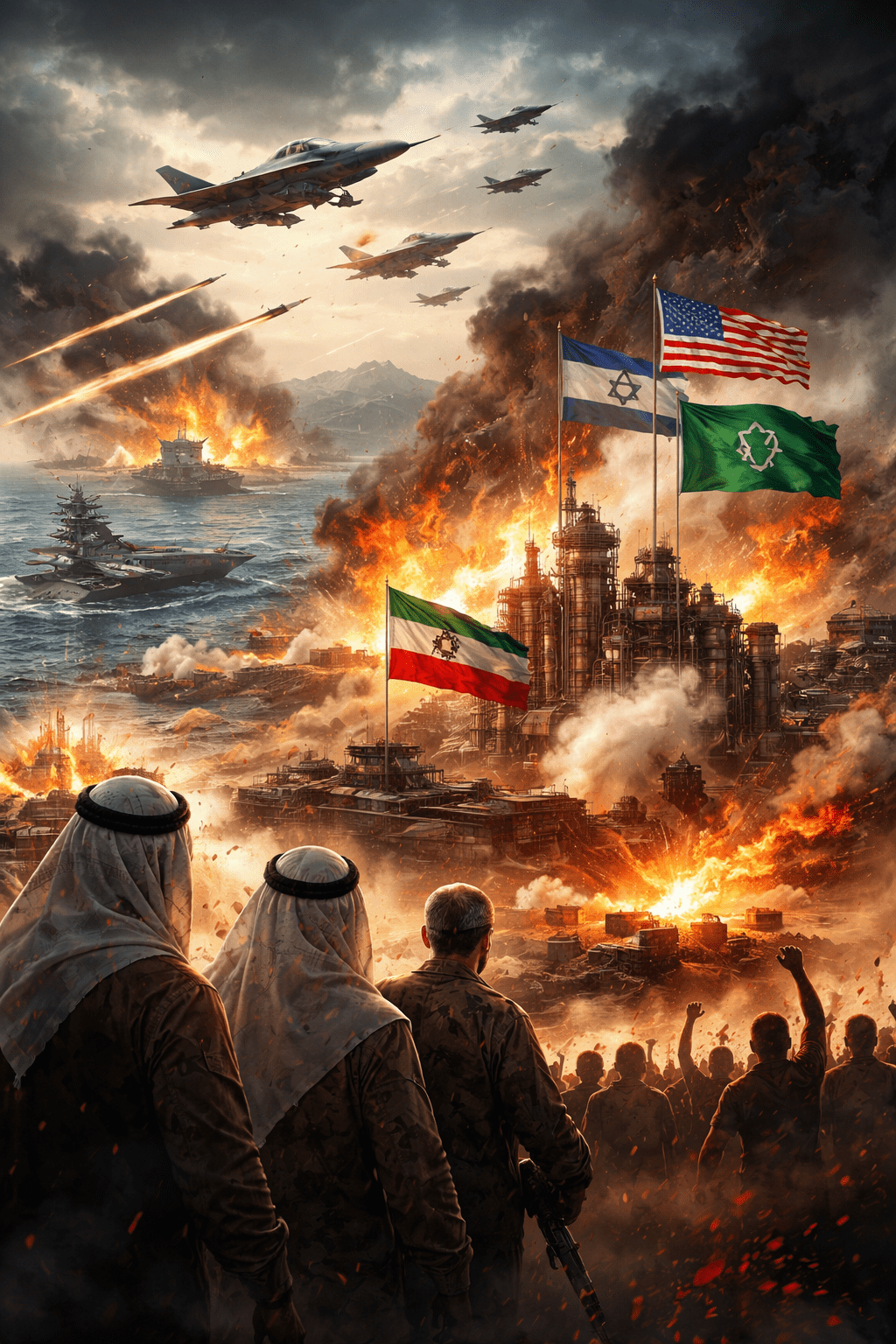
This essay begins by excavating how The Guardian recasts a U.S.-Israeli war and its aftermath into a fear narrative centered on Iran while muting the imperial structure behind the violence. It then reconstructs the real terrain: Gulf militarization, sanctions on Iran, strategic chokepoints, regional recalibration, and the diplomatic and economic relations the article leaves in the shadows. From there, it reframes the story as a symptom of imperial decay, where U.S. security architecture produces instability, Iran fights within a sovereignty struggle, and Gulf rulers cautiously probe a more multipolar order. Finally, it turns analysis toward organization, identifying the forces, solidarities, and working-class connections needed to confront the machinery of war across West Asia, the Gulf, and the imperial core.
By Prince Kapone | Weaponized Information
April 11, 2026
When Security Becomes a Story About Fear
The “Gulf states rethink security in light of US-Israel war on Iran” article by Saeed Shah, published in The Guardian on April 10, 2026, arrives wearing the pressed suit and polished shoes of sober journalism, but underneath the tailored cloth it is still the same old imperial alibi. The article tells us that the Gulf monarchies, shaken by Iranian retaliation and uncertain about what comes next, are rethinking their security arrangements in the aftermath of war. Missiles crossed the sky, diplomats made calls, analysts stroked their chins, and now the states of the Gulf must adjust to a dangerous new landscape. That is the official melody. But listen closely and the song is older than the paper it is printed on. Iran is cast as the storm, the menace, the ever-present danger around which everyone else must now reorganize their lives. The war itself enters the story not as an event with causes, authors, and structure, but as scenery. It is treated like bad weather that rolled in from nowhere. What matters, the article teaches us, is not who lit the fire but how the neighbors plan to rearrange the furniture afterward. The reader is thus guided, gently and professionally, away from history and toward mood: anxiety, uncertainty, vulnerability, and the familiar invitation to accept whatever new “security” regime the powerful are preparing to sell.
The Guardian, for all its carefully cultivated moral seriousness and liberal self-regard, remains lodged firmly inside the political economy of Western media. Yes, it is owned by the Scott Trust rather than by vulgar shareholders barking for quarterly profit. Yes, it likes to present itself as the ethical cousin in the family of imperial newspapers, the one who wears a conscience pin while attending the same banquet. But the paper still lives inside the same world of advertising markets, subscription pressures, donor circuits, and elite access. It still breathes the ideological air of the Anglo-American order. It may criticize the uglier facial expressions of empire, may even object when the knife is used too openly at the dinner table, but it rarely questions who owns the knife, who set the table, or why so many nations keep ending up on the menu. Its liberal internationalism gives it room to scold, but not room to escape. That matters because ideology is not merely a matter of opinion; it is a structure of perception. It tells a newspaper not only what to say, but what can be seen at all. And once you understand that, the silences in the piece become as loud as the words.
Saeed Shah writes from within that apparatus as a professional interpreter of power. He does not speak from the labor camp, the refinery floor, the dock, the airport cargo bay, the fishing harbor, the missile shelter, or the tenement block where migrant workers crowd together while the great men of the region make speeches about national security. He writes from the strata of respectable mediation, where correspondents, analysts, diplomats, professors, and think tank men pass explanations between one another like glasses of imported wine. That class position matters. It shapes who counts as a credible witness. In this piece the authoritative voices come from universities, policy circles, and expert institutions. Those people are not useless. But they are not neutral either. They are disproportionately drawn from worlds tied to statecraft, elite management, and imperial common sense. Absent from the article are the workers whose labor keeps the Gulf alive: the South Asian migrants who build the towers, clean the airports, drive the trucks, load the ships, maintain the pipelines, and bury their dead quietly when crisis comes. Absent are the families whose neighborhoods become strategic space on someone else’s map. Absent are the people who know war not as a policy problem but as an interruption in the rent, the wage, the meal, the medicine, the sleep. Their exclusion is not a bug in the story. It is part of the story’s method. Once the voices of ordinary people enter, the language of “security” begins to rot on the tongue.
The article’s most important labor is done through narrative framing. Iran is assigned the role of principal destabilizer, the actor whose missiles, geography, and power over the Strait of Hormuz turn the Gulf into a zone of permanent danger. It is described in language that paints it as an enduring and almost elemental threat, something like a volcano that must be monitored forever. The Gulf states, by contrast, are cast as reactive, defensive, prudent, almost long-suffering. They do not generate the crisis; they manage it. They do not project danger; they absorb it. This is not an innocent arrangement of sentences. It is the architecture of the article. It tells the reader who moves history and who merely copes with it, who threatens and who is threatened, who acts and who reacts. In that moral geography, Iran becomes history’s author while the Gulf monarchies and their partners become history’s burdened administrators. The asymmetry is ideological and deliberate. It empties the field of reciprocal force, prior coercion, and structured dependence. It turns a regional order saturated with bases, alliances, coercive systems, and imperial management into a morality tale with one dark center and a ring of nervous victims.
The article reinforces this framing through appeal to authority. The reader is led from one expert voice to another—professors, analysts, and think tank commentators who appear as neutral custodians of reason. But the authority of such voices is never dissected. Their institutional locations are not interrogated. Their assumptions are not dragged into the sunlight and beaten with a stick. Instead, their words are allowed to arrive bearing the halo of expertise. This is how bourgeois journalism launders politics into common sense. It does not always need to lie outright. Often it merely lets respectable people do the narrowing of thought for it. Once the experts have marked the boundaries of acceptable interpretation, the article can move comfortably within them. The result is a closed circuit of legitimacy: elite institution, elite newspaper, mass readership. The public is invited to consume the conclusions without ever inspecting the machinery that manufactured them.
Then comes card stacking, that old magician’s trick of showing you one hand in perfect detail while the other slips the coin into the sleeve. Iranian strikes are rendered with crisp numerical weight. The drones arrive in clusters. The missiles come in waves. The retaliatory force appears vivid, measurable, real enough to count. Meanwhile, actions by Gulf states, their allies, or the wider military system surrounding them are softened, blurred, or treated as passing notes. A reported strike on Iranian facilities is mentioned without equivalent development. Allied infrastructure appears as scenery, not agency. This is not merely imbalance. It is ideological distribution. Detail is political. What receives specificity receives emotional mass. What is left vague becomes atmospheric, incidental, secondary. By giving the reader a hard-edged picture of Iranian action and a soft-focus image of everything around it, the article engineers a hierarchy of attention. One side becomes concrete and dangerous. The other becomes background noise, the hum of the system itself.
Running beneath the whole piece is the politics of fear. Not the theatrical fear of tabloid headlines, but the low, disciplined fear of elite journalism—the kind served in moderate portions so the reader mistakes it for prudence. “Continuing threat.” “On guard for 24 hours.” An ever-present danger hovering over trade routes, cities, and alliances. This is how imperial common sense works when it wishes to appear mature. It does not scream. It repeats. It lets anxiety settle slowly into the bones. Over time, militarization begins to feel like realism, armed vigilance starts to look like common sense, and endless preparation for war becomes simply how responsible adults talk. Fear, in this mode, is not an emotional accident. It is a political solvent. It weakens memory, narrows thought, and prepares the public to accept arrangements they might otherwise resist.
And finally there is omission, the emperor of propaganda devices, the quiet sovereign that rules the whole page. The article does not dwell on how the war began. It does not seriously reconstruct initiating force. It does not situate retaliation within a chain of coercion, escalation, and strategic architecture. It does not trace the structures that made the war thinkable before the first headline announced it. It gives us consequence without cause, aftershock without quake, reaction without prior pressure. In so doing, it manufactures an eternal present, a cramped little box in which the reader can observe instability without being allowed to understand it. Once history is amputated, Iran’s behavior can be treated as self-generated, spontaneous, and self-explanatory. The region’s tensions appear to arise from temperament rather than system. Empire disappears into the wallpaper. The machinery of power is left offstage. The symptom is made to stand alone.
Put these devices together—narrative framing, appeal to authority, card stacking, fear, and omission—and the result is a story that feels measured, informed, and balanced to readers trained by liberal media to confuse polish with truth. But the calm voice is part of the trick. The moderation is one of the weapons. The piece escorts the reader, almost courteously, toward a conclusion decided in advance: that instability has one obvious source, that security has one proper logic, and that the structures producing both are best kept outside the frame. It is propaganda in a necktie. It is empire speaking softly so that its violence can continue to sound reasonable.
What the Article Leaves in the Shadows: Reconstructing the Real Terrain
The moment the scattered pieces are brought together, the article’s clean little arrangement starts to come apart in your hands. What appears on the page as a sudden crisis of Gulf confidence is nothing of the kind. It is the latest expression of a regional order already saturated with military integration, diplomatic recalculation, economic interdependence, sanctions pressure, and contending projects of sovereignty. The facts are not absent. They are dispersed, compartmentalized, and prevented from entering into relation with one another. That is often how propaganda works in its more sophisticated form. It does not always invent. It fragments. It takes a social totality and slices it into harmless little fragments until the reader can no longer see the beast as a beast.
The article’s own factual terrain already contains cracks wide enough to drive a convoy through. Saudi Arabia and Iran resumed direct ministerial contact during the conflict, and the call between Faisal bin Farhan and Abbas Araghchi centered on reducing tensions and restoring security and stability in the region. That matters because it shows that even in the middle of open regional crisis, the Saudi state was not simply hunkering down behind a wall of anti-Iran hysteria. It was also testing diplomatic channels. Bahrain publicly welcomed the ceasefire and called for de-escalation and peaceful resolution, which complicates any lazy picture of a monolithic Gulf bloc moving in lockstep around a single military line. The UAE documented sustained interceptions of ballistic missiles, cruise missiles, and drones over multiple days, which makes plain that the war was not symbolic theater or media exaggeration. It was a material confrontation with direct implications for air defense, infrastructure security, commerce, and political calculation.
The article is also not wrong that Gulf states are diversifying security relationships. It is just shallow about what that actually means. Saudi Arabia and Pakistan are linked through a Strategic Mutual Defense Agreement. That is not decorative language. It means the relationship is institutional, strategic, and embedded in a wider security horizon. The UAE and India formalized a January 2026 framework covering defense cooperation, advanced technology, training, and joint operational capacities. Again, this is not diplomatic wallpaper. It is evidence of a region no longer content to lean on one external patron while pretending that dependency is sovereignty. The Strait of Hormuz remained central to the ceasefire arrangement, with maritime passage regulated under coordination with Iranian armed forces. That one fact alone should have forced any serious writer to stop treating Hormuz as a rhetorical prop and start treating it as what it is: a concrete chokepoint where sovereignty, trade, and war collide.
But once we step beyond the article’s chosen fragments, the real architecture comes into view. This war is the product of U.S. and Israeli military aggression against Iranian territory. That is not some optional detail. It is a central fact of how the conflict is understood and justified by one of the principal actors. Remove it, and you do not simply shorten the story. You distort it. The reader is then left with the impression that Iranian actions floated down from the heavens under their own power, rather than arising within a sequence of attack, retaliation, and strategic contestation.
The same manipulation operates around Hormuz. The article frames the strait primarily as a lever of Iranian coercion. Yet the actual ceasefire position established regulated passage under Iranian coordination rather than an indiscriminate closure. That difference is not semantic fluff. It is the difference between depicting Iran as irrationally choking world commerce and recognizing that it was asserting controlled authority over a strategic waterway under war conditions. Bourgeois media loves to call sovereignty “coercion” when sovereignty is exercised by the wrong state.
The Gulf itself is also not some innocent stretch of desert suddenly exposed to danger by an unruly neighbor. It has been built, over decades, into a heavily militarized imperial security zone. GCC–U.S. summit documents lay out joint deterrence, intelligence sharing, and defense of key waterways such as Hormuz and Bab al-Mandab. That means the region entered this crisis already woven into a U.S.-led war architecture. The bases, security agreements, command relationships, and integrated defense assumptions were not aftereffects of the conflict. They were preconditions of it. The Gulf did not wake up one morning and discover that foreign military integration made it vulnerable. Vulnerability was built into the arrangement from the start. Protection came wrapped around exposure like a gift basket from hell.
The article also compresses time until history becomes a smudge. Iran and Saudi Arabia had already moved through the Beijing normalization process and restored diplomatic relations. That rapprochement involved not just symbolic smiles but the reopening of channels and the revival of cooperative mechanisms. Iran and the UAE had also resumed diplomatic engagement and discussed expanded trade, consular relations, and joint economic capacities. These are not marginal details. They show that before the war sharpened contradictions, the region was already experimenting with recalibration, de-escalation, and a partial loosening of older antagonisms. In other words, the war did not arrive in a frozen landscape of eternal hostility. It struck a region already moving, already rethinking, already trying to negotiate new space under changing world conditions.
Then there is the economic layer, which liberal journalism habitually flattens into abstractions about “interests” because class society finds concrete need embarrassing. The UAE–India relationship links defense with LNG, food trade, infrastructure, and financial integration. These are not random sectors on a PowerPoint slide. They address material needs. Energy security for India. Food security for the UAE. Supply-chain stability. Investment flows. Strategic redundancy. A state concerned with food, energy, finance, and defense at the same time is not merely “diversifying partners.” It is trying to protect the material basis of reproduction under unstable conditions. Saudi–Pakistan ties are similarly situated within a broader frame of regional peace and security, not simply a wartime handshake but a more durable strategic relation.
And standing behind all of this like a shadow that bourgeois commentary keeps pretending not to see is the sanctions regime on Iran. Restrictions on oil exports, banking access, medicine, and industrial imports have shaped Iran’s economic and security posture over years of sustained pressure. Sanctions are discussed in polite Western discourse as if they were clever diplomatic nudges, but in material life they are instruments of suffocation. They constrict development, narrow policy space, distort economic planning, and teach a besieged state that control over strategic resources and deterrent capacity is not optional. Any serious account of Iranian behavior that does not center this coercive history is not serious at all.
Once these facts are placed in relation to each other, the whole narrative changes. The region is not stumbling blindly into a new age of insecurity because one state became too dangerous. It is living inside an order already structured by military integration, coercive diplomacy, economic vulnerability, and contested sovereignty. The Gulf monarchies are not merely reacting to Iran. They are navigating a world in which dependence on the U.S. security umbrella creates its own risks while emerging partnerships with Pakistan, India, and others open new maneuvering space. Iran is not acting in a vacuum. It is moving under the weight of sanctions, external attack, and a long struggle to preserve sovereign room for action. The war did not invent these conditions. It stripped the paint off them.
When the Mask Slips: Security, Sovereignty, and the Crisis Beneath the Narrative
Once the full terrain is visible, the article’s tale of insecurity starts to smell less like analysis and more like ideological bookkeeping. What it calls “instability” is not an unfortunate regional condition produced by the bad habits of one unruly state. It is the visible expression of a deeper contradiction inside the imperial order itself. A system built in the name of stability now produces instability as one of its regular outputs. It sells protection and distributes exposure. It promises order and manufactures crisis. That is not a glitch in the machine. That is the machine operating according to design.
The Gulf did not wander accidentally into danger. It was built into a forward containment architecture in which military bases, integrated deterrence, intelligence coordination, and naval chokepoint management form the skeleton of regional security. The point of this architecture was never simply “peace.” It was discipline: discipline of trade routes, of energy flows, of regional alignments, of states deemed too independent, and of any wider order that might emerge beyond U.S. supervision. In such a system, war is never far away because coercion is always nearby. You cannot construct a region as an armed platform of imperial management and then act shocked when it behaves like one. To lament the smoke while admiring the arsonist’s engineering is the specialty of liberal geopolitics.
Seen from that angle, Iran’s posture looks very different. A state under long-term sanctions, strategic pressure, and direct military threat does not behave like some abstractly free actor making whimsical choices. It behaves like a state fighting to preserve sovereignty under siege. Its missile programs, regional relationships, maritime leverage, and insistence on controlling strategic space are not floating ideological preferences. They are instruments shaped by coercion. They are the tools of a state that learned, over years, that weakness invites suffocation and dependency invites dismemberment. One does not have to romanticize the Iranian state to understand this. One only has to reject the childish morality play in which all forms of force are equal except that force exercised by the imperial center somehow arrives as “security” while force exercised in resistance arrives as “destabilization.”
That inversion is the key trick of the whole narrative. The article invites the reader to fear Iranian capacity while ignoring the military web in which the Gulf is already embedded. But capacity does not emerge in the abstract. It emerges in relation to threat. Deterrence is born in the nursery of coercion. Strategic depth is sought where encirclement is felt. Maritime leverage becomes precious where sanctions seek to close every other door. To treat Iranian resistance as the beginning of the story is to erase the pressure that made such resistance rational. It is to turn consequence into cause and then congratulate oneself for being objective.
The Gulf monarchies, meanwhile, are not simply passive spectators trembling at the edge of Iranian power. Their recalibration shows consciousness of a changing world, though in cautious and contradictory form. By reopening channels with Iran, broadening ties with Pakistan and India, and deepening multi-sector strategic relations, they are acknowledging a truth the article circles but cannot name: reliance on a single imperial patron is a vulnerability masquerading as protection. The U.S. military umbrella does not merely shield. It also targets. It anchors local regimes to a regional war system whose retaliatory consequences they do not fully control. The bases remain, the security ties remain, the weapons deals remain—but their political meaning has shifted. What once seemed like insurance increasingly resembles entanglement.
This is where the crisis of imperialism becomes visible. Unipolar dominance depends not merely on military superiority, but on the credibility of control. The imperial center must convince partners that it can manage escalation, punish adversaries, protect aligned states, and preserve the flow of commerce all at once. But when deterrence yields retaliation, when allied territory becomes a battlefield, when chokepoints become contested, and when regional states begin looking sideways for additional partners, the aura of omnipotent management starts to crack. Empire does not die in a single cinematic explosion. It decays unevenly. Its promises become expensive. Its protections become hazardous. Its clients begin to wonder whether the bodyguard is also the man attracting the bullets.
That is why what we are witnessing is more than a regional security adjustment. It is part of a wider multipolar recalibration. States across the region are not severing all ties to the old order, but neither are they content to remain entirely trapped inside it. Saudi Arabia leans into wider diplomatic and defense relationships. The UAE knits security to food, finance, and energy networks stretching toward India. Pakistan appears not simply as a bilateral ally but as a regional interlocutor in a changing strategic field. Iran continues to defend sovereign space while seeking to survive a sanctions architecture designed to shrink its horizon. None of these moves amount, by themselves, to revolutionary rupture. But together they indicate that the old unipolar map no longer commands unquestioned obedience. The region is probing for room.
Yet this shift is not clean, pure, or complete. It unfolds through contradictions. The Gulf states remain deeply enmeshed in the very U.S.-led order whose limits they increasingly recognize. Iran asserts sovereignty under conditions of real pressure, but does so within a world still heavily shaped by imperial coercion. New partnerships emerge, but old dependencies endure. This is why the present moment feels so tense. It is not because nothing is changing. It is because much is changing without having yet settled into a new balance. This is imperialist decay in lived form: a world where the old architecture still stands, but its beams creak, its wiring sparks, and the people inside it begin to look for exits.
The article cannot tell this story because to do so it would have to indict the system from which it draws its assumptions. It would have to admit that “security” in the imperial lexicon often means the armed administration of dependency. It would have to acknowledge that instability is not generated by a single rogue actor but by a whole network of military integration, coercive policy, sanctions, and strategic chokepoint management. It would have to say plainly that the disorder haunting the region is not external to the imperial order but one of its products. That would be too much honesty for a respectable newspaper over breakfast.
For the global working class and the oppressed nations whose labor and resources sustain this whole apparatus, none of this is abstract. The energy extracted from the region, the logistics routes secured through armed dominance, the infrastructure defended in the name of stability, the sanctions imposed in the language of rules—these are all parts of a world system built on unequal power. Workers in ports, pipelines, warehouses, airports, construction sites, shipping lanes, and industrial zones are tied materially to the conflicts that elite commentary treats as chess matches. The bombs fall on one territory, the sanctions choke another, the bases anchor a third, but the system binding them together is global. That is why the story of the Gulf is not merely regional. It is a chapter in the wider crisis of imperial rule.
The recalibration now visible across the Gulf is therefore not simply policy adjustment. It is a signal flare from a changing world. The old guarantees no longer convince as they once did. The old architecture still commands great force, but less certainty. The instability is real, yes—but its source lies not in the fantasy of one permanently menacing state. It lies in a structure that can no longer secure the order it claims to defend. The empire still speaks with the voice of command, but underneath the command one can hear the grinding of gears. History has not yet delivered the new world in full, but the old one is sweating through its suit.
From Fragmentation to Solidarity: Where Organization Begins
If the first task was to expose the lie and the second to reconstruct the terrain, then the task now is to ask the only question worth asking in politics: where are the people already moving, and how do we strengthen their hand? It is not enough to condemn war in elegant prose and then go home feeling morally washed. Empire has survived for centuries not because it is omnipotent, but because it is skilled at fragmentation. It separates the Gulf worker from the South Asian migrant, the migrant from the diaspora, the diaspora from the antiwar movement, the antiwar movement from labor, labor from anti-imperialism, and everyone from the larger structure producing the violence. It turns every wound into a private injury and every struggle into a separate file folder. Then the pundits call the resulting confusion “complexity,” as if dismemberment were a philosophical category.
Any serious organizing line has to begin by breaking those separations. The lesson here is not merely that war is bad—children know that before they can read a newspaper. The lesson is that the architecture producing war links together the Gulf’s militarization, migrant super-exploitation, repression in West Asia, information warfare in the North, and the disciplining of political resistance across borders. That means solidarity cannot be sentimental. It has to be organized where the lines actually connect.
Samidoun: Palestinian Prisoner Solidarity Network matters in this regard because it understands that the prison cell, the border checkpoint, the surveillance apparatus, and the bombing campaign are all relatives in the same family of domination. Its work links Palestinian prisoner struggles to broader systems of criminalization and repression across the imperial world. That is invaluable because empire never wages war only with planes and missiles. It also wages war through classifications, blacklists, prisons, intelligence sharing, and the transnational circulation of repression techniques. Samidoun has built an explicitly internationalist organizing model connecting diaspora communities in North America and Europe with resistance in West Asia, and it refuses the fake line between “domestic” repression and “foreign” policy. Its own materials state plainly that it relies on grassroots donations and volunteer labor rather than state or foundation sponsorship, and public nonprofit records do not show the usual ties to Western government funding streams. That matters because organizations financed by empire rarely sustain politics against empire for long. Money has a memory. It usually remembers who fed it.
Workers in Palestine is important because it drags labor back into a field the bourgeoisie constantly tries to strip of class content. Occupation and war are not simply questions of diplomacy. They are questions of work, movement, wages, industrial access, permits, and the right of ordinary people to reproduce life under conditions designed to make life impossible. Workers in Palestine links Palestinian labor to international trade unions and worker solidarity networks, grounding anti-imperialist struggle in the daily violence of exploitation rather than in the sterile language of elite conflict management. Its own documents describe a worker-led structure built through grassroots union collaboration and solidarity support, while its public charity filings show a donor-based model rather than dependence on prohibited state-linked foundations. That means the organization is not simply speaking for workers in the abstract. It is built around the fact that the worker’s body is often the first battlefield and the last to be acknowledged.
Beyond these registered organizations lies another layer that must not be overlooked simply because it is less polished. Across social media, neighborhood circles, and informal mutual-aid channels, diaspora-led formations and worker collectives have been taking shape among communities with direct ties to West Asia and the Gulf. Among South Asian migrant workers in the UAE, Qatar, and Saudi Arabia especially, informal networks have been used for wage struggles, legal defense, emergency support, and the practical sharing of information under harsh and highly unequal conditions. These formations often do not come dressed in the respectable attire of nonprofit civilization. They may not have elegant websites, annual reports, or donor decks. Good. Too often those things are the uniforms of domestication. What matters is that these workers sit inside the very logistics, energy, and construction systems that keep the Gulf functioning. They are close to the arteries of the regional economy. Their labor is part of the material infrastructure through which war, sanctions, and militarization are felt. If antiwar politics does not reach them, then antiwar politics remains half-blind.
Peoples Dispatch also matters, not as a neutral news outlet floating above struggle, but as part of the communications infrastructure needed by internationalist politics. It consistently places West Asian conflicts inside a wider map of labor, anti-imperialist struggle, and Global South resistance, refusing the exoticizing habit of Western media that treats the region as a permanent theater of ancient chaos. Its public materials identify it with movement-based networks rather than corporate or state patronage, and public nonprofit records reinforce that it sits outside the usual prohibited funding channels. That matters because information is not neutral terrain. Empire fragments not only labor and geography, but perception itself. It teaches each people to experience the system only at the point where the knife enters their own skin. Movement media helps reconnect the body.
From these formations a strategic direction emerges, and it should be stated plainly. First, solidarity has to move along the labor chains that bind the Gulf to the broader Global South: port workers, truck drivers, warehouse workers, airport laborers, energy workers, seafarers, construction workers, and the logistics systems through which fuel, food, capital, and weapons circulate. These are not secondary terrains. They are chokepoints. They are places where imperial war becomes ordinary work and where organized disruption can begin to raise the cost of destruction for those who profit from it. Second, diaspora communities in the Global North must be organized not as isolated cultural enclaves or pleading minorities, but as active political extensions of wider struggles—capable of connecting local agitation, public pressure, labor solidarity, and antiwar campaigns to the sovereignty struggles of West Asia and the Gulf. Third, independent political communication has to be strengthened because imperialism does not merely bomb cities; it bombs memory, perception, and language. It takes a connected system of exploitation and makes it appear as disconnected tragedies. Then it calls anyone who notices the connections “ideological.” As if ruling-class amnesia were realism.
This means the task is not symbolic protest. Symbolic protest has its place, but the empire is not trembling because someone carried a tasteful placard between brunch and dinner. The task is alignment—political, organizational, and strategic. The same order that threatens Iran, militarizes the Gulf, and guards chokepoints with warships also super-exploits migrant labor, disciplines dissent in the imperial core, and treats whole regions as service corridors for capital. Once those connections are made, struggle becomes more than reaction. It becomes coherent. Then the antiwar movement stops being a moral appeal to the conscience of rulers and starts becoming part of a larger anti-imperialist force.
Solidarity, in that sense, is not a slogan, not a hashtag, not a tearful humanitarian pose struck for the cameras. It is a material practice of connection. It is workers, movements, prisoners, migrants, families, and communities recognizing that the borders separating their suffering were drawn by the same hands that profit from it. It is the patient, disciplined, often exhausting work of turning scattered injuries into organized force. That is where fragmentation begins to die. That is where resistance stops being decorative and starts becoming dangerous. And dangerous, for the people who have made a world out of war, is exactly what it ought to be.
 Weaponized Information
Leave a comment