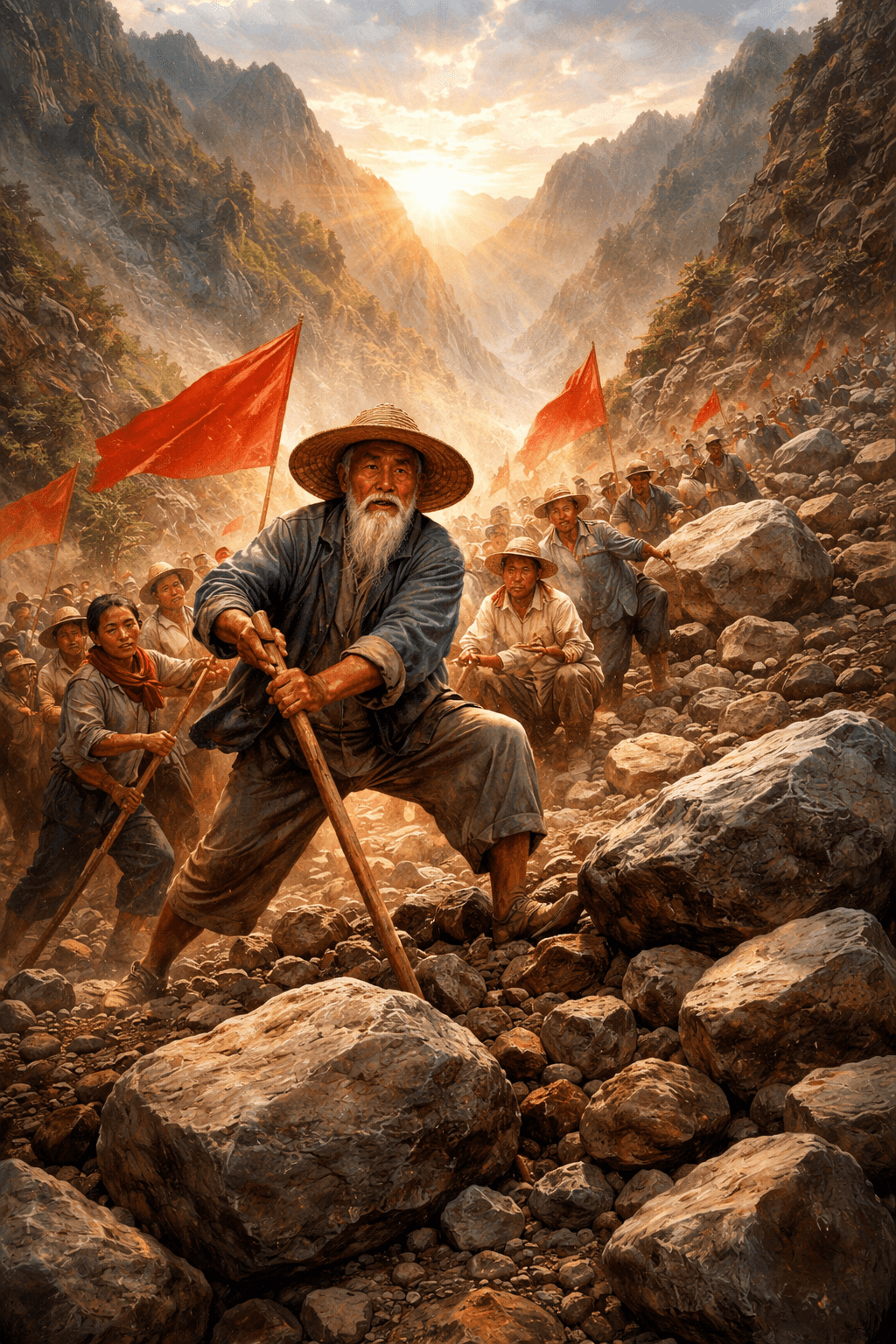
From Mao’s seizure of sovereignty to Xi’s effort to discipline capital, China’s modern history is neither a fall from revolutionary purity nor a smooth ascent into capitalism, but a protracted socialist struggle through contradiction. Each phase of development generated new class forces, new dangers, and new strategic adjustments, as the Party-state sought to preserve political command over capital inside a hostile imperialist world-system. Today, under the pressure of the New Cold War and the decline of Western hegemony, China’s socialist-rooted development model has become one of the central forces reshaping the global balance of power and opening the road to a multipolar world.
By Prince Kapone | April 2026
When the Poor Took Power and Refused to Apologize for It
Let us begin where polite history refuses to begin. Not with “mistakes,” not with “disasters,” not with the well-fed lamentations of those who only discovered China when it started producing cheap goods for their consumption. No—let us begin with a country that had been beaten, carved, taxed, occupied, starved, and humiliated for over a century. A country where the peasant did not own the soil he bled into, where famine was not an exception but a recurring season, where sovereignty itself was leased out to foreign powers like a storefront in a colonial marketplace. This was not a tragedy of poor management. This was the normal functioning of imperialism. And then, inconveniently for the civilized world, the peasants stood up.
The Chinese Revolution was not a dinner invitation extended to history; it was an eviction notice served to empire and its local landlords. When the Communist Party took power in 1949, it did not inherit a functioning nation—it inherited a bleeding wound. Industry was minimal, infrastructure shattered, literacy scarce, and life expectancy insultingly low. What followed was not a miracle, but something far more threatening to the dominant order: a deliberate reorganization of society by those who had previously been treated as disposable.
Land reform came first, and with it, the end of landlord power as a social fact. This was not an academic exercise in redistribution; it was the destruction of a class that had monopolized land, labor, and life itself. Millions of peasants gained access to land, and with that, a measure of dignity that had long been denied. Predictably, this is remembered in elite discourse as “violent excess.” History, it seems, becomes immoral the moment the poor stop dying quietly. It becomes an abomination once the rich and powerful are compelled to live like everyone else.
From there, the revolution moved to build what China did not have: a sovereign state capable of defending itself and organizing development. And here we arrive at the first major contradiction that the empire’s storytellers prefer to skip over. The same period they dismiss as “chaotic” is the period in which China consolidated its territorial integrity, resisted external domination, and established the institutional framework that would later sustain its rise. One cannot have it both ways: either China was a failed state in this period, or it laid the foundations of the state that now unsettles the global order. The evidence suggests the latter.
The social transformations were just as profound. Literacy campaigns spread across the countryside. Schools appeared where none had existed. Healthcare, once the privilege of urban elites, began to reach rural populations through systems like the barefoot doctors—mocked by intellectuals who confuse elitism with expertise, but recognized by millions as the first time medicine belonged to them. Life expectancy rose not because of charity from above, but because of organization from below. These are not ideological claims. They are measurable, material shifts in the conditions of life.
Industrialization, too, followed a path that confounded orthodox expectations. Without colonies to plunder or foreign capital to lean on, China pursued a strategy that combined central planning with decentralized initiative. Rural industry expanded, small-scale enterprises spread across villages and towns, and by the late Mao period tens of millions were employed in these sectors. This was not inefficient backwardness, as it is often caricatured, but a different model of development—one that refused to sacrifice the countryside on the altar of urban accumulation. Later, when reform-era economists congratulated themselves on the success of township and village enterprises, they were standing on foundations laid in the very period they were taught to condemn.
Now, we must speak of the Great Leap Forward—but we will do so without the theatrical exaggerations that pass for analysis in polite company. The Leap was an attempt to break the slow, dependency-bound trajectory imposed on the Global South—to industrialize, to transform agriculture, to mobilize human capacity at a scale that history had rarely seen. It produced real achievements in irrigation, infrastructure, and local industry. It also produced serious problems: inflated reporting, administrative pressure, ecological strain, and policy errors that collided with extremely difficult natural conditions. The result was a severe crisis, including famine. This is not in dispute.
What is in dispute—and must remain so—is the lazy morality play that reduces this complex process to the whims of a single individual or the supposed irrationality of a revolutionary project. Scholars like William Hinton, writing from the ground, documented not a landscape of passive victims but of peasants struggling, adapting, and participating in a transformative process. Mobo Gao, drawing from rural memory, reminds us that the Mao era cannot be reduced to catastrophe, that for many in the countryside it represented gains in equality, security, and social provision that would later be eroded.
And here is the point that makes the guardians of orthodoxy particularly uncomfortable: the Chinese state did not collapse under the weight of this crisis. It did not fragment into warlordism. It did not return to colonial dependency. It adjusted, recovered, and continued. Compare this, if one dares, to the record of postcolonial states subjected to the tender mercies of international finance, where crisis is often followed by structural adjustment, asset stripping, and long-term stagnation. The difference is not accidental. It is structural.
Then came the Cultural Revolution, that great scandal in the narrative of order. It is usually presented as a decade of madness, a cautionary tale about what happens when ideology runs amok. But this framing tells us more about the anxieties of elites than about the realities of the period. The Cultural Revolution was, at its core, an attempt—flawed, volatile, and at times destructive—to confront the emergence of new hierarchies within a socialist system. It was a struggle over who would control the direction of society: a bureaucratic elite consolidating power, or the masses who had made the revolution in the first place.
Millions participated—not as mindless followers, but as agents in debates over education, healthcare, culture, and governance. Rural education expanded, healthcare systems deepened, infrastructure projects continued, and experiments in popular participation proliferated. There was violence, there was excess, there was chaos—revolutions are not conducted with parliamentary decorum—but there was also a genuine attempt to reimagine social relations. To erase this complexity is not scholarship; it is ideological housekeeping.
So what remains, when the noise is stripped away? The Mao era was a period of extraordinary transformation, rooted in the mobilization of the poor and the reorganization of social life on new foundations. It achieved what few postcolonial societies managed: sovereignty, basic industrialization, mass literacy, expanded healthcare, and a significant reduction in inequality. It also revealed the limits of revolutionary ambition, the dangers of bureaucratic distortion, and the difficulty of sustaining egalitarian momentum in a hostile world system.
In other words, it was not a failure. It was a beginning—contradictory, unfinished, and deeply human.
“When the Revolution Learned to Bend Without Breaking”
By the time Mao committed the error of dying, China was not rich—but it was no longer broken. That distinction matters, though it is often erased by those who prefer their histories neat and their revolutions defeated. The country that Deng Xiaoping inherited in the late 1970s was not a collapsed experiment crawling out of ruin. It was a sovereign state with an industrial base, a literate population, a functioning administrative apparatus, and—perhaps most dangerously for the global order—a memory among the masses that history could, in fact, be made from below. The problem was not survival anymore. The problem was stagnation under scarcity, and the limits of a model that had built equality faster than it could generate abundance.
This is where Deng Xiaoping enters—not as a savior descending into chaos, but as a strategist confronting a new contradiction. How do you increase productivity, acquire technology, and generate surplus without reopening the door to domination? How do you “develop” without quietly reinstalling the very class relations the revolution had smashed? It is easy, in retrospect, to treat Deng’s answer as obvious. It was anything but. It required a gamble: to reintroduce market mechanisms without surrendering political control, to invite capital without allowing it to rule.
The first stones Deng stepped on were in the countryside. The Household Responsibility System did not privatize land, despite the convenient myths. Land remained collectively owned. What changed was the allocation of use rights, contracted to individual households, allowing families to make decisions about production and retain surplus beyond state quotas. The immediate effect was undeniable: productivity rose, incomes increased, and the countryside—long disciplined under collective structures—experienced a release of initiative.
But here, already, the contradiction sharpened. The earlier collective system had not only organized production; it had organized life. It coordinated irrigation, distributed risk, provided basic welfare, sustained education and healthcare, and acted as a buffer against the brutal arithmetic of the market. As scholars like Lin Chun and Zhun Xu remind us, the original reform vision did not intend to simply dissolve this layer. It imagined a dual structure: household incentives nested within collective coordination. What happened in practice was something else. The collective layer weakened, and with it, the institutional protection that had underpinned rural equality. Productivity rose, yes—but so did differentiation. The peasantry, once politically elevated as a collective force, began to fragment into uneven strata.
Meanwhile, the state moved outward. Special Economic Zones appeared along the coast—not as surrender, but as laboratories. Foreign capital was invited, but under conditions set by the state. Technology transfer was encouraged, exports disciplined, and integration into global markets carefully managed. This was not the shock therapy imposed on other post-socialist societies. There was no wholesale privatization of land, no handing over of financial sovereignty to international institutions, no collapse of the state into a broker for foreign capital. Deng’s formula—sometimes mocked as pragmatism without principle—was in fact brutally clear: use the market, but do not let the market use you. Or as Deng famously put it, “it doesn’t matter if a cat is black or white; as long as it can catch mice, it is a good cat.”
Still, markets have a way of teaching lessons that no theory can fully anticipate. The introduction of dual-track pricing—where goods were sold both at planned and market rates—generated both efficiency and opportunity. Enterprises could profit, production expanded, and bottlenecks eased. But alongside this came corruption, arbitrage, and the emergence of new intermediaries who learned quickly how to navigate the gap between plan and market. The egalitarian ethos of the Mao era began to erode, not in slogans at first, but in visible differences: who had access, who had connections, who could turn policy into profit.
This was not an accidental side effect. It was the social cost of the chosen path. Coastal regions surged ahead, while inland areas lagged. Managers and technocrats gained influence. Township and village enterprises flourished in some regions, creating new forms of local accumulation, while in others, opportunities remained scarce. The revolution had promised to flatten hierarchy; reform was beginning to redraw it.
By the late 1980s, the contradictions had become impossible to ignore. Inflation surged. Corruption scandals spread. Ideological certainty weakened as the old language of socialism coexisted uneasily with the new practices of the market. It is here that 1989 must be understood—not as a simple drama of democracy versus dictatorship, but as a moment when multiple tensions converged: external pressure, economic strain, social differentiation, political uncertainty, and competing visions of China’s future.
The Party’s response—decisive, repressive, and controversial—was shaped by a lesson drawn from beyond its borders. The Soviet Union was unraveling, not only economically but politically. For the Chinese leadership, the conclusion was stark: political liberalization without firm control could dissolve the state itself. Whatever one thinks of that conclusion, it defined the path forward. “Cross the river by feeling the stones,” Deng advised. Reform would continue, but under tightened political command. The stones in the river would be felt more carefully, but the crossing would not be abandoned.
And so, by the end of the Deng era, a new social landscape had emerged. The peasantry had gained in the short term, but had begun to differentiate and lose collective protection. Managers, technocrats, and local entrepreneurs had risen, navigating the expanding space between state and market. Coastal regions had become engines of growth, while inequalities deepened. The foundations of a bourgeois stratum—still embedded within a socialist framework, still constrained by Party authority, but increasingly visible—had begun to take shape.
Deng did not restore capitalism in the classical sense. The commanding heights remained under state control. Political power remained centralized. Sovereignty was not surrendered. But he did something perhaps more complex—and more dangerous. He opened a path through which capital could grow within socialism, a path that generated unprecedented development while simultaneously producing new class forces that would, in time, test the very boundaries of political control.
The revolution had learned to bend. The question, now, was whether it could keep from breaking.
When the Market Was Unleashed but the State Refused to Die
If the 1980s were a cautious experiment, the 1990s were a decisive wager. The question was no longer whether China would use the market, but how far it would go—and whether the Party-state could ride the tiger without being eaten by it. The collapse of the Soviet Union hung over this moment like a warning written in fire. In Eastern Europe and Russia, the socialist state had not been reformed; it had been liquidated. Assets were stripped, societies were shattered, and sovereignty was auctioned off under the polite name of transition. China watched this unfold and drew a lesson that would shape everything that followed: do not surrender the state, no matter how far you open the economy.
Deng Xiaoping’s Southern Tour in 1992 was not a nostalgic farewell tour of an aging revolutionary. It was a political intervention—a signal that hesitation was over, that development would accelerate, and that the experiment with market mechanisms would deepen. The phrase “socialist market economy” was formalized, and with it a kind of ideological judo: the market would be absorbed into socialism, rather than socialism dissolved into the market. Whether this was a clever synthesis or a dangerous contradiction would depend on what came next.
What came next was surgery—painful, deliberate, and transformative. State-owned enterprises, long the backbone of the socialist economy and the guarantors of urban security, were restructured. The slogan was tidy: “grasp the large, let go of the small.” In practice, it meant consolidating strategic sectors under state control while closing, merging, or privatizing smaller and less efficient firms. For millions of workers, this was not a slogan but a rupture. The iron rice bowl—the promise of lifetime employment, housing, healthcare, and dignity—was broken. Workers who had once been the political core of the socialist project found themselves laid off, reclassified, or simply abandoned to a new reality.
The term xiagang does not translate neatly. It is often rendered as “laid-off,” but that polite phrase hides a deeper wound. These were not just unemployed workers; they were a class dislocated from the social compact that had defined their place in society. The revolution had elevated them. Reform, in this phase, displaced them. And yet, even here, China did not follow the path of shock therapy. The state did not collapse. It did not relinquish control over the commanding heights. The banking system remained under public authority. Strategic industries remained state-owned. The surgery was brutal, but it was not an amputation of the state itself.
While one part of the old working class was being restructured, another was being created—on a scale unprecedented in human history. Rural migrants flooded into cities, factories, and construction sites, forming the backbone of China’s new export economy. They built the skyscrapers, assembled the electronics, stitched the garments, and powered the workshops that would turn China into the “world’s factory.” But they did so under conditions that revealed a new contradiction at the heart of reform.
The hukou system—often described as a residency registration mechanism—became, in effect, a structure of precarious citizenship. Migrant workers could labor in the cities, but they were not fully of the cities. They lacked access to public services, social protection, and stable urban rights. They were indispensable and yet marginal, central to production but peripheral in recognition. Families were split, with children left behind in rural areas while parents worked long hours in distant factories. If the Mao era had attempted to erase the divide between town and countryside, the reform era, in this phase, reorganized it under new terms.
And yet, amid all this transformation, one principle remained intact: the refusal to surrender sovereignty to global finance. When the Asian Financial Crisis struck in 1997, sweeping through economies that had opened themselves to speculative capital, China held its ground. It did not devalue its currency. It did not submit to IMF restructuring. Capital controls remained in place. The state absorbed the shock and stabilized the system. This was not ideological stubbornness; it was strategic clarity. Integration into the global economy would proceed, but not at the price of losing control over it.
The next step was even more consequential. China’s accession to the World Trade Organization in 2001 marked its full entry into global production networks. Exports surged. Foreign reserves accumulated. Factories multiplied. Supply chains stretched across continents, with China at their center. This was the moment when China ceased to be merely a participant in globalization and became one of its architects.
But growth, as always, carried its own logic. The expansion of export manufacturing intensified competition, both domestically and internationally. Inequalities sharpened. Coastal regions surged ahead, while inland areas lagged behind. A new class of entrepreneurs, developers, and export capitalists emerged—visible, confident, and increasingly influential. At the same time, the old socialist working class bore the scars of restructuring, and the new migrant proletariat labored under conditions that recalled, in uncomfortable ways, the early histories of industrial capitalism elsewhere.
Here, the class structure of the 1990s comes into focus with brutal clarity. Laid-off state workers—once the backbone of socialist legitimacy—became a wounded class, struggling to adapt to a world that no longer guaranteed their place. Migrant laborers formed a vast, disciplined, and precarious proletariat, essential to accumulation but denied full social integration. Private capital—whether in real estate, export manufacturing, or intermediary sectors—expanded rapidly, forming the embryo of a bourgeois stratum within a socialist framework. And above it all, the state retained control over strategic sectors, finance, and the overall direction of development.
This was not a simple transition from socialism to capitalism. It was something more unstable: a hybrid formation in which market forces were unleashed within a structure still governed by a party-state that refused to relinquish command. The result was growth—extraordinary, undeniable, historically significant. But it was also a new geography of inequality, a reconfiguration of class relations, and the emergence of forces that would, in time, test the limits of political control.
China had entered the global market without surrendering its state. The question now was whether the state could continue to command the market it had unleashed—or whether, slowly and quietly, the balance would begin to shift.
When the State Tried to Heal What the Market Had Torn Apart
By the early 2000s, China had achieved something undeniable: it had grown at a pace that startled the world and unsettled the empire. But growth, as Marx might have reminded the applause line, is not a moral category. It tells you how fast the machine is moving, not who it is moving for, nor who is being ground beneath it. By the time Hu Jintao stepped into leadership, the question was no longer how to unleash development—the 1990s had already done that with ruthless efficiency. The question was how to stabilize a society that had been stretched, stratified, and in many places quietly wounded by that very success.
Hu’s era is often dismissed as bland, technocratic, a kind of bureaucratic intermission between more dramatic acts. That is a mistake—though a convenient one. Because what Hu inherited was not simply a “rising China,” but a China pulled in different directions by the contradictions of its own transformation. The factories were humming, the exports were surging, foreign reserves were piling up like trophies of globalization. But beneath that surface, the fractures were visible to anyone willing to look without ideological blinders. Inequality had widened sharply. Rural regions lagged behind the coast. Migrant workers built cities they could not fully inhabit. Former state workers carried the scars of restructuring. Corruption had seeped into the joints of the system, particularly where local governments and developers discovered that land could be turned into profit faster than any factory could produce it.
Hu’s response did not come wrapped in revolutionary slogans. It came in the language of management—“Harmonious Society,” “Scientific Development.” Terms that sound, to the impatient ear, like committee minutes rather than historical direction. But behind this vocabulary was a recognition that the system could not continue on the trajectory of the 1990s without risking deeper instability. The Party, having unleashed the market, now had to contain its consequences.
One of the most significant moves was the abolition of the agricultural tax—a burden that had weighed on Chinese peasants for centuries. Its removal was not just an economic adjustment; it was a political signal that the countryside, long treated as a reservoir of labor and surplus, could no longer be ignored. Alongside this came the expansion of rural healthcare through the New Rural Cooperative Medical Scheme, increased social spending, and initiatives aimed at developing the western and inland regions. These measures did not reverse inequality, but they slowed its sharpest edges, reintroducing a measure of protection into a system that had, for a time, prioritized efficiency over equity.
And yet, one must be clear: this was repair, not transformation. The underlying structure of accumulation remained intact. Export-led growth continued. The hukou system still stratified citizenship. Migrant labor remained the quiet engine of the economy, disciplined not only by wages but by its own precarious status. The Party was managing contradiction, not resolving it. It was, in effect, placing bandages on wounds that the system itself continued to produce.
Then came 2008, and with it a test that few had anticipated in its full magnitude. The global financial crisis erupted from the very heart of the capitalist world, exposing the fragility of a system that had long lectured others on discipline. Factories closed, demand collapsed, and economies that had once preached free markets turned, almost overnight, to state intervention for survival. China, deeply integrated into global trade by this point, faced the prospect of a sharp downturn.
The response was swift and revealing. A massive state-led stimulus program was launched, channeling investment into infrastructure, construction, and public works. Roads, railways, cities, and entire regions were transformed in a matter of years. The state sector—often dismissed as inefficient by market enthusiasts—proved to be the decisive instrument of crisis management. It absorbed shock, maintained employment, and kept growth from collapsing.
But, as always, there was a cost. The stimulus deepened existing tendencies within the system. Local governments, already reliant on land sales for revenue, intensified their dependence on property development. Debt accumulated, often in opaque forms tied to local financing vehicles. Real estate, once a sector among others, began to take on a more central role in the growth model. The skyline rose, but so did the risk embedded beneath it.
Here, the class structure of the Hu era becomes clearer. Export-oriented industrial capital continued to expand, feeding off global demand. Real estate capital grew more powerful, intertwined with local-state interests in ways that blurred the line between governance and accumulation. Migrant workers remained subordinated, essential but precarious. Rural populations received partial relief through social policies, but not a fundamental reorganization of their position. The state, meanwhile, remained the ultimate coordinator—balancing interests, absorbing shocks, and attempting to keep the system from tilting too far in any one direction.
Hu’s decade, then, was not a pause in history. It was a delicate act of stabilization—a recognition that the contradictions unleashed by reform could not simply be ignored, but also a reluctance, or perhaps an inability, to confront them at their root. The Party softened the fractures without restructuring the forces that produced them. It governed through adjustment rather than rupture, through management rather than mobilization.
And so the question lingered, growing sharper with each passing year: how long can a system balance on a fault line without shifting the ground beneath it? The answer would not come from technocratic calibration alone. It would require a different kind of intervention—one that returned, in a new form, to the question that had haunted the revolution from the beginning: who commands whom?
Recentralize or Rot: When the Party Moved to Reassert Command
By the time Xi Jinping emerged as the central figure of Chinese leadership, the problem was no longer hidden beneath the surface of growth statistics or politely managed through technocratic language. The contradiction had matured. What had been tolerated as “flexibility” during the reform decades had, in places, hardened into something else—networks of power that did not openly challenge the Party, but increasingly operated with their own logic, their own interests, their own gravitational pull. Corruption was no longer incidental; it had become systemic in certain layers. Local governments, real estate capital, and administrative authority had fused into arrangements that Marx himself might have described as a partnership between land rent and bureaucratic discretion, lubricated by the quiet understanding that accumulation, once unleashed, rarely stays obedient.
Xi’s rise must be understood in that context—not as the arrival of a strongman in the abstract, but as a response to a system that risked drifting into something the revolution had not fought to build. The danger was not that China had “become capitalist” in some simplistic sense. The danger was more precise, and therefore more serious: that capital, through its entanglement with state structures, might begin to discipline the state itself. That is the moment where history turns, not with slogans, but with quiet shifts in who commands whom.
The anti-corruption campaign that followed was therefore not merely a moral crusade, though it was often presented that way for public clarity. It was a political intervention—a sweeping effort to break up entrenched networks, reassert vertical authority, and remind every layer of the system that power flowed from the Party center, not from local deals, private alliances, or accumulated wealth. Officials fell in numbers that made even seasoned observers pause. Some were petty operators; others were figures whose downfall signaled something much larger. The message was unmistakable: autonomy within the system had limits, and those limits were being redrawn.
But discipline alone does not stabilize a system. It must be paired with reconstruction. And so Xi’s early years were marked not only by campaigns against corruption, but by a broader effort to restore the architecture of political command. The military was reorganized, not as a ceremonial gesture, but to ensure loyalty and operational coherence under central authority. State-owned enterprises were restructured, with Party committees reasserted within their core, making explicit what had sometimes become implicit: that these were not merely economic actors, but instruments of national strategy. Even private firms were drawn more clearly into the orbit of Party supervision, not to eliminate their role, but to ensure that their growth did not translate into independent political power.
“Party leadership over everything” became not just a phrase, but a doctrine—a line drawn against the quiet diffusion of authority that had accompanied decades of rapid growth. To critics, this appeared as tightening, even regression. To the Party, it was correction—a re-centering after a period in which centrifugal forces had grown too strong.
At the same time, Xi’s governance did something that pure disciplinary campaigns cannot achieve: it moved to rebuild legitimacy among those who had borne the uneven costs of reform. The targeted poverty alleviation program, launched in 2013, was not simply a development initiative. It was a political project of immense scale. Cadres were sent into villages, data was collected household by household, and resources were directed with a precision that reflected both administrative capacity and political intent. By the end of the decade, China declared the elimination of extreme rural poverty—a claim that, whatever debates may exist at the margins, represents one of the largest coordinated poverty-reduction efforts in human history.
This matters because legitimacy is not sustained by growth alone. It is sustained by the perception—and reality—that the system still answers, in some meaningful way, to the needs of the masses. After decades in which inequality had widened and certain strata had surged ahead, the Party was signaling that the social contract had not been abandoned. It was being renegotiated.
Externally, Xi’s first phase also marked a shift. China was no longer content to integrate quietly into a system designed elsewhere. Through initiatives like the Belt and Road, it began to shape the physical and financial pathways of global development—building infrastructure, extending credit, and creating alternatives, however partial, to Western-dominated institutions. This was not altruism in the romantic sense. It was strategy. But strategy, in a world long structured by imperial monopoly, can itself be a form of disruption.
Seen through the lens of class, the early Xi period reveals a landscape under pressure. Tech capital was rising, carrying with it not only wealth but control over data and platforms that increasingly mediated daily life. Property capital remained deeply entrenched, tied to local government finance and urban expansion. Factional networks within the state had not disappeared; they had simply been forced into retreat. Beneath all this, the lower strata—workers, migrants, rural populations—remained politically significant but economically vulnerable, their position shaped by forces they did not fully control.
Xi’s response was not to abolish these strata. That was neither possible nor, in this phase, the objective. The response was to reassert hierarchy—to make clear that while different forms of capital could exist, they would exist within boundaries defined by the Party. Autonomy would be tolerated; sovereignty would not.
This is why the period can be understood as one of preemptive class management. The Party was not reacting to a completed loss of control. It was acting before such a loss could occur. It was recentralizing not because the system had already collapsed into bourgeois rule, but because it recognized the conditions under which such a collapse could become possible.
And so the stage was set for the next phase. Having reasserted command, the question would shift again—not simply how to control the system, but how to transform its direction. Because discipline, once established, creates a new possibility: the possibility of changing the terms under which development itself proceeds.
Common Prosperity or Managed Capitalism? When Development Itself Became the Battlefield
After the storm of rectification came something more difficult—something far less dramatic, but far more decisive. It is one thing to discipline a system; it is another to change its direction. By the late 2010s, it became increasingly clear that Xi Jinping’s project was no longer simply about restoring Party authority. That work, at least in its initial form, had been done. The new question was sharper, more dangerous, and far less forgiving: could China rebalance its entire development model without triggering the very instability it was trying to avoid?
Because the old model, for all its achievements, had reached its limits. Growth driven by property speculation, debt expansion, and low-end export manufacturing could not sustain itself indefinitely. It produced cities, yes—but also imbalances. It produced wealth—but also stratification. It produced speed—but also fragility. The Party now faced a contradiction that Marx would have appreciated: the very forces that had powered development were beginning to undermine its long-term stability.
Thus emerged the language of “high-quality development.” To the untrained ear, it sounds like bureaucratic poetry. But beneath it lies a strategic shift. The aim is not simply slower growth, but different growth—less dependent on real estate bubbles and external demand, more rooted in domestic consumption, technological capacity, ecological transition, and industrial upgrading. In other words, the Party is attempting to move from accumulation at any cost to accumulation under constraint, guided not only by markets, but by political priorities. :contentReference[oaicite:0]{index=0}
But slogans, as history has taught us, are cheap. Legitimacy is not. And this is where the poverty eradication campaign becomes central—not as a side achievement, but as a cornerstone of Xi’s second phase. Over the course of eight years, nearly one hundred million rural residents were lifted above the official poverty line through targeted interventions that combined central planning, local implementation, and massive cadre mobilization. This was not charity. It was governance. It was the state reaching into its most marginalized regions and attempting, however unevenly, to close a historical gap that had defined Chinese society for generations.
And here lies the political significance: after decades in which inequality had grown alongside prosperity, the Party was making a claim—not in words, but in policy—that development would not be allowed to abandon the masses entirely. Whether this claim is fully realized is another matter. But the attempt itself reshapes the terrain on which legitimacy is built.
At the same time, the Party turned its attention to a different kind of power—one that had emerged quietly, almost innocently, in the glow of innovation and growth. Platform capital. Tech giants. Financial hybrids that did not merely produce goods or services, but mediated information, transactions, and increasingly, social life itself. The suspension of Ant Group’s IPO was not an isolated event; it was a signal. Anti-monopoly campaigns, data-security laws, and tighter regulatory oversight followed in its wake. The message was clear, though rarely stated so bluntly: innovation is welcome, profit is tolerated, but sovereignty belongs to the Party.
This was not an attack on markets. It was a boundary-setting exercise. Capital could grow—but not beyond the reach of political authority. It could innovate—but not establish itself as an alternative center of command. In a system that had allowed significant room for private accumulation, this marked a recalibration, not a reversal. But recalibrations, as any engineer will tell you, can determine whether a structure holds or collapses.
If tech capital represented one frontier, real estate represented another—and a far more dangerous one. For years, property had functioned as both engine and crutch: driving growth, financing local governments, and storing household wealth. But it had also accumulated risk—layers of debt, speculative excess, and structural dependence that could not be unwound without consequence. The policy line that “housing is for living in, not for speculation” was not a moral statement. It was a recognition that the existing model had become unsustainable.
Measures like the “three red lines” sought to constrain developer leverage, reduce systemic risk, and push the sector toward a more stable footing. But here again, contradiction asserted itself. To deflate a bubble is to risk collapse; to sustain it is to deepen the eventual crisis. The Party’s task became one of controlled unwinding—tightening without breaking, disciplining without triggering panic. It is the kind of balancing act that economists prefer to describe with equations, but which, in reality, is closer to walking a tightrope in a storm.
All of this unfolded under conditions that no domestic policy could fully control. The global environment had shifted. The era of relatively smooth integration into the world economy was giving way to something else—something colder, sharper, more openly hostile. Trade restrictions, technology bans, financial pressures, military encirclement—what some call competition, others call containment. The terminology matters less than the reality: China was no longer operating in a permissive global environment. It was navigating a landscape increasingly shaped by strategic confrontation.
In response, the doctrine of “dual circulation” emerged—not as an abstract theory, but as a practical adaptation. Strengthen the domestic market. Secure supply chains. Reduce vulnerability to external shocks. Build technological self-reliance, particularly in sectors where dependence could become a strategic liability. Semiconductors, energy systems, advanced manufacturing—these were no longer just economic categories. They were questions of national survival.
This is where the internal and external contradictions converge. The push for self-reliance is not only about resisting external pressure; it is also about reshaping internal development. A system less dependent on foreign demand is also one that must address domestic inequality more seriously. A system that invests in high-end technology must also manage the displacement and retraining of labor. Every solution opens new problems. Every advance carries its own contradictions.
“Common prosperity” enters here—not as a finished condition, but as a direction. It is neither the restoration of Mao-era egalitarianism nor the continuation of unrestrained accumulation. It is an attempt—uneven, contested, incomplete—to redistribute, to regulate excess, to expand public goods, and to prevent the social polarization that could undermine both legitimacy and stability. It is, in essence, the Party acknowledging that the question of who benefits from development cannot be postponed indefinitely.
And yet, the class structure remains complex. Bourgeois strata have not disappeared. Property developers, tech entrepreneurs, export-linked capital, and high-income professionals continue to exist and, in many cases, thrive. What has changed is the space within which they operate. Their autonomy has been narrowed. Their relationship to the state has been redefined. They are participants in the system, but not its masters.
Below them, the landscape is no less contradictory. Workers face pressures from technological change and shifting growth patterns. Young graduates encounter an economy that no longer absorbs labor as effortlessly as before. Rural revitalization remains uneven. Local governments carry heavy debt burdens. Demographic aging looms as a structural challenge that no policy can easily resolve. The official language describes development as still “unbalanced and insufficient”—a phrase that, for all its dryness, captures a reality that cannot be smoothed over with rhetoric.
So what, then, is this phase? It is not socialism completed. It is not capitalism triumphant. It is something more unstable, more dynamic, and more revealing: a struggle to maintain political command over a system that has generated its own internal hierarchies, while simultaneously confronting external pressure from a world order unwilling to accept its rise.
And here we arrive at the edge of the present moment. Because the intensifying confrontation with the United States and its allies is not a background condition—it is an active force shaping policy. Trade wars, chip bans, military signaling, ideological campaigns—these are not isolated events. They are elements of a broader attempt to contain, delay, or redirect China’s trajectory. Some voices within the U.S. establishment speak openly of conflict within years. Whether such scenarios materialize is uncertain. What is certain is that Chinese policy is being made with that possibility in mind.
In that light, the recent turn toward self-reliance, strategic industry, poverty eradication, and tighter Party control appears not only as domestic correction, but as preparation. Preparation for a prolonged period in which development cannot be separated from security, and where the margin for error narrows considerably.
This does not guarantee a socialist advance. History offers no such guarantees. But it does alter the terrain. Because under conditions of external pressure, the question of who commands whom—state or capital, politics or profit—becomes harder to evade. And in that pressure, there is both danger and possibility.
Multipolarity Is Not Socialism — But It Breaks the Empire’s Monopoly on Punishment
There is a temptation, especially among those who think in slogans rather than contradictions, to collapse the entire question of China into a single, tired inquiry: is it socialist or not? As if history were an exam paper and nations merely candidates waiting to be graded. But this is not how the world moves. The more urgent question is not whether China fits an abstract category, but what its trajectory does to the structure of global power—and what that, in turn, makes possible for the rest of the world.
For most of the late twentieth century, the answer was brutally simple. The United States and its allies did not merely dominate the global system; they disciplined it. They controlled finance, technology, trade routes, and the institutions that set the rules of the game. If a country stepped out of line, the punishment was swift—sanctions, capital flight, currency collapse, political isolation, or, when necessary, something more direct. Sovereignty, for much of the Global South, was conditional. Development was permitted, but only within boundaries defined elsewhere.
China’s rise has not abolished this system. But it has disrupted it in ways that are impossible to ignore. Through infrastructure financing, industrial policy, currency arrangements, and institutional alternatives, it has begun to crack what might be called the empire’s monopoly on coercion. Initiatives like the Belt and Road are not acts of charity, nor are they expressions of classical proletarian internationalism. They are strategic projects—rooted in Chinese interests, shaped by geopolitical calculation. But their effect is nonetheless real: they create options where previously there were none.
A country that once had to accept the terms of Western finance can now, at least in some cases, look elsewhere. A state facing sanctions can find alternative trade channels. A government seeking infrastructure can access capital not tied, at least not in the same way, to the political conditions historically imposed by institutions like the IMF. This does not eliminate dependency. It does not erase inequality. But it shifts the balance. And in politics, as in war, a shift in balance is often the difference between submission and maneuver.
This is what multipolarity actually means—not a harmonious concert of nations, but a more fragmented, contested field in which no single power can enforce its will without resistance. It is not a world without hierarchy, but a world in which hierarchy is less absolute. And for countries long subjected to external discipline, even a modest loosening can open space for experimentation, for policy autonomy, for paths that were previously foreclosed.
But here we must be careful, because illusions are always waiting to be embraced. Multipolarity is not socialism. Chinese capital, where it operates abroad, behaves as capital does—seeking returns, securing advantages, navigating risks. Infrastructure loans are not gifts. Trade relationships are not inherently egalitarian. The global system, even as it shifts, remains structured by accumulation and competition. To mistake geopolitical change for social transformation is to confuse the rearrangement of power with its abolition.
At the same time, it would be equally mistaken to dismiss these changes as irrelevant. Because the weakening of imperial monopoly alters the conditions under which struggle takes place. A government that is no longer completely dependent on Western finance has more room to pursue redistributive policies—if it chooses to. A country that can access alternative markets may resist certain forms of external pressure. A region that can negotiate between multiple powers may extract concessions that were previously unavailable.
In this sense, China’s trajectory does not provide a template to be copied. It provides a condition—a shift in the global environment that changes what is possible. Whether that possibility is realized depends not on Beijing, but on the internal dynamics of other societies: their class structures, their political movements, their capacity to organize and act.
And here the circle closes. Because the same question that runs through China’s own history—who commands whom?—reappears on a global scale. Multipolarity weakens the ability of any single power to impose its will. But it does not decide how power will be used within each society. That remains the terrain of struggle, of politics, of organization.
So the conclusion is neither triumphalist nor dismissive. It is dialectical. China’s rise does not end imperialism, but it complicates it. It does not usher in socialism, but it creates breathing space in which socialist or sovereign projects might emerge. It does not resolve contradiction; it redistributes it.
And in that redistribution lies both the danger and the possibility of the present moment. Because when the empire can no longer punish with impunity, history becomes, once again, an open question.
No Straight Lines, No Surrender: History Is Not Asking for Permission
So here we are. After all the dissertations, all the think-tank briefings, all the cold-war recycling dressed up as concern for “human rights,” the question remains as hard and unembarrassed as ever: what, exactly, has China done that so terrifies the guardians of empire? The answer is not mysterious. China did not merely grow. Plenty of countries have grown. China did something far more offensive to the ruling classes of the West: it developed without handing the commanding heights of society over to foreign capital, and it continues—however unevenly, however contradictorily—to insist that politics must stand above capital rather than kneel before it.
That is the scandal. That is the unforgivable crime.
This is why the history of the People’s Republic must be read with a steel spine and clear eyes. Not as a church history of saints and heretics. Not as a melodrama of revolutionary innocence corrupted by markets. Not as a fairy tale in which Mao built paradise, Deng sold it, and Xi has now arrived to tidy the furniture. History is crueler, richer, and more intelligent than that. The history of socialist China is a history of struggle through contradiction—of a revolutionary state trying, in successive phases, to solve four brutal problems at once: how to hold sovereignty, how to build development, how to preserve social legitimacy, and how to keep capital from becoming the master of the house.
Mao seized sovereignty in a land broken by empire, landlordism, and famine. He and the revolution did not inherit a modern state. They built one. They broke the old ruling bloc. They lifted the peasantry into history. They expanded literacy, healthcare, and life expectancy on a civilizational scale. They industrialized under siege. They also generated new contradictions—above all the rise of a bureaucratic-administrative stratum inside the revolutionary state itself. The Mao era’s greatness lies not in its perfection, but in its audacity. It dared to put the poor in command of history. Its tragedy lies in the fact that no revolution escapes contradiction merely by declaring itself righteous.
Deng took over not a ruin, but a sovereign socialist state facing the hard ceiling of scarcity. His wager was that China had to bend if it was going to survive. Markets were introduced, but not sovereignly enthroned. Land stayed publicly owned. Finance remained under state command. The Party did not surrender political power. Yet the reform era loosened forces that do not politely remain in their assigned corner. Rural differentiation widened. Entrepreneurial strata emerged. Managers rose. Corruption found new cracks to seep through. Deng did not “restore capitalism” in any simple sense. He opened a path through which capital could grow inside socialism—and with it, a whole new field of struggle.
The 1990s accelerated that struggle. China entered the world market without letting the world market liquidate the state. That distinction is everything. Russia collapsed into oligarchy. Eastern Europe was strip-mined in the name of freedom. China, by contrast, kept command over finance, strategic industry, and the basic political architecture of sovereignty. But that refusal to die came at a cost. SOE workers were gutted by restructuring. A vast migrant proletariat was forged in the furnaces of export capitalism. A bourgeois stratum became visible. Inequality widened. The socialist state survived the furnace, but it emerged carrying new social antagonisms inside it.
Hu Jintao inherited a society that had grown richer and harder at the same time. His period was one of social repair, not transformation. Rural taxes were abolished. Healthcare expanded. The western regions received greater support. The state cushioned the blows of the 2008 crisis through massive intervention. But Hu governed contradiction administratively, not politically. He softened the fractures without uprooting the structures that kept reproducing them. He bought time. He did not settle the question.
Xi’s rise marks the moment when the Party recognized that buying time was no longer enough. Corruption had metastasized. Property capital, tech capital, and local-state factions had grown too comfortable, too embedded, too clever by half. The anti-corruption campaigns, military reforms, Party rectification, poverty alleviation, and later tech and property discipline were not random spasms of authoritarian reflex. They were attempts to reassert a very old and very unfashionable principle: that in a socialist-rooted state, capital may be used, but it may not rule.
And this is where the liberal mind, poor thing, begins to panic. Because it can understand states that serve capital. It can understand politicians bought by banks, media shaped by billionaires, whole populations disciplined into precarity while being told to call it freedom. That is normal. That is “democracy.” But a state that fines monopolists, halts giant IPOs, disciplines property speculation, eradicates absolute rural poverty, and openly speaks the language of common prosperity? That is treated like a threat to civilization itself. Civilization, apparently, is a gated subdivision built on foreclosures and drone bases.
Let us be plain. China today is not classless. It is not egalitarian in the Mao-era sense. It is not free of bourgeois strata, inequality, corruption pressures, demographic strain, local debt burdens, or deep regional contradictions. Anyone who says otherwise is not practicing dialectics; they are writing hymns. But the opposite error is even worse. To say that these contradictions simply prove China is “capitalist now” is to stop analysis the moment it becomes difficult. The decisive question is not whether capital exists. Capital exists. The decisive question is whether capital commands the state—or whether the state still commands capital.
That question has not been answered in theory. It is being fought out in policy, in institutions, in class struggle, and in geopolitics. And geopolitics matters here because the empire is not a neutral observer handing out report cards. The United States is not criticizing China because it cares deeply about workers or peasants or democratic dignity. The United States is criticizing China because China has become the first major power in generations to challenge Western monopoly without first surrendering political sovereignty. That is what the New Cold War is about. Not values. Not freedom. Power.
Washington’s campaign against China is not hidden. It runs through tariffs, chip bans, sanctions, military encirclement, propaganda, financing restrictions, and increasingly open talk of war. When American strategists say they are preparing for confrontation within years, they are not speaking in metaphor. China knows this. And once that fact is absorbed, a great many of Xi’s decisions become clearer. Self-reliance in semiconductors is not economic nationalism for its own sake; it is preparation against strangulation. Supply-chain security is not a slogan; it is an anti-siege measure. Poverty eradication is not only humanitarian policy; it is the reconstruction of internal legitimacy under pressure. Common prosperity is not a branding exercise; it is an attempt—still incomplete, still contradictory—to prevent the social polarization of the reform era from becoming a strategic weakness in an age of imperial confrontation.
This is why multipolarity matters, even while it remains insufficient. Multipolarity is not socialism. It does not abolish capital. It does not dissolve class antagonism. It does not turn every development loan into proletarian internationalism. Let us not become fools merely because we are tired of liars. But multipolarity does something essential: it breaks the empire’s monopoly on punishment. It opens room. It weakens unilateral coercion. It allows nations in the Global South to breathe, negotiate, maneuver, and sometimes refuse.
And breathing space matters. Anyone who has ever had a boot on their neck understands that before you can run, before you can organize, before you can fight effectively, you first need air.
So no, the lesson of China is not that revolution has been completed. The lesson is that revolution, if it is serious, does not move in a straight line. It mutates, doubles back, improvises, retreats, consolidates, and advances again through contradiction. It does not remain pure. Purity is the fantasy of people who have never governed anything larger than a reading group. History does not reward purity. It rewards power organized in the service of a strategic line.
And that is the line of demarcation before us.
On one side stands the imperial world-system: finance capital, military encirclement, sanctions, debt, propaganda, managed scarcity for the many and obscene luxury for the few, all draped in the language of democracy the way a thief might wrap stolen goods in a church flag. On the other side stands a contradictory, unfinished, socialist-rooted project that has bent, compromised, advanced, and struggled to keep politics above capital while building national power under siege.
You do not have to romanticize China to understand the stakes. You only have to refuse stupidity. You only have to see that in a world where the empire offers debt, bombs, privatization, and lectures, the survival and development of a sovereign post-revolutionary state on this scale changes the balance of forces for all of humanity.
History is not settled. The contradiction is not closed. The bourgeois strata inside China have not vanished. The Party’s supremacy over capital is not guaranteed by scripture. It must be reproduced in struggle, in policy, in class alignment, in the material improvement of life, and in the willingness to keep discipline over those who would quietly turn socialism into a management style for billionaires.
That struggle is still underway.
And if the question running through this entire history is who commands whom, then the answer cannot be given once and for all. It must be fought for, again and again, in every phase.
No straight lines. No romantic fog. No surrender.
Only contradiction. Only struggle. Only history, finally dragged back into the hands of those bold enough to make it.
 Weaponized Information
Leave a comment