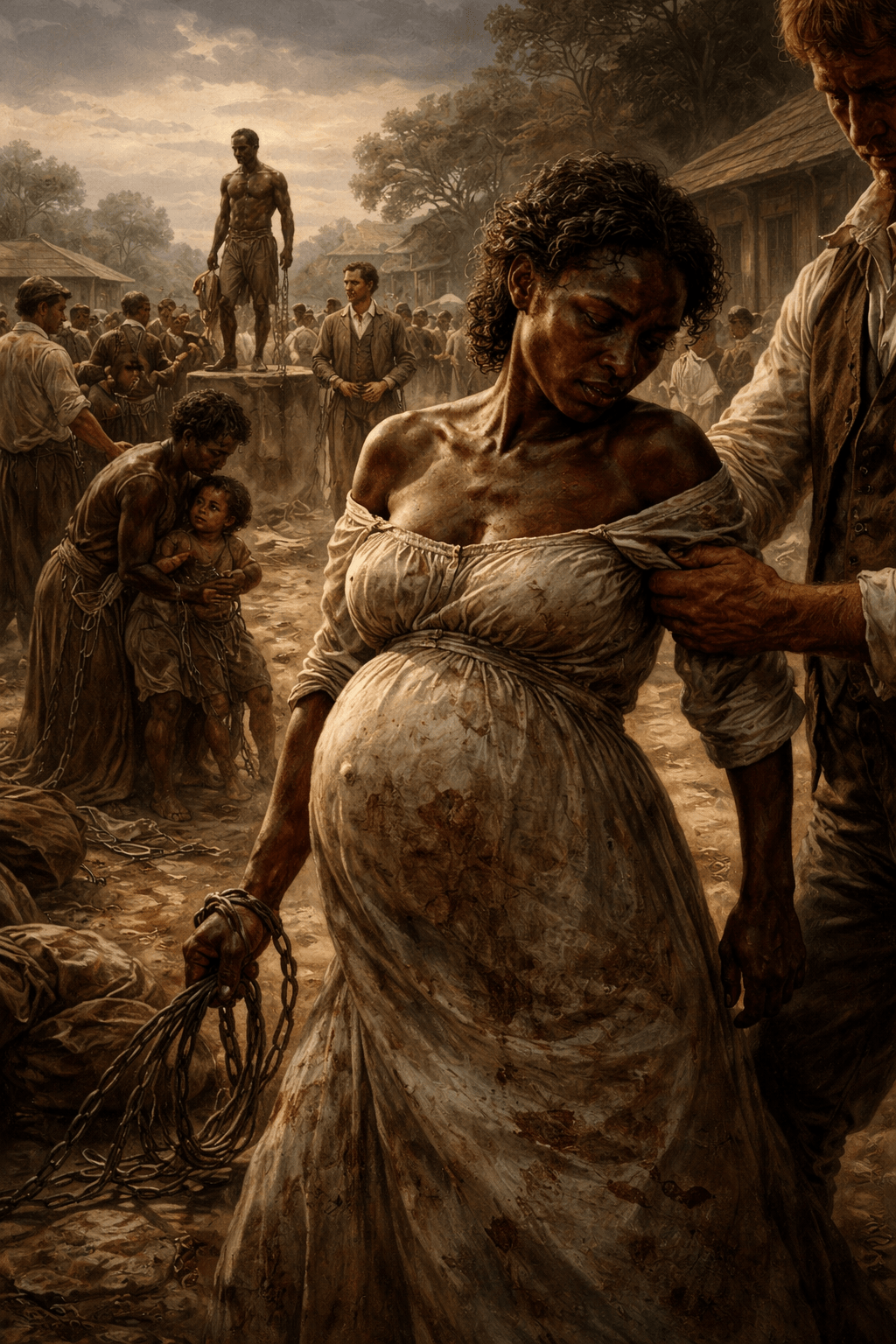
JSTOR’s tidy little history lesson reveals something real, but only after liberal scholarship scrubs the auction block clean enough for polite readers. Beneath the archive sits a system that turned rape, forced birth, and hereditary bondage into law, credit, and capital. The real story is not bad science gone astray, but a slave order using biology as cover for accumulation through terror. And if that crime still lives on in memory wars, maternal inequality, and stolen wealth, then the answer is not remembrance alone, but organized struggle.
By Prince Kapone | Weaponized Information | April 9, 2026
When the Archive Washes the Blood Off the Auction Block
“Race, Fertility, and the Science of Slavery in Antebellum America” comes dressed like a tidy little lesson for the educated public: brief, informative, respectable, and nicely pressed. It walks the reader through one of slavery’s nastier obsessions—the antebellum fixation on the fertility of mixed-race women—and explains how men like Samuel George Morton and Josiah Nott used the language of species, breeding, and biology to help justify slavery. That much is useful. It tells the reader something true and ugly: the white ruling class under slavery did not simply brutalize Black people with whips, chains, and auction blocks. It also brutalized them with categories, measurements, theories, and footnotes. It lied with a ruler in one hand and a skull in the other. But the piece also carries the scent of its institutional home. JSTOR Daily speaks in the polished voice of liberal scholarship—calm, careful, curious, and clean. Too clean for a subject soaked in blood, semen, breast milk, and money.
That cleanliness is not a style choice alone. It is the first trick. It takes a social order built on kidnapping, rape, sale, forced birth, and hereditary bondage and sets it under museum glass as a “history of ideas.” Horror in library lighting. The result is that race science appears mainly as bad thinking—false classification, broken logic, junk theory. All true, sure. But not enough. Plenty of nonsense floats around the ruling class like cigar smoke in a banker’s club. What mattered here was not simply that these theories were foolish. What mattered was that they were useful. They helped a slave society explain itself to itself. They gave the plantation a lab coat, the rapist a theory, and the trader a scholarly alibi. They took a cash register and dressed it as biology.
The piece also leans on the prestige of scholarship, especially through the work of Myrna Perez Sheldon, and in doing so it repeats one of liberal academia’s favorite habits: substituting expert mediation for full indictment. The reader is told, in effect, trust the archivists, trust the scholars, trust the institutions that have carefully processed the evidence. Fine. But a sharper truth gets sanded down in the process. These men were not simply mistaken intellectuals wandering around in the fog of nineteenth-century taxonomy. They were not absent-minded cranks who got lost on the way to the natural history cabinet. They were ideological workers for a slave order. They were clerks of organized theft. They were there to translate rape, forced breeding, and sale into something that could pass for nature. Not discoverers. Not seekers. Accountants of atrocity.
Then comes the article’s brevity, which is doing political work too. In a few brisk minutes, the whole machinery of sexual terror, coerced reproduction, and slave breeding gets condensed into an educational morsel for the “intellectually curious.” The blast radius gets contained. The reader leaves better informed, perhaps, but not properly scorched. The violence becomes intelligible without becoming intolerable. The archive cracks open just enough for the smell of the plantation to drift out, then the lid gets shut again before the room fills with it. That is not neutral. That is the acceptable form in which empire allows its crimes to be discussed.
The omissions tell on the piece as much as the facts do. It notes that the fertility of mixed-race women mattered economically and that enslavers trafficked in their reproductive capacity, but it does not fully rebuild the legal and material machinery that made that profitable. More importantly, it does not stay long enough with the filthiest contradiction in the whole arrangement: slavery itself produced the mixed-race population through white male rape, then race science stepped in to explain the results of that rape as a problem of nature. The system committed the crime, generated the evidence, and then hired a man with spectacles to blame biology. Marx would have laughed at the vulgar efficiency of it before cursing it. So would every enslaved woman who already knew, without needing a pamphlet or a skull measurement, that the master class was trying to turn its own filth into common sense.
That is what makes the piece worth reading and worth distrusting at the same time. It opens the door, but only halfway. It tells the truth, but in the manner empire finds digestible. It names the pseudoscience, but softens the social relation that produced it. It reveals the racist absurdity, but not the full machine humming beneath it. So no, this is not enemy propaganda in the crude sense of a screaming editorial with foam on its lips. It is more refined than that, which is exactly why it is useful to excavate. It is liberal academic mediation: a place where truth is allowed to appear, but only after it has been washed, ironed, and dressed for polite company.
The Machinery of Reproduction: What the Archive Leaves Out and the System Requires
The article correctly tells us that antebellum racial theorists obsessed over the fertility of mixed-race women, classified them as “hybrids,” and used that fixation to argue for the supposed separation of human “species.” But that only becomes fully legible once those claims are dragged out of the seminar room and shoved back into the slave market they served. The question is not simply what these men believed. The question is what work those beliefs were hired to do. And the answer begins here: slavery in the United States was not just a labor regime. It was a system of organized biological production, a machine that treated birth itself as part of the balance sheet.
The legal lever that made that possible was the doctrine of partus sequitur ventrem, which made the status of the child follow the status of the mother. In plain talk: if the mother was enslaved, the child was born enslaved. That meant every pregnancy could become new property, every birth a fresh entry in the master’s inventory. Reproduction was turned into capital accumulation by law. The womb was not merely part of the laboring body. It was made into a production site in its own right, manufacturing saleable property that could be bought, mortgaged, traded, seized, inherited, and counted long before it could walk.
The “capitalized womb” names this with the plainness it deserves. Enslaved women’s reproductive capacities were turned into financial machinery. Children were not simply born into a family or a world. They were born onto ledgers as assets, treated as “human savings accounts,” folded into the basis of money and credit. This was not merely labor exploitation with extra cruelty sprinkled on top. It was a system in which reproduction itself functioned as a form of finance, where the future body of the child could be counted in advance as value. Wall Street had not yet learned to securitize every breathing thing in sight, but the plantation was already doing the rough draft in blood and chains.
Once the United States formally banned the transatlantic slave trade in 1808, this internal reproductive system became even more central. The demand for enslaved labor did not shrink. It swelled with the cotton frontier and the ravenous expansion of plantation agriculture into the Deep South. What followed was a massive forced migration known as the “Second Middle Passage”, in which more than one million enslaved people were sold and driven from the Upper South into newer plantation zones. This trade depended on the ability of enslavers to breed, hold, and expand the enslaved population inside the country. Reproduction was no side issue tucked in the corner while the “real” economics happened elsewhere. Reproduction was one of the main engines under the hood.
And this is where the question of mixed-race women stops being an abstract demographic curiosity and becomes what it really was: evidence of a rape economy. These women were not the outcome of some neutral “mixing” between populations. They were the result of captivity and repeated rape. Enslaved women were owned, controlled, and used. They could be bought, sold, bred, and raped at will, with no law to protect them and no right to refuse. This was not occasional misbehavior by a few rotten men. It was routine, ordinary, built into the daily operation of slave society. The same men babbling about “pure races” were forcing themselves on Black women and then selling the children. That is not hypocrisy floating above the system. That is the system doing business. The plantation said one thing and did another, and the doing is what paid the bills.
The money logic of it was plain as daylight. Sale advertisements described enslaved women in terms that signaled reproductive value—prolific, likely breeder, good stock, strong girl. This was not colorful language. It was investor language. Buyers were not just purchasing labor in the present. They were purchasing the ability to produce more laborers in the future. A young enslaved woman could yield return after return, not through wages, but through coerced childbirth. The market understood perfectly well what liberal memory still likes to dodge: reproduction had been commodified down to the bone.
But the ruling order could not simply announce this nakedly and expect the whole arrangement to keep its dignity. If slavery depended on the reproduction of a visibly mixed population, then the racial line at its heart had to be constantly patched, painted, and explained. That is where “science” strutted in like a hired undertaker with a fancy vocabulary. Theories of polygenism, craniometry, and racial ranking circulated through books like Types of Mankind, helping turn a social crime into a story about nature. The trick was simple: take what had been made by force and present it as if God or biology had stamped it that way from the start. If the races were separate species, then slavery could pass as order. If mixed people were unstable or defective, then the consequences of rape could be blamed on nature rather than on the men doing the raping.
Step back, and the wider picture sharpens fast. Slavery was part of a broader settler-colonial capitalist order. It was not merely a labor relation in the narrow factory sense. It was a social formation built on land theft, racialized property, and hereditary unfreedom. Race was not an afterthought scribbled into the margins. It was built into the foundations as a tool for organizing labor, sorting populations, and keeping the whole machine stable, just as I argued in “The Colonial Architecture of Class: How Race Was Engineered to Divide Labor and Stabilize Empire”. The so-called science of race was one part of that machinery. It took theft, rape, and forced labor and translated them into common sense for respectable white society.
And the story does not stop at emancipation’s doorstep. The transatlantic slave system had already delivered hundreds of thousands of Africans into what became the United States, and the intellectual tools built to justify that order did not suddenly evaporate in 1865 like morning fog. They adapted. They crawled into new institutions, new sciences, new state practices. Darwinian racial thought and later forms of biological determinism kept doing the same old work with updated vocabulary, while race-making theories continued to police sex, reproduction, and the boundaries of the nation. The archive here is not a sealed tomb. It is the basement of the house.
That is why the present battle over memory matters. Efforts to strip slavery from public history are not random acts of forgetfulness. They are part of an ongoing fight over how much truth the system can afford to let people see. Because once the bond between race, reproduction, property, and accumulation becomes clear, the national fairy tale begins to wobble. The mythology of innocence cannot survive too much contact with the ledger.
When the Womb Became Capital: Slavery, Reproduction, and the Logic of Accumulation
Drop the velvet curtain and the archive’s polite throat-clearing. What we are looking at is a social order that turned women’s bodies into capital. Not “influence,” not “status,” not some vague historical importance. Capital. The plantation did not merely squeeze labor out of the living. It organized the production of future labor through rape, forced birth, and hereditary bondage. What the phrase “capitalized womb” gives us is not a poetic flourish. It is an x-ray. It shows a system in which human reproduction was wired directly into accumulation, where the body became a workshop and the child entered the world already tagged, priced, owned, and penciled into somebody else’s future wealth.
This is capitalism without its Sunday suit on. Marx told us capital came into the world dripping with blood and dirt. Here the blood is reproductive, and the dirt is the whole social order pretending not to notice where its money came from. The system did not patiently wait for labor to arrive on the market like some liberal economics fairy tale. It manufactured labor by force. It took women held in captivity, raped them, compelled them to bear children, and then counted those children as assets. Primitive accumulation did not stop at the fence line of the plantation field. It pushed through the body itself. It reached into the womb and called that business.
And that is why the science mattered. Not because the ruling class was intellectually curious, but because it needed cover. It could not come out and say, plain as day, we are reproducing a labor force through rape and calling it civilization. So it built itself a story. It said these were separate species. It said the racial order was natural. It said mixture was degenerate, unstable, strange. In other words, it took what had been produced through force and translated it into biology. That is the old ruling-class magic trick: first commit the crime, then hire a scholar to explain why the victim deserved the outcome.
But the lie kept tripping over the truth. The plantation itself was producing the evidence against its own ideology. The same men drawing hard racial lines in public were crossing them in private every night. The same system preaching purity depended on mixture to reproduce itself. The same order that claimed biological separation was manufacturing the proof of its own fraud. That is not a side contradiction. That is the whole machine flashing its wiring. The truth kept pressing against the lie, and the lie had to get fancier, thicker, more elaborate, like wallpaper pasted over a cracked wall in a landlord’s building.
Empire is not held together by bullets alone. It also survives by telling stories about itself—stories that make looting sound like order and butchery sound like necessity. In the slave republic, race was one of those stories. Not race as some eternal essence floating above history, but race as a tool. A weapon. A labor-management device. A way to justify theft, sort bodies, and keep poor and colonized people from reading the ledger too closely. Science, classification, measurement, taxonomy—this was the propaganda department in a lab coat.
And standing at the center of that whole filthy arrangement was the enslaved woman. Not as a symbol, but as the point where every demand of the system came crashing together. She was forced to work. Forced to bear children. Forced to survive rape. Forced to watch those children become somebody else’s property. Then, after all that, she was erased from the official story except as evidence, specimen, breeding stock, or problem. The system needed her body while refusing her humanity. It needed her children while denying their childhood. It needed her power to make life while reducing that power to collateral.
That is the colonial contradiction stripped to the bone: a system that feeds on a people it refuses to recognize, a system that needs life from those whose lives it discounts, a system that produces wealth by grinding down the very people who create it. It cannot solve that contradiction honestly without blowing itself apart. So it manages it. Covers it. Delays it. Renames it. That is what ideology does. It is not there to discover the world. It is there to buy time for a rotten structure.
So when we look back at the antebellum plantation, we are not looking at a primitive stage capitalism has since outgrown, as if the modern world were too sophisticated for such vulgarity. We are looking at a revelation of what accumulation is willing to do when stripped of polite excuses. The plantation was not some embarrassing side room off the main house of capitalism. It was one of the load-bearing beams. It showed that capital will reach into the most intimate parts of life—sex, birth, kinship, childhood—and reorganize them for profit if nothing forces its hand away.
And that is why this matters now. Because the techniques refined there did not vanish. The neutral language changed. The institutions changed. The paperwork got nicer. The knife learned to wear a necktie. But the basic habit remained: turn violence into administration, turn theft into policy, turn domination into expertise. The system did not misunderstand the world. It built it this way. And it will keep building it this way until somebody makes it stop.
From the Archive to the Street: Turning Memory into Material Struggle
If the lesson here is that the womb itself was conscripted into the machinery of capital, then the answer cannot be a candlelight vigil in the seminar room. Memory without organization is just grief on a shelf. The task is to turn historical truth into political force. Because the system that treated Black women’s bodies as wealth-generating equipment did not vanish into the past like a bad smell in an old book. It changed uniforms. It found new offices. It learned new legal language. But the old logic—squeeze life for value, sort people by race, hide the crime under respectable words—still walks around very much alive.
That is why reparations is not some symbolic apology project for guilty liberals with tearful podcasts and tasteful book clubs. It is a material demand rooted in stolen labor, stolen bodies, stolen children, stolen land, and stolen centuries. The African People’s Socialist Party / Uhuru Movement places reparations inside the broader struggle for anti-colonial self-determination, which is exactly where it belongs. Not as therapy for the nation’s conscience, but as a political and economic confrontation with a system that still sits on wealth accumulated through slavery and colonial plunder.
N’COBRA matters here for the same reason. It connects the historical record to organized demands, public education, and policy struggle. That matters because truth by itself does not redistribute a dime. The archive will not cough up stolen wealth out of embarrassment. Somebody has to build pressure. Somebody has to connect the ledger of the past to the budgets, institutions, and property relations of the present. Otherwise slavery remains a story the country tells about itself on commemorative holidays while keeping the cash.
And because this essay sits squarely on the question of reproductive exploitation, the struggle cannot stop at reparations in the abstract. The same order that once treated Black women as breeding stock still leaves Black women to die at higher rates in childbirth, still structures care through inequality, still makes the creation of life a battlefield of neglect, extraction, and contempt. The National Black Midwives Alliance matters because it intervenes where history is still breathing. Not in metaphor, but in clinics, births, training, and community survival. That is not a side issue. That is one of the present-day fronts where the old crime keeps reproducing itself in updated form.
The fight over memory is no less real. When public institutions strip slavery from exhibits, soften it in curriculum, or package it into harmless national reflection, they are doing political work. School boards, museums, archives, parks, and universities are not neutral warehouses of information. They are battlegrounds where the ruling order decides how much truth the public is allowed to handle. So the line of march has to be concrete: organize reading groups that feed people into campaigns, not just conversations; tie historical education to reparations organizing; fight curriculum whitewashing in local schools; defend public truth wherever institutions try to bleach the blood out of the story.
And let us be plain: “support” cannot mean liking a post, reposting a quote, and then going back to brunch feeling radical. It means giving money, showing up, building infrastructure, sharing skills, and helping turn scattered awareness into organized power. It means connecting the struggle over slavery’s memory to living fights over housing, healthcare, maternal survival, schooling, and political control in Black communities. It means understanding that the same state that sanitizes the past also manages the present, and that both jobs are part of one machine.
This is not about adopting a noble posture of solidarity like some well-behaved spectator in the balcony. It is about recognizing that the same order that built wealth from forced reproduction still shapes the lives of working and colonized people now. It still organizes labor. It still distributes premature death. It still decides whose families are secure and whose children are exposed to the market like meat on a hook. That system will not be persuaded by better manners or nicer footnotes. It will not blush itself into justice. It has to be confronted.
Because in the end, the archive frees no one by itself. It can expose the crime. It can name the mechanism. It can hand us the ledger and point to the fingerprints. But liberation begins only when that knowledge leaves the page, joins organized struggle, and starts pressing back against the structures that made the page necessary in the first place. The system did not misunderstand the world. It built it this way. The question now is whether we intend to leave it standing.
 Weaponized Information
Leave a comment