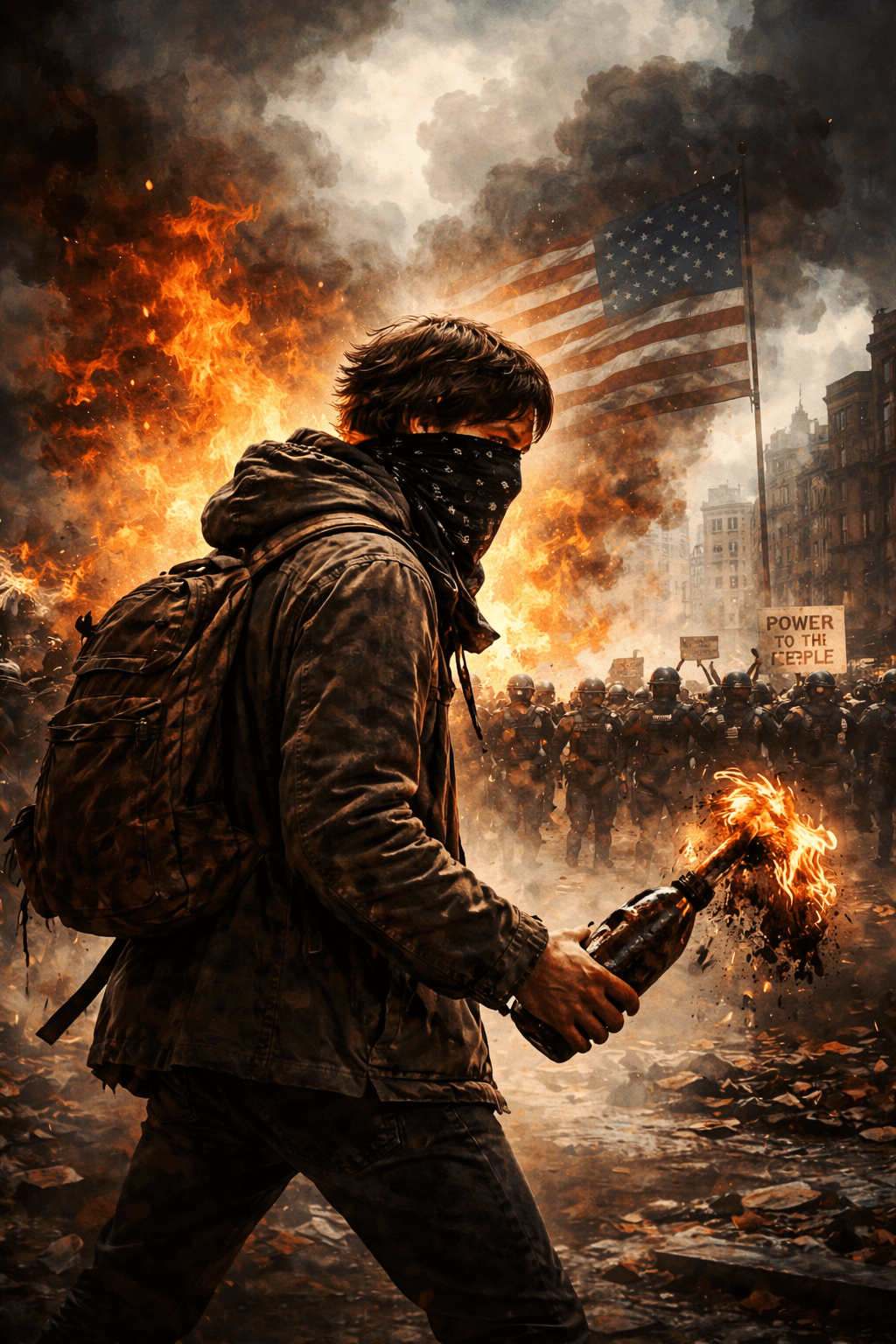
A liberal memoir transforms a history of anti-imperialist rebellion into a story of family inheritance, masking the structural realities of empire and repression. Beneath that narrative lies a system defined by imperial war abroad and counterinsurgency at home, where dissent is managed, surveilled, and neutralized. The Weather Underground emerged from this contradiction, but its turn toward clandestine violence revealed the limits of revolt detached from mass, colonized leadership. The task that remains is not to romanticize or condemn the past, but to build disciplined, organized power capable of confronting empire at its roots.
By Prince Kapone | Weaponized Information
April 7, 2026
The Family Album of Empire
“My Childhood in the Weather Underground”, published by The New Yorker on March 28, 2026 and written by Zayd Ayers Dohrn, arrives dressed in the soft cloth of remembrance. It is, on its face, a memoir of fugitivity: whispered departures before dawn, rusted station wagons, fake names, road atlases, safe houses, coded language, and the peculiar emotional weather of growing up with parents who were once among the most hunted radicals in the United States. But as with so much elite literary journalism, what matters is not only what is said, but how the saying itself performs ideological labor. The piece does not present itself as polemic. It presents itself as reflection, as maturity, as the burdened wisdom of a son who has inherited both the romance and the wreckage of the Weather Underground. And that is precisely why it deserves excavation. It is not crude state propaganda. It is better tailored than that. It is liberal prestige propaganda: elegant, intimate, humane in tone, and therefore all the more effective at laundering political history through personal memory.
This begins with the article’s basic positioning. The New Yorker presents itself as a magazine of rigor, fairness, excellence, and long-form seriousness, a cultural institution of the professional-managerial classes, housed inside a corporate publishing structure that is also very much a business. It is a division of Advance Magazine Publishers, tied to the Condé Nast universe, sustained by subscriptions, advertising, events, and the broader prestige economy of elite media. That matters because this is not some underground pamphlet mimeographed in a basement while the cops pound the stairs above. It is a highly polished commodity of imperial culture, built for an educated readership that likes its rebellion in retrospect, preferably with enough sorrow and nuance to make it feel safe. Dohrn, for his part, is not writing from the social position of an insurgent cadre or a dispossessed militant. He writes as a credentialed literary-professional, a Northwestern professor and dramatist whose relation to the story is deeply personal but also institutionally mediated. He is close enough to the fire to describe the smoke, but distant enough to turn combustion into craft.
The first major propaganda device in the essay is narrative framing through childhood innocence. We are not introduced to the Weather Underground first as a political formation emerging from the violence of the age, nor as a flawed white-radical attempt to answer imperial war and racial repression, but as the backdrop to a child’s confusion. The cold morning, the whispered urgency, the Burger King confession, the rearview mirror, the coded lives of parents who seemed part outlaw, part fairy tale—this is the emotional grammar of the piece. It invites the reader to inhabit not the political stakes of the period but the vulnerability of the son. The effect is powerful, because childhood is one of liberalism’s favorite solvents. Drop enough history into the basin of innocence and the sharpest contradictions begin to dissolve. The revolution becomes family drama. The anti-imperialist crisis becomes inheritance. The state recedes; the household comes forward.
The second device is source hierarchy. Nearly everything of consequence in the piece is mediated through memory, family lore, retrospective conversation, and the author’s interior reckoning. This does not make it false. But it does make it selective in a very particular way. The reader is placed inside a closed emotional circuit where the principal authorities are the son, the mother, the father, and the moral hindsight of adulthood. Figures like Fred Hampton and Assata Shakur appear, but they do not stand at the center of their own historical gravity. They enter chiefly as they pass through the orbit of one white radical family. In that sense, the article performs a familiar maneuver of U.S. liberal storytelling: Black revolutionaries and colonized struggle provide the atmosphere, but the white family provides the interiority. The history of repression is present, but filtered. The empire is there, but mostly as a force that shaped the conscience of these particular protagonists. One can almost hear the old republic clearing its throat and saying, “Yes, yes, there was some unpleasantness—but let us return to the children.”
The third device is omission, and omission here is not a side effect. It is architecture. The article gestures toward the Vietnam War, toward COINTELPRO, toward police murder, toward the Black freedom struggle, toward the wider atmosphere of domestic repression, but it never reconstructs them with real weight. It uses them the way a stage play uses a painted backdrop: enough to signal setting, not enough to alter the action. Fred Hampton is invoked as a turning point in Bernardine Dohrn’s radicalization, but the piece does not dwell on what it means for a state to murder a twenty-one-year-old Black revolutionary in his bed and then continue on calling itself democratic. COINTELPRO appears as an explanatory note for why some charges later fell apart, but not as a systematic machinery of counterinsurgency. Vietnam appears as outrage, but not as a mountain of corpses. This is how liberal memory works when it wants to seem honest without allowing truth to become structural. It acknowledges the crime scene just enough to show it has a conscience, then moves briskly back to the living room.
The fourth device is bad logic smuggled in as moral common sense. Dohrn writes that there may be moments when illegal violent resistance could be conceded as necessary—Nazi Germany, or the slave South—but that dynamite is “self-defeating” in a democracy, however imperfect. There, in one neat sentence, the whole liberal catechism comes marching in with polished shoes. We are asked to accept, without real argument, that the United States of assassinated Panthers, secret surveillance, illegal break-ins, imperial massacres, and domestic political warfare still retained enough democratic legitimacy to render insurgent violence not merely mistaken but conceptually incoherent. This is not analysis. It is boundary-policing. It is the old imperial trick of conceding excess while preserving innocence. The system may have done ugly things, the sentence says, but it remained fundamentally redeemable enough that armed struggle against it was absurd. That judgment is presented as sober adulthood. In truth, it is the ideological refund liberalism always offers itself after the blood dries.
The fifth device is soft rehabilitation through plain-folks normalization. The article is structured to move from the image of the hunted radical—the “most dangerous woman in America,” the safe houses, the bombs, the disguises—to the eventual reintegration of the family into ordinary American life: school, jobs, therapy, Little League, middle-class routine. This arc does more than humanize. It domesticates. It assures the prestige reader that whatever storms passed through the sixties and seventies have now been properly translated into familiar social forms: complicated parents, damaged children, hard conversations, adult ambivalence, healing of a sort. The revolution is no longer a threat. It is dinner-table material for reflective professionals. It can be consumed aesthetically, ethically, even sentimentally. The same imperial culture that once hunted radicals now sells their afterlives back to us in glossy prose, neat columns, and cultured melancholy.
And yet the article’s greatest strength is also what makes it so ideologically useful: it is not a cartoon. It does not simply sneer at its subjects. It grants them courage, seriousness, sacrifice, and conviction. But that very fairness is part of the operation. Liberal prestige media often works best not by caricaturing the enemy, but by absorbing him into a morally managed narrative. Here the Weather Underground is neither fully demonized nor vindicated. It is curated. The reader is invited to feel both admiration and disapproval, both tenderness and distance. The result is a mood of mature ambivalence, which is the favorite emotional register of a class that wants history without choosing sides in it too clearly. The bombs were wrong, perhaps understandable, certainly tragic, maybe reckless, but also part of the beautiful confusion of a difficult time. That is a wonderfully convenient ending for an empire that prefers its rebellions either crushed or converted into literature.
So what the piece finally offers is not the history of a revolutionary underground, and not even mainly the history of a fugitive childhood. It offers a family album of empire, carefully arranged for a liberal audience. Every photograph is emotionally legible. Every contradiction is made intimate. Every danger is filtered through the son’s retrospective conscience. The blood of the period is visible, but mostly in reflection. And that is precisely why the article works so well as ideological craft. It turns a historical confrontation with war, racism, repression, and rebellion into a story of inheritance, regret, and personal meaning. It does not lie outright. It does something more sophisticated. It tells the truth in such a way that the structure behind the truth remains just out of frame.
When the Bombs Enter the Picture but the Empire Stays Offstage
The factual terrain beneath “My Childhood in the Weather Underground” is, even on its own terms, more severe than the memoiristic framing allows. The article’s central claim is straightforward enough: Bernardine Dohrn and Bill Ayers emerged from the implosion of Students for a Democratic Society, helped form what became the Weather Underground, went underground in 1970, and participated in a campaign of bombings directed at institutions of the American state. That basic line is not invention. The state’s own record, ugly though it is, confirms that the Weather Underground grew out of the wreckage of SDS and became associated with bombings of targets including the Capitol and the Pentagon. The article also situates Dohrn as a figure of exceptional notoriety, and again this was not journalistic embroidery. J. Edgar Hoover did indeed elevate her into a national symbol of domestic insurgency, and she did end up on the FBI’s Ten Most Wanted list. The piece is also factually grounded in noting that by 1980 she and Ayers emerged from clandestinity into a judicial process that ended not with decades in prison but with a sharply reduced legal reckoning, largely because the state itself had been caught up to its neck in illegality. The same article rightly ties the further radicalization of Dohrn’s milieu to the murder of Fred Hampton, whose killing in Chicago was not rumor, not movement mythology, but an actual state crime against a rising Black revolutionary leader under FBI scrutiny. And when the article later gestures to the Brinks robbery as the moral and political train wreck that marked the decomposition of the remaining underground currents, it is again resting on a real event in which one guard and two police officers were killed. So yes, the bones of the narrative are real. But bones alone do not tell you what kind of body you are looking at.
What the article declines to reconstruct with any seriousness is the sheer scale of violence that formed the political weather of the period. A memoir about bombs in the United States that does not materially foreground the war in Vietnam is a bit like writing about smoke while refusing to mention the house fire. Vietnam’s postwar estimates placed the death toll at as many as two million civilians on both sides, alongside roughly 1.1 million North Vietnamese and Viet Cong fighters killed, while more than 58,300 U.S. personnel were listed dead or missing. That is the backdrop. That is the empire in motion. When sections of U.S. youth radicalized under those conditions, they were not hallucinating some abstract injustice in a philosophy seminar between coffee breaks. They were reacting, however unevenly and however disastrously at times, to an imperial war machine that was producing death on a scale the polite language of later literary reflection prefers to keep in the basement.
The article also names COINTELPRO in passing, but in the way a nervous liberal host mentions a murder in the family and then quickly asks whether anyone wants dessert. COINTELPRO was not merely a vibe of repression or an unfortunate series of excesses; it was a formal FBI counterintelligence program launched in 1956, and the subsequent record compiled by congressional investigators made clear that the U.S. intelligence apparatus engaged in “unlawful or improper conduct” against domestic political targets. That is not a marginal footnote to the story. It is one of the central conditions of possibility for the entire period. If the charges against figures like Dohrn and Ayers later collapsed or weakened, this was not because the state suddenly became merciful or history turned whimsical. It was because the same state that preached law and order had been caught burglarizing, wiretapping, blackmailing, infiltrating, and sabotaging political movements in open violation of the very constitutional mythology it sold to the public. The article mentions that, but only as a narrative explanation for why the family escaped harsher punishment, not as evidence of a deep and systemic domestic counterinsurgency regime.
Fred Hampton appears in the memoir as one of the catalysts pushing white radicals further into militancy. True enough, but that framing still places the Black revolutionary struggle in a supporting role for white political development. The historical record is harsher and clearer. Hoover described the Black Panther Party as “the greatest threat to the internal security of the country”, and the surveillance state did not simply target Panthers because some members carried guns or made militant speeches. National Archives material on Hampton shows a political organizer building rallies, forging a peace agreement among rival gangs, and helping establish a Free Breakfast program for children. The state did not merely fear rhetoric. It feared organized legitimacy among the oppressed. It feared institutions that could root revolutionary politics in everyday life. It feared a leader who could weld together anti-racist struggle, class anger, and mass discipline. So when Hampton was murdered, what was being attacked was not simply one charismatic young man, but the prospect of a social force developing real traction among the colonized and exploited. The memoir lets Hampton enter as tragic inspiration. The fuller record shows him as a strategic target in a wider war.
The article touches the Greenwich Village townhouse explosion primarily as a familial and emotional wound, which it undoubtedly was for those involved. But history does not end at grief. After the 1970 townhouse blast killed three Weather members while they were assembling explosives, surviving members shifted away from attacks intended to kill and toward warning-before-detonation bombings framed as symbolic acts. That shift matters—not as redemption, but as clarification. It marks a moment of rupture within the organization itself, where shock forced a reassessment of method, intention, and political meaning. To collapse the Weather Underground into a single, undifferentiated image of nihilistic violence is to erase that internal contradiction. There were debates, fractures, and attempts—however limited—to distinguish between symbolic disruption and indiscriminate killing. The memoir gestures toward this complexity, but only faintly. The fuller historical record shows an organization grappling, unevenly and imperfectly, with the consequences of its own strategy.
The same narrowing happens with Assata Shakur. In the article, her story enters mainly through the prism of what the jailbreak revealed about the father’s willingness to risk family stability for revolutionary obligation. That is one layer of it, sure. But the afterlife of Assata’s case tells us much more about the long duration of state repression than the memoir lets on. Shakur was granted political asylum in Cuba in 1984, and in 2013 she became the first woman placed on the FBI’s Most Wanted Terrorists list. That detail alone tells a whole bitter story. The state did not simply crush the Black revolutionary underground and move on. It continued, for decades, to police memory, criminalize political lineage, and keep certain names inside the symbolic architecture of enemy status. Assata was not merely a chapter in one family’s moral education. She remained a node in the state’s long war against Black insurgent memory.
To grasp the larger setting, one must also remember that SDS itself was not some tiny fringe sect operating from the margins of national life. Movement histories and archival records show that SDS grew into the largest and most influential radical student formation of the 1960s, with hundreds of chapters and tens of thousands of supporters by 1969. That matters because the Weather Underground did not descend from the sky as a self-generated cult of violence. It came out of a much broader antiwar and student ferment that reflected real political upheaval across the country. The turn toward clandestinity and bombing was one resolution—fatally flawed in many respects—of contradictions that had been generated inside a mass movement confronting imperial war, racial domination, and the obvious inability of respectable channels to restrain either.
Even the legal unraveling of cases against underground figures sits inside a broader pattern of state criminality. Former FBI official Mark Felt acknowledged ordering unlawful burglaries directed at groups including the Weather Underground, while later federal oversight and Justice Department reforms emerged precisely because the post-Watergate and post-Church Committee period forced open the machinery of domestic political surveillance. The issue, then, was never simply whether certain radicals broke the law. Of course they did. The issue was that the state had long since shredded its own law when confronting movements that threatened the racial and imperial order.
This wider terrain is not new, and recognizing that continuity is essential. Race in the United States functions not as a mere cultural prejudice but as a political architecture of colonial domination. This clarifies why Black revolutionary organization drew such ferocious state repression, and why white radicalization in solidarity with that struggle remained unstable unless it broke decisively with the settler horizon. From that same standpoint, COINTELPRO must be understood as one expression of a continuous domestic counterinsurgency tradition, not an aberration safely confined to the past. That distinction is decisive. The New Yorker piece renders repression as emotional atmosphere. The historical record reveals it as a permanent structure of colonial domination.
So the empirical reconstruction tells a much harder story than the prestige memoir is willing to hold in full. Yes, the Weather Underground existed. Yes, it used bombs. Yes, its history carried recklessness, tragedy, and real political failure. But those facts only become intelligible when placed against an empire that was saturating Vietnam in death, targeting Black liberation as an internal enemy, and deploying a domestic intelligence apparatus that behaved less like the guardian of democracy than like the secret police of a settler order under strain. Pull those facts back into view, and the memoir’s moral center begins to wobble. The underground no longer appears as a strange family aberration set against an “imperfect democracy.” It appears as one broken, contradictory, historically situated response to a system whose violence was always vastly greater, vastly more organized, and wrapped, with all the usual hypocrisy of empire, in the flag of law.
What the Memoir Cannot Admit About Empire, Whiteness, and Rebellion
This is not, in the end, merely a story about one son sorting through the emotional wreckage of radical parents. That is the surface form, the packaging, the sentimental wrapper tied around the historical bundle so the liberal reader can hold it without cutting his hands. The deeper story is about what happens when sections of youth inside an empire are radicalized by the sight of mass slaughter abroad and repression at home, yet remain unable to fully sever themselves from the political gravity of the settler order that formed them. In that sense, the Weather Underground was neither simple heroism nor simple madness. It was a contradictory white revolt against empire from within the belly of empire, animated by real anti-imperialist rage, drawn toward Black liberation, yet never fully able to solve the problem of how white militants rooted in the imperial core could truly fuse themselves with the organized historical interests of the colonized.
The memoir’s governing ideological maneuver is to take a historical collision between antiwar rebellion, Black revolutionary struggle, and state counterinsurgency and reduce it to an inheritance drama. That move is elegant, intimate, and politically disarming. The question becomes: how does a child live with the choices his parents made? That is a real question, and an honest one as far as it goes. But it is not the main question history asks here. The more difficult question is this: why did a white radical current that correctly recognized the obscenity of U.S. imperial violence and the legitimacy of Black insurgent struggle fail to become part of a durable, disciplined, mass revolutionary force? Why did it detonate rather than consolidate? Why did it turn toward clandestine symbolism instead of helping build the kind of rooted dual power that could survive repression and deepen political consciousness among the oppressed? The memoir cannot center that question because once you center it, the whole moral architecture shifts. Then the story is no longer mostly about family cost. It becomes about the political limits of a certain kind of white militancy under the conditions of settler empire.
The real story is not that a few young radicals lost perspective and “went too far.” That is the liberal bedtime version, the one told after the children are tucked in and the republic wants to reassure itself that its only real problem was excess at the margins. The real story is that the United States was prosecuting an imperial war of astonishing savagery in Vietnam while simultaneously developing a domestic regime of surveillance, infiltration, disruption, and outright political warfare against movements that challenged racial capitalism at home. In those conditions, the Weather Underground did not emerge from a vacuum, nor from some adolescent romance with explosion for its own sake. It emerged out of the crisis of imperial legitimacy, out of the spectacle of empire’s violence rebounding into the consciousness of segments of white youth who could no longer pretend not to see it. That is why the Weather phenomenon belongs to the history of the colonial contradiction inside the United States. Empire abroad and colonial domination at home were not separate theatres. They were connected fronts in the same social order, and the tremors of that order produced revolt even within sectors that had been socially trained to identify with the master’s house.
But the memoir also reveals, even when it does not intend to, the limits of that revolt. The Weather Underground wanted revolutionary rupture without resolving the problem of revolutionary anchoring. It recognized the barbarism of imperial power, but it did not solve the question of mass line, social base, or durable organization. It was willing to risk illegality, but often in ways that substituted clandestine gesture for the slower, harder, and politically deeper labor of building sustained popular power. That is the crux. A bomb can dramatize opposition. It can shatter windows, rattle marble lobbies, force the newspapers to look up from their cocktails for half an hour. But it cannot, by itself, construct the organized social infrastructure through which oppressed people become historical subjects capable of contesting power over time. It can announce fury, but it cannot replace disciplined political consolidation. In that sense the Weather Underground mirrored, in miniature, a familiar contradiction of white radicalism in the imperial core: high moral outrage, real courage, even genuine solidarity, but insufficient grounding in the autonomous political center of gravity of the colonized and exploited.
This is precisely why Fred Hampton matters so much more than the memoir allows. Hampton represented not merely militancy, not merely charisma, and certainly not merely martyrdom. He represented the possibility of welding anti-racist struggle, class struggle, and anti-imperialist struggle into a living bloc rooted among the oppressed. He was trying to build something materially dangerous to the order of things: not just an oppositional spectacle, but a social force. Breakfast programs, political education, coalition building, gang truces, community legitimacy—these were not side projects. They were embryonic forms of dual and contending power. They suggested that another kind of authority could be built inside the shell of the old one, one capable of drawing the dispossessed into a disciplined collective project. That is why the state killed Hampton. Not because he was noisy, but because he was becoming effective. The state can often manage noise. It can surveil it, absorb it, criminalize it, and then sell it back later in documentaries narrated by handsome men with serious voices. What it fears far more is organized legitimacy among the oppressed.
The memoir’s liberal resting point is the claim that dynamite is self-defeating in a democracy, however imperfect. But what kind of “imperfect democracy” murders Black organizers in their beds, infiltrates children’s breakfast programs, and runs counterintelligence operations against domestic movements while dropping devastation across Southeast Asia? One has to laugh, or else choke, at the piety of the phrase. An imperfect democracy? That is like calling a prison with murals on the walls an imperfect community center. The constitutional shell may remain, elections may continue, newspapers may still arrive on doorsteps, but when the state responds to liberation movements with burglary, blackmail, assassination, and saturation surveillance, we are no longer in the realm of mere democratic imperfection. We are in the realm of domestic counterinsurgency administered through the institutions of a settler-capitalist order. The polite language of liberalism does here what it always does: it shrinks structural violence into regrettable deviation so that rebellion can be judged against a fantasy of national innocence.
And yet the Weather story is not reducible to repression from above. That would be too easy, too clean, and history rarely affords us such hygiene. The story is also about contradiction within the white radical project itself. White militants could choose illegality; for Black revolutionaries and colonized communities, illegality was not always a choice but a condition imposed by the structure of rule itself. White militants could sometimes move, after the storm, back into teaching jobs, universities, and the soft furniture of professional life. Black militants and political prisoners were far more likely to meet prison, exile, assassination, or a lifetime of being marked as permanent enemies of the republic. That unevenness is not a sentimental footnote. It is part of the structure. It tells us that even solidaristic white radicalism inside the United States moved within unequal fields of consequence. The state punished everyone it could, but it did not punish everyone the same way, because it did not fear everyone the same way.
So the truthful reframing is harsher than both liberal condemnation and nostalgic romance. The Weather Underground was a historically intelligible response to imperial barbarism, and in that sense it deserves more seriousness than the easy sermonizing of the respectable classes. These were not simply thrill-seekers playing revolution between semesters. They were people radicalized by real horrors, and willing to sacrifice freedom, comfort, and in some cases life itself rather than make peace with empire. There is courage in that, and there is integrity in refusing the narcotic of normalcy. But courage is not enough. Integrity is not enough. Rage is not enough. Without strategic grounding in mass struggle, without rootedness in the organized life of the oppressed, without a political line capable of building rather than merely declaring rupture, resistance can become trapped in forms that are symbolically potent yet historically brittle. That is one of the hard lessons this memoir circles without quite naming.
The revolutionary lesson, then, is not that rebellion was foolish, nor that the state was justified, nor that the best we can do now is sit in our comfortable chairs and feel wise about everyone’s mistakes. It is that empire produces resistance as surely as rot produces flies. It is that resistance detached from durable social organization can be broken, isolated, or mythologized after the fact. And it is that the state fears organized popular power far more than it fears isolated acts of detonation. The memoir wants to leave us with inheritance: what do we pass on, what do we keep, what do we regret? Fair enough. But history demands a sterner conclusion. What must be passed on is not a romance of beautiful defeat, nor a liberal morality tale about the excesses of youth. What must be passed on is the understanding that imperialism and domestic repression are structurally linked, that white revolt within the imperial core remains politically crippled unless it is transformed by durable unity with the colonized and exploited, and that the real danger to the empire was never simply the bomb. It was always the possibility that the people at the bottom might become organized enough to no longer be ruled.
From Beautiful Defeat to Organized Power
History is not a museum, and the Weather Underground is not an exhibit to be admired or condemned at a safe distance. It is a lesson—hard, unfinished, and still alive. The question is not whether those young militants were right or wrong in the abstract. The question is what it means, today, to confront an imperial system that continues to wage war abroad while managing dissent at home through surveillance, criminalization, and fragmentation. If the previous generation revealed both the necessity of resistance and the danger of isolation, then our task is not to repeat their errors with better slogans. It is to build forms of struggle that cannot be so easily contained, detached, or folded back into the soft narrative of national reconciliation.
One place where this lesson is being taken seriously is in formations that refuse to separate antiwar politics from the internal colonial question. The Black Alliance for Peace has insisted, in both its analysis and organizing, that U.S. militarism abroad and repression at home are two expressions of the same system. Its campaigns against AFRICOM, NATO expansion, and sanctions regimes are not framed as distant geopolitical concerns, but as extensions of the same imperial machinery that disciplines Black and colonized communities within U.S. borders. To engage here is not simply to “oppose war” in the abstract. It is to understand war as a structure that organizes everyday life, from policing to political economy. The practical step is clear: build local antiwar committees rooted in working-class communities, use BAP’s educational materials to connect foreign policy to domestic conditions, and transform antiwar sentiment into organized, sustained political capacity.
At the level of political theory and long-term strategy, the African People’s Socialist Party has maintained one of the clearest lines: that Black people inside the United States constitute a colonized nation, and that the U.S. itself is a settler colonial formation sustained through the exploitation of that internal colony. This is not rhetorical flourish. It is a framework that reorganizes how struggle is understood, shifting the center of gravity away from abstract class unity toward the concrete reality of national liberation. What distinguishes this current from the failures of the Weather Underground is its insistence on leadership arising from the colonized themselves. For white radicals, this poses a non-negotiable question: are you organizing for your own moral expression, or are you aligning materially with the leadership, strategy, and demands of those most oppressed by the system? The task here is not symbolic solidarity, but disciplined political alignment—participation in study, material support, and organizing work that strengthens anti-colonial leadership rather than substituting for it.
That question of white participation is taken up directly by the Uhuru Solidarity Movement, which organizes white people explicitly under the political direction of the African People’s Socialist Party. This is not a comfortable model for many, precisely because it refuses the liberal fantasy of equal voice detached from historical position. But it is one of the few organized attempts to resolve the instability that has plagued white radicalism for decades: the tendency to oscillate between moral outrage and political drift. By placing white organizers inside a structure that is accountable to anti-colonial leadership, it offers a concrete alternative to the voluntarism and adventurism that defined much of the Weather Underground’s trajectory. The practical implication is straightforward: white militants must build organization among white workers that breaks from the settler horizon, not through isolated acts of rebellion, but through sustained political work tied to a broader anti-imperialist project.
At the level of multinational socialist organization, the Freedom Road Socialist Organization represents an effort to integrate the national question into a broader revolutionary strategy. Its emphasis on self-determination, national oppression, and the centrality of oppressed nationalities within the U.S. reflects an attempt to avoid the economistic traps that have historically reduced “race” to a secondary contradiction. What matters here is not organizational perfection—no such thing exists—but the recognition that class struggle in the United States cannot be abstracted from the structures of colonial domination that shape it. Engagement at this level means building cadre, participating in political education, and helping develop a line that can unite multinational working-class forces without erasing the specific conditions of colonized peoples.
Indigenous formations such as The Red Nation further expand this terrain by grounding anti-capitalist struggle in the ongoing reality of settler colonialism. Their work reminds us that the colonial contradiction is not only a question of Black liberation, but of Indigenous sovereignty, land, and the unfinished project of decolonization itself. To take this seriously is to move beyond symbolic acknowledgments of land theft and toward concrete political commitments—support for land back movements, opposition to extractive projects, and solidarity with Indigenous-led struggles that challenge the material foundation of the settler state.
What unites these formations, despite their differences, is a refusal to treat imperialism, racism, and class exploitation as separate problems to be solved in isolation. They insist—through theory, practice, and organization—that these are interconnected expressions of a single system. That insight is the starting point. But the decisive question is organization. The Weather Underground revealed what happens when resistance detaches from mass base and strategic discipline. These formations, in different ways, are attempting to answer that failure by building structures that can endure repression, develop leadership, and accumulate power over time.
The path forward is not glamorous. It does not offer the immediate catharsis of dramatic confrontation or the seductive clarity of moral absolutism. It demands study, discipline, patience, and a willingness to subordinate individual expression to collective strategy. It requires building institutions that can outlast moments of crisis, cultivating political education that deepens understanding, and forging solidarities that are material rather than performative. Above all, it requires a break with the idea that rebellion is an event. Rebellion must become a process—organized, sustained, and rooted in the lived reality of those most exploited by the system.
If there is one lesson to carry forward, it is this: the empire is not undone by spectacle. It is undone by power. And power, unlike dynamite, is not assembled in secret and detonated in a moment. It is built, patiently and collectively, until it can no longer be ignored.
 Weaponized Information
Leave a comment