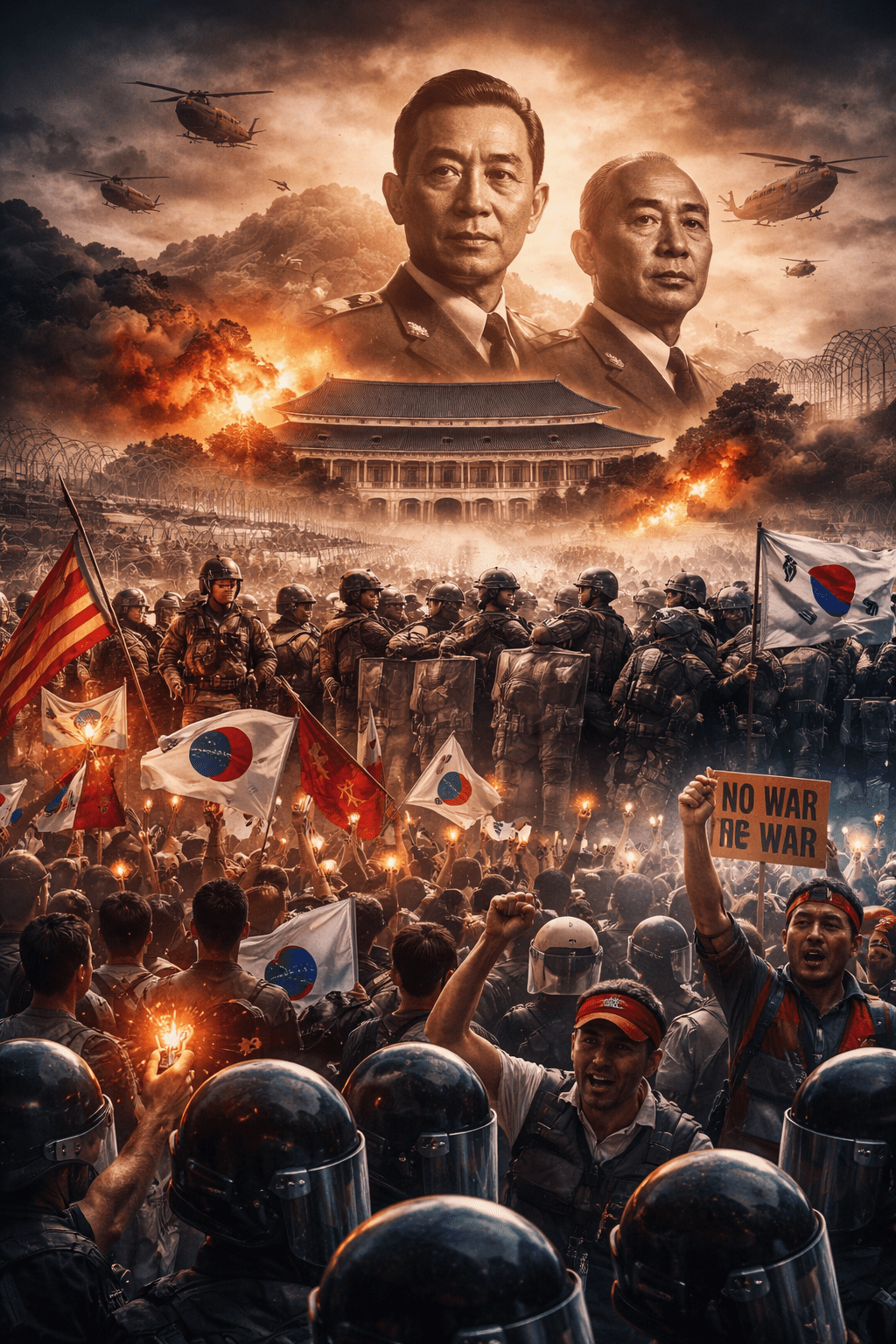
POLITICO turns a deep political rupture into spectacle, masking a crisis rooted in repression, dependency, and anti-communist rule. Beneath that spectacle lies a system shaped by coup attempts, militarized governance, U.S. command integration, and a society strained by inequality and dislocation. What appears as imported MAGA politics is in reality an old state logic speaking through a new ideological language under conditions of crisis. Against this, a living terrain of struggle—labor, peace movements, feminist resistance, youth organizing, and diaspora action—emerges as the material force capable of breaking the cycle.
By Prince Kapone | Weaponized Information | March 30, 2026
The Costume and the Cage
The article under excavation is “Hitting the Streets With the MAGA Youth of South Korea”, published by POLITICO Magazine on March 27, 2026 and written by Catherine Kim. On its face, the piece offers a vivid street-level report from Seoul, where young supporters of disgraced former president Yoon Suk Yeol gather in red hats, wave American flags, shout election-fraud slogans, and drape themselves in the language and symbolism of Trumpism. We are shown the Trump masks, the “Stop the Steal” signs, the “Yoon Again” chants, the glossy weirdness of MAGA paraphernalia transplanted into Gangnam. The article’s animating curiosity is not whether this political terrain was historically cultivated by empire, anti-communism, and militarized dependency, but what it feels like to witness American-style right-wing spectacle blooming in a foreign street. That distinction matters, because from the first paragraph onward the piece is less interested in causes than in appearances, less interested in structure than in scenery.
POLITICO’s institutional location is not incidental to this framing. This is not a ragged independent sheet written from the underside of the world system. It is a major political media organ owned by Axel Springer and sustained by advertising, sponsorships, and a premium intelligence model that markets policy information to corporations, institutions, and sectors of the governing class. In plain language, it belongs to the Atlantic professional-managerial information machine. That does not mean every sentence is dictated from a boardroom like some cartoon conspiracy. It means the publication inhabits a definite political universe. It looks at instability from above. It processes conflict for elites. It specializes in translating crises into intelligible, manageable stories for readers who may not control the tanks or the stock exchange, but who live close enough to power to smell the exhaust. Axel Springer’s declared commitments—to the transatlantic alliance, the state of Israel, a united Europe, and free-market capitalism—do not mechanically script the article, but they do form the ideological weather in which it was written. One should not expect a media institution of that kind to ask whether the South Korean right has been incubated for generations inside an anti-communist state architecture lashed to U.S. power. That would be asking the court stenographer to indict the judge.
Catherine Kim writes accordingly. Her prose is observant, mobile, attentive to gesture and mood. She knows how to place a reader in the scene. She notices the costume, the chant, the tears, the strange intimacy between political faith and theatrical performance. There is craft here. But craft is not innocence. The article is aimed at an American readership trying to make sense of a disturbing echo of its own domestic crisis, and so the Korean far right is introduced above all as a kind of transpacific mirror. MAGA has gone abroad. Trumpism has traveled. A political style once associated with Phoenix and Mar-a-Lago now appears in Seoul with a local accent. That is the hook. It is clever, legible, and deeply limiting.
This is narrative framing in its pure liberal form. The South Korean right first arrives as spectacle: a Trump mask, a red hat, a cape, English slogans, giant flags of the United States moving through the streets of another nation like props from a touring empire. The effect is cinematic. The reader is encouraged to recognize the symbols instantly, to feel the uncanny familiarity of them, and only then to ask what all of this means. But the frame has already done its work. By privileging the visual strangeness of MAGA abroad, the article casts the phenomenon primarily as cultural migration, as ideological style transfer, as a sort of political franchising operation. It trains the eye on the costume and away from the cage. The deeper machinery—the security state, the anti-communist tradition, the military dependency, the historical role of the United States in shaping South Korean reaction—remains politely offstage.
Appeal to emotion sharpens this effect. The article lingers on grief, fear, betrayal, desperation, wounded loyalty. We are shown young activists who believe their country is being stolen, supporters who speak in the language of siege, riders on the subway weeping after Yoon’s sentence, militants convinced that shadowy enemies are stripping the nation from beneath their feet. This emotional register is not trivial. It humanizes the movement, gives it texture, makes it feel lived rather than abstract. But it also launders politics through sentiment. The violence of the project itself—its authoritarian desire, its anti-communist hysteria, its longing for strongman restoration—is softened by the intimacy of sadness. The right becomes less a force advancing reaction and more a crowd nursing heartbreak. One leaves not with a clear account of what these people are trying to build, but with the liberal impression that democracy has somehow generated too much pain on all sides and that our task is to understand the confusion. Thus the tiger is introduced not by its claws, but by its loneliness.
Source hierarchy performs equally important work. The article allows the far-right milieu to narrate itself at length. Their anxieties, theories, aspirations, and symbols are given pride of place, then gently bracketed by institutional rebuttals from election authorities, courts, or polling data. This is the familiar grammar of establishment reporting: let the extremists speak, let official institutions supply the corrective, and call the result balance. Yet balance here is just a polished form of misdirection. What disappears is not a minor detail but an entire hierarchy of causation. The U.S.–South Korea alliance structure disappears. The anti-communist state tradition disappears. The long manufacture of pro-American conservatism under Cold War conditions disappears. The political economy of youth dislocation disappears. The article gives us actors, slogans, and rebuttals, but withholds the historical machine that produced them. The result is a portrait of symptoms detached from the body.
Omission, then, is not accidental but constitutive. The article notices that American flags carry enormous emotional charge in this movement, but it does not seriously ask why the flag of a foreign empire can function as a sacred object for a Korean right-wing current claiming to defend national sovereignty. It notices anti-communist paranoia, but not the state tradition that institutionalized anti-communism as a governing principle. It notices Yoon’s downfall, but not the longer genealogy of martial law, dictatorship, and emergency rule in a U.S.-backed southern state forged under partition and war. It notices a youth base drifting into reaction, but not the class dislocation, gender crisis, digital radicalization, and blocked social reproduction through which ruling-class politics are metabolized by the young. In other words, it notices the smoke while declining to inspect the wiring.
This is what controlling the message looks like in a refined imperial publication. The article is willing to acknowledge conspiracy theories, election denial, anti-China rhetoric, and misogynistic scandal. It is not blind. But it contains these phenomena inside a liberal interpretive fence. They become signs of democratic anxiety, examples of polarization, evidence of a roving global far-right style. What they do not become is proof of a deeper political formation rooted in militarized dependency and anti-communist statecraft. That limit is the article’s real politics. It can diagnose pathology, but not structure. It can describe contagion, but not incubation. It can say the reactionaries are dangerous, but not ask which institutions, alliances, myths, and class interests fed them until they could walk the streets dressed in American empire and call it Korean freedom.
The ideological function of the piece, then, is not to praise the Korean far right in crude terms. It is subtler than that, and therefore more effective. It packages a destabilizing development into a recognizable liberal parable: MAGA has become globally contagious. There is truth in that, but only in the shallow sense that a virus exists. The article does not ask why the body was already weak, why the organs were already compromised, why the immune system had long been trained to attack its own people in the name of anti-communist security. The deeper reality is harsher and more historically grounded. The South Korean right did not simply import MAGA from the United States like a new phone app or a line of knockoff merchandise. It found in MAGA a fresh vernacular for an older political tradition already sedimented in the South Korean order: pro-U.S., anti-communist, security-state, and hungry for emergency power when ordinary legitimacy begins to fray. POLITICO gives us the costume. Our task is to excavate the structure wearing it.
From Coup to Condition: Reconstructing the Terrain Beneath the Spectacle
If we step outside the narrow frame of the POLITICO article and reconstruct the material terrain on which this crisis unfolds, the first fact that demands clarity is that the political rupture at the center of the story was not symbolic, cultural, or merely rhetorical. It was an attempted reconfiguration of state power. Former South Korean President Yoon Suk Yeol was removed from office and sentenced to life imprisonment for insurrection tied to his December 2024 declaration of martial law, a sequence that places the events firmly in the register of political crisis rather than democratic disagreement. The POLITICO article acknowledges this outcome but immediately refracts it through a cultural lens, focusing on a youth movement that has taken up slogans such as “Stop the Steal” and “Make Korea Great Again.” The article presents organizations like Build Up Korea and Freedom University as central nodes in this milieu, while election authorities rejected the fraud claims that animate the movement, and President Lee Jae-myung continues to maintain relatively strong approval ratings, undermining the far-right narrative that legitimacy has collapsed entirely. These are the visible contours. But they are only the surface.
To understand what actually occurred, we have to begin where the Korean anti-imperialist movement itself began: before the coup was declared. The People’s Democracy Party warned in advance of the emergence of “war martial law,” identifying the Yoon administration as moving toward a pro-U.S., anti-communist authoritarian consolidation. This was not hindsight. It was a political diagnosis made in real time by forces embedded in the struggle. When the declaration came, those same forces immediately named it a “self-coup” and called for Yoon’s arrest, making clear that the event was not interpreted domestically as an aberration but as the culmination of an identifiable trajectory. That trajectory was explicitly ideological. PDP statements tied the coup attempt to intensified anti-communist, anti-China, and anti-DPRK mobilization, locating the event within a Cold War grammar that has long structured the South Korean state. Subsequent developments only deepened this interpretation. Prosecutors alleged that Yoon sought to provoke the DPRK into armed confrontation to justify emergency rule, while his administration had already suspended the inter-Korean military agreement and resumed frontline military operations, embedding the coup attempt in a broader arc of escalation. The rupture, in other words, was not sudden. It was prepared.
This preparation cannot be understood without situating it in the longer lineage of the South Korean security state. The contemporary republic did not emerge as a neutral liberal democracy that later deviated into authoritarian temptation. It was consolidated through dictatorship. The Gwangju Democratic Uprising of May 1980—an armed popular revolt against military rule—was violently suppressed under martial law, and remains one of the defining historical memories of the Korean people’s struggle against state repression. That memory exists alongside a legal architecture that continues to institutionalize anti-communism. The National Human Rights Commission of Korea has recommended abolishing the National Security Law precisely because it restricts political expression and suppresses dissent under the banner of anti-DPRK security. This means that anti-communism in South Korea is not a cultural residue or rhetorical excess. It is codified, enforced, and historically rooted. When contemporary movements mobilize around the threat of internal enemies, they are not inventing a language from scratch. They are activating a state tradition that has long defined dissent as danger and repression as protection.
That state tradition is inseparable from the question of sovereignty. South Korea is not simply a nation-state navigating its own independent political contradictions. It is embedded within a military structure dominated by the United States. The country hosts Camp Humphreys, the largest U.S. military base overseas, a concrete expression of its role as a forward platform in Washington’s regional strategy. At the same time, South Korea does not retain full wartime operational control over its own armed forces, meaning that in the event of major conflict, command authority is structurally subordinated. This is not a technical detail. It is a condition of dependent sovereignty. Within this arrangement, domestic political formations do not develop in isolation. They are shaped within a framework of permanent military alignment and continuous war preparation. It is therefore not incidental that Korean anti-imperialist organizations explicitly link far-right mobilization to U.S.–ROK war drills and preemptive-strike doctrine. The domestic and the geopolitical are fused. Reaction at home is inseparable from militarization abroad.
The social terrain on which this political crisis unfolds is equally decisive. South Korea’s celebrated economic development rests on a highly concentrated structure of capital. Chaebol conglomerates dominate the national economy, shaping employment, wages, and life chances for millions. Beneath the surface of aggregate growth lies a more fractured reality. Korean labor statistics define youth as ages 15–29, and national data continues to reflect persistent strain in youth employment and livelihood conditions, with housing costs, job insecurity, and social competition intensifying pressure on younger generations. This is the terrain on which political identity is formed. It is not surprising that dislocation, anxiety, and blocked futures can be redirected into reactionary narratives when the underlying structure offers limited stability or upward mobility. Yet this same terrain is also contested. The Korean Confederation of Trade Unions operates as a militant labor formation advancing economic and political demands, and its role in moments of crisis—including the period surrounding the martial law attempt—demonstrates that the working class remains an active force in shaping the political field.
Finally, the ideological environment in which all of this unfolds has been transformed by digital media. Korean reporting has documented the spread of election-fraud conspiracies and pro-martial law narratives through YouTube-centered far-right ecosystems, where influencers, commentators, and networks amplify fear, resentment, and anti-communist paranoia. These are not isolated fringe phenomena. They are integrated into broader transnational circuits of reaction, where styles, narratives, and conspiracies circulate across borders and are localized within specific political contexts. This is the point at which the POLITICO framing begins to break down. It is not wrong to observe that elements of MAGA have appeared in South Korea. But to stop there is to mistake circulation for origin. The digital sphere accelerates and reshapes political expression, but it does not generate the underlying conditions. Those conditions are produced by a historically rooted anti-communist state, a structure of dependent sovereignty, a militarized geopolitical position, and a social order marked by concentrated capital and youth dislocation.
When we widen the lens further, the deeper continuity becomes unmistakable. The Korean War did not end with a peace treaty but with an armistice, leaving the peninsula suspended in a permanent state of unresolved conflict. This unresolved war functions as a continuous justification for militarization, alliance dependency, and the reproduction of anti-communist ideology. Yoon’s foreign policy orientation was praised precisely because it deepened integration with U.S. regional strategy, even as domestic tensions escalated. Meanwhile, the Korea Peace Appeal challenges this entire framework by calling for a formal end to the war, a peace agreement, and a break from the cycle of escalation. The existence of such movements underscores a crucial point: the political terrain is not fixed. It is contested between forces that seek to intensify militarization and those that seek to dismantle it.
Taken together, these elements form a coherent structure. An unresolved war produces permanent militarization. Militarization reinforces anti-communism as an organizing ideology. Anti-communism justifies legal repression and political exclusion. Dependent sovereignty embeds the state within a U.S.-led command structure. Concentrated capital and social precarity generate dislocation, especially among youth. Digital ecosystems translate that dislocation into reactionary narratives. Within this structure, a figure like Yoon does not represent an anomaly but a crisis expression of the system itself. And a movement that waves American flags while denouncing domestic enemies does not represent a foreign import, but a familiar political formation speaking in an updated dialect. This is the terrain that the spectacle obscures—and the terrain that must be understood before any serious political conclusion can be drawn.
Empire’s Mirror: When Crisis Speaks in a Familiar Language
What appears in the streets of Seoul as imitation is, in substance, recognition. The red hats, the slogans, the theatrical borrowings from American political culture—these are not the origin of the phenomenon but its most visible surface. Beneath them lies a structure that predates MAGA and exceeds it. The crisis we are looking at is not the globalization of a brand. It is the convergence of a historically produced political order with a contemporary language capable of expressing its contradictions. In that sense, the Korean far right does not import MAGA so much as translate itself through it.
To see this clearly, we have to begin from the fact that South Korea is not a neutral democratic container temporarily disturbed by extremist ideas. It is an armistice state. Its political life has unfolded under the shadow of an unresolved war, a permanent division of the peninsula, and a security architecture built in alignment with U.S. power. This condition has shaped not only its foreign policy but its internal political grammar. Anti-communism is not one ideology among many; it is the organizing principle through which dissent is classified, threats are identified, and legitimacy is distributed. Under such conditions, the boundary between democracy and emergency rule is never fully settled. It is managed, negotiated, and, in moments of crisis, reasserted through force.
This is what gives the recent rupture its true meaning. Yoon’s attempt to impose martial law is not an alien intrusion into an otherwise stable democratic order. It is a reactivation of capacities that have always existed within that order. The language may shift, the personalities may change, the global context may evolve, but the underlying mechanism remains available: when legitimacy falters, the state turns to its security apparatus, and when the security apparatus is ideologically organized around anti-communism, repression presents itself not as deviation but as defense. The coup attempt, then, is not an accident. It is a possibility inscribed within the structure itself, brought to the surface by crisis.
What, then, is MAGA in this context? It is not the cause. It is the idiom. It is the vocabulary through which an existing political tendency expresses itself under new historical conditions. The Korean right has long been pro-U.S., anti-communist, and oriented toward strong-state solutions in moments of instability. What MAGA provides is a contemporary script: a ready-made narrative of stolen elections, internal enemies, national betrayal, and heroic restoration. It offers a dramatized form through which older ideological content can be rearticulated for a new generation. The American flag in Seoul is not simply a sign of admiration. It is a symbol of alignment, a declaration of belonging to a wider imperial order, and a shorthand for a politics that fuses nationalism with external dependency.
This is why the liberal framing collapses under scrutiny. To describe this phenomenon as the spread of MAGA is to invert cause and effect. It suggests that the Korean right became what it is by borrowing from the United States, rather than recognizing that both formations emerge from related structures within a global system. The United States is not merely exporting ideology; it is the central node of an imperial order that produces similar political tendencies across different regions. In that order, militarization, anti-communism, and economic concentration generate recurring patterns of crisis. MAGA is one expression of that crisis in the imperial core. The Korean far right is another expression in a dependent formation. Their similarities are not accidental, but structural.
The youth dimension of this movement follows the same logic. It is tempting, from a liberal standpoint, to interpret young people adopting far-right symbols as evidence of irrational drift or cultural contamination. But this interpretation avoids the material question: what conditions make such politics intelligible, even attractive, to a segment of the youth population? Here the contradiction becomes sharper. Young people come of age within a society marked by intense competition, concentrated wealth, precarious employment, and constrained social mobility. At the same time, they are immersed in a digital environment that amplifies grievance, simplifies complexity, and offers ready-made narratives of blame. Within this terrain, anti-communism provides a familiar enemy, nationalism offers a sense of belonging, and conspiracy narratives supply a framework that transforms diffuse anxiety into directed anger. What appears as ideological extremism is, in part, the political metabolism of social dislocation.
But the terrain is not one-sided. The same structural conditions that produce reaction also produce resistance. Labor movements, feminist organizations, peace campaigns, and student formations do not arise from outside this system; they emerge within it as counter-forces. The Korean working class, historically forged through struggles against dictatorship and exploitation, remains an active participant in shaping the political field. Women’s organizations confronting militarization and exploitation challenge not only specific abuses but the broader system that sustains them. Youth movements opposing war, repression, and reaction demonstrate that generational politics are not predetermined. What we are witnessing, then, is not the inevitable rightward drift of a society, but a contested field in which multiple futures are struggling to take form.
This brings us back to the role of media. When an outlet like POLITICO frames the Korean far right as a cultural echo of MAGA, it does more than simplify. It obscures the structural relations that produce both phenomena. It allows the imperial center to appear as the origin of political distortion rather than as a participant in a system that generates crisis across different contexts. It reduces a historically grounded formation to a spectacle of imitation. And in doing so, it protects the deeper architecture from scrutiny. If MAGA is merely a style that travels, then the problem is diffusion. If, however, MAGA and its analogues are expressions of a wider crisis within imperial capitalism, then the problem is structural—and far more difficult to contain.
The task, then, is not to deny the visible similarities between the American and Korean right, but to situate them correctly. They are not evidence of cultural contagion alone. They are reflections of a shared condition: a world system under strain, in which established forms of legitimacy are weakening, and in which ruling blocs experiment with new combinations of nationalism, repression, and ideological mobilization to maintain control. In that sense, what we see in Seoul is not simply MAGA abroad. It is empire looking at itself from another angle, speaking in a different language, but articulating the same underlying contradiction. The mirror does not create the crisis. It reveals it.
Where the Struggle Lives: Organization Against the Armistice Order
If the previous section clarified anything, it is that the same structure that produced the far right must also define the terrain on which it is defeated. This is not a battle of ideas floating above society. It is a struggle over a concrete formation: an anti-communist state built under conditions of unresolved war, sustained through U.S. military integration, and stabilized through a social order marked by inequality, precarity, and ideological discipline. That means the response cannot be rhetorical. It must take root in the forces already confronting these conditions at their point of reproduction.
At the level of political clarity, the line has already been drawn from within Korea itself. The People’s Democracy Party (민중민주당) has consistently framed the Yoon crisis not as an isolated abuse of power, but as the expression of a pro-U.S., anti-communist state trajectory moving toward authoritarian consolidation—captured in its characterization of the martial law move as a “self-coup” (친위 쿠데타). This matters because it refuses the liberal illusion that democracy simply malfunctioned. Instead, it identifies the system as the problem. Any serious alignment with Korean struggle has to begin here—with the recognition that what is being contested is not a deviation from the norm, but the norm itself.
From that starting point, the central structural contradiction comes into focus: the unfinished war. The Korea Peace Appeal / Peace Campaign to End the Korean War is not simply calling for peace in the abstract. It is targeting the armistice order that has normalized militarization, justified emergency powers, and anchored South Korea within a permanent security framework. The absence of a peace treaty is not a historical footnote—it is the condition that makes every escalation legible, every repression defensible, and every crisis governable through force. To support this campaign is to strike at the foundation that allows reaction to reproduce itself.
At the level of class power, the contradiction sharpens further. The Korean Confederation of Trade Unions (KCTU) stands as a direct counterweight to the chaebol-dominated order that structures South Korean capitalism. This is not incidental to the current crisis—it is central to it. The same system that concentrates wealth, disciplines labor, and produces youth precarity is the one that leans on anti-communism and security logic to maintain stability. During the martial law confrontation, KCTU affiliates and allied labor formations mobilized in opposition, linking the defense of democratic space to the material struggle of workers. Where liberal politics asks for restoration, labor struggle opens the possibility of transformation.
The gendered dimension of this system reveals itself most clearly in the geography of militarization. Organizations like Durebang (My Sister’s Place) operate in the camp-town zones surrounding U.S. bases, where the underside of dependent sovereignty becomes visible in the form of exploitation, trafficking, and social abandonment. These are not marginal spaces—they are integral to the reproduction of the military order itself. Alongside this work, formations such as Women Cross DMZ and Korea Peace Now! tie demilitarization to feminist struggle, making clear that the fight against war is inseparable from the fight against the social relations that sustain it. Here, resistance is not only oppositional—it is reconstructive.
The youth terrain, so easily flattened in the original article, is also a site of active struggle rather than passive drift. Student formations such as Student Action for Peace have organized against war and militarization, while campus-based coalitions opposing far-right incitement demonstrate that universities remain contested political ground. This matters because it breaks the narrative of inevitable rightward movement. The political future of youth in South Korea is not being imported—it is being fought over.
Beyond the peninsula, the structure extends into the imperial core, and so must the struggle. The Nodutdol for Korean Community Development represents a critical node in this extension, organizing diasporic Koreans around anti-imperialism, reunification, and national liberation. Its US Out of Korea campaign directly targets the base structure and command architecture that define South Korea’s limited sovereignty, while initiatives like the First People’s Summit for Korea demonstrate concrete coordination between Korean and diaspora movements. This is not symbolic solidarity. It is strategic pressure applied within the imperial center itself.
Taken together, these forces map directly onto the contradictions that define the crisis. Anti-imperialist political formations confront the ideological structure of the anti-communist state. Peace campaigns challenge the armistice order that sustains permanent militarization. Labor struggles attack the chaebol-centered political economy that produces precarity and inequality. Feminist organizations expose and resist the gendered social reproduction of militarized dependency. Youth movements contest the political direction of a generation shaped by crisis. Diaspora formations extend the struggle into the core of empire. Each operates on a different front, but all are oriented against the same underlying formation.
The far right, for all its spectacle, offers only a reactionary consolidation of that formation: deeper militarization, intensified repression, and tighter integration into U.S. strategic command. It is not a solution. It is a management strategy for crisis within the anti-communist state form. The alternative cannot mirror it in reverse. It must break from the logic entirely—toward peace instead of permanent war, toward sovereignty instead of dependent command, toward collective well-being instead of concentrated accumulation, and toward forms of democratic life rooted in material participation rather than ideological discipline.
What is at stake, then, is not simply a political contest within South Korea, but the future of a society organized under an armistice order, constrained by dependent sovereignty, and governed through an anti-communist state structure that reaches into everyday life. The forces outlined above do not yet constitute a unified bloc, but they already exist as the material basis for one. The task is to connect them—to turn fragmented resistance into organized power capable of breaking the cycle of militarization and crisis. That is where this struggle will be decided.
 Weaponized Information
Leave a comment