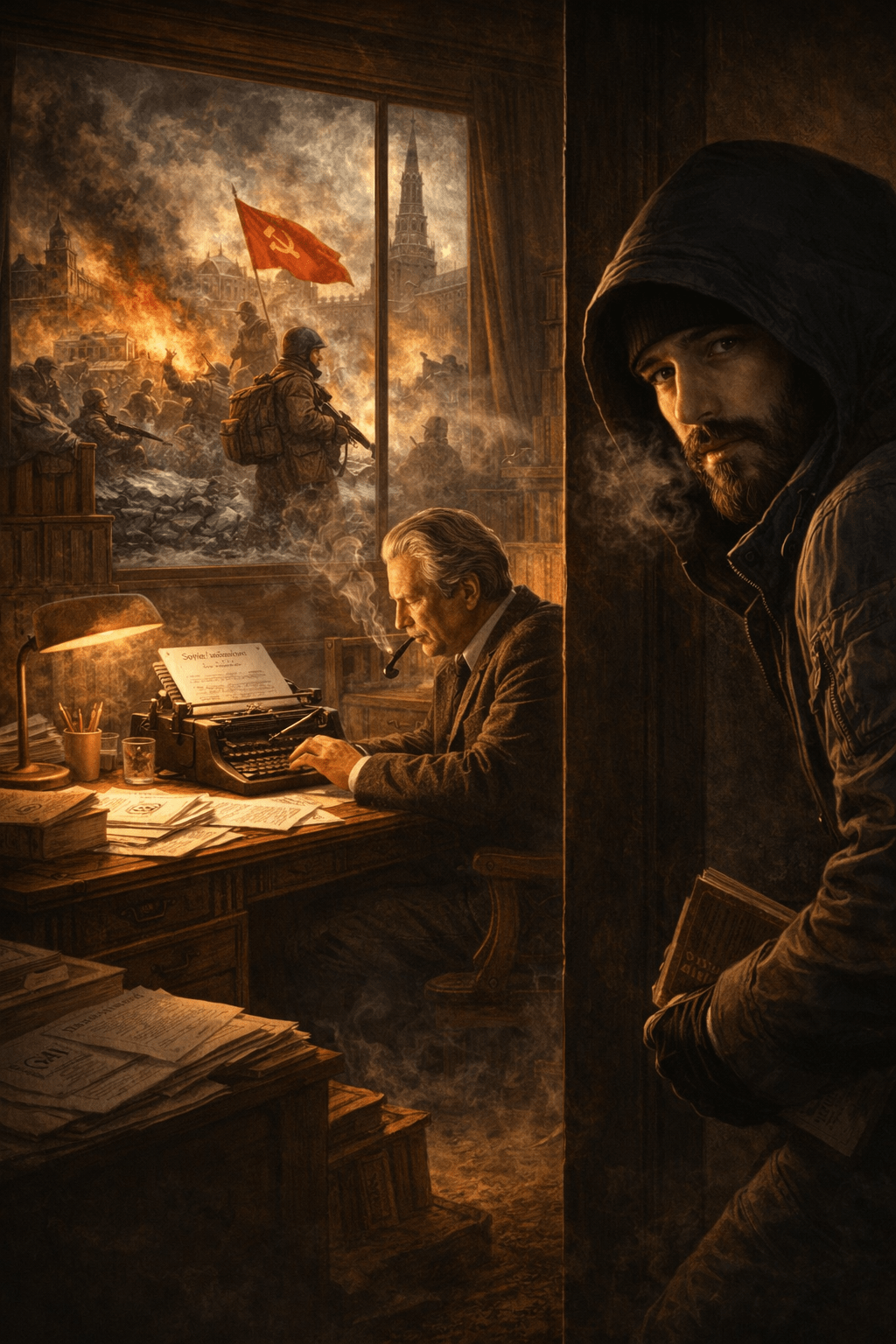
A ruthless chapter-by-chapter assault on Herbert Marcuse’s Soviet Marxism: A Critical Analysis, exposing it not as some noble “immanent critique” of actually existing socialism, but as a polished work of Cold War Western Marxist sabotage—an effort to sever Marx from Lenin, dialectics from revolution, and theory from the hard, blood-soaked labor of building socialism under imperial siege.
By Prince Kapone | Weaponized Information | Weaponized Intellects Book Review | March 25, 2026
A Note In The Margin
I did not come to Marxism through the seminar room, nor through the slow accretion of academic curiosity. I came to it under confinement. In 2004, at eighteen years old and incarcerated, I encountered communism not as an abstract intellectual tradition but as a living weapon—something forged in struggle, sharpened in contradiction, and carried by those who had already confronted the state at its most naked level. My first guides were not professors but incarcerated revolutionaries who introduced me to: Malcolm X, Huey P. Newton, George Jackson, Che Guevara, Fidel Castro, Mao Zedong. Through them, I arrived at Marx—not by way of footnotes, but through fire. As a member of what is often called the lumpen criminal class, my understanding of capitalism had never been theoretical in the first place. It was immediate, visceral, and enforced. It was learned in the informal economy, in the constant negotiation with scarcity, in the omnipresence of police, in raids, hand-cuffs, and cages. By the time I read Marx, I already knew something of class struggle—not as a concept, but as a condition.
It was only later, during a second period of incarceration from 2009 to 2011, that I encountered what passes for “Marxism” in the academic world. I enrolled in college courses, earned an AA degree, and was introduced to figures like Marcuse, Althusser, and the broader canon of Western Marxism, particularly the Frankfurt School tendency. But by then, I was already politically formed. I had studied, organized, and debated with comrades both inside and outside prison. I had read deeply enough to recognize that what I was now being presented with bore little resemblance to the Marxism I had come to know. It was not that these thinkers lacked intelligence or sophistication. It was that their work seemed fundamentally detached from revolutionary practice—from the conditions of struggle, from the question of power, from the problem of actually transforming the world. Their Marxism appeared as interpretation, critique, and abstraction—rarely as strategy, rarely as commitment, and almost never as a guide to action. For those of us coming from the streets and the cellblocks, it was not only unconvincing—it was largely irrelevant.
For that reason, I set them aside. I did not take them seriously as revolutionary theorists, and I did not feel the need to engage their work in any sustained way. But more recently, after first reading Gabriel Rockhill’s Who Paid the Piper of Western Marxism, I found myself compelled to return—to go back and actually read Marcuse, not as a passing academic reference, but as a central figure in the formation of Western Marxist discourse. What I found confirmed some of my earlier suspicions, but also demanded a more rigorous response. This essay, then, is an attempt to settle accounts—not casually, but systematically. Part I focuses on the first part of Marcuse’s Soviet Marxism, engaging it closely, critically, and on its own terms. Part II will take up the second half of his argument. What follows is not written from the standpoint of academic neutrality, but from the standpoint from which I first came to Marxism: that of struggle, contradiction, and the insistence that theory must ultimately answer to practice.
The Revolution Marcuse Refuses to Recognize
Marcuse opens Chapter One with a gesture of false fidelity. He tells us that Marxist concepts develop by “unfolding the elements inherent in the original concept,” preserving their “theoretical consistency” and “identity,” and from there he reconstructs the classical Marxian conception of transition as the “objective historical coincidence between progress of civilization and the revolutionary action of the industrial proletariat.” This is not an innocent summary. It is the laying of a trap. Marcuse begins by embalming Marxism. He fixes it at the level of an original conceptual architecture, and then prepares to prove that history has betrayed the blueprint. The revolution, in his hands, is already guilty before the trial begins, because it has occurred in the wrong sequence, on the wrong soil, and under the wrong balance of class forces.
In fairness, Marcuse does put his finger on a real historical problem. He is right that Marx and Engels expected the transition to socialism to emerge out of advanced capitalism, out of a high level of productivity, the concentration of economic power, and the organized growth of a class-conscious proletariat acting “not in, but against the capitalist system.” He is also right that Marx’s distinction between the first and second phases of socialism presupposed a transitional period marked by continued labor, continued inequality, and what Marcuse correctly describes as a time lag between “the means and the end of liberation.” But where a dialectician should ask how these categories develop under altered world conditions, Marcuse asks how the altered world departs from the categories. That is the beginning of the fraud. He treats the historical development of capitalism into imperialism less as a transformation of the revolutionary terrain than as a challenge to the conceptual dignity of Western Marxism.
The key move comes when Marcuse says that mature capitalism may produce “a long-range trend toward class collaboration rather than class struggle,” and that if this happens, “the traditional Marxian categories no longer apply.” Here he is naming a real contradiction, but he names it in order to smuggle in a metaphysical conclusion. For Marcuse, if the proletariat in the advanced capitalist countries does not act as the revolutionary class in the way classical Marxism expected, then a “new historical period” begins and Marxism is faced with the task of redefining transition and strategy. So far, fine. Lenin would have agreed with that much. But Lenin’s conclusion was that Marxism had to be developed through the analysis of imperialism, national oppression, unequal development, the labor aristocracy, colonial revolt, and the revolutionary role of the peasantry under communist leadership. Marcuse, by contrast, presents the shift as though it were primarily a wound inflicted on theory by recalcitrant history. That is classic Western Marxist behavior: history moves, and the first thing they check is whether the manuscript still feels intact.
This is why Marcuse’s treatment of class collaboration is both insightful and deeply evasive. He sees clearly enough that periods of stability and prosperity can draw the proletariat under the sway of “capitalist ideas,” that the “immediate” economic interest of workers can supersede their “real” historical interest, and that the organized working class in the advanced industrial countries may become integrated into the established order. He is not hallucinating this problem. Engels himself had already noted the embourgeoisement of sectors of the English working class, and Lenin would later theorize the labor aristocracy and the political consequences of imperial superprofits. Marcuse is strongest precisely where he identifies this contradiction. But then he turns around and uses it to imply that Soviet Marxism arose from the collapse of the original revolutionary subject rather than from the global reorganization of capitalism itself. In other words, he recognizes the disease but blames the doctor for changing the prescription.
The entire chapter strains toward that conclusion. Marcuse notes that Marx and Engels recognized the discrepancy between “essence and phenomena,” between the proletariat “in reality” as the negation of capitalism and the proletariat “in appearance” as a class not yet conscious of its mission. He even emphasizes Marx’s distinction between a “class in itself” and a “class for itself,” and the corresponding gap between theory and practice. But instead of treating this as the basis for a historically flexible revolutionary method, he treats it as a problem whose later development threatens the very identity of Marxism. This is where the chapter’s scholastic core reveals itself. Marcuse wants to grant historical movement just enough room to appear dialectical, while quietly insisting that any major strategic development—especially Lenin’s—must answer to the sanctity of the original conceptual arrangement. The result is a Marxism that may describe motion but is not allowed to learn from it.
One sees this most clearly in his treatment of the party question. Marcuse is compelled to admit that Lenin’s strategy of the avant-garde party responded to a real historical transformation: reformism in the workers’ movement, the political weight of the labor aristocracy, and the declining revolutionary potential of the proletariat in the advanced capitalist countries. He also concedes that the center of gravity shifts toward the backward countries and the peasantry. But he presents all this as a sign of theoretical inadequacy, as though Lenin had smuggled a new reality under the table while pretending to preserve old orthodoxy. The complaint here is not merely analytical. It is civilizational. Lenin dragged Marxism out of the European parlor and into the colonial storm. He made the peasantry, the oppressed nation, and the weak link intelligible as revolutionary forces. He shifted the axis of world revolution away from the self-image of the Western worker. Marcuse never forgives him for it.
Against this, the anti-colonial development of Marxism must be stated plainly. Lenin’s theory of imperialism was not an arbitrary supplement to Marx. It was Marxism growing up under monopoly capital and colonial partition. Stalin’s contribution, whatever one’s later judgments on this or that policy, cannot be reduced to bureaucratic vulgarity; it lay in theorizing and organizing socialist construction under siege, in grasping that a backward workers’ state would have to industrialize, centralize, and arm itself or be crushed. Mao extended the same logic in a semi-colonial setting, demonstrating that the revolutionary energy of the peasantry, under proletarian leadership, could break the chain where European orthodoxy saw only backwardness. Nkrumah showed that the world system reproduces underdevelopment as a condition of imperial prosperity. Che treated revolutionary morality, sacrifice, and organization as practical weapons in anti-imperialist war. Rodney shredded the smug metropolitan assumption that Europe’s development and the colonized world’s underdevelopment were separable stories. Yeshitela has, in our own political terrain, forced the colonial contradiction inside the U.S. settler state back to the center. Marcuse’s chapter, for all its talk of redefinition, cannot metabolize this world-historical expansion of Marxism. It remains trapped in a European family dispute while the colonized are remaking history outside the house.
The chapter’s most revealing sleight of hand concerns the relation between theory and practice. Marcuse emphasizes that Marx and Engels insisted the revolution must be the “direct organized action of the proletariat as a class,” and that they did not recognize any “substitute” for it. He then treats Lenin’s party conception and later Soviet development as signs that the proletariat has been transformed from subject into object. Again, there is a real contradiction here worth taking seriously: the relationship between class, party, leadership, consciousness, and revolutionary representation is not simple, and socialist experience did generate bureaucratic deformations and real tensions between mass initiative and institutional command. A dialectical critique must not hide that. But Marcuse’s handling of the problem is one-sided because he abstracts it from the historical collapse of the Second International, from the integration of organized labor into imperial politics, and from the concrete fact that without revolutionary organization, the proletariat does not magically become a class “for itself” just because a philosopher is fond of the phrase. The Western Marxist wants spontaneity where history has supplied social democracy, chauvinism, and trade-union bureaucracy; then he faults the revolutionaries for building an instrument to overcome them.
Even more telling is Marcuse’s use of Hilferding and Kautsky. He recounts the theories of finance capital and “ultra-imperialism,” describing the possible stabilization and integration of capitalism through monopoly, cartelization, political centralization, and expansion into weaker regions. He then argues that the postwar capitalist world came closer than ever to the “dreaded specter” of a “general cartel,” a planned Western bloc held together by anti-communism, military integration, and the East-West conflict. This is one of the chapter’s strongest passages, because here Marcuse is forced to admit that capitalism did not simply continue in the nineteenth-century form presupposed by a certain reading of Marx. It reorganized itself internationally, politically, militarily, and ideologically. But again he cannot follow the logic to its full conclusion. For if capitalism changed that profoundly, then the revolutionary subject, the strategy of transition, and the forms of socialist construction also had to change. Leninism would then appear not as deviation but as the determinate development of Marxism in the imperialist epoch. Marcuse stands right at the door of that conclusion, nods toward it, and then backs away into conceptual melancholy.
What finally emerges from Chapter One, then, is not a devastating critique of Soviet Marxism, but a devastating revelation of Marcuse’s own horizon. He sees the contradiction between original expectation and actual development. He sees the integration of sectors of the proletariat into advanced capitalism. He sees the shift toward backward countries, peasants, revolutionary parties, and anti-imperialist conflict. He sees the possibility of a capitalist order stabilized through monopoly, militarization, and bloc formation. He even sees that the very progress of the Soviet system helped force the West into this reorganization. But because he remains chained to the metaphysics of an original revolutionary image—the industrial proletariat in advanced Europe as the privileged and almost exclusive carrier of historical reason—he can process these facts only as injuries to theory, not as the grounds for theory’s development.
That is why this chapter must be answered mercilessly. Marcuse is not simply clarifying Marx’s concept of transition. He is policing the borders of a Western Marxist imagination that cannot bear the fact that Marxism had to become anti-colonial, strategically flexible, organizationally hard, and materially developmental in order to remain revolutionary in the real world. He wants to hold Marxism to its “identity” while the world that made that identity possible has been shattered by empire, monopoly, world war, colonial revolt, and socialist revolution. The result is drivel dressed as rigor: a metaphysics of lost purity masquerading as dialectics. What the chapter really teaches is not that Soviet Marxism departed from history’s path, but that Marcuse could not recognize history once it stopped speaking with a German accent.
The Party as Substitute, or the Birth of Revolutionary Strategy?
Marcuse begins Chapter Two with a smirk disguised as caution. He tells us that Soviet Marxism cannot simply be dismissed as “mere propaganda,” that its theoretical pronouncements continue to matter, that the distinction between “propaganda” and “truth” is too easy if it assumes a demonstrable truth standing cleanly outside history. Fair enough. But this opening modesty only prepares a sharper move. Marcuse wants to show that Soviet Marxism speaks in a kind of double register: “orthodox” Marxian notions remain on the lips, while the actual policies of the Soviet state proceed from conditions that those notions allegedly deny. The phrase he uses—“Aesopian language”—is telling. Soviet theory, he suggests, speaks in code even to itself. It says proletariat while meaning party, says world revolution while meaning national survival, says capitalism’s imminent contradictions while practicing long-term coexistence with an enemy it cannot yet defeat. In other words, Marcuse is not interested in theory as a battlefield of strategic adaptation. He is interested in theory as evidence for the prosecution.
Now again, one must concede the real problem before crushing the false conclusion. Soviet Marxism did preserve formulas from the older Marxian vocabulary even as the terrain of revolution had shifted drastically. It did continue to invoke the “revolutionary proletariat” in countries where reformism, trade-union economism, imperial privilege, and political integration had clearly altered the class situation. It did insist on deepening capitalist contradictions while adjusting its policies to periods of stabilization, coexistence, and retrenchment. Those tensions are real. But tensions between theory and practice are not in themselves proof of insincerity or betrayal. They are the normal condition of any revolutionary doctrine trying to move through a world that does not politely arrange itself according to philosophical expectation. Marx himself wrote in the register of contradiction. He named a historical subject whose consciousness lagged behind its structural position, a revolutionary process whose conditions matured unevenly, and a future that could be grasped only through tendencies not yet visible on the surface. The gulf between concept and reality is not an embarrassment to materialism. It is where politics lives. Marcuse knows this in the abstract, but when Soviet Marxism lives that contradiction under pressure, he suddenly treats the gap as a moral defect.
This is why his transition to Lenin is so revealing. He says the formation of Soviet Marxist theory “proceeds on the basis of Lenin’s interpretation of Marxism, without going back to original Marxian theory,” and from there he lays out what he takes to be Leninism’s decisive features: the shift in the revolutionary agent from the “class-conscious proletariat” to the “centralized party as the avant garde of the proletariat,” and the elevation of the peasantry as ally in the revolutionary process. These, he says, arose under the impact of capitalism’s sustained strength at the imperialist stage, but then became general principles of international strategy. The phrase that matters most comes a few lines later: to counteract the integration of organized labor into capitalism, “the ‘subjective factor’ of revolutionary strategy is monopolized by the Party.” There it is. Not organized, not concentrated, not fought over—monopolized. Marcuse has already written the verdict into the verb.
He then reconstructs Lenin’s argument with more clarity than many of Lenin’s vulgar enemies ever manage. The worker, he says, pursues immediate improvement within capitalism. Trade-union struggle can win those improvements, but in doing so it sustains the worker as an exploited class and stabilizes the system. The resulting “class peace” “deflects” the proletariat from its objective historical position. Therefore the immediate interest must be subordinated to the “real” interest of the class, the economic struggle transformed into a political one, and this becomes “the function of the Leninist party.” Marcuse’s summary is accurate enough. The trouble begins with what he does with it. Instead of asking whether this was a necessary strategic response to the actual decomposition of proletarian revolutionary consciousness in the imperial core, he treats it as the point at which Marxism begins to cheat. The party enters where the class has failed, and for Marcuse that very entry is already suspect.
Here the whole moral economy of Western Marxism shows its ass. The proletariat, in this tradition, must be revolutionary not only in historical function but in temperament. It must suffer and yet remain pure, be integrated and yet somehow generate the right consciousness on schedule, be bribed by imperial spoils and still act as universal humanity. When it fails, the doctrine cannot be allowed to learn too much from the failure. Instead, suspicion falls on the instrument built to overcome it. Lenin’s party becomes the scapegoat for the disappointing behavior of the Western working class. Marcuse cannot quite say that out loud, so he gives us a more elegant formula: the party “monopolizes” the subjective factor. But behind the elegance is a familiar resentment. Lenin refused to wait for Europe’s workers to become worthy of theory. He built a political instrument for acting under conditions of defeat, fragmentation, and retreat. That is the unforgivable act.
This becomes even clearer when Marcuse asks the decisive question: what happens when the “deflection” affects “the bulk of the proletariat in the advanced capitalist countries”? Has Marxism then lost the “mass basis required for its realization”? Has not the “connection between theory and reality” also been lost “unless the former redefines itself by redefining the latter”? Up to this point, he is right. Those are exactly the questions Leninism had to answer. But where Lenin responded by analyzing imperialism, the labor aristocracy, uneven development, and the new strategic centrality of the colonial and semi-colonial world, Marcuse turns the whole matter into a lament for lost orthodoxy. He writes as though Leninist theory was “driven” into reevaluation by difficulty, as though the revision were an emergency concession rather than the development of Marxism under monopoly capital and empire. The proletariat in the West has failed to fulfill its expected role; therefore Lenin appears not as a strategist of a new epoch but as a custodian improvising around disaster. It is all very proper, very mournful, and very false.
Take his handling of uneven development. Marcuse quotes Lenin’s formulation that “uneven economic and political development is an absolute law of capitalism,” and then notes Lenin’s conclusion that “the victory of socialism is, at the beginning, possible in a few capitalist countries,” or even in a single one. He observes that Lenin still retained the older assumption that socialism would triumph first in advanced countries, and that even after October he hesitated to treat the Russian Revolution as fully socialist, calling it in 1919 a “bourgeois revolution in so far as the class struggle on the countryside had not yet developed.” All this is true, and Marcuse is right to underline the tension. Lenin did not simply wake up with a perfectly finished theory of revolution in a backward peasant country. He fought his way toward it through contradictions. But where a dialectician should see the painful growth of theory through real historical struggle, Marcuse sees the first foreshadowing of “Stalinism”—as though Lenin’s hesitation were evidence not of rigor but of an unresolved corruption in the concept.
He is especially gleeful when he reaches Lenin’s statements on state capitalism. In April 1918, Lenin says bluntly that “state capitalism would be a step forward for us,” that “state capitalism would be our savior,” because it would bring “centralization, integration, control, and socialization,” which “is precisely what we lack.” One month later, Lenin calls “state-monopolistic capitalism” the “complete material preparation for socialism,” the “anteroom” of socialism, and asks whether it is not clear that “we cannot reach the door to socialism by any other way than through this ‘anteroom’.” Marcuse seizes these lines because they allow him to suggest that the later “Stalinist” priority of industrialization over liberation is already present at the origin, that Lenin himself makes “industrialization” prior to “socialization,” and thus places the state over the workers. There is no need to deny the harshness of those formulations. But what do they actually show? They show a revolutionary leader confronting backwardness without illusions. They show Lenin saying what Western Marxists hate to hear: socialism is not made from noble intentions and philosophical correctness alone. It requires productivity, technique, discipline, electrification, transport, trained labor, large-scale coordination—in short, the material conditions that capitalism had developed elsewhere and that Russia did not possess.
Marcuse reads this as proto-Stalinist sin because he cannot accept that a backward workers’ state might have to pass through coercive forms of development in order not to be strangled in the cradle. He is scandalized that socialism might have to build its own preconditions. This is the luxury of distance speaking again. It is very easy to sneer at the “anteroom” when you have always lived in the house. Lenin’s realism here is not a betrayal of Marxism but a refusal to turn Marxism into liturgy. He knew that without the material basis of modern production, talk about distribution according to need remained pious wind. Marcuse quotes the man and still does not hear him. Or rather, he hears him perfectly and resents what he hears.
The key to the whole chapter lies in Marcuse’s treatment of Lenin’s late reflections on global development. He turns to “Better Fewer, But Better” and draws attention to Lenin’s statement that Western Europe was not moving toward socialism “in the way we formerly expected,” but through the exploitation of some countries by others and “the exploitation of the whole of the East.” He notes Lenin’s claim that “Russia, India, China, etc.” now formed the overwhelming majority of the world’s population and were being drawn into the struggle for emancipation. He also cites Lenin’s line that the urgent task was to “ensure our existence” by making the East “more civilized,” by developing “electrification, hydro-peat, Volkhovstroy,” and that “in this and in this alone lies our hope.” Marcuse is correct that these passages condense the old and the new together. They preserve the language of Marxian finality while orienting to a world in which capitalism has shifted westward, colonial peoples have entered history on a new scale, and the Soviet state must survive long enough to develop materially. But once again he treats this as unresolved ambiguity rather than as the jagged birth of a new revolutionary horizon.
The horizon is perfectly legible if one is not chained to a European mirror. Lenin is groping toward the recognition that the decisive terrain of world revolution has moved, that the colonial and semi-colonial world can no longer be treated as reserve scenery for the European drama, and that Soviet policy must combine three things at once: exploiting contradictions among the imperialist powers, avoiding annihilation by them, and raising the productive and cultural level of the East. Marcuse admits all of this and still cannot grasp its significance. He complains that Lenin designated the new historical agent only vaguely—“Russia, India, China, etc.”—and did not create a proper new theoretical concept to alter the structure of Marxian doctrine. But history was already altering the doctrine by moving through those peoples whether the concept had reached scholastic elegance or not. This is the Western Marxist disease in pure form: colonized millions enter the stage of world history, and the first concern is that the terminology has not yet been sufficiently systematized.
Marcuse’s second-half analysis of Soviet capitalism and Western stabilization follows the same pattern of insight and retreat. He reconstructs with some force the Soviet Marxist notion of the “general crisis” of capitalism: monopoly, permanent war economy, American supremacy, the shrinking capitalist market, the existence of “two world markets,” militarization, intensified exploitation, and the idea that capitalism survives only through expanding state controls and war preparation. He is not wrong that Soviet Marxism often overstates the imminence of capitalist breakdown while still implicitly acknowledging long periods of “partial stabilization.” He is not wrong that doctrines of “general crisis” and “coexistence” exist in uneasy tension. In fact, he is often incisive when he points out that this tension is not accidental but policy-making, that Soviet theory treats capitalism as living through a whole stage of historical crisis rather than standing on the edge of immediate collapse. He even notes the famous formula of “two stabilizations,” the partial stabilization of capitalism alongside the strengthening of socialist elements in the USSR. This is one of the strongest parts of his chapter, because here he finally stops moralizing and starts seeing structure.
But then the abstraction returns. He recognizes that Soviet policy after the defeats in Central Europe, after the rise of the United States, and especially after the Second World War had to reckon with a capitalist world far stronger and more integrated than older revolutionary hopes had assumed. He sees that French and Italian Communism could not simply storm the barricades while the real command positions of the enemy lay in Washington, New York, and the Allied occupation structure. He sees that the postwar “united front” and “minimum program” were not arbitrary cowardice but adaptation to a nonrevolutionary situation in the West. He even concedes that the “class enemy” could no longer be defeated “on the barricades” in Paris, Milan, or Bologna. But what he does with these recognitions is telling. Instead of asking how Marxism had to transform under the new intercontinental political economy of American-led capitalism, he asks how all this distorts the classical revolutionary image. The reality is grasped, but only as damage.
This is why even his analysis of the Western proletariat remains oddly bloodless. Marcuse correctly shows that Soviet theory retained the revolutionary image of the Western working class long after policy had effectively put that proletariat “on ice,” treating it as a future force to be reactivated while operating in practice through coexistence, anti-fascist fronts, national sovereignty campaigns, and democratic minimum programs. He notes that the “revolutionary class” comes to assume “the features of democratic reformism,” that the Communist parties risk becoming heirs to Social Democracy, and that united-front strategy adapts itself to a majority that is not revolutionary. Again, this is a real contradiction and he is right to identify it. But he cannot place it in the world-historical context that makes it intelligible: the embourgeoisement of sectors of labor in the imperial core, the colonial transfer of value, the rise of U.S. hegemony, the saturation of Western politics with anti-communist institutions, and the new revolutionary vitality of the colonial world. Without that frame, the tension appears as theoretical bad faith rather than as the lived contradiction of a revolution that survived in the East while the core working classes remained chained to empire.
And then comes the final move, which is as elegant as it is revealing. Marcuse asks whether there is a “break” between Leninism and “Stalinism.” He grants that the differences are obvious—the growth of centralization, authoritarianism, the “dictatorship not of but over the proletariat and the peasantry.” But he immediately invokes the dialectical law of quantity turning into quality and concludes-rightfully, but scornfully-that “Stalinism” is the qualitative development of Leninism under the conditions produced by the “retardation” of revolution in the West and the stabilization of capitalism. Lenin, he says, established the “priority of industrialization over socialist liberation,” “the priority of the Soviet state over Soviet workers.” Stalin merely accelerated that program under harsher conditions. Here the entire chapter crystallizes. Marcuse does not merely want to criticize Soviet development. He wants to punish Lenin and make him answer for Stalin in advance, to show that the hard kernel of later state-socialist development was already present in Lenin’s own prescriptions!
There is a real point buried beneath the poison. Lenin did privilege survival, industrialization, and state consolidation under conditions of isolation. He did understand that Soviet power without modern productive forces would remain a slogan floating above misery. He did lay down strategic priorities that later made Stalin’s acceleration possible. Only a fool or a priest would deny that. But Marcuse’s treatment remains one-dimensional because he turns necessity into genealogy. He treats the historical pressures that pushed Lenin toward these choices as secondary, and the choices themselves as the true essence. The actual sequence—failed revolutions in Europe, imperial encirclement, civil war, underdevelopment, fascist ascent, and the impossibility of surviving as a peasant republic in a world of steel and bombers—is folded into a conceptual family tree of domination. That is not dialectics. It is the moral autobiography of a Western Marxism that cannot forgive revolution for becoming statecraft.
What Chapter Two finally reveals, then, is not the hidden insincerity of Soviet Marxism so much as the instability of Marcuse’s own framework. He sees too much to remain a simple liberal and too little to become a revolutionary materialist. He recognizes that capitalism has reorganized itself on a world scale, that the Western proletariat has been integrated in new ways, that Soviet policy is shaped by prolonged coexistence with a stronger capitalist enemy, that colonial and semi-colonial populations have become decisive, that Communist tactics in the West have had to adjust to nonrevolutionary conditions, and that Lenin’s strategy arose from all these facts. But each time he arrives at the threshold of a genuinely historical conclusion—that Marxism had to become anti-colonial, developmental, strategically flexible, and organizationally hard in order to remain revolutionary—he cowers back into conceptual suspicion. The party has “monopolized” the subjective factor. The proletariat has become object rather than subject. Theory has not redefined reality honestly enough. Lenin has not really solved the contradiction. The result is a familiar song: history keeps changing, and Western Marxism keeps filing complaints about the paperwork.
Marcuse must be answered here without ceremony. He does not expose Leninism as a betrayal of Marxism. He exposes his own inability to think revolution once it ceases to look like the European script handed down by a disappointed orthodoxy. Lenin’s real offense is not that he built a party, theorized uneven development, or recognized the strategic weight of the East. His offense is that he forced Marxism to leave the sentimental geography of Western radicalism and enter a world where revolution meant organization, discipline, national liberation, state power, industrial development, and survival under fire. Marcuse can quote the evidence all day. He still cannot stomach the conclusion. The second chapter, for all its acuity, remains what the first was: a brilliant exercise in seeing the facts and recoiling from their meaning.
The Machinery of Survival and the Romance of Autonomy
Marcuse opens Chapter Three with another performance of methodological innocence. He tells us he will avoid both “socialism” and “totalitarianism,” as though he were suspending judgment in the name of rigor, and will instead identify the governing principles of the civilization of “socialism in one country.” This is the sort of scholarly throat-clearing that usually signals an ideological ambush. He presents a numbered inventory—industrialization, collectivization, mechanization, rising living standards conditional on production goals, universal work morale, strengthened state and party machinery, and only then, at the far end, distribution according to need. The list is accurate enough as description, but the arrangement already does political work. It invites the reader to encounter Soviet development as an apparatus before encountering it as history, as a sequence of controls before seeing it as a response to siege, backwardness, and the long emergency imposed by imperialism. Marcuse is not yet condemning the Soviet Union outright, but he is already stacking the courtroom in which it will be tried.
To be fair, there is a real contradiction here, and no serious Marx will dodge it. Soviet society did prioritize heavy industry, state planning, military preparedness, labor discipline, and the expansion of administrative machinery. It did subordinate immediate consumption to long-term development. It did preserve and strengthen institutions of coercion during a period that Marx and Engels had imagined would eventually move toward the withering away of the state. Those are not inventions of hostile propaganda; they are visible features of the Soviet experience, and Marcuse is right to begin from them. But what he cannot do is explain them historically without making them seem morally intolerable to the sensibility of Western Marxism. He therefore strips them of their battlefield and presents them as symptoms of a rationality that is itself suspect.
The battlefield matters. The Soviet Union did not emerge in a world of neutral observers, liberal textbooks, and patient developmental timelines. It emerged from the ruins of Tsarism, civil war, foreign intervention, famine, economic collapse, and then passed into a world in which fascist extermination was not a metaphor but a program. Under such conditions, “total industrialization” was not an aesthetic preference. It was the condition of survival. “Priority of Division I,” the building of heavy industry and the means of production, was not chosen because Soviet leaders found smokestacks spiritually uplifting. It was chosen because a workers’ state without steel, machinery, electrification, transport, and military capacity would be turned into a carcass for imperial vultures. Marcuse lists these priorities as though they were entries in a pathology report. A materialist reads them as the grammar of survival for a backward society forced to modernize under threat of annihilation.
This is why Marcuse’s treatment of “the new rationality” is strongest where it is descriptive and weakest where it becomes philosophical. He sees that Soviet development telescoped historical stages, that it “skipped” liberalism, free competition, and the mature culture of the bourgeois individual. He sees that the Soviet path does not reproduce the Western route through enlightened absolutism, liberal parliamentarism, private enterprise, and the whole sentimental education of the autonomous ego. He even notes that Soviet society, like the West, belongs to the larger orbit of “late industrial civilization,” marked by centralization, regimentation, mass communications, bureaucratic rule, and the integration of labor into vast productive systems. This is an important observation, because it places the Soviet Union not outside modernity but inside its hardest contradictions. Yet Marcuse cannot hold that recognition without flattening the decisive difference between capitalist and socialist organization of those forms. The minute he sees common technical features, he starts to dissolve the difference in class content. The machine becomes the culprit, and politics recedes behind sociology.
That is the old Western Marxist dodge. Instead of asking who owns, directs, and benefits from the productive apparatus, Marcuse asks what sort of subjectivity it produces. Instead of beginning from production relations, class power, imperial location, and historical necessity, he begins from the fate of “autonomy.” In his account, the modern Western idea of Reason centers on the “autonomy of the Ego Cogitans,” the independent subject whose thinking discovers and implements the rational laws of nature and society. The liberal individual, with privacy, inwardness, spontaneity, and calculable self-command, becomes the bearer of rationality itself. And from there the argument practically writes its own indictment: if Soviet development subordinates this autonomous individual to a centralized apparatus, then Soviet rationality must be domination in streamlined form.
Now here the whole bourgeois soul of the chapter comes into view. Marcuse writes as though the liberal individual were the natural child of civilization rather than the specific ideological form of a property society. He speaks of autonomy, privacy, and subjective reason as if they belonged to humanity in general, not to a particular class order built on colonial plunder, racial hierarchy, primitive accumulation, and the exploitation of labor on a world scale. The Western ego he mourns was never a universal human achievement. It was a metropolitan luxury purchased with blood and unpaid labor from elsewhere. Walter Rodney understood this with the clarity of a revolutionary historian: Europe’s celebrated development did not occur in a moral vacuum. It was fed by the underdevelopment of Africa and the colonized world. Marcuse inherits the psychological furniture of that civilization and then scolds socialism for failing to arrange its house around the same armchairs.
This is where his contrast between the two tendencies of technological progress becomes ideologically revealing. He says mechanization and rationalization can, on the one hand, free human energy and time from material labor, opening the possibility for the “free play of human faculties.” On the other hand, the same processes generate conformity, submission, adjustment to the machine, and the reduction of autonomy. There is insight here. Marx said much the same in a different register: that the development of the productive forces creates the material conditions for freedom while, under capitalism, turning those very forces into means of domination over labor. But Marcuse handles the contradiction in a way that evacuates the class question. The issue is no longer whether the productive forces are organized for profit or for social need, under private appropriation or public planning, but whether the apparatus tends to discipline human beings. Of course it does. Every serious productive system disciplines. The decisive question is: toward what end, under whose control, and in the service of which historical project?
Marcuse refuses that question because it would force him to admit that the same technical forms can mediate different class contents. Nationalization, he says, “does not, by itself, constitute an essential distinction” so long as production is centralized and controlled from above rather than by the “immediate producers.” The sentence has bite because it names a real problem: nationalization is not identical with socialism, and state ownership without mass initiative can reproduce hierarchy in new forms. A Marxist serious about socialist construction has to wrestle with that. But Marcuse turns the problem into a metaphysical verdict. Since control from below is incomplete, nationalization is reduced to a “technological-political device” for increasing productivity and strengthening domination. In one elegant stroke, the abolition of private ownership in the means of production is made almost incidental, while the persistence of administration becomes the essence. This is not dialectics. It is a bait-and-switch.
The distinction matters precisely because history matters. “Initiative and control from below” are not incantations that can dissolve illiteracy, backwardness, invasion, sabotage, and scarcity by moral force. A largely peasant country emerging from collapse cannot govern its industrial transformation by the same forms that might emerge in a fully developed socialist society with high productivity, broad education, and secure material abundance. Marx himself recognized that the first phase of socialism would still bear the “birthmarks” of the old society. Lenin understood, with painful sobriety, that without electrification, technical education, centralized planning, and industrial development, Soviet power would remain a slogan over a wasteland. Stalin, stripped of caricature and returned to history, grasped the same thing more harshly: the Soviet Union had to build or be buried. Marcuse sees the administrative shell and mistakes it for the entire organism.
From there he turns to the Soviet Marxist claim that socialism has resolved the opposition between subjective and objective reason, that the social order institutionalizes the “real interests” of individuals so that truth and falsehood, right and wrong, are measured by the development of that order. Marcuse treats this as the ideological signature of Soviet “realism”: society becomes the sole criterion of reason, transcendence disappears, the higher norm beyond what exists is abolished, and with it individual autonomy. There is a serious target here. Soviet ideological self-interpretation often did collapse the distinction between the actual state and the rational society it claimed to prefigure. It frequently identified the historical tendency with the existing administration. That is a genuine contradiction and, at times, a dangerous one, because it tempts the regime to treat dissent not as a conflict within socialist development but as irrationality or sabotage. Marcuse is not inventing that tendency. But again he handles it as a closed system rather than a contradictory one. He identifies the ideological overreach, then quietly erases the historical circumstances that gave it traction: a society mobilizing millions through a developmental project under siege, attempting to compress decades of education, industrialization, and social reorganization into a historical minute hand moving like a whip.
This matters because Marcuse then makes one of the most revealing moves in the chapter: he recasts Soviet Marxist language as ritual, command, and even “magic.” Official propositions, he says, do not function cognitively but pragmatically; they are repeated formulas whose truth lies not in correspondence with fact but in the behavior they produce. “Soviet realism,” on this account, is not a philosophy so much as a linguistic technology of direction, a system of statements designed to create the world they claim already to describe. There is a shard of truth in this. Political language in mass societies does acquire ritualized and directive forms; slogans do organize conduct; ideological formulas do function performatively. But Marcuse’s way of saying this is less an analysis of mass politics than a cultivated shudder before the plebeian fact that theory, once in command, no longer behaves like a seminar.
One should note how selectively he applies the point. The capitalist world is saturated with magical language: “freedom,” “democracy,” “opportunity,” “national security,” “development,” “peacekeeping,” “human rights”—words repeated with liturgical force to make men kill, work, consume, obey, and forget. The commodity itself, as Marx taught, is a social hieroglyph, a fetish that speaks in enchanted form. Advertising, political propaganda, patriotic ritual, anti-communist hysteria, racial ideology—all are practical incantations in advanced capitalism, commanding action while concealing the relations beneath them. Marcuse knows enough to say that modern mass societies reactivate magical elements in communication, but in this chapter he reserves his deepest contempt for the Soviet version, where the ideological formula is tied to a developmental state and an explicit historical project. When the bourgeois world chants its abstractions, it is civilization. When the Soviet world does it, it is sorcery.
The truth is more uncomfortable for him. Soviet Marxist language did have a ritual function, but not because the Russians were uniquely bewitched. It had that function because backward and oppressed populations were being hauled, often brutally, into modern political life and industrial labor under conditions of external threat. Marcuse almost says this when he admits that the “original promises of Marxian theory play a decisive part” in moving “large underprivileged masses on an international scale,” and that the ritualization of theory helps communicate it “to a backward and suppressed population” that is to be “whipped into political action, contesting and challenging advanced industrial civilization.” There the whole chapter betrays the secret it wants to hide. Soviet rationality is not irrational because it mobilizes the backward masses with promises, discipline, and formulaic language. It is historical. It is what happens when theory ceases to be the property of educated Europeans and becomes an instrument for peoples trying to wrench themselves out of subjugation. What Marcuse hears as incantation is, in part, the pedagogy of accelerated history.
This is where Rodney’s grounding becomes indispensable against Marcuse’s metaphysics. The colonized and the underdeveloped do not enter modernity by way of the liberal Bildungsroman. They enter through plantation ruins, colonial schools, wage compulsion, military violence, peasant debt, missionary discipline, and the hard schooling of anti-imperialist struggle. Any revolutionary project in such a world will necessarily compress development, politicize language, and organize discipline on a mass scale. The alternative is not some pastoral autonomy of the ego. The alternative is continued underdevelopment under the management of capital. Marcuse’s entire argument rests on comparing Soviet society not with the actual historical alternatives available to it—imperialist dependency, military defeat, capitalist recolonization—but with a normative image drawn from the best self-description of Western bourgeois civilization. It is like condemning a man crossing a minefield because his gait is not graceful enough.
And yet the deepest weakness of the chapter lies elsewhere. Marcuse does occasionally glimpse that technical progress militates against repressive organization, that rising productivity threatens to undermine the discipline required by scarcity, that Soviet policy changes may reflect awareness of these countertendencies. In other words, he sees that the Soviet system contains pressures toward a different future, that its own productive success could make some of its repressive forms historically obsolete. This should have forced him into a genuinely dialectical question: whether the “new rationality” was a permanent essence or a contradictory form specific to a phase of socialist construction under hostile conditions. But he cannot sustain the question. Instead he folds the contradiction back into a general theory of domination shared by East and West. Late industrial civilization becomes the master category, and socialism’s specificity is dissolved into the sociology of administration.
That is the final poverty of Marcuse’s chapter. He identifies real tensions—between productivity and freedom, planning and spontaneity, administration and emancipation, ideological promise and social reality—but he resolves them through a framework that cannot think historical necessity without moral revulsion. He takes the rationality of survival in a backward, encircled socialist state and measures it against the romance of bourgeois autonomy, then finds the former wanting. He sees the apparatus and misses the war. He hears the slogan and ignores the hunger. He notices the discipline but forgets the fascists at the gate. And because he cannot distinguish between the class content of Soviet planning and that of capitalist administration, he mistakes the tragedy of socialist development under siege for the essence of socialism itself.
So Chapter Three does not, in the end, uncover some timeless secret of Soviet domination. What it uncovers is Marcuse’s own horizon: a Western Marxist sensibility so attached to the ideological afterglow of bourgeois individuality that it cannot recognize the rationality of a revolution forced to build industry, arm itself, organize labor, and mobilize belief in order not to be exterminated. He is right that Soviet society generated a hard, disciplined, administrative rationality. He is wrong about what that rationality means. It was not merely “streamlined domination.” It was the historical form taken by socialist construction in a world where the advanced powers had already reserved freedom for themselves and backwardness for everyone else. Marcuse looks at that world and mourns the lost autonomy of the ego. A revolutionary materialist looks at it and asks a simpler, harder question: given the actual alternatives, what would it have taken not to lose?
Socialism in One Country, or Socialism Under Siege?
Marcuse opens this section with a formulation so clean it almost hides the violence beneath it. Soviet society, he says, embodies a paradox: “the most methodical system of domination” preparing the ground for freedom, “suppression” justified as “liberation.” There it is again—the same rhetorical sleight of hand dressed up as dialectics. He refuses both crude dismissal (“mere propaganda”) and crude affirmation (“socialist society in the Marxian sense”), and instead offers us a third path: the paradox as essence. Soviet society becomes not a stage in history, but a contradiction suspended in moral amber. It is neither fraud nor fulfillment—it is a system that reveals itself precisely through its failure to resolve itself. This is clever. It allows Marcuse to avoid vulgar anti-communism while arriving at a conclusion just as politically useful: socialism as structurally self-negating.
But what does this “paradox” actually describe? Strip away the philosophical perfume and you are left with something far more concrete: a workers’ state born in backward conditions, encircled by hostile powers, forced to industrialize at breakneck speed, and compelled to organize production and society under conditions of permanent threat. Marcuse calls this domination masquerading as liberation. A materialist calls it survival under siege. The difference is not semantic—it is class position translated into theory.
Marcuse insists that as long as control over production is not exercised “from below,” nationalization remains “an instrument of more effective domination.” This is the old Western Marxist refrain: unless the worker immediately and directly governs production, the entire socialist project collapses into repression. It is a beautiful demand—pure, abstract, and historically unserious. Because it ignores the actual conditions under which Soviet nationalization occurred. The Russian proletariat did not inherit a developed industrial apparatus ready for democratic self-management. It inherited devastation—war, famine, illiteracy, and economic collapse. The question was not whether workers would administer abundance, but whether there would be anything left to administer at all.
Marcuse sees nationalization as continuity with “late industrial civilization,” as though the Soviet Union were merely replicating the logic of advanced capitalism under a different flag. But this flattening only works if one erases the international structure within which Soviet development took place. Western capitalism developed through colonial plunder, slave labor, and centuries of primitive accumulation. The Soviet Union developed under blockade, invasion, and isolation. To equate the two as parallel expressions of “mass society” is not analysis—it is ideological laundering.
The real target of Marcuse’s critique emerges when he turns to “socialism in one country.” He acknowledges that the doctrine arose from concrete historical conditions—the isolation of the revolution, the confinement of socialism to backward regions, the reconsolidation of capitalism on a global scale. But he immediately reframes it as a “world-historical justification for the repressive functions of the Soviet state.” In other words, necessity becomes ideology, and ideology becomes indictment. The Soviet state did not develop coercive capacities because it was under existential threat; it developed them because its theoretical framework required domination. The cause is inverted, and the inversion is presented as insight.
This becomes clearer in his treatment of contradictions. Soviet Marxism, he notes, identifies internal contradictions—between proletariat and peasantry, between mental and physical labor, between “old consciousness” and socialist mentality—and external contradictions rooted in global capitalism. So far, this is simply Marxism operating at a higher level of historical concreteness. But Marcuse cannot allow that. He insists that the distinction collapses, that external contradictions “perpetuate” internal ones, and that therefore the entire framework of “socialism in one country” dissolves into incoherence. What he describes as collapse is in fact the basic insight of Leninism: that socialism cannot be understood within national boundaries alone, that the fate of a workers’ state is bound to the international balance of forces. Marcuse sees interdependence and calls it contradiction. Lenin saw it and built strategy upon it.
The most revealing move comes when Marcuse reinterprets the internationalization of class struggle. He claims that Soviet Marxism transforms class struggle into geopolitical conflict—that it becomes a struggle for “space and populations,” subordinating social questions to political ones. This is presented as a distortion of Marx’s original conception. But here Marcuse quietly erases imperialism. Because once capitalism becomes a global system—once entire continents are subordinated, once labor and resources are organized across borders—the class struggle cannot remain confined within the factory walls of Manchester or Berlin. It necessarily assumes geopolitical form. Anti-colonial struggle, national liberation, and socialist state power become expressions of class struggle on a world scale. Marcuse sees this transformation and calls it “transubstantiation,” as though Marxism had turned into theology. What has actually happened is that Marxism has left Europe.
This is why his critique of the Soviet “two-camp” doctrine is so telling. He mocks the idea that the socialist camp represents the “real” interests of the proletariat while Western workers remain trapped within the imperialist system. But this is not mystical substitution—it is a recognition of uneven development and the labor aristocracy. The Western working class, materially integrated into imperialism, cannot act as the universal revolutionary subject under those conditions. The revolutionary initiative shifts elsewhere—to the colonized, the semi-colonial, the “backward.” Marcuse acknowledges this shift but refuses its implications. He would rather accuse Soviet theory of metaphysical distortion than accept that history has relocated the center of gravity.
His insistence that socialism requires immediate control of production “from below” reaches its peak in the argument that without this, the revolution has no “raison d’être.” Here Marcuse reveals the full weight of his abstraction. He treats Marx’s vision of worker control as a fixed starting point rather than a historical process. But Marx himself outlined stages—transitional forms, periods of coercion, uneven development. The Critique of the Gotha Program does not promise instant emancipation; it sketches a long struggle through contradiction. Marcuse takes the endpoint and turns it into a litmus test for the beginning. If socialism does not immediately abolish all antagonisms, it is no different from capitalism. This is not dialectics—it is moral absolutism dressed in Marxist vocabulary.
And yet, despite all this, Marcuse cannot entirely suppress the material reality pressing against his framework. He admits that the Soviet Union’s survival depends on breaking the global deadlock, that its internal development is tied to international struggle, that its productive forces must be redirected toward improving the lives of its people in order to demonstrate socialism’s superiority. He even acknowledges the strategic logic of “contagion”—that socialism must prove itself not only through theory but through material results. These are not the reflections of a system collapsing under its own contradictions. They are the reflections of a system grappling with history on a world scale.
But Marcuse cannot reconcile this. He must return to the paradox. The Soviet state strengthens itself to defend against capitalism, and in doing so perpetuates the very conditions it seeks to overcome. True enough—but this is not unique to socialism. It is the condition of any system engaged in existential struggle. The United States militarizes to defend its order and in doing so reproduces global instability. Capitalism expands to overcome crisis and in doing so generates new crises. Dialectics is not a Soviet invention—it is the law of motion of all historical systems. Marcuse isolates it in the Soviet case and presents it as evidence of failure.
What we are left with, then, is not a critique of “socialism in one country,” but a refusal to understand socialism in a capitalist-imperialist world. Marcuse sees the contradictions of Soviet society, but he sees them as deviations from an ideal rather than as expressions of a real historical process. He cannot grasp that socialism, emerging in backward conditions and encircled by hostile powers, must pass through stages that bear the marks of necessity—centralization, discipline, uneven development, and yes, repression. These are not the negation of socialism. They are the terrain on which it is fought.
And so the paradox dissolves. What Marcuse presents as the coexistence of domination and liberation is simply the coexistence of struggle and construction. The Soviet Union was not a finished society failing to live up to its concept. It was a society in motion, attempting to build the material basis of freedom under conditions designed to make that task impossible. To call this domination is easy. To understand it requires something Marcuse cannot quite bring himself to do: to think Marxism not as a European inheritance, but as a weapon forged in the fires of a world that refused to remain European.
The State That Refused to Wither
Marcuse opens Chapter Five by doing something deceptively simple: he restates Stalin’s theory of the socialist state with enough fairness to sound sober, and then arranges it so the conclusion seems to condemn itself. Under conditions of “socialism in one country” and “capitalist encirclement,” he tells us, the state does not wither but grows. Its first functions are to “suppress the overthrown classes,” “defend the country from foreign attack,” and carry out “economic organization and cultural education.” Later, after the “elimination of the capitalist elements,” the function of direct suppression inside the country is said to cease, but the protection of “socialist property,” national defense, and economic-cultural organization remain. And since the state is to continue “unless the capitalist encirclement is liquidated,” Stalin can condense the whole dialectic into the notorious formula: “The highest possible development of the power of the State with the object of preparing the conditions for the dying away of the State—that is the Marxist formula.” Marcuse presents this with visible relish, because he knows it sounds like the perfect self-indictment: the state grows in order to disappear, repression intensifies in order to prepare freedom, coercion expands in order to abolish coercion. The paradox is real. But the question is not whether the formula sounds paradoxical. The question is what historical conditions made it intelligible, and to whom.
Here, to his credit, Marcuse does not simply fabricate a contrast between Marx and Stalin. He admits that the continuation of the state in the first period of socialism is “implied in the original Marxian conception.” He notes that Marx assumed the “enslaving subordination of individuals to the division of labor” would continue in the first phase of socialism, and that Engels also spoke of a period of transformation rather than instant abolition. He even quotes Engels against the anarchists: the proletariat cannot destroy the political organization of the state “in one moment” because that organization is the only instrument through which it can subdue its enemies and carry through the social revolution. This matters, because it ruins the childish fairy tale repeated by liberals and romantic leftists alike—that Marxism promised a sudden leap from capitalism into a world without discipline, administration, or coercive institutions. Marcuse is too serious to pretend that. But having conceded the point, he immediately performs the familiar trick: he grants continuity only so that he can make Soviet development appear as continuity too far, statehood beyond all plausible transition, bureaucracy raised from temporary instrument to permanent essence.
This is where his argument begins to harden into ideology. Marcuse says that in Marx and Engels the socialist state remains a coercive form only in a radically altered sense, because the proletariat as ruling class is both subject and object of coercion. The state is supposed to become, not immediately but tendentially, a “non-state,” coercion transforming into administration as class domination disappears. In contrast, he writes, the Soviet state continues to exercise “political and governmental functions against the proletariat itself,” domination remains a “specialized function in the division of labor,” and bureaucracy monopolizes command over and above society. This contrast is not entirely false. There is a real contradiction here, and one would have to be either stupid or pious to deny it. Soviet society did not abolish hierarchy within the labor process, did not dissolve administrative command into generalized self-management, did not abolish the separation between planners and planned, rulers and ruled. Marcuse is right to press on that wound. But what he does with it is one-sided in the extreme. He abstracts the contradiction from the circumstances that made it unavoidable, then presents the abstraction as the essence.
What circumstances? The very ones he himself keeps naming and then quietly draining of weight: underdevelopment, imperial encirclement, military threat, delayed revolution in the advanced capitalist countries, and the requirement to industrialize faster than history normally allows. Marx and Engels imagined the first phase of socialism on the basis of capitalism’s highest development. The Soviet Union entered it from the opposite end of the telescope—from peasant backwardness, civil war, sabotage, famine, and an international order committed to its destruction. The problem, then, was not whether the proletariat would administer abundance through associated labor in the smooth way imagined by a theory rooted in advanced capitalist development. The problem was whether there would be enough steel, grain, electricity, transport, technical cadres, and military capacity to keep the new order alive at all. Marcuse sees the state growing and says: this is the reification of power. A revolutionary materialist sees the same fact and asks: under those conditions, what else could possibly have carried the burden?
Marcuse cannot really answer that question, so he changes the level of analysis. He says Soviet Marxism “justifies this anomaly” by the anomalies of “socialism in a capitalist environment,” and that the Soviet state takes shape exactly as Engels described the state in class society: common social functions become “a new branch of the division of labor,” producing particular interests separate from the population. The Soviet state, he says, becomes “a reified, hypostatized power.” The phrase is elegant, but what does it amount to? It means that administration becomes separate, permanent, specialized, and politically elevated. Again, true enough as description. But the political conclusion is smuggled in by omission. Marcuse writes as if that specialization emerged from some inner Soviet lust for domination rather than from the massive and objective tasks of building industry, planning production, arming the state, coordinating a vast territory, and disciplining a labor force that had to be transformed almost from scratch. He wants the state’s specialization to appear as the proof of its illegitimacy. But in a backward and threatened society, specialization is not a moral scandal. It is a material necessity, one that only becomes politically scandalous if treated as eternal, desirable, or sufficient.
And this is where the chapter becomes more interesting than Marcuse perhaps intended, because he is forced to describe the Soviet state not merely as a coercive machine, but as the “basic instrument” for the establishment of socialism and communism. He notes, accurately, that Stalinist doctrine sees social development taking place “from above rather than from below.” He quotes Stalin’s own formulation of collectivization as “a revolution from above, on the initiative of the existing regime with the support of the basic masses of the peasantry.” There is real brutality in that phrase. It captures both the administrative violence and the social alliance that made collectivization possible. Marcuse uses it to underscore the institutionalization of the state in the revolution from above, especially under the first Five-Year Plan, when workers and peasants were subjected to a bureaucratic-dictatorial organization of production. But once again, what he really cannot abide is not only the coercion. It is the fact that revolution here becomes administration, policy, planning, and command rather than the spontaneous self-poetry of the masses. The Western Marxist always prefers his revolution in lyrical form. He is scandalized when it arrives wearing Dickie’s and carrying a production quota.
This is why Marcuse’s discussion of bureaucracy has real force and yet still falls short. He does not rely on crude fantasies of a single all-powerful bureaucratic demon. He actually asks a serious question: who or what is the Soviet state? Is social control exercised by a specific group within the bureaucracy, or by the bureaucracy as a class? He admits that the bureaucracy does not own the means of production in the traditional sense, and therefore shifts the issue to “control.” He distinguishes between technical-administrative control and social control. He notes that the top ruling stratum is changing, heterogeneous, made up of party, army, management, and state elements, each with specific interests. He even recognizes that the plan itself arises from conflicts, negotiations, and compromises among those interests. This is some of the strongest analysis in the chapter, because here Marcuse is forced to move beyond the cartoon of the state as a monolithic monster and confront the Soviet system as a contradictory structure.
But again, when the time comes to decide what the contradiction means, he retreats back into abstraction. He concludes that the bureaucracy constitutes “a separate class” because it controls the underlying population through economic, political, and military institutions, even though no particular subgroup can permanently institutionalize its own special interests over the whole. This formulation is slippery in a revealing way. Marcuse is trying to preserve a class analysis without the actual classical markers of property and without conceding that the bureaucracy remains structurally subordinated to the long-range developmental requirements of the system. In practice, he wants to say two things at once: that the bureaucracy is not sovereign in the old bourgeois sense, because it is itself constrained by the plan, technology, force balances, and international conditions; but also that it remains a ruling class in the politically decisive sense because the underlying population lacks effective control “from below.” The tension is real. Yet what he cannot quite admit is that the bureaucracy’s power, precisely because it is bound to the developmental imperatives of the socialist state, is not reducible to a private or self-sufficient interest. It is exploitative and functional at the same time. Marcuse sees the first and underweights the second.
His treatment of terror is an even clearer example. He defines terror as the “centralized, methodical application of incalculable violence,” not just in emergency but as a normal state of affairs. He then distinguishes political from technological terror, noting that as organized opposition disappears, terror tends to become predominantly technological—punishing inefficiency, poor performance, nonconformity, and failures of execution, often under political forms. This is a hard, sobering point, and there is truth in it. Soviet terror was not reducible to paranoid personality or theatrical ideology. It was built into a system of accelerated accumulation, bureaucratic competition, political insecurity, and economic siege. But Marcuse’s way of framing it still quietly naturalizes the liberal alternative. He describes the omnipresence of terror as if the capitalist world were governed by a more rational, transparent, and less violent calibration of sanctions. Yet the very capitalist modernity he inhabits is saturated with coercion and mass violence distributed through unemployment, market dependence, colonial warfare, racist policing, anti-communist purges, prisons, debt, and the disciplinary routines of the labor process. Soviet terror was often more open, more centralized, more spectacular, and in some moments, perhaps, more brutal. But Marcuse does not compare forms of coercion or violence historically and structurally. He compares the Soviet form of overt compulsion with the Western form of normalized domination and then awards the latter the prize for seeming less crude.
Still, his analysis produces something valuable against his own intention: the recognition that even the top Soviet leadership could not simply exercise arbitrary personal power unconstrained by structure. Stalin’s dictatorship, he says, depended on the system whose requirements in turn were codetermined by the armed forces, the police, the managers, and the developmental needs of society. After Stalin, this becomes even clearer. The state apparatus is internally conflicted, the plan mediates among interests, and policy must eventually “be corroborated and ‘verified’ by the objective factors of the international and domestic situation.” This is an extraordinary admission, because it breaks the fairy tale of Soviet omnipotence. The bureaucracy cannot simply decree reality. It must still answer to industrial capacity, geopolitical pressure, technical possibility, agricultural output, and the world balance of forces. In other words, it remains imprisoned inside history, just like the rest of us. Marcuse sees this and yet still wants the Soviet state to stand as a kind of metaphysical deviation from the Marxian script. The poor man keeps stumbling over his own sophistry.
The most illuminating section of the chapter comes when Marcuse asks whether the bureaucracy represents the “common interest” of society. Here he is forced into a more dialectical register. He admits that in any nonhomogeneous society, the common interest is not identical with the sum of particular interests. The rise in general welfare and general freedom may conflict with the immediate interests of particular groups, even large ones. Universal law and social necessity abstract from “particularities” and therefore involve inequality and negation. This is a profound point, and Marcuse makes it against the grain of his own moralism. Because once you admit that the “common interest” can conflict with the immediate wants of large social groups, you have reopened the very Leninist distinction between immediate and real interests that he has spent so much time pathologizing. He cannot have it both ways. Either the social whole does sometimes require the subordination of immediate demands to long-term collective development, or else all talk of social planning collapses into sentimental populism.
This contradiction becomes explicit when Marcuse summarizes Soviet Marxism’s own account of the matter. The state, he says, hypostatizes the “common interest,” making the Marxian distinction between immediate and real interest “the rationale for the building of the political structure.” The state claims to embody the social interest while the people continue to want “less work, more freedom, more consumer goods,” and the official theory replies that backwardness and scarcity still require the subordination of these wants to armament and industrialization. Here Marcuse thinks he has reached the heart of the Soviet anomaly: the state claiming to know the people’s real interest better than the people themselves. But the very form of the argument also exposes the weakness of his own position. In a backward society facing military threat and development under pressure, could the immediate consumer wants of the population simply become policy without reproducing dependency, weakness, and eventual defeat? Marcuse never squarely answers. He simply wants the state’s claim to represent the social interest to appear self-discrediting. Yet all large-scale modern societies—capitalist not least of which—govern through some version of that claim. The difference is that bourgeois states conceal the social interest of capital behind the fiction of neutrality, while Soviet Marxism states the principle much more openly and thus makes itself easier to accuse.
And that openness, in the end, is what Marcuse punishes most severely. He cannot forgive the Soviet state for being explicit about what all advanced states do in one form or another: mediate between immediate desires and long-term social requirements through institutions standing over society. His own critique is strongest when it asks whether, and under what conditions, such mediation can cease to be domination and become rational administration under genuine collective control. But he weakens the critique every time he turns that historical question into a moral essence. Because the decisive issue is not whether the Soviet state was separate, coercive, bureaucratic, and politically elevated. It was. The issue is whether those features expressed an eternal truth of socialism or a contradictory phase of socialist construction in a backward, encircled society. Marcuse continually gestures toward the second possibility and then retreats into formulations that smuggle back the first.
Marcuse’s idealistic formulations must be answered with precision and without sentiment. He does not really destroy the Stalinist theory of the state. He shows, often usefully, that it contains tensions between administration and emancipation, state command and social freedom, bureaucracy and collective control. But instead of locating those tensions in the material circumstances of socialist construction under siege, he turns them into evidence that the Soviet state is simply a new hypostatized power draped in Marxist language. He sees the state refusing to wither and assumes that history has stopped. In fact, what he is looking at is the form taken by the problem of transition when revolution survives in one part of the world while capitalism remains stronger on the world scale. The state grows because the danger remains. The danger remains because the capitalist world persists. The capitalist world persists because revolution in the core has failed and imperialism continues to organize the globe. None of that absolves the Soviet state. But it does make Marcuse’s melancholy diagnosis look exactly what it is: a critique too abstract to be strategic, too Western to be adequate, and too frightened by power to understand what it means to build it for the wrong people.
When the Superstructure Learns to March
Marcuse opens Chapter Six by returning to one of the oldest problems in Marxist theory—the relation between base and superstructure—but he does so in a way that once again snitches on himself. He reminds us, correctly enough, that in Marxian theory the state belongs to the superstructure not as a simple mirror of the relations of production, but as a mediating structure, one that sustains “universal law and order” and thereby secures a minimum of equality and security for society as a whole even while remaining the state of the ruling class. He quotes Engels on the two principal ways the state can “react” upon the economic base—either against the development of the productive forces, or “in the same direction,” thereby “accelerating” it. So far, good. Marcuse is on solid ground here. He is right to reject the vulgar caricature in which the superstructure is a mere decorative reflection of the economy, and right again to insist that Marxism always allowed for reciprocity, mediation, and active political force. But the way he deploys this point is characteristic. He is less interested in clarifying a dialectical relation than in preparing the next insinuation: that Soviet Marxism, in granting the state the role of “directing force” of economic development, has stretched reciprocity until it becomes revision, and revision until it becomes domination.
Now here one must be precise. Marcuse says some analysts treat the Soviet redefinition of base and superstructure as a revision of fundamental Marxian theory, but he himself does not quite make that crude charge. He admits that Stalin’s claims about the state “accelerating” the base follow logically enough from Engels’s own proposition that the state may act “in the same direction” as economic development. He even concedes that if Soviet society is indeed socialist, then its state would necessarily stand in an “essentially different relation to the base” than a capitalist state. This concession matters. It means Marcuse cannot simply claim that Soviet Marxism has invented the active political role of the superstructure out of thin air. The problem, for him, lies elsewhere. It lies in the fact that once the state becomes “the direct political organization of the productive apparatus,” “the general manager of the nationalized economy,” and the “hypostatized collective interest,” the “functional differences between base and superstructure” tend to disappear. In his telling, the superstructure no longer mediates—it marches. It no longer contains transcendent and even antagonistic elements relative to the base—it is systematically stripped of them. And in this process, ideology itself is transformed.
This is one of the chapter’s more serious arguments, and therefore one of the more dangerous. Marcuse is right to notice that nationalization and planning alter the old liberal separation between economy and polity. He is right again that when the state directly organizes production, law, administration, education, and ideology are no longer merely hovering above the economy but are fused with it in new ways. The Soviet state did not leave the productive apparatus to “blind” economic laws operating through competition. It took command of the means of production, coordinated them through the plan, and placed political administration inside the heart of economic life. That is not a fantasy. It is the defining feature of the Soviet form. But once again Marcuse turns a historical specificity into a near-metaphysical suspicion. The state becomes “the hypostatized collective interest,” ideology becomes the methodical reduction of transcendence, and the old tension between “idea and reality, between culture and civilization, between intellectual and material culture” is not overcome but compressed administratively. One can almost hear the mourning in the margins. The liberal superstructure, with all its contradictions, at least allowed ideas to float a little above life. Soviet society, the barbarian, forces them to work for a living.
The hidden premise here is worth dragging into the light. Marcuse treats the tension between base and superstructure, between idea and reality, as one of the driving forces of Western civilization. This is true in a limited sense. Bourgeois society did produce a powerful ideological realm—philosophy, law, literature, religion, art, and political ideals—which both expressed and mystified the contradictions of the social order. It did preserve, in distorted and false-universal form, images of liberty, equality, humanity, and fulfillment that pointed beyond the existing relations. Marx and Engels knew that. Marcuse knows it too, and he says so well: ideology is illusion, but a necessary illusion, and into it enter “the perpetual hopes, aspirations, and sufferings of man,” “the images of integral justice, happiness, and freedom.” Fine. But what he refuses to confront is that bourgeois society preserved those images precisely because it could not realize them. The superstructure floated above the base because the base itself was founded on exploitation, private appropriation, colonial robbery, and the mutilation of the producer. The ideology retained transcendence because reality could not bear it.
Marx’s wager was not to preserve this transcendence forever like a museum curator guarding a ruined cathedral. It was to abolish the conditions that made transcendence necessary. Marcuse knows this too, and says it in almost so many words: Marx wanted philosophy to find its “fulfillment in the action of the proletariat,” and in that fulfillment philosophy would reach its end, its “loss,” because reason and freedom would be translated from ideas into political reality. This is all classical Marxism. But the minute the Soviet revolution claims—even partially, unevenly, prematurely—to be undertaking such a translation, Marcuse grows anxious. What was glorious in Marx as an anticipation of revolutionary practice becomes suspect in Soviet Marxism as the administrative reduction of transcendence. Here the whole Western Marxist dilemma appears. They love the negation while it remains beautiful, philosophical, and safely beyond power. The moment somebody tries to institutionalize it, however harshly and incompletely, they begin to miss the old distance.
This is why Marcuse’s treatment of ideology oscillates so strangely between acuity and resentment. He argues that because the proletariat no longer acts in the advanced capitalist countries as the revolutionary class, theory reverts from practice back into ideology—“not as false consciousness, but as conscious distance and dissociation from, even opposition to, the repressive reality.” In this form, theory becomes politically vital precisely because it preserves the ideals of liberation against a failing practice. There is truth in this. Marxist theory did survive, in part, as a refusal of the capitalist order where revolutionary practice faltered. But Marcuse uses this truth to privilege distance itself, to re-enchant ideology as opposition. Soviet Marxism, by contrast, becomes guilty because it tries to make ideology operative, to convert it into directives, institutions, norms, and organized social behavior. In other words, the Soviets are condemned not because they lied about reality in ways peculiar to them—bourgeois society lies every day and calls it news—but because they refused to leave the truth in the realm of beautiful postponement.
This is the real significance of Marcuse’s claim that in Soviet society base and superstructure are “methodically and systematically assimilated.” He is saying that ideology no longer enjoys the same freedom to oppose the social order from within the social order. Philosophy is absorbed into dialectical materialism, ethics into codified norms of behavior, law into state policy, art into “realism.” The danger zone of transcendence is fenced, patrolled, and made useful. There is something to this. The Soviet state did indeed seek to subordinate the symbolic life of society to the developmental and political aims of the regime. But Marcuse writes as though bourgeois society leaves the symbolic realm free. It does no such thing. It commercializes, trivializes, commodifies, and administers it. It makes philosophy into academic specialization, ethics into liberal sermonizing, law into the sanctification of property, and art into entertainment, investment, and status. Marcuse is sharp enough to know that the modern West coordinates culture with the established order through the market, the mass media, the education system, and the ideology industry. Yet in this chapter his grief is reserved for the Soviet version, where control is more explicit and therefore less easily idealized.
The section on philosophy gives the game away. Marcuse says that metaphysics, the great refuge of ideas of freedom and fulfillment, is declared in the Soviet world to be superseded by dialectical materialism and the emergence of a rational society in socialism. Ethical philosophy is transformed into a pragmatic system of rules and standards of behavior. Philosophy, in short, is not allowed to stand above the regime wagging its finger. Marcuse presents this as ideological closure, and certainly it was in part that. But the issue is not so simple. Marxism had always claimed that philosophy, in its old speculative form, was historically bound to a society in which reason remained unrealized. The demand to supersede philosophy was not Stalin’s invention. It was inscribed in the Marxian project from the beginning. The contradiction lies in the fact that Soviet society declared philosophy superseded while still reproducing many of the antagonisms that had made philosophical transcendence necessary. Marcuse is strongest when he points to this contradiction. He is weakest when he silently upgrades the old philosophical distance into a virtue in itself, as though leaving reason homeless were preferable to giving it a damaged and coercive address.
This same pattern reaches its most militant and revealing form in his treatment of art. Here Marcuse is often brilliant. He insists—correctly—that art is not merely decoration or emotional recreation but a cognitive and political force. He says realism in its critical sense can expose the betrayal of freedom in existing reality and thus preserve transcendence. He argues that Soviet realism, by contrast, confines itself to the established social order, criticizes only its “shortcomings, blunders, and lags,” and presents the communist future as evolving from the present without a true rupture, “without ‘exploding’ the existing contradictions.” When Soviet aesthetics attacks the notion of the “unsurmountable antagonism between essence and existence,” Marcuse says, it attacks the principle of art itself. There is enormous force in that observation. The greatest art does indeed preserve the determinate negation of the world that exists. It remembers possibilities reality has not yet redeemed. Marcuse is entirely right to see the Soviet state’s suspicion of dissonance, formal rupture, abstraction, and catastrophe as politically telling.
But here too his argument only becomes adequate if one completes what he leaves partial. Soviet aesthetics did not emerge from the simple malice of censors who hated beauty and complexity. It emerged from a revolution attempting to educate, mobilize, and unify enormous masses under conditions of scarcity, war preparation, and administrative command. Socialist realism was not merely bad taste in power. It was an aesthetic form corresponding to a state that needed legibility, optimism, role models, disciplined affect, and narratives of historical ascent. That does not absolve it. It explains it. Marcuse is right that such an art tends to destroy art by abolishing its transcendence, by insisting that the ideal is already immanent in the real and that the future grows out of the present without catastrophe. But what he cannot quite say is that the pressure to do this came not simply from an authoritarian will but from the position of Soviet society itself: a developmental state that had to hold together a contradictory world by persuading millions that repression, toil, and sacrifice were already the road to freedom, and soon enough its substance.
He is at his most devastating when he writes that Soviet aesthetics “wants art that is not art, and it gets what it asks for.” That line deserves to survive. Yet even here he veers into a one-dimensionality that weakens the full force of the critique. He contrasts Soviet realism unfavorably with the great “bourgeois antirealists and formalists,” whose dissonance and irreality preserve the unreality of freedom against totalized society. He is right to defend those artistic forms against philistine denunciation. But he underestimates the historical truth that bourgeois art itself had already been driven into formal rupture because bourgeois society could no longer house its own ideals. The avant-garde did not appear because capitalism loved freedom so much it let art roam. It appeared because capitalist modernity shattered inherited forms and made realism itself inadequate to the social catastrophe. Soviet realism responded to the same catastrophe differently: by trying to force aesthetic form back into historical confidence, into legibility, direction, and collective purpose. The result was sometimes didactic, inert, and deadening. But the deadness was social before it was aesthetic.
Marcuse’s notion that Soviet art reverts to “magic” is one of the most suggestive and one of the most slippery parts of the chapter. He says art in the Soviet world aims at producing “a definite relation toward reality,” creating model attitudes embodied in the heroic images of the patriot, the worker, the socialist struggler. In that sense, art becomes a kind of practical illusion, an enactment of desired reality in fantasy in order to shape reality indirectly. He calls this magical. There is something right in the comparison. Soviet art often functioned as ritual pedagogy, as the aesthetic scripting of the subject the regime wished to produce. But magic is not an exclusively Soviet vice. Capitalist culture is magical to the bone. Commodity advertising, patriotic spectacle, celebrity, the dream factory, the endless transmutation of desire into purchasable images—these are modern enchantments par excellence. The difference is not that one system uses magic and the other reason. The difference is that capitalist magic sells compliance as personal fulfillment, while Soviet magic preached sacrifice as collective ascent. Marcuse sees the latter clearly because it is too explicit to flatter the spectator.
And yet his deepest point remains valid despite his unevenness: art is dangerous because it preserves possibilities the established order cannot safely absorb. That is why Plato feared it, why bourgeois society commercializes it, and why the Soviet state administered it so heavily. Marcuse is right that the attack on “formalism,” abstraction, and dissonance was not merely aesthetic conservatism but a political effort to “bring in line” the one dimension where human beings still rehearsed what the world denied them. He is right that the “harmonious forms” reimposed by decree tend to become instruments of adjustment. He is right, finally, that the cognitive force of art is inseparable from its ability to stand at an angle to reality. These are strong and lasting insights. But once more he cannot quite hold them historically. He wants the Soviet attempt to abolish transcendence to appear as singular proof of totalitarian closure, when in fact it is one version—hard, crude, pedagogical, developmental—of a broader crisis of ideology in advanced mass society.
That broader crisis is the real background of the chapter and the real source of its strength. Marcuse sees that ideology changes when the base itself grows more organized, more centralized, more capable of managing consciousness directly. He sees that the old bourgeois distance between ideal and real shrinks as both capitalist and socialist modernity develop more systematic means of administration. He sees that thought, art, and moral life are no longer left to wander so freely between truth and illusion because mass society—East or West—has learned to coordinate them more tightly with production, policy, and power. On this, he is often brilliant. Where he fails is in refusing to distinguish adequately between the class content and historical tasks of those parallel developments. The Soviet reduction of transcendence took place inside a society trying to overcome backwardness, abolish private ownership of the means of production, and defend itself against imperial destruction. The Western reduction of transcendence took place inside a society preserving exploitation, empire, commodification, and managed democracy. To collapse the two into a sociology of administered consciousness is to betray the very dialectics he otherwise invokes.
So Chapter Six, like the others, is strongest where Marcuse stays close to contradiction and weakest where he resolves contradiction into a lament for lost liberal distance. He sees correctly that Soviet Marxism transforms the relation between base and superstructure, turns ideology into more direct instrument, absorbs philosophy, disciplines ethics, and domesticates art. He sees correctly that this reduces the space in which ideals of freedom, justice, and fulfillment can survive as opposition. He sees correctly that socialist realism often destroys art in the name of reconciling art with reality. But he cannot say, with the same clarity, why this happened historically, why a revolution under siege would try to conquer transcendence by decree, and why the tragedy of that effort cannot be understood apart from the world system that kept making transcendence necessary. He wants the Soviet superstructure to be guilty of marching. A revolutionary materialist asks instead: guilty before whom, and under what fire?
That is why this chapter must be taken seriously and then broken open. Marcuse is right that the struggle over ideology, philosophy, and art is a struggle for survival. He is wrong to suggest that only Soviet society makes it so. He is right that the Soviet state tried to abolish the distance between idea and reality by force. He is wrong to treat that simply as the pathology of domination rather than also as the deformed ambition of a revolution that wanted to realize what bourgeois civilization could only promise. He is right that art dies when transcendence is outlawed. He is wrong to forget that transcendence itself survives only because reality remains unfree. In the end, what he gives us is not a neutral account of superstructure under socialism, but a refined version of the old imperial complaint: the revolution should either remain beautiful and oppositional, or else it must be condemned for trying to become a world.
Dialectic Under Discipline: When Contradiction Is Put on a Schedule
Marcuse approaches the question of dialectic like a man who knows he is standing at the nerve center of Marxism. He does not begin carelessly here. He begins with an acknowledgment that matters: dialectical logic is not an ornament of Marxian theory—it is its engine. It is what allows Marxism to grasp reality not as static but as contradictory, not as given but as becoming. And from this starting point, Marcuse poses the decisive problem: if dialectic is altered, even subtly, then the entire trajectory of Marxism is altered with it. This is not dogma; this is method. So when interpreters claim that Soviet Marxism has “arrested” dialectic—muted its explosive transitions, softened contradiction, reintroduced formal logic, buried the “negation of the negation”—they are not merely arguing about philosophy. They are arguing that history itself has been ideologically managed. Marcuse is right to take this seriously. Where he begins to slip is not in identifying the stakes, but in how he reads the transformation.
Because Marcuse does something careful, and then something revealing. He admits—quietly, but unmistakably—that none of the supposed Soviet “revisions” actually contradict the formal structure of dialectical logic as developed by Hegel and Marx. The shift from explosive to gradual change, the distinction between antagonistic and nonantagonistic contradictions, even the disappearance of certain canonical formulas—none of these, in themselves, violate dialectics. In fact, they can be derived from it. This is a crucial concession. It means the issue is not that Soviet Marxism abandons dialectic at the level of doctrine. The issue is something deeper: the transformation of dialectic from a weapon of critique into a system of administration. From movement into method. From contradiction into curriculum.
This is where Marcuse sharpens—and where we must sharpen further. He argues that dialectic in Soviet Marxism is no longer a mode of critical thought but a universal “world outlook,” codified, regulated, and standardized. It becomes something you learn, not something you wield. It becomes official. And once dialectic becomes official, it ceases to be dialectical in the living sense. It becomes what he calls a kind of philosophical formalism, even when it claims to oppose formal logic. The contradiction is almost tragic: the more dialectic is declared universal, the more it stiffens into abstraction. The more it claims to explain everything, the less it explains anything concretely. It becomes, in Marcuse’s phrase, an “empty shell.”
There is truth here, and it must be faced directly. The Soviet codification of dialectics—through textbooks, партийные (Party) formulations, canonical summaries—did produce a kind of philosophical ossification. The reduction of dialectic to a list of laws, to be memorized and applied, drained it of its dangerous elasticity. Dialectic, which in Marx is inseparable from the concrete analysis of concrete conditions, was too often transformed into a universal grammar detached from history. And Marcuse is right: dialectic resists this. You cannot turn contradiction into a checklist without killing what makes it alive. The very attempt to produce a “textbook dialectic” contains within it the seeds of failure.
But here is where Marcuse stops short—where he sees the form but misreads the force behind it. He treats this codification primarily as ideological stabilization, as the philosophical armoring of a regime that fears being surpassed. And yes, there is an element of that. Any state that declares itself the culmination of history will develop an allergy to dialectics that point beyond it. But Marcuse does not fully situate this transformation historically. He abstracts it. He reads it as closure, rather than as contradiction under pressure.
Because what is actually happening is not simply the “arrest” of dialectic. It is its displacement under conditions of survival, development, and uneven revolution. Marx’s dialectic emerges from a society where contradiction is explosive because it is uncontrolled—capitalism tearing itself apart through crisis, class struggle, and accumulation. But what happens when a revolutionary state takes control of the productive apparatus? When contradiction does not disappear—but is administered? The Soviet distinction between antagonistic and nonantagonistic contradictions is not, in itself, a betrayal. It is an attempt—however crude—to theorize a new condition: a society that claims to have abolished class antagonism but still confronts internal tensions. The question is not whether contradictions exist, but how they are processed. Through rupture—or through management.
Marcuse reads this shift as ideological softening. But from another angle, it is the signature of a developmental state attempting to replace catastrophic dialectics with planned transformation. Whether it succeeds is another matter. But the attempt itself is not foreign to Marx. Marx himself distinguishes between blind necessity and conscious control. The entire project of socialism rests on the possibility that humanity can move from being governed by unconscious laws to consciously shaping them. The Soviet claim—that contradictions can be resolved without explosion—only becomes ideological if the underlying contradictions remain antagonistic in substance. In other words: the problem is not the theory of nonantagonistic contradiction. The problem is whether the society claiming it has actually transcended antagonism.
And here, Marcuse is closer to the truth than he realizes. Because when he says Soviet dialectic is used to “substantiate the claim of socialism for a nonsocialist society,” he touches the real nerve. The issue is not dialectic as method. It is dialectic as legitimation. Soviet Marxism does not so much revise dialectics as it relocates it—using it to affirm a present that has not yet fulfilled its own premises. This is not unique to socialism. Bourgeois ideology does the same with liberalism every day—declaring freedom realized where it is systematically denied. The difference is that Soviet Marxism must do it in the language of dialectics, which makes the contradiction harder to hide.
Marcuse’s deeper philosophical move—his reconstruction of Hegel and Marx—is one of the strongest parts of the chapter, and it deserves to be taken seriously. He reminds us that dialectic is not merely a method of thought but a logic of reality itself, grounded in contradiction as the motor of development. For Hegel, this contradiction is ontological—the unfolding of Reason in the world. For Marx, it is historical—the conflict embedded in material relations of production. In both cases, dialectic is inseparable from movement toward liberation. It is not neutral. It is not descriptive. It is directional. And this is precisely what is lost when dialectic becomes a “world outlook.” It ceases to point beyond. It becomes a map without a destination.
But even here, Marcuse hesitates at the threshold of his own insight. Because he frames the loss of dialectical negativity primarily as philosophical decline, rather than as the expression of a specific historical contradiction: a revolution that has seized power but not yet transformed the conditions that made revolution necessary. The Soviet Union exists in a suspended dialectic—no longer capitalist, not yet communist, forced to industrialize under siege, to consolidate under threat, to discipline where it cannot yet liberate. In such a condition, dialectic does not disappear. It becomes dangerous. And dangerous things are often domesticated.
This is why the question of determinism and voluntarism becomes so central. Marcuse traces the tension carefully: Marxism always contained both elements—the objective laws of development and the subjective intervention of revolutionary agency. Under conditions of revolutionary upsurge, these align. Under conditions of defeat or delay, they separate. The party becomes the bearer of consciousness “from without,” standing above a proletariat that no longer acts as a unified revolutionary subject. This is not a Soviet invention. It is a response to historical fragmentation. Lenin understood this. What Marcuse calls “authoritarian voluntarism” is, in part, the attempt to force history forward when its material conditions lag behind.
But again, Marcuse reads this primarily as deviation rather than contradiction. He sees the party imposing will where history does not support it, and concludes that dialectic has been replaced by decision. What he underplays is the structural reason for this shift: the revolution did not occur where Marx expected it. It occurred in the weak link of the imperial chain, under conditions of backwardness and encirclement. This is not a footnote—it is the entire problem. Dialectic, in such a context, cannot operate in its classical form. It is stretched, compressed, rerouted. Sometimes it hardens into dogma. Sometimes it erupts unpredictably. But it does not simply vanish.
The Soviet emphasis on dialectics of nature, which Marcuse criticizes as abstract and empty, also belongs to this shift. He is right that Engels’s “Dialectics of Nature” lacks the concreteness of Marx’s analysis of capitalism. He is right that extending dialectics into nature risks turning it into analogy rather than analysis. But the Soviet insistence on this extension is not accidental. It is an attempt to ground Marxism as a universal science, to compete with bourgeois science on its own terrain, to claim epistemological authority in a world where legitimacy increasingly flows through scientific discourse. In doing so, it inevitably deemphasizes history—the very terrain where dialectics is most alive. This is not simply philosophical confusion. It is ideological positioning in a global struggle over knowledge.
And yet, even within this codified dialectic, Marcuse notices something that complicates his own thesis. He observes that Soviet discussions of logic and language begin to move away from extreme “class conditioning” toward more universal conceptions. Formal logic is rehabilitated as universally valid. Language is no longer treated as purely ideological. These are not signs of closure. They are signs of adjustment. Of a system preparing to stabilize, to coexist, to normalize its relations beyond permanent mobilization. In other words: ideology is shifting because reality is shifting. Dialectic, even in its petrified form, is still responding to movement.
This is the irony Marcuse cannot fully embrace. He sees dialectic being turned into dogma, and he is right. But he also sees that even this dogma is unstable, forced to adapt, to reinterpret, to reopen questions it had closed. The “petrification” is never complete. Because the society producing it is not static. It is still developing, still contradictory, still unfinished. Dialectic, even when buried under formulas, continues to leak through the cracks.
So the real question is not whether Soviet Marxism “arrests” dialectic. It is whether it contains and manages it in a way that postpones its full implications. Marcuse answers: yes, and in doing so, it transforms Marxism into ideology. The weaponized response must go further. Yes—but ideology itself becomes a terrain of struggle, shaped by material pressures the regime cannot fully control. The codification of dialectic is not only repression. It is also a symptom of a deeper contradiction: a revolution trying to stabilize itself without abandoning its claim to transformation.
And here is the final turn. Marcuse wants to preserve dialectic as critique—restless, negative, transcendent. He fears its institutionalization because he fears its death. But Marx did not intend dialectic to remain pure. He intended it to become practice. The tragedy of Soviet Marxism is not that it tried to operationalize dialectic. It is that it did so under conditions that distorted it. The lesson is not to retreat into critique. It is to understand why dialectic, when forced to build a world under siege, sometimes learns to march in formation—and sometimes forgets how to explode.
Communism by Administrative Decree, or the Future on a Production Schedule
Marcuse opens Chapter Eight where Soviet Marxism itself was forced, sooner or later, to open: not at the question of whether socialism had been built, but whether it could move beyond itself. The entire ideological edifice, he says, is now “focused on the transition from socialism to communism,” or, in the official interchangeable formula, from the first to the second phase of communist society. This is not a small point. Soviet Marxism could endure many contradictions, many evasions, many brutal silences, but it could not permanently surrender this one. If it ceased to speak of transition, it ceased to speak as Marxism at all. A workers’ state that no longer points beyond itself becomes something else—a new system of administration with a red flag draped over it. Marcuse understands that. He notes that Stalin’s last major text, “Economic Problems of Socialism in the USSR,” was treated by Soviet theorists as the first authoritative attempt to describe the “concrete forms” of this passage. The regime, in other words, was compelled to say not only what it had built, but what it was building toward.
Here Marcuse is at his best when he stays close to the text. Stalin’s article, he notes, assumes a “normal” development, meaning no war with the West, and within that horizon insists on the continued priority of interimperialist conflict over direct war between the capitalist and socialist camps. Stalin says, with his usual confidence, that war between the imperialist and Soviet camps “is not inevitable,” while conflict among capitalist powers remains embedded in the structure of imperialism. Marcuse is right to dwell on the ambiguity here. For the shift matters. The old Leninist-Stalinist emphasis on the inevitability of wars inside the imperialist camp is retained, but now the emphasis falls increasingly on the avoidability of general war and the possibility of prolonged competition. What is changing is not the official vocabulary so much as the practical center of gravity. The Soviet leadership is beginning to think less like insurrectionary guardians of a besieged fortress and more like managers of a long historical contest. The problem is no longer how to survive tomorrow’s encirclement, but how to outproduce, outlast, and outshine the enemy over time.
Marcuse sees this clearly enough. He argues that the proposition on sharpening capitalist contradictions introduces the discussion of communism not merely as doctrine, but as policy. Domestic policy regains primacy over foreign adventurism. The emphasis shifts toward internal growth, economic competition, and what he calls the “normal” supremacy of domestic policy. This is important because it allows him to identify something many anti-communists could not or would not grasp: Soviet Marxism was not only a rhetoric of war and siege; it was also increasingly a rhetoric of staged development. The regime could not live forever on emergency oxygen. It had to promise that one day necessity itself would loosen its grip. Marcuse quotes Stalin’s crucial admission that even under socialism the productive forces “run ahead” of production relations, that contradictions remain, but can be solved “in good time and without ‘exploding’ the social order.” This is a decisive statement. The Soviet state presents itself now not as the midwife of rupture, but as the administrator of transition.
And here is the nerve that Marcuse keeps pressing, correctly, even when he cannot quite say what it means. The problem is not that Soviet theory abandons Marxism by talking about development through contradiction. The problem is that it claims contradiction without rupture, transition without revolution, communism without the producers taking power over production in any substantive sense. Stalin says that at a certain stage distribution will be regulated “not by the law of value” but by “the growth of society’s need for goods.” He even reaches back to Engels and quotes the regulation of production “in accordance with the needs both of society as a whole and of each individual.” Marcuse is right to stop right there and insist that those last words matter. They are not decorative. They are the whole question. Because if society’s needs are still defined from above—by ministries, plans, party organs, economic managers, and the apparatus of state power—then the individual does not yet appear as the free subject of communist production. He appears, once again, as the object of administered abundance.
This is why Marcuse’s central claim in the chapter deserves to be stated sharply: in Stalin’s conception, communism arrives not through the abolition of the state’s command over the social process, but through its intensified success. The transition is to be organized, scheduled, and introduced by the “directing agencies” of the Soviet state. Communism becomes a matter of administrative maturity. It is as though history were now a rail line, and the only remaining question was whether the right officials had clipped the tickets. Marcuse is merciless here, and he should be. For Marx did not imagine the higher phase of communist society as a benevolent distributional upgrade managed by a superior bureaucracy. He imagined a social order in which the associated producers had ceased to confront their own collective powers as an alien force standing above them. Stalin, by contrast, imagines the second phase as the triumph of plan over lag, management over imbalance, development over insufficiency. The people will receive communism, as it were, by state delivery.
Still, Marcuse’s strength here lies not merely in denunciation, but in his grasp of the contradiction. He recognizes that the post-Stalin turn does not break with the late Stalin line so much as extend it. He notes the continuity with Khrushchev: the “main economic task” remains “to catch up with and to outstrip the most developed capitalist countries in production per capita”; heavy industry remains prior, even as consumer goods are to expand more rapidly; working hours are to be reduced; training, education, and the formation of technical specialists remain central. This continuity matters. It means Soviet society is not abandoning the developmental logic forged under Stalin. It is attempting to reap a different political fruit from the same industrial tree. Marcuse puts it well when he says that what could not once be developed “simultaneously” can now be attempted together: heavy industry and rising consumption, military preparedness and higher living standards, competitive strength and domestic welfare. The regime begins to tell its people: you no longer need to choose between sacrifice and the future. The future is now being installed alongside sacrifice.
That is a real historical shift. And Marcuse is right to insist that it has a material basis. By the mid-1950s, Soviet industrialization had created a productive foundation strong enough to support a modest but meaningful expansion of mass consumption without abandoning accumulation. The old Stalinist alternative—either build steel or build comfort, either arm the state or feed the appetite—could be partially overcome by growth itself. In this respect Marcuse is no fool. He does not treat the welfare turn as pure propaganda. He sees that a real expansion of social production can drive a real improvement in material life. He sees, too, that this can narrow the gap between rulers and ruled, spread education, mechanize labor, and reduce some of the most brutal forms of scarcity. He even concedes that such development may lay the basis for a qualitative change. Where he refuses to yield, however, is on the decisive point: abundance is not socialism if the social powers that produce abundance still stand over and against the producers.
This is where the full philosophical question of Marx and Engels returns, and Marcuse is right to summon it, even if his answer remains partial. Marx never defined communism simply as more production, more goods, more literacy, more machines, more skills, or even more free hours. All those were conditions of possibility, yes—but not the content. The content was the transformation of the relation between human beings and their own social labor. It was the end of the condition in which the social process becomes an alien power confronting the individual. The Soviet project, by its own account, expands production, deepens education, increases free time, and raises living standards. But as Marcuse notes, even free time is immediately recaptured. Stalin calls for reducing the working day “at least to six and then to five hours,” which sounds at first like the language of liberation. Then the trapdoor opens: this time is needed so that people may receive “the leisure time necessary for a thorough education.” Leisure is not yet freedom. It is preparatory labor by other means. The worker leaves the factory only to report to the schoolroom for further refinement as an instrument of the plan.
Marcuse’s sarcasm is restrained here, but the point lands hard. The future Soviet subject, in Stalin’s image, is not the many-sided human being released from the tyranny of necessary labor. He is the universally trained technician. The “polytechnical” citizen. The exchangeable, adaptable, disciplined participant in a highly rationalized apparatus. Marcuse sees that this marks a deep continuity with the moral logic of the first phase. The “abolition of labor,” which Marx and Engels had envisaged as the historical horizon of communism, is quietly transmuted into labor’s universalization. Everybody becomes competent. Everybody becomes educated. Everybody becomes productive. But the measure of that education remains the apparatus itself. The realm of freedom is colonized in advance by the needs of social administration. Marcuse is devastating on this point because he is correct: the communist future is presented less as liberation from the compulsion of labor than as its cultural completion.
And yet, as elsewhere, Marcuse both reveals and conceals. He reveals the contradiction beautifully: a society that claims to move toward freedom continues to reproduce itself through disciplined labor, technical training, and the mediated fulfillment of needs from above. He conceals the historical force behind this contradiction by flattening it into the logic of domination. Soviet society did not universalize technical discipline because some bureaucratic demon simply loved control. It did so because it emerged from backwardness into a world where survival required industrial, scientific, and military competence on the highest level. A socialism born under the bomber, the blockade, and the threat of annihilation is not going to define education in pastoral or bohemian terms. It is going to educate for steel, electricity, chemistry, engineering, and administration. That does not absolve the repression. But it tells us why the repression takes the form it does.
This is precisely why Marcuse’s larger argument about the welfare state is so important—and so limited. He argues that the post-Stalin trajectory points toward a “growing welfare state,” with rising standards of living, broader access to goods and services, greater mechanization, some exchangeability of technical functions, and a narrowing of the gap between bureaucratic elites and the underlying population. That is plausible, and in many respects insightful. He understands that technical development can overrun older forms of repression, making them economically obsolete. He understands that some forms of terror become too costly and too irrational once mass administration can function through routinized incentives, education, professional mobility, and controlled consumption. In that sense he anticipates something real: the transformation of naked coercion into more normalized forms of regulation.
But then he halts, as if frightened by his own intelligence. He says the reward will not be the end of domination but only a smoother administration of society. He insists that “administration of things is not likely to replace the administration of men.” Now, there is wisdom in this caution. Marxism should never become a fairy tale about paperwork dissolving into pure human harmony. But Marcuse pushes the caution too far because he does not fully theorize the possibility that the very expansion of socialized production might alter political capacities from below. He says, reasonably enough, that “socialist democracy” would require two conditions: social wealth sufficient to cancel the prerogatives of privilege, and an international situation in which the conflict of systems no longer organizes economic and political life. This is one of the strongest formulations in the chapter. It restores the international condition to the heart of the problem. It recognizes that the Soviet state cannot be analyzed in isolation from the global war structure that helped produce it. But having said this, Marcuse still treats popular control as something perpetually deferred rather than as a contradiction pressing within the system itself.
The most powerful pages in the chapter are those where he acknowledges that the technical-economic basis for a higher stage may already exist. He says plainly that by now the obstacle is “no longer an economic but a political problem.” That is a major admission. It means the issue is not simply scarcity. It is power. Who defines need? Who controls production? Who decides how the social surplus is used? Who speaks for society, and who obeys in its name? Marcuse is absolutely right to say that until the “immediate producers,” or even in a more automated future the “immediate consumers,” exercise control over the social process, the welfare turn remains contained within the framework of the post-Stalin state. But again, the dialectical implication is larger than he allows. If the contradiction is political now, then the expansion of welfare, education, free time, and technical capacity may itself produce new political demands and new political subjects inside the system. Marcuse notices the possibility only dimly, because he is too invested in the conclusion that administration reproduces itself.
His treatment of morality and consciousness at the end of the chapter reveals both his brilliance and his limit. He argues that as long as the East-West conflict structures the whole economy and policy of Soviet society, it justifies “repressive competition and competitive mobilization on a totalitarian scale.” Yes. Exactly. That is the colonial and imperial condition in another form: accumulation under threat, development under siege, welfare under militarized rivalry. He then warns that the “spirit” of Soviet construction—the work ethic, the disciplinary apparatus, the managed value system, the transformation of freedom into security—may be reproduced from below as well as from above. This is a serious point. Repression becomes durable not only when institutions enforce it, but when subjects internalize it. The ruled learn to reproduce their subordination as moral duty, technical necessity, and social realism. Marcuse is right to see this danger. But here too the same question must be put back to him: is this specifically Soviet, or is it the general tendency of advanced industrial society, capitalist and socialist alike, under conditions of technocratic competition and mass administration?
In truth, Marcuse knows the answer. He says it himself, though not always as clearly as he should. The Soviet “communist spirit” resembles the capitalist spirit described by Weber not because socialism has become capitalism in disguise, but because both societies are traversing a shared historical stage of industrial modernity in which productivity, discipline, rationalization, and coordinated mass behavior become decisive. That is why the chapter’s strongest insight lies in its closing suggestion: Soviet society may well produce abundance, education, social mobility, and a rising welfare standard without thereby overcoming domination. This is not because socialism is impossible. It is because socialism in one country—or even one orbit—under prolonged coexistence with a hostile imperial order is forced to develop through categories inherited from scarcity, competition, and state command. The future arrives carrying the marks of the road it took.
So what does this chapter finally show? Not that the Soviet transition to communism is a fraud from top to bottom. That would be too easy, too liberal, and too stupid. It shows something more damning and more instructive: that the Soviet state imagines the higher phase not as the political self-activity of freely associated producers, but as the successful culmination of administrative development. It imagines communism as what happens when enough steel, electricity, technical education, work discipline, agricultural integration, and planned distribution accumulate under correct leadership. Marcuse is right to tear into this. Marx would have torn harder. Because a society does not become communist merely by learning how to distribute more goods with greater efficiency. It becomes communist when the social powers that have been estranged from humanity are returned to humanity itself.
And yet Marcuse’s own critique remains incomplete because it hovers too often at the level of philosophical reproach. It is not enough to say that administration cannot produce freedom. One must ask what historical conditions made administration the form through which freedom was pursued in the first place. It is not enough to say that the Soviet future remains within the framework of domination. One must explain why a revolution born in backwardness, civil war, encirclement, and world hostility would imagine the road beyond domination as one of intensified development before liberated self-government. The answer is not hard to find. It is written across the twentieth century in blood, steel, and anti-colonial struggle. The Soviet Union tried to compress history. It tried to build the preconditions of abundance before it could fully unleash the politics of freedom. Marcuse sees the compression. He denounces the cost. What he cannot quite admit is that the cost was not paid in a vacuum. It was charged by the imperial world that never stopped trying to make the socialist experiment fail.
That is why this section, like the whole book, must be turned back against its author. Marcuse is right to insist that communism cannot be reduced to better administration, higher consumption, shorter hours, and more technical schooling. He is right that the political question remains decisive. He is right that without control from below the welfare state remains the heir of the repressive state. But he is wrong to leave the problem there, as if Soviet development were simply the self-reproduction of domination in red language. What he describes is a contradiction of a much harsher kind: a revolutionary society compelled to build the material basis of freedom under conditions that continually deform freedom into organization, training, mobilization, and command. To expose that contradiction is not to refute socialism. It is to refute every Western Marxist fantasy that socialism could ever be born clean, leisurely, and philosophically intact. History did not offer that option. It offered only struggle, unevenly distributed, and a future that had to be manufactured before it could be lived.
 Weaponized Information
Leave a comment