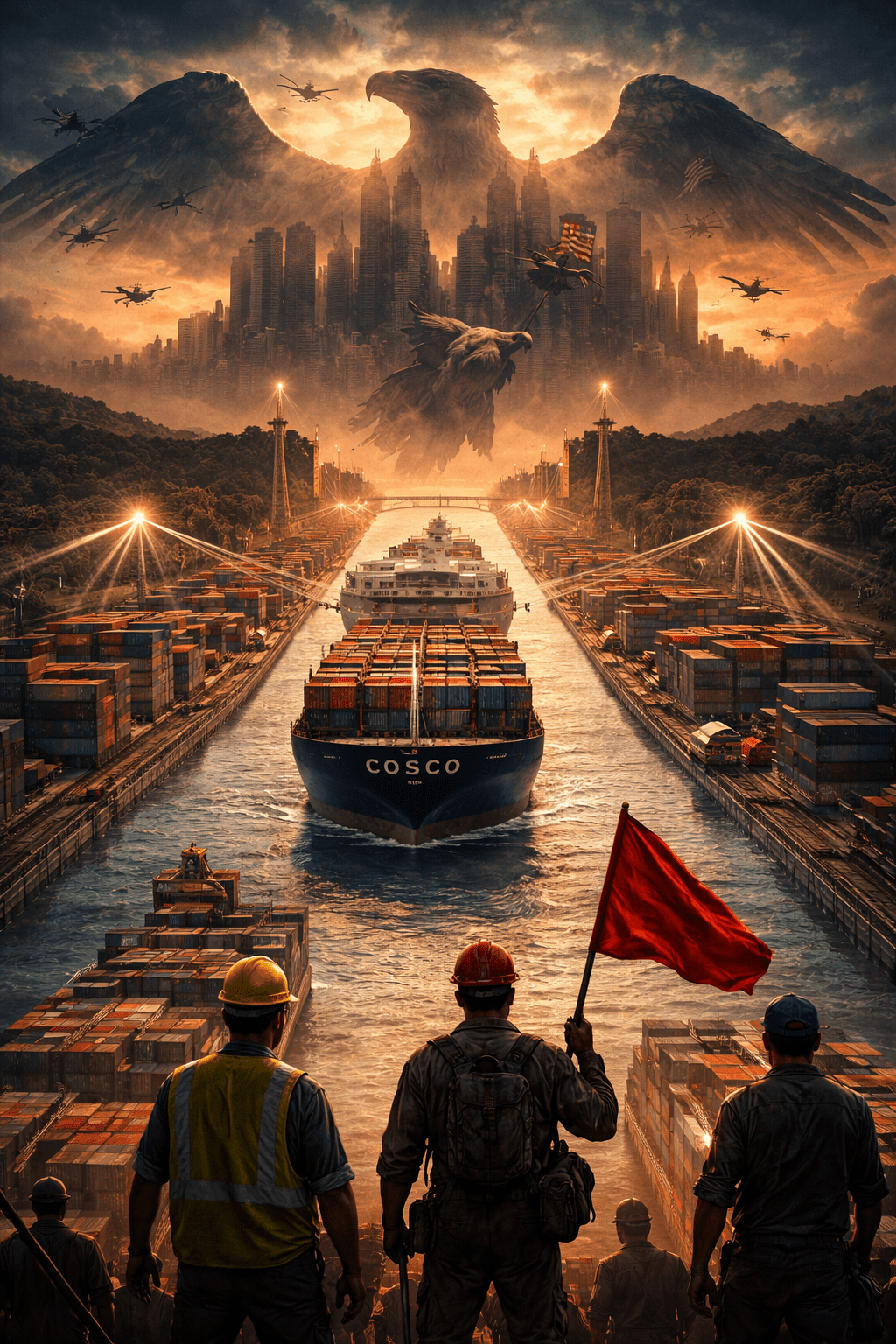
A logistics trade report tells us COSCO left Panama’s Balboa terminal because of a tidy legal dispute, the sort of story written from the boardroom side of the dock. Look closer and the facts show something rougher: U.S. pressure, ports changing hands, and global finance capital circling one of the narrow passages through which the world’s wealth moves. Set in its historical frame, the episode looks less like a shipping hiccup and more like the tightening grip of Fortress America and the emerging American Pole strategy across the hemisphere. Seeing that clearly leaves us with a task—link the struggles of workers and nations across the Americas so the corridors of empire become corridors of resistance.
By: Prince Kapone | Weaponized Information | March 14, 2026
When Empire Speaks in the Calm Voice of Port Management
There is a very particular tone that appears whenever power wants to make something political look like something technical. It is the tone of the memo, the advisory notice, the polite announcement pinned to the office bulletin board. Calm. Procedural. Responsible. The kind of voice that tells you the building is on fire but insists everyone remain orderly while exiting through the nearest staircase. That is the atmosphere surrounding “Panama Government Seizes 2 Main Canal Terminals: China’s COSCO Halts Panama Canal Port Calls as a Result”, published by Newsroom Panama. The article appears to tell a straightforward story about a legal dispute over port concessions at the Panama Canal. A court rules. A government decree follows. A shipping company suspends port calls. Lawyers sharpen their pencils for arbitration. Everything is narrated in the tidy grammar of procedure.
But pay attention to how the story is arranged. The protagonists are not people. They are institutions. Courts move. Companies respond. Decrees are executed. Cargo is rerouted. Arbitration is invoked. The whole scene unfolds like a choreography of paperwork. If you read the piece without thinking too hard, you might come away believing the drama here is little more than a bureaucratic hiccup in the smooth operation of global commerce. It is the kind of writing that gives the impression the world runs on filing cabinets and polite conference calls. As Marx once joked about bourgeois economics, the system begins to look like a natural law of gravity — unfortunate when disturbed, but essentially beyond question.
The language itself performs a quiet trick. The port seizure is introduced through the vocabulary of administration: constitutional rulings, decrees, concession frameworks, operational continuity. The result is that the reader is ushered into the situation through the front door of governance. The scene looks orderly. Responsible officials are managing a difficult but manageable problem. The deeper tensions are nowhere to be found in the opening frame. One almost expects the next paragraph to include a clipboard and a high-visibility safety vest.
From there the narrative settles comfortably into the viewpoint of global shipping capital. Containers, bookings, arrivals, departures, routing adjustments, throughput statistics — the article moves through the technical landscape of the port like an engineer inspecting the gears of a machine. None of these details are false. Ships do arrive. Containers do move. Logistics systems do require coordination. But the way these details are arranged does something subtle. It trains the reader’s eye to look at the world from the bridge of the cargo vessel rather than from the ground beneath the port cranes. When the story is told from the vantage point of the shipping schedule, the highest moral value becomes efficiency. Stability becomes virtue. Disruption becomes the villain of the story.
Notice also how geopolitics enters the article. It arrives politely, halfway through the narrative, as though it were an unexpected guest wandering into an otherwise well-organized meeting. The text tells us that the institutional dispute has “intersected” with geopolitical competition. Intersected. A curious word. It suggests that the legal dispute came first and the politics arrived later. That sequence is not argued explicitly. It is simply built into the narrative rhythm. First the administrative matter. Then the commercial response. Only afterwards the hint of something larger. It is a neat trick of storytelling. By the time the reader reaches the geopolitical dimension, the story has already been domesticated into a manageable dispute among responsible actors.
The emotional register of the article is equally revealing. There is no dramatic alarm. Instead the piece cultivates a quiet anxiety about “uncertainty,” “political risk,” and the need to protect the “integrity of the logistics hub.” These are the fears of a particular social class — the people who manage the arteries of world trade and worry that turbulence might interrupt the flow of capital. It is not the language of dockworkers, truck drivers, fishermen, or the neighborhoods that live in the shadow of container yards. It is the language of boardrooms and maritime conferences, where the greatest tragedy imaginable is not domination or dispossession but the disruption of schedules.
Then there are the voices the article chooses to amplify. Maritime analysts. Port specialists. Logistics business councils. These figures appear as the interpreters of reality. They speak with the authority of technical expertise, and their expertise lies precisely in keeping the machinery of global commerce running smoothly. One does not need to accuse them of bad faith to recognize the horizon of their concerns. Their world is a world of cargo flows, investor confidence, and infrastructure management. In that world, the question is never who owns the corridor of trade or who commands its movement. The question is simply how to keep the corridor open.
Another device appears in the article’s constant balancing of perspectives. Corporate arbitration claims are placed alongside constitutional arguments. Commercial reactions sit beside official reassurances. Chinese concerns appear next to Panamanian statements about continuity. On the surface this looks like journalistic neutrality. But neutrality can be a mask. When profoundly unequal forms of power are placed side by side as if they were equivalent claims in a polite debate, the reader is encouraged to see the whole affair as a disagreement among stakeholders. The knife and the loaf of bread share the same table, and the conversation is conducted as though both merely have different culinary preferences.
The article concludes by returning to its central moral lesson: stability. The logistics hub must remain intact. Operations must continue. Trade must flow. It is a soothing ending, the sort that leaves the reader feeling the adults are still in charge of the machinery. But the calmness itself is instructive. Calm prose can be a political technology. It reassures the reader that everything happening in the world — even events involving strategic infrastructure and international rivalry — can be understood as a matter of prudent management. The turbulence of history is reduced to the language of port administration.
In this sense the article performs a familiar labor. It does not shout propaganda slogans. It does something more effective. It normalizes the viewpoint of those who sit atop the infrastructure of world trade. The port becomes a technical space. The conflict becomes an administrative dispute. The stakes become operational continuity. And the reader is gently guided to see the world through the eyes of those whose primary concern is that the ships keep moving and the contracts remain enforceable. In the polite weather of such prose, power rarely looks like power. It looks like management.
That is why texts like this are worth reading carefully. Not because they are crude propaganda — they are too disciplined for that — but because they reveal how the language of administration can quietly reorganize reality. A struggle over strategic infrastructure can be narrated as a procedural matter. A clash of interests can appear as a question of investor confidence. And an entire geopolitical landscape can shrink down to the dimensions of a container yard. In the end the ships sail through the paragraphs exactly as they do through the canal itself: smoothly, efficiently, and with very little discussion about who built the locks or who commands the water.
The Hard Facts Beneath the Shipping Notice
Before theory begins, the facts have to be laid out plainly. Not the upholstered language of “operational continuity,” but the material sequence of events that produced the struggle now unfolding around the Panama Canal. Once those facts are placed in order, the pattern becomes harder to hide.
The immediate trigger came from Panama’s own legal system. In late January 2026, Panama’s Supreme Court annulled the contracts held by Panama Ports Company, a subsidiary of Hong Kong–based CK Hutchison, to operate the Balboa and Cristóbal terminals. Those are not marginal facilities. They sit at the Pacific and Atlantic entrances of the canal and function as key container terminals within the wider canal logistics complex. When the ruling was later published in the official gazette, CK Hutchison itself said the concession was deemed terminated as of February 23, 2026.
Panama then moved from judgment to occupation. Under Executive Decree No. 23, the Panamanian state assumed control of the port assets and approved temporary concession contracts lasting up to eighteen months. APM Terminals, part of A.P. Moller–Maersk, took over Balboa, while TIL Panama, part of Mediterranean Shipping Company, took over Cristóbal. In other words, the terminals did not pass from private control to some neutral public pause. They moved almost immediately from one multinational logistics network into the hands of others.
The scale of those firms matters. UNCTAD identifies MSC as the world’s largest container shipping operator by capacity, while MSC describes Terminal Investment Limited as its port-operating arm. Maersk and MSC were until recently linked through the 2M alliance, and both remain among the dominant firms in global container shipping. When subsidiaries tied to those companies move into terminal control at the entrances of the Panama Canal, they are not merely staffing a dock. They are integrating those docks into global shipping alliances that coordinate routes, schedules, and container flows across entire continents.
The commercial shock came quickly. In March 2026, COSCO Shipping suspended operations at Balboa. Reportedly the company halted arrivals and departures there and redirected clients to return empty containers to terminals in Colón province instead. A day later, Panama’s minister for canal affairs said COSCO accounts for about 4% of the cargo moving through Balboa, which gives a rough sense of the immediate commercial disruption even before wider knock-on effects are counted.
The infrastructure involved is not small. According to figures reported from Panama’s Maritime Authority, Panama’s ports handled 9.9 million Twenty-foot Equivalent Units (TEUs) in 2025. Of that total, Balboa handled about 2.7 million TEUs and Cristóbal about 1.2 million. Put together, that is roughly 3.8 to 3.9 million TEUs, or nearly 40% of Panama’s total container throughput. These are not side terminals at the edge of the system. They are central nodes in the country’s logistics economy.
The legal fight did not end with the takeover. CK Hutchison began international arbitration proceedings after the contracts were annulled, and trade reporting indicates that the company is seeking at least $2 billion in damages under International Chamber of Commerce rules. Panama, meanwhile, has defended the move on constitutional grounds, arguing that the terminals are public infrastructure even when operated by private concessionaires.
The dispute broke open under pressure from Washington that looked far less like diplomacy and far more like a displaced landlord demanding the keys to the house back. In February 2025, Marco Rubio began his first Latin American trip in Panama and pressed the government over what Washington described as Chinese influence around the canal. Immediately afterward, Panama announced it would not renew its participation in China’s Belt and Road Initiative. Reuters reported at the time that Washington’s concern extended specifically to Chinese business presence around the canal corridor, including CK Hutchison’s port concessions.
The ownership question then widened beyond Panama alone. In March 2025, CK Hutchison agreed to sell a controlling stake in its ports business to a consortium involving BlackRock, Terminal Investment, and Global Infrastructure Partners, including 90% of Panama Ports Company. Reuters later reported that BlackRock’s Global Infrastructure Partners would hold 51% of the two Panama ports, with TIL holding the remainder. BlackRock’s own materials describe the GIP acquisition as creating a world-leading infrastructure private-markets platform, while the firm’s infrastructure marketing openly identifies ports alongside power systems, data centers, and pipelines as major infrastructure investment targets. What was at stake, then, was never just a local concession dispute. It was also a question of which bloc of capital would sit closest to one of the most strategic maritime chokepoints on earth.
The canal’s global weight explains why the terminals matter so much. The Panama Canal Authority says between 5% and 6% of world maritime trade passes through the canal. The authority’s own annual reporting also emphasizes that the canal connects 180 routes in 170 countries through nearly 1,920 ports worldwide. That means the terminals at Balboa and Cristóbal are not merely national assets in a narrow domestic sense. They are docking points inside a corridor that links Asian manufacturing, Atlantic consumer markets, energy shipments, and containerized trade across multiple continents.
Historically, none of this should surprise anyone. The canal remains one of the world’s most strategically sensitive waterways, and for most of the twentieth century the United States exercised direct control over the Canal Zone after backing Panama’s separation from Colombia in 1903. Sovereignty was only fully transferred to Panama in 1999 under the Torrijos–Carter treaty process. The water may be Panamanian now, but the geopolitical struggle over who commands the corridor never disappeared.
Once the sequence is assembled in full — the court ruling, the termination of CK Hutchison’s concession, Executive Decree No. 23, the rapid handover to Maersk and MSC-linked operators, COSCO’s suspension, the arbitration claim, Rubio’s pressure campaign, Panama’s retreat from Belt and Road, and the BlackRock-linked effort to acquire the terminals — the dispute looks very different. What appears at first glance as a legal-commercial quarrel over port management begins to look like a realignment of control around a chokepoint through which a significant share of world maritime trade still passes.
Where the Containers End and the Empire Begins
By the time we arrive here, the canal no longer looks like a canal. It starts to look like what it has always been for empire: a lever. A narrow passage in geography, yes, but also a pressure point in history. A place where steel, water, insurance, ports, finance, diplomacy, and war planning all shake hands in broad daylight and then pretend they have never met. That is the first thing we have to say plainly. The dispute over these terminals is not a side argument about paperwork. It is a struggle over a chokepoint, and chokepoints are where the polite language of commerce reveals its military posture.
Capitalism likes to talk as if trade simply flows, as if commodities wake up in the morning and politely move themselves across the seas out of a natural love for circulation. But trade does not “flow” in the abstract. It moves through corridors, locks, straits, railheads, depots, fiber routes, and ports. It moves through infrastructure built by labor and disciplined by power. And because it moves through narrow passages, those passages acquire enormous significance. The Panama Canal is one of those places where the whole fraud of bourgeois innocence falls apart. You cannot look at that thin strip of passage joining the Atlantic and Pacific and still pretend that logistics is merely technical. This is not just shipping. This is organized power moving through concrete.
That is why the terminals matter. The canal may be the throat, but the ports are the hands at the neck. They sort, receive, redirect, delay, privilege, and channel. They determine which shipping networks secure a foothold, which firms gain logistical advantage, and which states sit closer to the wheel. When Balboa and Cristóbal shift operator, even temporarily, we are not watching a clerical update. We are watching the furniture move inside one of the engine rooms of world trade. And when that movement happens in a moment of rising confrontation between Washington and Beijing, under a White House openly speaking the language of domination across the hemisphere, only a fool or a liar would treat it as an isolated business matter.
The deeper pattern becomes visible once we stop staring only at the dock and lift our eyes to the hemisphere. Trump 2.0 has not approached Latin America and the Caribbean as a region of equals, nor even as a region to be persuaded in the old liberal language of partnership. It has approached the hemisphere like a landlord returning with armed cousins to inspect the property. Panama. Venezuela. Cuba. Mexico. Canada. Different cases, different histories, different internal contradictions, yes. But the direction of motion is unmistakable. Washington is trying to tighten command over the political and economic orientation of the American landmass and its surrounding waters. It is trying to discipline the hemisphere into a more obedient rear base in a world where its old universal supremacy is cracking. That is what we mean by Fortress America.
Fortress America is not just a border slogan for red-hat rallies and cable news theatrics. It is a structural response to imperial decline. When an empire can no longer command the whole planet with the same confidence, it consolidates what it can still grip. It hardens the nearer field. It fortifies the neighborhood. It begins treating the hemisphere not as one arena among many, but as a secured zone of ports, corridors, energy routes, labor reservoirs, military access points, and compliant states. The language used to justify this changes with the times. Yesterday it was anti-communism. Today it is “hostile foreign influence,” “security,” “organized crime,” “border integrity,” and “critical infrastructure.” New labels, same old whip. Empire always updates the packaging on the baton.
In that sense, the canal terminals sit inside something larger than a port dispute. They sit inside what we have been calling the American Pole. By this we do not mean some elegant diplomatic doctrine written in polished think-tank prose and passed around over expensive coffee. We mean the concrete effort to reorganize the Western Hemisphere as a strategic bloc under U.S. primacy at a moment when the wider world is slipping from singular control. The American Pole is the attempt to turn regional dominance into compensation for declining global supremacy. If Washington cannot so easily dictate the movement of the planet, it will try to lock down its own continental field of maneuver more tightly than before.
Once that is understood, the sequence around Panama starts to read less like coincidence and more like alignment. Rubio’s visit. Pressure around Chinese influence. Panama letting its Belt and Road participation lapse. Review of Chinese-linked infrastructure. The BlackRock-linked acquisition move. COSCO pulling back from Balboa. Temporary control shifting toward operators tied to the big shipping oligarchs. None of this proves a cartoon conspiracy. We do not need cartoons. Reality is sharper than cartoons. What it shows is that state pressure, corporate restructuring, and logistics realignment are moving in the same direction: closer U.S.-aligned control over infrastructure adjacent to a major chokepoint.
The article under excavation speaks of “stability,” but stability for whom? Stability for the dockworker? For the Panamanian people? For the poor of Colón? For the wider peoples of a hemisphere long treated as a warehouse, mine, plantation, and buffer zone? No. The stability being defended is the stability of a particular order of circulation. It is the stability of contracts, routes, concessions, and investor confidence. It is the stability required by a ruling class that wants the corridor to remain legible to capital even as the geopolitical winds become less obedient. What is presented as neutral logistical continuity is, in truth, the desired calm of imperial management.
And now we come to the other side of the matter: labor. Chokepoints are not only about ships and statecraft. They are also about labor regimes. This is where the canal question links up with the broader recalibration underway across the hemisphere. Fortress America is not simply trying to command ports and corridors. It is trying to discipline the human geography around them. Tariffs, sanctions, deportations, nearshoring, security agreements, migration controls, and supply-chain restructuring all work together to reorganize labor power across the region. Some workers are trapped in place. Some are expelled. Some are selectively imported. Some are held in fear. Some are thrown into informal survival. The point is not order in the abstract. The point is a labor map suitable to a hardened imperial region.
That is what we mean by regional labor recalibration. Not an academic phrase to decorate a paragraph, but a material process visible all around us. As Washington pressures states across the hemisphere, punishes disobedient governments with sanctions, threatens tariffs against rivals and supposed allies alike, and pushes capital toward friend-shored or near-shored production chains, it is also restructuring where labor sits and under what conditions it can bargain. Cheapened labor in one zone. Deportable labor in another. Sanction-strangled labor in another. Informalized labor feeding logistics corridors elsewhere. The empire is trying to tune the labor market of the hemisphere the way a plantation overseer tunes a machine: enough pressure to maximize output, enough fragmentation to prevent coordinated refusal.
Here the canal returns with new meaning. A chokepoint is not only a place where commodities pass. It is a place where labor’s world is reorganized to serve those commodity flows. The ports are linked to trucking, warehousing, customs, fuel supply, insurance, ship repair, maintenance, and the immense invisible bureaucracy that keeps circulation alive. To control the chokepoint is to influence the terms under which all this labor is subordinated to the needs of capital. And because the canal sits in a region increasingly central to the struggle between a declining imperial core and a more multipolar world, that labor discipline acquires strategic value. Panama is not merely handling containers. It is being positioned inside a wider regional contest over who will command the terms of movement for goods, capital, and people.
This is why the article’s narrow framing cannot hold. It asks us to see a legal dispute where there is a geopolitical realignment. It asks us to see arbitration where there is struggle over a chokepoint. It asks us to see commercial continuity where there is an attempt to consolidate Fortress America. It asks us to see operator substitution where the American Pole is trying to draw the hemisphere tighter into its field of command. In other words, it asks us to keep our eyes on the paperwork while history rearranges the room.
From the standpoint of the global working class and peasantry, from the standpoint of colonized nations and those forces in the North that have not sold their souls for a seat in the imperial waiting room, the issue is not whether one concessionaire is more efficient than another. The issue is whether strategic infrastructure in our region is to be subordinated ever more tightly to the requirements of a declining empire trying to preserve itself through consolidation and coercion. The issue is whether the waterways, ports, and labor of the hemisphere will continue to serve as instruments of outside command, or whether they can become part of sovereign development oriented toward human need rather than imperial necessity.
So let us call the thing by its proper name. This is not a port story with geopolitical implications. It is a geopolitical struggle expressed through ports. It is a conflict over a chokepoint unfolding inside the hardening architecture of Fortress America. It belongs to the wider project of the American Pole, where Washington seeks to turn the hemisphere into a disciplined strategic bloc under its command. And it is inseparable from regional labor recalibration, through which the peoples of the Americas are being sorted, pressured, displaced, and reorganized to fit that project. Once you see that, the canal stops looking like water and concrete. It begins to look like what it really is: one of the narrow places where empire tries to put its hand around the throat of history.
Turn the Corridor Into a Front of Struggle
Once the thing is named properly, the task changes. We are no longer standing in the sterile waiting room of maritime law, asking which operator has the cleaner contract and which investor has the sadder face. We are standing inside a struggle over power, territory, labor, and sovereignty. And when that becomes clear, the question is no longer how to interpret the dispute, but how to organize around it. Because a chokepoint is not only a strategic asset for empire. It is also a vulnerability. The same narrow passage that allows capital to move with arrogant speed can become a point of pressure when workers, peoples, and movements begin to understand what it means and whom it serves.
That is the first political lesson. Empire sees the hemisphere as a corridor. We must see it as a field of struggle. Fortress America wants ports, customs zones, trade routes, labor reserves, and compliant governments all stitched together into a disciplined rear base. Very well. Then the answer cannot be fragmented outrage in ten separate corners. The answer must be political intelligence equal to the scale of the offensive. Panama cannot be understood apart from Cuba. Cuba cannot be understood apart from Venezuela. Venezuela cannot be understood apart from migration, sanctions, tariffs, nearshoring, and the remapping of labor across Mexico, Central America, and the Caribbean. These are not separate files in a bureaucrat’s cabinet. They are chapters in the same imperial manual.
So the struggle must begin with connection. Dockworkers, canal workers, truckers, warehouse workers, logistics workers, public-sector unions, peasant organizations, anti-sanctions campaigns, migrant justice formations, sovereign development currents, and anti-imperialist political organizations across the hemisphere have to be understood as facing different expressions of the same enclosure. The forms differ, yes. A Cuban family facing economic strangulation, a Venezuelan community facing destabilization, a Panamanian worker watching strategic infrastructure pulled between rival blocs of capital, a migrant worker in Mexico facing intensified border discipline, a Canadian worker squeezed between tariff threats and corporate blackmail—these are not identical situations. But they are increasingly shaped by one regional architecture of coercion. That architecture is what must be made visible.
And here we should be concrete. There are already movements and organized forces on the ground struggling around these contradictions, even if bourgeois media treats them like background noise. In Panama, labor and popular organizations have repeatedly mobilized around sovereignty, austerity, privatization, and control over national assets. Across Latin America and the Caribbean, anti-imperialist formations, trade union currents, campesino movements, left parties, student organizations, feminist popular movements, and neighborhood committees have been fighting sanctions, IMF discipline, extractive plunder, and foreign domination for years. The task is not to invent struggle from scratch like some nonprofit consultant with a fresh grant proposal. The task is to identify, strengthen, connect, and politically clarify the struggles already underway.
In practical terms, that means one front of work must be educational. People have to understand what a chokepoint is, what the canal means, how strategic infrastructure functions, and why port control matters far beyond the shipping industry. Too often our people are trained to think geopolitics belongs to professors, spies, and television generals. Nonsense. Geopolitics is already in the price of bread, in the fuel bill, in the migration route, in the sanctioned bank transfer, in the port city where jobs are reshuffled because some asset manager in New York wants a cleaner line to profit. Political education must therefore pull the curtain back. Not in academic jargon for conference panels, but in the living language of the people. Study circles, popular pamphlets, union education, movement media, teach-ins, neighborhood assemblies, political schools—these are not optional decorations. They are the workshop where scattered anger is turned into organized understanding.
A second front must be media and information struggle. If we leave the story in the hands of commercial logistics outlets and imperial news desks, the people will always be told that sovereignty is “uncertainty,” that sanctions are “pressure,” that labor discipline is “competitiveness,” and that militarized regional domination is “security.” We need independent media organs, workers’ platforms, anti-imperialist publications, grassroots radio, movement journalism, and cross-border communications networks able to track infrastructure grabs, sanctions damage, shipping realignments, and labor restructuring in real time. The empire has its intelligence services; the people need their own intelligence too. That is one of the central tasks of Weaponized Information: to take the data of domination and return it to the oppressed as a weapon of clarity.
A third front must be labor internationalism grounded in the actual map of circulation. It is not enough to speak generally about solidarity while capital coordinates globally with ruthless precision. If ports are central, then port labor matters. If logistics corridors are central, then logistics workers matter. If nearshoring and regional labor recalibration are central, then unions and worker committees across those chains need stronger communication and common political framing. The old labor internationalism was often too slow, too ceremonial, too trapped in resolutions that made everyone feel honorable and changed very little at the point of production. The period we are entering demands something more serious: active ties among workers situated across the same corridors of circulation, able to recognize when they are being played against one another and able, when possible, to disrupt the flow that disciplines them.
This also means fighting the poison of chauvinism with absolute mercilessness. Fortress America works not only through sanctions and shipping routes but through the political manufacture of division among the people. It tells workers in the North to fear migrants. It tells one nationality to resent another. It tells the battered worker in the imperial core that the colonized worker abroad is the problem, when in fact both are being reorganized by the same system to serve the same imperial metabolism. No serious anti-imperialist movement can leave this poison untouched. The answer to regional labor recalibration cannot be a prettier nationalism inside the North. It has to be a harder, clearer internationalism rooted in material truth: the worker in Panama, the peasant in Cuba, the migrant in Mexico, the Black proletarian in the United States, the indigenous community resisting extraction, the sanctioned family in Venezuela—all are living under different faces of the same order.
Another necessary front is direct opposition to sanctions, tariff warfare, and economic strangulation. Economic warfare is often treated as a clean substitute for military invasion, as though ruining hospitals, wrecking currencies, choking energy systems, and suffocating development were somehow civilized because the bombs arrive slowly. We must reject that lie. Sanctions are not diplomacy. They are siege. Tariff war in this context is not a neutral tool of trade adjustment. It is an instrument used to punish disobedience, reorder supply chains, and force states and workers into more subordinate positions. So movements in the North especially have a responsibility here. They must fight sanctions not as a charitable issue affecting unfortunate foreigners somewhere else, but as part of the same imperial apparatus that weakens labor, militarizes society, and hardens the American Pole against all alternatives.
From there the political task sharpens further. Support must go to sovereign projects, however uneven and contradictory, that resist total subordination to imperial command. Not because every government outside Washington is pure, and not because serious people play children’s games with romantic illusion, but because the right of nations to control their infrastructure, labor, resources, and development path remains a decisive democratic question in an age of imperial consolidation. If the hemisphere is to become merely a rear base for U.S. rivalry with China, then every breach in that plan matters. Every assertion of sovereignty matters. Every refusal to submit matters. Every effort to build regional integration outside imperial management matters.
That brings us back to Panama. The fight there must not be reduced to a spectator sport in which one bloc of capital bets against another while the people watch from the curb. The democratic question has to be forced back into view: who should control strategic infrastructure, for what purpose, and under whose authority? If the answer remains private operators, foreign investors, shipping oligarchs, asset managers, and external pressure from Washington, then the people have already been written out of the story. If, however, labor, popular sectors, and sovereign political currents can raise the level of struggle around the canal and the ports—linking national control to social need, linking infrastructure to public purpose, linking the canal question to wider anti-imperialist regional struggle—then the corridor can stop being merely a passage for imperial accumulation and begin to become a front of democratic contest.
None of this will happen automatically. Empire is organized. Capital is organized. Shipping oligarchs are organized. Asset managers are organized. The Pentagon is organized. The State Department is organized. The question, then, is whether the working classes, the peasantry, the colonized nations, and the revolutionary anti-imperialist forces across the North and South can reach a level of organization and political clarity sufficient to meet the hour. That does not begin with grand slogans floating in the air. It begins with patient work: study, agitation, links between movements, coordinated campaigns, labor education, anti-sanctions organizing, migrant solidarity, regional political communication, and the rebuilding of confidence that history is not owned by the powerful.
The canal teaches a brutal lesson. The wealth of the world moves through narrow passages. So does power. But the lesson cuts both ways. Because if the corridors are narrow for the people, they are also narrow for empire. A chokepoint can be a weapon in the hands of domination, yes. But it can also become a point where the organized people discover the strategic weakness of the system that claims to rule them forever. That is why this struggle matters beyond Panama. It is a glimpse of the wider fight over who will command the hemisphere, who will discipline its labor, who will own its infrastructure, and who will define its future.
So let the liberals fuss over investor confidence and let the empire’s clerks call this a dispute over concession law. We know better. This is part of a larger campaign to harden Fortress America under the sign of the American Pole, to tighten the grip on chokepoints, and to recalibrate labor across the region for a harsher imperial age. Our answer must be equally clear: organize the corridor, expose the architecture, connect the struggles, defend sovereignty, defeat sanctions, break chauvinism, and build a hemispheric front of workers and peoples capable of turning the empire’s narrow passages into sites of refusal. That is the task. And history, rude as ever, is not waiting.
 Weaponized Information
Leave a comment