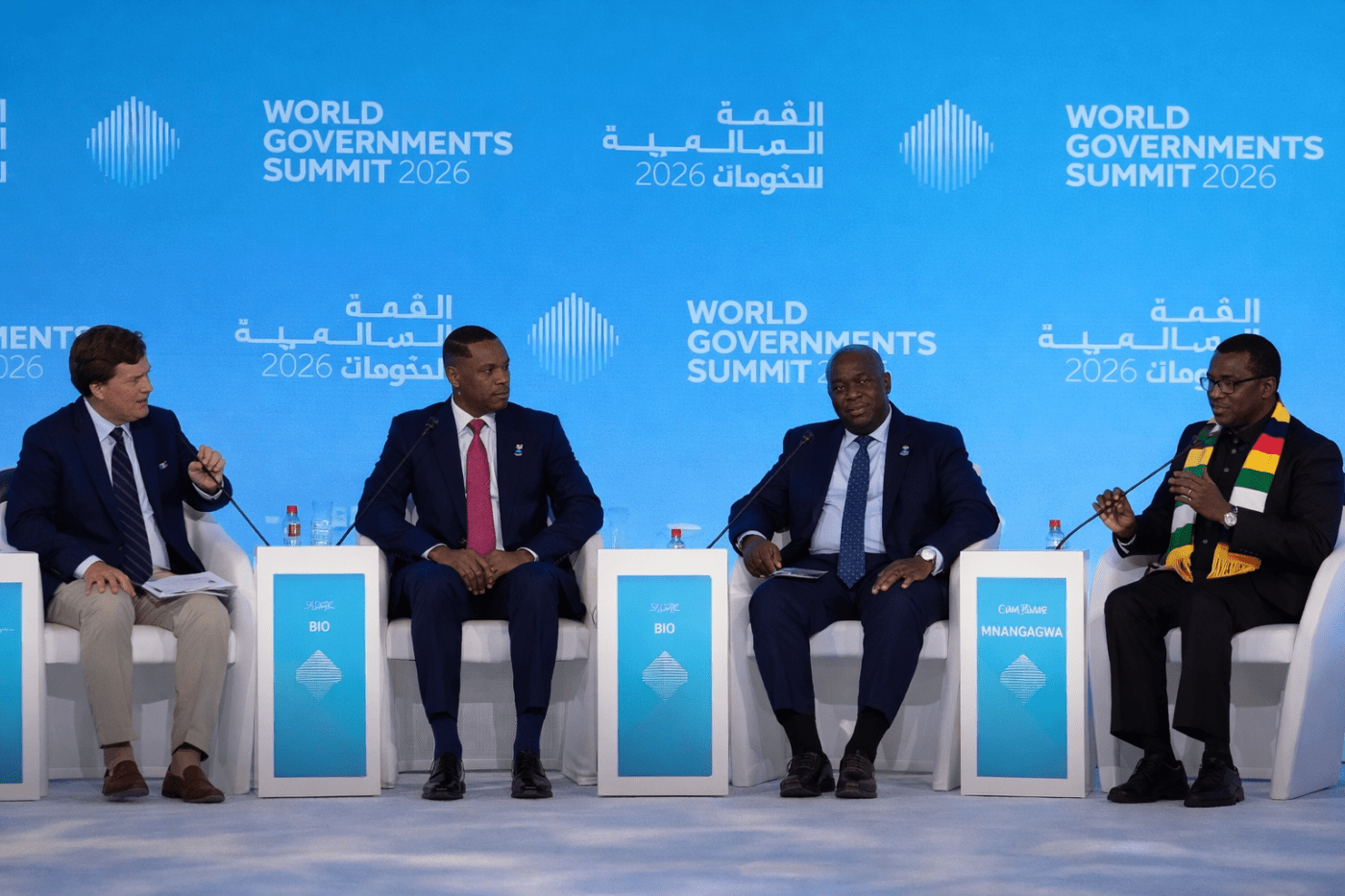
At a summit built to “shape future governments,” African heads of state confront old imperial binaries inside a new architecture of power. Tucker Carlson presses the familiar frames—China versus the West, democracy as sermon, race as property—while sanctions, AI infrastructure, and development finance reveal the harder machinery beneath the talk. Zimbabwe’s discipline, Sierra Leone’s education struggle, and Africa’s youth pressures expose how sovereignty is managed through institutions and capital. Then Venezuela detonates the room, proving that in the so-called rules-based order, the rules bend for the powerful and snap for the rest.
By Prince Kapone | Weaponized Information | February 12, 2026
Dubai Is Not a Backdrop: It’s the Stagecraft of Multipolar Elite Governance
The clip we are excavating here comes from a live panel at the World Governments Summit in Dubai, where the presidents of Botswana, Zimbabwe, and Sierra Leone sit across from Tucker Carlson and field questions about China, the West, democracy, land reform, and Africa’s future. It looks like a sharp exchange between a Western media figure and African heads of state. But this is not cable television. It is not a press conference. It is a curated conversation inside a global summit that openly declares its mission to “shape future governments” in its own words. That framing matters. Because before a single question is asked, the architecture of power is already in place.
The World Governments Summit presents itself as a gathering of governments, international organizations, “thought leaders,” and private-sector innovators working together to design the next phase of governance as the summit describes its purpose. The 2026 agenda makes the priorities plain: global governance, economic prosperity, strategic investment, and the management of “urban futures & evolving demographics” as outlined in the official program. This is not the language of democratic struggle. It is the language of administration. It is governance treated as a managerial problem—how to stabilize populations, align capital, and integrate technology into rule.
That is the first contradiction. The summit markets itself as a global civic conversation about the future. Structurally, it functions as a coordination platform for states, investors, and technological infrastructure—the executive layer above electoral politics. Elections happen below. Policy alignment happens here. The people vote; the architects meet.
And Dubai is not incidental. It is a strategic location in the present world order: a non-Western convening capital where Western decline can be managed without surrendering Western leverage, and where rising blocs can negotiate without pretending the old liberal sermon still persuades. In a moment of geopolitical fracture, Dubai provides a polished floor for multipolar bargaining. Everyone arrives with a smile. Everyone arrives with interests.
So when Tucker Carlson sits down across from African presidents, he is not just moderating a discussion. He is operating inside an architecture built to manage power transitions. The summit is the stagecraft of elite governance in a shifting world system. If we want to understand what follows—the tension, the refusals, the discomfort—we start here. Not with personalities. With structure.
And the structure tells us something immediately. Before Africa’s “next decade” is discussed, before sanctions or sovereignty or land reform are mentioned, the summit turns first to technology—to artificial intelligence, infrastructure, and the mechanics of the next global order. That sequencing is not accidental. It is the logic of the era.
The AI Prelude: Before Africa Speaks, the Infrastructure Speaks
If you were watching closely, you noticed something important about the sequencing. Before African heads of state were brought on stage to discuss sovereignty, development, democracy, and global alignment, the summit platformed a flagship session on artificial intelligence. Joseph Tsai of Alibaba was featured prominently in that discussion as reported during the summit proceedings, and UAE state media documented that the AI conversation brought together Tsai and venture capitalist Chamath Palihapitiya under the moderation of Omar Sultan Al Olama, the UAE’s Minister of State for AI and Vice Chair of the World Governments Summit in the official recap. This was not a side event. It was a headline act.
And what was the substance? Not poetic speculation about machines dreaming. Not philosophy. It was about architecture. Alibaba Cloud’s own summary of Tsai’s remarks emphasized open-source models and the advantages of “full-stack” companies—firms that control the infrastructure layer, the cloud, the data environment, the application ecosystem in its corporate framing. In other words, the discussion was about who owns the pipes through which the future will flow.
This matters because the question of sovereignty has moved. It is no longer confined to territory, minerals, or even debt—though those remain decisive. Sovereignty now lives in server farms, in undersea cables, in cloud dependency contracts, in AI model licensing regimes. If your government relies on foreign platforms for data storage, digital identity, defense systems, or financial clearing, your autonomy is already entangled. That is the quiet truth beneath the summit’s choreography.
So when Africa’s “next decade” is placed on the agenda immediately after a discussion of AI infrastructure, it is not accidental. The message is implicit: the next phase of power is infrastructural. Governance is increasingly mediated through code, analytics, and cloud architecture. States that do not control their technological stack will negotiate from a position of dependence. The summit’s structure makes this clear long before anyone utters the word “sovereignty.”
This is why the old colonial binary—China versus the West—already feels outdated in this setting. The deeper contest is not who smiles more warmly in bilateral meetings; it is who builds and controls the digital scaffolding upon which governance itself will sit. The presidents who walk onto that stage are not just negotiating trade deals or investment flows. They are negotiating their place in an emerging infrastructural hierarchy.
And that is what gives the panel its tension. Because when Tucker Carlson finally begins asking his questions, he frames them as moral dilemmas and civilizational choices. But the room has already revealed the real terrain: the struggle over infrastructure, dependency, and leverage in a system where technology, finance, and governance have fused into a single apparatus.
The Panel as Political Theater: Tucker Carlson Meets African Sovereignty
By the time the African presidents took their seats, the stage had already been prepared. The conversation that followed—circulated online as “FULL DISCUSSION: Tucker, Botswana, Zimbabwe & Sierra Leone…” in the published recording—was not a spontaneous exchange. It was an artifact of a global governance summit, mediated through a Western political personality whose brand is confrontation wrapped in populist plain-speak. Regional reporting made clear that Tucker Carlson was present at the World Governments Summit in Dubai, publicly questioning Zimbabwe’s president about China, land reform, and economic decline as covered here. This was deliberate staging.
Carlson did not arrive as a neutral journalist. He arrived as a civilizational proxy, carrying with him the anxieties of a declining Western center that no longer commands automatic obedience but still commands the microphone. His questions were not random. They were tightly framed around a familiar script: is China exploiting you or saving you? Did land reform destroy your country? Is democracy fading because you failed to uphold it? Each question assumed that Africa’s choices must be interpreted through Western moral categories.
What made the exchange significant was not Carlson’s posture. It was the refusal. The presidents did not accept the patron-client binary. They did not reduce their foreign policy to gratitude toward Beijing or resentment toward London. They did not collapse sovereignty into a morality tale about who behaved better over the past century and a half. Instead, they repeatedly asserted a principle that sounds simple but carries weight: we act in our own interest.
This is the part Western media framing tends to miss. Africa is often treated as peripheral—reactive, dependent, waiting for alignment signals from larger powers. Yet here, on a stage built to coordinate global elites, African heads of state articulated themselves as negotiating actors within a multipolar field. The discomfort in the exchange did not come from ideological radicalism. It came from the breakdown of an assumption: that Africa must justify its partnerships to the West.
In that sense, the panel was less about policy detail and more about narrative control. Carlson tried to translate sovereignty into Western culture-war vocabulary. The presidents kept pulling it back to statecraft. The friction between those two modes—ideological framing versus strategic autonomy—is what gives the conversation its edge.
And it is precisely here that the trap becomes visible. Because once the “China versus West” frame is laid down, the next move is predictable: force a choice. The real significance of what followed lies in how that trap was handled.
The China Trap Frame—and the Refusal to Choose a Patron
Once Tucker Carlson laid down the binary—China versus the West—the script was clear. The question was not whether Zimbabwe or Botswana or Sierra Leone had benefited from Western colonialism; that history is settled in blood and extraction. The question was whether China represented something fundamentally different, or merely a new version of the same old imperial bargain. It was posed as a moral dilemma, as though Africa must declare which camp treats it more kindly. But the presidents did not answer in moral language. They answered in strategic language.
That refusal matters. Because the summit environment itself encourages bloc thinking. The World Governments Summit openly convenes states, global institutions, investors, and technology firms under one roof by its own definition, and its 2026 agenda integrates governance with capital flows and demographic management in plain sight. Inside that architecture, power blocs do not disappear; they coordinate. The implicit pressure is always alignment.
But the presidents did not accept the premise that sovereignty means choosing a patron. They did not romanticize China, nor did they seek Western approval. They reframed the question: we negotiate based on what serves our national interest. That is not anti-West rhetoric. It is not pro-China rhetoric. It is statecraft. In a world where infrastructural power—cloud platforms, data flows, technology stacks—now shapes autonomy as even the summit’s AI session implied, the real issue is not who is “nicer.” It is who offers leverage without surrender.
Western discourse often reduces Africa’s foreign policy to dependency narratives: either trapped by debt to Beijing or beholden to former colonial powers. But what unfolded in Dubai suggested something more pragmatic. African leaders are reading the structural shifts. They understand that multipolarity creates bargaining space. They understand that the old Western monopoly over finance, narrative, and military reach is under strain. And they are operating accordingly.
This is why the “China versus West” framing fails. It assumes Africa is an object to be claimed. The presidents spoke as subjects navigating a contested field. That difference is not rhetorical. It reflects the emergence of a world where alignment is no longer automatic, where smaller states hedge, diversify, and negotiate across blocs to preserve autonomy.
But sovereignty spoken on a stage and sovereignty exercised in practice are not always the same. Once the conversation shifted from patronage to land, sanctions, and punishment, the deeper mechanics of enforcement came into view. And that is where the rhetoric of choice meets the reality of discipline.
Zimbabwe: Land, Sanctions, and the Architecture of Financial Discipline
When Tucker Carlson pivoted to Zimbabwe’s land reform, the tone shifted from abstract geopolitics to historical grievance. The subtext was familiar: your predecessor “kicked out the whites,” the economy collapsed, and the world responded. But what is presented in Western shorthand as moral recklessness must be situated inside the machinery that followed. Zimbabwe did not simply face criticism. It faced codified financial discipline.
The legal architecture is not hidden. The Zimbabwe Democracy and Economic Recovery Act (ZDERA), Public Law 107–99, establishes U.S. policy linking rule of law and democratic reform criteria to U.S. influence in international financial institutions in the statute itself. In other words, access to multilateral finance becomes conditional. That framework was later amended in 2018, updating language around reconstruction and governance expectations as documented in the revised law. This is not symbolic pressure. It is policy embedded in legislation.
Even when the U.S. executive branch announced in March 2024 that it was terminating the national emergency underpinning the Zimbabwe sanctions program according to the State Department notice, analysts immediately clarified that the story did not end there. CEPR’s assessment made clear that while certain sanctions mechanisms were lifted, other tools and designations remained in place in its policy review. Meanwhile, Africa-based security research has examined the “curious case” of Zimbabwe sanctions, noting how they are framed as targeted while remaining politically central to Western leverage strategies in the ISS analysis.
This is the mechanism behind the morality play. Land reform is narrated as racial vengeance or economic mismanagement. Sanctions are narrated as targeted accountability. But structurally, what we see is the use of finance as a disciplining instrument. When a state disrupts established property relations—especially those tied to colonial-era ownership patterns—it does not simply face reputational damage. It encounters constraints in credit markets, multilateral lending channels, and investor access. Sovereignty becomes expensive.
The contradiction exposed in Dubai was not about whether land redistribution was perfectly executed. It was about who defines legitimacy and who controls the choke points of economic recovery. If access to international finance is mediated through political criteria codified in foreign law, then sovereignty is exercised within a field of conditionality. Zimbabwe’s experience illustrates that punishment does not arrive only through military means; it arrives through balance sheets and loan approvals.
That is why this section of the exchange matters. It shows how the language of democracy and reform can function alongside a structured system of financial leverage. The presidents’ insistence that they will “please themselves” was not bravado. It was an acknowledgment that autonomy carries cost. And once that cost is understood, the conversation naturally expands beyond one country to a broader question: what happens when the very states that preach democratic virtue are themselves experiencing democratic retreat?
Democracy in Retreat: When the Instructors Lose Faith in the Lesson
When Julius Maada Bio observed that those who once lectured Africa on democracy now appear less committed to it themselves, he was not engaging in rhetorical deflection. He was describing a measurable pattern. The narrative that positions liberal democracy as a universal end-state, administered from Western capitals outward, is colliding with empirical decline within those very centers.
The data are not speculative. The V-Dem Democracy Report 2025 concludes that the level of democracy enjoyed by the average global citizen in 2024 has fallen to levels last recorded in 1985, marking a sustained period of autocratization since the 2012 peak as documented in the report. Freedom House’s Freedom in the World 2025 likewise records the nineteenth consecutive year of global freedom decline, with sixty countries deteriorating and only thirty-four improving in its annual assessment. Even mainstream reporting on the Economist Intelligence Unit’s Democracy Index reflects historically low scores across multiple regions as summarized here.
This is not an African anomaly. It is a systemic contraction. The same states that once tied aid, loans, and diplomatic recognition to governance reforms are now grappling with polarization, executive overreach, surveillance expansion, and declining institutional trust at home. The teachers are not practicing what they preach, and that contradiction weakens the moral authority behind conditionality regimes.
From a structural standpoint, this erosion aligns with broader shifts in global political economy. Periods of imperial strain often produce internal hardening. When capital concentration intensifies and geopolitical rivalry sharpens, liberal norms become more negotiable. Stability, security, and control move to the foreground. Democratic procedure becomes secondary to regime continuity. What was once presented as an ethical commitment begins to look increasingly instrumental.
For African leaders, this matters. It reframes the “democracy question” from a one-directional standard imposed by the West to a contested global terrain. If democracy is in retreat in its historic strongholds, then governance models are no longer anchored to a single center of legitimacy. That does not mean democratic principles lose value. It means they are no longer monopolized by one bloc.
And it is precisely at this point—when the universal language of democracy begins to fracture—that another structural pressure becomes unavoidable. Because governance legitimacy is not shaped by institutions alone. It is shaped by population dynamics, labor markets, and generational change. To understand the weight pressing on African states, we have to look at the demographic foundation beneath the politics.
The Youth Dividend or the Youth Pressure? Demography Beneath the Politics
When African leaders speak about youth, it is often framed in the language of opportunity. A young continent. A rising workforce. Energy, innovation, demographic advantage. But demographics are not slogans. They are structural facts, and the structure matters. According to the United Nations World Population Prospects, Africa remains the youngest continent in the world by median age as documented in the UN’s demographic data. Comparative median-age data from the CIA World Factbook reinforces the gap between Africa’s youthful population profile and the aging societies of Europe, North America, and parts of East Asia in country comparisons. The generational imbalance is not marginal; it is decisive.
This demographic structure produces both promise and pressure. A young population can mean labor-force expansion, domestic consumption growth, and long-term geopolitical weight. But it also means employment demand, educational strain, urban expansion, and heightened expectations. Reuters has highlighted the tension between aging political leadership and the world’s youngest populations across Africa in its reporting, underscoring how generational gaps intersect with governance legitimacy. Youth does not automatically translate into stability. It can amplify dissatisfaction when economic structures fail to absorb it.
Here the contradiction sharpens. Global investors celebrate Africa’s “youth dividend” as future labor supply and market expansion. At the same time, the international economic architecture channels value outward through debt servicing, commodity pricing structures, and unequal terms of trade. When domestic economies struggle to generate sufficient skilled employment, the demographic advantage becomes demographic pressure. Youth becomes a variable to be managed rather than empowered.
This is why demographic analysis cannot be separated from sovereignty. A state with a median age in the teens or early twenties must produce jobs, education, and institutional trust at scale. Failure to do so does not merely create discontent; it creates migration flows, informal economies, and political volatility. In that sense, youth is both asset and vulnerability. It is leverage in a multipolar negotiation, and it is also exposure in a global labor hierarchy.
And once we acknowledge that, another layer comes into view. Because when young, tertiary-educated citizens leave in significant numbers, the issue is no longer simply demography. It becomes measurable structural outflow. The question Tucker posed about how many stay and how many leave cannot be dismissed. It must be quantified.
Brain Drain: When Education Feeds the Center
When Tucker Carlson asked how many educated young people leave and how many stay, the implication was subtle but familiar: if talent exits, governance has failed. But the movement of skilled labor is not anecdotal and it is not reducible to moral judgment. It is measurable. The World Bank tracks what it calls the “emigration rate of tertiary educated” — the percentage of a country’s university-trained population residing in OECD economies rather than at home as defined in its metadata. This is not rumor. It is a structural indicator embedded in global development statistics.
Once framed in these terms, the conversation shifts. Brain drain is not primarily about patriotism or ambition. It reflects the gravitational pull of capital concentration, currency stability, research infrastructure, and corporate ecosystems located in advanced economies. Skilled migration follows opportunity structures that are unevenly distributed by design. Education systems in the Global South bear the cost of training doctors, engineers, and technologists; wealthier states frequently absorb their labor without bearing the initial investment burden. What appears as individual choice aggregates into patterned value transfer.
This dynamic sits within the broader international political economy. Capital moves across borders with relative ease, especially in digital and financial sectors. Skilled labor moves selectively through visa regimes and recruitment pipelines calibrated to meet shortages in high-income economies. When demographic aging accelerates in the North, policy shifts often aim not at structural reform but at targeted talent acquisition. The result is a quiet redistribution of human capital from periphery to center.
The contradiction deepens when placed alongside the rhetoric of the “youth dividend.” Africa’s young population is celebrated as a future engine of growth, yet global economic structures incentivize outward migration of its most highly trained segments. That dual movement — resource extraction outward, talent extraction outward — shapes the developmental landscape. The question is not whether young people are wrong to seek opportunity. The question is whether the system within which they move is organized to retain or to siphon.
From a sovereignty standpoint, this matters profoundly. A state that invests in higher education but cannot provide commensurate employment or research ecosystems risks becoming a training ground for other economies. The loss is not simply demographic. It is fiscal, institutional, and strategic. Skilled labor underpins technological adoption, public health systems, and industrial upgrading. When significant shares of that labor pool reside abroad, domestic development trajectories narrow.
This is why the migration question cannot be dismissed as cultural drift or governance failure alone. It reflects structural imbalances in global labor allocation. And it connects directly to the preceding demographic pressure: youth bulges require employment pathways. If those pathways are not constructed domestically, they will be found elsewhere. The next step in the analysis is therefore unavoidable. If migration is structured and education is the channel, we must examine how education itself is financed, governed, and conditioned.
Free Education and the Price of Autonomy: Sierra Leone’s Balancing Act
When Julius Maada Bio described education as “navigation equipment” for a complicated twenty-first-century world, he was not speaking metaphorically. Sierra Leone’s Free Quality School Education (FQSE) program was formally launched in 2018 as a central pillar of his administration as outlined in his launch address. The initiative aimed to eliminate tuition at primary and secondary levels, expand access, and reverse chronic underinvestment in human capital. In principle, this is sovereignty-building: equip your population with literacy, skills, and technical competence, and you expand your developmental room to maneuver.
But education does not unfold in a vacuum. World Bank project documentation detailing the Free Education Project underscores the fiscal, governance, and performance challenges embedded in implementation in its project brief. Enrollment expansion strains budgets. Learning outcomes require reform of teacher training and monitoring systems. Procurement, oversight, and financial management must satisfy donor expectations. The European Union’s public communication around its support for the initiative further situates the program within a wider donor architecture as reflected in its release.
This is where the contradiction sharpens. Education is framed domestically as emancipation, and rightly so. It expands capacity, raises literacy rates, and opens pathways beyond subsistence agriculture and informal trade. Yet when financing, performance indicators, and reform benchmarks are intertwined with international institutions, sovereignty-building and dependency management coexist. The same policy can function as nation-building internally and as compliance management externally.
There is nothing inherently illegitimate about international partnership in education. The issue is structural. When budgetary sustainability depends on multilateral lending frameworks, and when reform criteria align with donor governance metrics, domestic policy becomes partially conditioned by external oversight. The room for autonomous adjustment narrows. Policy experimentation is shaped by what can be financed and approved.
In the Dubai exchange, Bio’s articulation of education as preparation for a digital, technologically evolving world connects directly to the earlier AI discussion. If the next phase of global competition is infrastructural, then education is the pipeline feeding into that infrastructure. But who captures the output? If graduates migrate at high rates, or if domestic innovation ecosystems remain thin due to capital constraints, the education investment becomes part of a larger global circulation of value.
Thus Sierra Leone’s program embodies the broader tension running through the entire summit: development strategies are necessary for sovereignty, yet they unfold inside an international architecture that structures finance, evaluation, and mobility. The question is not whether to educate. The question is how to translate education into retained capacity rather than exported skill.
And that brings the conversation to its sharpest point. Because if education and migration reveal structural flows, and sanctions reveal financial discipline, then what happens when sovereignty itself is openly overridden? That was the moment that changed the temperature in the room.
Venezuela and the Moment the Mask Slipped
The temperature in the room changed the moment Venezuela entered the conversation. Until then, the exchange could be read as a negotiation over partnerships, governance models, or strategic alignment. But when Tucker Carlson asked what the African presidents thought about what had just happened in Venezuela, abstraction evaporated. The issue was no longer investment or democracy metrics. It was sovereignty in its most concrete form.
The January 3, 2026 U.S. operation that resulted in the capture and transfer of Venezuela’s president was documented by the U.S. Congressional Research Service in its official insight. Legal analysis outside Washington immediately challenged the compatibility of the operation with established principles of sovereign equality and non-intervention, including critique from Chatham House in its assessment. Mainstream coverage tracked the subsequent legal processing of the captured head of state as reported here, while policy institutions such as the Council on Foreign Relations laid out timelines and implications in their explainer. Enforcement actions extended into maritime space, including the boarding of a Venezuela-linked tanker as reported by Reuters.
But in Dubai, the question was not procedural detail. It was precedent. African leaders were not parsing indictments. They were reading signals. If a sitting head of state can be seized under foreign authority and processed under foreign law, then the protective shell of sovereignty is thinner than advertised. The language of the “rules-based order” suddenly appeared less like a neutral legal framework and more like a hierarchy.
For states with histories shaped by coups, interventions, and externally conditioned reforms, the message was unmistakable. Sovereignty is not only constrained through debt, sanctions, and compliance regimes. It can be overridden. When enforcement aligns with geopolitical interest, rules stretch. When it does not, rules harden. The differential application becomes visible.
This is why the reactions in the room carried weight. They were not theatrical condemnations for applause lines. They reflected strategic calculation. If enforcement capacity is asymmetric, then small and mid-sized states must hedge. They must diversify partnerships, regionalize cooperation, and insulate critical sectors where possible. Multipolarity ceases to be ideology; it becomes insurance.
The Venezuela episode did not introduce a new logic. It clarified an old one. The rules-based order operates with elasticity, and elasticity correlates with power. That recognition, spoken carefully but unmistakably in Dubai, pushed the conversation beyond polite diplomacy. It exposed the structural tension between proclaimed universality and practiced exception.
To understand the full weight of that contradiction, however, one must move from reaction to principle. Because once sovereignty is shown to be conditional in practice, the next step is to examine the legal baseline itself—and the widening gap between doctrine and execution.
From Law to Leverage: How the Order Actually Functions
What became visible in Dubai was not merely a controversial enforcement action. It was the operating logic of the current international system. Sovereignty today is mediated through three intertwined mechanisms: financial architecture, technological infrastructure, and legal interpretation. These are not separate domains. They reinforce one another.
Zimbabwe’s experience illustrates how legislation such as ZDERA embeds political conditions into access to international finance as codified in U.S. law. Democracy metrics documented by V-Dem and Freedom House show measurable global decline even among states that historically positioned themselves as arbiters of democratic legitimacy in empirical reporting. AI governance discussions at the summit underscored the growing importance of “full-stack” control over digital infrastructure in corporate framing. These strands are not accidental overlaps. They form a pattern.
Finance constrains. Technology mediates. Law legitimizes. Together, they create a system in which compliance is incentivized and deviation is costly. When access to capital, cloud infrastructure, and global legal recognition is filtered through power centers, sovereignty becomes conditional in practice even when affirmed in principle.
This is the deeper meaning of the exchange in Dubai. African leaders were not simply defending national pride. They were navigating an integrated order where development policy, sanctions frameworks, democratic standards, and digital dependency are structurally linked. To speak of sovereignty today without referencing infrastructure and finance is to describe only half the battlefield.
The so-called “rules-based order” does not operate as a neutral referee. It operates as a layered governance system in which law provides language, finance provides discipline, and technology provides dependency. States that understand this move accordingly. They diversify partnerships. They invest in regional coordination. They seek technological autonomy where possible. They hedge.
This is not rebellion. It is structural adaptation. And once seen clearly, it explains why the Africa-on-stage narrative in Dubai was less about choosing sides and more about expanding maneuvering room inside a tightening architecture.
The final question is therefore not whether the order is breaking. It is whether new forms of leverage can be built before old forms of enforcement consolidate further.
Sovereignty as Struggle: The Line of Division in the New World Order
What Dubai revealed is not simply that the world is “multipolar.” It revealed that sovereignty itself has become the primary terrain of class struggle on a planetary scale. Not sovereignty as a flag or anthem, but sovereignty over land, over finance, over data, over labor, over the rules by which nations are judged and disciplined. The conversation exposed a hard truth: in this system, sovereignty is tolerated only so long as it does not disrupt the architecture of capital and strategic control.
For the global working classes, this is not an abstract geopolitical chess match. When sanctions squeeze a country, it is workers who absorb inflation and scarcity. When migration becomes structural, it is labor that is uprooted and reinserted into new hierarchies. When AI infrastructure consolidates, it is workers who become data points and precarious inputs into automated systems owned elsewhere. The convergence of finance, governance, and technology is not neutral modernization — it is the reorganization of control over human life.
For colonized and neocolonized nations, the lesson is equally stark. Negotiation without structural leverage becomes dependency. Development without financial autonomy becomes conditionality. Democracy without economic sovereignty becomes theater. The refusal voiced in Dubai — “we do not please East or West” — only acquires substance if it is matched by material independence: diversified trade, regional integration, technological capacity, and collective bargaining among Global South states.
And for socialist and genuinely multipolar forces, the task clarifies. Multipolarity is not automatically emancipatory. A world of many powers can still reproduce hierarchy unless it is grounded in the liberation of labor and the dismantling of extraction. The emerging order will not be shaped by polite summits but by organized blocs capable of defending economic sovereignty and building alternative infrastructures — financial, technological, and institutional.
The global line of division is therefore not East versus West. It is between those who control the instruments of enforcement — financial systems, sanctions regimes, technological stacks, maritime corridors — and those whose development and survival are conditioned by them. That line cuts through every continent, every class structure, every alliance.
Dubai was a glimpse of this fracture becoming visible. The ideological mask is thinning. The language of “rules” is colliding with the reality of power. The space for maneuver is widening — but only for those prepared to organize within it.
The future will not be decided by summits alone. It will be decided by whether workers, movements, and sovereign states recognize that the struggle over governance, finance, and infrastructure is one unified struggle. Sovereignty, in this era, is not granted. It is constructed, defended, and, when necessary, fought for.
 Weaponized Information
Leave a comment