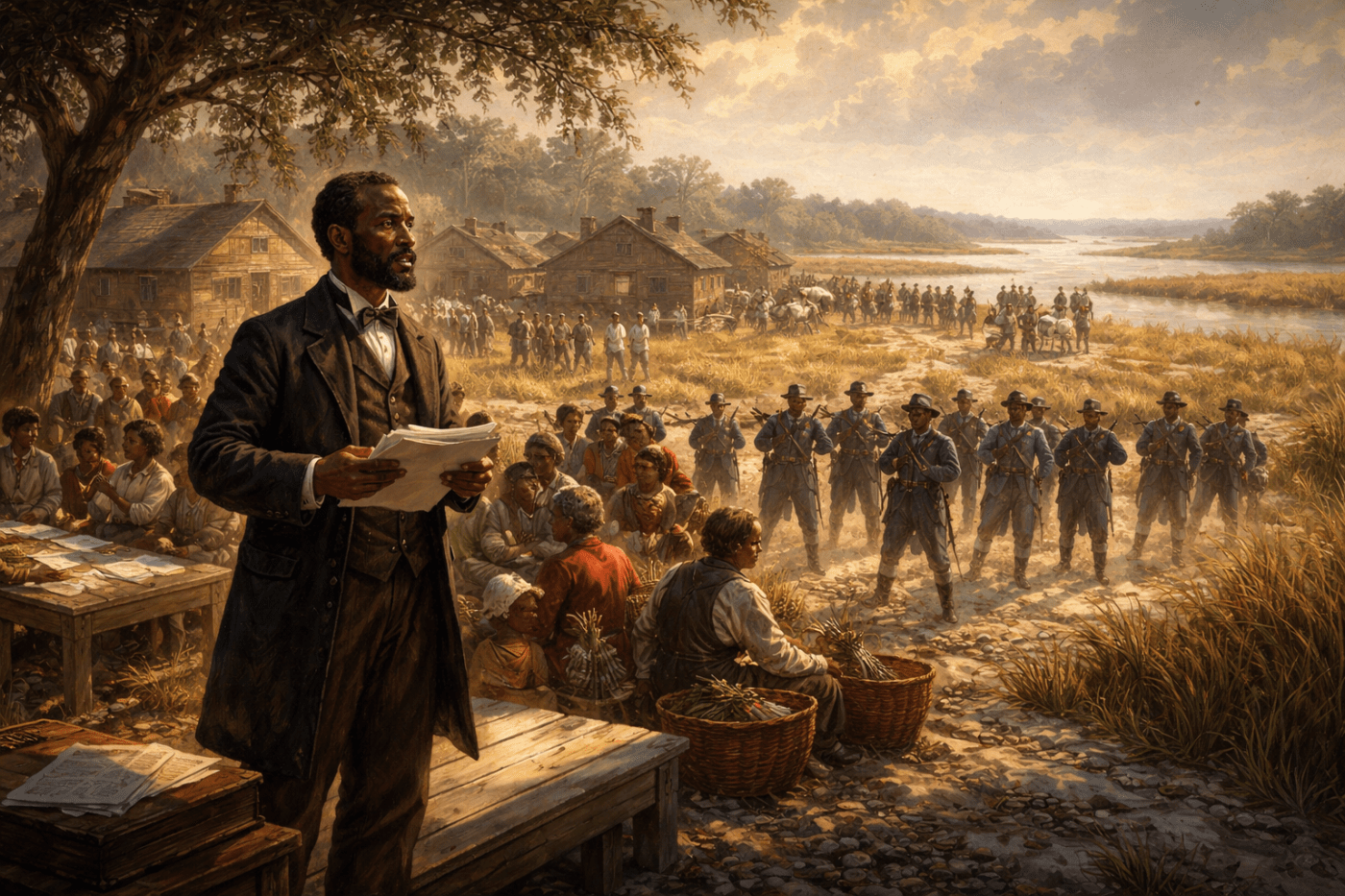
Born free in a slave republic, Campbell became an architect of Black self-rule after emancipation. On Georgia’s Sea Islands, freedpeople built land-based democracy before federal power restored white property. Rising to state leadership, he was criminalized as Reconstruction turned into counterrevolution. His life reveals Reconstruction as an unfinished revolution over land, labor, and power.
Prince Kapone | Weaponized Information | Black History Matters Series | February 4, 2026
Born Free in an Unfree Nation: Early Life Inside a Slave Republic
Tunis Campbell entered the world in 1812 in New Jersey, technically free in a country that loudly celebrated liberty while quietly profiting from bondage. His birth status placed him outside the legal category of enslavement, but not outside the reach of a racial order built to extract labor, restrict mobility, and define Black life as a problem to be managed. The early United States was not divided neatly into a free North and a slave South; it was a single political economy stitched together by slavery, land theft, and racial hierarchy. In that system, even free Black people lived under watch, exclusion, and economic marginalization. Campbell’s childhood unfolded inside this contradiction: free in name, constrained in reality.
Like many Black men who came of age before the Civil War, Campbell’s path to leadership ran through self-education, discipline, and community organization rather than elite institutions. Formal opportunities were scarce, but necessity is a strict teacher. Black mutual aid societies, churches, and abolitionist circles served as alternative schools of political thought, where literacy meant not only reading books but reading power. These networks cultivated a generation that understood freedom not as a gift handed down, but as something defended through collective effort. Campbell absorbed this lesson early. His development was not the story of an exceptional individual rising above his environment; it was the story of a politically conscious Black community producing organizers from its own ranks.
The North, often remembered as a refuge, functioned more like a different wing of the same house. Industrial growth depended on cotton grown by enslaved hands. Shipping, finance, and manufacturing were tied to plantation production. Black workers in northern cities faced job exclusion, housing segregation, and legal discrimination that reminded them daily that emancipation had not yet arrived for millions, and equality had not arrived for anyone. This broader economic reality shaped the outlook of Black activists in Campbell’s generation. They understood that slavery was not only a moral crime but an economic system, and that racial hierarchy served material interests. Freedom would therefore require more than sympathy; it would require structural change.
By the time Campbell entered public life as an organizer and abolitionist lecturer, he was part of a tradition that linked personal dignity to collective struggle. Black abolitionists did not wait for white allies to define their agenda. They built institutions, published newspapers, raised funds, and debated strategy in halls often denied to them elsewhere. Campbell’s early activism reflected this culture of self-directed political work. He spoke, organized, and moved within networks that saw Black people not as objects of reform but as agents of history. The task was not to prove humanity to a hostile nation, but to prepare for the day when that nation’s labor system would crack under the weight of its own contradictions.
In this sense, Campbell’s early life mirrors the broader trajectory of free Black political consciousness before the Civil War. Living inside a republic that proclaimed equality while enforcing racial capitalism sharpened analysis rather than dulling it. Experience taught what textbooks often concealed: that rights without power are fragile, and that freedom detached from land, labor, and political control remains incomplete. These lessons would travel with Campbell when war finally tore open the old order. The man who would later help build new institutions for freedpeople did not emerge from nowhere in 1865. He was forged in decades of struggle within a nation that was free for some because it was unfree for others.
When War Shattered the Slave Economy and Opened the Door to Revolution
The Civil War did not begin as a war to liberate Black people, but it became a war that made liberation unavoidable. When Southern planters seceded, they were not simply defending “states’ rights.” They were defending a labor system worth billions, a system in which Black bodies were capital and Black labor powered the global cotton trade. Once the war started tearing through that system, the old economic order began to crack. Enslaved people fled plantations, sabotaged production, and forced the question onto the battlefield: what would freedom actually mean once slavery collapsed?
For men like Tunis Campbell, who had spent years agitating against slavery from the margins of political life, the war created an opening that had not previously existed. The federal government, desperate to win, found itself leaning on the very people it had long excluded. Black labor became essential to the Union war effort. Black soldiers entered the army. Emancipation, once treated as radical fantasy, turned into military necessity. History sometimes moves slowly; sometimes it lurches forward under pressure. The Civil War was one of those lurches, when contradictions that had been managed for decades exploded into the open.
Emancipation, however, solved only one part of the problem. It ended legal ownership of people, but it did not automatically decide who would own the land they had worked for generations without pay. The Southern economy was built on plantations that concentrated both land and power in the hands of former slaveholders. If freedom meant simply returning formerly enslaved workers to those same plantations under wage contracts, then slavery would be replaced by dependency, not autonomy. Freedpeople understood this clearly. Across the South, they insisted that freedom must include land, protection, and the ability to build institutions of their own.
This was the moment Tunis Campbell stepped into a new historical role. The war had transformed abolition from moral agitation into practical governance. Someone had to help organize the transition from slavery to freedom on the ground. Campbell, with his background in education, organizing, and Black political networks, became part of that effort. He was not entering a blank space but a battlefield of social relations. Planters wanted their labor force back. Freedpeople wanted land and independence. The federal government was caught between preserving national unity and managing a social revolution it had not fully intended to unleash.
The immediate postwar period therefore contained genuine revolutionary potential. Not revolution in the sense of a sudden overthrow from above, but in the sense of a deep transformation in who controlled land, labor, and local authority. The destruction of slavery had removed the legal foundation of the old order; what replaced it was still undecided. Campbell’s work in the South would unfold inside this unstable terrain, where the future of Black freedom depended on whether emancipation would be anchored in material power or reduced to a legal formality. The war had opened the door. What walked through it would depend on struggle.
Where Freedom Met the Land: Tunis Campbell and the Struggle to Make Emancipation Real
When Tunis Campbell arrived on the Georgia Sea Islands in the immediate aftermath of the Civil War, he stepped into a region where history was moving faster than law could keep up. Plantations had been abandoned during the war, Confederate authority had collapsed, and thousands of formerly enslaved people were already living on and working the land. For them, freedom was not an abstract legal status waiting to be defined in Washington. It was a practical question: who would control the soil beneath their feet? If they were forced back under the authority of former slaveholders, emancipation would shrink to a change in vocabulary. If they could hold land collectively and independently, a new social order might begin to take shape.
Federal wartime policy had briefly aligned with this second possibility. Coastal lands, including parts of the Sea Islands, had been set aside for Black settlement under military authority. These measures were uneven and temporary, but they created a rare opening in which freedpeople could begin farming for themselves rather than under plantation discipline. Campbell’s assignment placed him at the heart of this process. He was tasked with supervising land claims, helping organize settlements, and guiding communities composed of people who had been denied legal personhood only months earlier. His role was administrative on paper, but political in substance. Every decision about land, labor, and authority carried the weight of a larger struggle over the future of the South.
Campbell understood that land was not simply a resource; it was power. A family that farmed its own plot could negotiate wages, refuse abusive contracts, and build institutions independent of planter control. Without land, freedpeople would be pushed back into labor arrangements that reproduced many of the old hierarchies. This is why the demand for land spread so widely among the formerly enslaved. It was not a dream of wealth. It was a strategy for survival and dignity. Campbell’s work therefore revolved around translating that demand into structured settlement: assigning plots, encouraging cooperative labor, and helping communities establish routines of production that could sustain them over time.
The Sea Islands became a living laboratory for the meaning of emancipation. Freedpeople organized their lives around small farms, mutual aid, and collective decision-making. They built homes, planted crops, and began to form schools and churches that served as centers of community life. This was not a passive waiting period before “real” freedom arrived from above. It was freedom being built from below, through daily labor and local organization. Campbell’s presence mattered not because he imposed a system, but because he helped coordinate and defend an emerging order in which Black workers, for the first time, exercised meaningful control over the conditions of their lives.
At this stage, the outcome was still uncertain. The old planter class was weakened but not gone. Federal policy was supportive in some moments and hesitant in others. The freedpeople’s experiment depended on a fragile alignment between their own determination and a temporary tolerance from federal authorities. Campbell stood at the intersection of these forces, trying to stabilize a new social arrangement before the old one could regroup. The question was no longer whether slavery would return in its previous legal form. It was whether the post-slavery South would be organized around independent Black landholding and self-government, or around restored white property and controlled Black labor. On the Sea Islands, that struggle had already begun.
When the Freed Began Governing Themselves: The St. Catherines Experiment in Democracy
As the settlements on the Sea Islands stabilized, something deeper than land redistribution began to emerge. Freedpeople were not only farming; they were governing. Daily life required rules, conflict resolution, collective decision-making, and protection. Out of these practical needs grew institutions that resembled the foundations of a political order. Under Tunis Campbell’s leadership, communities on St. Catherines Island and neighboring areas developed structured forms of self-rule that challenged the long-standing assumption that Black people required white supervision to maintain “order.” What had once been plantations governed by overseers were becoming communities governed by the formerly enslaved themselves.
Local courts were established to settle disputes over land boundaries, labor arrangements, and personal conflicts. Meetings were held to decide communal matters, and representatives emerged to carry out decisions. Rules were written and enforced not by distant authorities but by people who lived under them. Campbell acted as a central coordinating figure, helping translate the needs of the community into workable legal and administrative forms. His authority rested not simply on federal appointment, but on the trust and recognition of the freedpeople who saw in him an organizer committed to their collective well-being.
Community defense was another crucial element. The memory of slave patrols, kidnappings, and planter violence had not vanished with the war’s end. Freedom without protection was fragile. Organized groups of Black men took responsibility for maintaining internal order and deterring outside intimidation. This was not an army raised for conquest; it was a community asserting its right to exist without constant fear. The presence of disciplined self-defense unsettled those who believed that only white men had the right to bear arms or enforce law. It signaled that emancipation had political as well as economic implications.
White access to the islands was also regulated. This was not racial reversal for its own sake, but a practical measure rooted in historical experience. For generations, white presence on these lands had meant coercion and exploitation. Autonomy required the ability to set boundaries and control who entered the community. In this way, the Sea Islands settlements operated with a degree of internal sovereignty unusual in the history of the United States. They were not recognized as independent states, yet in daily practice they functioned as self-governing Black political communities shaped by the priorities of those who lived there.
The significance of this experiment cannot be overstated. Formerly enslaved workers were not merely adapting to freedom; they were constructing democratic institutions from the ground up. Courts, assemblies, security, and landholding combined into a form of working-class governance that directly contradicted the racial and economic order of the antebellum South. Tunis Campbell’s role was to help give structure and durability to this process, linking local initiative with administrative coherence. For a brief moment, the Sea Islands revealed what Reconstruction could become if the freed were allowed to determine the terms of their own freedom.
When Property Demanded Its Revenge: The Federal Turn Toward Counterrevolution
The experiment unfolding on the Sea Islands did not collapse because freedpeople failed to govern. It faltered because the balance of national power shifted. The same federal government that had tolerated, and at moments facilitated, Black landholding during wartime now faced a different political calculation. Reuniting the nation on terms acceptable to white elites became the priority. In this new equation, the property claims of former slaveholders carried more weight than the freedom claims of the formerly enslaved. The land question, which had briefly leaned toward redistribution, tilted back toward restoration.
Policy changes in Washington signaled this turn. Amnesty and restoration measures opened the door for ex-Confederates to reclaim lands that had been abandoned or confiscated during the war. Legal arguments about “property rights” took on renewed force, even when that property had been cultivated for generations through unpaid Black labor. For communities on the Sea Islands, these decisions were not distant legal abstractions. They threatened the very foundation of their autonomy. If the land was returned to former slaveholders, the economic base that supported self-government would vanish.
Federal administrators and military authorities increasingly acted to implement this reversal. Land titles were reexamined, claims invalidated or reduced, and pressure applied to Black settlers to vacate or renegotiate their position. What had been a revolutionary opening narrowed into a corridor leading back toward dependency. The state, which had briefly stood as an imperfect shield against planter power, now became an instrument for restoring it. The message was clear: emancipation would be recognized, but not at the cost of overturning the Southern property order.
Tunis Campbell found himself caught in this tightening vise. The structures of self-rule he had helped nurture depended on land security. As that security eroded, so did the practical ability of communities to sustain independent institutions. This was not a spontaneous retreat but a coordinated political shift. The federal government chose reconciliation with former slaveholders over continued support for Black autonomy. The Sea Islands settlements, once symbols of a new social possibility, were reframed as irregularities to be corrected in the name of national stability.
This moment marks the transition from Reconstruction as revolutionary transformation to Reconstruction as managed containment. The destruction of the Sea Islands experiment reveals that the limits of freedom were not set by what freedpeople could achieve, but by what entrenched power would tolerate. When Black working communities began to exercise real control over land and local governance, they crossed a line. Property demanded its revenge, and the state obliged. The counterrevolution did not announce itself with a single decree; it advanced through administrative decisions that quietly unraveled the material basis of Black self-rule.
From Island State-Builder to Reconstruction Statesman
The rollback on the Sea Islands did not end Tunis Campbell’s political life; it transformed its terrain. If land-based autonomy could no longer be secured in isolated coastal settlements, the struggle would have to move into the formal structures of state power. Campbell shifted from local organizer and administrator to a broader political role in Georgia during Radical Reconstruction. This was not a retreat from his earlier principles, but their extension. The same man who had helped build courts, land systems, and community defense on the islands now entered a legislature where the future of those very questions was being contested at a statewide level.
Campbell emerged as a leading Black political figure in coastal Georgia, building a base among freedpeople who still saw him as a defender of their interests. Land ownership, cooperative farming, and local organization remained central to his work. He understood that political rights divorced from economic footing were easily stripped away. Representation in the state senate was therefore not an end in itself, but a tool to protect and expand the material gains freedpeople had managed to secure. He carried into formal politics the same practical orientation that had guided his work on the Sea Islands: institutions matter because they shape who holds power in everyday life.
In the Georgia State Senate, Campbell participated in one of the most ambitious democratic experiments in U.S. history. Reconstruction governments, propelled by Black voters and white allies, attempted to remake Southern society through public education, expanded civil rights, and more inclusive political participation. These measures were not gifts handed down from enlightened leaders. They were the legislative expression of demands that had been building among freedpeople since emancipation. Campbell’s presence in the senate symbolized the entry of formerly enslaved communities into the arena of state governance, not as subjects but as actors.
Yet this stage of his career also revealed the fragility of Reconstruction democracy. Black legislators operated in an environment saturated with hostility. Former Confederates, white supremacist organizations, and conservative politicians viewed their very presence as illegitimate. The same racial order that had resisted land redistribution now resisted Black political leadership at the state level. Violence, intimidation, and legal maneuvering were deployed to undermine Reconstruction governments from within and without. Campbell’s transition from island organizer to state politician thus placed him at the front line of a broader battle over whether the postwar South would be governed by its newly enfranchised majority or by the remnants of the planter elite.
This phase of Campbell’s life illustrates a key dynamic of Reconstruction: the movement from local experiments in autonomy to attempts at systemic transformation through state power. His trajectory shows that Black political leadership was not accidental or symbolic; it was rooted in years of grassroots organization and a clear understanding of the relationship between land, institutions, and governance. By stepping into the legislature, Campbell did not abandon the vision of self-determination he had helped nurture on the Sea Islands. He sought to scale it up, to make the principles of freedom, land security, and democratic participation the foundation of Georgia’s political order. That effort would provoke a reaction as fierce as any he had faced before.
The Crime of Black Governance: Repression and the Making of a Political Prisoner
As Reconstruction governments struggled to hold ground across the South, the opposition hardened from resentment into organized retaliation. For white elites who had lost their legal ownership of Black labor, the rise of Black political leadership represented a deeper threat than emancipation itself. Slavery had guaranteed control over work; Reconstruction threatened control over law, taxation, and public institutions. Men like Tunis Campbell embodied that danger. He was not merely voting; he was governing. And in a society built on the assumption that Black people should be ruled, Black governance itself was treated as a crime.
The backlash took many forms: paramilitary violence, economic intimidation, and legal prosecution. White supremacist organizations worked to terrorize Black voters and officeholders, while conservative political forces sought to reclaim state governments through elections backed by coercion. Within this climate, legal charges became a weapon. Accusations of corruption or misconduct were leveled against Black officials not primarily to correct wrongdoing, but to remove them from power and discredit the broader project of Reconstruction. Law became the language through which counterrevolution presented itself as “order.”
Tunis Campbell was drawn directly into this machinery. He was accused of malfeasance and election-related irregularities—charges that must be read in the context of a political environment where Black leadership was considered illegitimate by definition. His prosecution was not an isolated legal matter; it was part of a coordinated effort to break the backbone of Black political power in Georgia. By targeting prominent figures, white elites aimed to send a message to entire communities: participation in governance would bring punishment, not protection.
Campbell was convicted and sentenced to hard labor, forced into a system that blurred the line between punishment and re-enslavement. The symbolism was stark. A man who had helped formerly enslaved people build institutions of freedom was placed in chains by a state determined to restore racial hierarchy. His imprisonment marks a crucial turning point. Reconstruction was no longer merely contested; it was being dismantled through criminalization. The tools of repression that would later be used against Black radicals, labor organizers, and civil rights leaders were being tested and refined in this moment.
From prison and later in his own published account, Campbell bore witness to this transformation. His life traced the arc from emancipation’s promise to counterrevolution’s punishment. The lesson is not simply that injustice occurred, but that repression followed power. When Black communities moved from petitioning to governing, the state and its allies responded by redefining political leadership as criminality. Campbell’s fate reveals Reconstruction’s final contradiction: the same legal system that proclaimed freedom could be mobilized to cage those who tried to make that freedom real.
Memory Against Erasure: What a Defeated Revolution Still Teaches
By the time Tunis Campbell reached the later years of his life, the world he had fought to build had been largely rolled back. Reconstruction governments had fallen, white supremacist rule had reasserted itself across the South, and the language of “redemption” was being used to celebrate the defeat of Black political power. Yet defeat in history does not mean disappearance. It means the memory of what was possible becomes dangerous. Campbell’s life, stretching from antebellum abolitionism through emancipation, self-government, and repression, preserved a record of a different South that had briefly existed and could not be easily forgotten.
The dominant story of Reconstruction would later paint the era as chaotic, corrupt, or misguided—an experiment doomed by the supposed incapacity of the formerly enslaved. Campbell’s experience tells another story. It shows that freedpeople were capable of building functioning institutions, governing communities, and participating in state power with seriousness and discipline. The collapse of that experiment was not the result of incompetence from below, but organized resistance from above. Property, racial hierarchy, and political control were defended through violence and law until Black autonomy was forced into retreat.
Campbell’s own writings after his imprisonment stand as an act of resistance against this erasure. By documenting his persecution, he refused the narrative that criminalized him. He insisted that what had been punished was not wrongdoing, but the attempt to make freedom meaningful. His testimony links personal suffering to structural conflict, showing how the machinery of the state could be turned against those who sought to transform it. In this sense, memory becomes a political weapon. It challenges official history by preserving the perspective of those who were defeated but not silenced.
The broader lesson of Campbell’s life is that Reconstruction should be understood not as a tragic mistake, but as an unfinished revolution. For a brief period, the foundations of Southern society were genuinely up for debate: who would own the land, who would control local institutions, and who would define law and order. That these questions were ultimately answered in favor of the old elite does not make the earlier struggle irrelevant. It reveals how much power was at stake. The intensity of the backlash is itself evidence of how far the experiment had gone.
Remembering Tunis Campbell, then, is not an exercise in nostalgia. It is a reminder that Black freedom has repeatedly advanced to the point of threatening the economic and political structure of the United States, and that each time, counterrevolution has mobilized to contain it. His life connects emancipation to Reconstruction, Reconstruction to repression, and repression to the long struggle that followed. In that continuity lies the real meaning of his story: revolutions can be rolled back, but the knowledge that they were once possible remains a force that future generations can draw upon.
 Weaponized Information
Leave a comment