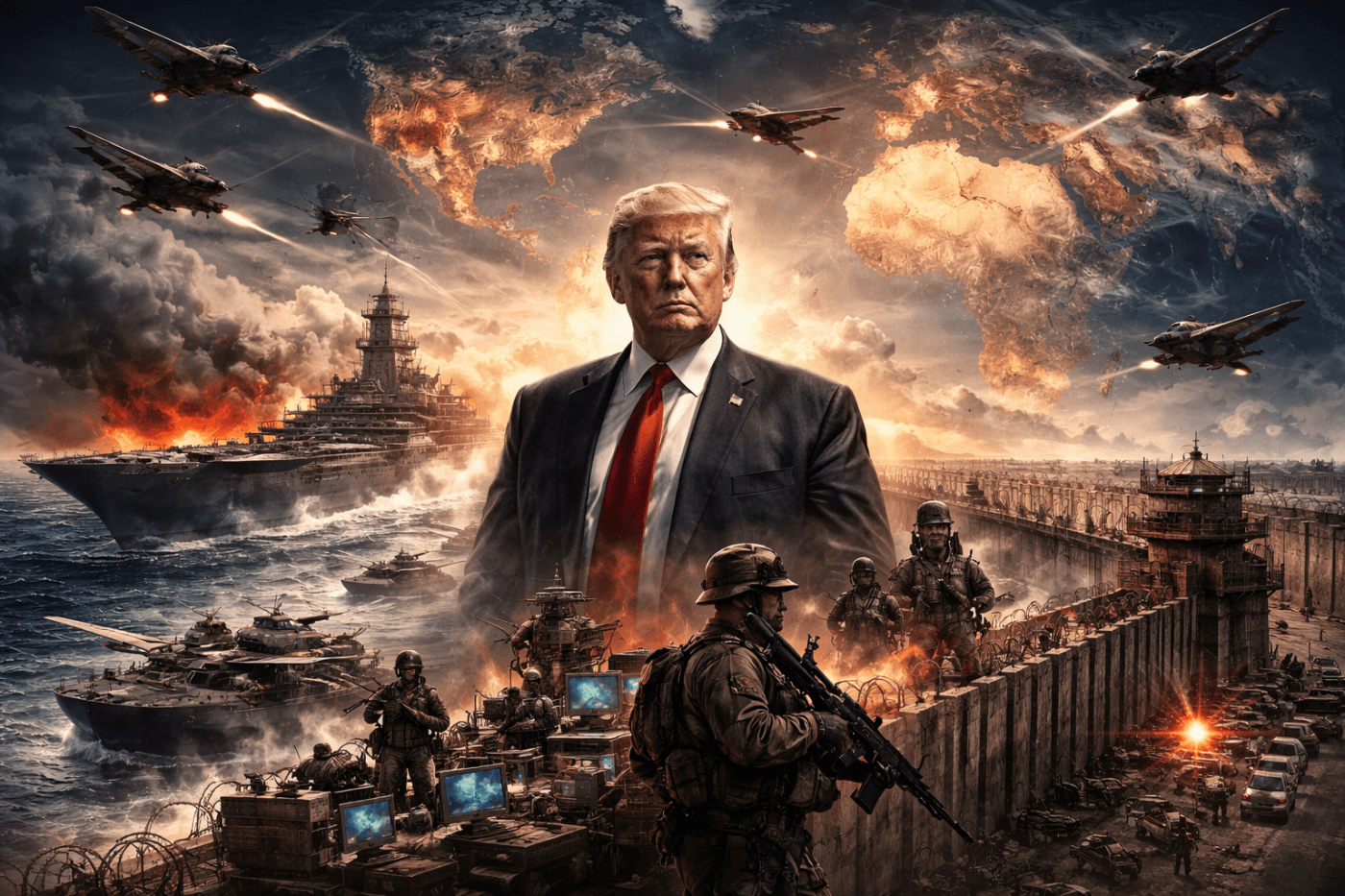
The 2026 NDS turns imperial storytelling into imperial workflow. The Western Hemisphere is redesigned as warfighting rear-base and corridor system. Denial becomes the empire’s default form of power under constraint. Simultaneity panic fuses alliances, industry, and border militarization into one war-state machine.
By:Prince Kapone | Weaponized Information | January 27, 2026
When Doctrine Stops Explaining and Starts Building
Last year we read the 2025 National Security Strategy like you read a tired landlord’s speech to the tenants — lots of talk about “renewal” and “resilience,” but really a confession that the building is cracking and the rent money isn’t stretching like it used to. That document was empire in therapy. It was Washington trying to convince itself that narrowing its ambitions was wisdom, not weakness; that pulling back to the hemisphere was “focus,” not fear; that panic about borders, industry, and social cohesion was just responsible stewardship. It was ideology under pressure, the ruling class explaining its own decline in the soft voice it uses when it doesn’t want to alarm the neighbors.
The 2026 National Defense Strategy is something else entirely. Therapy is over. Now the contractors show up. Where the NSS spoke in the language of stories and self-justification, the NDS speaks in the language of force posture, basing, denial lines, and mobilization pipelines. One document tried to reassure a nervous elite that retreat could be marketed as strategy. The other tells the military, the arms industry, and the alliance system how to physically reorganize around that retreat. This is where the PowerPoint becomes concrete.
That change in genre is not cosmetic. Grand strategy papers float high above the ground, full of noble phrases about “leadership” and “values.” Defense strategies are where those phrases get turned into runways, ports, procurement contracts, and deployment cycles. If the NSS told us the United States wanted to consolidate an “American Pole” in the Western Hemisphere while tightening the screws in Asia, the NDS shows what that means with a tape measure in hand: which regions count as primary terrain, which rivals must be boxed in, which allies are expected to carry more of the load, and which domestic industries are to be wired straight into the war machine.
On the surface, the NDS uses a calmer tone on China than the chest-thumping many expected. There’s polite talk of “stability” and avoiding “needless confrontation.” To the casual reader, it sounds almost reasonable — like the empire finally discovered manners. But tone is theater, and posture is plumbing. While the rhetoric cools, the underlying structure hardens. The strategy centers on building a denial belt in the Indo-Pacific, tightening military integration along the First Island Chain, and ensuring U.S. access to the most economically dynamic region on earth. At the same time, it elevates homeland defense and the Western Hemisphere as the core theater, tying U.S. security to control over key terrain, strategic corridors, and the political alignment of neighboring states.
So no, the NDS does not break with the trajectory mapped in the NSS. It installs it. The hemisphere-first logic becomes force planning. The fear of overstretch gets a technical name — the “simultaneity problem” — which is just Pentagon language for a simple truth: the United States can’t assume it can fight everywhere at once and stroll away smiling. The answer offered is not peace but prioritization: lock down the core, harden the Asian perimeter, and make allies pick up more of the tab elsewhere. This is empire under constraint, learning to shift its weight without loosening its grip.
Through our lens, the American Pole stops being a clever geopolitical phrase and starts looking like a military logistics system. The Western Hemisphere is framed not just as a sphere of influence but as a zone where access must be guaranteed, rivals kept out, and instability managed before it creeps north. Borders blur into battle lines, migration policy melts into security doctrine, and trade corridors start looking like strategic arteries. Meanwhile, the Indo-Pacific becomes the outer defensive ring of this hemispheric fortress, where China’s rise is handled not with sermons about democracy but with layered denial, forward positioning, and tight alliance wiring.
The result is a strategy that speaks softly while building hard edges. Washington isn’t announcing a crusade; it’s installing guardrails, choke points, and tripwires. It is preparing for a world where it can’t dictate outcomes everywhere, but can still shape the terrain by controlling where others can move, trade, and project power. This isn’t the swagger of a system at its peak. It’s the careful engineering of a system that knows its limits — and plans to defend those limits with concentrated force.
If the NSS was the empire explaining itself, the NDS is the empire wiring itself. And once you get to wiring — bases, budgets, industrial pipelines, alliance tasking — the conversation changes. We are no longer in the realm of narrative spin. We are watching the physical reconfiguration of power for a long season of managed decline, hardened borders, and permanent rivalry. The age of imperial reassurance is over. The age of imperial construction has begun.
From Imperial Storytelling to Imperial Workflow
Part I was about how empire talks to itself when it’s nervous. Part II is about what it does once the talking stops. The National Defense Strategy isn’t written to impress voters or soothe pundits. It’s written for planners, logisticians, contractors, alliance managers — the people who turn imperial anxiety into schedules, budgets, and shipping manifests. This document doesn’t sell a vision. It hands out assignments.
And that’s where things get real. Speeches can promise anything. Workflows can’t. A workflow forces decisions about who gets resources and who waits. Which base gets expanded and which stays vulnerable. Which ally gets weapons first and which gets a speech about “shared sacrifice.” How fast ships can actually be built. How long missile stockpiles would last in a real fight. This is not the language of destiny. It’s the language of limits.
That’s the quiet truth running through the NDS: the empire is no longer planning from the assumption of endless capacity. It is planning from the reality of managed scarcity. Time is tight. Industrial depth is thin. Political patience — at home and abroad — is fragile. Even escalation itself is treated like a resource you have to ration. You can’t afford to burn through everything at once anymore.
So the answer isn’t bold new adventures. It’s integration — the favorite word of systems under stress. Integration of commands. Integration of allies. Integration of industry. Integration across land, sea, air, space, and cyber. But integration here isn’t about elegance. It’s about substitution. If U.S. forces are stretched in one theater, an ally has to hold the line somewhere else. If domestic production can’t surge fast enough, foreign supply chains have to be tightened into the system. Every part of the machine is being wired so that when one piece strains, another can take the load.
Read it like this and the NDS starts to look less like a war plan and more like a stress-management blueprint for a declining power. It assumes crises will overlap. It assumes supply bottlenecks. It assumes contested access. So it builds redundancy, pre-arranged basing, dispersed logistics, and alliance task-sharing into the structure itself. The goal isn’t to eliminate danger. The goal is to keep danger from cascading into loss of control.
And this is where geography quietly changes meaning. Places are no longer judged mainly by their politics or their slogans about democracy. They’re judged by function. Can this corridor move equipment when others are blocked? Can this port handle surge? Can this ally operate for weeks without direct U.S. backup? Can this region absorb disruption without forcing Washington to pull forces from somewhere else? Land becomes infrastructure. Infrastructure becomes survivability.
So if Part I showed us the empire wiring itself, Part II shows us what that wiring is built for: strain, overlap, delay, shortage, friction. This system is not designed for smooth, uncontested dominance. It’s designed for endurance in a world where supremacy can no longer be taken for granted. And once endurance becomes the organizing principle, the most important places on earth are not the ones with the loudest speeches — they’re the ones that keep the machine running when everything else is on fire.
The American Pole Becomes a Warfighting Theater
Once doctrine turns into workflow, the “American Pole” stops being a geopolitical vibe and becomes a map with tasks attached to it. The hemisphere isn’t just where Washington wants more “influence.” It’s where Washington wants more control—because in the NDS logic, the Western Hemisphere is no longer a backyard you manage. It is the rear operating base you must be able to fight from, sustain from, and seal off when the wider system is under stress.
That is the primary refinement the NDS gives us. In the older imperial playbook, Latin America could be handled through a revolving toolkit of debt, trade discipline, intelligence operations, NGO pipelines, and the occasional coup when a government stepped out of line. The Marines were always there as the final argument, but they were not the organizing principle. The organizing principle was political management. The NDS quietly shifts the organizing principle to something colder and more material: warfighting reliability. The hemisphere is evaluated by whether it can function as strategic depth—secure supply, secure mobility, secure corridors, secure infrastructure—under conditions of long rivalry.
This is where the document’s talk of “key terrain” matters. “Key terrain” is not poetry. It’s the language used when a region is being reorganized as a theater. And in this theater, the decisive “ground” is often not a hill or a trench, but infrastructure: the nodes and corridors that decide whether forces, fuel, food, components, and data move—or don’t.
Panama is a prime example. In a commercial story, it is a canal. In a warfighting story, it is an artery between oceans. The Gulf and Caribbean approaches stop being travel brochure water and become corridor geometry—shipping lanes, port access, interdiction routes, forward staging space. Greenland and the Arctic approaches become early-warning and access problems: sensor coverage, missile defense calculus, northern routes, and the ability to see threats early enough to manage them. When you put these pieces together, you can see the architecture taking shape: Panama connects the circulatory system, the Gulf/Caribbean are the bloodstream’s vulnerable passages, Greenland/Arctic are the eyes and ears. This is not “regional policy.” This is theater design.
Borders undergo the same conversion. Migration, organized crime, and instability are recoded through a defense lens that treats movement itself as a potential breach. The line between homeland defense and hemispheric defense gets thinner—not as rhetoric, but as planning logic. The southern border, Caribbean approaches, and northern routes are treated like parts of a continuous perimeter. Civilian life gets translated into security variables. Social flows get entered into the same spreadsheets that track force protection.
And once you’re looking at the hemisphere this way, the economic terrain can’t stay “economic.” Ports, rail networks, energy grids, semiconductor supply chains, telecom backbones, lithium and rare earth corridors—these are no longer treated as development questions first. They are treated as operational questions: do these systems strengthen the rear base, or do they create vulnerabilities inside it? That is why rival involvement in infrastructure triggers alarm. A Chinese port contract, a digital backbone, a satellite facility, an energy project—none of this is read as neutral commerce. It is read as potential leverage inside what the NDS now treats as protected strategic depth.
This is what distinguishes the NDS-era “hemisphere priority” from older versions of hemispheric dominance. It’s not just louder Monroe Doctrine rhetoric. It is a functional redesign: the hemisphere is being treated as a logistics fortress whose reliability must be guaranteed in wartime conditions. Influence is not the end goal. Access is. Mobility is. Continuity of supply is. The political purpose of hemispheric control is now explicitly military: to ensure that when the U.S. tightens into its shrinking core, the core doesn’t seize up.
So yes—the Monroe Doctrine is back, but it’s no longer a warning on paper. It is becoming a set of operating assumptions wired into basing, corridor control, border militarization, and infrastructure discipline. Exclusion stops being declarative and becomes structural. The real question is no longer “who claims influence in the Americas?” The real question is: who can physically operate in the Americas—move, supply, communicate, sustain—when the system is under strain?
And once the hemisphere is defined as warfighting theater, everything downstream tightens around that fact. Alliances become tools for guarding approaches. Industrial policy becomes a way of ensuring the rear can supply the front. Border enforcement becomes perimeter defense. The American Pole stops being a slogan. It becomes the material foundation from which U.S. power intends to endure a long period of rivalry—by turning the hemisphere into strategic depth, and treating anything that threatens that depth as a security problem to be managed, corrected, or removed.
The Age of Denial: When Empire Turns from Ruling to Blocking
Once the hemisphere is redesigned as a warfighting rear, the logic of the wider strategy comes into focus. An empire that is fortifying its base is not planning to run the whole world the way it once did. It is planning to manage a world it can no longer fully control. That is where the NDS makes its next conceptual move, even if it never says the words out loud: the United States is becoming an empire of denial.
Denial is what power looks like under constraint. If you cannot confidently govern every region, you shift to making sure no rival can govern them either. If you cannot outproduce a competitor across the board, you work to out-interdict—controlling the corridors, chokepoints, and escalation ladders that determine who can turn economic weight into strategic freedom. Power stops flowing outward in the form of remaking political orders. It hardens into barriers, tripwires, and gates.
This is the symmetry that links the two geographic pillars of the NDS. In the Western Hemisphere, denial means keeping rival powers from embedding themselves in the logistical arteries of the Americas—ports, canals, digital infrastructure, energy networks, mineral corridors. The issue is not simply influence; it is whether, in a crisis, those systems could be leveraged in ways that constrain U.S. freedom of action. The answer the strategy seeks is structural: limit rival footholds, tighten oversight, and make the hemisphere’s infrastructure legible and reliable for U.S. operations first.
Across the Pacific, the same method appears under the banner of “deterrence by denial.” The First Island Chain is not treated as a friendly diplomatic neighborhood. It is treated as a perimeter wall. Missile networks, surveillance layers, forward basing, naval integration with allies—these are not symbolic signals. They are designed to restrict China’s ability to translate its economic mass into unimpeded military movement. The objective is not to collapse a rival’s system, but to box it in geographically and operationally.
Put the two theaters together and the pattern sharpens. Hemisphere denial aims to keep competitors out of the empire’s rear. Indo-Pacific denial aims to keep a rising rival from breaking out of its front. Different maps, same method: structure the environment so that the other side’s strength cannot easily become freedom of action. Denial becomes the “how” of hyper-imperialism in an age where the “why” is survival under narrowing margins.
This is a different posture from the era of unipolar expansion. Then, U.S. power often moved by attempting to reorder states directly—regime change, large-scale occupation, ambitious nation-building projects. Those were the moves of a system confident it could remake political space. The denial empire is more defensive in shape but not gentler in effect. It accepts that it cannot reliably transform every region, so it focuses on controlling the gateways that determine how others move through the system.
The moral language of “freedom of navigation” and “open access” remains, but its function shifts. Openness becomes selective. Movement is free when it flows through corridors under U.S. supervision. It becomes threatening when it builds autonomous pathways that bypass those corridors. The strategy is less about universal rules and more about managing the geometry of power—who sits astride the straits, who controls the ports, who secures the data routes, who can escalate, and who must think twice.
Denial, then, is not just a military tactic. It is the operating philosophy of an empire that knows it cannot stretch without breaking. Instead of promising to shape the whole world, it works to ensure that the parts it cannot shape remain constrained. The NDS does not celebrate this openly. But once you trace its emphasis on key terrain, corridor control, layered defenses, and rival exclusion, the outline is unmistakable: when empire can no longer run the system, it stands in the doorways and decides who gets through.
The Empire’s Real Nightmare: Too Many Fires at Once
The calm tone toward China and the hardening posture around it both make more sense once you see the problem that quietly organizes the entire strategy: simultaneity. The nightmare scenario for Washington is not just a strong rival. It’s several crises, in several regions, unfolding at the same time while the United States no longer has the spare capacity to handle them all directly.
This fear doesn’t shout in the document. It hums underneath it. The NDS is structured around the idea that the United States must avoid being pulled into multiple major conflicts at once — a war in Asia while Europe erupts, a crisis in the Western Hemisphere while tensions spike in the Middle East, cyber and space disruptions layered on top of conventional fights. The old imperial model assumed you could dominate everywhere because your margin of superiority was wide. That margin has narrowed, and the strategy is built around managing that narrowing.
So instead of planning for unlimited intervention, the Pentagon is designing a system that can stretch without snapping. That means building alliances not just for solidarity, but for substitution. It means stockpiling industrial capacity so production can surge if one theater consumes resources. It means forward-positioning forces and pre-negotiating access so time isn’t lost when a crisis breaks. It means ensuring that, even if the United States has to concentrate on one main front, other fronts don’t collapse overnight.
This is where the softer rhetoric toward China intersects with the harder military design. Washington wants to slow the tempo of confrontation in order to buy time to prepare for a world where crises may stack. You don’t want to trigger the big one before your logistics, alliances, and industrial base are aligned. The strategy is less about winning a single decisive showdown and more about surviving a long period of overlapping tensions.
The result is a form of managed omnipresence. The United States can no longer be everywhere at once in the old sense, with overwhelming force on demand. Instead, it tries to simulate that presence through networks: allies carrying more of the load, prepositioned equipment standing in for permanent deployments, industrial partners ready to scale production, intelligence and surveillance systems providing early warning. The empire shifts from direct control to orchestrated coordination.
But this also reveals the underlying vulnerability. If you are designing your entire strategy around avoiding simultaneity, you are admitting that you cannot comfortably fight on multiple fronts. Rivals know this. They watch for moments when U.S. attention is tied down elsewhere. They probe for weak spots, test red lines, and explore coordination among themselves. The more the United States talks about “pacing threats” and “prioritization,” the clearer it becomes that choices will have to be made — and that some regions will inevitably feel deprioritized when pressure spikes elsewhere.
So simultaneity becomes both the organizing principle of U.S. strategy and its structural pressure point. The NDS is an attempt to engineer a system that can absorb shocks in more than one place at a time without breaking. Alliances, denial zones, industrial mobilization, and homeland fortification all plug into this central problem. Each is a way of reducing the chance that one crisis triggers a cascade.
This is what imperial planning looks like when supremacy can no longer be taken for granted. The goal is not to guarantee dominance everywhere, but to prevent any single shock — or combination of shocks — from unraveling the whole position. The empire prepares not for a clean war, but for a messy era where conflicts overlap, resources are finite, and endurance becomes as important as victory.
Allies, But on the Payroll
Once simultaneity becomes the central fear, “alliance” stops meaning friendship and starts meaning labor allocation. The 2026 NDS treats partners less like sovereign equals and more like assigned roles in a very large, very tense division of work. The empire cannot be everywhere at once, so it reorganizes others to stand in, hold ground, and buy time.
This is what burden-sharing really looks like in practice. Not a gentle request, but a structured expectation: you defend this front, you finance this capability, you host these systems, you align your industry with our supply chains. In return, you remain inside the security umbrella and the economic ecosystem that still runs through Washington. Step too far outside, and the umbrella gets smaller.
The difference between regions is revealing. In Europe, the message is increasingly blunt: Russia is dangerous, but manageable — you take the lead. Rearm, expand production, carry more of the conventional burden. The United States will support, coordinate, and provide high-end capabilities, but the day-to-day weight shifts eastward. Europe becomes a semi-autonomous front where U.S. power is present but not solely responsible.
The Indo-Pacific is treated differently. Here, China is not “manageable” in the same way; it is the pacing threat. So even as allies like Japan, Australia, the Philippines, and others are pushed to do more, the United States remains the central military pillar. Command-and-control integration deepens. Joint planning tightens. Bases multiply. The region is not outsourced — it is layered, with allies acting as force multipliers inside a U.S.-led architecture.
That asymmetry tells us something important. Burden-sharing is not a sign of retreat; it is a technique for stretching limited capacity. Where the stakes are seen as secondary, responsibility is devolved more aggressively. Where the stakes are existential to the balance of power, Washington keeps a firmer grip while still demanding contributions. The language is about partnership. The structure is about hierarchy.
Economically, the same pattern appears. Allies are encouraged — and pressured — to align their defense industries with U.S. standards, supply chains, and procurement cycles. Production is internationalized, but under U.S.-centered coordination. This spreads the load while also locking partners deeper into a system where strategic autonomy comes at a price. To diverge too far is to risk losing access, contracts, intelligence, or protection.
Seen this way, alliance management becomes a form of subcontracted empire. The United States does not withdraw from enforcement; it distributes pieces of it. Policing functions, forward presence, and industrial output are parceled out across a network that still orbits U.S. command structures. It is imperial governance by delegation, not abandonment.
But delegation has its tensions. Allies have their own domestic politics, economic constraints, and regional priorities. The more they are asked to shoulder, the more they will calculate what they get in return — and what they risk if they are drawn into conflicts that serve U.S. strategy more than their own immediate interests. Friction is built into the system. Yet from Washington’s perspective, friction is preferable to overstretch.
So the alliance system evolves from a shield into a workforce. Each partner is a node in a larger machine designed to prevent the simultaneity nightmare from becoming reality. Some hold the line in Europe. Some anchor the island chains in Asia. Some provide industrial capacity. Some host infrastructure that turns geography into leverage. Together, they form the distributed skeleton of an empire that can no longer carry all the weight itself — but still intends to set the direction of the lift.
When the War State Comes Home for Good
By the time alliances are reorganized into a global division of military labor, the line between “foreign policy” and “domestic policy” is already starting to dissolve. The NDS doesn’t just describe threats abroad; it quietly reorganizes life inside the United States so the home front functions as part of the warfighting system. This is where strategy stops being something that happens “over there” and becomes an administrative logic that reshapes the state itself.
Border policy is the clearest example. Migration is no longer treated primarily as a humanitarian, economic, or social issue. It is folded into national defense language — threats, infiltration, instability, loss of control. The southern border becomes not just a line of entry, but a militarized frontier in a hemispheric security doctrine. Walls, surveillance systems, National Guard deployments, detention infrastructure — all of it starts to resemble the outer ring of the same fortress logic applied abroad.
This is not accidental drift. If the Western Hemisphere is defined as the core strategic rear, then instability within it is treated as a security vulnerability, not a social problem. Movements of people, flows of drugs, political unrest — these are folded into the same mental map as rival power penetration and strategic encroachment. The border becomes a battlespace in the language of planning, even if it is described in bureaucratic tones.
At the same time, the industrial push we discussed earlier feeds directly into this domestic-security merge. Reviving manufacturing capacity, securing supply chains, accelerating AI and defense innovation — these are framed as economic policy, but justified as strategic necessity. The state’s hand grows heavier in directing capital, not because Washington has rediscovered social democracy, but because monopoly capital cannot rebuild industrial depth on the timelines required for great-power rivalry without state coordination and guaranteed demand.
Layer onto this the expansion of homeland defense technologies: missile defense initiatives, counter-drone systems, cyber protection of critical infrastructure, space resilience. These are sold as protective measures, and in a narrow sense they are. But institutionally, they tie civilian infrastructure, private industry, and military command structures closer together. Power grids, ports, telecommunications, and transportation networks are increasingly mapped as targets, nodes, and assets in a potential conflict. Civilian life is diagrammed in the same planning software as war.
This is where technofascism stops being just an ideological drift and becomes an institutional convergence. Homeland security, border enforcement, intelligence agencies, the military, and major defense and tech firms operate inside a more integrated ecosystem. Data flows, surveillance capabilities, logistics platforms, and emergency authorities overlap. The justification is resilience. The result is a state apparatus more comfortable treating society as a strategic terrain.
None of this requires open dictatorship. It grows through contracts, regulations, joint task forces, and “whole-of-government” initiatives. Each piece can be defended as reasonable on its own: secure the border, protect infrastructure, invest in domestic industry, defend against missiles and drones. But together they form a system where the distinction between civilian administration and war preparation becomes harder to see.
In that sense, the NDS marks a shift from the war state as narrative to the war state as routine. Not a dramatic mobilization, but a steady knitting together of security, industry, and domestic governance. The front line does not just run along distant seas and island chains. It runs through ports, factories, data centers, and detention facilities at home. And once that integration is normalized, it becomes much easier for future crises — real or manufactured — to justify pushing it further.
Building a War Economy Without Calling It One
Once the war state settles in at home, the next move is obvious — even if it’s never described in those words. You cannot run a denial strategy, manage simultaneity risks, and stretch alliances across multiple theaters with a hollowed-out industrial base. So the NDS leans heavily into what looks like innovation policy, but functions as the quiet construction of a modern war economy.
The language is all about “resilience,” “innovation,” “supply chain security,” and “advanced manufacturing.” But behind those words sits a more basic reality: monopoly-finance capital, left to its own devices, optimized for short-term returns and offshored production. That model is excellent for stock buybacks and fragile for great-power rivalry. The state now steps in not as a neutral referee, but as an organizer, coordinator, and guaranteed customer.
Defense spending becomes the stabilizer. Long-term contracts, R&D subsidies, public–private partnerships, and industrial incentives redirect capital toward sectors considered strategically vital — semiconductors, aerospace, shipbuilding, AI systems, cyber infrastructure, energy systems tied to military resilience. This is not a command economy in the socialist sense. It is a command framework for capital, where market actors still profit but within tighter strategic lanes drawn by the state.
Allies are pulled into this as well. Production is internationalized, but not freely. Supply chains are rearranged to reduce reliance on rivals and to bind partners more closely to U.S.-centered systems. Joint production agreements, interoperability standards, and shared procurement programs do double duty: they increase output while deepening dependency. An ally that builds key components for U.S. weapons systems is not just a partner; it is locked into a shared warfighting architecture.
Technology becomes the ideological bridge. Investments in AI, autonomous systems, and next-generation platforms are sold as the frontier of innovation, the path to competitiveness in a fast-moving world. But the strategic subtext is clear: advanced technologies are seen as force multipliers that can compensate for manpower limits, geographic distance, and the narrowing margin of superiority. Innovation is not just about growth; it is about maintaining military leverage under constraint.
What makes this moment distinctive is not that the United States is linking industry and defense — that has happened before. It is that this linkage is framed as permanent baseline rather than temporary mobilization. There is no declared wartime footing, no rationing, no formal shift to emergency production. Instead, the war economy is normalized through policy, contracts, and planning assumptions that treat long-term rivalry as the default condition.
This has consequences for labor and class structure as well. Resources flow toward sectors tied to defense and high-tech production, while social spending remains politically contested and tightly constrained. Workers are encouraged to see industrial revival as national renewal, even as the benefits are unevenly distributed and tied to sectors that serve strategic priorities more than social need. The promise is jobs and security; the structure is discipline and alignment.
In this sense, the NDS doesn’t just prepare the military for future conflict. It prepares the economy to live inside a permanent horizon of tension. Investment, innovation, and industrial policy are reorganized around strategic competition as a fact of life. The market still speaks, but the state increasingly decides what counts as a strategic voice. And once economic planning is justified in the name of security, it becomes far easier to steer resources toward war preparation than toward human development.
The result is a system where the war economy grows quietly, without the spectacle of mobilization, embedded in the everyday language of competitiveness and resilience. The factory floor, the research lab, and the venture capital pitch deck all become part of the same long arc — an arc bending not toward peace dividends, but toward sustained preparation for a world where rivalry never really turns off.
Peace, According to Empire
By the time you get to the end of the NDS logic, the word “peace” starts to sound different. It’s still there, polished and repeated, but it no longer means what ordinary people mean when they use it. In this strategic vocabulary, peace is not the absence of coercion. It is the successful management of coercion in ways that keep the system running.
Peace means the shipping lanes stay open — under U.S. naval supervision. Peace means energy flows don’t get interrupted — unless sanctions decide otherwise. Peace means financial networks keep clearing transactions — as long as you’re on the right side of the rules. Peace means rival powers are boxed in tightly enough that they think twice before pushing too hard. Stability, in this grammar, is the smooth operation of corridors under imperial oversight.
This is why denial, alliances, industrial mobilization, and homeland fortification all sit comfortably inside the language of “defending peace.” The strategy does not see a contradiction between building missile defenses, expanding basing access, militarizing borders, and calling it a peace agenda. From the standpoint of empire, these are the conditions that make peace possible — not for everyone equally, but for the continuation of a particular order.
Under this definition, peace also has a domestic component. Social unrest, political polarization, and economic disruption are not just internal issues; they are vulnerabilities that adversaries could exploit. So managing dissent, securing infrastructure, and maintaining economic performance become part of the peace project. A stable home front is treated as a strategic asset, not simply a democratic good.
Allies, too, are folded into this imperial peace. They are expected to pay more, produce more, and align more closely, all in the name of shared stability. But the structure is uneven. Some states get more voice than others. Some absorb more risk. Peace is collective in rhetoric, but stratified in practice. It is a hierarchy of security, with Washington at the center and everyone else orbiting at different distances.
Seen from below — from the standpoint of workers, migrants, and nations on the receiving end of sanctions or military pressure — this version of peace can feel a lot like permanent tension. Trade is conditioned, development is constrained, and political choices are shaped by the gravitational pull of a system that still claims the right to set the outer limits. Conflict may be managed, but the pressure never fully lifts.
So when the NDS talks about preserving peace, it is really talking about preserving the operating environment of U.S. power. Corridors function, rivals are contained, allies are disciplined, and domestic instability is controlled. That is peace in imperial grammar: not a world beyond rivalry, but a world where rivalry is held within boundaries that favor one side.
Understanding this shift in meaning is crucial. It reminds us that the strategy is not neutral language describing an objective reality. It is a political document that defines security and peace in ways that align with the survival of a particular order. To read it clearly is to see that the enforcement mechanisms of that order — military, economic, technological, and domestic — are no longer peripheral. They are the architecture of “peace” itself.
Five Upgrades: What the NDS Adds to the Framework
By now the pattern is clear: the NDS is not a new worldview. It is a systems upgrade. The 2025 NSS told us how empire understands its predicament. The 2026 NDS shows us how it plans to operate inside that predicament. And when you line them up side by side, you can see the refinements — the places where ideology hardens into machinery.
First, the American Pole stops being a geopolitical metaphor and becomes a warfighting theater. In the NSS, the hemisphere was framed as a space of influence and priority. In the NDS, it is treated as terrain to be secured, accessed, and, if necessary, forcibly controlled. Borders become operational zones. Sea lanes become military problems. Greenland and Panama are no longer diplomatic abstractions but logistics nodes in a defense architecture.
Second, denial doctrine emerges as the empire’s default form of power. The earlier strategy still carried echoes of global management. The NDS is blunter: if you cannot run every region, you prevent anyone else from doing so. Power shifts from shaping entire political orders to controlling choke points, corridors, and escalation ladders. It is a strategy of obstruction more than transformation — a sign of constraint, not confidence.
Third, soft rhetoric is formalized as escalation management. The friendlier language toward China is not ideological moderation; it is a tactical layer wrapped around a hardening posture. Military-to-military dialogue, talk of “deconfliction,” and nods to coexistence function as shock absorbers. They are designed to keep competition below the threshold of open war while denial structures are built into place.
Fourth, simultaneity fear becomes the organizing principle of force design. The NSS hinted at anxiety over multi-theater crises. The NDS engineers around it. Alliance roles are redistributed, industrial capacity is emphasized, and “optionality” becomes a keyword. The United States is preparing for a world where it cannot dominate everywhere at once, so it designs a system that can stretch, subcontract, and surge when pressure spikes.
Fifth, technofascism moves from ideological tendency to institutional integration. The earlier document leaned on narratives of national renewal and internal cohesion. The NDS shows the wiring: border enforcement, homeland defense, industrial mobilization, and advanced surveillance capabilities are treated as parts of one security ecosystem. Domestic order and external power projection are no longer separate policy realms — they are managed as a single strategic problem.
Taken together, these upgrades tell us something important. The shift is not from empire to restraint, but from expansion to consolidation. The system is being retooled to survive in tighter conditions, with fewer illusions and more hardware. The language is still about peace and stability, but the underlying logic is about holding ground, controlling flows, and managing decline without admitting it.
That is what the NDS adds. Not a new story, but a clearer blueprint — one that shows how an overstretched power tries to make contraction look like strategy and containment look like balance.
Where the Pressure Will Build: Struggle at the Shrinking Core
Once doctrine hardens into posture and posture hardens into infrastructure, the geography of conflict changes. Empires in expansion scatter their violence outward; empires in contraction pull the lines tighter. The NDS makes clear which direction history is moving. The center of gravity of U.S. power is narrowing, and with that narrowing comes a concentration of coercion. This is not a retreat into calm. It is a retreat into fortification.
The Western Hemisphere becomes the interior of a siege system, and interiors are always policed more harshly than frontiers. Resource corridors, ports, airspace, borders, and data routes are not just economic lifelines; they are strategic arteries that must be kept under firm control. That means more surveillance, more militarized logistics, more “security partnerships” that look suspiciously like command relationships. What was once informal dominance becomes formalized enforcement.
At the same time, the outer ring — the Indo-Pacific denial belt — does not relax. It stabilizes into a condition of permanent tension. The goal is not victory in the old sense, but management: keep rivals boxed in, keep escalation calibrated, keep allies tied into the system through dependence and fear. A world of controlled friction replaces a world of uncontested supremacy.
Inside the United States, this external tightening shows up as institutional fusion. The border is treated like a forward defense line. Industrial policy reads like mobilization planning. Technology sectors are folded into security architecture. The language remains civilian, but the logic is military: readiness, resilience, capacity, surge. Society itself is reorganized as strategic depth.
This is why contraction does not mean a softer empire. It means a denser one. Fewer zones of unquestioned dominance, but more intensity in the zones that remain. Fewer universal claims, but stricter enforcement where leverage still exists. The danger does not recede with decline; it concentrates.
For those watching from below — workers, migrants, colonized nations, people living along the corridors that keep this system running — this concentration changes the terrain of struggle. Flashpoints are no longer abstract debates about “global order.” They are concrete sites: a canal, a port, a semiconductor plant, a border crossing, an island chain, a mineral basin. The future is being engineered through infrastructure, and resistance will increasingly form along those same lines.
The NDS does not announce this openly. Strategy documents rarely admit where their pressure points lie. But read as evidence rather than aspiration, it tells us enough. The empire is bracing at its core and along its most vital edges. That is where it feels most vulnerable — and where the next phase of history will press hardest.
Contraction Is Not Collapse — It Is Compression
Empires rarely announce their own decline in plain language. They speak instead of “renewal,” “resilience,” and “strength through adaptation.” But when you read the NSS beside the NDS, stripped of ceremony, a different story emerges. The United States is not preparing to lead an uncontested world. It is preparing to hold a shrinking one by force, coordination, and administrative discipline. Power is not evaporating; it is being compressed.
That compression changes the character of rule. Where the old order relied on broad consent lubricated by consumer abundance and financial expansion, the emerging order relies on tighter management of space, movement, production, and information. Corridors matter more than continents. Access matters more than ideology. Denial matters more than persuasion. This is not the language of a confident hegemon. It is the operating logic of a system that knows it cannot stretch itself thin without snapping.
The American Pole, in this light, is not a triumphant re-centering. It is a fallback architecture — a hemispheric stronghold designed to anchor a global position that can no longer be guaranteed everywhere at once. The Indo-Pacific denial ring is not a sign of limitless reach; it is an admission that rivals must be boxed in because they cannot be absorbed. Burden-sharing is not generosity; it is the redistribution of imperial labor to patch over limits in U.S. capacity. Industrial mobilization is not visionary planning; it is a state stepping in where private accumulation failed to sustain strategic primacy on its own.
None of this makes the system gentler. Compression increases pressure. When dominance narrows, enforcement intensifies. Borders harden. Supply chains militarize. Technology becomes a security instrument before it is a social one. Domestic governance and external strategy bleed into each other until it becomes hard to tell where “foreign policy” ends and “internal order” begins. This is how a war state looks when it is no longer expanding but entrenching.
For the rest of the world — and for working people inside the core itself — this means the next phase of struggle will not revolve around abstract debates about “American leadership.” It will revolve around the material infrastructure that keeps this compressed empire functioning: shipping lanes, data cables, rare earth mines, energy grids, semiconductor fabs, border regimes. These are not just economic sites; they are political choke points where power is exercised and can be contested.
The great illusion of declining empires is that contraction will bring humility. History suggests otherwise. Contraction more often produces rigidity, anxiety, and the temptation to manage problems through force and control rather than structural change. The NDS reads like a document written inside that mindset: not a blueprint for a new cooperative order, but a manual for holding position under stress.
Understanding this matters because it clarifies the stakes. We are not watching the slow fading of a superpower into irrelevance. We are watching the consolidation of a more concentrated, more security-driven, more infrastructure-focused form of imperial power. It will be less expansive, but more intrusive. Less universal, but more intense where it still holds leverage.
And that is the historical hinge we are standing on. The question is no longer whether the old unipolar moment is over — that verdict is already in. The question is how this compressed empire will behave as it tries to stabilize itself, and how the rest of the world — from the internal colonies of the United States to the nations of the Global South — will respond when the pressure of that stabilization lands on their lives.
Compression is not the end of history. It is the beginning of a sharper phase of it.
 Weaponized Information
Leave a comment