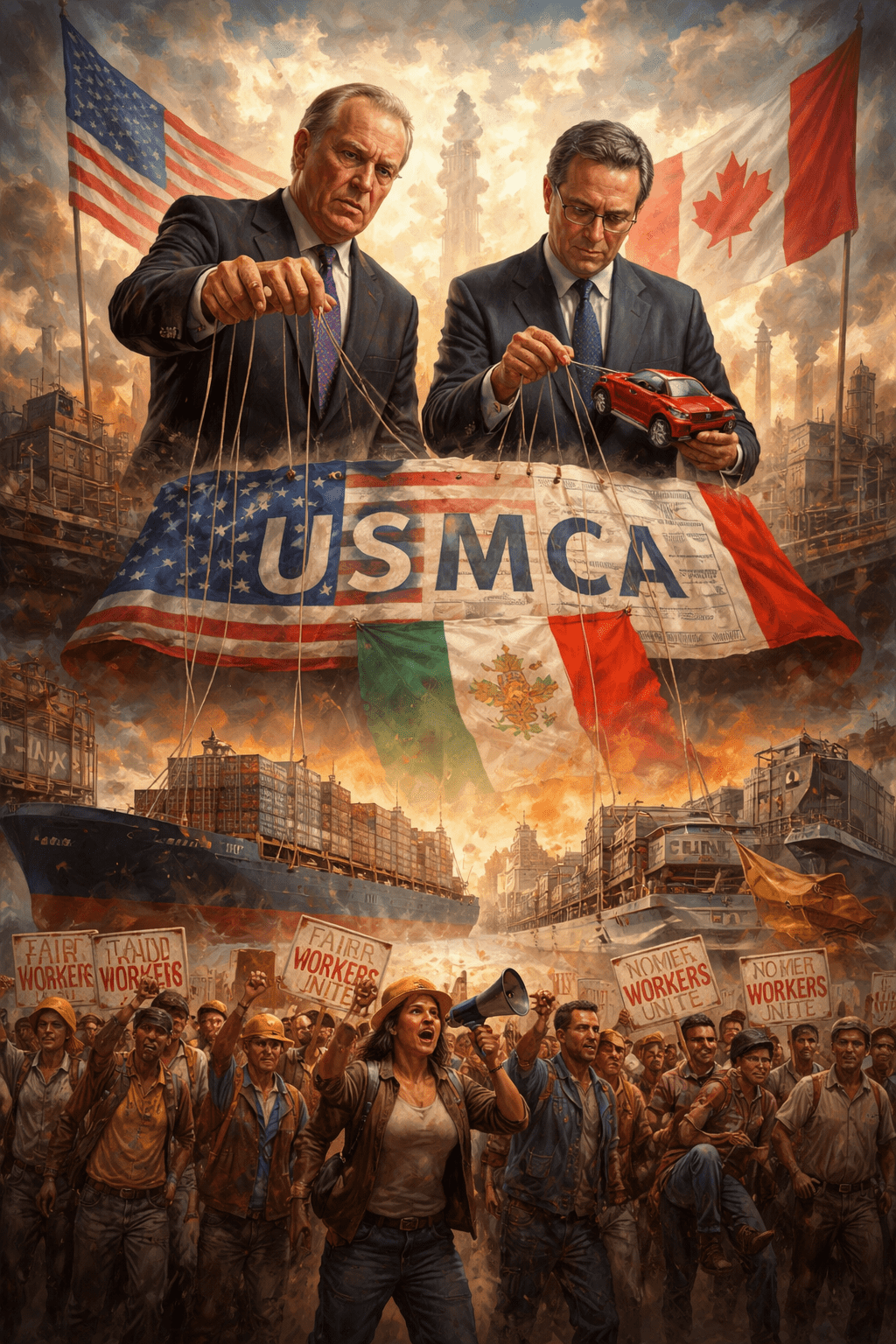
A U.S. trade official scolds Canada for stepping outside its assigned lane, revealing how power speaks through “commentary.” The facts show a bounded policy shift unfolding inside an unstable trade and industrial landscape the story refuses to name. Placed in historical and imperial context, the outrage reads less as economics than as enforcement of hierarchy in decline. The exposure points toward organizing across borders, sectors, and struggles already resisting trade regimes built on discipline from above.
When Discipline Masquerades as Commentary
The article under excavation, “Lutnick: Carney’s China deal opens ‘road map’ to change USMCA”, published by Politico, reports on remarks made by U.S. Commerce Secretary Howard Lutnick criticizing Canadian Prime Minister Mark Carney’s recent trade engagement with China. Framed around comments delivered in Davos, the piece centers on U.S. concerns that Canada’s openness to Chinese electric vehicle imports could weaken Ottawa’s position ahead of the scheduled 2026 review of the United States–Mexico–Canada Agreement. Drawing primarily on statements from U.S. officials, the article presents the dispute as a question of strategic judgment and leverage, situating Canada’s policy shift as a potential disruption to North American trade alignment while offering limited exploration of the broader conditions in which the decision was made.
The Politico piece does not read like a report on trade policy so much as a warning dressed up as analysis. From its opening posture, the article is structured around a single gravitational center: the displeasure of U.S. power. Everything else—Canada’s actions, China’s presence, the future of the USMCA—rotates around that center, never quite allowed to exist on its own terms.
The narrative spine is thin but firm. Canada, under Prime Minister 1, has committed an error of judgment by engaging China. This error, we are told, “undermines” its negotiating position with the United States. The article does not pause to ask what Canada’s negotiating position is meant to serve, or whether Canada might possess interests distinct from Washington’s. Those questions never enter the frame. Instead, the reader is guided toward a simpler conclusion: deviation invites consequence.
Voice allocation does much of the political work here. The dominant register belongs to U.S. officials, especially Commerce Secretary 2, whose comments are rendered not as claims to be interrogated but as common sense to be absorbed. His language is casual, almost flippant—Canada is “arrogant,” the strategy is “the silliest thing I’ve ever seen.” This tone matters. It shrinks the space for serious debate and replaces it with ridicule, a technique as old as empire itself: when persuasion fails, mockery will do.
Canada’s responses, by contrast, are framed as reactive and defensive. Canadian officials “brush off” comments, “push back,” or offer mild reassurances. They do not speak forward; they respond. Agency is unevenly distributed. The United States acts and judges. Canada reacts and explains. China barely appears at all, except as a kind of shadow—an implied contaminant whose mere proximity supposedly destabilizes an otherwise orderly system.
Time, too, is weaponized. The upcoming USMCA review is invoked not as a procedural moment but as a looming test, a disciplinary horizon. The suggestion that Canada’s China engagement provides a “road map” to changing the deal relies on implication rather than demonstration. No mechanism is explained, no process outlined. The power of the claim lies precisely in its vagueness. It signals that consequences are possible, even likely, without having to specify how or why.
Throughout the piece, strategic silences do heavy lifting. There is no exploration of why Canada might seek to diversify its trade relationships. There is no acknowledgment that U.S. policy itself has become volatile, transactional, and openly coercive. The idea that Canada’s overwhelming dependence on the U.S. market might be a vulnerability rather than a blessing is never entertained. Instead, dependence is reframed as protection, and protection as something that can be withdrawn.
What emerges, then, is not a balanced account of trade tensions but a lesson in acceptable behavior. Autonomy is recoded as arrogance. Strategy is reduced to “political noise.” And the reader is gently but firmly instructed to see U.S. leverage as natural, reasonable, even benevolent. The article does not argue this openly; it assumes it. That assumption is the propaganda.
In this way, the piece performs a familiar ideological task. It narrows the field of the possible, disciplines dissent before it fully forms, and reminds subordinate partners of the costs of thinking out loud. The reporting is clean, the prose professional, but beneath it runs an old message: in a world still ordered by empire, initiative is a privilege reserved for the center.
What Actually Happened — and What the Story Leaves Out
Strip away the scolding tone and the talk of “arrogance,” and what remains is a short, concrete sequence of events that the Politico article never fully lays out. Canada, under Prime Minister 0, adjusted its trade posture toward 1 on electric vehicles. That adjustment is presented as a reckless swerve. In reality, it only makes sense when placed back inside the policy road that led there.
Start with the baseline. In May 2024, the United States raised its tariff on Chinese electric vehicles to 100 percent, framing the move as necessary to protect U.S. manufacturers from China’s “unfair” trade practices during the EV transition. Canada soon followed, announcing its own 100 percent surtax on Chinese-made EVs. At that moment, there was nothing ambiguous about North American policy. Ottawa and Washington were moving in lockstep, erecting a shared barrier around the EV market.
That wall did not collapse overnight. In Just last week, Canada announced a recalibration, not an abandonment. The new arrangement with China allows up to 49,000 Chinese-manufactured electric vehicles to enter the Canadian market under a reduced tariff of 6.1 percent, replacing the earlier 100 percent surcharge. In return, China lowered tariffs on selected Canadian agricultural exports. This is not an open gate but a narrow opening, measured in quotas and percentages, with clear limits written into the deal.
All of this unfolded under the shadow of the United States–Mexico–Canada Agreement (USMCA), which came into force in July 2020. The agreement includes a joint review scheduled for July 1, 2026. That review is often spoken of as a cliff edge, but on paper it is far more procedural. The three governments are required to decide whether to extend the agreement for another sixteen years. Extension happens only if all three confirm it in writing. If they do not, the agreement does not suddenly vanish. It stays in place while annual reviews continue, unless and until a separate withdrawal process is invoked.
Canada enters this process with a trade structure that is heavily tilted southward. Roughly three-quarters of Canadian exports head to the U.S. market, most of them moving tariff-free under USMCA rules. Nowhere is this more visible than in autos. Cars and parts zigzag across the border again and again before a vehicle ever reaches a driveway. The industry is stitched together by roads, rail lines, and contracts that ignore national slogans.
The electric vehicle transition has only tightened these knots. EV production demands massive upfront investment, fragile battery supply chains, and consumers willing to pay higher prices in uncertain times. Canada has felt these pressures directly. In 2025, General Motors announced it would halt electric van production at its CAMI plant in Ontario and adjust employment to match market demand. The move was a reminder that the green transition, as currently organized, is neither smooth nor guaranteed.
While Canada was adjusting its position, the United States was hardly standing still. At the same time Ottawa was reworking its China policy, Reuters reported confirmation from Beijing that President Donald Trump planned a visit to China in 2026. High-level engagement was back on the table. This parallel track rarely appears in the Politico story, yet it forms part of the same moment.
Once this wider picture is restored, the gaps in the original article become harder to ignore. There is no mention of the coordinated tariff regime that existed before Canada’s shift. There is no explanation of how the USMCA review actually functions. There is no discussion of the strain inside Canada’s auto sector or of Washington’s own simultaneous dealings with Beijing. The facts themselves do not announce a verdict, but they do tell us something essential: Canada’s move did not occur in a vacuum. It took place inside a crowded, unstable landscape shaped by industrial transition, trade concentration, and shifting power—conditions the article prefers to leave in the shadows.
When Trade Becomes a Test of Obedience
Once the facts are laid out plainly, the Politico narrative begins to unravel under its own weight. What is framed as Canada’s recklessness is better understood as a symptom of a deeper structural shift. The global trade order that once disciplined allies through predictability now disciplines them through uncertainty. In that environment, initiative by subordinate partners is no longer treated as routine statecraft, but as insubordination.
The United States no longer presents trade agreements as stable compacts among equals. Instead, they function as conditional arrangements whose terms can be tightened or relaxed depending on political alignment. The USMCA review mechanism, often described in ominous tones, does not automatically threaten collapse. Yet its repeated invocation as a looming danger turns procedure into pressure. The agreement becomes less a shared framework and more a lever—something to be pulled when partners drift from the line.
Canada’s recalibration toward China emerges from this terrain, not outside it. The concentration of Canadian exports in a single market is not a natural fact; it is the historical outcome of decades of continental integration shaped by U.S. capital and infrastructure. That integration brought efficiencies and profits, but it also narrowed Canada’s room to maneuver. When the dominant partner signals that access itself is conditional, diversification ceases to be an abstract idea and becomes a material question of survival.
This is where the electric vehicle transition sharpens the contradiction. The shift to EVs is presented as a clean technological march forward, yet on the factory floor it appears as disruption, layoffs, stalled production, and uncertain demand. North American automakers face rising costs, fragile supply chains, and uneven consumer uptake. Under these conditions, tariff walls do not simply protect workers; they protect incumbent firms while socializing risk downward. The costs are absorbed by labor and by peripheral economies, while flexibility remains concentrated at the top.
China’s role in this story is less about the vehicles themselves than about what they represent. China stands in as the boundary marker of permissible autonomy. Engagement beyond that boundary is treated as contamination. Yet the United States itself moves freely across it, pursuing its own negotiations and signaling openness to recalibration when it suits its interests. What is condemned in allies is normalized in the center. The issue, then, is not China, but who is allowed to adjust and who is expected to comply.
From the standpoint of the global working class and peasantry, this drama looks different altogether. Trade disputes between powerful states are routinely narrated as contests of strategy, but for workers they register as factory closures, price shocks, and shrinking public capacity. Agreements like the USMCA discipline labor mobility and industrial policy far more strictly than they discipline capital. They lock in asymmetries while presenting themselves as neutral rules.
What the Politico article ultimately conceals is not a secret deal or hidden motive, but a transformation in how empire manages decline. As U.S. dominance erodes, flexibility is hoarded, and discipline is externalized. Allies are expected to absorb volatility while remaining loyal; deviation is met with scolding, threats, and the language of irresponsibility. In this sense, the outrage over Canada’s China policy is less about electric vehicles than about maintaining hierarchy in a world where hierarchy is increasingly contested.
Seen through this lens, Canada’s move is neither heroic nor treacherous. It is a constrained response within a system that offers fewer and fewer stable options. The real instability does not originate in Ottawa or Beijing, but in an order that demands obedience from its periphery while reserving freedom of movement for its core. That is the contradiction now surfacing, however awkwardly, in the language of trade.
Turning Exposure into Organization
Once the fog is cleared, the task before us is no longer interpretive but practical. The contradictions exposed in this episode are not academic. They are already being lived by workers in shuttered plants, by farmers squeezed between tariff regimes, and by communities asked to absorb the costs of an energy transition they do not control. The question is not whether to respond, but how to connect with struggles already underway and help them find common ground.
Across North America, auto and manufacturing workers are already organizing around job security, public investment, and democratic control over industrial transition. Unions in Canada, the United States, and Mexico have begun to speak openly about the instability created by trade regimes that protect capital while leaving labor exposed. These formations do not frame their demands as geopolitical alignment; they frame them as survival. That grounding matters. It is where internationalism begins—not in abstract solidarity, but in shared material conditions.
Climate justice movements have also entered this terrain, insisting that the shift to electric vehicles cannot be governed by monopoly pricing, speculative investment, and closed-door trade negotiations. Groups pushing for publicly owned charging infrastructure, domestic battery production, and affordable transit are already challenging the idea that “green transition” must come packaged with austerity and precarity. Their struggle intersects directly with trade policy, even when trade is not named explicitly.
Beyond North America, countries in the Global South are navigating similar pressures. They are told to liberalize, to align, to accept rules written elsewhere—until those rules change. Popular movements resisting sanctions, conditional trade, and extractive investment have accumulated hard-won experience in confronting these mechanisms. Building channels of exchange with these movements—political, educational, and organizational—grounds solidarity in lived resistance rather than rhetoric.
For revolutionary and multipolar forces in the Global North, the immediate task is clarity. Trade agreements must be exposed as political instruments, not neutral frameworks. Educational work inside unions, community organizations, and climate movements can demystify how review clauses, tariffs, and “market access” are used to discipline entire societies. This is not about choosing one state over another, but about rejecting a system that demands obedience from below while preserving freedom at the top.
Concretely, this means supporting cross-border labor coordination that resists the race to the bottom embedded in trade regimes. It means backing campaigns for public ownership and planning in strategic sectors like energy and transport. It means strengthening independent media and research networks that can counter the soft threats and polite scoldings of establishment outlets. And it means refusing the false choice between nationalist protection and imperial alignment.
The exposure of propaganda is only the first step. Its purpose is not cynicism, but orientation. The cracks in the trade order are widening, and the ruling classes are scrambling to manage decline by pushing risk downward. The opening lies in organizing across those cracks—linking workers, peasants, and colonized peoples into a force that no longer asks permission to move. That is how critique becomes power.
 Weaponized Information
Leave a comment