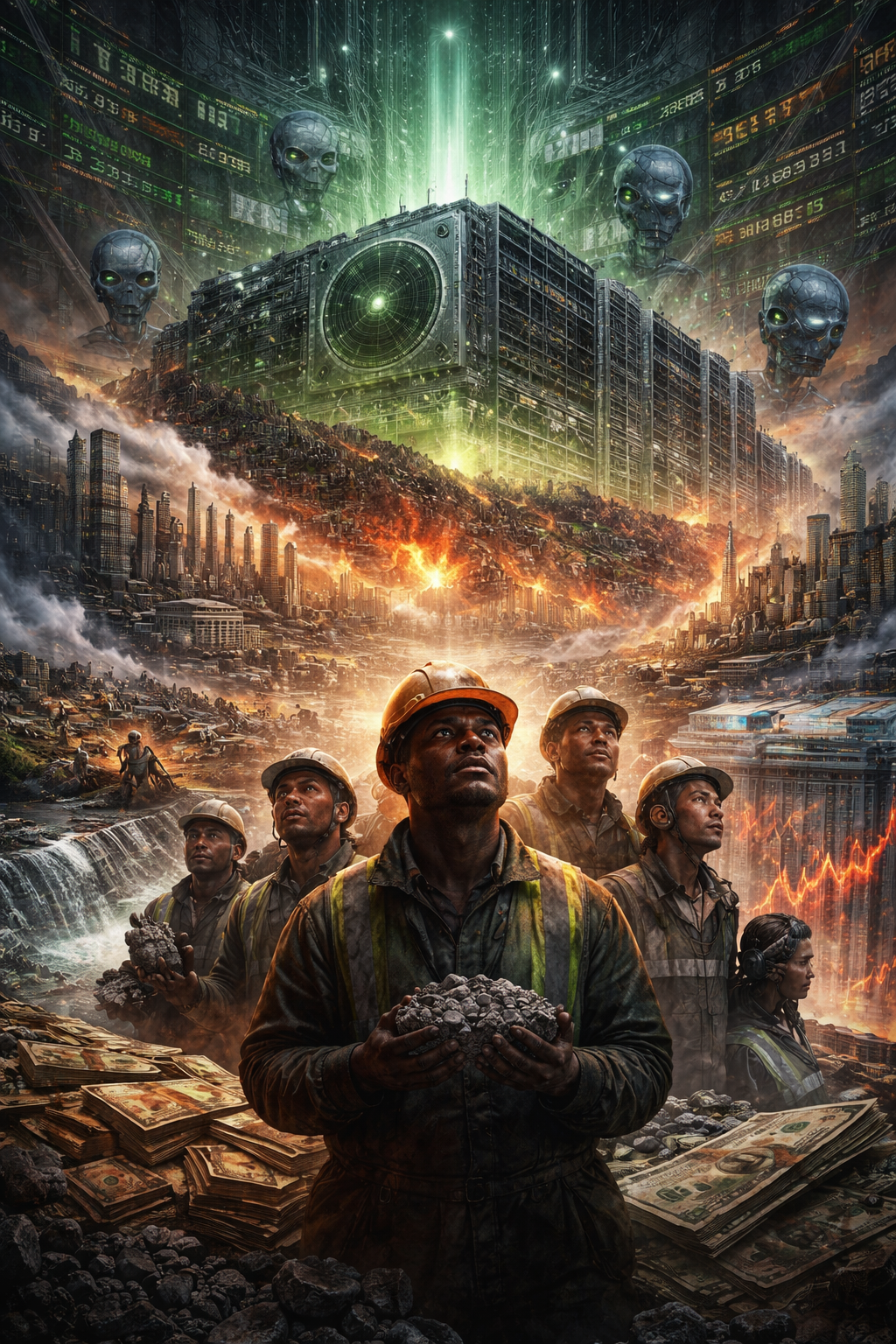
TheStreet’s “IMF warning” is not neutral analysis but a piece of market propaganda that converts class power into spreadsheet logic and fear into investor common sense. Beneath the tech hype, the U.S. growth story is revealed as a fragile pyramid propped up by the Magnificent Seven, Nvidia’s monopoly rents, and a debt-financed AI buildout that can’t deliver the productivity myths it’s priced for. In reality, the “cloud” is a heavy industrial project—powered by strained grids and water theft in the North and fed by mineral extraction, dispossession, and super-exploitation in the Global South, all policed by an IMF order built to protect creditors and discipline societies. The only way out is organization: workers, peasants, and anti-imperialist forces must build power across the infrastructure of empire—from mines and ports to data centers and bond desks—and turn this crisis of accumulation into a crisis of rule.
Prince Kapone | Weaponized Information | January 21, 2026
How the IMF Warning Gets Repackaged as Market Common Sense
At the center of today’s financial media swirl lies an article titled “IMF drops blunt warning on US economy”, published on January 20, 2026 by Moz Farooque in TheStreet. This piece reports that the International Monetary Fund foresees continued U.S. economic growth — led by investment in artificial intelligence and elevated stock market valuations — but warns that the narrow foundation of that growth increases “vulnerability” and leaves a thin margin for error. In the vernacular of markets, it frames the IMF’s position as a matter of portfolio risk: growth is strong so long as AI delivers the productivity gains investors have priced in; if it does not, a sharp correction could erupt. The article treats this projection as neutral expert analysis, offering reassurance and alarm in the same breath, and uses the IMF’s authority to signal what markets should fear and what they should believe.
The article arrives like a message from the mountaintop. The International Monetary Fund has spoken, and the markets are listening. On the surface, the story is simple and soothing: the U.S. economy remains the strongest in the developed world, growth is holding up, and the numbers still look good. But beneath the calm statistical veneer, we are told, the foundation is narrow and fragile. The economy is riding on the back of an AI boom and a red-hot stock market, and if artificial intelligence fails to deliver the productivity miracles investors are betting on, a brutal correction could come fast. This is presented as a neutral technocratic caution — not a political diagnosis, not a social warning, not a class question — but a matter of market expectations and financial mechanics.
The story is written for a particular reader. Moz Farooque appears not as a labor reporter, a historian of capitalism, or a political economist, but as a markets-first financial writer and analyst whose professional identity is built around AI, emerging tech, stock narratives, and investor positioning. In this universe, the working class does not exist as a historical subject or social force. It appears only indirectly, dissolved into abstractions like “consumption,” “confidence,” or “sentiment.” The bio branding as a founder and editor of an investment-focused outlet makes the article’s audience unmistakable: asset holders trying to front-run risk, not workers trying to survive volatility.
TheStreet itself is no neutral messenger. It sits inside a consolidated media holding structure under The Arena Group, the kind of ad-dependent digital media conglomerate whose business model runs on clicks, volatility, “must-read warnings,” and market drama. This is not a public-interest newsroom. It is a content factory designed to keep finance audiences engaged, nervous, and subscribed. Its ownership story reflects capital’s revolving-door grip on information channels, where changes in controlling stakes and corporate maneuvering are treated as business strategy rather than democratic risk — even as this same outlet helps manufacture what passes for “economic common sense” among retail investors.
The “AI economy” storyline does not circulate by accident. It is amplified by the sell-side research ecosystem and the financial media loop, institutions whose entire business model depends on sustaining attention, capital flows, and confidence in the same mega-cap complex now being theatrically “warned” about. The warning is not a break from the system. It is part of its choreography.
The article itself is built on a carefully managed emotional rhythm. It opens with confidence — the U.S. economy is strong, growth is leading the developed world, the numbers look good. Then it pivots to anxiety — the foundation is narrow, the market is overheated, the margin for error is thin. Growth is framed as a technocratic and quantitative achievement, something that lives in GDP tables and earnings multiples. Risk is framed as sudden and catastrophic, something that strikes fast and without mercy when expectations fail. The narrative swings back and forth between reassurance and alarm: growth leads, but things could get ugly fast; markets are resilient, but they are on shaky ground. Stability exists, but only so long as investors believe. The economy becomes a confidence trick, and confidence becomes the economy.
In this drama, the International Monetary Fund plays the role of economic oracle. It is introduced as the “global economic watchdog,” the neutral arbiter of truth, the final word on systemic health. Its chief economist, Pierre-Olivier Gourinchas, appears as a detached technocrat and sober realist, a man of numbers rather than politics. His words are treated like scripture, quoted as objective diagnosis rather than institutional judgment. The IMF is not portrayed as a political institution embedded in a specific world order. It is presented as an authority beyond ideology, beyond power, beyond history. Its authority is deployed to legitimize market anxiety, to naturalize financial risk, and to discipline expectations.
Within this frame, “the U.S. economy” is quietly reduced to a handful of market indicators: equity valuations, AI capital expenditures, market multiples, index concentration, investor sentiment. Workers, households, and communities do not appear as economic actors. They exist only as background noise, folded into abstractions like “consumption” or “confidence.” Economic life is rendered as market arithmetic, portfolio exposure, and risk positioning. The nation is translated into a balance sheet. Society is collapsed into a spreadsheet.
The language of the piece is saturated with crisis spectacle. A “bombshell.” A “blunt warning.” “Shaky ground.” “No room for error.” “Ugly fast.” These phrases do not merely inform; they perform. They generate emotional urgency, reader suspense, and a fetish for volatility. Instability becomes entertainment. Risk becomes content. The reader is positioned as a spectator of danger, watching the drama of markets unfold from the stands.
Artificial intelligence is cast in a double role. On one hand, it is the engine of growth, the source of productivity salvation, the justification for soaring valuations. On the other, it is the economy’s Achilles heel, the hinge of stability, the trigger for collapse. The future is made to hang on a single technological wager. If AI delivers, prosperity. If AI fails, catastrophe. No alternative economic model is imagined. No different social arrangement is permitted to enter the frame.
Financial power itself is stripped of its politics and rendered as math. Debt issuance becomes momentum. Capital spending becomes innovation. Market concentration becomes a statistical feature, a structural inevitability, a neutral fact of life. Domination is expressed as a ratio. Control is reduced to a multiple. Power is made to look like arithmetic.
And through it all, the human consequences vanish. The article never asks who bears the losses if a correction hits, who absorbs the layoffs, or who pays for volatility. Market instability is abstracted from employment, housing, energy, and public services. Economic risk is depersonalized. The economy trembles. The market shakes. But the people are nowhere to be seen.
This is how an imperial financial order teaches itself to speak. Through calm authority and managed fear. Through numbers without history. Through markets without people. Through warnings that never name the system they serve. And it is on this manufactured common sense that the next layer of reality will now be built.
The Material Economy Beneath the AI Boom
The market story tells us that the International Monetary Fund is simply cautioning investors about elevated valuations and a narrow foundation for growth. But when we step outside the trading floor and into the real economy, a very different picture comes into view. The IMF’s January 2026 outlook does not describe a world cruising on stable fundamentals. It describes a global system “shaking off tariff shock,” still weighed down by geopolitical fragmentation, trade disruptions, and financial volatility. Global growth is projected at roughly 3.3 percent, with revisions driven overwhelmingly by the United States and China, while the Fund explicitly flags downside risks tied to financial-market repricing and inflated expectations around artificial intelligence. In IMF-linked briefings, even a “moderate” correction in technology stocks is acknowledged as capable of shaving meaningful fractions off global growth and transmitting losses through international portfolios and capital flows. What appears in TheStreet as a domestic market warning is, in fact, a world-system exposure.
The reason the IMF is watching AI so closely is simple: the U.S. economy is now structurally dependent on it. According to Jason Furman, the former chief economic adviser to President Obama, investment in information-processing equipment and software — overwhelmingly AI capital expenditure — accounted for 92 percent of U.S. GDP growth in the first half of 2025. Strip out that spending and growth would have been roughly 0.1 percent. Near stagnation. The celebrated “strong economy” is being kept alive by a speculative infrastructure boom. The future has been pulled forward and booked as present-day growth.
This dependency is reflected in the extreme concentration of financial power. The so-called Magnificent Seven — Amazon, Apple, Google, Meta, Microsoft, Nvidia, and Tesla — now make up more than 35 percent of the S&P 500. Their combined market capitalization is so large that it sits in the same order of magnitude as major regional equity blocs reported by the World Federation of Exchanges—for example, EMEA’s total domestic market capitalization. The U.S. stock market has become a pyramid balanced on seven corporate pillars, and at the center of that pyramid stands Nvidia.
Nvidia is the only major firm in the AI sector generating extraordinary profits. It holds a near-monopoly on the design of advanced GPUs used to train and operate large AI models. While many AI developers and hyperscalers spend heavily on data centers and software, Nvidia’s chips remain the essential “shovels” of the AI build-out. It became the first company in history to exceed a $4 trillion market capitalization, underscoring its pivotal role in the market. Yet its stock trades like a casino chip, swinging by hundreds of billions of dollars in a single day, driven by sentiment rather than fundamentals. Four customers accounted for roughly 61 % of Nvidia’s sales in a recent quarter. If those buyers slow their spending, Nvidia’s profits collapse.
Beneath the soaring valuations lies a fragile financial architecture. Hyperscalers are buying Nvidia chips on credit. Nvidia’s accounts receivable have surged as customers pay later for hardware they cannot yet afford. Its inventories have also risen sharply in the past year, reaching nearly $20 billion, even as the company insists demand is insatiable. Nvidia is also investing directly in its own customers, recycling capital back into firms like OpenAI so they can continue buying its chips. This is not organic industrial growth. It is circular financing. A speculative credit loop in which revenue is pulled forward from an imagined future.
The entire buildout is underwritten by debt. Reuters and market analysts have documented a wave of jumbo bond issuance by hyperscalers, as AI infrastructure spending reshapes global credit markets. Pension funds, insurance capital, sovereign wealth, and public savings are now tied to the profitability of a handful of technology monopolies. AI is not only a stock-market story. It is a credit-cycle event. When the cycle turns, the bill will be paid in layoffs, austerity, and cuts to social reproduction.
Strip away the mythology of the cloud and the AI economy reveals itself as a heavy industrial project. Digital technology and infrastructure depend heavily on raw materials and come with growing water and energy needs. Data centers demand large and rising quantities of energy, water and raw materials. The International Energy Agency warns that electricity demand from data centres worldwide is set to more than double by 2030, with AI as the most significant driver of the increase. Grid operators now treat hyperscaler expansion as a reliability challenge, as shown by how PJM Interconnection has moved to manage AI-driven data-center load growth to protect grid reliability, and by warnings that U.S. transmission constraints are becoming a core obstacle to powering expanding data centers. In drought-prone regions, server farms compete with communities for water: reporting has shown Big Tech building data centres in water-scarce areas across multiple continents, while local investigations describe how data centers reshape
grids, plumbing and water politics in drought-stressed regions. The digital future rests on copper, steel, and cooling-tower-heavy mechanical systems.
The United Nations Conference on Trade and Development has been blunt about what this means. Digital infrastructure depends on vast material inputs and comes with rising energy and water demands and significant environmental costs. The benefits of the digital economy are highly concentrated, while its burdens are widely distributed. The cloud has a very heavy footprint.
Follow the fiber-optic cables far enough and they lead back to the mine. Lithium from the Andes. Cobalt from the Congo. Bauxite from Guinea. Copper from Zambia and Chile. The AI boom is driving a new scramble for critical minerals across Africa and Latin America, intensifying land dispossession, ecological devastation, and labor super-exploitation. Policy and academic research now explicitly links data centers in the North to extraction zones in the South. Digitalization is reproducing the old colonial division of labor: platforms and rents in the imperial core, raw materials and sacrifice zones in the periphery. The cloud rests on the mine.
Presiding over this architecture is the International Monetary Fund, presented in financial media as a neutral watchdog. Yet history tells a different story. From Latin America to Africa to Asia, IMF programs have enforced austerity, dismantled public services, broken labor power, and locked postcolonial states into cycles of debt dependency. Tricontinental’s research on African debt crises traces how IMF conditionality has functioned as a mechanism of imperial discipline. Peer-reviewed studies link IMF interventions to protest and political instability. Recent uprisings in countries like Kenya show that “macroeconomic stability” often arrives in the form of higher taxes and higher prices, and cuts to health and education. The IMF is not an oracle. It is a pillar of the imperial financial order.
And the story is policed by an information system that treats markets as the economy and portfolios as the nation. Financial media translate social life into balance sheets, erase workers and communities from economic analysis, and manufacture the common sense of empire. Tricontinental has shown how control over information is now a strategic front in global power. UNCTAD has documented how digital rents concentrate in a few hubs while the Global South absorbs the costs. Economic reality is not merely reported. It is produced.
Even the monopoly at the center of the bubble is already under geopolitical pressure. China has made the development of advanced chips a national priority. Huawei, Alibaba, Baidu and others are building rival GPU ecosystems. State-backed industrial policy is targeting Nvidia’s dominance. The rents of the AI empire are contested, and that contest only adds to the system’s fragility.
Taken together, the record is clear. U.S. growth is now structurally dependent on AI capital expenditure. The AI economy is a monopoly-rent machine. Its expansion is debt-financed. Its infrastructure is energy- and mineral-intensive. Its supply chains are extractive and colonial. Its institutional guardian is a creditor enforcer. Its narratives are manufactured by financial media. And its future is geopolitically contested. This is the real economy beneath the market story — the material baseline from which the meaning of the IMF’s warning must now be understood.
From Market Warning to Imperial Crisis: The AI Boom as the New Engine of Exhaustion
Once the material record is placed on the table, the IMF’s ‘blunt warning’ stops reading like caution and starts reading like confession. It reads as a signal flare from a system running on speculative life support. The celebrated strength of the U.S. economy is not anchored in rising wages, expanding public goods, or a revival of broad industrial production. It is anchored in a single, fragile pillar: an AI infrastructure boom financed by debt, driven by monopoly rents, and booked as growth before it has produced anything resembling a social return. When ninety-two percent of GDP growth is coming from capital expenditure on machines and code, the economy is no longer growing in the ordinary sense. It is borrowing from the future and calling it prosperity.
This is why the IMF is nervous. Not because technology might disappoint, but because the imperial growth model has reached the point where asset inflation substitutes for social production. Growth appears real because valuations are real. Valuations rise because capital is concentrated. Capital is concentrated because monopoly has replaced competition. And monopoly now replaces productive accumulation with financial expansion. What passes for economic leadership is valuation-led accumulation — an economy measured by market caps instead of living standards, by share prices instead of social well-being.
At the center of this architecture stands Nvidia, the shovel seller in a digital gold rush. The AI sector, stripped of its mythology, is not a miracle of productivity. It is a monopoly-rent machine. Nvidia’s near-control over advanced GPU design has turned it into the only major firm extracting extraordinary profits from the boom, while its customers bleed cash trying to build models that do not yet pay for themselves. This is not the story of innovation lifting all boats. It is the story of a single corporation collecting tolls on the future.
The boom itself is not sustained by organic demand. It is sustained by credit. Hyperscalers buy chips on borrowed money. Revenues are booked on receivables. Inventories pile up. Capital circulates in loops, recycled from Nvidia into its own customers so they can continue purchasing its hardware. Debt replaces patience. Credit replaces production. The future is securitized, discounted, and sold back to the present. In this regime, finance no longer lubricates production. It replaces it.
And the so-called digital economy is anything but immaterial. Artificial intelligence is not software floating in the cloud. It is a new round of fixed-capital expansion on a planetary scale. It runs on power stations and transmission lines, on cooling towers and water tables, on chip fabs and logistics corridors. It consumes copper and cobalt, lithium and nickel, bauxite and rare earths. It is a heavy industrial project dressed in digital clothing. Like railroads, electrification, and oil before it, AI is reorganizing the geography of empire.
Follow the data streams far enough and they lead back to the pit and the quarry. Data centers in the North sit atop strained power grids and compete with communities for water. Those grids depend on minerals torn from the soil of Africa and Latin America. Land is seized for extraction zones and energy corridors. Ecosystems are sacrificed for server farms. The digital transition reproduces the old colonial division of labor: platforms and rents in the imperial core, raw materials and sacrifice zones in the periphery. The cloud rests on the mine.
Holding this architecture together is an institutional order designed to protect creditors and discipline societies. The International Monetary Fund is presented in financial media as a neutral guardian of stability, but history reveals it as the manager of postcolonial debt and the enforcer of austerity regimes. Its programs have stabilized capital by destabilizing lives. When it speaks of macroeconomic stability, it means stable debt service, stable capital flows, and stable investor confidence. From the standpoint of the Global South, IMF stability has meant higher taxes, higher prices, cuts to health and education, and the repression of popular resistance. The Fund does not warn about crisis to protect the people. It warns about crisis to protect the system.
What emerges from the full record is not a story of a risky tech sector that might cool off. It is a story of a world economy in which growth depends on monopolies, infrastructure depends on extraction, finance depends on debt expansion, energy systems are stretched, ecosystems are ravaged, and states are subordinated to capital. This is not a cyclical downturn waiting to happen. It is a structural crisis of imperial accumulation. The system can only move forward by deepening the very contradictions that now threaten to tear it apart.
From the standpoint of the global working class, the “AI economy” means automation and job displacement, algorithmic management and surveillance, rising energy costs, housing pressure along data-center corridors, and the privatization of public grids. From the standpoint of the peasantry and rural poor, it means land seizures, toxic waste, militarized extraction zones, and super-exploitation. From the standpoint of humanity, it means a digital empire built on ecological ruin.
Yet these contradictions are already producing resistance. States seek technological autonomy. Regions fight data colonialism. Communities demand public control of energy. Workers organize against algorithmic domination. The struggle over artificial intelligence is not technological. It is political. It is a struggle over who controls infrastructure, energy, data, credit, and labor. It is a struggle over the future of civilization.
This is what the IMF is really warning about. Not that AI might fail, but that the imperial growth model is exhausted, financial command is overstretched, legitimacy is eroding, and the system is running on borrowed time. The warning is not about markets. It is about empire. And from this point forward, the question is no longer whether a correction will come, but who will pay for it — and who will organize to end a system that demands permanent sacrifice to keep its illusions alive. If the warning is about empire, then the response must be about power.
From Exposure to Organization: Turning the Crisis of Empire into the Power of the People
The IMF’s warning has pulled back the curtain just enough for us to see the outline of a system in trouble. An economy balanced on monopolies. An infrastructure boom financed by debt. An imperial order dependent on extraction, surveillance, and financial command. The question now is not whether the contradictions will sharpen, but whether the global working classes and the colonized nations will organize fast enough to turn crisis into transformation. History is clear on this point: when empires wobble, the future belongs either to reaction or to revolution. There is no third road.
The terrain of struggle is already mapped by the very forces driving the so-called AI economy. From the data centers that drain public grids to the warehouses that feed digital logistics, from the mines that supply the minerals to the ports that move them, from the bond desks that finance the buildout to the ministries that enforce austerity when the bills come due — every link in this chain is a site of class conflict. The empire is not an abstraction. It is a network of workplaces, extraction zones, transport corridors, and financial pipelines. And every one of them runs on labor.
Across the Global North, tech workers are beginning to recognize that their labor is being folded into systems of repression, surveillance, and militarized control. Organizing drives inside the tech giants, contractor networks, and platform firms are challenging the idea that digital workers are a privileged caste outside the working class. Energy workers and communities are resisting the privatization of grids and the monopolization of electricity by hyperscalers whose profits soar while public infrastructure crumbles. Logistics and warehouse workers are building power against algorithmic management that treats human beings like disposable inputs in a machine. These are not isolated struggles. They are the front lines of a digital class war.
In the Global South, the fight is even more direct. Peasant movements, Indigenous communities, and mine workers are confronting the new extractive frontier that feeds the digital empire. From lithium basins to cobalt belts, from bauxite mountains to copper corridors, resistance is growing against land seizures, ecological devastation, and labor super-exploitation. These struggles are not merely environmental. They are anti-colonial. They are battles over sovereignty, development, and the right of nations to control their own resources rather than serve as sacrifice zones for imperial consumption.
At the level of states and regional blocs, the contradictions of the digital empire are producing new political alignments. The drive for technological autonomy, public control of strategic infrastructure, and digital sovereignty is no longer confined to academic debate. It is becoming a pillar of multipolar politics. The fight over who owns the cloud, who controls the data, and who governs the energy that powers it is now inseparable from the struggle over the future world order. The same forces that once fought over oil fields and shipping lanes are now fighting over chip fabs, undersea cables, and server farms.
For the working classes of the imperial core, the task is clear. We must break the spell of market common sense and name the system for what it is: a machinery of extraction that converts our labor, our resources, and our futures into private profit. We must build power where the empire is most vulnerable — in the workplaces that operate its infrastructure, in the communities that supply its energy and water, in the institutions that finance its expansion. Union power in tech and logistics, public ownership of grids and cloud infrastructure, international solidarity with anti-extractivist struggles, and mass political education on the realities of financialized capitalism are not slogans. They are necessities.
The global working class does not face a future written by algorithms. It faces a future written by struggle. The peasantry does not face a destiny determined by mineral markets. It faces a destiny forged in land defense and popular sovereignty. The colonized nations do not face an inevitable subordination to digital monopolies. They face a choice between dependency and liberation. And the peoples of the Global North face a responsibility: to defect from empire, to refuse complicity, and to stand in material solidarity with those resisting its rule.
The IMF has told the truth in the language of capital: the growth model is unstable, the margin for error is gone, and the system is running on borrowed time. Our task is to translate that truth into the language of liberation. To organize across borders, sectors, and struggles. To build institutions of popular power. To seize back control of the infrastructure of life itself. The digital empire runs on labor, and labor is waking up. When the people move, the markets follow. And when the people rule, the empire falls.
 Weaponized Information
Leave a comment