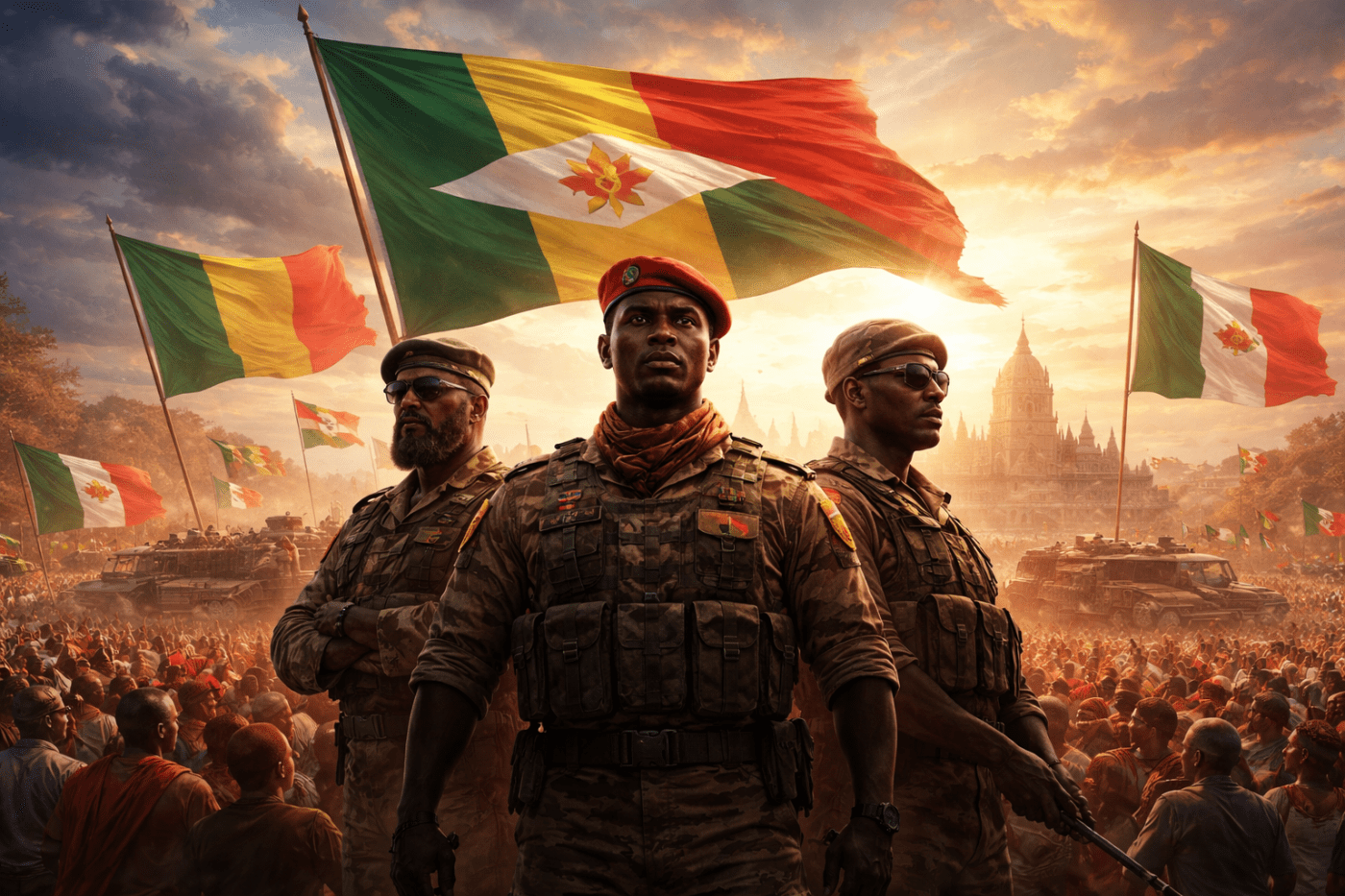
The Second Session of the AES/CESS as a Turning Point in State Power, Regional Integration, and the Unfinished Question of Rupture
By Prince Kapone | Weaponized Information | January 2, 2026
What Was Actually Decided in Bamako: Reading the Communiqué as a Political Act
The second session of the College of Heads of State of the Confederation of Sahel States did not open with soaring rhetoric or civilizational claims. It opened, as the final communiqué makes clear, with a review of “the political, economic and security situation” of the confederal space and an examination of the “state of implementation of previous decisions.” This phrasing matters. The summit presents itself not as an inaugural gesture, but as a checkpoint in an ongoing process. The AES is framing itself as a governing structure with memory, continuity, and accountability to its own prior commitments, rather than as an episodic alliance reacting to crisis.
The communiqué is explicit about the institutional chain of command that led to Bamako. The Heads of State “approved the conclusions and recommendations” of the first session of the Confederal Council of Ministers held on 20–21 December 2025. This is not bureaucratic filler. It signals that the AES is attempting to build a layered architecture in which ministers deliberate, prepare instruments, and transmit them upward for political validation. In regions historically subjected to ad-hoc governance, emergency decrees, and donor-driven agendas, the insistence on an internal policy pipeline is itself a political statement: the Confederation intends to govern itself through its own procedures, however embryonic they may still be.
The central decisions of the summit are concentrated in the adoption of four additional protocols to the founding treaty. The communiqué lists them with precision: a protocol on Defense and Security; a protocol on the Coordination of Diplomatic Action; a protocol on the Coordination of Development Action; and a protocol on Confederal Sessions of Parliaments. Taken together, these protocols outline the skeleton of a confederal state-form. Security establishes the monopoly of force at a collective level; diplomacy disciplines external relations; development coordination asserts a shared economic direction; and parliamentary sessions gesture, however tentatively, toward future mechanisms of representation. This is not ideological improvisation. It is institutional sequencing.
The language used to justify these protocols is revealing. The Heads of State describe them as necessary for the construction of an “architecture institutionnelle solide et efficace.” The emphasis is not on symbolism, but on solidity and effectiveness. The communiqué repeatedly returns to the idea of operationalization—structures that function, forces that deploy, mechanisms that collect and allocate resources. This is consistent with the tone of the summit as a whole. Bamako does not ask to be admired; it asks to be taken seriously as a governing project under pressure.
The communiqué also records a formal political transition: the designation of Captain Ibrahim Traoré as President of the Confederation for a one-year term, marking the end of Assimi Goïta’s tenure. This rotation is not framed as a democratic breakthrough, nor is it treated as a minor administrative detail. It functions as a stabilizing mechanism within a fragile confederal triangle. By institutionalizing rotation, the AES attempts to prevent the confederation from collapsing into personal rule or inter-state rivalry. In this sense, leadership rotation is less about representation than about cohesion.
Read closely, the communiqué does not pretend that the Confederation has already resolved its contradictions. It does not claim that development has been achieved, that peace has been secured, or that popular participation has been institutionalized. What it claims instead is more modest and more consequential: that a set of states once treated as peripheral and ungovernable are assembling the minimum instruments required to act collectively in a hostile regional and global environment. Bamako is therefore not the proclamation of emancipation. It is the formalization of intent. The political significance of the summit lies not in what it celebrates, but in what it commits the AES to attempt next—and in the fact that these commitments are now written, dated, and publicly owned.
Security as Premise, Not Policy: How the Communiqué Defines the Battlefield
The second session’s final communiqué does not treat security as one file among many. It treats it as the condition that makes all other files legible. After opening with a joint review of the “political, economic and security situation,” the text moves immediately to terrorism, destabilization, and defense coordination, establishing an unmistakable hierarchy. Development, diplomacy, and finance appear only after force has been addressed. This ordering is not accidental. It reflects a judgment forged by experience: without territorial control and collective defense, every promise made elsewhere is provisional.
The communiqué’s description of the threat is unusually explicit. Terrorism is framed not as a spontaneous local pathology, but as violence “supported by foreign state sponsors,” reinforced by “economic and media terrorism,” disinformation, and hostile narratives. By placing sanctions, propaganda, and armed groups within the same analytical frame, the AES collapses the false distinction between kinetic warfare and political pressure. Security is defined as a multidimensional struggle over territory, resources, and meaning. The enemy is not only the gunman, but the system that finances, legitimizes, and narrates his presence.
This framing is echoed and sharpened in the opening address delivered by General Abdourahamane Tiani. Tiani insists that the Confederation is confronting a single integrated offensive targeting sovereignty through security, economics, and information simultaneously. His speech does not present security as a temporary emergency to be managed until “normalcy” returns. It presents it as a long-term structural condition that must be handled collectively if the Sahelian states are to avoid being reabsorbed into dependency. In this sense, the speech functions as a doctrinal gloss on the communiqué’s procedural language.
It is within this logic that the communiqué emphasizes the “entry into activity” of the Unified Force of the AES and highlights ongoing joint operations. The wording is careful and deliberate. The force is not introduced as an aspiration or a future project, but as an operational reality. This insistence serves two purposes. Internally, it is meant to reassure populations that the Confederation can still protect life and territory. Externally, it signals that security in the Sahel is no longer an open contract to be subcontracted to foreign militaries or multilateral missions operating without political accountability to the region itself.
As outgoing confederal president, Assimi Goïta reinforces this line by framing joint security action as evidence that “the balance of fear has shifted.” Whether this claim holds uniformly across all theaters is an empirical question. Politically, however, the statement matters because it announces a change in posture. The AES is attempting to recode the Sahel from a space of permanent intervention to a space of coordinated defense. Protection is asserted as the primary source of legitimacy, rather than elections supervised from abroad or approval conferred by donors.
Historically, this marks a rupture with the post–Cold War security doctrine imposed on much of Africa, which treated force as a service to be outsourced and governance as a performance to be evaluated externally. Bamako rejects this model explicitly. Security is redefined as a sovereign function that must be exercised collectively or not at all. Yet the documents also reveal a tension they do not resolve. While the communiqué repeatedly invokes the protection of populations and national unity, the architecture it describes remains firmly state-centric and military-led. No mechanisms are specified through which popular forces shape security policy itself.
This tension is not an oversight; it is a historical fault line. Every sovereignty project born under siege consolidates force before it democratizes it. The question raised—but not answered—by the Bamako texts is whether the security architecture now being assembled will later be subordinated to social transformation or frozen into permanent emergency. The sources make one thing clear: the AES has chosen its battlefield deliberately. Whether that battlefield becomes a bridge toward emancipation or a trap that consumes the political future it claims to defend will depend on how the force described in these documents is ultimately governed, contested, and opened—or closed—to the people in whose name it operates.
Endogenous Finance, Named at Last: What the Communiqué Says About Money and Power
Where many regional summits speak about development in the abstract, the Bamako communiqué does something more precise and therefore more dangerous: it names money. The Heads of State do not confine themselves to aspirations about growth or partnership; they record concrete instruments already adopted and under implementation, notably the Prélèvement Confédéral de l’AES (PC-AES) and the Banque Confédérale pour l’Investissement et le Développement (BCID-AES). The language is careful but unmistakable. These mechanisms are presented as tools for “financement endogène, durable et prévisible,” a formulation that signals an explicit break with the donor-driven and emergency-budget model that has long disciplined Sahelian states. In the logic of the communiqué, sovereignty without its own revenue stream is not sovereignty at all, but administration on borrowed time.
The placement of finance inside the same institutional register as security and diplomacy is itself a statement. The communiqué does not relegate development finance to future conferences or external negotiations; it situates it within the confederal architecture already being built. By doing so, the AES implicitly rejects the sequencing imposed on Africa for decades, in which states were told to liberalize first, attract capital second, and worry about autonomy later. Bamako reverses this order. It asserts that the ability to collect, pool, and allocate resources collectively is a prerequisite for development, not its byproduct. This is why the text links the PC-AES directly to confederal priorities rather than to donor benchmarks.
The communiqué’s emphasis on the BCID-AES is equally revealing. Development banks have existed across Africa for generations, often announced with ceremony and quietly hollowed out by undercapitalization or external conditionality. Bamako acknowledges this history indirectly through its insistence on coordination, predictability, and endogenous control. The BCID-AES is framed not as a prestige institution, but as an operational lever meant to support infrastructure, productive activity, and economic convergence across the confederal space. The text avoids grand promises, but it is explicit about intent: development is to be organized at the level of the Confederation, not left to fragmented national plans competing for external favor.
At the same time, the communiqué exposes the central contradiction of confederal finance without resolving it. Endogenous revenue can be emancipatory, but it can also become a new mechanism of internal extraction. The text speaks of improving living conditions and transforming local resources, yet it does not specify how decisions over confederal funds will be contested, audited, or socially supervised. This silence is not incidental. It reflects the reality that financial sovereignty is easier to proclaim than to democratize. A levy collected in the name of independence can quickly resemble a tax imposed in the name of security if popular oversight is absent.
What distinguishes Bamako is not that it has solved this problem, but that it has placed it on the table. By institutionalizing a confederal levy and a development bank, the AES acknowledges that the struggle over the Sahel’s future will be decided as much by control over surplus as by control over territory. The communiqué makes clear that money is no longer to be treated as a neutral technical matter delegated to partners and experts. It is a political question embedded in the confederal project itself. Whether the PC-AES and BCID-AES become instruments of collective advancement or pillars of a fortified state economy will depend on how they are used—and on who is allowed to shape their priorities as the Confederation moves from declaration to practice.
“Une Voix Commune”: How the AES Rewrites Diplomacy as Collective Discipline
The Bamako communiqué treats diplomacy not as ceremony, but as a vulnerability that must be closed. In plain language, the Heads of State commit to the “coordination of diplomatic action” and to systematic consultation before international engagements. This is not the vocabulary of courtesy; it is the vocabulary of discipline. The text records the adoption of a dedicated protocol for diplomatic coordination and insists that common positions be defined upstream, before any member state speaks in global forums. Read against the history of the region, the intent is unmistakable: the Confederation seeks to end the practice by which Sahelian states were isolated, pressured, and negotiated against one another in rooms where the outcome had already been decided.
The communiqué’s insistence on coordinated diplomacy follows directly from its diagnosis of the threat environment. Having already named “economic and media terrorism” and disinformation as instruments of destabilization, the text implicitly recognizes that international legitimacy is itself a battlefield. To speak separately is to be interpreted separately; to speak together is to force engagement on different terms. This logic is reinforced by the communiqué’s commitment to mutual support for candidacies and shared positions within international organizations. Representation is no longer treated as a national privilege, but as a confederal resource to be pooled and deployed strategically.
This posture is echoed in the speeches delivered at Bamako, where diplomacy is framed as an extension of sovereignty rather than a substitute for it. In his address, General Abdourahamane Tiani situates international action within the same integrated struggle described in the communiqué, warning against the illusion that external forums offer neutral arbitration. His intervention underscores a lesson learned repeatedly by Sahelian states: diplomacy conducted from weakness becomes compliance by another name. The protocol adopted in Bamako is therefore designed less to amplify visibility than to reduce exposure.
The communiqué also sharpens the criteria for partnership. Cooperation is explicitly conditioned on respect for sovereignty and alignment with the interests of the confederal populations. This phrasing is deliberate. It avoids ideological alignment with any single bloc while rejecting the asymmetrical relationships that have long defined Sahelian engagement with external powers. In effect, the AES announces a transactional realism rooted in collective leverage: partnerships are acceptable insofar as they do not demand political submission, security subcontracting, or economic disarmament.
One of the more revealing diplomatic moves recorded in the communiqué is the explicit recognition of the diaspora as part of the confederal political field. This acknowledgment reflects an understanding that contemporary diplomacy is fought as much through narratives as through treaties. Sahelian communities abroad occupy media spaces, academic institutions, and political arenas where the region is routinely defined by others. By naming the diaspora as an asset, the AES implicitly accepts that sovereignty today requires the capacity to contest meaning, not merely to negotiate terms.
Yet the documents also reveal a familiar tension. Diplomatic unity can protect against external manipulation, but it can also become a filter that insulates decision-makers from criticism and dissent. The communiqué does not specify how common positions will be debated internally or how disagreement will be resolved once coordination becomes mandatory. This omission matters. A diplomacy that is disciplined outward but closed inward risks reproducing the same distance between state power and social life that undermined earlier regional projects. Bamako marks a serious attempt to reclaim diplomatic agency. Whether that agency becomes an extension of popular sovereignty or merely a more efficient statecraft remains an open question—one that the protocol itself cannot answer, but that the practice it inaugurates will inevitably confront.
Breaking Without Burning Bridges: How the Communiqué Handles ECOWAS as a Political Terrain
The question of ECOWAS appears in the Bamako communiqué without theatrical rupture or conciliatory retreat. Instead, it is addressed in the language of reports, consultations, and negotiations. The Heads of State note that discussions have taken place between the confederal foreign ministers and the President of the ECOWAS Commission and that reports on these exchanges were examined by the College. This wording is deliberate. It situates ECOWAS not as an abstract adversary, but as an institutional terrain that must be navigated carefully, even as the Confederation affirms its strategic autonomy. Bamako does not deny the rupture; it manages it.
The communiqué’s emphasis on protecting the “supreme interests of the populations” bound by secular ties across borders reveals the material stakes of this posture. ECOWAS is not merely a treaty organization; it is a lived social space. Markets, pastoral routes, migration corridors, and family networks predate and outlast formal institutions. The AES acknowledges that political exits cannot be executed as clean breaks without producing social damage. This recognition marks a departure from the technocratic logic that often treats regional institutions as interchangeable policy tools rather than as frameworks embedded in everyday life.
At the same time, the text makes clear why the AES has chosen to step outside the ECOWAS framework. While the communiqué avoids polemics, its broader diagnostic—economic coercion, political pressure, and security manipulation—implicitly indicts a regional order that increasingly functioned as a relay for external discipline. The Confederation’s insistence on sovereignty, collective security, and endogenous finance cannot be reconciled with a structure that repeatedly enforced sanctions and conditionality aligned with extra-regional interests. Bamako therefore frames disengagement not as isolationism, but as an act of political self-defense.
The balancing act is evident in the language of negotiation itself. By engaging ECOWAS as a bloc rather than as individual states, the AES seeks to invert the asymmetry that previously defined these encounters. Negotiation from fragmentation invites punishment; negotiation from coordination creates space for redefinition. The communiqué does not claim that this strategy has succeeded. It records the process as ongoing, contested, and unresolved. This honesty is itself notable in a political culture long accustomed to declaring victories before they materialize.
The ECOWAS question thus becomes a test of the Confederation’s capacity to translate sovereignty into social protection. A rupture that preserves mobility, trade, and everyday life would mark a rare historical achievement. A rupture that produces shortages, isolation, or social fracture would erode the legitimacy the AES seeks to consolidate. Bamako does not resolve this contradiction; it names it. In doing so, the communiqué situates ECOWAS not as a binary choice between exit and submission, but as a field of struggle in which the Confederation must prove that political autonomy can coexist with social continuity.
Beyond Coordination: How the Communiqué Quietly Introduces the Federal Question
The most consequential sentence in the Bamako communiqué is not announced as such. It appears without fanfare, embedded in procedural language, when the Heads of State reaffirm that the Confederation constitutes a step toward a future federation. This formulation is precise and deliberate. The text does not romanticize federation, nor does it present it as imminent. It presents it as a horizon. In doing so, the AES transforms the meaning of everything else recorded in the communiqué. A confederation can remain a loose pact among sovereign states; a federation implies the gradual pooling of sovereignty itself. By naming this trajectory, the AES binds its present decisions to a future political form that cannot be achieved through coordination alone.
The institutional measures adopted in Bamako must be read against this horizon. The four new protocols—on security, diplomacy, development coordination, and confederal parliamentary sessions—map directly onto the functional requirements of a federating entity. Security is centralized because federations cannot survive with fragmented force. Diplomacy is disciplined because federations cannot speak in contradictory voices. Development is coordinated because uneven accumulation fractures political unity. Parliamentary sessions are introduced because federations require some mechanism, however limited at first, for representation beyond executive command. The communiqué does not claim these mechanisms are complete; it records their initiation as part of a longer sequence.
The rotation of the confederal presidency from Assimi Goïta to Captain Ibrahim Traoré must also be understood in this context. The communiqué frames this transition as a routine institutional act, but its political significance lies in what it attempts to prevent. Federations collapse when leadership becomes personalized and rivalry between capitals hardens into structural division. By institutionalizing rotation, the AES seeks to stabilize cohesion during an early and fragile phase. This is not democratization; it is risk management. The documents make no pretense otherwise.
The introduction of confederal parliamentary sessions is perhaps the clearest signal that the federation question cannot be postponed indefinitely. While the communiqué offers no details about composition, powers, or procedures, the mere adoption of a protocol on parliamentary sessions acknowledges a structural gap. Executive coordination alone cannot sustain a federating project over time. Representation, contestation, and legitimacy must eventually be institutionalized, or the project will harden into permanent emergency governance. Bamako does not resolve this tension, but it places it squarely within the confederal architecture rather than leaving it outside as an afterthought.
Geopolitically, the federation horizon alters how the AES must be interpreted. External actors can tolerate a temporary alliance; they prepare differently for a political formation that seeks permanence. A federating Sahel would constitute strategic depth across territory, resources, and security corridors, reshaping regional balance in West Africa and beyond. This is why the federation language matters even before any formal steps are taken. It signals intent, disciplines internal behavior, and forces external recalculation.
At the same time, the federation horizon sharpens unresolved contradictions already visible in the communiqué. Shared sovereignty raises immediate questions about who decides, who benefits, and who bears the costs. Without popular participation, federation risks consolidating state power upward rather than redistributing it outward. Without social transformation, it risks freezing inequality across a larger map. Bamako does not answer these questions. What it does is elevate them. By naming federation as the destination, the AES commits itself to a path where coordination will no longer be sufficient and where the relationship between state power and social life will determine whether integration becomes emancipation or merely a more durable form of rule.
The Sahel Enters the World-System on Its Own Terms: Why Bamako Resonates Beyond the Region
The Bamako session matters beyond the Sahel because it intervenes directly in how the Global South is expected to behave in a fractured world order. For decades, regions like the Sahel were permitted only two roles in the world-system: passive recipients of aid or managed theaters of security intervention. The AES communiqué rejects both. By asserting collective security, endogenous finance, and coordinated diplomacy as confederal functions, the text situates the Sahel not as an object to be administered, but as a political subject attempting to negotiate its position from below the imperial hierarchy. This shift, however incomplete, is what gives Bamako its wider resonance.
The communiqué’s repeated insistence on sovereignty and non-subordination must be read against the history it is implicitly contesting. African regional projects were long encouraged so long as they lubricated trade liberalization, facilitated foreign investment, or absorbed social pressure without challenging external control over security and finance. Bamako inverts this logic. It begins with force and money, not markets and credibility. In doing so, it echoes a broader pattern visible across parts of the Global South, where states facing the exhaustion of neoliberal governance are experimenting with new forms of coordination to survive intensifying geopolitical pressure.
This is why the AES immediately attracts attention from external powers, even when it avoids naming them directly. A confederation that refuses security subcontracting, seeks endogenous finance, and speaks with one voice complicates the usual instruments of influence. Sanctions become harder to calibrate, diplomatic isolation becomes less effective, and narrative control becomes contested terrain. The communiqué’s references to economic warfare and media destabilization reflect an awareness that these pressures will intensify precisely because the AES attempts to act collectively rather than individually.
For the Global South, the AES functions as a test case. It asks whether regional sovereignty can be constructed under conditions of permanent pressure without collapsing into isolation or dependency under a new name. It also raises a more uncomfortable question: whether multipolarity will simply redistribute leverage among states, or whether it can open space for social transformation within them. Bamako does not claim to resolve this dilemma. It situates itself within it.
The risk, clearly visible in the documents, is that the AES could become a hardened sovereignty bloc—resistant to external domination but internally insulated from social contestation. The opportunity is that it could become something rarer: a regional formation that converts state autonomy into a platform for collective advancement. Which path is taken will not be determined by the existence of protocols or the rotation of presidencies, but by how the confederal structures described in the communiqué are opened—or closed—to popular struggle.
Bamako therefore resonates beyond the Sahel not because it announces a new ideology, but because it stages a confrontation with the limits of the existing order. It shows what it looks like when states that have long been governed by crisis attempt to govern themselves collectively instead. Whether this attempt becomes a precedent for the Global South or a cautionary tale will depend on what follows. The communiqué records the opening of that process. History will record whether it was deepened or arrested.
From Confederation to Power: What the Documents Say About Multipolar Capacity
The Bamako communiqué never uses the language of “multipolarity,” yet it is written entirely inside its reality. Every institutional move recorded in the document—security coordination, endogenous finance, unified diplomacy, and the federation horizon—is oriented toward a single practical question: how does a region long treated as expendable acquire the capacity to endure pressure from multiple directions at once? Multipolarity, as it appears in the communiqué, is not an abstract balance-of-power concept. It is a test of survival. The AES is not positioning itself as a pole; it is attempting to make itself ungovernable by others.
The text’s emphasis on collective security reveals how the Confederation understands power in the present world-system. Security autonomy is treated as the prerequisite for every other form of agency. Without it, diplomatic coordination collapses into pleading and financial initiatives dissolve under sanction or threat. The communiqué’s insistence that the Unified Force has entered into activity, and that joint operations are ongoing, signals an attempt to move from declaratory sovereignty to operational capacity. In multipolar conditions, intention without capacity is read as weakness. Bamako is clearly written with this audience in mind.
Endogenous finance occupies the same register. By institutionalizing the PC-AES and BCID-AES, the Confederation acknowledges that multipolar engagement cannot be sustained on donor flows and emergency funding. The document repeatedly links financial autonomy to predictability and durability, indicating an awareness that pressure will not arrive as a single shock but as a sequence of constraints—credit restrictions, trade barriers, and investment withdrawals. Multipolar power, in this sense, is the ability to absorb economic blows without political collapse. The communiqué does not claim this capacity has been achieved; it records the first attempt to construct it.
Diplomatic coordination completes this picture. The requirement for pre-consultation and common positions reflects a recognition that external actors will attempt to exploit divergences within the Confederation. Speaking with one voice is not presented as moral unity, but as strategic necessity. In multipolar competition, fragmentation invites penetration. The AES responds by treating diplomacy as a collective defense mechanism, designed to reduce exposure to coercion rather than to maximize prestige.
Yet the documents also expose the limits of confederal power as currently constituted. Capacity is being built at the level of states, not societies. The communiqué speaks in the name of populations, but it does not yet embed them institutionally within the confederal decision-making process. This matters because multipolar endurance is not secured by institutions alone. It depends on whether populations are willing to bear the costs of pressure—economic adjustment, diplomatic isolation, security strain—over time. Without popular ownership, confederal capacity remains brittle, vulnerable to internal fracture when external pressure intensifies.
Bamako therefore presents multipolarity not as an achieved condition, but as a demanding threshold. The AES has begun assembling the minimum instruments required to act collectively in a competitive world-system. Whether these instruments mature into real power will depend on their social anchoring. A confederation that can defend territory, mobilize resources, and coordinate diplomacy is formidable on paper. A confederation whose populations see themselves reflected in its institutions becomes formidable in practice. The documents point toward the former. The struggle ahead will determine whether they evolve toward the latter.
Where the Texts Fall Silent: The Unresolved Question of Rupture
Read carefully, the Bamako communiqué and the presidential speeches converge on a shared ambition—sovereignty—but stop short of articulating rupture. This is not an omission born of confusion; it is a political choice visible in the documents themselves. The communiqué repeatedly invokes “the interests of populations,” national unity, and the protection of Sahelian peoples, yet it does so without introducing new mechanisms through which those populations exercise power over the confederal structures now being assembled. The people appear in the text as beneficiaries and justifications, not as organized political agents. This silence is as important as what is said.
The speeches reinforce this pattern. Abdourahamane Tiani frames the struggle as one of sovereignty under siege, emphasizing resistance to external domination and the necessity of collective discipline. Assimi Goïta presents security coordination as proof that the balance of power has shifted, anchoring legitimacy in protection and control. Ibrahim Traoré, in assuming the confederal presidency, speaks of youth, unity, and the future, but does so within the language of state leadership rather than mass political mobilization. Together, these interventions define a project led from above, even as they gesture toward popular horizons.
Historically, this posture places the AES at a familiar crossroads. Sovereignty projects born in conditions of external pressure often consolidate state power first, postponing social transformation to an undefined later phase. Sometimes that phase arrives. Often it does not. The documents from Bamako reveal an acute awareness of external threats—economic warfare, media destabilization, diplomatic isolation—but show far less engagement with internal contradictions of class, inequality, and political exclusion. The absence is not accidental. To name these contradictions would be to invite struggles that the current confederal architecture is not yet designed to contain.
Revolutionary rupture, in the strict sense, would require more than coordinated state action. It would require the redistribution of decision-making power, the socialization of economic planning, and the transformation of security from a state monopoly into a collectively accountable function. None of this appears explicitly in the Bamako texts. What appears instead is a determination to survive as states and to survive together. This does not diminish the historical significance of the project, but it defines its limits in the present moment.
The tension between sovereignty and rupture is therefore embedded in the documents themselves. The communiqué anticipates intensified pressure from outside—sanctions, narrative warfare, legal harassment—but it does not yet anticipate pressure from below. This asymmetry matters. External pressure can be countered through coordination; internal pressure demands transformation. A confederation that hardens against the former while deferring the latter risks converting emergency into permanence.
Bamako thus marks not a culmination, but a threshold. The AES has succeeded in moving the Sahel from passive dependency into active confrontation with the world-system. The question the texts leave unanswered is whether this confrontation will deepen into a social rupture or stabilize as a fortified sovereignty managed by the state. That answer will not be written in future communiqués alone. It will be written in how the confederal institutions now being built respond when popular demands move from the margins of speeches into the center of political life. The documents show us where the line is drawn. Only time will tell whether it is crossed.
What Bamako Commits the Sahel to Become
Taken together, the Bamako communiqué and the three presidential interventions do not read like a manifesto of liberation, nor like a technocratic memo emptied of politics. They read like a commitment made under pressure. The texts bind the AES to a course of action that is now public, dated, and institutionalized: collective security exercised without subcontracting; finance organized endogenously rather than begged for externally; diplomacy disciplined into common positions; and a declared horizon that moves from confederation toward federation. None of these elements guarantees emancipation. Each of them, however, forecloses a return to the old posture of managed dependency without visible retreat or fracture.
What Bamako commits the Sahel to, first and foremost, is endurance. The documents assume that pressure will intensify rather than dissipate—through sanctions, narrative warfare, legal harassment, and diplomatic isolation—and they are structured accordingly. This assumption explains the sequencing visible throughout the texts: security before development, finance before partnership, coordination before representation. It is a defensive architecture designed to keep the project alive long enough for deeper questions to be posed. Whether one approves of this sequencing or not, it reflects a sober reading of the terrain on which the AES has chosen to operate.
At the same time, the documents delimit the project’s present ceiling. The people of the Sahel appear repeatedly in the language of protection, interest, and destiny, but not yet as institutional actors shaping confederal decisions. This absence does not negate the project’s significance; it defines its current form. Bamako records the consolidation of state capacity, not the socialization of power. The texts therefore commit the AES to a contradiction it can no longer avoid: sovereignty achieved without popular participation must either deepen or harden.
This is why Bamako should be read neither as triumph nor as betrayal, but as a threshold. The Confederation has crossed out of passive accommodation and into active construction. It has done so with documents that leave a paper trail—protocols adopted, forces activated, institutions named, leadership rotated. These texts can be cited, contested, and enforced. They also create expectations that cannot be indefinitely deferred. A federation named as a horizon demands representation. Endogenous finance demands social accountability. Security justified in the name of the people demands legitimacy beyond emergency.
The ultimate significance of Bamako will not be measured by the elegance of its protocols or the coherence of its speeches, but by how the commitments recorded there are tested by reality. When economic pressure tightens, will confederal finance be used to protect social life or to fortify the state alone? When security stabilizes territory, will political space open or remain sealed? When diplomacy hardens positions, will dissent be treated as sabotage or as a necessary force of correction? The documents do not answer these questions. They make them unavoidable.
Bamako commits the Sahel to becoming something it has rarely been allowed to be: a region that attempts to decide collectively how it will be governed, defended, and developed. Whether that attempt matures into a transformative rupture or stabilizes as a durable but limited sovereignty will depend on struggles that unfold after the ink dries. The communiqué marks the moment when the Sahel stopped asking for permission. History will judge what it did with the power it claimed.
 Weaponized Information
Leave a comment