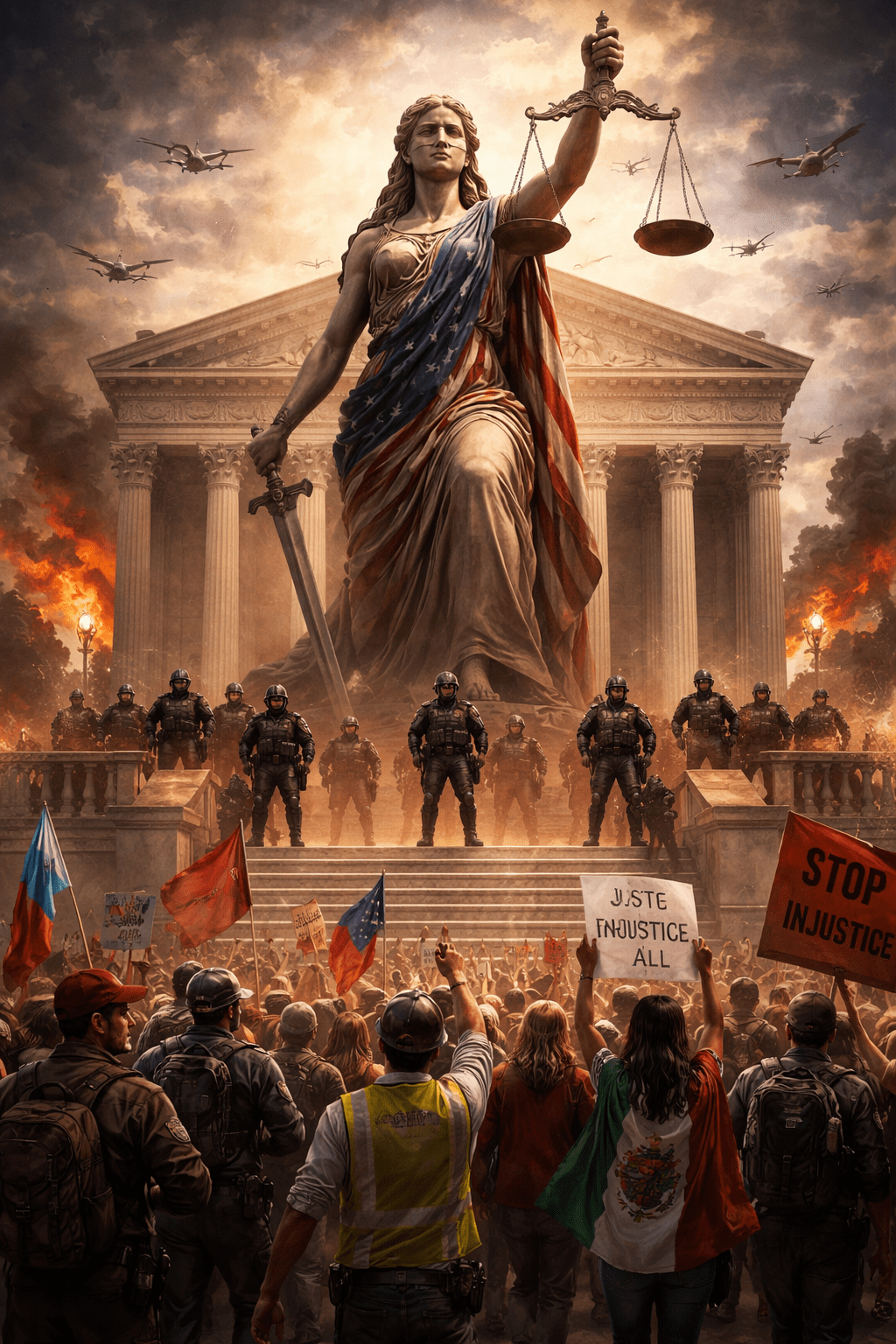
Judicial authority is framed as neutral refuge amid political chaos. Emergency procedure quietly accelerates executive power at home and abroad. History and ritual are deployed to manage a growing crisis of legitimacy. Working people face governance without consent while being asked for faith.
By Prince Kapone | Weaponized Information | January 1, 2026
A Warm Blanket Called “Judicial Independence”
The article under excavation is “Chief Justice John Roberts pushes for judicial independence in history-heavy report”, written by John Fritze and published by CNN on December 31, 2025. It reads less like reporting and more like a lullaby for anxious liberals. The story tells us that politics has grown ugly and loud, that people are nervous, and that somewhere above the shouting there exists a calm, robed institution faithfully guarding the Constitution. The message is simple and soothing: whatever storms rage below, the Court remains steady, ancient, and wise.
This reassurance is produced not through argument, but through tone. The article never interrogates the judiciary as a political actor; it allows the Court to speak about itself and treats that self-description as sufficient. Conflict is present only as mood music—“partisan politics,” “rattled Americans”—a vague unease in the air rather than a struggle driven by power, interests, and decisions. The reader is gently positioned as a worried citizen who needs comfort, not clarity.
The main trick of the piece is temporal retreat. When the present becomes uncomfortable, the narrative backs slowly into the past: the Declaration of Independence, colonial grievances, the impeachment of Samuel Chase. History here is not opened up for struggle or contradiction; it is polished and displayed like a family heirloom. The effect is to drain the present of urgency. By the time the article returns to today, the reader has been trained to see contemporary tensions as echoes of a long-resolved story rather than as living conflicts that demand judgment.
Authority is built through a careful stacking of elite voices. Roberts quotes the founders; the article quotes Roberts; Roberts then quotes Rehnquist and Coolidge. Each quotation borrows prestige from the last, until the argument no longer needs to be made. Tradition itself becomes the proof. This is how power hides in plain sight: it speaks through names we are told to respect, until respect replaces thought. The closing line—“True then. True now.”—does not explain anything. It commands assent.
Notice also what the article refuses to dwell on. It briefly acknowledges attacks on judges and tensions with the executive, but it will not sit with them. These moments are passed over quickly, like hazards on the road that the driver does not want to discuss. The judiciary’s own actions are never examined as part of the conflict; instability is presented as something that happens to the Court, not something the Court participates in. This is depoliticization by omission, accomplished with a smile.
The author’s position helps explain the shape of the story. Fritze writes as a professional court correspondent, embedded in the rhythms and rituals of Supreme Court coverage, where access and credibility depend on treating the institution as fundamentally legitimate. And the piece appears in a corporate media outlet whose business model depends on presenting U.S. institutions as durable, reformable, and worthy of trust. In that environment, radical clarity is not a professional virtue; moderation is.
What emerges is a performance of neutrality that is anything but neutral. The article does not tell readers what to believe outright. Instead, it quietly teaches them what not to question. “Judicial independence” is elevated into a sacred principle, while the social reality of judicial power is kept offstage. The Court appears not as a force in history, but as history’s custodian—a role that demands faith rather than scrutiny. And faith, as every worker knows, is most often demanded when those in charge would rather not explain themselves.
What the Article Says — and What It Leaves Out
CNN’s account frames Chief Justice John Roberts’ year-end message as a calm defense of judicial independence amid rising partisan conflict, noting that he avoids naming Donald Trump while gesturing at tensions between the courts and the White House, and it sketches—briefly but plainly—that many clashes have flowed through the Supreme Court’s emergency (“shadow”) docket, where the Court has often given the administration what it wants, even as Roberts holds up the judiciary as a counter-majoritarian check anchored in founding-era history.
But if we actually want to understand the moment, we have to step outside the article’s soft lighting and look at the institutional record. Start with Roberts’ own text: the 2025 Year-End Report on the Federal Judiciary is a carefully curated historical meditation—heavy on the Declaration of Independence and the founders’ rejection of Crown-controlled courts—and it explicitly describes judicial independence as a “counter-majoritarian check” that has been in place for 236 years. That isn’t “analysis.” It is an attempted transfer of legitimacy from sacred documents to a very present-day institution under very present-day stress. And it is doubly revealing because Roberts has already shown he knows exactly what the political temperature is: in March 2025, he issued a rare public rebuke stressing that “impeachment is not an appropriate response to disagreement concerning a judicial decision”. The article mentions this dynamic but treats it as background noise, when in fact it is a sign that the judiciary is managing a legitimacy problem, not merely teaching a civics lesson.
The article also refuses to grapple with how power is being moved through procedure. The “shadow docket” isn’t a metaphor; it refers to the Court’s emergency pipeline, in which matters can move on an accelerated timetable and be resolved without the full merits process that usually includes extensive briefing and oral argument. Civil-society tracking of the Court’s shadow docket and SCOTUSblog’s emergency-docket coverage highlight that this channel often produces high-impact outcomes under compressed procedures and, at times, with limited public-facing explanation. That design matters, because the emergency pipeline—built for genuine emergencies—can become a routine highway for high-stakes governance fights. When the article treats the emergency docket as a mere venue where controversies “wind up,” it hides the real point: the venue itself is a political fact. It changes what can be challenged, how it can be challenged, and how much explanation the public receives when rights, budgets, and administrative power get rearranged from the top down.
And rearranged they have been. On foreign aid alone, Reuters reported Supreme Court intervention allowing the administration to pause compliance with a lower-court order on foreign-aid spending, followed by additional Reuters reporting describing an outcome that permitted the administration to withhold roughly $4 billion in congressionally authorized aid. The article mentions “foreign aid” as one item on a list; what it omits is the geopolitical weight of that lever. Aid cuts are not just domestic budget trivia—they hit real people and real institutions worldwide, and they land inside an already documented funding crisis for global humanitarian operations, including UN OCHA’s Global Humanitarian Overview 2026 and OCHA’s warning that needs continue to outstrip resources. Even mainstream policy chronologies tracking the U.S. aid freeze and the administrative turmoil surrounding USAID underscore the scale and sequence of these shifts. When the article reports these as bureaucratic skirmishes, it hides that this is state power reaching outward—disciplining the periphery by tightening the spigot.
The same pattern appears in domestic governance: expedited Supreme Court orders can open the gate for executive action while limiting the ability of lower courts to hold the line. In June 2025, the Supreme Court’s decision in Trump v. CASA, Inc. curtailed the availability of nationwide (or “universal”) injunctions, meaning that even when lower courts find a policy unlawful, the remedy may be narrowed to the parties before the court rather than the public at large, as summarized by the Congressional Research Service. For readers who want to see the conflict inside the Court itself, the Court’s own dissenting opinions warn about the practical stakes of limiting equitable relief in the face of challenged executive conduct. The article calls this an “important win” for the president; what it does not do is spell out the downstream consequence: narrowing remedies is one of the cleanest legal ways to let contested policies operate in the real world while litigation grinds on.
Now look at the concrete substance of emergency-docket outcomes that the article only gestures toward. The Court’s emergency posture allowed the administration to proceed with terminating $783 million in NIH grants linked to DEI initiatives while litigation continued. It also granted emergency relief regarding the administration’s passport policy requiring new passports to display “biological sex at birth,” staying a lower-court injunction in Trump v. Orr, as reflected in the Supreme Court’s own docket filings. And on immigration enforcement tactics, appellate court records document emergency fights over detentive stops and the legal standards governing them, including challenges to stops without individualized reasonable suspicion. This is where the “independence” sermon meets the street: not in a textbook, but in the routine capacity of the state to stop people, question them, process them, and move them through the machinery.
The article’s passing reference to Chicago also deserves a sharper and more factual placement. In December 2025, the Supreme Court left in place a lower-court order barring the administration from deploying National Guard troops in Illinois via an unsigned emergency-docket order, as tracked in the SCOTUSblog case file for Trump v. Illinois. Whatever one’s preferred civics-language for it, this episode illustrates that the emergency docket has become a real-time command center for disputes over coercive force and federal authority, with outcomes that can pivot fast and land hard.
Then there is what the article avoids almost entirely: the judiciary’s internal credibility crisis. Public pressure over judicial ethics has been intense enough that the Supreme Court adopted a formal Code of Conduct in 2023—its first—and the Code arrived without an external enforcement mechanism, as noted by the Congressional Research Service. Investigative reporting, including ProPublica’s documentation of gifts, disclosures, recusals, and wealthy patrons, underscores why such a code arrived at all. When a chief justice speaks of “faith” while the institution’s ethics regime remains largely self-policed, that is not merely a footnote—it is part of the legitimacy terrain.
Finally, the article’s smooth talk about “independence” also sidesteps the material security crisis now surrounding judges themselves. The U.S. Marshals Service’s threat statistics show hundreds of judges named in protective investigations—for example, FY 2025 data list 396 unique judges identified as threatened, with 564 total recorded threats. Whether one approaches this as public safety, political intimidation, or institutional backlash, the point is the same: “independence” is not floating above society; it is being fought over, pressured, and contested. A history lecture that refuses to confront the present conditions under which the judiciary is operating is not neutral. It is a strategy of self-preservation.
Put all this together and the story looks different. The judiciary is not merely a constitutional ornament offering moral comfort while politicians misbehave. It is actively shaping the operating environment of executive authority through emergency procedure, remedial limits, and high-speed stays that determine what policies can function in practice while the public waits for slow-moving merits decisions. The article tells readers to admire the marble and trust the myth. The omitted record shows a living institution, wielding immense power at decisive choke points of the state—often with minimal explanation, and at maximum consequence.
How Power Moves When the Robes Stay Clean
Once we place the verified record back on the table, the story CNN tells about “judicial independence” collapses into something far more concrete and far less comforting. What confronts us is not a court hovering above politics, but an institution deeply involved in governing how power moves, how fast it moves, and who bears the cost while it does. Independence, in this light, is not neutrality. It is distance—distance from popular pressure, distance from accountability, and distance from the people most affected by the decisions being cleared through its doors.
Begin with procedure. The repeated use of the emergency docket is not an accidental feature of the present moment; it is a method. Speed becomes a political weapon. When cases move quickly, when stays are issued with minimal explanation, when lower-court rulings are frozen while litigation drags on, power does not pause—it proceeds. Policies operate in the real world while legal debate is deferred into an indefinite future. This is governance by acceleration: what favors executive authority is rushed forward, while challenges are slowed, narrowed, or fragmented. The Court does not need to announce its preferences loudly; it simply controls the tempo.
This control over tempo matters because remedies are power. The narrowing of injunctions is not a technical adjustment for law reviews; it is a practical rearrangement of who is protected and who is exposed. When relief is limited to named parties rather than applied broadly, the law ceases to function as a collective shield and becomes a case-by-case negotiation. For workers, migrants, and communities facing state action, this means living under policies that courts themselves may later find unlawful—but only after the damage is done. Legality is postponed, and in politics, postponement is often victory.
From the standpoint of the global working class and the colonized world, this procedural architecture is not abstract at all. Decisions allowing the withholding of foreign aid are not budget disputes; they are acts that reverberate through clinics, food programs, and humanitarian operations already stretched to the breaking point. When the Court enables such outcomes through emergency orders, it becomes a quiet transmission belt of imperial power—facilitating discipline abroad while presenting itself at home as restrained and principled. The people affected are far from the marble steps, but they are squarely inside the consequences.
The same logic applies domestically. Immigration enforcement rulings that clear the way for aggressive stops and interrogations are not philosophical statements; they are green lights. They authorize everyday coercion—who gets stopped, who gets questioned, who gets processed through the machinery of the state. Here again, independence does not mean withdrawal from power. It means insulation from the backlash produced by its use. The Court’s decisions land on bodies and neighborhoods, while its rhetoric floats above them.
This is where the history-heavy tone of Roberts’ report reveals its function. Faced with growing scrutiny, ethics controversies, and open political conflict, the institution responds not by opening itself to democratic oversight, but by wrapping itself more tightly in origin stories and ritual language. History is mobilized not to illuminate change, but to freeze legitimacy in place. By invoking the founders, Chase’s impeachment, and Coolidge’s reassurance, the Court presents itself as timeless precisely when its authority is most contested. This is legitimacy management, not civic education.
The contradiction at the heart of the article is now clear. The judiciary claims independence at the very moment it is most deeply entangled in managing executive power during a period of imperial strain. Its distance from elections is presented as virtue, even as that distance allows it to authorize sweeping outcomes without democratic exposure. From below—from the perspective of workers, migrants, and peoples subjected to U.S. power globally—this does not look like balance. It looks like governance without consent.
Reframed this way, “judicial independence” ceases to be a sacred principle and appears instead as a political arrangement with winners and losers. It stabilizes the state during crisis by buffering decision-makers from mass accountability while keeping policy machinery running at speed. The CNN article asks readers to trust this arrangement as natural and necessary. The material record shows something else: a court acting as a regulator of power flows in an unequal world, shaping outcomes quietly, procedurally, and with consequences that fall hardest on those farthest from the bench.
From Faith in Institutions to Power in Motion
Once the myth of judicial neutrality falls away, the question that confronts us is no longer whether the courts can be trusted, but how people are already responding to a system that governs without their consent. The contradictions exposed in this excavation are not theoretical. They are being lived, resisted, and organized against—often far from the polite language of constitutional reverence. Across borders and within the imperial core, people have learned through experience that justice does not arrive on its own timetable, and rarely through institutions designed to shield themselves from popular pressure.
In the Global South, the effects of judicially enabled aid freezes and administrative blockades have not been met with passive acceptance. Popular movements, humanitarian workers, and governments aligned with multipolar projects have increasingly organized around alternatives to Western-controlled funding and legal regimes—seeking regional financing, South–South cooperation, and political coordination that reduces exposure to unilateral U.S. legal choke points. These efforts are uneven and contested, but they reflect a growing refusal to allow distant courts and executive offices to dictate the conditions of survival.
Inside the United States, the same dynamics are visible wherever people confront the sharp end of state power. Migrant defense networks, legal aid collectives, and community organizations have already adapted to a reality in which courts may narrow remedies, delay relief, or clear enforcement practices while cases grind on. Rather than waiting for final rulings, these groups organize rapid response systems, court accompaniment, bail funds, and political pressure campaigns aimed at reducing harm in real time. Their work begins from a clear-eyed assessment: legality is not protection unless it is enforced, and enforcement rarely arrives from above.
Labor movements, too, are learning that judicial processes often trail behind economic damage. Workers facing mass layoffs, funding cuts, or regulatory rollbacks cannot afford to suspend struggle while lawyers argue doctrine. This has pushed organizing toward direct action, workplace solidarity, and cross-sector alliances that treat the law as one terrain of struggle among many—not as the final arbiter of justice. Where injunctions are narrowed and relief delayed, organization fills the gap.
What unites these efforts is a shared lesson: institutions that present themselves as independent are often independent only of the people they govern. Real accountability has come not from trusting those institutions to self-correct, but from building pressure outside them—through mass organization, political education, and international solidarity. This is not a call to ignore the law, but to stop mistaking it for salvation.
The task ahead is therefore not abstract opposition, but connection. Connect struggles against immigration raids to struggles against global aid cutoffs. Connect battles over court procedure to the everyday reality of workers, tenants, and communities whose lives are shaped by decisions made without them. Support organizations already doing this work, learn from movements that have survived legal repression before, and build forms of collective power that do not collapse when a ruling goes the wrong way.
The judiciary will continue to speak in the language of permanence and principle. That language is meant to slow us down, to persuade us that patience is virtue and waiting is wisdom. History teaches something else. Rights that are not defended collectively are eroded procedurally. Power that is not challenged materially is consolidated quietly. The answer to judicial governance without consent is not louder faith, but organized force—from below, across borders, and rooted in the lives of those who already know that justice is not granted. It is made.
 Weaponized Information
Leave a comment