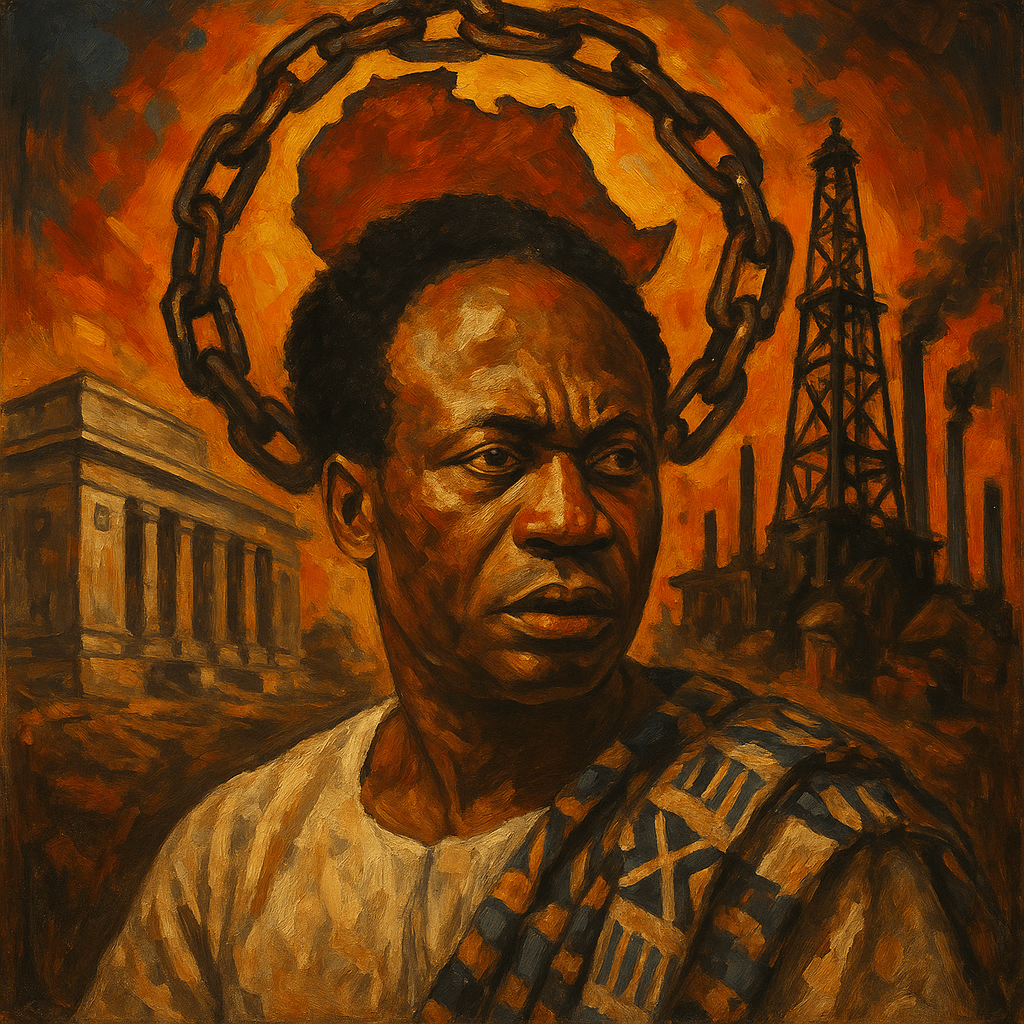
Kwame Nkrumah’s Neo-Colonialism: The Last Stage of Imperialism and the Structural Trap That Confronted the Ghanaian Revolution
Writing from Inside the Trap
Neo-Colonialism: The Last Stage of Imperialism is not a book written from the safety of theory. It is written from inside power, under pressure, with the walls closing in. Kwame Nkrumah does not approach imperialism as an academic puzzle or a historical curiosity. He approaches it as a head of government who has already won political independence and is discovering, day by day, how little that victory actually means. From the opening pages, neo-colonialism is defined not as a policy choice or a diplomatic imbalance, but as the dominant form of imperialism after formal decolonization: a system in which a state carries the flag of sovereignty while its economy, its currency, its trade, and ultimately its political horizon are directed from outside.
Nkrumah’s starting point is blunt and unsentimental. Old-style colonialism is no longer efficient. Direct rule provokes resistance, drains resources, and invites international scrutiny. Neo-colonialism solves these problems by preserving the outward forms of independence while retaining control over the decisive levers of accumulation. The neo-colonial state appears free in law but is unfree in fact. It signs its own treaties, flies its own flag, and sits in international assemblies, yet its development path is already pre-selected by external finance, foreign trade structures, and inherited economic dependency. This is imperialism without the burden of administration, power without responsibility, exploitation without redress.
What gives this analysis its force is that Nkrumah is not describing a hypothetical future. He is naming the condition Ghana already inhabits. Independence has not delivered control over prices, over markets, or over investment. Cocoa still moves through imperial channels, its price set elsewhere. Industrialization demands machinery, capital, and technology that must be imported under hostile terms. Foreign exchange shortages, balance-of-payments pressures, and credit dependency are not anomalies; they are structural facts. Neo-colonialism, in this sense, is not something that arrives after independence fails. It is what independence is allowed to become under capitalism.
This lived contradiction is crucial. Nkrumah writes as a revolutionary who has already committed the cardinal sin of the neo-colonial order: attempting to convert political independence into economic sovereignty. From the outset, Ghana’s most ambitious development plans—large-scale electrification, industrial integration, and the redirection of surplus toward national development—were not treated as neutral policy choices. They were read by imperial power as tests of obedience. Long before any single project reached completion, the limits of acceptable development were being quietly, methodically enforced.
This is where Nkrumah departs decisively from liberal and Western Marxist illusions. He refuses the comforting idea that political sovereignty automatically generates economic autonomy, or that time and good governance will gradually resolve underdevelopment. He insists, instead, that the world market is not a neutral arena but a weaponized structure. The rules are written by those who already dominate production, finance, and trade. A newly independent state enters this system at the bottom, selling cheap and buying dear, exporting raw materials and importing dependency. To describe this arrangement as “participation” is to mistake coercion for choice.
Nkrumah also makes clear that neo-colonialism is not simply economic. Because direct imperial rule has become politically costly, domination shifts into forms that appear technical, contractual, and developmental. Finance, trade agreements, aid packages, and investment terms become the primary instruments of control, backed by the latent threat of political intervention. The neo-colonial state is not denied development outright; it is offered development on terms that reproduce dependency while masking domination as partnership.
Read this way, the opening of Neo-Colonialism is already a reckoning. Nkrumah is diagnosing the contradiction that will ultimately undo his own government: the impossibility of building genuine sovereignty inside an imperial world economy without breaking its rules. The book does not begin with confidence; it begins with clarity. Independence, he tells us, is only the opening move. Without control over production, finance, and scale, the state remains trapped—responsible for the welfare of its people but denied the means to secure it. Neo-colonialism names that trap precisely, before it snaps shut.
Abundance Without Power
Having named neo-colonialism as the dominant structure of post-independence domination, Nkrumah turns to what appears, on the surface, to be a contradiction bordering on absurdity: Africa is one of the richest continents on earth, yet its people remain among the poorest. This is not a rhetorical flourish. It is the empirical foundation of his argument. Africa possesses immense reserves of minerals, energy, water power, fertile land, and human labor. Its soil and subsoil have fed the industrial revolutions of Europe and North America for generations. And yet, Africa accounts for only a tiny share of global industrial output and income. For Nkrumah, this is not paradoxical at all. It is the normal outcome of imperial organization.
What Nkrumah exposes is not scarcity, but extraction without development. African economies are structured around the export of raw materials whose prices are fixed externally, processed elsewhere, and returned as finished goods at monopoly prices. Mining enclaves, plantations, and export zones operate as islands of intense activity inside vast seas of poverty. They generate profits, but not development. Wages remain low, technology transfer is minimal, and the commanding heights of production are owned and managed from abroad. The surplus produced by African labor does not circulate locally to build industry, infrastructure, or social capacity; it flows outward to reinforce accumulation in the imperial centers.
Ghana stands as a concentrated expression of this continental condition. Independence did not alter the basic fact that cocoa remained the backbone of the economy, nor did it shift control over how cocoa was priced, traded, or consumed. Increased production did not translate into increased earnings. On the contrary, as output rose, prices fell. The harder Ghana worked, the less it gained. This was not mismanagement or inefficiency; it was the logic of primary commodity dependence operating exactly as designed. Nkrumah’s continental statistics therefore read as a general theory whose concrete proof lay directly beneath his feet.
Nkrumah is especially sharp in dismantling the myth that mining and export production naturally raise living standards. Even where extraction generates high revenues, those revenues are overwhelmingly captured by expatriate firms, foreign shareholders, and imported managerial layers. Large portions of national income are repatriated as profits, salaries, and interest payments. What remains is insufficient to transform the broader economy. Mining zones may show pockets of relative privilege, but they float atop an impoverished social base. Development, in this model, is always partial, uneven, and externally oriented.
This is why Nkrumah insists that Africa’s poverty cannot be explained by climate, culture, or lack of effort. Those arguments collapse under even minimal historical scrutiny. The same conditions cited to justify African underdevelopment once characterized the now-developed capitalist states themselves. What changed was not geography or mentality, but control over production and surplus. Africa’s enforced role as a supplier of cheap inputs to imperial industry has locked it into a subordinate position that no amount of efficiency, discipline, or technocratic competence can escape.
For Ghana, this reality imposed an immediate and unforgiving dilemma. To remain locked in cocoa was to accept stagnation and vulnerability. To escape cocoa required industrialization, electrification, and large-scale transformation—projects that demanded capital, technology, and external financing. The contradiction was stark: the very abundance that made Ghana valuable to imperial markets also made it dependent on them. Any attempt to redirect that abundance toward national development would have to pass through structures designed to prevent precisely such a redirection.
In laying out Africa’s wealth in such granular detail, Nkrumah is not celebrating potential; he is issuing an indictment. Under neo-colonialism, abundance becomes a source of power only for those who control it. For those who do not, it becomes a vulnerability to be managed by others. Ghana’s experience reveals the truth behind the statistics: resources alone do not confer sovereignty. Without power over how wealth is mobilized, processed, and distributed, abundance merely deepens dependence.
The Ceiling Imposed from Outside
From the question of resources, Nkrumah moves to the harder problem of motion: why, even after independence, African economies remain unable to convert wealth into development. His answer is unsparing. The obstacle is not a lack of plans, ambition, or labor, but a structural ceiling imposed by the imperial system itself. Economic progress in the neo-colonial world is permitted only up to the point where it does not threaten the dominance of the developed capitalist states. Beyond that point, pressure is applied—through prices, credit, trade, and political interference—to force retreat.
Nkrumah is especially clear that the most serious barrier is industrialization. Under neo-colonialism, the developing country is encouraged to remain agricultural, to refine its “comparative advantage,” and to postpone manufacturing until some undefined future when it is supposedly “ready.” This advice is presented as technical wisdom, but Nkrumah exposes it as ideological discipline. Industrialization is postponed precisely because it would allow formerly colonized nations to control value-added production, reduce dependency on imports, and challenge imperial monopoly profits. What is framed as prudence is, in reality, containment.
Ghana’s experience again gives this argument weight. Nkrumah’s government did not reject agriculture; it sought to use agricultural surplus as a foundation for industrial growth. But the moment this transition was attempted, the limits appeared. Machinery had to be imported. Technology had to be purchased. Skilled expertise had to be hired at high cost. Each step increased dependence on foreign exchange earned through primary exports whose prices Ghana did not control. Development planning thus became hostage to fluctuations in external markets. When export earnings fell, investment stalled. When credit tightened, projects were shelved. The ceiling was not theoretical; it was enforced daily.
It is here that the figure of Arthur Lewis becomes decisive—not as a counterpoint to Nkrumah, but as an unwitting confirmation of his critique. Lewis, a Nobel Prize–winning development economist working firmly within the Keynesian tradition, warned that industrial projects undertaken under imperial conditions would tend to generate few domestic linkages, employ limited labor, and disproportionately benefit foreign firms. His caution was not rooted in hostility to development, but in sober economic assessment. Large-scale industrial ventures, he argued, could easily reproduce dependency if control over capital, markets, and pricing remained external.
The significance of Lewis’s intervention is precisely that it came from within the boundaries of respectable economics. He did not question the legitimacy of global capitalism, yet even from this vantage point he could see the limits imposed on peripheral industrialization. His warnings underscore Nkrumah’s central claim: the problem was not ideology outrunning economics, but economics itself being structured to deny autonomy. That even “good faith” development economics arrived at this impasse reveals the depth of the constraint.
Nkrumah also dismantles the idea that scale does not matter. Small, fragmented economies cannot sustain diversified industry, absorb shocks, or negotiate fair terms in global trade. They are structurally weak units in a system dominated by large, integrated capitalist economies. Ghana’s population, market size, and regional isolation made it vulnerable even with disciplined planning and broad popular support. This is why Nkrumah insists that African unity is not a cultural aspiration but an economic necessity. Without regional integration, no single African state can escape the gravitational pull of imperial markets.
Western economists often interpret these failures as evidence of inefficiency or political interference. Nkrumah reverses the lens. He shows that what fails is not development planning, but the expectation that development can occur inside a system designed to prevent it. The neo-colonial economy allows growth only in forms that reinforce dependency—export crops, raw materials, enclave industries—while blocking those that would generate autonomy. Industrial stagnation is not an unfortunate side effect; it is the mechanism by which control is maintained.
This section carries an implicit warning that would soon become explicit in Ghana’s own fate. A government committed to genuine transformation will inevitably collide with the externally imposed ceiling. When persuasion fails, pressure intensifies. When pressure fails, destabilization follows. The problem is not that revolutionary governments aim too high, but that the world economy sets strict limits on how far they are allowed to go. Nkrumah does not present this as a tragedy of poor timing. He presents it as a permanent feature of neo-colonialism.
By grounding the problem of “obstacles to economic progress” in structure rather than intention, Nkrumah strips away the moral alibis of imperialism. Ghana’s stalled industrialization was not the result of impatience or ideological excess. It was the predictable outcome of attempting to build sovereignty under conditions where sovereignty was never meant to be real. The ceiling remained firmly in place, and the cost of pushing against it would soon become unmistakable.
Finance Capital as the Real Sovereign
Having established that political independence leaves intact a hard ceiling on economic transformation, Nkrumah turns to the force that enforces that ceiling with the greatest discipline and the least visibility: imperialist finance. In the neo-colonial world, sovereignty does not rest where constitutions say it does. It rests with those who control credit, currency, and investment flows. Banks, financial institutions, and monopoly capital do not merely respond to policy; they actively shape the range of policies that are possible. A state may legislate freely, but it cannot spend, import, industrialize, or even stabilize its currency without passing through the gatekeepers of international finance.
Nkrumah’s insight here is precise and unsparing. Neo-colonialism does not require constant political interference because economic dependency performs that function automatically. Control over foreign exchange, access to credit, and balance-of-payments support allows imperial finance to reward compliance and punish deviation without firing a shot. Loans arrive with conditions. Aid returns to the donor through procurement rules and profit repatriation. Capital retreats at the first sign of independent policy. The result is a system in which elected governments are disciplined not by voters, but by markets they do not control.
It is at this point that Ghana’s most ambitious development effort—the Volta River Project—enters the story not as a technical undertaking, but as a political economy in motion. Conceived as a means of breaking dependence on cocoa through electrification and integrated industrial development, the project was from the outset shaped by the availability and terms of external finance. British withdrawal did not create autonomy; it created a vacuum quickly filled by the World Bank and the United States, both of whom viewed Ghana less as a sovereign development project than as a strategic site in the Cold War and a test case for acceptable post-colonial modernization.
Financing became leverage. The form of the Volta Project was reshaped before construction began. Integrated aluminum production under Ghanaian control—central to Nkrumah’s original vision—was steadily hollowed out. In its place emerged a structure designed to minimize risk and maximize returns for foreign capital. Kaiser and ALCOA secured access to cheap, long-term electricity through concessionary pricing, while Ghana assumed the debt burden, the displacement of communities, and the obligation to guarantee stability. What appeared as development was, in fact, a contractually enforced transfer of power.
This was finance capital acting as sovereign. Ghana could not dictate terms because it did not control the capital required to build. The World Bank and U.S. financiers did not need to oppose development outright; they simply redefined it. Electrification was permitted, but only insofar as it served external accumulation. Industrialization was allowed, but stripped of linkages, employment, and domestic control. The state remained responsible for social outcomes while decisive economic power lay elsewhere.
Nkrumah’s broader argument about aid acquires concrete meaning here. What is presented as assistance functions as a revolving credit mechanism that returns value to its source with interest. Funds circulate briefly through the neo-colonial state before flowing back outward in the form of equipment purchases, management contracts, profit guarantees, and debt service. The appearance of partnership masks a relation of discipline. Where aid fails to stabilize the situation, financial pressure escalates, narrowing policy space further and preparing the ground for political intervention.
The dominance of imperial currencies sharpens this dependence. Ghana’s need for foreign exchange to service Volta-related obligations and import industrial inputs intensified vulnerability to external shocks. Monetary sovereignty remained nominal. Inflationary pressure, balance-of-payments crises, and fiscal constraint were not side effects of mismanagement; they were the predictable outcomes of financing development through imperial credit. In this way, the Volta Project did not escape the cocoa economy’s logic—it translated it into industrial form.
What this reveals is the deeper truth at the heart of Nkrumah’s analysis. Finance capital governs not by issuing orders, but by structuring necessity. It defines what can be built, how it can be financed, and who ultimately benefits. Ghana’s confrontation with these forces was not a failure of will or intelligence. It was a collision with the real sovereign of the post-colonial world. In naming finance capital as such, Nkrumah strips neo-colonialism of its disguises and exposes the power that stands behind the façade of independence.
The Lies That Accompany the Ledger
Neo-colonialism does not operate silently. It speaks constantly, wrapping its operations in the language of concern, expertise, and inevitability. In the chapters where Nkrumah dissects the “truth behind the headlines,” he exposes how economic domination is stabilized by narrative control. The story told to the world is always the same: when a newly independent state struggles, the cause is mismanagement, corruption, or ideological excess. What is never placed on trial is the structure of the world economy itself. The headlines condemn the patient while protecting the disease.
Nkrumah writes with the authority of someone who has lived inside this distortion. Ghana’s economic difficulties did not emerge in a vacuum, yet they were relentlessly framed as evidence of African incompetence or socialist overreach. Declining export revenues became proof of fiscal irresponsibility rather than the predictable outcome of imperial price-setting. Foreign exchange shortages were blamed on reckless planning rather than on structural dependency. The same forces that constrained Ghana’s options then presented those constraints as moral failures. Neo-colonialism, in this sense, requires a permanent propaganda operation to conceal its own mechanics.
Development projects played a central role in this ideological laundering. Large-scale initiatives were celebrated in international discourse as signs of progress, partnership, and benevolence, even as their underlying terms guaranteed foreign control. The Volta River Project was repeatedly presented as proof that Ghana was being responsibly integrated into the modern world economy. What remained unspoken was how financing arrangements, ownership structures, and pricing terms stripped the project of its emancipatory content. Development was applauded in form precisely because it had been neutralized in substance.
This narrative work served a disciplinary function. International legitimacy, investor confidence, and diplomatic standing were conditioned on conformity to imperial expectations. A state that insisted on sovereignty was described as obstinate; one that resisted foreign capital was accused of hostility to progress; one that attempted to redirect surplus toward national priorities was labeled authoritarian. These judgments circulated faster than facts, shaping the environment in which decisions were made. By the time material pressure intensified, ideological isolation had already prepared the ground.
Ghana’s leadership was thus confronted with a double bind. To accept externally defined development was to forfeit control while retaining responsibility for outcomes. To resist was to invite condemnation, capital flight, and diplomatic hostility. The headlines did not ask whether Ghana was being structurally constrained; they asked why it could not behave more “responsibly.” In this way, neo-colonialism transformed coercion into common sense. The victim was instructed to internalize the verdict against itself.
Nkrumah insists that this ideological assault is inseparable from the economic one. Control over information flows, expert opinion, and global discourse ensures that resistance appears irrational before it appears dangerous. When economic pressure escalates into destabilization, the narrative infrastructure is already in place. Intervention can then be presented as correction rather than punishment, as restoration rather than domination. The headlines do not report neo-colonial enforcement; they justify it.
By exposing these mechanisms, Nkrumah refuses the comfort of surface explanations. Ghana’s difficulties are not denied, but they are relocated within a hostile environment designed to produce precisely such outcomes. Without this relocation, neo-colonialism could continue to operate as an unnamed assumption, always present but never acknowledged. With it, the moral authority of imperial judgment collapses.
In stripping away the ideological cover, Nkrumah arms the reader with a disciplined skepticism. When a revolutionary state is declared unviable, the first question is no longer “what did they do wrong?” but “who benefits from this narrative?” The answer, more often than not, points back to the same forces that dominate finance, trade, and production. The ledger and the headline, Nkrumah shows, tell the same story—once you know how to read them together.
Locked into the Export Trap
With the ideological veil stripped away, Nkrumah returns to the material core of neo-colonial domination: the enforced role of primary production. The neo-colonial economy is not merely encouraged to export raw materials; it is organized so that it cannot do much else. Primary resources are extracted, shipped abroad, processed elsewhere, and sold back at monopoly prices. This structure is not transitional. It is permanent by design. As long as this circuit remains intact, development in the colonized world can occur only on imperial terms.
Nkrumah dismantles the comforting fiction that export growth naturally improves living standards. In reality, the more efficiently a primary-producing country exports, the deeper it is drawn into dependency. Prices fluctuate downward, terms of trade deteriorate, and increased output yields diminishing returns. The value created by labor and land is siphoned off through pricing mechanisms that no producing country controls. The imperial centers stabilize their own economies by absorbing cheap inputs and exporting higher-value goods back to the periphery.
Ghana’s dependence on cocoa is the classic expression of this trap. When cocoa prices fell, national income collapsed regardless of how hard farmers worked or how much production increased. Productivity became punishment. The market rewarded stagnation and disciplined ambition. This was not an accident of poor policy but the normal operation of a system that requires the periphery to remain a supplier of cheap inputs. What Ghana faced in cocoa was not failure, but function.
The decisive lesson, however, is that this logic did not disappear when Ghana attempted to industrialize. It was reproduced. The Volta River Project, far from breaking the export trap, translated it into industrial form. Electricity—generated through massive public investment and social disruption—was treated as a raw input rather than as a lever of national development. Power flowed cheaply to foreign-controlled aluminum interests, while the value created downstream was realized elsewhere. Ghana exported energy just as it had exported cocoa: cheaply, under terms it did not control, and with minimal domestic transformation.
This reproduction of dependency is what gives Nkrumah’s analysis its enduring force. Industrialization alone does not dissolve neo-colonial relations; under imperial terms, it can entrench them. The product changes, but the structure persists. Cocoa and electricity occupy different places in the production chain, yet both function as inputs for accumulation centered outside Ghana. In each case, the country bears the social cost—labor, land displacement, ecological damage—while control and profit migrate outward.
Nkrumah is explicit that this outcome is not the result of ignorance or miscalculation. It is the predictable consequence of attempting to escape primary dependence without control over pricing, processing, and markets. Development that remains externally oriented reproduces underdevelopment at a higher level. What appears as progress deepens vulnerability. The export trap is thus not escaped by changing what is exported, but by breaking the relations that govern export itself.
The political consequences of this trap are severe. As export revenues fluctuate and foreign obligations mount, the burden of adjustment is pushed downward onto workers and peasants. Austerity, wage restraint, and social unrest follow. The state is blamed for outcomes it cannot control, while the structures that produce those outcomes remain invisible. Instability then becomes the pretext for intervention. Neo-colonialism converts structural exploitation into political crisis and uses that crisis to justify further domination.
In tracing this dynamic, Nkrumah clarifies why sovereignty cannot coexist with an export-led development model under imperial conditions. Control over resources without control over how they are valued, processed, and circulated is a hollow victory. Ghana’s experience demonstrates that as long as a nation remains locked into this role, its political independence will remain fragile and conditional. The export trap is not merely an economic problem; it is the hinge on which neo-colonial power turns.
Monopoly Power and Its Local Intermediaries
At this stage of the argument, Nkrumah removes any remaining ambiguity about who governs the neo-colonial world. It is not the flag, the parliament, or even the formal state apparatus that ultimately determines outcomes, but an interlocking architecture of monopoly capital operating across borders with remarkable coordination. Neo-colonialism, he insists, is not enforced by isolated firms acting independently, but by dense networks of mining houses, financial institutions, trading companies, and insurance cartels whose interests converge and whose power transcends any single nation-state.
Nkrumah’s detailed catalogues of corporations and combines are therefore not digressions. They are the anatomy of power rendered concrete. These entities control extraction, transport, marketing, credit, and reinvestment, ensuring that value generated in Africa never accumulates there. Ownership is external, decision-making is external, and profit realization is external. The neo-colonial state is left to administer labor discipline, infrastructure maintenance, and social stability, while monopoly capital captures surplus without assuming responsibility for development.
But neo-colonialism does not operate through external power alone. It requires internal mediation. The architecture of monopoly capital depends on local class forces that benefit from, defend, and normalize dependency. In Ghana, this took the form of a cocoa bourgeoisie whose fortunes were tied to export circuits and price stabilization within imperial markets, as well as a liberal-nationalist political current that framed integration into the world economy as realism rather than subordination. These forces did not need to conspire; their material interests aligned naturally with the preservation of existing trade structures.
Figures associated with this liberal-nationalist current, including J. B. Danquah and his allies, articulated an alternative vision of independence rooted in constitutionalism, private enterprise, and continued engagement with imperial markets. This vision did not openly reject sovereignty, but it redefined it as compatibility with foreign capital rather than control over it. In doing so, it provided ideological cover for neo-colonial arrangements, presenting dependency as moderation and state-led transformation as excess.
The presence of these internal class forces shaped the terrain on which Nkrumah governed. The Ghanaian state did not confront monopoly capital as a unified social bloc. It faced a fragmented domestic landscape in which sections of the petty bourgeoisie, commercial elites, and regional interests viewed radical transformation as a threat to their own positions. This fragmentation limited the depth of mass mobilization and pushed the revolutionary project increasingly toward reliance on state machinery rather than a consolidated worker–farmer alliance.
This dynamic did not negate the primacy of imperial power; it facilitated it. Monopoly capital rarely rules alone. It governs through alliances, intermediaries, and ideological formations that translate external pressure into internal opposition. When development plans strained Ghana’s export-dependent economy, these internal forces amplified the crisis by framing austerity, discipline, and retreat as common sense. Neo-colonialism thus appeared not as foreign imposition, but as domestic correction.
What Nkrumah’s analysis makes clear is that internal class mediation does not contradict the structural nature of neo-colonialism—it completes it. External domination requires internal anchors. Without a class base committed to transforming production relations and defending sovereignty at the level of everyday life, the state remains exposed. Ghana’s vulnerability was not simply imposed from outside; it was stabilized through domestic structures shaped by colonial history and post-colonial class formation.
By integrating monopoly power with internal class dynamics, Nkrumah refuses both fatalism and moralism. Ghana’s defeat is not reduced to betrayal, nor is it excused as inevitability. It is understood as the outcome of a specific alignment of global power and local class relations. Neo-colonialism persists not only because it is strong, but because it embeds itself within the social fabric of the societies it dominates.
Unity as the Missing Condition
At this stage of the argument, Nkrumah turns from diagnosis to the question that haunted every strategic decision he made in power: why no single African state, no matter how disciplined or committed, could escape neo-colonial domination on its own. His answer is uncompromising. Fragmentation is not a residue of colonial history gradually fading with time; it is an active mechanism of control. Neo-colonialism depends on the existence of small, economically non-viable states that lack the scale to industrialize, defend themselves, or negotiate fair terms in the world economy.
Balkanization ensures weakness. Individually, African states are forced to sell cheap and buy dear, competing against one another for access to imperial markets while lacking the leverage to set prices or control supply. Monetary zones, foreign banking systems, and inherited trade patterns lock these states into externally managed circuits of accumulation. Political independence, under these conditions, becomes an administrative responsibility without material power. The neo-colonial state governs scarcity while abundance flows outward.
Ghana’s experience gives this argument its sharpest clarity. Nkrumah understood early that Ghana alone could not sustain industrialization, price stability, or economic sovereignty. The internal market was too small, external markets too hostile, and financial dependence too deep. Pan-African unity was therefore not an ideological flourish or sentimental commitment; it was the only viable material strategy for breaking the structural limits imposed on development. Without regional integration, Ghana’s revolution would remain permanently exposed.
The Volta River Project underscores this reality. As a national undertaking, it lacked the regional scale needed to bargain effectively with finance capital or to integrate production across borders. Had electrification, aluminum processing, and industrial planning been embedded within a continental framework, the balance of forces might have shifted. Instead, Ghana confronted imperial capital alone. Isolation transformed vulnerability into inevitability. What could not be imposed on a continent was easily imposed on a single state.
Nkrumah’s insistence on unity also reveals the connection between continental fragmentation and internal class division. Just as Africa was broken into non-viable states, Ghana itself remained divided by regional, class, and ideological lines inherited from colonial rule. These internal fractures limited the depth of popular mobilization and weakened the social base required to sustain continental commitments. Pan-Africanism required not only diplomatic alignment, but mass support rooted in a shared material project. Where that support was thin, unity remained vulnerable.
The failure of unity, therefore, was not merely a political disappointment; it was a structural defeat. As continental projects stalled and rivalries deepened, neo-colonial pressure intensified. Fragmentation allowed imperial powers to apply pressure selectively, isolate defiant governments, and discipline others through example. Ghana’s isolation became a warning to the rest of the continent. Unity was not delayed by accident; it was obstructed by design.
In foregrounding unity as the missing condition, Nkrumah refuses nationalist consolation. Independence without regional power reproduces dependence at a higher level. The flag changes, the anthem changes, but the balance of forces does not. Ghana’s predicament demonstrates that sovereignty is not an attribute of the nation-state alone, but of the scale at which production, finance, and defense are organized. Without unity, even the most principled revolution remains structurally outmatched.
This is why unity occupies such a central place in Neo-Colonialism. It is not a moral appeal or a cultural slogan. It is an economic and political necessity born of experience. Nkrumah writes not as an idealist disappointed by slow progress, but as a revolutionary who learned, through governing, that fragmentation is the lifeblood of neo-colonial power. To defeat it requires not better management, but a break in scale commensurate with the system it confronts.
When Economics Fails, Force Decides
By the time Nkrumah turns to the mechanisms of enforcement, the logic of neo-colonialism is already complete. Writing before his own overthrow, he analyzes force not as a personal fate but as the final instrument of imperial discipline. Economic pressure is the preferred instrument, but it is not the last one. When credit discipline, trade manipulation, and ideological isolation fail to secure compliance, neo-colonialism reveals its coercive core. Intervention does not always arrive in uniform. It comes through intelligence penetration, military training missions, mercenary forces, and the quiet cultivation of internal opposition. Political independence is tolerated only so long as it does not obstruct imperial interests.
Nkrumah is explicit that this escalation from economics to force is not accidental. Neo-colonialism prefers invisibility because it is cheaper and more stable, but it does not hesitate to use violence when the façade cracks. Limited wars, covert operations, and coups replace colonial conquest, achieving the same ends with lower cost and less international scrutiny. The developing world becomes the terrain where imperial contradictions are managed and where defiant governments are disciplined before their example spreads.
Nkrumah identifies this pattern before it reaches Ghana itself. His overthrow in 1966 would later give this analysis its tragic confirmation. By that point, the mechanisms of economic control he had described were already in motion. Export volatility, foreign exchange shortages, debt obligations tied to development projects, and capital flight had narrowed the government’s room to maneuver. Internal class opposition, amplified by ideological narratives of mismanagement and excess, provided a domestic face to what was fundamentally an external campaign of pressure. When economic discipline failed to produce compliance, political force completed the task.
The coup did not represent a sudden rupture in Ghana’s trajectory; it was the logical endpoint of a process already well advanced. Sections of the military had been cultivated through training and external ties. Intelligence services had embedded themselves within state institutions. Political isolation abroad translated into vulnerability at home. What could not be reversed through markets was resolved through force. Sovereignty was revoked not because Ghana had collapsed, but because it had refused to accept permanent dependency.
This is why Nkrumah rejects the liberal habit of treating coups as spontaneous reactions to internal failure. Such explanations mistake the instrument for the cause. The coup restored a neo-colonial order that economic mechanisms alone could no longer guarantee. It reestablished “confidence,” reopened channels of foreign capital, and reassured imperial interests that deviation would not be tolerated. Political violence entered not as chaos, but as correction.
What makes this moment decisive is its signaling function. Nkrumah’s overthrow was meant to be exemplary. It demonstrated to other post-colonial states the limits of acceptable sovereignty and the consequences of exceeding them. The lesson was clear: independence could be granted, development could be discussed, but control over accumulation would remain imperial. Those who challenged this arrangement would be isolated, destabilized, and removed.
Nkrumah’s analysis strips away the moral camouflage that usually surrounds such events. The issue was never democracy versus authoritarianism, nor competence versus incompetence. It was compliance versus rupture. Ghana’s experiment was not destroyed because it failed, but because it threatened to succeed beyond the boundaries set by imperial power. In naming this reality, Nkrumah transforms the coup from an inexplicable tragedy into a structural necessity of neo-colonial rule.
By tracing the path from economic discipline to political overthrow, Nkrumah completes his account of neo-colonial power. Extraction, dependency, ideological cover, fragmentation, and finally force form a coherent system. Ghana’s experience does not stand outside this logic; it confirms it. Neo-colonialism, he shows, is not merely the last stage of imperialism—it is imperialism refined for a world that pretends colonialism has ended.
The Limits of National Development
In its final movement, Neo-Colonialism: The Last Stage of Imperialism sheds any remaining illusion that national independence, however radical in intent, can secure emancipation on its own. Nkrumah does not retreat into despair, but he refuses consolation. The lesson he draws from Ghana’s experience is neither moral nor managerial; it is structural. A single post-colonial state attempting to build sovereignty inside an imperial world economy confronts limits that cannot be negotiated away. Without a break in scale, class power, and international alignment, development becomes containment by another name.
This is where the question of strategy becomes unavoidable. Nkrumah’s project relied heavily on the state as the principal agent of transformation. This reliance was not born of theoretical preference alone; it was conditioned by Ghana’s class structure. The working class was small, the peasantry fragmented, and internal class forces aligned with export dependency constrained mass mobilization. In the absence of a consolidated worker–farmer alliance capable of sustaining prolonged struggle, the state became the primary instrument available. Neo-colonialism exploited this necessity by isolating the state from its social base.
The counterfactual therefore cannot be evaded, even if it cannot be resolved cleanly. Could a deeper worker–farmer alliance have altered the outcome? Could mass mobilization on the scale seen in revolutionary China have shifted the balance of forces? Nkrumah does not provide a definitive answer, nor does history allow one. Ghana’s demographic composition, colonial legacy, and regional position differed sharply from those of peasant-majority societies where prolonged revolutionary warfare proved viable. The absence of a Maoist-style path in Ghana was not a failure of imagination; it reflected material constraints.
Yet acknowledging these constraints does not absolve the limits of the chosen strategy. State-led transformation without durable class power beneath it remained exposed. When economic pressure mounted and external force intervened, the revolution lacked the organized social depth required to defend itself. This was not a betrayal by the masses, but a structural vulnerability shaped by colonial development, export dependency, and internal class fragmentation. Neo-colonialism triumphed not because the people were indifferent, but because the terrain was uneven.
Nkrumah’s turn toward continental unity and, later, toward armed struggle must be read in this light. These were not abrupt ideological shifts, but strategic responses to a closing field of possibility. Pan-Africanism was an attempt to resolve the problem of scale; revolutionary force, a recognition that economic and diplomatic routes had been foreclosed. That these paths were obstructed or arrived too late does not invalidate their necessity. It underscores the depth of the trap Nkrumah had already named.
For contemporary revolutionaries, the enduring value of Neo-Colonialism lies precisely here. The book is not a blueprint, but a warning. It demonstrates that development under imperial conditions reproduces dependency, that sovereignty without control over accumulation is hollow, and that national projects unbacked by mass class power remain vulnerable to isolation and overthrow. It also exposes the bankruptcy of Western Marxist abstractions that treat the Global South as a stage for theory rather than a terrain of struggle.
Nkrumah’s defeat does not negate his analysis; it confirms it. His fate illustrates the price paid by those who attempt rupture without the means to sustain it. At the same time, his clarity arms future struggles with hard-earned knowledge. Neo-colonialism is not an accidental afterlife of empire; it is its most efficient form. To confront it requires strategies that match its scale, its coordination, and its ruthlessness.
In this sense, Neo-Colonialism endures not as a lament, but as a weapon. It teaches that independence is only the opening act, that development is a battleground, and that liberation demands organization capable of surviving success as well as repression. Nkrumah writes from inside the trap so that others might recognize it before it closes. That recognition remains indispensable for any revolutionary project in the Global South today.
 Weaponized Information
Leave a comment