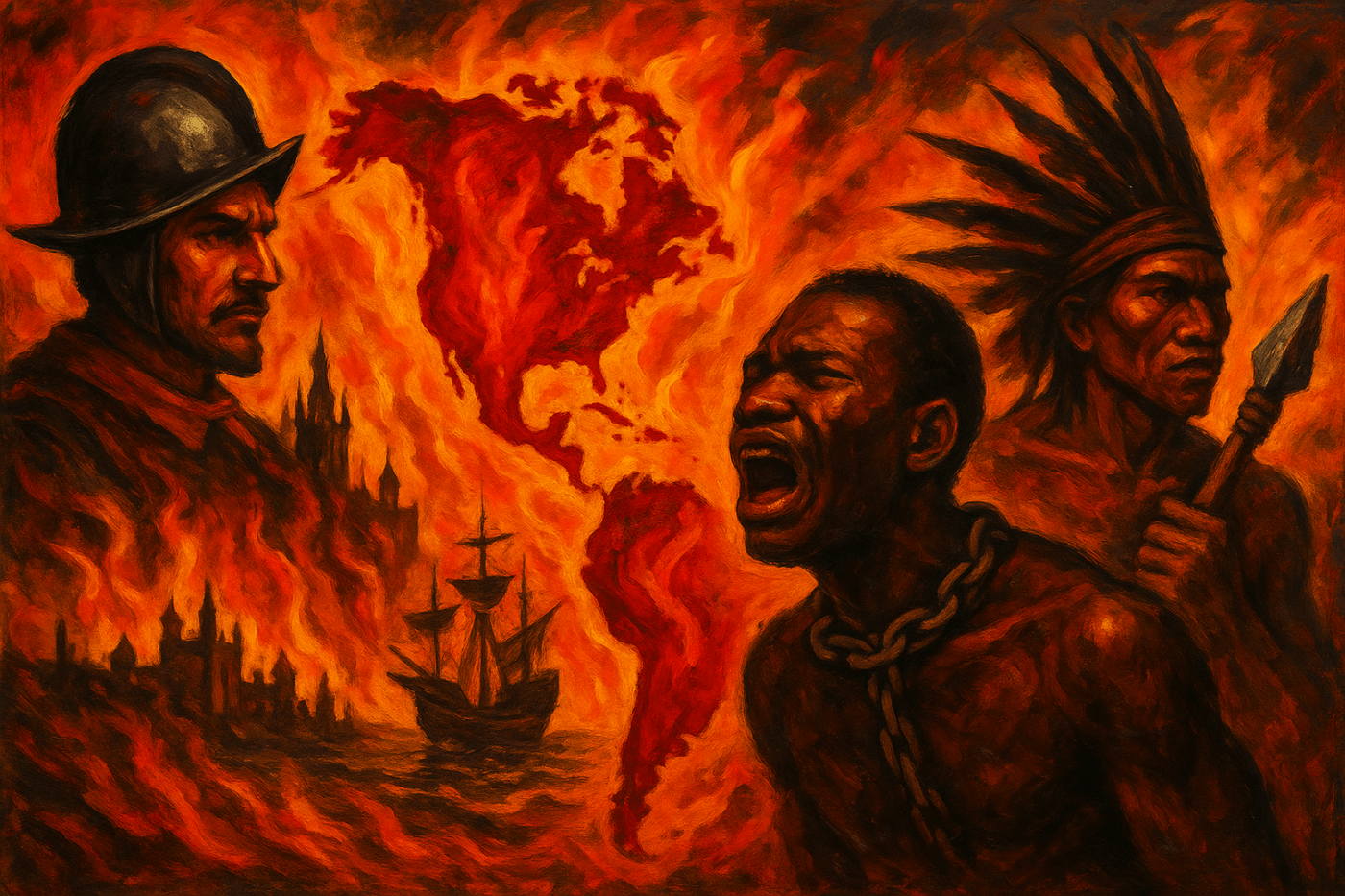
This Weaponized Intellects review takes Gerald Horne’s The Dawning of the Apocalypse as what it is: a devastating, must-read indictment of the long sixteenth century that built the American settler empire we’re still trapped inside.
By Prince Kapone | Weaponized Information | November 29, 2025
When Race Replaced God: Europe Prepares the Apocalypse
Gerald Horne opens The Dawning of the Apocalypse with a simple but devastating move: he starts not in 1492 or 1619, but in 1977, when Andrew Young, then Washington’s ambassador to the UN, casually remarked that London had “invented” racism. The British and their media howled; the U.S. establishment bristled. Horne’s reply is basically: Young was right about the neighborhood, wrong about the exact address. Yes, London was central to the birth of modern racism, but its bastard child in North America took that poisonous inheritance and turned it into a full-blown system, a permanent regime of racialized exploitation and extermination.
What Horne calls the “long sixteenth century” is the stretch of history where this turn happens—the period when European ruling classes slowly shift from ruling in the name of God to ruling in the name of “the white race.” Religion doesn’t disappear; it gets repurposed. The point is not a polite story of “religious wars” and “exploration,” but a hard account of how Christian Europe, under pressure from crisis and competition, begins to harden difference into something more durable than doctrine. The cross is not discarded. It is fused with the sword and the ledger into a single weapon.
Horne insists that before we get to North Carolina in the 1580s or Jamestown in 1607, we have to understand a quieter, older crime: the way England trained itself on Jews. Drawing on Geraldine Heng, he describes medieval England as “the first racial state in the West,” where anti-Judaism stopped being just religious polemic and became state policy. Jews were cast as demonic, as possessing a “fetid stench,” horns, tails, cannibalistic habits—less a community of believers than a polluted biological threat. This is the rehearsal. Once you’ve learned to strip a people of humanity at that level, it becomes easier, centuries later, to do the same to Africans and Indigenous nations.
From there, Horne shows how “whiteness” emerges as a kind of emergency alliance. Catholic Spain and Portugal batter Muslim powers around the Mediterranean while expelling and disciplining Jews at home. Protestant England starts as the underdog: poorer, weaker, on the back foot compared to Madrid. To survive and advance, London has to get flexible. It dials down sectarian rigidity when it suits imperial needs, aligns with Muslim powers against Catholic rivals, experiments with new mixtures of conquest, trade, and piracy. Out of that scramble, a new umbrella identity takes shape—“Christian,” “European,” then simply “white”—broad enough to unite rival powers in a shared project of plunder.
This is what Horne is getting at when he contrasts the old religious language with the new racial one. The Crusader mindset, honed in campaigns against Muslims and Jews, migrates into the Atlantic world and becomes something even more vicious: not just “the wrong faith,” but “the wrong kind of human.” As Horne puts it, the rise of these North American Protestant settlements marks the “supplanting of religion as an animating factor of society with ‘race.’” Race becomes the new theology—less concerned with saving souls and more concerned with sorting bodies.
When Horne calls this period the “dawning of the apocalypse,” he isn’t being poetic. He is being statistical. From 1501 to 1650—before England and France really take over the trade—about 726,000 Africans are dragged across the Atlantic, mostly into Spanish and Portuguese territories. From 1650 to 1775, once London and Paris are fully in the game and sugar and tobacco are booming, that number explodes to roughly 4.8 million. By 1866, the total reaches about 10.6 million human beings shipped like cargo into a slave system built to consume their lives.
On the other side of the Atlantic, Indigenous life is being erased at a pace that makes the word “apocalypse” sound clinical. Horne notes that between 1520 and 1620, the Aztec and Inca civilizations lose around ninety percent of their populations. Disease is one part of the story; deliberate slaughter, forced labor, and systematic dispossession are the rest. This is not unfortunate collateral damage. It is the operating logic of a new world system, one in which continents are turned into sacrifice zones so that a small elite in Europe can rise.
For those of us raised on the mythology of “1619” as the start of slavery in what becomes the United States, Horne’s move is sharp. He doesn’t dismiss 1619; he calls it “notional at best,” the man without the child. If 1619 is the teenager, he wants us to look at the childhood: the late 1400s and 1500s, when Iberian crowns test-drive plantation labor, African enslavement, and Indigenous destruction from the Caribbean to Mexico to Brazil. By the time Africans are recorded in Virginia, the machine that will devour them is already built, debugged, and running.
In Weaponized Information terms, what Horne is doing here is stripping away the liberal comfort stories. There is no “good England” that accidentally goes wrong in the colonies. There is no innocent “New World” corrupted by a few bad men. There is a long sixteenth century in which European elites—Catholic and Protestant, Iberian and English—learn how to rule the globe through a combination of religious jihad, racial sorting, and what we would now call early capitalism. The United States is not the exception to that history; it is the sharpest expression of it.
This first part of the book is, in effect, a warning label for the rest. If you want to understand why the United States today can bomb, sanction, police, and cage huge sections of the planet while preaching “freedom” and “democracy,” you have to go back to this dawning moment when Europe learns to treat entire peoples as waste. If you want to understand why “race” in the U.S. is not a side issue but the software of the whole operating system, you have to start here, where race begins to replace God as the justification for rule.
In the next sections, Horne will walk us step by step through this transformation—from the laboratories of Iberian conquest to the killing fields of Florida and New Mexico, and finally to Jamestown, where the apocalypse stops “approaching” and fully arrives. For now, Part I leaves us with a basic conclusion: the world we live in was not born in Philadelphia in 1776 or on a slave ship in 1619. It was born in a longer, dirtier century, when Europe practiced on Jews, Moors, Africans, and Indigenous nations how to build a world that could only stand on their graves. Our task is not just to know that history, but to figure out what it means to fight from inside its ruins.
Europe Sharpens Its Knives: Iberia’s Crusade Marches Into the Atlantic
If Part I lays out the ideological compost from which racial capitalism sprouts, Part II shows us the moment the soil turns toxic. In Chapter 1—aptly titled Approaching 1492 | Approaching Apocalypse—Horne takes us into late-medieval Iberia, where Christian monarchies rehearse the very techniques they will soon unleash on the Americas. The standard textbook story paints this as a tale of “exploration,” brave navigators seeking new routes and new riches. Horne flips the camera: what we see instead is a Europe bloodied by crusades, bankrupt from war, terrified of Islamic power, and looking for salvation not in the heavens but on the seas.
As Horne makes clear, the Iberian Peninsula is the first battlefield of the coming world system. Spain and Portugal are locked in holy wars, expelling Moors and persecuting Jews, not simply out of dogma but because this violence clears the way for new forms of political consolidation. Anti-Jewish pogroms, the Inquisition, forced conversions—these become state tools for refining the logic of domination. Jews become “hereditary threats,” Moors become “permanent enemies,” and both become laboratories for a new kind of thinking in which human beings are classified, ranked, and targeted through a worldview that is no longer purely theological but increasingly racial. It is in this furnace that the racial state begins to take shape.
And then there is Portugal—the sharp end of the spear. Horne shows how the Portuguese monarchy, desperate for revenue and geopolitical breathing room, turns to the ocean with a cold, experimental mindset. The West African coast becomes their workshop. At first it’s raiding, then trading, then fort-building, then mass kidnapping. The early slave trade is not yet the industrial machine it will become, but the outlines are all here: European ships, African captives, militarized ports, missionaries, royal charters, and a growing realization that human lives can be extracted and sold across continents like gold or grain.
This is what Horne means when he says the apocalypse was already approaching before Columbus ever sailed. The Iberians had already learned to fuse faith, violence, and commerce into a single instrument. They had already learned to classify whole peoples as exploitable raw material. They had already learned that profit could be drawn from suffering on a scale unknown in earlier centuries. Catholic Spain destroys Indigenous polities in the Caribbean; Portugal locks down the West African coast; both build the first transoceanic networks of extraction. These are not side quests. These are the first blueprints for the system that will govern the modern world.
Meanwhile, Europe as a whole is convulsing. The Black Death has shattered population levels, labor systems, and worldviews. Markets are shifting. Empires are rising and falling. And in the middle of all this upheaval, Iberian elites recognize something radical: the path out of crisis lies not in reforming feudal structures at home, but in exporting crisis outward—outward onto Africa, outward onto the Americas, outward onto every land where European ships can deliver cannon fire. What begins as desperation mutates into an imperial science.
Horne draws special attention to the way Christian supremacist ideology evolves during these years. It becomes leaner, more pragmatic. The holy war against Muslims becomes a training ground; anti-Jewish hysteria becomes a racial template. When the Iberians later describe Indigenous Americans as beasts, cannibals, or natural slaves, these are not new inventions—they are recycled slurs first used on Jews and Moors. The “logic of extermination” that will define the Americas is conceived in Iberia’s religious wars.
But the Iberians are not just killers—they are innovators. They test out plantation labor in the Atlantic islands like Madeira, São Tomé, and the Canaries. They perfect sugar monoculture. They expand slave raiding across West Africa with devastating speed. This is where Horne shows his sharpest intervention: the plantation is not born in Barbados or Virginia but in the crucible of Iberian capitalism, where African labor, European finance, and global markets are first fused into a single apparatus. Long before the English arrive, the machine is already humming.
And it is precisely this success—this grisly profitability—that draws England into the race. The English ruling class studies Iberia the way the CIA later studied Vietnam: a failed rival who nonetheless perfected a model worth stealing. Portugal’s plantations, Spain’s conquests, their joint domination of African captives—this is what convinces England that it must pivot from a continental underdog to an Atlantic predator. As Horne notes, by the 1500s London is still weak, but it is studying the Iberian playbook with the discipline of a student preparing for empire.
So Part II closes with a clear picture: as 1492 approaches, Europe is not “discovering” the world—it is arming itself to devour it. Iberia leads the way, sharpening tools of racial violence that England will soon steal, refine, and expand. The apocalypse is not a single event. It is a gathering storm. And the Americas, though they do not yet know it, stand directly in its path.
Two Continents in the Crosshairs: The Twin Genocides That Built the Modern World
By the time Horne ushers us into Chapter 3—Liquidation of Indigenes | Reliance on Africans | Tensions in London—the fuse has been lit. The Iberian Peninsula has already given Europe its ideological weapons; now the colonial powers turn those weapons outward, firing in two directions at once. What Horne captures in this section is the simultaneous destruction of two worlds: Indigenous America and West Africa, both ground down into the raw material that will become the skeleton of global capitalism.
In the Euro-American mythology, these stories are taught separately. Indigenous genocide is painted as one tragic stream, the slave trade another parallel one, maybe intersecting in a few polite paragraphs of “triangular trade.” Horne tears that lie apart. These two genocides are not parallel—they are interdependent. The destruction of Indigenous nations creates the land base; the kidnapping and trafficking of Africans provides the labor. Together, they create the economic engine Europe needs in order to catapult itself into world domination.
The liquidation of Indigenous peoples begins immediately in the Caribbean, where the Spanish deploy every available tool—murder, terror, forced labor, starvation, religious coercion, dog hunts, scorched earth. Populations collapse at speeds that even European chroniclers struggle to comprehend. This is where the word “apocalypse” begins to lose all metaphor. Horne notes that entire societies were extinguished in the span of a single human lifetime. Settler colonialism is not improvisational here; it is systemic. It is a military and commercial project designed to clear the land for the plantations and mines that Europe desperately needs.
But genocide alone cannot sustain an empire. With Indigenous nations resisting, fleeing, dying, or refusing to submit, Spain and Portugal turn more aggressively to Africa. Enslaved Africans—soldiers, workers, rebels, navigators—are brought into the Americas in increasing numbers. Horne documents how Africans arrive not as faceless labor units but as political subjects: people already versed in warfare, statecraft, and resistance. Many are urbanized, multilingual, well-trained in military tactics, materially sophisticated. These are not “primitive peoples” but the survivors of West African polities that Europe had already spent a century destabilizing.
And this is where Horne is careful to show what liberal histories hide: African resistance begins immediately. Africans revolt in the Caribbean, escape into mountains, form joint forces with Indigenous nations, sabotage plantations, and wage war against colonial forts. They are never passive. In fact, their resistance is so formidable that it forces drastic structural adaptations in the colonial system. Plantation slavery is not just imposed—it is engineered through trial and error, refined under the pressure of African revolt.
Meanwhile, across the Atlantic, the rise of this deadly new system produces deep anxiety in London. The English ruling class watches the Iberian powers grow rich off Indigenous extermination and African labor and begins to feel its own relative weakness. Horne describes tensions in England—economic crises, political factionalism, religious conflict, domestic rebellions—that make imperial expansion seem not optional but necessary. The material wealth seized from the Americas and extracted from Africa is not simply profit; it is the lifeline European capitalism needs to stabilize itself. This is why London “must” join the fray. Its survival depends on it.
What makes this section so important for the WI lens is that Horne dismantles the entire Western Marxist myth of “primitive accumulation” as a kind of neutral pre-history of capitalism. There is nothing neutral about this. The “primitive accumulation” of Europe is genocide and slavery—the deliberate, planned destruction of Indigenous civilizations and the mass abduction of Africans. The rise of capitalism is not an economic evolution but a military conquest funded by human suffering on a continental scale.
And Horne’s point is devastatingly clear: if you want to understand the United States, you must understand this dual process. The U.S. will be the inheritor and perfectionist of a world system built from two genocides. Its wealth, its ideology, its military doctrines, its borders, its racial formations—all of them are sculpted in this crucible where Africans and Indigenous peoples are simultaneously crushed and weaponized as labor, while Europe reorganizes itself around the spoils.
When we read this chapter through the Weaponized Information framework, the lesson is unmistakable: the “American Dream” is not built on stolen land and stolen labor—it is built on the destruction of worlds and the forced reconstruction of human beings into commodities. You cannot reform what was born this way. You cannot detoxify a society whose founding energy source is human devastation. You can only fight it, dismantle it, and build something that does not require apocalypse to live.
What Horne shows in this chapter is that the apocalypse is not coming. By the mid–sixteenth century, it has already begun to spread. The death worlds that will one day be called Florida, Carolina, Virginia, and New Mexico are being paved in advance—in the Indies, in West Africa, in the boardrooms of London and Seville. The United States is already visible in embryo: a settler-colonial republic dependent on whiteness as organizing principle and on slavery as economic engine. The next sections will show how that embryo grows teeth.
Florida Burns First: Where Indigenous Nations and African Rebels Shattered Europe’s Illusions
When Horne turns to Florida in Chapter 4, Florida Invaded, he is not giving us a side story or a regional footnote. He is taking us to the very first U.S. battleground—the testing ground where the architecture of settler colonial violence was hammered into shape. Florida is where Europe’s confidence shatters. It is where Indigenous nations and African rebels smash the myth of European invincibility long before Jamestown, Plymouth, or Massachusetts Bay ever existed.
You can feel Horne’s impatience with American mythology here. We’re taught to imagine North America as a blank slate awaiting English farmers and Puritan angels. But centuries before the English arrive, the Spanish are already fighting for their lives against a coalition of Indigenous nations and enslaved Africans. The first “New World” wars are not Europeans conquering passive natives—they are Europeans barely hanging on, retreating, starving, being hunted down by people who refuse to be swallowed by empire.
Horne reminds us that Florida under Spanish rule was not a static frontier but a war zone. Africans fought the invaders as soldiers, deserters, escapees, and rebels; Indigenous nations from Guale to Timucua to Apalachee carried out coordinated resistance operations; and Spain’s presence consisted mostly of desperate forts, burning missions, collapsed settlements, and terrified governors sending frantic dispatches across the Atlantic. The Spanish empire—supposedly a global juggernaut—could barely survive in this land.
And then Horne gives us one of the most important correctives in the whole book: Africans were not simply labor here—they were political agents and military actors. They fought alongside Indigenous nations, organized uprisings, and in some cases led large-scale revolts that set entire regions aflame. Africans are not introduced into Florida as enslaved labor units; they enter the story as insurgents. This reality is erased from nearly every U.S. history textbook, because it explodes the lie that Black resistance begins with 19th-century abolitionism or civil rights. Black resistance begins with invasion itself.
One example Horne cites—rooted in his earlier chapters but echoed here—is the 1526 uprising in the region now known as South Carolina and Georgia. Africans, newly brought into a struggling Spanish settlement, torch the colony, flee into Indigenous territories, and form alliances with Guale rebels. The Spanish attempt at settling the area lasts three months. Three. That’s the durability of European supremacy at this stage when confronted by a united front of Indigenous and African fighters.
Florida is where this pattern repeats at scale. The missions, the forts, the plantations—they rise and fall with dizzying speed. Indigenous confederacies, armed with intimate knowledge of terrain, strike Spanish settlements with deadly force. Africans sabotage infrastructure, revolt in plantations, desert into maroon communities, and fuse their struggles with Indigenous resistance. Every Spanish “victory” is temporary; every foothold is precarious; every colonial triumph requires overwhelming violence just to survive the month.
And this is no accident. Florida, Horne argues, is the geopolitical hinge between the Caribbean and the North American mainland. Whoever controls Florida controls the frontier between two continents. Spain knows this. So does Portugal. And soon, so will England. Florida becomes valuable not because of its crops or gold—there is little of either—but because it is the continental doorframe through which Europe hopes to drag its empire.
Yet what Horne shows is that this doorframe will not hold. Florida is the graveyard of European certainty. It is where colonizers are forced to see, again and again, that Indigenous people are not “savages” but political actors defending their territory; that Africans are not “property” but insurgents with military intelligence; and that settler dreams can be extinguished by Indigenous fire and maroon uprisings before they ever take root.
For Weaponized Information, this chapter is critical because it blows apart a central lie of the American settler imagination—that Indigenous nations simply “declined” and Africans were “brought” as labor. Horne shows instead that both peoples fought, strategized, collaborated, and struck fear into the heart of Europe. The colonial order had to be constructed against them, through relentless repression, massacre, forced displacement, and the militarization of daily life.
Put simply: there is no “peaceful settlement” of North America. There is only war. Florida teaches Europe that its empire will not be built through trade routes and missionary speeches; it will be built through annihilation. The colonial project is already failing before England even arrives—which means England’s strategy must be even more violent, more racialized, more absolute, if it hopes to succeed.
This is why Florida matters. It is the first time Europe confronts the fact that colonization is not a theological mission or a civilizing duty—it is a counterinsurgency operation. And as we move into the next chapters, Horne will show how England, studying Iberia’s bloody setbacks, prepares itself to become the most ruthless settler empire on earth.
The World Tilted: Africa Buckles, Empires Collide, and England Smells Opportunity
By the time Horne guides us into Chapter 5—Turning Point—the stage is no longer just Florida or the Caribbean. The entire planet is vibrating with crisis. Europe is not yet the master of anything; it is a collection of fracturing kingdoms clawing their way through religious wars, commercial failures, rebellions, bankruptcies, and imperial overreach. Africa is reeling under new pressures; the Americas are already bleeding; and Asia is beginning to feel the approaching tremors of European intrusion. Horne’s brilliance in this chapter is showing that the rise of the British Empire—and eventually the United States—only makes sense when we zoom out to see the world-system transition underway.
What he reveals is not a story of heroic European “explorers,” but a story of collapsing states, violent power realignments, and desperate grabs for survival. This is the global terrain in which England finds its opening: not through inherent superiority, but because the older pillars of the world are cracking all at once.
Start with Africa. Horne paints a continent under tremendous stress—not because Africans are weak or disorganized, as racist histories suggest, but because Europeans have spent a century injecting poison into regional politics with incessant slave raiding, commercial disruption, and religious meddling. Kingdoms like Benin, Ilé-Ifè, Nupe, and Ijesa confront internal dislocation precisely as European militaries and merchants strengthen their beachheads. African polities are not passive victims; they resist, sanction, bargain, and strategize. But the combined weight of European weaponry, Atlantic markets, and religious fracture—particularly the destabilizing arrival of Christian factions—begins to eat away at political cohesion.
Horne highlights one of the most telling examples: by the early 1600s, Jesuits in Luanda are lounging in luxurious houses, running plantations holding more than 10,000 enslaved people. At that point, the Portuguese are not simply trading captives; they are manufacturing captivity, turning entire regions into extraction zones feeding a global machine. This is one face of the turning point: Africa is being forced into the world order as a reservoir of coerced labor.
Meanwhile, the Americas are undergoing their own seismic shifts. Indigenous populations have been decimated in Mexico, the Caribbean, and parts of South America, not by a single force but by a lethal combination of disease, labor conscription, infrastructural sabotage, ecological devastation, and outright slaughter. As these societies fracture under relentless pressure, the Spanish Empire stretches itself thin trying to maintain control over a vast and volatile territory. Revolts proliferate. Maroon communities expand. Silver shipments become lifelines and vulnerabilities simultaneously.
And then come the Dutch. Horne centers the often-overlooked fact that it is the rising Dutch Empire—not England—that first challenges Iberian dominance. Dutch merchants, financiers, and naval forces begin carving away at Portugal’s and Spain’s overseas possessions, seizing ports, attacking shipping lanes, and inserting themselves into West African and Brazilian slave markets. Their ascent fractures the Iberian order and introduces a second major competitor into the colonial arena.
This is where England—still relatively weak—makes a fateful strategic choice. Horne shows that London decides not to compete directly with the Dutch and Portuguese at first, but to exploit the cracks between them. England finances Lisbon against Holland. Then it coerces Lisbon into dependency. This maneuver both weakens a competitor and strengthens England’s access to Atlantic knowledge, enslaved labor, and maritime networks. It is imperial opportunism at its finest: learn from Iberia, steal from Iberia, let the Dutch bleed Iberia, then step into the vacuum.
The turning point is not England “becoming powerful.” The turning point is England learning how to play the long game—how to weaponize global crisis for national advantage. England studies the failures of Iberia, internalizes the lessons of African rebellions, observes the Dutch insurgency against the Portuguese, and understands that the future belongs not to the first colonizers, but to the colonizers nimble enough to exploit the chaos others create.
And as Horne emphasizes, this chaos is not confined to Africa and the Americas. Europe itself is convulsing. The Ottomans remain powerful, though their earlier momentum slows; the Mediterranean balance of power is shifting; religious wars consume the continent; and commercial networks are being re-routed from Mediterranean centers to Atlantic entrepôts. The old world is falling out of balance. Someone will inherit the wreckage.
England believes that someone will be England. And the embryo of the future United States—the settler, the adventurer, the merchant-adventurer class emerging in London—begins to sense the same thing. They see that whoever controls the Atlantic controls the world. Whoever controls African labor and American land controls the future. The apocalypse is not yet fully born, but its outlines are unmistakable.
In WI terms, this chapter marks the shift from “the world Europe wants to build” to “the world Europe now knows it must seize violently.” Everything is in motion: Indigenous collapse, African destabilization, Iberian overstretch, Dutch intrusion, English calculation. The old world is dying, and a new one—violent, racialized, mercantilist, extractive—is taking shape.
What Horne shows here is that the rise of the British Empire was not ordained. It was made possible by destruction: destruction of African political order, destruction of Indigenous nations, destruction of Iberian unity, destruction of old trade routes, destruction of entire ecosystems and civilizations. And the United States, still centuries from independence, is already glimmering in the wreckage as the sharpest future expression of this global rearrangement.
The apocalypse is gathering coherence. And England—hungry, calculating, ruthlessly adaptive—is ready to ride it into history.
1588 and the Birth of a Predator: When England Inherited the Future
Chapter 6—titled with cold precision, 1588: Origins of the U.S.A.?—is where Horne makes one of his most devastating interventions. He does not locate the roots of the United States in 1776, nor in Jamestown 1607, nor in Plymouth Rock’s fantasy of innocence. He points instead to a naval battle: the defeat of the Spanish Armada in 1588. A clash of empires, a shift of planetary gravity. This is the moment when England glimpses the silhouette of its own future—and the future of the settler republic it will spawn.
After 1588, England is no longer the besieged island of petty kings and religious sectarians. It is no longer the underdog learning imperial warfare from Iberia. It is suddenly a contender—bloodied, hungry, politically unified enough, racially cohesive enough, and economically desperate enough to reimagine itself as a global force. Horne’s point is sharp: 1588 is not simply the end of Spanish supremacy. It is the beginning of England’s long march toward constructing the first fully racialized empire—and the United States will be its most perfected version.
Why does this matter? Because all the ideological ingredients we now recognize as “American” are already fermenting in post-Armada England. Protestantism weaponized into national identity. Anti-Catholicism mutating into pan-European whiteness. A rising merchant-adventurer class demanding expansion. Militarized capitalism tied to naval ascendancy. These elements do not form overnight; they form when Spain falters. Suddenly, London sees not just opportunity but destiny. The apocalypse that Iberia unleashed can now be harnessed by a more ambitious heir.
Horne shows that the political imagination of the English elite shifts dramatically in the wake of Spain’s defeat. The crown, merchants, and adventurers begin to conceptualize their mission not as participation in an existing imperial order, but as building a rival one. And crucially, they see their advantage not in religion—which had fueled Iberia—but in whiteness, an emerging supranational identity that allows England to consolidate Europeans under its leadership in ways Spain could not. Race becomes a kind of imperial passport. Protestantism becomes scaffolding, not foundation. What matters is alignment under “Englishness,” increasingly synonymous with a purified European identity.
The Armada’s defeat is also economic revelation. England realizes that if it controls the seas, it controls the slave trade, the silver routes, the sugar circuits, and the very arteries of global accumulation. It understands that its relative poverty can be overturned only by absorbing African labor and American land into one system. And it sees that Spain’s weakness opens doors across the Caribbean, Florida, Mexico, and the Atlantic world. The puzzle pieces shift. A new map takes shape in London’s mind.
Here Horne’s argument becomes even more important for a WI reader: 1588 marks the moment when England begins to think like a settler power, not just an imperial one. The English ruling class starts imagining colonies where Europeans will not simply extract but replace. Settler colonialism becomes thinkable, desirable, and ultimately inevitable. This is the ideological pivot that gives birth to the future United States—a political structure premised on land theft, racial domination, and an export economy driven by enslaved labor.
Horne notes that the English learned from Iberia’s failures. Where Spain relied heavily on conversion, hierarchy, mixed systems of rule, and limited European settlement, England embraces a far more ruthless model: permanent European occupancy, Indigenous elimination, African enslavement, and the creation of a self-reproducing settler population. The goal is not governance over the colonized but governance without them. This is the architecture of the United States centuries before the Declaration of Independence.
And as Horne emphasizes through archival voices and historical trajectories, the English ruling class understands that this racialized settler model only works if “the European” becomes a meaningful political category. Anti-Catholic prejudice transforms into a broader, sturdier frame: “white,” “Christian,” “English-speaking,” “civilized.” The very categories that structure U.S. racial ideology are forged in this transitional moment when England steps into the vacuum left by Spain.
So when Horne provocatively asks whether 1588 marks the “origin of the U.S.A.,” he is not being cute. He is making a structural argument: the United States was not born in a constitutional convention but in a global realignment of power. It emerged from the ashes of the Spanish empire, the destabilization of West Africa, the collapse of Indigenous populations in the Americas, and the violent recomposition of Europe along racial lines. The U.S. is the inheritor of English strategy, English opportunism, and English racial capitalism. It is England’s world-historical project taken to its most extreme conclusion.
For Weaponized Information, this is the crux: the United States is not a deviation from European history—it is Europe’s greatest monster. Its racial logic is not aberration; it is refinement. Its settler project is not unique; it is perfected. Once England defeats Spain in 1588, the apocalypse gains direction, momentum, and long-term strategy. The U.S. is that strategy in its most distilled form.
In the next section, Horne will take us directly into the killing fields of Florida and New Mexico, where England’s rising ambition meets Indigenous refusal—and where the blueprint of the future settler republic is tested in blood. Here, in 1588, the monster opens its eyes. Soon it will learn to walk.
Laboratories of Elimination: Florida and New Mexico as Prototypes of the Settler State
By the time Horne brings us to Chapter 7—Origins of the U.S.A.: Indigenous Floridians Liquidated | Ditto for New Mexico—the picture becomes unmistakable: the future United States is already being tested, refined, and blood-soaked in the borderlands Spain cannot hold. These lands—Florida in the southeast, New Mexico in the southwest—become the twin laboratories where the methods of elimination, racial order, and settler permanence are worked out through violence so systematic that even Europe’s chroniclers struggle to sanitize it.
If the previous chapters showed the ideological weapons being forged, this chapter shows them being aimed directly at living peoples. Florida and New Mexico are not side theaters—they are the proving grounds of the settler-colonial project. They foreshadow every structural component of the future U.S.: scorched-earth warfare, forced relocation, the destruction of food systems, mass kidnapping, racial hierarchy, religious terror, and the use of African labor as a wedge for deeper colonial penetration.
Let us begin with Florida. Horne demonstrates with brutal clarity that Indigenous Floridians were not overrun by European “superiority”—they were targeted for liquidation. This is a policy, not an accident. Spanish chronicles record entire villages wiped out, food stores destroyed, captives chained and marched, sacred sites torched, and Indigenous political structures shattered through a combination of military terror and missionary repression. Florida becomes a killing ground where the Spanish Crown attempts to impose a colonial order through constant violence—only to find resistance everywhere, erupting from every direction at once.
Africans, once again, appear not as labor units but as fighters and revolutionaries. They desert Spanish positions, join Indigenous nations, spearhead revolts, sabotage colonial supply lines, and form maroon communities that become strategic threats. Florida’s soil becomes one of the first places in North America where African and Indigenous alliances form durable, long-term countersystems to colonial power—rebellions so fierce they force Spain into cycles of withdrawal, reinforcement, and panic.
Yet Spain does not learn restraint—it escalates. And this escalation, Horne argues, is precisely what opens the door for England. Spain’s brutality destabilizes the region so thoroughly that it becomes ripe for a different imperial approach. England studies Spain’s failures—the overreliance on coercion, the inability to build settler populations, the fragile religious colonies—and begins imagining an alternative: a settler population large enough, armed enough, and racialized enough to do what Spain could not. Florida becomes the graveyard of Spanish ambition and the seedbed of English strategy.
Then Horne pivots to New Mexico, where the same story unfolds with regional specificity and equal horror. Indigenous civilizations—Pueblo, Apache, Navajo—face campaigns of violent suppression. Missions become surveillance centers; forced labor becomes routine; rebellions become regular; and Spanish authorities describe the land as ungovernable without permanent military occupation. New Mexico becomes another demonstration of the fundamental truth: European colonization in North America can only survive through continuous and totalizing violence.
Again, Africans are present here too—as enslaved laborers, domestic workers, soldiers, rebels, intermediaries, and runaways. Their presence signals a deeper pattern Horne traces across the continent: Africans are inserted into the colonial frontier not only as forced labor but as an expanding buffer zone of exploited bodies used to advance European rule. Spain uses them this way. England will later use them with even greater brutality.
What Horne wants us to see is that by the late 1500s, the basic pillars of American settler colonialism are already standing. The “U.S.A.” does not spring from Enlightenment philosophy or constitutional debates. It emerges from systems first refined in these frontier killing zones. Florida and New Mexico function as political laboratories where Europeans learn the limits of missionary conversion, test the efficiencies of Indigenous enslavement, experiment with the importation of African labor, and discover that long-term colonial occupation requires something Spain does not have: a self-reproducing settler army.
For Weaponized Information, the significance is strategic and ideological. The primary contradiction of the empire that becomes the United States—its drive toward Indigenous elimination and African enslavement—does not come from faulty founding ideals or flawed interpretations of liberty. It comes from the material realities of colonization tested in these regions. A settler state requires land and cheap labor; Indigenous nations block the land; Africans are targeted as the labor. The logic is genocidal from inception, not by later corruption.
Horne’s reframing exposes one of the greatest deceptions in U.S. political culture: the notion that the American project began noble and was later betrayed. Florida and New Mexico prove the opposite. The project begins as a counterinsurgency campaign grafted onto genocidal and racialized extraction. The future United States does not lose its way; it perfects the way carved out by Spain’s failures and England’s opportunism.
Here, standing in the ruins of Indigenous Florida and New Mexico, we are staring at the earliest silhouette of the United States: a settler empire built through elimination, dependent on African enslavement, and determined to replace Indigenous sovereignty with European permanence. The next chapter, as Horne shows, is where this silhouette steps fully into the light—in Virginia, 1607, where the apocalypse no longer approaches. It arrives.
When the Apocalypse Put Down Roots: Jamestown and the Settler Blueprint
Chapter 8—Apocalypse Dawning—is where Horne stops tracing the approach of the apocalypse and shows us its arrival, boots on the ground, muskets loaded, armor strapped tight, marching into the territory that will one day call itself “Virginia.” This is not the sanitized Jamestown of children’s textbooks and Disney fantasies. This is Jamestown as a military beachhead: an armed colonial outpost, an imperial experiment, and the embryo of the United States’ settler state.
Horne opens with something crucial: the settlers who arrive in 1607 are not pilgrims, not romantics, not farmers—they are battle-hardened mercenaries forged by decades of European warfare. They come from the Dutch-Spanish wars, from English-Ottoman conflicts, from the pirate economy of the Atlantic frontier. John Smith—treated in U.S. lore as a swashbuckling explorer—is described by one contemporary chronicler as “the real founder and preserver of the Anglo-Saxon in America,” a man whose résumé includes fighting on every side of Europe’s imperial brawls. :contentReference[oaicite:0]{index=0}
These men do not arrive to build a community. They arrive to establish dominance. They step onto Indigenous land fully armed, instructed that each man must have armor, a musket, twenty pounds of gunpowder, and sixty pounds of shot. That is not the gear of settlement. That is the gear of occupation. This is how the apocalypse steps ashore—not in black robes or with Bibles in hand, but with military hardware designed for European battlefields being repurposed for the annihilation of new targets.
And the Indigenous nations see it immediately. Powhatan and the network of allied nations do not greet the English as guests. They greet them as intruders—dangerous, unpredictable, and likely temporary if properly resisted. Horne drives home a point that shatters centuries of colonial mythology: the Indigenous response to Jamestown is not awe or confusion—it is political clarity. They understand exactly what is happening because they have already endured a century of Spanish warfare, slaving raids, disease vectors, and missionary coercion up and down the Atlantic coast. They know that Europeans mean death.
The Indigenous counteroffensive is fierce. Food blockades, tactical retreats, siege operations, scorched earth around the colony. This is not the “First Thanksgiving” delusion transplanted southward; this is war. Indigenous resistance is so effective that Jamestown almost collapses in its first years. Horne cites Bridenbaugh, who notes that the English “failed completely to gauge the depth of the resentment of the English intrusion” among the region’s Indigenous rulers. :contentReference[oaicite:1]{index=1} The settlers describe the land as hostile not because of nature but because of the people—organized, capable, unwilling to surrender.
And here Horne’s framing is devastating: Jamestown survives not because of English ingenuity, but because of starvation, reinforcements, and overwhelming violence. The invaders experience the infamous “Starving Time,” resorting to cannibalism, while Indigenous nations maintain constant pressure. The English state, desperate to keep its colonial experiment alive, dispatches ships, troops, weapons, and administrators. The colony becomes a money pit, a military outpost eating resources faster than it produces anything.
Yet this is exactly why Jamestown matters: it is the first place where England learns that a settler colony cannot survive without a racial order. The settlers cannot coexist with Indigenous nations as the Spanish occasionally attempted through marriage, mixed governance, or shared labor regimes. English survival requires Indigenous expulsion or extermination. And once that logic takes hold, the rest follows with gruesome coherence: expansion, land seizure, militarization, and finally the importation of enslaved Africans as the labor force that will anchor the colony’s economy.
Horne emphasizes that even before Africans arrive in large numbers, the racial grid is forming. “Anglo-Saxon” identity begins to take shape. Indigenous peoples are cast not simply as religious others but as ontological enemies—obstacles to be removed. Settler community cohesion depends on defining whiteness as the glue holding the colony together. And the colony depends on the Crown’s military subsidies, because a settler project this violent cannot sustain itself without metropolitan support.
It is in this crucible that the United States begins to take recognizable shape. Horne’s point is that Jamestown is the transition point where the apocalypse stops being Iberian and becomes Anglo. The English learn that colonization is not just trade or fortification—it is the construction of a society built on Indigenous death and African bondage. Jamestown is the prototype for everything that comes later: the plantation regime, the reservation system, the settler militia, the racial code, the logic of replacement.
Through the Weaponized Information lens, this chapter shatters another American lie: that the U.S. is a nation of pioneers who hacked civilization out of wilderness. Jamestown shows the opposite. The “wilderness” was a lie covering a landscape already inhabited, cultivated, governed, and defended. And the “civilization” the settlers brought was a racialized military occupation built from Europe’s most violent traditions.
Once Jamestown stabilizes, even barely, England realizes it has invented something Spain never could: a settler colonial engine that can reproduce itself. A colony that produces its own white population, uses Africans as labor and Indigenous people as targets, and generates wealth for Europe through land theft and racial violence. This is the blueprint of the United States.
When Jamestown finally stands upright, bleeding but unbroken, the apocalypse is no longer dawning—it is standing firmly in the sunlight. And the next two centuries of continental conquest, African enslavement, Indigenous resistance, and imperial consolidation are simply the unfolding of the logic born here, in a fort made of hunger, muskets, and English racial ambition.
The Long Sixteenth Century as World-Ending Architecture: How the Apocalypse Became the Modern World
Horne closes The Dawning of the Apocalypse not with a neat bow, but with a panoramic sweep—a final reckoning that forces us to confront what the long sixteenth century truly produced. This is not an ending but a revelation: by the year 1607, when Jamestown claws its way into existence, the apocalypse that began in 1492 is no longer approaching or dawning. It has already reorganized the world.
The Americas have been transformed into a graveyard of shattered civilizations. Africa has been twisted into a reservoir of human labor for a global machine of extraction. Europe has reconstituted itself around a racial identity broad enough to sustain imperial unity and narrow enough to justify genocide. And England—the once-irrelevant island that watched Iberia dominate the world—is now positioned to inherit the future, not because of divine providence, but because it has studied, absorbed, and refined every technique of domination its rivals developed.
Horne reminds us of what historians prefer to flatten: between 1501 and 1650, about 726,000 Africans are trafficked across the Atlantic into Iberian territories. From 1650 to 1775, once England and France seize control of the slave trade and plantation system, that number jumps to about 4.8 million. And from 1775 to 1866, another 5.1 million follow. These numbers are not economic abstractions; they are the pulse of a world order built on flesh. :contentReference[oaicite:0]{index=0}
Meanwhile, Indigenous civilizations across the Americas suffer mortality rates of 80–90 percent in the century after conquest. These are not “population declines.” They are civilization-level collapses induced by disease deliberately weaponized, by war, by enslavement, by forced labor, by destruction of food systems, by scorched-earth campaigns, by colonial terror. The apocalypse is not metaphor—it is demographic fact.
And then Horne hits the point that most sharply aligns with the Weaponized Information framework: this apocalypse is not an accident of history or the tragic excess of a few cruel men. It is the necessary precondition of capitalism. It is the material basis for the rise of the modern world. Without Indigenous extermination, there is no land base for plantations, mines, settlements, and colonial economies. Without African enslavement, there is no labor force capable of producing the wealth that transforms Europe from a peripheral peninsula of Asia into the center of a global system.
In Horne’s terms, the sixteenth century is the “takeoff” of the apocalypse; the seventeenth is its “boost phase.” By the time England plants its flag in Virginia, the new world-system is already stabilized, humming, devouring. The catastrophe that Indigenous nations and African peoples experience is not the side effect of modernity—it is modernity. It is not a deviation from capitalism—it is capitalism’s birth canal.
This is where Horne’s intervention becomes a direct assault on Western Marxist mythology. There is no “primitive accumulation” separate from colonial violence. There is no capitalism without genocide. There is no Enlightenment without enslavement. Every European philosophical advance is underwritten by the silver of Potosí, the sugar of Brazil, the bodies buried in Caribbean plantations, and the stolen lives of millions of Africans who were forced into the furnace of global commodity production.
And critically, Horne shows that the United States—far from being a latecomer—is the culmination of these long processes. The U.S. emerges as a settler colony that perfects Iberia’s brutality and England’s strategies. It combines racial hierarchy, militarized land seizure, Indigenous elimination, mass enslavement, and commercial capitalism into a single unified mechanism. It becomes the first nation-state designed from birth to be the apex predator of the world-system.
For Weaponized Information, this chapter is the ideological detonator. It tells us that the United States is not a country that “lost its way.” It did not fall from grace. It was born in sin because sin was its business model. Its founding mythologies—liberty, democracy, manifest destiny—are retrofitted justifications for an empire built atop continents of bones.
And because the U.S. is the inheritor of the apocalyptic system constructed in the sixteenth century, it cannot reform itself out of its foundations. A nation built on the elimination of Indigenous life cannot offer justice without Indigenous sovereignty. A nation built on African enslavement cannot offer equality without dismantling the structures that still siphon wealth from Black labor. A nation built as a settler empire cannot become a force for peace without ceasing to be itself.
Horne’s final implication is clear: if the apocalypse built the modern world, then the struggle to build a post-apocalyptic world will require nothing less than the abolition of the system that calls itself the United States of America. Not its borders, not its people, but its foundations—the global machinery of racial capitalism born in fire between 1492 and 1607.
The apocalypse has already happened. We live in its ruins. And if we are to build something different—something just, something human, something not fed by death—we must understand the structure of the world Horne lays bare. We must treat this history not as tragedy but as diagnosis, not as guilt but as instruction, not as lamentation but as the starting point for a new struggle.
Horne has shown us the roots. Our task, as revolutionaries, is to tear out the trunk.
The Long Sixteenth Century and the Birth of the American Empire
By the time Horne closes The Dawning of the Apocalypse, the reader can no longer cling to the liberal hallucination that genocide, slavery, and racial capitalism were unfortunate byproducts of a noble project. The long sixteenth century reveals itself instead as a designed architecture—a world-engine constructed through Iberian terror, refined by English racialization, and perfected by the settler republic that will call itself the United States of America.
Horne’s argument lands with the force of a continent-wide indictment: the modern world does not simply “emerge” out of markets, innovation, or European curiosity. It is birthed through the destruction of Indigenous civilizations, the mass kidnapping and enslavement of Africans, and the consolidation of whiteness as a planetary organizing principle. Europe needed a world to consume, and it manufactured one by turning entire peoples into raw material.
The conclusion synthesizes this brutal arithmetic. Between 1501 and 1650, Iberia trafficked three quarters of a million Africans into the Americas. After England and France seized the trade, the scale of human theft exploded, transforming Caribbean islands and American coastlines into industrial zones of human extraction. Meanwhile, Indigenous nations from the Caribbean to Mexico, from Florida to New Mexico, were being annihilated under the combined weight of slavery, war, forced labor, disease, and deliberate state policy. This is not “tragedy.” This is the operating system of capitalism.
Horne’s central revelation is devastating: the United States is not the repudiation of this system — it is its crown jewel. The settler colony established at Jamestown did not improvise its violence; it imported the scripts Spain had rehearsed in the Caribbean and the blueprints Portugal had drafted in West Africa. But the English added something new, something lethal: a self-reproducing settler population held together by whiteness, weaponized through militia structures, and engineered to replace Indigenous peoples rather than rule over them.
This is why the conclusion matters for a Weaponized Intellects review. Horne shows that the U.S. state did not fall from grace — it arose from grace as a lie. Its foundations are soaked in extermination campaigns. Its wealth is the compounded interest of centuries of African labor. Its borders are the grave lines of Indigenous nations. Its democracy is built to protect whiteness, not dismantle it. The long sixteenth century is not a prelude to the United States; it is the womb that gestated it.
And because the U.S. inherited this apocalypse rather than transcending it, the apocalypse continues. It transforms, mutates, upgrades its hardware, but never abandons its original purpose. The plantation becomes the prison. The frontier becomes the drone strike. The missionary becomes the NGO. The racial codes become the police data centers. The settler militias become Border Patrol and ICE. And the imperial crusades of the sixteenth century become the twenty-first century’s permanent war economy.
Horne’s warning is unmistakable: the apocalypse is not in our future — it is our past made permanent. The modern world is built on a centuries-long catastrophe that was never resolved, never repaired, never repented. Instead, it was institutionalized into law, normalized into culture, and globalized into a planetary hierarchy with the United States at its apex.
For Weaponized Intellects, that means the task is equally clear. We do not study this history to weep over it, nor to perform liberal guilt, nor to add another citation to the bookshelf of power. We study it because every revolutionary project must understand the enemy’s origin story. And the United States — the imperial core of today’s technofascist project — is the direct descendant of the long sixteenth century’s genocidal world-making.
If we are to build a world beyond racial capitalism, beyond settler colonialism, beyond the machinery of extraction that devours continents and calls it prosperity, then we must begin where Horne ends: by naming the apocalypse for what it is, understanding the empire that rose from its ashes, and throwing ourselves into the struggle to bring this system to its end.
The long sixteenth century built the world we inherited. The question now is whether we will build the one that comes next.
 Weaponized Information
Leave a comment