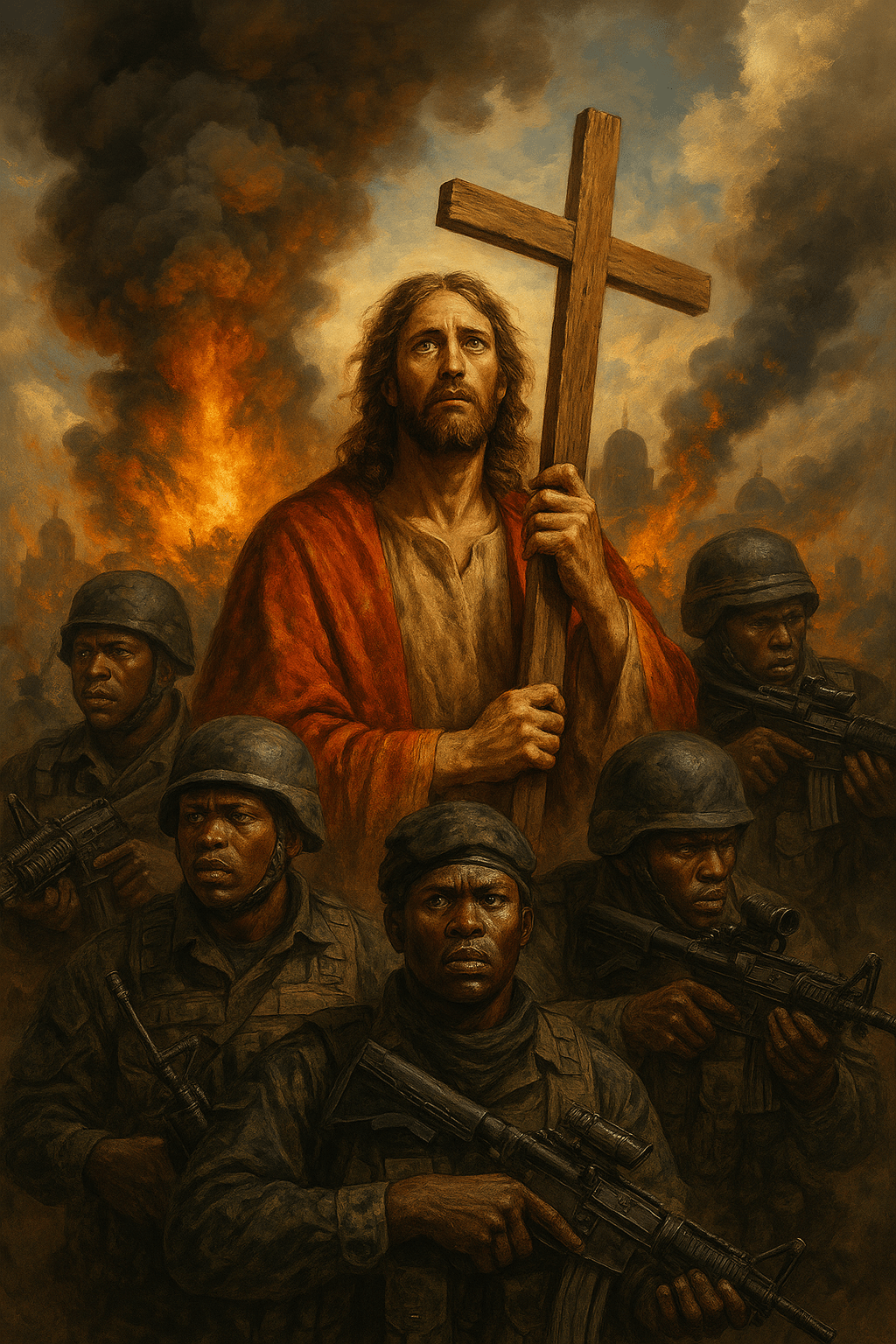
Trump’s threat to “save Nigerian Christians” is not a humanitarian mission — it is a geopolitical power grab, a resource war masquerading as moral duty, and the latest chapter in a centuries-long imperial script that uses race and religion to sanctify domination.
By Prince Kapone | Weaponized Information, | November 20, 2025
The Empire Cries “Save Them!” While Holding the Match
Let’s be honest, comrades: Donald Trump didn’t suddenly develop a tender heart for Nigerians. The man who can barely pronounce “Namibia” didn’t wake up one morning with deep spiritual concern for Black Christians. So when he thunders about invading Nigeria to stop a supposed “genocide of Christians,” a claim he publicly framed as an “existential threat” to Christians, with Fox News holy warriors echoing him and Nicki Minaj reading off a teleprompter at the UN—we’re not witnessing compassion. We’re watching theater. Imperial theater. And like all imperial theater, it’s written by people who have never listened to a single African voice except the ones on their payroll.
This is an old script with new actors, the kind the empire recycles whenever it wants a moral pretext for intervention—exactly the pattern described when analysts noted that Trump’s threat of U.S. military action clashed with Nigeria’s own reality and denials. First you pick a population the American public has been trained to care about—Christians, women, children. Then you find a corner of the world sitting on something the empire wants—oil, cobalt, lithium, a foothold against China. And finally, you package the coming intervention as “protection.” This is how colonialism dressed itself up in moral robes in the 19th century, and it’s how neoliberal warlords dress it up today. Change the fonts, update the hashtags, but the machinery is the same.
Nigeria is the perfect stage for this operation because it is simultaneously Africa’s largest Black nation and a rising hub of lithium, nickel, and rare earth extraction. When Trump talks about “saving Christians,” he’s really talking about rescuing U.S. influence in a region drifting away from Western control. Empire isn’t crying because Nigerians are dying; empire is crying because Africa is leaving the plantation.
And this is where the Christian nationalist movement in the U.S. comes in, because Christian-nationalist media explicitly elevated Trump’s genocide claim as a rallying point for interventionist politics. In their hands, Christianity is not a faith. It’s a passport. A membership badge. A racialized identity that says: “Those people are like us, and those other people—Muslims, Africans, migrants, whoever—are the threat.” So when they say “Christians are being killed in Nigeria,” what they’re really saying to white America is: “Those are your people. If we don’t go rescue them, the darkness over there will come here.” It’s missionary politics mixed with fear, mixed with old-fashioned racism—all sharpened into a weapon to justify an invasion.
But the trouble for Trump and the choir he’s conducting is that Africans have their own storytellers, because Nigeria’s government and the African Union rejected the “Christian genocide” claim outright. Nigerian journalist David Hundeyin has already exposed this narrative as a fraud. He’s been clear: yes, there is violence—but it is not the Hollywood fantasy of Muslims hunting Christians. It is a complex storm created by corruption, climate pressure, banditry, state neglect, and the fallout from Western wars in the region. It is, in short, the kind of crisis that grows in the soil of a global system designed to exploit Africa while pretending to save it.
And this is not just Hundeyin’s analysis, since the AU chair publicly confirmed “there is no genocide in Nigeria” in response to Trump’s threats. African Stream, Black Agenda Report, Hood Communist, and Black Alliance for Peace have all documented the same pattern. The so-called “terror epidemic” in West Africa didn’t drop from the heavens. It came from Libya. When NATO tore Libya apart in 2011, they cracked open a dam full of weapons, militias, and mercenaries that flooded the Sahel. Mali burned. Niger burned. Nigeria burned. The empire that now claims it must intervene to stop terrorism is the same empire that armed the men who lit the region on fire.
That’s why this essay doesn’t accept the story as told. The entire narrative is upside down. We’re told Africa is collapsing into barbarism and needs America’s firm hand. In reality, Africa is suffocating under the barbarism America already spread—slavery, colonialism, coups, debt traps, AFRICOM bases, structural adjustment, drone strikes. We’re told Nigerian Christians are uniquely targeted. In reality, official Nigerian data confirms the majority of terror victims in the northeast are Muslims, and the victims across the country are overwhelmingly poor, regardless of faith. The suffering is real—but the story is counterfeit.
And here’s the real punchline: Christian lives only matter when they serve U.S. power, as shown when Israeli strikes—backed by U.S. weapons—hit Gaza’s Christian churches and killed Christian civilians with no U.S. calls for intervention. The same politicians weeping for Nigerian Christians funded, armed, or ignored the destruction of Christian communities in Gaza, Syria, and Iraq. Christians only become sacred when empire needs them as props.
So let us say it plainly: Trump’s talk of “Christian genocide” is not a moral stand. It’s a marketing strategy for war, resource extraction, and geopolitical turf-claiming. He is preparing the U.S. public to accept a military push into West Africa, where lithium mines and rare earth deposits are becoming the new oil fields of a changing world. “Saving Christians” is the halo they place on the helmet.
In the next sections, we will strip away the halo and show the machinery underneath. We will map how NATO’s destruction of Libya supercharged the terror networks Trump now points to. We will expose the racial and imperial logics that hide African agency and erase Muslim suffering. We’ll follow the mineral routes, the AFRICOM pipelines, the proxy partnerships, and the fear of a multipolar future that terrifies Washington far more than any bandit in northern Nigeria ever could.
And we will end where all real analysis must begin: with African sovereignty. With the voices, struggles, and demands of the people actually living on this land—people who do not need Donald Trump, the Pentagon, or Nicki Minaj to speak for them. As Walter Rodney taught us, imperialism does not save the oppressed; it saves only the profits of the oppressor. And as the empire decays, its lies become louder, its theatrics more desperate, its moral performances more absurd.
This essay is written to make those lies visible—and to remind us that Africa’s future will be built by Africans, not by the empire that claims to kill in the name of saving.
How to Build a Lie: The Factory Floor of Imperial Mythmaking
Every imperial project begins with a story, and every story begins with an author. The lie about a “Christian genocide” in Nigeria did not emerge from the soil of West Africa; it grew out of a narrative that was consciously manufactured in the United States by evangelical and Christian political networks that framed Nigerian violence as a one-sided war on Christians. It was assembled piece by piece, the way a factory assembles weapons: raw materials gathered from scattered incidents, hammered into shape by pundits, polished by celebrity PR, and shipped out as humanitarian truth. What we are witnessing is not misinformation—it is imperial construction work.
The people pushing this lie are not confused. They are not misled. They are not reading the wrong news. They are building a narrative that serves power. It starts with the U.S. Christian right, because Christian advocacy organizations and conservative politicians in the U.S. have aggressively promoted a “Christian genocide” frame as a rallying cause for intervention. This political machine has long treated Africa as a canvas for its fantasies—fantasies of spiritual warfare, fantasies of civilizational battle, fantasies of white guardianship over Black “souls.” These groups cannot control America the way they used to, but overseas? Africa is still the place where they imagine themselves as righteous saviors standing between Christ’s flock and the “forces of darkness.” Give them a crisis, any crisis, and they will shape it into the image of their theology.
Trump’s circle picked up this raw material and weaponized it. As journalists and researchers have noted, advocacy reports and isolated atrocities were recast in U.S. politics and media as evidence of a coordinated “Christian genocide,” even though the underlying violence is far more complex. Suddenly, minor incidents became “massacres”; regional conflicts became “holy war”; and Nigeria—a nation with 220 million people, dozens of languages, and complex political contradictions—was flattened into a cartoon of marauding Muslims and helpless Christians. The goal was never to understand Nigeria; the goal was to prime the American public for intervention. And for that, you need a simple plot and a clear villain. The empire has always preferred cartoons; they make war easier to sell.
Then the Pentagon entered the stage. Nothing moves the U.S. media ecosystem faster than an official “leak”—the shadowy art of telling journalists exactly what you want them to print while pretending they discovered it independently. So suddenly there were whispers of “possible U.S. action in Nigeria,” “deteriorating humanitarian conditions,” and “terrorist expansion threatening regional stability,” as Trump ordered the Pentagon to prepare for potential military action and threatened to cut aid over alleged persecution of Christians. These are not leaks. These are policy advertisements. They are how the national security state warms the public before it turns up the heat.
And just when the machine needed its final touch—its glitter, its emotional hook—along came celebrity moral authority. A pop star at the United Nations is not a political event; it is a marketing strategy. Nicki Minaj’s high-profile remarks at a UN event, echoing Trump’s language about persecuted Christians in Nigeria and thanking him for his “leadership,” amplified the same narrative onto a global stage. Her scripted concern for Nigerian Christians was not spontaneous compassion—it was the glamorous final coat of paint on a narrative engineered in Washington. Empire long ago replaced missionaries with influencers. The job is the same: make domination look like compassion.
Black Agenda Report captured this perfectly: a narrative “designed in Washington that uses Africans as props to sell imperial warfare to the U.S. public,” a line that was sharpened in its segment on Nigeria when David Hundeyin explained on Black Agenda Radio that the genocide claim is cover for great-power competition and resource control, not a response to one-sided religious slaughter. In one stroke, BAR says what the entire Western press refuses to admit. Africa is not being spoken to; Africa is being spoken about. Africans are not being protected; Africans are being instrumentalized. The moral anguish being broadcast across American airwaves is not rooted in Nigerian reality—it is rooted in U.S. imperial need.
And the choice of Nigeria is not random. Nigeria is the African cornerstone of U.S. geopolitical anxiety. It is the most populous Black nation on Earth, an oil giant, a rising mineral hub, and a state whose direction shapes the fate of the entire region. It is also a country where the United States has spent years deepening military cooperation through AFRICOM, arms transfers, training, and intelligence partnerships under the banner of “counterterrorism,” while using Nigeria as a proxy to secure oil flows and counter China’s influence. As MR Online and allied research have emphasized, this proxy role is expanding at the same time that China is increasing investment, infrastructure, and energy projects across West Africa. The “Christian genocide” narrative is a crowbar meant to pry the country away from multipolar realignment.
That is why the religious framing is so crucial. Christianity is the emotional bridge between white America and African bodies. It transforms distant Africans into “our people,” and it transforms Muslims into the convenient other. Analysts have noted that the genocide language has gained particular traction in U.S. conservative and Christian-nationalist circles precisely because it activates a sense of besieged global Christian identity. This is not theology—it is racial coding. It is the empire’s favorite language: a humanitarian moralism that only applies to those who can help justify U.S. force. Black radical writers at BAR have long described this as a kind of “weaponized compassion”—a form of care that always arrives with a gun in its shadow.
But perhaps the most important part of the lie is this: it presents the United States as the only adult in the room. By painting Nigeria as a helpless victim, it erases Nigerian sovereignty, Nigerian analysis, and Nigerian agency. It replaces African journalism with U.S. punditry, African self-determination with U.S. interventionism. As researchers on Nigerian violence and foreign propaganda have pointed out, the genocide discourse often ignores local data and Nigerian voices that reject the label. This is not just a narrative distortion; it is a colonial relationship reproduced in media form. When the empire manufactures myths, what it is really manufacturing is the consent needed to override African independence.
So when Trump says he wants to “protect Nigerian Christians,” understand what is being said beneath the words. It is not a plea—it is a claim. A claim to Nigeria’s resources, Nigeria’s geopolitical position, and Nigeria’s political future. A claim that U.S. force, bases, and training are the natural custodians of “stability” in a region that Washington has already helped destabilize under the banner of counterterrorism. A claim that Africans, once again, must be saved by the very power that helped light the fires burning around them.
Here we emphasize a simple truth: the “Christian genocide” narrative is not a misunderstanding. It is a manufactured myth—built in Washington, sold by the media, sanctified by Christian nationalists, and decorated by celebrities. It is a pretext dressed as pity. And like every imperial pretext, it will lead to war unless it is exposed.
The Fire They Lit in Libya Now Burns Across the Sahel
If you want to understand the so-called “terror crisis” in West Africa—the very crisis Trump now waves around as justification for invading Nigeria—you have to start in Libya. Not in Borno. Not in Kaduna. Not in Plateau or Zamfara. Libya. Because that is where the match was struck. That is where NATO, under the holy banner of “democracy,” “human rights,” and “Responsibility to Protect,” launched its 2011 military intervention that toppled the Libyan state with decisive U.S. and European air power. In doing so, NATO turned a functioning African state into what multiple studies describe as a major source of uncontrolled arms flows and a hub for armed groups across the region. The fire did not spread south by accident; it followed the gravitational pull of imperial violence. When you destroy a state, the shockwaves do not stop at the border. They travel through the region like a pulse of chaos, seeking the cracks colonialism already left behind.
Before 2011, Libya was not some paradise free of contradictions. No nation is. But it was a state—with borders, institutions, revenue, and the ability to police its territory. When NATO dropped its bombs, it wasn’t “liberating” anything; it shattered the country’s security architecture and unleashed armed factions into the wider Sahel-Sahara zone. Overnight, arms depots were cracked open like giant metal eggs. Tanks, rifles, rocket-propelled grenades, ammunition—all of it spilled into the desert, into the hands of whoever could grab them first. Research has documented how Libyan stockpiles qualitatively enhanced the firepower of non-state armed groups in Mali and beyond, while arms trafficking routes from Libya into Niger and the Sahel re-emerged as a major source of weapons after the war. Mali noticed. Niger noticed. Chad noticed. And yes, Boko Haram noticed. The West does not like to talk about this because it exposes the truth: they didn’t just “intervene” in Libya—they detonated the entire Sahel.
Black Agenda Report, Hood Communist, and the Black Alliance for Peace have been screaming this truth for years, long before CNN pretended to discover “African instability” in a panic. These outlets documented the immediate chain reaction: Tuareg fighters, suddenly unemployed and heavily armed after Gaddafi’s fall, moved into Mali and helped trigger the 2012 rebellion, a process also traced by mainstream security analysts who link the Malian crisis directly to Libya’s collapse and the flow of fighters and arms south. AQIM and MUJAO followed the trail of weapons like vultures circling a fresh carcass. In Nigeria, Boko Haram—once a localized movement with limited capacity—suddenly had access to military-grade firepower, as multiple reports on illicit arms flows from Libya into West Africa highlight the group’s qualitative leap in weaponry after 2011. As David Hundeyin notes, this was not divine prophecy or the unfolding of ancient ethnic hatreds. It was the predictable consequence of turning Libya into an imperial graveyard.
Even the U.S. government has been forced to admit this, but only in hushed tones. Congressional and UN reporting have acknowledged that the collapse of Libyan state control led to arms proliferation and destabilization across the Sahel despite an arms embargo. This is polite diplomatic language for: “We smashed the state and handed weapons to every armed group within a 1,000-mile radius.” You will never hear these admissions in public speeches because they unravel the central myth of Western interventionism: that the empire brings order, not chaos. In reality, the empire manufactures chaos the way a factory produces plastic—endlessly, cheaply, and without accountability.
African Stream and MR Online have gone deeper, tracing how the fallout from Libya reshaped the entire Sahel political economy. What looks like “religious extremism” from Washington’s distance is, on the ground, a collapse of borders, economies, and political structures once held together in part by Libya’s regional role as a labor market, financial hub, and security actor—dynamics echoed in analyses that link the current Sahel crises to the long aftershocks of NATO’s Libyan war and the broader failures of the Western security model. Wars in Mali, coups in Niger, insurgencies in Burkina Faso—these are not disconnected events. They are aftershocks of a single imperial earthquake. And just as with every earthquake, the most vulnerable are hit the hardest: the rural poor, migrants, pastoralists, women, young men with no jobs and plenty of desperation.
Nigeria felt the shock too. Boko Haram—notorious as it already was—transformed from a fringe insurgency into a regional menace. Weapons flowed in. Fighters trained in Libya arrived with battlefield skills. Smugglers built new routes. Banditry escalated. Studies on regional arms flows show how weapons trafficked from Libya and other conflict zones have fed armed groups across the Sahel, including in Nigeria’s borderlands. The Nigerian state, hollowed by decades of corruption and neoliberal restructuring, could not contain the tide. This wasn’t simply a Nigerian failure—it was a regional collapse engineered thousands of miles away in the offices of NATO commanders and U.S. policymakers who still congratulate themselves for “saving Libya.”
So when Trump now points at Nigeria’s insecurity and declares it proof of “Islamic terror spiraling out of control,” we should answer him plainly: “You lit the fire.” The West created the conditions for Boko Haram’s expansion. The West expanded AFRICOM across the continent under the excuse of “counterterrorism,” even though every expansion of AFRICOM’s footprint has coincided with the spread of armed groups and violent attacks rather than their reduction. The West smashed Libya, opened the floodgates, and now claims it must invade Africa because Africa is burning. It is the logic of the arsonist who returns with a fire hose and demands payment for his service.
This is why the “Christian genocide” framing is not just a lie—it is a lie built on top of another lie. The terror networks that supposedly justify U.S. intervention were amplified by Western intervention in the first place. As Hood Communist and BAP writers argue, imperialism manufactures the very insecurity it later cites as a mandate for more bases, more training missions, and more arms deals. As Black Agenda Report reminds us, AFRICOM’s core function is not to stop terrorism but to secure U.S. control over African territory, governments, and resources under a counterterrorism brand. And as African Stream makes clear, the Sahel’s turn away from France and toward new partners—Russia, China, and intra-African solidarity—has made Western powers desperate to reassert dominance.
Understand this, comrade: the empire is not horrified by the violence in West Africa. It is horrified that the violence it helped unleash has opened a political space in which African countries are rejecting Western authority. Mali expelled the French. Burkina Faso expelled the French. Niger expelled the French and then withdrew from ECOWAS, moves that culminated in the formation of the Alliance of Sahel States, a bloc openly asserting sovereignty and building joint security structures outside Western control. The AES states have deepened ties with non-Western partners and publicly denounced neocolonial interference, as their formal exit from ECOWAS and creation of a separate regional framework made clear. In this context, Nigeria becomes the big prize—the state the West must hold onto if it wants to contain this tidal wave of self-determination.
That is the real backdrop to Trump’s rhetoric. Libya was ground zero. The Sahel is the fire line. Nigeria is the target. And the “Christian genocide” story is the bait. Strip away the tears and the trembling voices, and you see what you always see behind imperial humanitarianism: strategy, resources, and fear. Fear that Africa is breaking free. Fear that multipolarity is maturing. Fear that the days when the West could burn a country and walk away without consequence are fading into history.
The West may have lit the fire, but Africa is learning to rebuild without them. And that, more than anything, is what keeps them awake at night.
The Victims They Ignore: When Truth Dismantles the Holy War Story
The entire premise of Trump’s narrative rests on a simple claim: that Christians in Nigeria are uniquely and systematically targeted by “Islamic terrorists,” and that only U.S. military intervention can stop the slaughter. It’s a clean story—clean enough for cable news chyrons and Sunday sermons. But clean stories rarely survive contact with reality. And in Nigeria, reality tears this story to pieces.
Start with the basics, the kind of facts the empire studiously avoids. According to the African Union Commission chairperson Moussa Faki Mahamat, and to Nigerian government and security figures who publicly rejected the “Christian genocide” framing, as well as years of UN- and NGO-based reporting on Boko Haram and ISWAP violence, the overwhelming majority of victims in the northeast are Muslims. Let me repeat that slowly, for the benefit of any Christian nationalist operative who might be confused: most of the people killed by Boko Haram are Muslims. They are the farmers in Borno. The traders in Yobe. The children in Adamawa. The villagers attacked on their way to fetch water or tend their fields. Reports compiled by humanitarian and research bodies consistently describe Muslim-majority rural communities bearing the brunt of terrorist and militia violence across northern Nigeria. They are poor, rural, and abandoned by the Nigerian state long before the militias arrived.
But you will never hear this from Trump or from the Christian-right media machine backing him. Because if Muslims are the primary victims, then the story collapses. It stops being a clash of civilizations and becomes what it really is: a crisis of state neglect, economic deprivation, climate pressure, corruption, and the aftershocks of NATO’s war on Libya. Analysts and field research on Nigeria’s overlapping conflicts emphasize land pressure, climate stress, food insecurity and criminal opportunism , along with a general security vacuum exploited by multiple armed groups. And that kind of crisis cannot be solved by U.S. Marines, drones, or the enthusiastic Bible-thumping of Fox News commentators. It requires development, justice, sovereignty, and political courage—things the empire has never offered to Africa.
David Hundeyin has said it plainly: the violence in Nigeria is not the neat religious war that American politicians want it to be. In his conversation with Black Agenda Report, archived by MR Online’s feature on “Major Power Politics, Rare Earth Minerals, and Claims of Genocide in Nigeria”, he rejects the idea of a one-sided genocide against Christians and instead describes a messy, structural conflict produced by decades of theft and decay at the top of Nigerian society, combined with regional destabilization unleashed by Western intervention. Yes, Christians have been killed. Yes, churches have been targeted. But so have mosques, Muslim communities, markets, and entire Muslim-majority towns; documentation of attacks by Boko Haram and ISWAP includes repeated assaults on both Christian and Muslim places of worship and communities. This is not a holy war—it is a war on the poor.
The Western press erases this complexity because it disrupts their script. Their script requires Christian victims—preferably Black, preferably photogenic, preferably crying on camera. It requires a villain who can be framed as the embodiment of Islamic barbarism. And it requires a savior: the United States, riding in on a drone, whispering “we’ll protect you” while simultaneously arming half the actors in the conflict. If Muslims are dying in greater numbers—and they are—then the moral logic collapses. You cannot justify invading a country to “save Christians” when the people doing most of the dying are Muslims. The empire’s halo begins to crack.
And let’s go even deeper: why does the American public so easily accept a narrative of Muslims slaughtering Christians? Because U.S. media and political culture have spent twenty years marinating this society in Islamophobia. After 9/11, a dense web of think tanks, pundits, and security commentators normalized the idea of Muslims as an inherent security threat, while civil rights and research organizations tracked a sharp rise in anti-Muslim stereotypes, violence, and discriminatory policy. Muslims are “terrorists.” Muslims are “radical.” Muslims are “the problem.” So when Trump and his disciples say “Muslims are killing Christians in Nigeria,” the narrative slips smoothly into the grooves of imperial common sense. No need for evidence. No need for context. Just stir the pot and let the audience’s prejudices do the rest.
This is why the erasure of Muslim suffering is not an accident—it is a requirement. You cannot mobilize white Christian America to support intervention in Nigeria unless you create a hierarchy of victims: Christian suffering at the top, Muslim suffering buried beneath the floorboards. As Black Agenda Report has long argued in its coverage of U.S. wars and “humanitarian” interventions, this pattern is central to U.S. foreign policy. Humanitarian concern is never universal; it is selective. It is a racial and political calculation disguised as empathy.
So what does the real map of Nigerian suffering look like? The real map is not organized by religion. It is organized by poverty. By geography. By corruption. By the lines colonialism drew and neoliberalism deepened. In the northeast, Muslims are the first and last victims of Boko Haram. In Plateau, Kaduna, and Benue, clashes between farmers and herders reflect economic desperation, land disputes, climate stress, and the collapse of conflict-resolution mechanisms—factors even acknowledged inChristian advocacy literature that still tries to emphasize a religious frame. In the northwest, rural banditry has evolved into a relentless cycle of murder, rape, abduction, and extortion that frequently targets Hausa Muslim villagers—it has no loyalty to creed, it kills whoever is in reach. The empire flattens all this into a single cartoon: “Muslim savages killing Christians.” But the people on the ground know better.
And Africans are saying it loudly. Nigerian officials, retired military officers, jurists and academics have publicly rejected the claim that current violence amounts to a uniquely Christian genocide. The African Union leadership has warned against loose “genocide” rhetoric and stressed that Boko Haram’s first victims were Muslims, not Christians. African researchers and independent journalists, from national outlets to diaspora platforms, have repeatedly emphasized that the violence cannot be reduced to religious identity. As Hundeyin puts it, in that MR/BAR conversation: Nigeria’s crises are political and economic, not theological. The poor are dying on both sides of the religious divide, and the wealthy elites atop the state—along with the Western powers hovering over them—are the only ones gaining from the turmoil.
The tragedy is real. The grief is real. The loss is real. But the empire’s story about it is fake. And when a lie is built upon the graves of the poor, we owe it to the living to expose it. Trump is not proposing intervention to protect Christians. He is proposing intervention to protect U.S. interests. The people dying in Nigeria—Muslim and Christian alike—are not his concern. They are his excuse.
The real victims do not need an American savior; they need a world that stops treating their suffering as a political tool. They need a Nigeria that serves the people instead of the elite. They need a region free of Western militarism and foreign manipulation. And above all, they need the truth—because the truth is the first casualty of every imperial war.
When Christians Die on the “Wrong” Side of Empire
If the United States truly cared about protecting Christians, the world would look very different. Church leaders in Jerusalem have documented how Israeli airstrikes hit the compound of Gaza’s St. Porphyrios Greek Orthodox Church in October 2023, collapsing church halls where displaced families were sheltering and killing at least 18 people, including children. After that attack, many survivors took refuge at the nearby Holy Family Catholic Church, which itself has since been damaged and repeatedly threatened by Israeli military operations. On 16 December 2023, the Latin Patriarchate of Jerusalem reported that an Israeli sniper killed two Palestinian Christian women and wounded seven others inside the Holy Family parish compound where most of Gaza’s Christian families had taken refuge. All of this has unfolded under a bombardment campaign in which Amnesty International has identified U.S.-made JDAM kits in unlawful Israeli strikes on homes in Gaza, and in which investigators describe air-dropped explosive weapons causing “catastrophic impacts” on civilians across the strip. Yet there was no wave of demands from Trump or his Christian-right base to send the Marines to “save” these Palestinian Christians. Christian lives only matter to the empire when they can be weaponized. When they get in the way of imperial plans, their deaths are footnotes, collateral, or simply invisible.
The same double standard stretches across the broader region. Research on Christians in the Middle East notes that communities in Iraq and Syria—some with roots going back many centuries—have been devastated by the U.S. invasion of Iraq, state collapse, and the rise of extremist militias such as ISIS. In Iraq and Syria alike, entire Christian populations have been displaced from historic towns in places like Mosul and parts of the Nineveh Plains as wars and sectarian violence have torn societies apart.
These communities were not destroyed by some abstract “evil.” They were destroyed in conflicts where regional and Western powers funneled money and weapons into armed factions vying for power in Syria and Iraq, while extremist groups exploited the collapse of state institutions. Churches burned. Families fled. In many areas, most of the local Christian population vanished within a few years. Washington did not frame this as a moral emergency demanding intervention to save Christians, because at that moment those Christians were “in the way.” Protecting them would have interfered with the real mission: regime change and regional dominance.
Empire does not operate on morality. It operates on utility. When Christian deaths help a narrative—when they can be used to manufacture a moral emergency that justifies military action—the empire wraps itself in the language of compassion. Even as Christian organizations and solidarity campaigns in the Global South and North document the role of U.S. and European arms manufacturers in supplying weapons used in Gaza, the official U.S. line remains unwavering support for Israel’s war. When those same weapons level Palestinian neighborhoods, including church compounds, the silence from Washington’s power brokers is deafening. It is not that the empire hates Christians; it is that it has no use for Christians unless they serve its geopolitical aims.
This is why Trump’s sudden sanctimony about Nigerian Christians rings so hollow.
The same administration that tried to ban people from several Muslim-majority countries from entering the United States under Executive Order 13769, “Protecting the Nation from Foreign Terrorist Entry into the United States” now claims it wants to save African Christians from Muslim violence. The same political current whose core base—white evangelical Protestants—remains the most supportive of Israel’s bombing campaign in Gaza, with roughly 64% saying Israel is justified in its military actions and 60% opposing limits on U.S. military aid, now claims to be heartbroken about Christian suffering abroad.
These are not the instincts of a movement driven by compassion; they are the reflexes of a bloc that treats religion as a tool of statecraft.
Marx once said the ruling class is capable of anything except telling the truth about itself. Here, the truth is obvious: Christianity is not holy to the empire; it is a weapon in its arsenal. The cross becomes a cudgel. Compassion becomes cover. Tears become ammunition. And the suffering of Black Christians in Nigeria becomes the latest installment in an old imperial pattern: turn the oppressed into props, then march the troops in behind them.
To believe Trump’s story, you would have to believe the empire has had a sudden moral awakening. But empires don’t wake up moral. They wake up hungry. Radical political-economic analysis from outlets like Monthly Review has long argued that U.S. wars follow the map of resources and strategic chokepoints, not the map of human rights rhetoric. Nigeria—rich in oil, rich in minerals, rich in strategic position—is exactly the kind of meal the empire prepares its prayers for. “Saving Christians” is not a mission; it’s a marketing campaign. It’s the sermon preached before the bombing run.
And so we say, with the clarity the working class always brings to politics: if the United States didn’t save Christians in Gaza, or in Syria, or in Iraq, it is not coming to save Christians in Nigeria. It is coming to save its interests. Everything else is decoration.
The challenge for us is to tear down the decoration, expose the machinery underneath, and insist that Christian, Muslim, and all Nigerian lives have value independent of U.S. strategy. Because once you strip away the lies, one thing becomes clear: the empire never protects the people it claims to. It protects the extraction routes, the military bases, and the geopolitical chessboard. Everyone else is collateral.
The Empire’s Favorite Fuel: Terror as a Renewable Resource
The United States talks about “fighting terrorism” the way an oil company talks about “protecting the environment.” With one hand they point to the flames, and with the other they pour gasoline. The entire architecture of Western security in Africa—from AFRICOM’s network of bases and outposts to NATO partnerships to shadowy special operations and “light footprint” deployments—functions not to eliminate terrorism, but to manage it, cultivate it, and deploy it whenever it becomes politically useful. Terror, for the empire, is not an obstacle. It is a resource. A renewable one.
This is not rhetoric; it is the documented political reality of U.S. operations across the continent. Black Agenda Report’s analysis of AFRICOM shows that “if AFRICOM’s mission is to fight terrorism, then why have terror attacks increased five-fold since the U.S. began its military occupation of the continent,” explicitly tying AFRICOM’s expansion to a surge in militant violence. Nick Turse’s summary of Africa Center for Strategic Studies data, circulated through Black Alliance for Peace’s AFRICOM Watch Bulletin, reports that deaths from terrorism in Africa have jumped more than 100,000 percent during the U.S. “war on terror,” with fatalities in the Sahel alone reaching about half of all militant Islamist-linked deaths on the continent. At the global level, the Wilson Center and the Institute for Economics and Peace’s Global Terrorism Index document that the Sahel now accounts for roughly 40–50 percent of terrorism deaths worldwide, up from a marginal share in the early 2000s. The curve is unmistakable: every year AFRICOM expands its bases, its training programs, its “advisory missions,” and every year insurgent violence spreads further across the Sahel. If AFRICOM were a medicine, any rational doctor would have pulled it from the shelves by now. But AFRICOM isn’t medicine—it’s a business model, a justification for permanent military access to African soil.
You can see this logic nakedly in NATO’s own Sahel and “south” strategy papers, which treat “Sahel instability” not as a humanitarian nightmare but as a strategic opportunity for “engagement,” “partnership,” and “projecting stability” through military presence. In their view, instability creates the conditions for “engagement,” and “engagement” creates the conditions for military presence, and military presence creates the conditions for influence. This is not a conspiracy; it is the imperial doctrine spelled out in technocratic language. Policy documents and base maps alike show that crises are used to justify deeper NATO and U.S. entrenchment. Terror does not threaten Western power—it clarifies the necessity of Western power. Without chaos, the empire would have no argument for its global sprawl.
And this brings us back to Nigeria. Geopolitical analysts like David Hundeyin have put the matter plainly in investigations and interviews: the violence in Nigeria is not being used to save the Nigerian state—it is being used to position Nigeria as a U.S.-aligned pivot in the emerging global conflict with China and other rivals. Anti-imperialist researchers have likewise argued that AFRICOM’s core purpose is geopolitical competition with China, not “fighting terror”. Nigeria is too big, too strategic, too mineral-rich to be left in the hands of a multipolar future. It must be secured, disciplined, and integrated into Washington’s plan for an African front in the new Cold War. Terrorism is simply the convenient excuse.
This is not new. It is the Libya–Syria template all over again. None of this should come as a surprise when you trace the genealogy of the very forces Washington now claims to be fighting. The U.S. intelligence services have a half-century track record of cultivating, arming, and unleashing Islamist paramilitaries whenever it suits imperial strategy. During the Cold War, the CIA’s massive covert program in Afghanistan—Operation Cyclone—poured billions of dollars in weapons into mujahideen factions through Pakistan’s ISI, helping create the transnational jihadist networks that later evolved into al-Qaeda. As specialists in the origins of al-Qaeda have documented, this was not accidental “blowback” but the predictable result of a deliberate strategy: use Islamist militancy as a destabilizing proxy force against geopolitical rivals. Washington did not “discover” terrorism in 2001—it had been funding, training, and weaponizing the very currents that became global jihad for decades.
The pattern only intensified in the 2010s. In Libya and Syria, U.S. officials were perfectly aware that their “rebel partners” were deeply intertwined with al-Qaeda–linked factions. A declassified 2012 Defense Intelligence Agency memo explicitly warned that Western, Gulf, and Turkish support to the Syrian opposition risked creating a “Salafist principality” in eastern Syria—effectively predicting ISIS. Yet the arms flowed anyway. In leaked emails published by WikiLeaks, Hillary Clinton’s inner circle acknowledged that U.S. allies Saudi Arabia and Qatar were providing “clandestine financial and logistic support” to ISIS and other extremist groups. Another leaked email from Jake Sullivan to Clinton summed up U.S. policy with chilling bluntness: “AQ is on our side in Syria.” These were not mistakes. They were choices. Terror was not an external threat—it was a tool of statecraft.
Nigeria fits perfectly into this pattern. Boko Haram’s origins were local, but its transformation into a regional powerhouse was not. That transformation followed the collapse of the Libyan state after the 2011 NATO intervention, the flood of looted weapons from Libyan stockpiles into the Sahel and Lake Chad basin documented by Conflict Armament Research field investigations, the collapse of state capacity across the Sahel, and the expansion of AFRICOM’s “counterterrorism operations”—which, in practice, meant more training, more militarization, and more corruption inside African security structures. UN and UNODC studies on firearms trafficking in the Sahel similarly show how porous borders, post-Libya weapons flows, and militarized responses have amplified violence rather than reduced it. Whenever the empire touches a conflict, it grows. Whenever the empire arms a state, that state becomes weaker. Whenever the empire claims to bring stability, instability multiplies.
This is why the U.S. is not panicking about terror in Nigeria. It is panicking about losing control. It is panicking about African realignment toward Russia and China. The Alliance of Sahel States openly frames its break with France and the West as an assertion of sovereignty, and Russia has deepened its military backing for Sahel governments that have expelled Western troops. French influence is evaporating across West and Central Africa under pressure from popular mobilizations and new governments, and African populations have repeatedly taken to the streets to demand foreign forces, especially French troops, leave their soil. It is panicking because Africa is slipping away, and without Africa, U.S. global power collapses. Terror is simply the scaffolding they use to justify holding on.
The empire needs terrorism because terrorism explains the empire. Without an endless parade of jihadist threats, “state failure,” and “regional instability,” there is no justification for U.S. bases and drone hubs stretching from Niger to Djibouti, no justification for forward operating sites in Kenya like Camp Simba, no justification for U.S. naval patrols along West Africa’s coast in the Gulf of Guinea, no justification for the billions in weapons contracts and “security partnerships” that enrich the military-industrial complex, documented even in cautious policy papers warning of U.S. overreach. Terror is the constant crisis that legitimizes constant occupation.
And so we arrive at the bitter truth: the United States does not want to eradicate terrorism in Africa. It wants to curate it. Shape it. Keep it at a level that justifies its presence without threatening its dominance. Analysts mapping U.S. basing and drone infrastructure in Africa show how this permanent war footing is baked into the architecture itself: bases, runways, logistics hubs, training camps, “partner” units, all designed for endless “stability operations.” As long as the fire burns—not so hot that it spreads beyond containment, but hot enough to require American firefighters—the empire can continue to position itself as indispensable.
Trump’s Nigeria rhetoric fits neatly into this framework. The talk of “Christian genocide” is the moral gloss. The talk of “terror spiraling out of control” is the strategic justification. The real goal is deeper: pull Nigeria firmly into the Western orbit as part of AFRICOM’s broader strategy, block Chinese influence and other multipolar partners, lock in access to strategic minerals and energy, and prevent the Sahel’s anti-colonial momentum from spreading to Africa’s most important state.
In other words: terrorism in Africa is not a crisis to be solved—it is a political instrument to be wielded. And the empire is determined to wield it for as long as Africa remains central to the struggle over the 21st century.
Where the Guns Are, the Minerals Are: Mapping Death Along the Empire’s Supply Chains
If you strip away the sermons, the crocodile tears, and the breathless Fox News monologues about “persecuted Christians,” what you find underneath Trump’s Nigeria narrative is something older and far more familiar: a map. Not a map of religion. Not a map of ideology. A map of extraction. A map of profit. A map of minerals. Because wherever the empire points and screams “barbarism,” you can be sure it has already circled the resources in red ink.
Look at the geography of Nigeria’s violence. Start in Zamfara and Kaduna. These are not centers of Christian martyrdom. They are centers of gold. Illicit gold extraction has been shown to prolong violent conflict in Zamfara. Authorities themselves admit that illegal mining and gold smuggling are tightly linked to banditry and arms flows. Nigeria today is a war economy in which bandits seize mining sites, extort miners, and convert gold into weapons through middlemen and smuggling routes. Studies of artisanal and small-scale gold mining in Nigeria find widespread child labour in these informal mining belts, and health researchers have shown how gold booms in northern Nigeria have literally been killing children. The “gold-for-guns” economy is not a metaphor; journalistic investigations describe how gold proceeds are stockpiled and smuggled across borders to buy rifles, RPGs, and other weapons that tighten bandit control over whole districts. Bandits are not stumbling into these mining belts by coincidence. They are there because gold has become more valuable than human life, and because corrupt elites—local, national, and foreign—are profiting from the chaos. If you want to understand the bullets, follow the bullion.
Move down to the Niger Delta. For decades, the delta has been the core of Nigeria’s oil production and export economy and yet one of the poorest and most socially devastated regions in the country. Oil majors like Shell have left vast areas of the delta heavily contaminated, with clean-up efforts failing to repair the ecological disaster. The conflicts there are not about God. They are about pipelines, pollution, land theft, and the violent backlash against a state that treats the people like collateral damage in an oil war. For residents, as one study put it, “it is the presence of oil that has made them poor,” as livelihoods are destroyed by spills and gas flaring. The delta taught the empire something important: if you keep a region unstable, you can extract what you want while pretending you are bringing “security.”
And now, Nigeria finds itself in the crosshairs of a new global scramble—not for just for oil or gold this time, but for the minerals that will power the so-called green transition. Lithium. Nickel. Rare earth elements. The building blocks of electric vehicles, batteries, solar panels, and advanced electronics. Analysts of the new “resource frontier” note that lithium, cobalt, and rare earths are now explicit levers of state power in great-power rivalry. China currently dominates global processing of many critical minerals, including around 80% of rare earths and other key inputs for high-tech industries, and U.S. policy white papers openly frame critical mineral supply chains as a national security issue and a domain of strategic competition. Minerals that China already dominates in mining, refining, and processing. Minerals that the United States desperately wants to control.
Where are Nigeria’s richest lithium deposits? Geochemical studies identify major lithium-bearing pegmatites in Kogi, Nasarawa, Ekiti, Kwara, Cross River, Oyo, and Plateau States. Nigeria is already moving to capitalise: the government has announced Chinese-backed lithium processing plants and policies to curb raw exports, and Chinese firms are taking stakes in Nigeria’s lithium and electric-vehicle future. On the ground, the boom looks like something else entirely: in Nasarawa, dozens of informal and illegal lithium sites have sprung up, with children and desperate workers labouring in dangerous pits to feed global battery supply chains. Again: not a coincidence. In every era of African extraction—from Belgian rubber terror in the Congo Free State to today’s cobalt mines in the DRC supplying “green” technologies—violence follows the minerals like a shadow. The empire does not arrive when a region is stable. It arrives when a region is profitable. And if the region is not profitable yet, it becomes “unstable” until it is.
This is what David Hundeyin and the Black Alliance for Peace have in mind when they link the “Christian genocide” narrative in Nigeria to a scramble for rare earths and other strategic minerals. It is not a metaphor. It is literal. In interviews and investigations, Hundeyin has argued that U.S. rhetoric about protecting Christians masks a bid to secure control over Nigeria’s rare mineral deposits against China. The story being sold to the American public is the moral wrapper around a geopolitical mission: seize access to the minerals of West Africa, block China from consolidating its supply chains, and position Nigeria as a Western-controlled hub in the global energy transition. Dossiers mapping U.S. and allied bases across Africa show how AFRICOM’s footprint clusters along key strategic corridors, and African and diasporic anti-war movements explicitly describe AFRICOM as the military enforcement arm of a neocolonial project to guarantee access to African resources. AFRICOM bases do not appear randomly. They appear along the arteries of extraction.
And this is not new. The empire has been running this playbook since the first European boots touched African soil. Rubber concessions in the Congo were enforced through mutilation, forced labour, and mass death. Uranium from Niger has long powered France’s nuclear industry under exploitative conditions that have fuelled political crisis. Cobalt in Congo is ripped out of the ground by workers and children for global tech companies. Oil was entangled with the long Angolan civil war and the interests of Western oil majors, and oil exports in Sudan became a turning point that intensified war and displacement. Today it’s lithium and rare earths. Tomorrow, it will be whatever powers the next phase of imperial profit. In every case, the formula is the same: create instability, militarize the region, demonize the local population, paint the U.S. as a benevolent savior, then carve out the resources while the world watches the humanitarian theater instead of the extraction machinery behind it.
The murder maps and mineral maps overlap because they are drawn by the same hand. Every point of violence is a point of value—value for corporations, for Western strategists, for political elites, for mining conglomerates. And every time the U.S. cries “crisis,” “terror,” or “Christian genocide,” it is preparing the ideological ground for securing those points of value with soldiers, proxies, or sanctions.
Nigeria is not being targeted because Christians are dying. Nigeria is being targeted because lithium is rising. Because gold is bleeding out of the earth. Because China is investing. Because multipolarity is gaining ground. Because Chinese capital and firms are already anchoring parts of Nigeria’s lithium and EV supply chain. Because the empire cannot afford to lose Africa’s most strategic state at the exact moment its global hegemony is slipping.
So when Trump waves the banner of “saving Christians,” understand the real message beneath it: “Save the minerals.” “Save the contracts.” “Save U.S. dominance.” This is the theology of empire—the religion of extraction dressed up as compassion. And until we expose it, the bodies will continue to pile up on the front lines of someone else’s profit margin.
The Empire’s Panic Button: Africa Is Walking Away
To understand why Trump is suddenly thundering about Nigeria, you have to look beyond Nigeria. You have to zoom out and see the continent-wide shift that is scaring the hell out of Washington. Africa—long treated as a backyard, a laboratory, a pit of raw materials—is no longer moving on Western time. One country after another is snapping the chains of neocolonial military tutelage. The Sahel, once the centerpiece of French and American control, is breaking away. And the empire, used to ruling Africa by default, is watching its influence evaporate like water in the Sahara sun.
Look at Mali. After years of French soldiers on the ground, after countless counterterror missions and speeches about “partnership,” the people finally said: enough. In August 2022, the last French troops left Mali, ending a nine-year deployment. In January 2023, Burkina Faso told French forces to pack up and leave. By 2024, France agreed to end its military presence in Niger after the new authorities demanded their withdrawal. Then came the next step: Mali, Burkina Faso, and Niger forged the Alliance of Sahel States mutual defence pact, and later walked out of ECOWAS together. The message is simple: no more foreign tutelage, and no more playing junior partner to Paris.
On the streets, that break with the old order looks and sounds like celebration. Crowds in Bamako, Ouagadougou, and Niamey welcomed the end of France’s Operation Barkhane. In the political sphere, the Alliance of Sahel States has put sovereignty, not “partnership,” at the centre of its agenda. The Sahel’s new governments frame their break with France as part of a wider anti-imperialist turn. This is not the decorative sovereignty the West hands out at conferences. This is real power being shifted back to capitals that were expected to take orders.
Western media promised disaster if the French left: chaos, collapse, extremist takeovers. The same outlets have far less to say about the reality that followed. Local reporting from the Sahel describes populations that see the AES as a vehicle to end decades of humiliation and external control. Pan-African forces connect this shift directly to a broader fight against hyper-imperialism on the continent. The script says Africa cannot function without Western supervision. The lived experience in the Sahel is saying otherwise.
Now place Nigeria into this unfolding picture. Nigeria holds about half of West Africa’s population, with well over 200 million people. World Bank projections put that number more than 100 million higher by mid-century. GDP revisions in 2024 reaffirmed Nigeria’s place near the top of Africa’s largest economies. In regional diplomacy and security, Nigeria has long been treated as the anchor inside ECOWAS. If the Sahel’s anti-colonial wave reaches a country of this size and weight—if Nigeria tilts away from Washington’s orbit—the nerve centre of imperial power in West Africa starts to come apart. France is already losing its grip. If the U.S. loses Nigeria, it loses the region. If it loses the region, it loses Africa. And in a century defined by resource wars and systemic crisis, losing Africa means losing the future.
This is the backdrop for Washington’s anxiety about China. China’s deepening ties with Africa and the BRICS+ framework are already cutting into U.S. leverage. Chinese companies are building roads, railways, ports and industrial parks across the continent, and Beijing openly lists African rail lines, port facilities, power plants and special economic zones as key Belt and Road projects. Flagship projects include the standard gauge railway in Kenya and new port infrastructure in Djibouti. Opinion surveys across the continent show that majorities view China’s economic and political influence positively. For the first time in half a millennium, Africa is not locked into a single imperial supplier.
For the U.S. ruling class, that is a direct challenge. AFRICOM was built to keep the continent wired into Washington’s security circuitry, even as the expansion of U.S. military presence marched in step with worsening insecurity. ECOWAS has been nudged into the role of regional enforcer, threatening military action against Niger when the new government broke with France and the West. At the same time, Sahel governments are spelling out sovereignty projects that do not pass through Western approval. Protesters in Burkina Faso demanded French withdrawal until it became a reality, and even Senegal has started the process of transferring French bases back to its own control. Meanwhile, Nigeria has signed new economic and energy deals with China, including projects under the Belt and Road banner. The monopoly is gone; choices are multiplying.
This is where the “Christian genocide” story comes in. It gives the empire a moral emergency to brandish as it fights to reinsert itself. In his latest threat against Nigeria, Trump presented himself as the defender of Christians against “mass slaughter”. Regional bodies and international partners, including ECOWAS, the EU and China, have pushed back on that framing and voiced support for Nigeria’s sovereignty. The narrative turns a crisis of U.S. power into a humanitarian crisis for U.S. audiences. Africa’s anti-colonial realignment is recast as an invitation to restore Western tutelage. Military intervention is repackaged as a rescue mission.
The panic is not about Christians. The panic is about control. The panic is about the Sahel rejecting occupation. The panic is about Russia and China filling a vacuum the West created. The panic is about multipolarity putting down roots in African soil. The panic is about the empire losing the continent it long treated as expendable. In Washington’s mind, a sovereign Africa is a crisis. A multipolar Africa is a threat. And a Nigeria aligned with African interests over Western interests is an existential danger to U.S. hegemony.
So when Trump bellows about intervening in Nigeria, hear the translation: “Africa is slipping from our hands. We must create a moral pretext to grab it back.” That is the meaning of the moment. Behind all the noise about religion, terrorism, and humanitarian concern lies a single geopolitical truth: the empire is panicking because Africa is finally walking away.
The Missionary Mask: How Empire Uses Race and Religion to Sanctify Theft
Strip away the speeches, the Scripture quotes, and the trembling voices on Fox News, and what you find beneath Trump’s Nigeria narrative is not theology—it’s anthropology. Not faith—race. Not compassion—hierarchy. The United States is not mobilizing to “save Christians”; it is mobilizing to protect a racialized world order in which African life is expendable, African sovereignty is negotiable, and African land is a staging ground for Western ambition. Religion is the mask. White supremacy is the face.
This is the oldest trick in the colonial playbook. For centuries, the colonizer insisted he was rescuing Africans—from sin, from savagery, from themselves. First it was the missionaries with their crosses, then the administrators with their ledgers, now the generals with their drones. The story is always the same: Africans are children, the West is the father, and domination is “protection.” The empire cannot comprehend Africa outside this framework because the framework is what justifies its existence.
As every revolutionary must understand: humanitarianism is one of the most durable ideological weapons of Western imperialism. It launders violence into virtue. It converts domination into duty. It makes occupation sound like obligation. And when you add Christianity into that mix—particularly a weaponized, racialized Christianity rooted in American exceptionalism—you get the perfect ideological cover for neo-colonial intervention. This is not the Christianity of liberation theology. This is the Christianity of gunboats and plantation overseers, reborn in the age of AFRICOM.
Hood Communist extends this analysis: the United States presents itself as the “adult in the room” precisely by rendering Africans as helpless dependents. In this worldview, Nigerians cannot understand their own crises. They cannot diagnose their own suffering. They cannot define their own solutions. Only America—armed, armored, and absolutely convinced of its moral superiority—can intervene. This is not just arrogance. It is a racial logic baked into the bones of the settler empire.
And this is where your seventh refutation lands its blow: from the standpoint of the white ruling class, Nigerians are Africans first and Christians second. White supremacy sorts the world by usefulness. A Black Christian is still Black before anything else. If their suffering can help justify intervention, they become “brothers in Christ.” If their suffering complicates U.S. strategy—like Palestinian Christians killed in church compounds in Gaza by U.S.-armed Israeli forces—they simply vanish from the narrative. The hierarchy is always racial first, instrumental second, moral never.
The empire constructs a hierarchy of humanity in which Africans occupy the bottom rung. At the top stand white Westerners—the default humans whose lives anchor the meaning of violence. Beneath them stand useful Others: the “good” Christians, “good” moderates, “good” allies who can be deployed as symbolic capital. Beneath them stand suspicious populations—Muslims in particular—whose suffering rarely registers unless it serves a strategic narrative. And at the bottom lie Africans in general, whose humanity is acknowledged only when it can be converted into imperial leverage.
This is why the suffering of Muslims in Nigeria has been erased: their deaths are not politically useful. This is why the suffering of Christians in Nigeria is suddenly highlighted: their deaths can be weaponized. And this is why the suffering of Christians in Gaza is ignored: their deaths undermine the U.S.-Israeli alliance. The logic is not theological. It is imperial. Race shapes the scope of empathy, and geopolitics shapes the scope of morality.
Walter Rodney understood this structure better than anyone. In How Europe Underdeveloped Africa, he argued that colonialism never existed to protect Africans; it existed to control the resources beneath their feet, to organize African labor and land for the enrichment of European capital. In Nigeria, the “Christian genocide” narrative is the latest chapter in this long history. The empire claims to protect African Christians while preparing to extract African minerals. It pretends to defend African lives while positioning African territory for military expansion. It disguises domination as deliverance. And it counts on centuries of indoctrination to make that disguise believable.
Race and religion are the twin masks the empire wears when it violates African sovereignty. They transform war into mercy, greed into conscience, plunder into paternalism. They allow Trump, the Pentagon, and their media allies to baptize militarism in the language of faith. They allow white America to feel righteous while supporting the machinery that immiserates Black populations worldwide. And they allow the empire to continue the work of colonialism under a humanitarian halo.
The task before us is to tear off the mask and show the machinery beneath it. Because the empire’s appeal to religion is nothing more than a veil stretched over a racial order that has never stopped siphoning African labor, wealth, and life. And until that veil is ripped apart, the same old violence will continue—wrapped in new justifications, spoken in new tongues, but driven by the same cold logic that has governed the West’s relationship with Africa for half a millennium.
Decolonizing the Story, Defending the Future
And so we arrive at the heart of the matter, comrade: Trump’s threat to invade Nigeria has nothing to do with saving Christians, nothing to do with moral duty, and nothing to do with humanitarian concern. It is the old imperial game wearing a new mask. The empire has simply updated its vocabulary—replacing “civilizing mission” with “counterterrorism,” replacing “protectorates” with “partnerships,” and replacing missionaries with celebrities. But the structure underneath has not changed. The same system that carved Africa into colonies now wants to carve Africa into supply chains. The same system that enslaved Africans now demands the right to “save” them. The same system that burned Libya to the ground now pretends it is shocked—shocked!—that the flames have reached Nigeria.
Let us restate the dialectic clearly, so there is no confusion and no room for imperial revisionism. NATO destroyed Libya. That destruction flooded the Sahel with weapons. Those weapons supercharged the terror networks now used as justification for U.S. militarization. The chaos produced the pretext. The pretext produced the bases, the arms deals, and the geopolitical leverage. The leverage is now being deployed to block China, secure rare earth minerals, and discipline African governments drifting too close to multipolar sovereignty. And the entire operation—every bomb, every lie, every base—is wrapped in the language of saving Christians. It is a vicious cycle dressed up as moral responsibility.
But there is another dialectic unfolding too—one the empire did not plan for. Africa is not passive. Africa is not waiting to be rescued or conquered. Africa is reorganizing itself. The Sahel has rejected French occupation. Grassroots movements across the continent are rejecting AFRICOM and the suffocating grip of Western financial institutions. New alliances are emerging—between Mali, Niger, Burkina Faso; between BRICS nations; between African states tired of being treated like mines instead of countries. Multipolarity is not a future possibility; it is the present terrain. The empire is not trembling for Christians—it is trembling because the colonial leash is snapping.
That is why African voices must remain at the center of any truthful narrative. David Hundeyin has torn apart the myth of a one-sided Christian genocide. African Stream has documented the anti-colonial realignment across the Sahel. Black Agenda Report has exposed the racial, political, and economic machinery behind AFRICOM. Black Alliance for Peace has shown that U.S. militarism in Africa increases violence instead of ending it. These are the voices the empire tries hardest to silence—because they illuminate what Washington most wants to hide: Africans understand exactly what is being done to them, and they are fighting back.
The path forward is not intervention. It is sovereignty. It is development directed by African priorities, not IMF spreadsheets. It is mineral wealth controlled by African populations, not multinational corporations. It is security shaped by African cooperation, not U.S. drone bases. It is the dismantling of AFRICOM, the rejection of “counterterrorism” as a development model, and the embrace of multipolar partnerships that allow Africa to negotiate on equal footing. The only people who can save Nigeria are Nigerians. The only people who can save Africa are Africans.
For our part, as those committed to truth and liberation, our task is clear: we must break the spell of imperial storytelling. We must disrupt the missionary myths, the humanitarian theater, the religious manipulation, and the racial fantasies that justify Western domination. We must refuse to let the empire turn African suffering into American moral currency. And we must insist that the world hear African analysis, African demands, and African visions for the future—not the propaganda crafted in Washington think tanks.
Trump’s lie is not new. It is centuries old. But the empire telling it is not what it once was. Its grip is weakening. Its narratives are cracking. Its threats are starting to sound like the desperate yells of a fading power that can no longer command obedience. And in that rupture lies possibility. The possibility of a world where Africa is not a battleground for imperial competition, but a pole of its own—sovereign, self-determined, and free.
Let the empire scream about “saving Christians.” Let it wave its flags and moralize its theft. Let it cling to its crumbling mythology. Africa does not need its salvation. Africa needs its freedom. And as long as we continue to expose the machinery behind the mask, the future will not belong to those who kill in the name of saving. It will belong to those who refuse to be ruled.
 Weaponized Information
Leave a comment