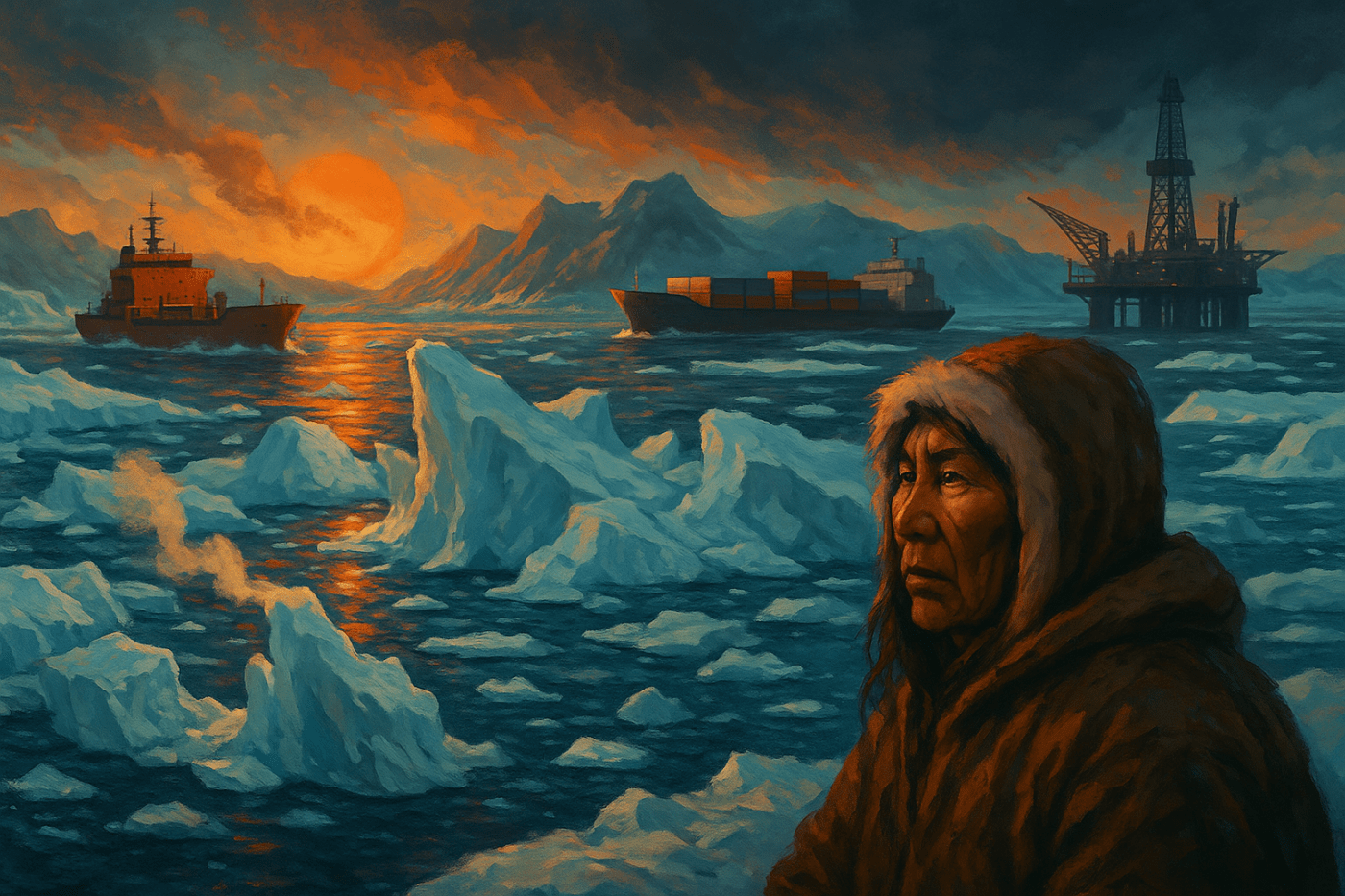
As the ice retreats, The Economist promises “connection.” But beneath the shipping lanes and rare-earth dreams lies a deeper reality: the Arctic is becoming a frontline where empires overreach, Indigenous nations resist, and a multipolar world begins to surface through the cracks.
By Prince Kapone | Weaponized Information | November 19, 2025
How an Empire Sells a Melting World as a Market Opportunity
Let’s start by naming the thing in front of us. The Economist’s World Ahead 2026 article, “The Arctic will become more connected to the global economy”, is not simply a report about climate and trade. It’s a sermon. A quiet homily about how the world is supposed to look when the ruling class finishes rearranging it. The tone is polite, the language smooth, the logic familiar: the ice is melting, ships are moving, investors are circling, and the Arctic—long treated as an inconvenient blank space on the imperial map—is finally ready to be folded into the circuits of capital.
This is the imperial imagination at work. It takes disaster—literal planetary collapse—and treats it like a business opportunity. It takes people’s ancestral lands and calls them “frontiers.” It takes militarization and calls it “geopolitics.” And it takes the violence that made this world burn in the first place and replaces it with a story about “connectivity,” as though the Arctic has been patiently waiting for Wall Street and NATO to bless it with significance.
Behind this narrative stands the author, Anton La Guardia, a man trained in the craft of translating Western power into digestible wisdom. And behind him stands The Economist, a magazine whose job—since the days when London ruled half the planet—has been to give empire a friendly face. The publication’s owners sit deep inside the banking and consulting networks that manage the global economy. The writers are fluent in the dialect of imperial reason. If the U.S. State Department is the armed wing of the American empire, The Economist is its PR department.
When you read the article slowly, you can see the propaganda sliding across the page. The first trick is the frontier fantasy. The Arctic is painted as empty land waiting for “activity”—tankers, freighters, cruise ships, private yachts—as though the Inuit, Kalaallit, Gwich’in, Saami, and other Indigenous nations don’t exist, or don’t matter. Empire always begins by pretending a place is uninhabited.
Then comes the technocratic optimism. The ice is disappearing because of climate catastrophe, but La Guardia writes as if this is simply a logistical update. Less ice means “easier transit.” Permafrost thaw becomes a “complication.” Storms, flooding, collapsing coastlines—all of it is reduced to footnotes, irritations. Capital looks at a drowning world and doesn’t see a crisis—it sees a shorter shipping route.
The next device is the smoothing of militarism. The article tosses Russia, China, the U.S., and Western Europe into one bowl labeled “geopolitics,” as if they’re all acting within the same logic. But the asymmetry is glaring. When NATO expands surveillance along the Arctic rim, it’s called security. When Russia invests in icebreakers, it’s called ambition. When China sails a scientific vessel, it’s suspicion. Imperial power never describes itself; it only describes others.
There’s also the familiar market inevitability trick. The Economist frames the Arctic’s “integration” into the global economy as something that just happens—like gravity or the weather. No corporations, no state departments, no intelligence agencies. Just a gentle drift toward resource extraction, as though capitalism weren’t a system built and enforced through violence.
And finally, there’s selective illumination. The article plucks a few convenient details—a Chinese ship passing through the Northern Sea Route, South Korea testing its own Arctic access, Trump loosening drilling regulations—and strings them together like neutral developments. What’s missing is everything that matters: the colonial land theft that made this region so “available” to Western interests in the first place; the Indigenous governments fighting for control; the rare-earth competition driving U.S. military posture; the oil giants lobbying for extraction in a region already mutilated by warming.
By the time you reach the end, the spell is clear. The Arctic is transformed from a site of ecological devastation and colonial struggle into a playground for investors and a chessboard for Western planners. The people disappear. The ecosystems disappear. The history disappears. What remains is the empire’s favorite illusion: that capitalism is simply the way the world expands, and that everyone else should get out of the way.
But propaganda has fingerprints. And when you dust this article for prints, you find exactly what you’d expect: the logic of a dying empire trying to turn a melting planet into one last frontier for profit.
What the Ice Reveals: The Facts Beneath the Empire’s Story
Once we scrape away the sugarcoating from The Economist’s narrative, we’re left with a set of hard facts—some the article admits, many it avoids, and all of them pointing toward a world in deep structural crisis. This section doesn’t interpret that crisis yet; it simply lays out the terrain. What is verifiable. What is omitted. What is quietly true beneath the imperial gloss. This is the groundwork upon which any real political understanding must be built.
The article names several factual elements. Yes, the Arctic ice-cap’s September 2025 minimum was 39% smaller than in 1980. Yes, a Chinese-operated container ship sailed the Northern Sea Route to Britain. Yes, South Korea will begin testing that same route in 2026. Yes, China’s rare-earth export restrictions have intensified Western hunger to crack open Arctic deposits. And yes, Trump’s push to double Alaska’s oil exports is constrained by mind-bending costs and aging infrastructure.
Those are the facts the article is comfortable using. They support its storyline: an Arctic opening for business, a world busy adjusting, and a U.S. empire ready to seize opportunity with clever policy and “right-sizing” of regulation. But these aren’t the only facts. The omissions are louder than the inclusions.
The first major omission is Indigenous sovereignty. Nowhere does the article acknowledge that Greenland’s elected government — representing the Inuit majority — has repeatedly resisted foreign mining ventures, rejecting projects that threaten land, culture, and autonomy. The Kalaallit Nunaat parliament’s decisions in 2023 and 2024 regarding uranium and rare-earth extractionare not marginal footnotes; they are central political events shaping the Arctic’s future. Yet they vanish from the page.
The article also omits the deeper geopolitical restructuring underway. China’s “Polar Silk Road” is not just an experiment; it is a long-term infrastructure strategy linking the Arctic to Eurasian trade networks. Russia’s “Arctic Strategy 2035” is not improvisation; it is a state project spanning energy, shipping, research, and military posture. To mention a single container ship but ignore the entire state strategies behind it is to intentionally shrink reality.
Then there is the ecological violence missing from the article’s technocratic cheerfulness. Arctic extraction is high-risk, and it has already produced disasters — from the Kola Peninsula spill and extraction-zone contamination to the 21,000 m³ Norilsk diesel spill, to thawing pipelines, permafrost collapse and contaminated food-webs in Indigenous zones. Global warming isn’t just melting trade routes; it is destroying homes, food systems, and entire ecosystems across the circumpolar world. These costs are not abstract. They are measurable and ongoing, — yet they do not fit the “business opportunity” frame, so they disappear.
The piece also erases the strategic limits of U.S. power. The U.S. military budget — now at nearly $1 trillion — stretches itself across approximately 750–800 overseas bases. The Arctic, with its logistical costs and extreme conditions, remains a hard theatre for sustained U.S. presence, as shown by GAO findings on infrastructure and capability gaps in the U.S. Arctic. Trump’s promise to boost Alaska’s oil output runs into not only financial constraints but the fact that Arctic extraction ranks among the highest-cost, most volatile forms of hydrocarbon production globally. The Economist nods to cost, but avoids the implication: the U.S. cannot dominate this region the way it once dominated others.
Another omission is environmental lawfare and sanctions machinery. When the article references Russia re-entering global markets or being squeezed by sanctions, it fails to explain that the sanctions regime isn’t neutral regulation — it is a geopolitical weapon aimed at shaping who gets to develop Arctic resources and who doesn’t. The economic screws placed on Russia aren’t background noise; they are the central lever through which Western states try to control Arctic development.
And finally, the article erases the colonial and Cold War history of Arctic militarization. The U.S. has been trying to secure Arctic dominance since at least the 1940s — through Operation Nanook and other early missions, through Cold War radar chains like the DEW Line, through the militarization of Alaska, through deep integration with Canadian policy and bases as documented in the U.S.–Canada Arctic military buildup. The Arctic did not suddenly become “strategic” in 2026. It has been treated as a war zone and extraction zone for nearly a century.
When we line up the facts—both spoken and unspoken—a clearer picture emerges. The Arctic is not merely becoming “connected to the global economy.” It is being pulled, pressured, contested, and reshaped by competing states, corporations, and Indigenous nations. It is a battleground of logistics, sovereignty, ecology, and imperial strategy. The melting ice reveals not a clean new trade route, but a tangled web of old colonial forces, new multipolar challenges, and the urgent struggles of people trying to defend their land in a world that refuses to slow down.
Rewriting the Map: Empire’s Melting Frontier and the Rise of a Multipolar North
Once the facts are laid bare—the melting ice, the competing corridors, the Indigenous resistance, the sanctions architecture, the soaring cost of Arctic extraction—the narrative that The Economist built begins to collapse under its own weight. What it framed as a story of “connection” is, in reality, a story of rupture. A world whose old imperial scaffolding is cracking. A world where the Arctic is not quietly sliding into the global economy, but violently contested by forces that embody three different futures: a dying Western empire, an emergent multipolar order, and the Indigenous sovereignties that predate both.
From the perspective of the global working class and the colonized nations, the Arctic is not an open frontier—it is the latest trench in a centuries-long struggle over land, labor, and life. When La Guardia describes the shrinking ice-cap as an opportunity, he echoes the same logic that turned the Caribbean into plantations, Africa into a mining grid, and the Middle East into a petro-military zone. The language changes, the technologies get sleeker, but the underlying impulse stays the same: take what can be taken, label it “integration,” and hide the extraction behind the language of progress.
But this particular frontier is different. Unlike the colonial expansions of the past, the Arctic opens at the exact moment the Western imperial system is losing its planetary grip. The U.S.–led unipolar order that dominated the second half of the 20th century is unraveling, and the Arctic makes this contradiction impossible to ignore. The U.S. wants to double Alaska’s oil exports, but the costs of drilling skyrocket. It wants to dominate Arctic shipping, but China and Russia have already laid down their own corridors. It wants to secure Greenland, but Indigenous and independence movements are blocking the door. It wants cheaper routes, but the climate crisis it helped create is destabilizing the very foundation of those routes.
The Economist frames all of this as logistical complication. From our standpoint, it is something deeper: the breakdown of an imperial model that relied on cheap energy, cheap labor, and uncontested military power. Here, in the melting North, all three of those pillars are buckling. Extraction costs are rising. Indigenous communities are fighting back. And multipolar forces—China with its Polar Silk Road, Russia with its icebreakers and northern ports, and a constellation of non-Western states exploring alternatives—are refusing to let the West draw the map alone.
This is why the omissions in the article matter so much. To acknowledge Indigenous sovereignty would be to admit that the Arctic is not empty. To recognize the scale of ecological collapse would be to admit that capitalist “opportunity” is inseparable from planetary death. To name China and Russia’s long-term Arctic strategies would be to concede that the West is no longer the center of global logistics. To confront the sanctions regime honestly would be to reveal that “global markets” are not natural forces but weapons.
And beneath all these silences sits one truth: the Arctic is becoming a site of imperial overreach. The U.S. and its allies are attempting to militarize, sanction, and securitize their way into relevance in a region where their economic footing is weakening. Their hope is that control over ports, insurers, data cables, and maritime law can substitute for the material power they no longer possess. Their hope is that mapping, naming, regulating, and militarizing the region will outweigh the fact that climate collapse is making the terrain ungovernable.
But the world is moving differently now. Greenlandic parliamentarians rejecting extraction projects are rewriting the script. Inuit Circumpolar Council organizers calling for full sovereignty over shipping and resource rights are rewriting the script. Russian and Chinese trade routes that bypass Western chokepoints are rewriting the script. And the global ecological crisis—created by Western industrial capitalism itself—is rewriting the script faster than any empire can adapt.
When we step back and look at the total picture, the Arctic becomes a mirror. It reflects the contradictions of an imperial system trying to convert catastrophe into profit. It reflects the rising multipolar order that refuses to kneel. And it reflects the oldest truth on this planet: that people who belong to a land, who have lived with it for thousands of years, will not quietly hand it over to corporations, militaries, or mining firms just because the ice melted.
The Economist wants readers to believe that the Arctic is being “connected.” But connection to whom? Connection for whom? The truth is simpler and sharper: the Arctic is being pulled into a global struggle over sovereignty and survival. And the people of the North—Inuit, Kalaallit, Saami, Gwich’in, Dene—along with workers across the world’s supply chains, are positioned to become the most decisive actors in that struggle. This is not a story of integration. It is a story of contestation. A story of empire on thin ice. A story still being written.
From Melting Ice to Rising Struggle: Building a Frontline of Arctic and Global Solidarity
If Section III shows us anything, it is that the Arctic is no longer a “remote zone” waiting to be folded into the global economy. It is a battleground where Indigenous peoples, workers, and multipolar states are pushing back against an imperial system that wants to turn collapse into profit. The question now is: what do we do with this knowledge? How do we turn analysis into struggle, and struggle into material gains for the people who are actually fighting to defend the land, the waters, and the future?
We begin by grounding ourselves in the organizing already in motion. The Inuit Circumpolar Council has spent years fighting for full control over shipping lanes, fisheries, and resource rights. The Kalaallit independence movement in Greenland has forced foreign mining corporations onto the defensive and suspended rare-earth projects that violate Indigenous sovereignty. In Alaska and Northern Canada, Gwich’in and Inupiat environmental defenders are blocking destructive oil and gas projects that the U.S. state claims are “national necessities.” These struggles are not symbolic—they are concrete battles against the very extraction circuits The Economist wants to present as “Arctic connectivity.”
From within the imperial core, solidarity with these forces begins with understanding that the West is not simply exploiting the Arctic—it is collapsing on top of it. Workers in Seattle ports, in Canadian rail unions, in Scandinavian dockyards are already battling surveillance expansions, militarized logistics, and privatization schemes tied to Arctic shipping corridors. The same empire that treats Greenland as a resource colony treats its own labor force as expendable. The fight at one end of the supply chain is the fight at all ends.
That is why the call to mobilize cannot be abstract. It must be rooted in the actual contradictions exposed by the Arctic front. Climate catastrophe is opening dangerous new routes. Western powers are racing to militarize these openings. Multipolar states are building alternatives. Indigenous nations are defending their land. And workers everywhere are being pulled into a logistics regime that surveils, exploits, and discards them. The task is to weave these resistances into a shared program of struggle.
One place to begin is the steady growth of Arctic-based environmental justice coalitions. Groups like the Alaska Wilderness League, the Gwich’in Steering Committee, and the Protect the Arctic coalition are already coordinating with Indigenous parliamentarians and youth movements across the circumpolar North. They have been fighting the militarization of the North Slope, opposing the expansion of the Trans-Alaska Pipeline, and challenging the data-surveillance infrastructure being laid alongside new ports and shipping hubs. Strengthening these organizations—and linking them with anti-war, labor, and climate groups in the Global North—is not charity. It is strategy.
Another front is the logistics chain itself. Workers at ports, rail hubs, and shipping terminals in the U.S., Canada, Denmark, and the UK have enormous potential leverage. When Western governments impose sanctions or push new Arctic oil projects, it is these workers who load the shipments, inspect the containers, manage the ports, and keep the surveillance networks running. Already, we have seen dockworkers in Italy and South Africa refuse to handle weapons shipments bound for imperial wars. Similar acts of solidarity in Arctic-linked ports could fracture the infrastructure the U.S. empire relies on to militarize the region.
A third front lies in the terrain of knowledge and narrative. The Arctic has long been depicted as empty space, a blank page for imperial ambitions. But Indigenous scholars, youth organizers, and local media outlets—from Greenland’s KNR to Nunavut’s IsumaTV—are rewriting the region’s political identity on its own terms. Supporting these platforms, amplifying their reporting, and circulating their analysis among union locals, student groups, and anti-war networks is a direct blow against the ideological machinery that allows The Economist to frame extraction as “opportunity.”
Finally, the global movement for multipolar sovereignty must treat the Arctic as a central theater of struggle. The BRICS+ discussions around alternative shipping insurance pools, new ice-capable fleets, and independent northern trade corridors are not technocratic debates—they are the material foundation of a world no longer hostage to Western ports and corporate insurers. For workers and revolutionary organizations in the Global North, supporting these projects means building the political will to break from NATO’s agenda, oppose Arctic militarization, and defend the right of nations—especially Indigenous ones—to control their land without being coerced into Western extraction schemes.
The ice is melting. But beneath it, a new geography of struggle is emerging: Indigenous sovereignty movements fighting for land, multipolar states challenging Western dominance, and working-class forces resisting the militarized logistics regime binding all of this together. Our task is to recognize these fronts as one struggle, one map, one future. The Arctic is not opening for the global economy—it is opening for revolution.
 Weaponized Information
Leave a comment