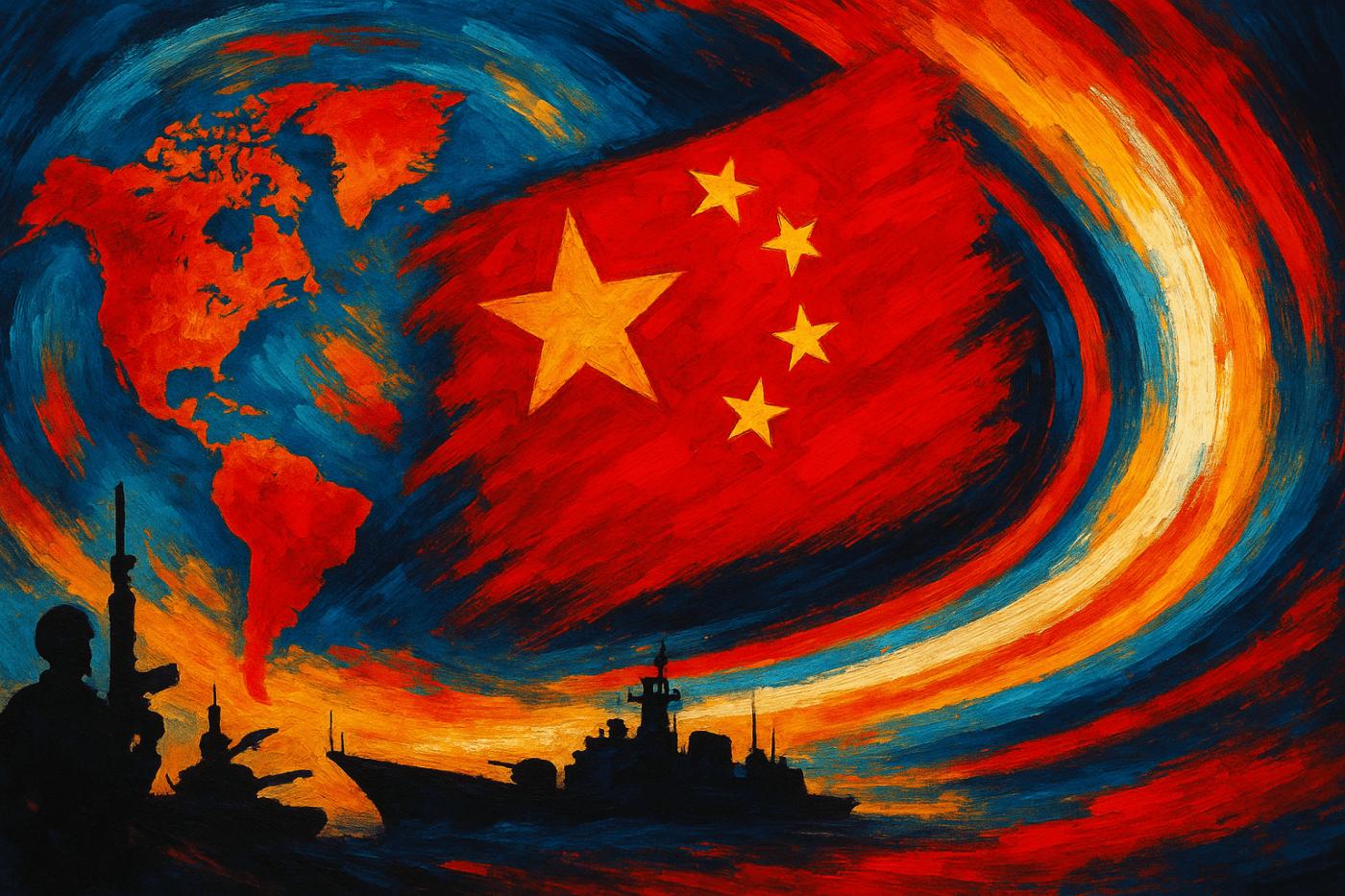
A Weaponized Information excavation of Western propaganda, global power shifts, and the struggle for a just multipolar world.
By Prince Kapone | Weaponized Information | November 17, 2025
Temptation as a Weapon: How the Economist Manufactures China’s “Hubris”
The point of departure for this excavation is an article published by The Economist, “China will be tempted to shift geopolitically from defence to offence”, which warns that 2026 may become a year of “dangerous overreach” for Beijing. The piece frames China as a power on the verge of moral slippage, suggesting that its economic resilience, export strength, technological advances, and global initiatives are signs of potential “hubris.” It claims that Xi Jinping faces temptations on three fronts—trade, Taiwan, and global rule-making—and argues that China should restrain itself because Donald Trump is already dismantling the Western-led order more effectively than China ever could. This imperial framing, presented as neutral analysis, is the terrain from which our examination begins.
The Economist wants you to believe that China’s greatest danger in 2026 is not the collapsing world around it, nor the tightening U.S. military noose that stretches from Yokosuka to Darwin, nor the slow-motion implosion of Western finance capital—it is “temptation.” As if the world economy is a monastery, and China is a restless novice fidgeting under the stern gaze of the imperial abbot. The article dresses up this moral fable in the language of prediction and expertise, but behind the suit and tie is the same old sermon: China must restrain itself for the good of the world, which really means the good of the West.
Patrick Foulis, the Foreign Editor of The Economist, is not writing from some mountaintop of objectivity. He is writing from the catwalk of Western finance, where every sentence is tailored to the anxieties of investors, diplomats, and defense strategists who read the magazine to have their worldview confirmed. His class function is clear: narrate the world from the vantage point of those who believe it is their rightful inheritance. That’s why the tone throughout the piece is not analytical; it is custodial. China is treated like a rebellious ward of the dying Western order, a giant adolescent whose body is outgrowing its role in an American-scripted play.
And what of the outlet itself? The Economist has long been the velvet tongue of imperial capitalism. It translates the worries of London bankers and Washington officials into rhythmic prose and clever metaphors. Its pages serve as a pressure valve for the ruling class, a place where they can confess their fears about decline while still pretending they run the world. Every sentence in this article participates in that imperial self-soothing. China is not a sovereign state navigating the contradictions of a changing world—it is a crisis to be managed by the West’s managerial elite.
The propaganda is not subtle. It begins with the framing device of “temptation,” as if Xi Jinping is a character out of a medieval morality play rather than the head of a state confronting sanctions, encirclement, and global fragmentation. This frame allows The Economist to turn every Chinese policy decision—from trade diversification to tech development—into a moral lapse in waiting. When China invests in chipmaking? Temptation. When China proposes global rules? Temptation. When China strengthens its export capacity? Temptation. Nothing China does is structural, historical, or geopolitical. It is psychological. And psychology is the favorite weapon of those who have run out of arguments.
From there, the article leans into the “hubris narrative.” It lists moments from the Xi era—wolf warrior diplomacy, common prosperity, zero Covid—not as contradictions of a state navigating real crises, but as a litany of overreactions by a leader prone to excess. This technique functions like a prosecutor introducing prior bad behavior to prejudice the jury. By the time the article gets to 2026, the case is already decided: China will overreach because “China always overreaches.” Structural realities are irrelevant. History is irrelevant. Only the moral disposition of the accused matters.
The Taiwan section is where the propaganda congeals. Here, speculative fiction masquerades as geopolitical analysis. China, we are told, may launch “customs inspections” or “grey-zone operations,” while Trump’s ambivalence presents a moment of unique danger. None of this is grounded in verifiable conditions; it is crafted to evoke dread. The goal is to naturalize U.S. military involvement and blame China for any possible escalation—even hypothetical ones. In cognitive warfare, this is called preemptive narrative shaping: define your opponent’s future actions before they occur, and you’ve already won half the ideological battle.
The trade section reads like a eulogy for Western manufacturing. China is cast as “swamping” the world with exports, and the West as a helpless victim of its own consumer appetite. The structural causes—neoliberal outsourcing, dismantled industrial policy, decades of corporate offshoring—are erased. In their place, we get a morality tale where China’s productive capacity is not a result of planning or labor, but a menace to be contained. It is a kind of economic Orientalism: the West invents global capitalism, exports its production to the Global South, and then accuses the Global South of being too productive.
Finally, the article paints China’s global rule-making efforts as an ominous attempt to impose new norms. Finance, climate policy, AI, space, rare earths—China’s participation in these arenas is depicted as overreach. Meanwhile, decades of Western-dominated institutions—the IMF austerity mill, the WTO arbitration racket, the SWIFT sanctions machine—are treated as natural features of the landscape. This is the ideological trick: Western power is simply “order,” while Chinese power is automatically “coercion.”
And then comes the punchline—the quiet confession. The Economist concludes that China shouldn’t rush to change the world because Donald Trump is already doing the work of dismantling the Western-led order for them. It is hard to imagine a clearer admission of imperial decay. The empire is collapsing not under foreign assault, but under its own contradictions. Yet even this collapse is weaponized as a reason for China to stay in its place.
This is not analysis; it is a plea. The Economist is begging China to behave because the West can no longer afford to. That is the real subtext. And that is why the narrative must be unraveled, line by line, so the global working class can see through the fog of imperial storytelling and understand the world as it is—not as the empire wishes it were.
The World Behind the Curtain: Extracting the Facts and Rebuilding the Context
Before we can expose the ideological scaffolding of The Economist’s narrative, we have to isolate the raw material it relies on. This section is the excavation of the article’s empirical scaffolds—the verifiable claims that appear in its text—stripped of moralizing gloss, geopolitical innuendo, and imperial anxieties. These are the bones of the story as presented. Only once these facts are cleanly extracted can we trace the distortions, omissions, and inversions that define the propaganda frame.
The article tells us that China’s economy expanded by “about 5%” in 2025, that its equity markets outperformed the S&P 500 in dollar terms, and that China raised more capital in initial public offerings than Wall Street. It insists that 30% of China’s trade is now invoiced in yuan rather than dollars, and that the country’s oil stockpile climbed to 1.2 billion barrels. The narrative emphasizes an 11% surge in Chinese exports to non-U.S. markets, highlighting Germany’s swelling $100 billion annualized deficit. It points to BYD’s planned expansion to 2,000 stores in Europe by late 2026, paints Xi Jinping as having instructed the PLA to be capable of invading Taiwan by 2027, and claims that Trump’s ambivalence makes 2026 especially perilous. It tells us that “some 70 countries” support China’s right to reunify with Taiwan by “all means,” and it underscores China’s launch of a “Global Governance Initiative” spanning AI, climate, finance, and space. It presents China’s proposed compulsory licensing of rare earths as a worrying posture. And finally, it ties these strands into a single conclusion: China must restrain itself, because Trump is sabotaging the Western-led world order more effectively than China ever could.
These are the claims on the page—what the imperial scribe allows into the frame. But what is absent is always more revealing than what is present. For every figure The Economist selects, there are deeper structures it refuses to touch. To understand the propaganda, we must introduce the world that surrounds these facts: the military architectures, economic histories, and geopolitical shifts that the imperial narrator steadfastly ignores.
The first great omission is the U.S. military perimeter encircling China . Around 290 American bases form a containment arc from Japan’s shores to Australia’s deserts. This reality shapes every Chinese policy decision, yet the article’s warnings of “overreach” erase the very pressures that define China’s defensive posture. The second omission hides the economic marrow binding Taiwan to the mainland: more than a quarter of Taiwan’s exports are absorbed by China, and an estimated one million Taiwanese live or work there. The Economist’s Taiwan narrative requires a clean break, a stark polarity—cross-strait integration would complicate the morality tale.
Just as glaring is the silence around Western deindustrialization. For forty years, U.S. and European corporations gutted domestic manufacturing in search of cheap labor and higher margins abroad. The article blames the resulting industrial hollowing on Chinese “export aggression,” as though the West’s own capitalists did not build the very supply chains they now fear. The narrative also omits the history of Western control over rare earth minerals—a resource class Washington weaponized long before Beijing entered the game. By erasing that history, The Economist can portray China’s regulatory proposals as something uniquely sinister.
Another major omission concerns the collapsing legitimacy of Western global governance institutions. Across Africa, Latin America, and Asia, the IMF and World Bank are widely condemned for decades of austerity and structural adjustment. Meanwhile, the IMF, World Bank, and WTO are all criticized for undermining sovereignty in the Global South. China’s Global Governance Initiative emerges from this crisis of legitimacy, not from a sudden thirst for domination. Yet the article must suppress this context to maintain the fantasy that Western rule is natural and benign.
Then there is the structural decay of the Western core itself. The Economist warns that China’s export strength will “trigger panic,” but it never explains why Western economies are so fragile in the first place. The U.S. share of global GDP has declined steadily for decades, with sharp erosion after the 2008 crisis. Meanwhile, the U.S. is returning to state-led industrial policy—CHIPS, IRA, and other major industrial investments—at a scale unseen since World War II. The article attacks Chinese planning while hiding the West’s own economic dirigisme, because acknowledging reciprocity would puncture the narrative of Chinese exceptionalism.
On Taiwan, U.S. arms flows are scrubbed from the story. Over $50 billion in defense equipment and services have been sold to Taiwan, island fortification and asymmetric-warfare doctrines shape the political reality of the Strait, yet the article speaks as though China alone militarizes the region. Finally, the article ignores the tectonic shift in global sentiment: across Africa, Latin America, and Southeast Asia, China is increasingly viewed as a more reliable development partner than the United States, and BRICS+ has eclipsed the G7 in economic weight, population, and strategic resources. Multipolarity is not a future possibility—it is already here.
The Economist cannot acknowledge these conditions because they would invert its entire argument. If China is acting within a world shaped by encirclement, Western decline, collapsing institutions, and emerging multipolar blocs, then the narrative of “temptation” collapses. What emerges instead is a picture of a state managing its contradictions in an international environment that the West itself destabilized. That is why this section must be read carefully: these facts and omitted facts form the empirical battlefield on which the rest of the ideological confrontation will unfold. From here, the propaganda can be reframed, but only once the terrain is fully visible.
When the Mask Slips: Reframing China, the West, and the Imperial Crisis
Once the facts are placed back into the world from which The Economist violently removed them, the narrative twists into its opposite. What the article calls “temptation” is not temptation at all. What it calls “hubris” is not hubris at all. What it calls “aggression” is not aggression at all. These are the shadows cast by a dying empire, projected across the body of a rising society. The Economist demands that China act like an apprentice in a workshop whose master has lost both his eyesight and his tools. But the real drama is not about China’s impulses—it is about the West’s unraveling, and the panic it produces in its traditional intelligentsia.
The geopolitical landscape revealed by the omitted facts is not a moral stage upon which Xi Jinping might overact. It is a heavily militarized arena constructed by the United States over decades of encirclement. When a country is surrounded by more than 300 foreign military installations, patrolled by aircraft carriers, and laser-scanned by missile shields from Yokota to Perth, it is not stepping “from defense to offense” when it seeks to protect itself. It is responding to a strategic reality in which the United States has already placed the pieces on the board. The Economist erases this terrain because acknowledging it would illuminate the real source of escalation: the Cold War architecture that Washington continues to expand even as its own political foundations collapse.
The same inversion is at play in the article’s Taiwan narrative. It warns that China may soon be tempted to tighten pressure on the island, yet it says nothing about the deep economic arteries binding Taiwan to the mainland, or the decades of U.S. weapons shipments that have militarized the island’s political imagination. In the imperial press, China must always appear as the initiator of tension. The United States, even when arming a territory it officially recognizes as part of China, must appear neutral—merely reacting, never provoking. Yet the historical record is unambiguous: Washington has shaped Taiwan’s security environment more than any actor in the region, and it continues to escalate its role even as it claims to be a bystander to “Chinese ambition.”
In the economic sphere, the reversal becomes even more stark. The Economist laments that China’s export strength risks “swamping” the world, as though the factories in Shenzhen and Chongqing materialized from thin air. They were built by Western corporations, Western capital, and Western policymakers who spent forty years dismantling their own industrial base and relocating it to Asia in search of higher profits. Now, with the bill coming due, China’s productive capacity is reimagined as a battlefield threat. But the threat is not Chinese industry—the threat is the exposure of Western capitalism’s cannibalistic logic. When a system devours its own working class to feed its shareholders, the eventual decline is not caused by foreign competitors; it is caused by domestic decisions rooted in greed.
The article’s anxiety over China’s role in global rule-making similarly reveals Western insecurity. China’s proposals on climate, AI governance, finance, and rare earths do not exist in a vacuum. They emerge from the long devastation caused by IMF structural adjustments, World Bank conditionalities, WTO arbitration biases, and decades of Western control over critical minerals. Across the Global South, these institutions are widely understood not as neutral creatures of international cooperation, but as instruments of economic discipline and neocolonial extraction. China’s initiatives, whatever their limitations, arise from a material demand by much of the world for alternatives. The Economist can only portray Chinese rule-making as dangerous by pretending that Western rule-making has been benevolent.
The structural decline of the United States haunts every paragraph of the article like an unacknowledged ghost. It is never named, but its footprints are everywhere. The fear of Chinese exports makes sense only in a world where Western industry has withered. The fear of Chinese diplomacy makes sense only in a world where Western legitimacy is fading. The fear of Chinese investment makes sense only in a world where Western capital is too fractured to lead. And the fear of Chinese stability makes sense only in a world where Western politics has descended into farce, polarization, and institutional decay. What The Economist presents as warnings about China are really confessions about America.
And that is what ties the entire narrative together: projection. The West’s anxiety about its own collapse becomes a story about Chinese overreach. The West’s militarization becomes Chinese aggression. The West’s rule-making failures become Chinese ambition. The West’s economic decline becomes Chinese distortion. This is not simply ideological distortion—it is the psychological reflex of a ruling class watching its world slip away.
From the standpoint of the global working class and peasantry, the story looks different. The collapse of Western industry has immiserated workers from Detroit to Sheffield, but none of them were impoverished by Chinese policies. They were impoverished by their own capitalists, who outsourced their livelihoods for profit. The suffering of workers in the Global South did not come from Chinese investment—it came from the structural adjustment regimes crafted in Washington. And the aspirations of nations across Africa, Asia, and Latin America for a more just global order are not responses to Chinese temptation—they are responses to centuries of Western domination.
Seen from below—not from the editorial desks of London or the defense circles of Washington—the real global contradiction is not China versus the so-called “rules-based order.” It is the world’s majority struggling to break free of a decaying imperial system, and the imperial system struggling to reassert control. China’s rise is part of that larger realignment, shaped by its own contradictions but propelled by the collapse of the Western project that once claimed to govern the world. The Economist asks whether China will succumb to “hubris” in 2026. But the deeper question is whether the West can accept a world where it no longer holds the whip.
From Propaganda to Power: Organizing Against Empire in a Multipolar World
If we follow the imperial script laid out by The Economist, the global working class has only one role to play: spectator. We are meant to watch the choreography of great powers, absorb the anxieties of Western elites, and nod along as they tell us which country threatens “stability” this week and which leader suffers from a bout of “hubris.” But once we strip away the narrative scaffolding, a different picture emerges—one where the forces most affected by imperial decline and multipolar rise are not the financiers or foreign editors in London, but the workers, peasants, students, migrants, and dispossessed who have always borne the cost of empire. This final section is not about interpretation. It is about action. It is about transforming the clarity we won from the propaganda excavation into a living, breathing politics of resistance.
Across the Global South, the contradictions revealed in this analysis are not abstract. They take the form of debt traps, dollar dependency, IMF conditionalities, stolen resources, militarized borders, and the suffocation of national sovereignty. And movements have already emerged to confront these realities. In Latin America, CELAC and ALBA-TCP continue to advance projects of regional sovereignty outside the orbit of Washington. In Africa, the African Union’s push for debt justice and monetary independence reflects a deepening refusal to accept Western control over the continent’s future. Across Asia, states once coerced into the Washington Consensus are exploring alternative development, trade, and security frameworks, often through BRICS+ coordination. These are not footnotes to history—they are the embryos of a world in transition.
In the imperial core, the contradictions manifest differently but with the same root: the decay of Western capitalism. Workers in the United States face collapsing cities, unaffordable housing, and wages that have stagnated for half a century. British and European workers face austerity regimes that shred public services while banks and arms manufacturers grow fat. The anxiety The Economist projects onto China is the anxiety that Western elites feel toward their own populations. And the working classes of the core have begun to stir. U.S. autoworkers launched the most militant strike wave in decades. British rail and postal workers have paralyzed parts of the economy. French workers have shut down refineries and ports. These movements do not speak the language of “hubris” or “temptation”—they speak the language of survival, dignity, and class confrontation.
These forces already resist the world that The Economist tries to obscure. When anti-war coalitions mobilize against AUKUS, when Asian-American groups reject Sinophobic scapegoating, when diaspora media counters Western narratives about China, when labor unions demand reindustrialization that benefits workers instead of shareholders—they are all pushing back against the imperial illusions that shape this article. They are refusing the story that China is the reason for their suffering. They are refusing the story that the West’s crisis is a foreign plot. And in refusing these stories, they are laying the groundwork for a new internationalism.
The task now is to connect these struggles—not as abstract gestures of solidarity, but as concrete organizational linkages. The imperial system is global, and so must be our resistance. Anti-war movements must link their campaigns against U.S. militarization with the struggles of workers facing plant closures and layoffs. Labor unions must adopt an internationalist stance that understands outsourcing as part of a global strategy of exploitation, not as an attack by foreign nations. Student movements must educate their peers about the history of IMF structural adjustment and the emerging multipolar alternatives. Migrant-rights organizations must expose the role of U.S. foreign policy in displacing millions across the Global South. And community media must continue building independent platforms capable of confronting state propaganda from below.
This is not a call for charity or moral sympathy. It is a call for strategic unity rooted in material interests. The working classes of Detroit and Durban, of Manila and Manchester, of São Paulo and Shenzhen, share a common adversary: the imperial system that extracts, dispossesses, and destabilizes in the name of profit. The Economist’s article trembles at the prospect of a world where China does not bend to Western demands. But what it fears even more—what it cannot even imagine—is a world where workers and peasants refuse to be conscripted into imperial rivalry.
The aim is not to cheer for one superpower or another. The aim is to dismantle the imperial scaffolding that traps the world in a permanent state of war, coercion, and hierarchy. In this moment of global transformation—this threshold where the old order is collapsing and the new is struggling to be born—the responsibility falls not on the editorial boards of London but on the masses of the world. It is our task to amplify the movements already in motion, to build new ones where they do not yet exist, and to ensure that multipolarity becomes not a competition of empires but a foundation for human liberation.
The Economist asks whether China will succumb to temptation in 2026. But the real question facing humanity is whether the people of the world will allow the dying imperial powers to drag us into new wars, new sanctions, new crises, and new forms of domination. We have the clarity. We have the movements. We have the history behind us and the future before us. What remains is to organize—to turn the knowledge we have excavated into power capable of reshaping the world.
 Weaponized Information
Leave a comment