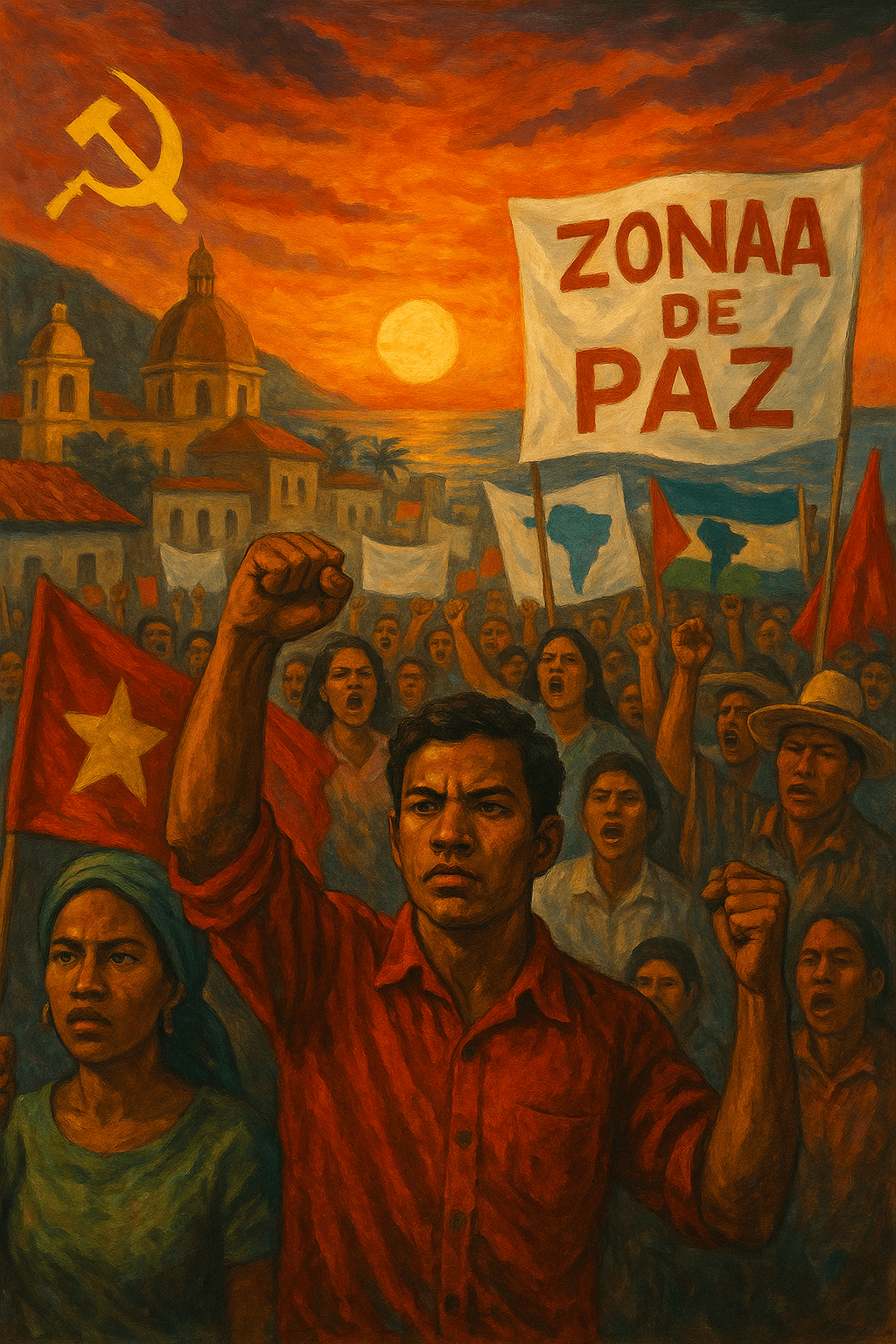
A Weaponized Information Report on the III Cumbre Social de los Pueblos de América Latina y el Caribe — Where the peoples of the continent gathered to defend the Zone of Peace, advance desdollarization, secure food sovereignty, and confront the ongoing imperial restructuring of the United States.
By Prince Kapone | Weaponized Information
| November 10, 2025
The Land Remembers: Santa Marta and the Unfinished Battle for the Hemisphere
Santa Marta is not just a dot on the Caribbean map. It is shoreline and sugar, wind and war; a place where the long memory of the continent keeps accounts. Every tide brings back the same lesson: empires arrive with ledgers and uniforms, peoples answer with dignity and organization. The III Social Summit of the Peoples of Latin America and the Caribbean gathers in this memory, not as spectacle, but as a continuation of a struggle older than the flags that pretend to rule it. From Haiti’s audacity to Bolívar’s unfinished map, from Sandino’s mountains to Fidel’s islands, this hemisphere has always been a field where two projects face each other—one that extracts and disciplines, and one that builds life out of what the extractors leave behind.
The first project is familiar. The United States called it the Monroe Doctrine and dressed it up as security. It was always a doctrine of foreclosure: close the books on sovereignty, open the ports to capital, militarize whatever refuses the deal. It is the patient geometry of bases and blockades, of sanctions and “partnerships,” of lawfare and lectures. Its media sells the old fraud with new packaging: the coups are constitutional, the sanctions humanitarian, the invasions peacekeeping. In this story, the hemisphere is a neighborhood and Washington is the landlord. If you can’t pay, there’s always a sheriff.
The second project is also familiar, though it speaks in many tongues. It is the stubborn insistence of peoples to govern their own land, feed their own children, and decide their own future. It arrives as a campesino assembly under a mango tree and as a dockworker meeting at dawn; as an indigenous council defending rivers and as a nurse demanding public health; as a youth brigade with dusty shoes and an old woman who remembers the last time soldiers “brought democracy.” It does not need a euphemism. It is called sovereignty. And in our time it carries a new word that frightens the old order: multipolarity. Not the polite choreography of diplomatic communiqués, but the practical construction of another circuitry—finance that is not debt peonage, trade that is not hunger, technology that is not spyware, integration that is not annexation.
The Summit enters here, as a hinge between memory and program. It is not a gathering of specialists; it is the inventory of a continent. The participants arrive with calloused hands and sharpened arguments, with statistics and stories, with maps of water tables and lists of the disappeared. They do not come to beg. They come to synchronize struggles: to defend a Zona de Paz against the permanent war economy; to dispute the dollar’s leash by building regional instruments; to link agrarian reform to food sovereignty; to treat migration not as crime but as the receipt for a debt the empire refuses to pay; to insist that culture and communication are not ornaments but the terrain where consent is manufactured and can be broken.
If this sounds ideological, it is because reality is ideological. The old order claims to be neutral while it loads the dice. That is why our language refuses to be polite. The numbers on export graphs are written in displaced families; the green ratings of extractive firms are painted over poisoned rivers; the “stability” prized by investors is the silence of a union beaten back by police. The Summit names things as they are: sovereignty against occupation, bread against speculation, dignity against the algorithm that decides which neighborhood gets fed and which gets raided. This clarity is not a rhetorical flourish—it is a method.
Santa Marta concentrates this method into purpose. The peoples do not meet to trade slogans; they meet to draft the coordinates of a different future. The question is not whether the United States will tolerate it. The question is whether we will construct it at a pace that outstrips the empire’s sabotage. That is the wager of the Summit: to move from the poetry of resistance to the arithmetic of power—institutions, logistics, financing, security, culture—so that the next generation inherits something sturdier than courage alone. The land remembers who tried and who hesitated. In that ledger, the III Social Summit aims to settle accounts the only way that lasts: by turning memory into organization, and organization into sovereignty, until the hemisphere is no longer a property line but a home.
The Gathering of the Peoples: Organization as the Engine of Sovereignty
The III Cumbre Social de los Pueblos did not arrive by accident. It was not conjured out of diplomatic courtesy or NGO choreography. It was built the long way: through unions that survived massacres, campesino leagues with martyrs’ names on their banners, Afro-descendant councils fighting land theft, feminist collectives organizing in neighborhoods where the police only arrive to kill or to recruit. It came from indigenous nations who have defended rivers since before there was a word for “nation,” and from youth who have already learned that capitalism has no future to offer them except debt and despair. These are not sectors to be represented; they are forces—organized, intentional, historical.
The Summit gathered in Santa Marta because Colombia today is a crossroads. It is a nation where the oligarchy and the narco-paramilitary state apparatus once seemed eternal. Yet here, in the very terrain where counterinsurgency was perfected, the people forced open a breach in history. The presence of diverse social movements under a government no longer fully aligned with Washington’s command structure is not a miracle—it is the result of decades of struggle written in prisons, in clandestine radios, in marches that filled whole valleys with footsteps. The Summit recognized this moment not as stability, but as opportunity: a contested and fragile opening in which the peoples can intervene and redirect history’s river before the empire restores control.
The organizational form of the Summit matters. It did not gather as a rally or spectacle. It debated in nueve mesas de trabajo—working tables—each one a front of the continental contradiction. In the Zona de Paz table, delegates confronted militarization and the international architecture of lawfare, mapping how U.S. courts, media networks, and intelligence fronts operate across borders. In the BRICS and desdollarization table, economists and popular educators sketched the foundations of regional financial sovereignty, arguing that multipolarity is not an ideology—it is a logistics system. The agrarian and food sovereignty table drafted fronts of resistance against agroindustrial colonialism. The health sovereignty table named pharmaceutical monopolies as weapons of empire as lethal as drones. The environmental table made clear that the “green transition” of the North is being built by mining the South’s mountains, burning its forests, and poisoning its waters.
These were not academic discourses. Delegates did not speak in abstractions but in measurements: hectares stolen, rivers dammed, pesticides sprayed, union leaders assassinated, children disappeared along migrant routes, microchips traced back to lithium fields taken by force. If Washington’s think tanks produce “policy options,” the Summit produces mandates. The difference is class interest. One serves capital; the other serves life.
The composition of the Summit also gives it weight. When trade unions stand beside indigenous confederations, when feminists organize with longshore workers, when Afro-descendant territorial councils strategize with students, when campesino guards coordinate with urban neighborhood committees, a new geometry of power begins to take shape. It is a geometry that does not wait for permission. It does not lobby empires; it surrounds them. It does not plead for inclusion; it produces parallel institutions that make the old ones obsolete. This is what the empire fears—not protests, but coordination.
The III Summit, therefore, is not simply a meeting. It is the return of strategy to the peoples. It is the recognition that sovereignty must be organized, not imagined; that multipolarity must be constructed, not admired; that peace must be defended, not declared. And it is the reminder that the oppressed have never lacked courage—what they have been deprived of is infrastructure. In Santa Marta, they began to build it.
Zone of Peace Against the War Machine
The words “Zone of Peace” sound gentle enough—until you remember who profits from war. In Latin America and the Caribbean, peace is not the absence of conflict but the refusal to serve as someone else’s battlefield. The Summit’s first and most urgent demand was clear: the continent must be defended from imperial militarization. Beneath the tropical sun of Santa Marta, delegates spoke plainly about what that means—no NATO bases disguised as humanitarian outposts, no covert training missions under the banner of counternarcotics, no foreign fleets patrolling the Caribbean under the pretext of “security cooperation.” Peace, for the peoples, is not a slogan; it is a strategy for survival.
In the language of Washington, “stability” means obedience. In the language of the oppressed, it means self-determination. For decades, the United States has cultivated instability as a weapon: coups in Honduras and Bolivia, proxy wars in Colombia, sabotage in Venezuela, blockades against Cuba and Nicaragua. Every time a government in the region asserts sovereignty, the empire discovers a new crisis that requires its management. The Summit named this pattern for what it is—permanent counterinsurgency against Latin America’s right to chart its own destiny. Delegates denounced the hybrid war tactics that combine financial strangulation, judicial manipulation, digital censorship, and military intimidation into one seamless architecture of domination.
Yet the response from the floor was not despair. From the BRICS table to the communications front, participants treated the Zone of Peace as a collective project of defense. If the empire wages multidimensional war, the peoples must build multidimensional peace. That means continental intelligence of our own, to monitor the movements of bases and the flow of covert funding. It means legal coordination to protect revolutionary governments from lawfare and international blackmail. It means training a generation that can code as well as march, that can defend data as fiercely as territory. Peace, in this framework, is not passive—it is insurgent nonalignment.
The delegates also remembered that militarization always hides an economic agenda. Where the Marines land, extractivism follows. The same hand that offers “security assistance” signs contracts for oil concessions and mining rights. Against this, the Summit reaffirmed that genuine peace cannot exist without social justice. There will be no demilitarization without land reform, no sovereignty while IMF technocrats write budgets, no stability while hunger stalks the barrios. To demilitarize the continent is to disarm imperialism itself—its armies, its banks, its propaganda.
Delegates summarized the distinction this way: what the empire calls peace is silence; what the peoples call peace is the capacity to speak, eat, and organize with dignity. The ovation that followed was not ceremonial. It was the sound of people who know that the United States does not fear missiles in Latin America—it fears ideas, alliances, and production beyond its control. The Summit’s declaration of a Zone of Peace, then, is more than a diplomatic statement. It is a declaration of independence renewed—an oath that the Caribbean and Latin America will no longer serve as the empire’s testing ground, but as the workshop of a new world.
BRICS, Desdollarization, and the Architecture of a New World
The language of empire has always been financial. Long before the United States deployed aircraft carriers, it deployed credit ratings, structural adjustment, and the dollar. The dollar is not just a currency—it is a leash. It decides who eats and who starves, which hospitals receive medicine and which rot, which nations can industrialize and which must remain plantations. Every sanction regime is a siege; every IMF loan is a treaty of surrender disguised as relief. The III Social Summit answered this not with rhetoric, but with a program: if the empire rules through finance, liberation must also be built through finance. Multipolarity is not a theory. It is an infrastructure.
In the BRICS and desdollarization working table, delegates from unions, socialist economists, indigenous authorities, cooperatives, and popular educators drafted the scaffolding of a new regional economy. They spoke not of abandonment but of construction: monetary stabilization funds that are not controlled from Washington; sovereign development banks that prioritize electrification, transport, public housing, and ecological restoration rather than foreign shareholder profits; payment systems insulated from sanctions; technology transfer agreements that do not arrive wrapped in patents and espionage. They emphasized that BRICS is not a club—it is a corridor out of dependency, but only if the peoples seize its direction.
The discussion returned repeatedly to a single point: desdollarization is not merely the replacement of one currency with another. If all we do is trade one master for another, we have learned nothing. True financial sovereignty means breaking with the logic of extractivism and debt peonage itself. It means producing food rather than importing starvation. It means refining lithium and copper in Latin America instead of exporting raw minerals and re-importing them at 700% markup. It means building telecommunications that are not monitored by the NSA. It means turning ports into public goods instead of private profit machines. Sovereignty is material or it is nothing.
The BRICS framework offers space—but space is not freedom unless it is organized. Delegates insisted that the entry of Latin American states into the multipolar economy must be coordinated with social movements, not handed over to technocrats who speak in the accent of Davos. The people of the continent have already learned what free trade means: layoffs, monocropping, deforestation, child labor, and barrios emptied out as migrants flee the economic violence. A new financial order must reverse this logic. It must finance public healthcare, public water, public land, and public energy—not the shareholders of multinational conglomerates who never set foot in the territories they devour.
Cooperative movements from Brazil and beyond distilled the goal with precision: the task is not to “enter” the global economy on imperial terms, but to transform its rules, ownership, and direction so that finance serves life rather than extraction. Desdollarization is not about prestige—it is about oxygen. It is about removing the boot from the continent’s neck. It is about ensuring that a country cannot be starved into obedience just because it refuses to privatize its forests or criminalize its unions. In that sense, the BRICS table was not a discussion about economics—it was a discussion about power.
And here, the Summit made a historical declaration without needing to shout it: the era in which Washington could dictate the economic terms of the hemisphere is ending. Not because the empire has grown benevolent, but because the peoples have learned to build alternatives faster than it can shut them down. The dollar is still strong. But its spell is broken. The world has begun to remember that no empire lasts forever—and that sovereignty is not granted. It is engineered, defended, and shared.
Land, Bread, and Territory: Agrarian Reform and Food Sovereignty as Class War
Latin America has always known that the question of land is the question of power. Empires are not maintained by speeches; they are maintained by plantations, by monocrop economies, by borders drawn with rifles, by deeds signed in blood. The Summit returned to this truth with the clarity of people who plant in the morning and bury their dead in the afternoon. Agrarian reform is not a “policy area.” It is the front line. Whoever controls the land controls the food, and whoever controls the food controls life itself.
Delegates mapped the continent in terms that no technocrat would dare admit: millions of hectares owned by a handful of families and corporations; forests cut to the stump for foreign cattle and soy contracts; Indigenous territories invaded by mining firms flying subcontracted paramilitaries as their security guards. The agrarian model imposed by imperialism is not just ecocidal; it is a counterinsurgency strategy. A hungry people does not rebel. A displaced people cannot defend territory. A poisoned land cannot sustain communal life. Monocropping is not agriculture—it is occupation.
The Summit affirmed that food sovereignty is not merely the right to eat—it is the right to decide how food is produced, distributed, and valued. Campesino organizations spoke of seeds as memory, not intellectual property. Afro-descendant communities described fishing grounds as ancestral inheritance, not “marine assets.” Indigenous delegates reminded the assembly that the land is not a resource—it is a relative. These were not romantic flourishes. They were strategic epistemologies—ways of knowing that imperial agribusiness has tried to exterminate precisely because they threaten its monopoly.
The working table on agrarian reform did not stop at declarations. It outlined concrete strategies: territorial self-defense brigades to protect communities from paramilitary land grabs; cooperative grain and distribution networks independent of supermarket cartels; communal land titling that cannot be overturned by courts owned by the oligarchy; agroecological training schools that transmit knowledge intergenerationally. If the empire organizes dispossession, then the people must organize possession. If the empire privatizes, the people must collectivize. If the empire fractures communities, the people must federate them.
There was no nostalgia for peasant purity here. Delegates understand that rural struggle today must meet the scale of global extraction. Agrarian reform now means confronting hedge funds, mineral futures markets, satellite reconnaissance used to target new deposits, and global shipping cartels that determine who eats and who does not. To face this, the Summit positioned campesino struggle as part of a continental economic plan aligned with multipolar integration. Land reform linked to food sovereignty linked to regional financing linked to energy transition linked to cultural production. A whole system—living and breathing—against the machinery of death.
Organizers from Haiti brought the point into focus: hunger in our region is engineered, not natural—and what is engineered can be dismantled. The agrarian question, then, is not about yield or subsidies—it is about emancipation. It is the class war in the soil itself.
The Battlefield of Meaning: Culture, Media, and the War for Consciousness
If land is the material terrain of struggle, then culture is the spiritual one. Empires do not endure by force alone; they endure by convincing the oppressed that nothing else is possible. Before the Marines land, the narrative arrives. Before the IMF loan is signed, the story is told. Before the coup is launched, the news anchors rehearse their lines. The III Social Summit understood this with absolute precision: the struggle for sovereignty will be lost or won not only in fields and factories, but in the battlefield of meaning—where truth is produced, circulated, censored, and weaponized.
Delegates spoke of how the media architecture of the hemisphere is wired to the North. Algorithms censor news that threatens capital. Search engines bury the voices of workers, campesinos, and indigenous nations. Corporate platforms amplify fascists, demobilize the young, and fabricate crises to justify intervention. The coup does not begin when soldiers storm the palace—it begins when headlines declare the president “authoritarian,” “corrupt,” or “a threat to stability.” Stability means obedience. Democracy means foreign investment. Peace means silence. Everything else is chaos by definition.
The communications working table approached this not with lamentation, but with strategy. The peoples of the continent already have their own media: community radio stations broadcasting from the mountains and favelas; teleSUR and continental public broadcasters challenging the monopoly narrative; indigenous audiovisual collectives documenting land defense; feminist networks transmitting testimonies that courts refuse to hear. These are not “alternatives”—they are counter-hegemonic institutions operating under siege. The Summit recognized that these must be scaled, federated, and fortified.
Delegates called for a continental communications front: a coordinated network capable of rapid response to imperial propaganda, cross-border production of investigative reporting, shared technological infrastructure protected from corporate capture, and digital defense strategies that treat data as territory. If the empire has cyber commands and psychological operations centers, then the people must build their own strategic communications corps—not as a copy, but as a counter-logic rooted in collective memory and popular education.
The debates returned again and again to a simple truth: while the empire monopolizes satellites and studios, the peoples hold the one resource it cannot counterfeit—living memory as continuity of resistance. Memory is infrastructure. Memory is how a people recognizes itself. The empire wants to privatize imagination just as it privatizes water. The Summit answered: Not here. Not now. Not ever.
Thus the cultural struggle is not ornamental to the political one—it is its soul. The battle for sovereignty must be waged in the language of the market and in the language of the ancestors; in the streets and online; on the radio and in the plaza; in the schools and in the songs sung at funerals. A people who knows its own story cannot be colonized. A continent that remembers itself cannot be ruled.
The Shadow Empire: Washington’s War to Reassert Hemispheric Control
No empire retreats willingly. It is pushed. The III Social Summit met under the clear understanding that the United States does not see Latin America and the Caribbean as neighbors, partners, or sovereign nations—it sees them as a strategic asset, a rear courtyard of its global military machine, a reserve of lithium, oil, water, and cheap labor. The entire history of U.S. policy in the hemisphere can be read as a single sentence written in many forms: This territory belongs to us. They called it the Monroe Doctrine in 1823, the Alliance for Progress in the 1960s, Free Trade in the 1990s, Democracy Promotion in the 2000s, and “Regional Stability” today. The name changes because the lie must be updated, but the architecture remains.
The delegates did not theorize this in the abstract; they narrated it from experience. Honduras remembers 2009. Brazil remembers 2016. Bolivia remembers 2019. Haiti has been made to remember for decades. Venezuela lives under siege. Cuba has survived an economic blockade engineered to break its lungs. Nicaragua has endured destabilization campaigns launched from Miami radio stations and D.C. think tanks. Peru’s elected government was dissolved by a judiciary trained in U.S. soft-power academies. Everywhere, the empire speaks with many mouths: the embassy, the NGO, the “independent” media outlet, the human rights monitor that somehow never monitors assassinations committed by its allies.
This is not conspiracy—it is statecraft. The United States deploys humanitarian rhetoric the way a pickpocket deploys a smile: as distraction. SOUTHCOM patrols the Caribbean not for drug interdiction, but to protect maritime lanes for extractive commerce and to threaten governments that break ranks. The DEA, under the banner of narcotrafficking, has intervened in peasant territories while cooperating with the very cartels that facilitate capital flows. USAID and the National Endowment for Democracy seed political parties, media training programs, and judicial doctrine to ensure that even when the empire loses elections, it wins the courts. The OAS plays secretary to the whole operation, taking attendance and calling it legitimacy.
But something has changed. The empire’s tactics are the same, yet its confidence is not. It is no longer facing isolated governments—it is facing organized peoples who have learned to read every gesture of imperial strategy like farmers read weather. They know that “anti-corruption” campaigns are precursors to coups. They know that sudden NGO concern for “democratic institutions” means a government is becoming too sovereign. They know that fact-checkers funded by Silicon Valley are not correcting errors, but disciplining discourse. And they know that sanctions are not punishments for wrongdoing—they are instruments of economic warfare designed to produce hunger, desperation, and political collapse.
Delegates at the Summit did not respond with fear. They responded with counter-power. They discussed continental legal defense networks to block lawfare coups. They outlined strategies for defending revolutionary governments by building popular legitimacy at a scale that cannot be overturned by a Supreme Court populated by oligarchs. They strategized communication systems capable of bypassing corporate platforms, and logistical networks able to sustain struggle through economic siege. They recognized security—not as police repression, but as the ability of the people to defend their gains.
The mood matched a well-known analysis from the Bolivian revolutionary tradition: the United States can no longer govern Latin America as before, yet it has not learned how to withdraw. In that stutter of imperial uncertainty lies opportunity. A wounded empire is a dangerous one—but also a predictable one. It repeats itself, reveals itself, overextends itself. The task of the peoples is not to wait for its collapse—it is to build the replacement before the vacuum becomes catastrophe.
The III Summit therefore did not simply denounce the empire. It diagnosed its weakness. The United States can no longer enforce obedience without exposing itself. Its threats sound old. Its alliances are fraying. Its economy depends on extractivism it can no longer fully guarantee. The empire is not vanquished—but its aura has cracked. And when fear breaks, history accelerates.
The Declaration of Santa Marta: A Mandate for Life in the Age of Collapse
When the delegates gathered for the final plenary, there were no illusions that a single document could resolve five centuries of exploitation. The Declaration that emerged in Santa Marta is not a treaty, nor a proclamation meant for the archives of diplomats. It is a mandate—a coordinated plan of struggle for a continent that refuses to die quietly. It is the articulation of sovereignty not as symbolism but as infrastructure: land, food, finance, communication, production, and defense. The Declaration speaks in the language of those who have carried coffins and crops in the same week. It does not ask for permission. It announces intention.
The core of the Declaration is simple: the peoples of Latin America and the Caribbean will build a sovereign, multipolar future—even if the empire calls it disorder. The document situates sovereignty as something inseparable from material dignity. There can be no peace while campesinos are expelled from the land to make way for export cattle. There can be no democracy while courts are written by ambassadors. There can be no sustainable future while rivers are detonated for lithium extraction that does not feed or electrify the barrios. There can be no freedom while the dollar dictates the price of bread. Sovereignty, the Declaration insists, must be lived—not recited.
The Declaration affirms the Zona de Paz as the strategic foundation of regional integration: no foreign military presence, no coups framed as “constitutional corrections,” no sanctions disguised as diplomacy. It ties the call for peace directly to the dismantling of U.S. military and financial occupation. It also asserts the necessity of desdollarization as a condition for development—not a utopian gesture, but a technical prerequisite. A sovereign continent must control its own currency systems, energy grids, and ports. A sovereign people must feed themselves. The Summit names food sovereignty as both ecological restoration and class struggle.
What gives the Declaration its force is that it is not abstract. Every paragraph corresponds to a terrain of struggle already underway. The protection of Amazonian and Caribbean biomes is tied to territorial guard formations that already exist. The call for communication sovereignty is tied to media collectives already broadcasting. The demand for feminist and plurinational transformation is tied to assemblies already governing community institutions without state authorization. Nothing is hypothetical. Everything is in motion.
The Declaration also rejects the false choice between national sovereignty and regional unity. It understands that a single country cannot confront empire alone—not Cuba, not Venezuela, not Brazil, not Haiti, not Colombia. Isolation is defeat. Integration is survival. But the integration proposed in Santa Marta is not the integration of free trade zones and investor courts. It is the integration of peoples: supply chains built for need rather than profit; coordinated climate defense rather than resource auctions; labor mobility based on dignity rather than desperation.
A short poem circulated in the closing session, written anonymously in pen on the back of a flyer. It was not read into the official record, but it moved through the hall as softly and steadily as breeze:
We are not asking for the world to change.
We are changing it.
The empire does not negotiate with the wind.
The wind does not ask permission to move.
The Declaration is this wind. Not a law, not a promise, not a metaphor—but a shift in direction, a pressure system that cannot be contained by borders or police lines. It affirms that the crisis of empire is not simply a danger—it is an opening. And that the peoples of Latin America and the Caribbean are not waiting for the future to arrive. They are already constructing it with their hands, their assemblies, their seeds, their barricades, and their memory.
The Future Is Being Built in Latin America
The III Social Summit did not end when the chairs were stacked and the banners folded. It did not disperse back into isolated struggles or private frustrations. It left Santa Marta as a coordinated horizon, a shared tempo, a continental orientation. A sense that history is not something that happens to the peoples—it is something the peoples are once again determining. The empire wants the world to believe that the future is made in Washington, Beijing, Silicon Valley, or Brussels. But here, in a humid port city where Bolívar took his last breath, the future was spoken in the voices of workers, elders, students, healers, organizers, fishers, mothers, ex-combatants, and barefoot children who ran between the tables listening and learning without needing to be told.
Those who gathered know that the United States is not done. It is already recalibrating: signing defense pacts in the Caribbean, reactivating Fourth Fleet maneuvers, laundering interventionist rhetoric through NGOs and media influencers, strengthening intelligence-sharing programs with business elites who fear the loss of their privileges. The empire is reorganizing because it can feel the ground shifting beneath it. But power built on extraction can only respond in one register—coercion. And coercion, once recognized, loses its magic. The peoples of this continent no longer mistake domination for destiny.
The future emerging from Santa Marta is not naive. It knows that building sovereignty requires forging institutions capable of resisting sabotage, corruption, military blackmail, and economic siege. It knows that the transition from an extractive economy to an ecological, cooperative one will require decades of work, discipline, and invention. It knows that the ruling class will not step aside peacefully. And yet—and yet—the Summit made something unmistakably clear: the peoples of Latin America and the Caribbean are no longer asking whether another world is possible. They are asking how fast they can build it.
The proletarian and communal movements of the region have moved past slogans. They are now building parallel power—community-run clinics, popular food networks, self-defense guards, autonomous media federations, plurinational assemblies, and cooperative production chains that bypass the capitalist market entirely. These are not experiments. They are prototypes of a post-imperial world. And when prototypes multiply, they become institutions.
From the Caribbean and the Andes to the Southern Cone, organizers repeated a quiet conviction: the world calls us poor, but our courage and clarity cannot be devalued. Courage is contagious, but so is lucidity—and Santa Marta produced both.
So the message the Summit sends to the planet is not a request, a plea, or a theory. It is a declaration of method:
Organize the land.
Seize the narrative.
Disarm the empire.
Build the future by hand.
It is the same message whispered by maroons in the mountains, written in Maceo’s letters, chanted by Sandinistas in the hills, broadcast from Radio Rebelde, and carried by mothers of the disappeared into courts built to ignore them. It is the message that reappears every time the oppressed remember that they have always been the authors of history, not its spectators.
The world-system is cracking. The unipolar empire is weakening. The climate is collapsing. Capitalism has exhausted its own promises and can only devour what remains. In this twilight, the peoples of Latin America and the Caribbean rise not as victims of global crisis, but as architects of its alternative. They carry the mandate of Santa Marta forward: a hemisphere without masters, a sovereignty rooted in life, a future that remembers the ancestors and feeds the children.
From the Caribbean coast, the call goes out—across mountains, jungles, barrios, and ports:
The empire does not end by collapsing. It ends by being replaced.
And the replacement is already under construction.
 Weaponized Information
Leave a comment