Read the previous essays in this series:
- Silver Against the Dragon: China, the World Market, and the Long Prelude to the Opium War
- Primitive Accumulation by Narcotic: The Opium Wars and the Forcible Integration of China into the World Market
- The Heavenly Commune: Taiping Rebellion and the Spectre of Peasant Communism
From the ashes of the Taiping commune to the siege of Beijing, China’s peasantry rose again—secret societies, Red Lanterns, and village militias defending land and life against railroads, missions, and debt—until the Eight-Nation Alliance revealed the naked violence of the colonial world-system.
From the Ashes of the Heavenly Kingdom
The soil that birthed the Boxers was already scorched. Twenty years after the fall of the Taiping Heavenly Kingdom, the countryside still reeked of smoke and famine. Villages once alive with the songs of labor had been turned into cemeteries. The empire had survived, but the people had not. Out of forty million corpses, a new generation rose—born of defeat, debt, and drought—carrying in their bones the memory of a revolution drowned in blood.
The Qing dynasty had been restored by bayonets and loans, a throne propped up by foreign creditors. British, French, and American financiers refinanced the empire they had just finished humiliating, binding its treasury to indemnities that bled through every tax collector and granary. The landlords returned with vengeance, squeezing the peasantry for silver in a land that no longer had any. Where the Taiping had dreamed of land held in common, the Qing exacted rent with interest. The war had ended, but the extraction had only begun.
The defeat of the Heavenly Kingdom shattered more than a rebellion—it broke the moral economy of the village. Canals clogged, granaries emptied, the peasantry fragmented. Those who survived turned to the roads: displaced farmers, ex-soldiers, beggars, martial drifters. These were the children of the commune’s collapse, the lumpen seed of a new era. Yet even in ruin, the Taiping’s fire did not go out. Its vision of equality, of life beyond rent and empire, lived on in whispers, in legends, in rituals performed under the moon. Every temple and tavern carried a rumor that Heaven had once descended to Earth—and might again.
The Boxers would inherit that rumor. They were not born from superstition but from memory—from the living residue of an unfinished revolution. Their “magic” was the collective courage of a people who had nothing left to lose. The spirit possession and invulnerability rites mocked by missionaries were, in truth, the broken language of a class that still remembered how to fight. When imperialists saw fanaticism, they were really witnessing the afterlife of the Taiping: the peasantry reorganizing itself under new conditions of subjugation, seeking in ritual what had been denied by reason and rifle alike.
The Heavenly Kingdom had promised the abolition of private property; the Boxers sought the defense of what little remained. The Taiping had stormed cities; the Boxers would defend villages. One spoke the language of utopia, the other of survival. But both were expressions of the same will—the will of the Chinese peasantry to live without masters, to reclaim dignity from defeat. If the Taiping were the revolution’s dawn, the Boxers were its dusk before the long night—a desperate light flickering in a land still haunted by empire.
Thus the Boxer Rebellion did not appear from nowhere. It was the ghost of the commune rising again, half-remembered and half-transfigured, in a time when the old order had collapsed but the new had not yet been born. Beneath the foreign gunboats and missionary schools, the countryside still dreamed of Heaven on Earth. The Boxers came to make that dream fight once more.
The Wounded Land: Drought, Debt, and the Machinery of Extraction
The generation that rose after the Taiping inherited not a country but a collection of wounds. The imperial restoration had restored neither grain nor grace—it had restored collection agencies. The silver that financed the dynasty’s survival did not flow from the land but from loans; and each loan, stamped with a foreign seal, reached its repayment date at the peasant’s doorstep. Every sack of rice hauled to the tax station was another payment on the empire’s humiliation, another interest installment to London or Paris. Debt had become the hidden gunboat moored in every village.
The indemnities from the Opium and Taiping wars did more than drain the treasury; they rewired China’s economy to serve the world market. The Maritime Customs Service—staffed by foreigners and backed by warships—monopolized tariff collection and handed the revenues directly to imperial creditors. To guarantee repayment, foreign syndicates demanded collateral in the form of concessions: mining rights, railway corridors, and river ports. Steel rails carved through ancestral graves; telegraph lines stretched like nerve fibers of a foreign brain. Imperialism no longer needed to occupy China outright—it had installed itself inside the circulation of her blood.
The landlords adapted to this new order with their usual cunning. Grain prices fell under the pressure of imported goods, while taxes rose to service imperial debts. The result was the slow strangulation of subsistence agriculture. Granaries once built to withstand famine were emptied to pay interest. Laborers left the soil for the towns, where they became porters, coolies, and hawkers—cheap limbs for foreign merchants. The village, stripped of youth and silver, aged into dependency. Even Heaven seemed to turn away: drought gripped the North China Plain through the 1890s, and the Yellow River, swollen and silted, broke its dikes again and again. Famine became as natural as sunrise.
In the countryside’s ruins, new forces crept in. Missionaries bought up land to build their churches and schools, sheltered by the extraterritorial privileges granted in the unequal treaties. They preached compassion but practiced enclosure. Their converts, backed by foreign consuls, became untouchable; their property immune to local law. The ancestral temple, once the heart of collective life, found itself competing with a steeple that doubled as a fortress. To the peasantry, the cross was no longer a symbol of salvation but a flag of occupation. The foreign God had come, and he collected rent.
The crisis was total: ecological, economic, and spiritual. What the Taiping had tried to overthrow with fire, imperialism reimposed with contracts. The Qing court signed away rivers and mountains to settle its balance sheets; the gentry leased their own provinces to European syndicates; and the peasants paid for it all with their daughters, their fields, and their teeth. From this cauldron of ruin emerged the social material of rebellion—the itinerant workers, martial artists, failed students, and dispossessed farmers who would soon call themselves the Righteous Fists of Harmony. They were not born from fanaticism; they were forged in accounting ledgers and drought-cracked earth. The empire was still called China, but it now functioned as a colony with a Chinese flag.
By the time the century turned, the land itself seemed to groan under the weight of its debts. Rivers no longer obeyed their channels; peasants no longer trusted their officials; Heaven no longer favored the emperor. The countryside was ready—not for reform, but for rupture. In the parched fields of Shandong and Zhili, where famine met railway, the next insurrection was already rehearsing its lines. The Boxers would not speak in the language of politics or scripture; they would speak in fists. And their enemy was not merely the foreigner—it was the entire machinery of extraction that had turned China’s heartland into collateral.
The Righteous Fists Rise: Class Composition and the Practice of Revolt
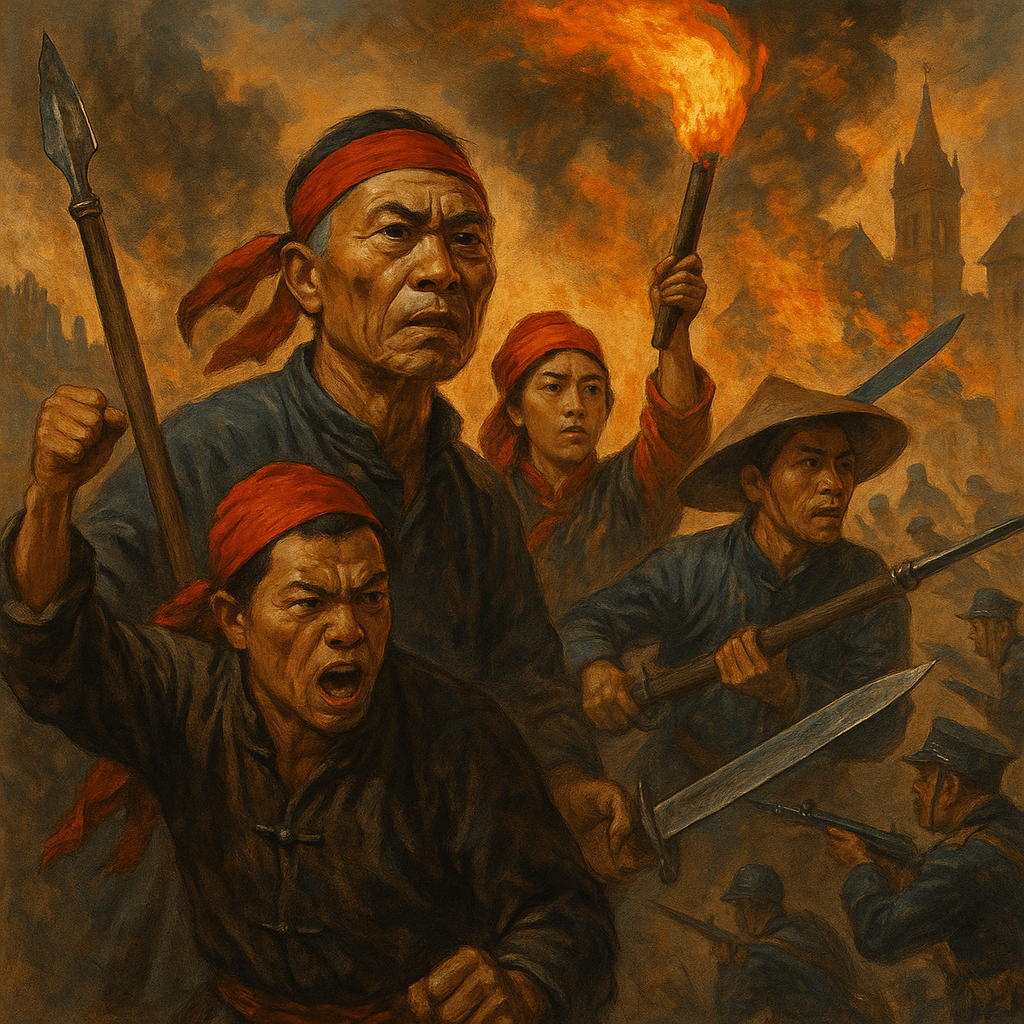
Out of this wounded countryside, a new kind of army took shape—one without uniforms, payrolls, or generals. Its ranks were drawn from the discarded layers of society: tenant farmers evicted by landlords, coolies laid off from railway construction, martial drifters who once served as guards or entertainers, and ex-soldiers who had survived the wars of the empire only to find themselves unwanted. These were the people left behind by both Heaven and the market, and together they became the Yihetuan—the Righteous and Harmonious Fists.
To the imperial observer, they looked like rabble. To the peasantry, they were a mirror: a collective self-portrait of those forced into itinerancy by taxes and drought. They trained not in barracks but in temple courtyards and threshing grounds. Their drills combined martial arts, trance, and communal chanting—half combat, half ceremony. The rituals mocked by Western journalists as “invulnerability cults” were, in truth, exercises in solidarity. They fused the physical with the spiritual to transmute fear into courage, isolation into belonging. The Boxer camp was the village rediscovering its collective heartbeat.
Every class carries its own means of organization. The bourgeoisie has its stock exchange; the proletariat its factory committee. The peasantry, lacking both capital and machinery, turns to the only resources it still possesses—its bodies, its rituals, its shared hunger. The Boxers’ invulnerability rites were not madness but a language of organization, a moral code encrypted in gesture and chant. Their “spirit possession” was the collective hypnosis of the dispossessed: a discipline strong enough to make a barefoot farmer charge a machine gun. When the foreign missionary called it sorcery, he revealed more about the poverty of his own imagination than about the people’s faith.
The movement’s structure mirrored the land itself: scattered, decentralized, but bound by invisible arteries of kinship and oath. Lodges, brotherhoods, and martial guilds acted as local nuclei, spreading from Shandong to Zhili, from village to market town. Each unit was autonomous, yet the ideology that united them was simple and universal—expel the foreigners, punish the corrupt, restore righteousness to the world. In that triad, “foreigner” meant empire, “corruption” meant landlord, and “righteousness” meant the memory of the commune. The Boxers were not defending the old order; they were defending what fragments of collective life remained.
Women, too, joined the struggle. The Red Lanterns—young women trained in martial and spiritual discipline—served as messengers, healers, and sometimes fighters. In their ranks, the peasant patriarchy momentarily cracked, as necessity overruled custom. In the eyes of the imperial elite, this was further proof of madness; in truth, it was revolution in embryo. The Heavenly Kingdom had dreamed of gender equality but could not realize it; the Red Lanterns lived it, however briefly, in battle.
By 1899, these networks had turned parts of the North China Plain into liberated zones. Local officials fled; foreign rail crews were ambushed; Christian missions were besieged. The imperial bureaucracy, rotting from within, could neither suppress nor absorb the movement. In many counties, magistrates discreetly funded the Boxers, hoping to redirect their rage toward foreigners and away from the throne. Thus the rebellion spread like wildfire through dry grass, ignited by desperation, tolerated by opportunism, and sustained by faith. It was not a planned insurrection—it was a social metabolism, a countryside in motion, organizing itself against extinction.
The rise of the Righteous Fists marked a turning point in the Chinese revolutionary continuum. The Taiping had sought to build Heaven on Earth; the Boxers sought to defend the Earth itself from becoming hell. Their consciousness was contradictory—half mystical, half material—but their movement was unmistakably political. They were the peasantry groping its way from revolt toward revolution, from hunger toward history. Beneath every spell and oath lay a single, lucid demand: that China belong again to those who tilled her soil.
Redemptive Violence: Land, Spirit, and the Rejection of Foreign Rule
When the Righteous Fists began to move, it was not with the hesitancy of a petition but with the certainty of judgment. The first blows fell on the agents of empire closest at hand—the missionaries, their converts, and the compradors who had sold the village to foreign law. Each torched mission, each razed warehouse, was not a random act of vengeance but a sentence passed on a social order that had ceased to be tolerable. The Boxer revolt was a people’s tribunal held on the open field, and its verdict was clear: no peace with those who had turned famine into finance.
Violence, for the Boxers, was never abstract. It had geography and memory. The cross raised on confiscated temple grounds was not simply a religious symbol; it was the monument of a foreign landlord. The telegraph pole bisecting a village cemetery was a desecration of ancestors. The railroad track that cut across irrigation dikes did more than carry goods—it redirected the flow of life itself away from the peasantry and toward the treaty ports. To tear up those tracks was to heal the land; to storm the mission was to reclaim a stolen sanctuary. The rebellion’s target was not the foreigner’s skin but the infrastructure of exploitation.
The Boxers’ war fused social, ecological, and spiritual fronts into a single theater of resistance. They struck at landlords who collaborated with foreign syndicates, at merchants who profited from indemnity loans, at Qing officials who accepted bribes for rail concessions. In each act of arson was the echo of a failed harvest; in each killing, the buried history of hunger. The rebellion was less a coordinated campaign than a social reflex—millions of small, simultaneous insurrections converging on a single truth: that China could no longer survive as collateral for imperial debt.
In their rites before battle, the Boxers did not merely pray for invulnerability—they affirmed the justice of their cause. “Heaven supports the righteous,” they said, and they meant it as material fact. Heaven, to them, was not some remote divinity but the moral law embedded in the earth and its cycles. When the land was defiled, Heaven itself was violated. Thus, their violence was not nihilism but restoration. They killed not to destroy order but to create one grounded in communal right rather than imperial decree. Theirs was the theology of the oppressed: a vision of salvation that required no priest and no permission.
The Qing court, terrified and divided, hesitated. Local officials alternated between suppression and support. Some saw in the Boxers a useful weapon to channel anti-foreign anger while preserving the dynasty; others saw in them the specter of another Taiping. This contradiction at the top mirrored the contradictions below: a peasantry still loyal to the emperor but revolting in his name, a rebellion that sought to defend the throne from foreigners while undermining the very class order the throne depended on. The Boxers were both defenders and destroyers of empire, patriots and revolutionaries in the same gesture.
When they entered Beijing in 1900, joined by sympathetic units of the imperial army, it seemed for a moment that the cycle of humiliation might break. Foreign legations were besieged; missionaries fled; the court declared war on all invaders. For the first time since the Opium Wars, the empire stood, however briefly, on the side of its own people. Yet beneath the surface unity lay irreconcilable tensions: a peasant movement demanding expulsion of foreigners and a dynasty seeking only renegotiation of its debts. The court sought to survive; the Boxers sought to live. The two goals were not the same.
The rebellion’s fury was both its strength and its limit. It liberated villages but could not liberate the nation; it destroyed symbols but could not yet dismantle the system. Still, in its brief radiance, the Boxer War exposed the full geography of China’s enslavement—from the rail lines to the mission walls, from the flooded paddies to the empty granaries. It was not a revolt of superstition but of clarity, an elemental uprising that declared what no diplomat dared admit: that China’s crisis was not moral but material, not cultural but colonial. The Boxers fought to make that truth visible, written not in treaties but in fire.
Empire Strikes Back: The Eight-Nation Invasion and the Logic of Hyper-Imperialism
The foreign powers answered the peasantry’s uprising with a unity they could never muster for peace. Britain, France, Germany, Russia, Japan, the United States, Austria-Hungary, and Italy—rivals in Europe, but partners in profit—marched under a single banner: defense of civilization. In truth, it was the defense of their balance sheets. The same nations that had forced opium upon China now declared themselves avengers of order. The counterattack that followed was not a war but a foreclosure: the armed recollection of a continent’s debt.
From Tianjin to Beijing, the Eight-Nation Alliance advanced like a machine built to demonstrate the future of conquest. Railways supplied the troops; telegraphs guided their columns; repeating rifles and machine guns shredded militias armed with sabers and faith. Every feature of modernity became a weapon against those who had refused to die quietly. Villages were burned in the name of law, women raped in the name of morality, granaries looted in the name of commerce. It was counterinsurgency elevated to industrial scale—a prototype of the colonial wars that would later scar Africa, the Middle East, and Asia alike.
The empire’s propaganda framed the campaign as a punishment for “barbarism.” The real crime had been insubordination. The Boxers had torn up the rails of profit and declared that foreigners could no longer walk unarmed through Chinese soil. For that insolence, the world’s mightiest nations converged to teach them discipline. Behind the armies came accountants and diplomats to tally the cost of retribution. Each dead villager became a line item in the next indemnity bill. The logic was precise: rebellion destroyed infrastructure; indemnity rebuilt it—this time under imperial ownership. War was no longer an interruption of commerce but its most lucrative extension.
The massacres were systematic. In Zhili and Shandong provinces, whole counties were erased. Foreign troops executed peasants by the thousands, sometimes by lottery, to save bullets. German officers called it Schrecklichkeit—the policy of terror. American marines called it “pacification.” Japanese soldiers learned the efficiency of atrocity that they would later export to Manchuria and Nanjing. The Eight-Nation Army was less an alliance than a rehearsal for a century of imperial coordination. It was the birth of what would later be called “multilateral intervention”—the capitalist world policing the periphery under the banner of universal values.
When the smoke cleared, the invaders installed their terms: the Boxer Protocol of 1901. China was forced to pay an indemnity of 450 million taels of silver—more than its annual revenue—plus interest over nearly forty years. Foreign troops were stationed in Beijing; the legation quarter became an armed enclave beyond imperial law. The customs houses, already controlled by foreigners, now directly serviced the indemnity. Railways, mines, and ports were mortgaged to Western syndicates. The Qing court, humiliated, survived only as the administrative arm of its creditors. The empire was restored as colony.
For the world bourgeoisie, the suppression of the Boxers was a triumph not merely of arms but of coordination. It proved that capital could settle its internal rivalries long enough to exterminate a common enemy: the mobilized poor. The Eight-Nation intervention was hyper-imperialism in embryo—the integration of finance, technology, and warfare into a single planetary system of extraction. The same telegraph that guided the troops would later guide markets; the same loans that rebuilt the rails would chain new nations to debt. China was no longer a sovereign landmass but a laboratory where the West perfected the management of rebellion.
Yet in this orgy of victory lay the seeds of decline. The invaders left behind not submission but memory: the memory of unity among the dispossessed, the knowledge that empire bleeds when struck, and the conviction that only a revolution reaching beyond the village could end the cycle of indemnity and invasion. The Eight-Nation Army thought it had buried the Boxers; it had only tilled the ground for the next revolt.
The Boxer Legacy: Memory, Militancy, and the Rebirth of Peasant Sovereignty
In the aftermath of defeat, the ashes of the Righteous Fists refused to cool. The fields they defended were razed, their temples desecrated, their leaders hunted, yet the idea they embodied—of a people fighting for its own land, against both foreign masters and native parasites—remained unextinguished. Every peasant community that had seen its sons die with the cry “Support the Qing, destroy the foreigner!” learned something more enduring than loyalty to the throne. They learned that no empire, Chinese or foreign, would deliver justice unless the people seized it themselves.
The Boxers left no party, no doctrine, no written program, but they left behind an organizational memory that would outlive their bodies. The sworn brotherhoods and self-defense associations that sprouted in the rebellion’s wake became the skeletal structure of rural militancy for decades to come. Some hardened into reactionary gangs and protection rackets—the embryo of future warlord armies. Others transformed into revolutionary cells, peasant leagues, and local militias that would later rally to the banners of 1911, 1927, and 1949. What the Boxers lacked in theory they compensated for in practice: they had demonstrated how to organize the disorganized, how to turn desperation into discipline.
The Qing court, shaken but still breathing, attempted to salvage legitimacy through “reform” from above: new schools, new armies, new bureaucracies. Yet all these reforms shared the same fatal flaw—they did not touch the land. The Boxers’ ghosts haunted every classroom and drill field, reminding the rulers that education without sovereignty and discipline without justice were just new tools for old masters. The so-called “Self-Strengthening” measures built arsenals for a state that no longer owned its own railways. Every new military academy trained not patriots but future mutineers. Beneath the surface of loyal modernity, the spirit of revolt quietly rearmed itself.
In the cities, the foreign victory produced an unintended consequence: contact. Dockworkers, miners, translators, and railway hands came face to face with global capital, its language, its machines, and its arrogance. They learned not only the power of the foreigner, but also his vulnerabilities—his dependence on Chinese labor, his need for Chinese markets, his fear of another uprising. This encounter gave birth to something new: an urban proletariat. It was small, scattered, and overworked, but it carried the seeds of a consciousness that would one day link peasant rage with worker organization. The world that had crushed the Boxers was producing the class that would avenge them.
In the countryside, the memory of the Righteous Fists persisted as oral history, song, and ritual. Village elders told stories of the young men who had fought foreign soldiers with spears and conviction, of the Red Lantern girls who lit the night sky with courage. These stories kept alive a moral logic: that resistance, even when doomed, was the only dignity left to the poor. In an empire rebuilt on fear, the legend of the Boxers taught courage. Their failure became a curriculum; their annihilation, a manual in negative for the next generation of rebels.
By the dawn of the new century, the rebellion’s embers glowed beneath every reformist slogan and patriotic society. The “Society to Revive the Nation,” the “Restoration League,” and the underground networks of Sun Yat-sen’s followers all drew on the peasantry’s latent anger and the secret-society infrastructure the Boxers had revived. Where the Taiping had preached a collective Heaven, and the Boxers had defended sacred soil, these new movements began to imagine a nation—not as a dynasty, but as a people. Thus the line of descent ran unbroken: from the commune to the militia, from the militia to the revolution.
The Boxers’ historical significance lies not in what they achieved, but in what they revealed: that China’s revolutionary energy was rooted not in the palace or the port, but in the countryside itself. They exposed the empire’s dependency, the comprador’s cowardice, and the world market’s cruelty. More importantly, they reminded the world that the peasantry, however deceived or desperate, was not passive. When pushed beyond endurance, it organizes—first in prayer, then in arms, and finally, in history.
The rebellion’s defeat was not an end but a metamorphosis. Its scattered survivors, the lumpen and the loyal alike, would fill the ranks of the 1911 insurgents, the Red Spears, and eventually the Communist guerrillas who encircled the cities a generation later. The same hand that once clenched in prayer would soon clench around the rifle. The Fist had fallen, but its muscle remembered. In that memory, China’s revolution kept breathing.
The Fist Was Not Enough: From Peasant Fury to Revolutionary Consciousness
The Righteous Fists had fought like a people possessed, and perhaps they were—possessed not by gods, but by history itself. Yet even history demands more than courage. It demands organization. The Boxers had embodied the highest form of spontaneous peasant revolt: collective, sacrificial, militant. But their fists struck air when they needed a structure; their spirit rose like fire but had no furnace to contain it. What they proved in blood was that resistance without coordination cannot outlive its first victory, that revolt must evolve into revolution or be buried beneath it.
Their movement was crushed not by moral weakness but by historical isolation. The peasantry had risen before the proletariat had matured, before national consciousness had crystallized, before the instruments of coordination—the press, the school, the party—had been forged. Their faith and discipline were immense, but they could not substitute for a program. They struck at empire’s limbs without yet seeing its heart. When the Eight-Nation Army advanced, the Boxers had no plan of retreat, no unified command, no network beyond the province. The rebellion drowned not in superstition, but in geography—it could not yet speak the language of the nation.
Yet in their failure lay the blueprint for the century to come. The Boxers had shown that the peasantry was the bedrock of resistance, but also that it could not stand alone. Their uprising forced a generation of thinkers, reformers, and radicals to ask the decisive question: how could this volcanic energy of the countryside be fused with the new currents of the city—the students, the printers, the dockhands, the miners? The answer would arrive in stages: the 1911 Revolution’s clumsy birth of a republic; the May Fourth generation’s discovery of Marxism; the Communist Party’s disciplined merger of worker and peasant. Each was an echo, an elaboration of the Boxer lesson—that the people could fight, but to win they must also organize.
The Righteous Fists had believed that Heaven itself sided with the poor. Their descendants would learn that Heaven is history, and history sides only with those who understand it. What the Boxers intuited through ritual, later revolutionaries would codify through science: that the true invulnerability of the oppressed lies not in charms or chants, but in collective consciousness. The party cell would replace the temple; dialectical materialism would replace prayer; the red flag would inherit the red lantern’s light.
None of this cancels the Boxers’ greatness. They were the hinge between worlds—the last insurgency of the old China and the first tremor of the new. They fought for the soil, not the stock exchange; for the right to exist, not to profit. They stood at the limit of what spontaneous rebellion could achieve and, in crossing it, revealed the road beyond. Theirs was not a tragedy of ignorance but of timing. The peasant commune had reappeared before the revolutionary subject that could defend it. Their fists pointed toward a future they could not yet enter.
When later generations raised the slogan “Political power grows out of the barrel of a gun,” they were, in a sense, finishing the Boxers’ sentence. The Righteous Fists had already discovered that moral force alone could not overturn an empire armed with steel and credit. What they lacked was not bravery, but the synthesis of discipline and direction—a revolutionary party rooted in the same soil that had birthed them. That synthesis would not come for decades, but the Boxers had prepared the terrain, clearing the imperial illusions from the land.
Thus their defeat completes, not cancels, their meaning. The peasant revolution had now traversed its full cycle: from the utopian commune of the Taiping to the defensive militias of the Boxers, from the dream of Heaven-on-Earth to the demand for Earth itself. The next stage would belong to those who could unite these fragments into a single front—a movement that would no longer pray for deliverance but seize it. The fists had struck first; the rifle would answer; the theory would follow. And in that sequence—the dialectic of ruin, resistance, and renewal—China’s long revolution took its first full breath.
 Weaponized Information
Leave a comment