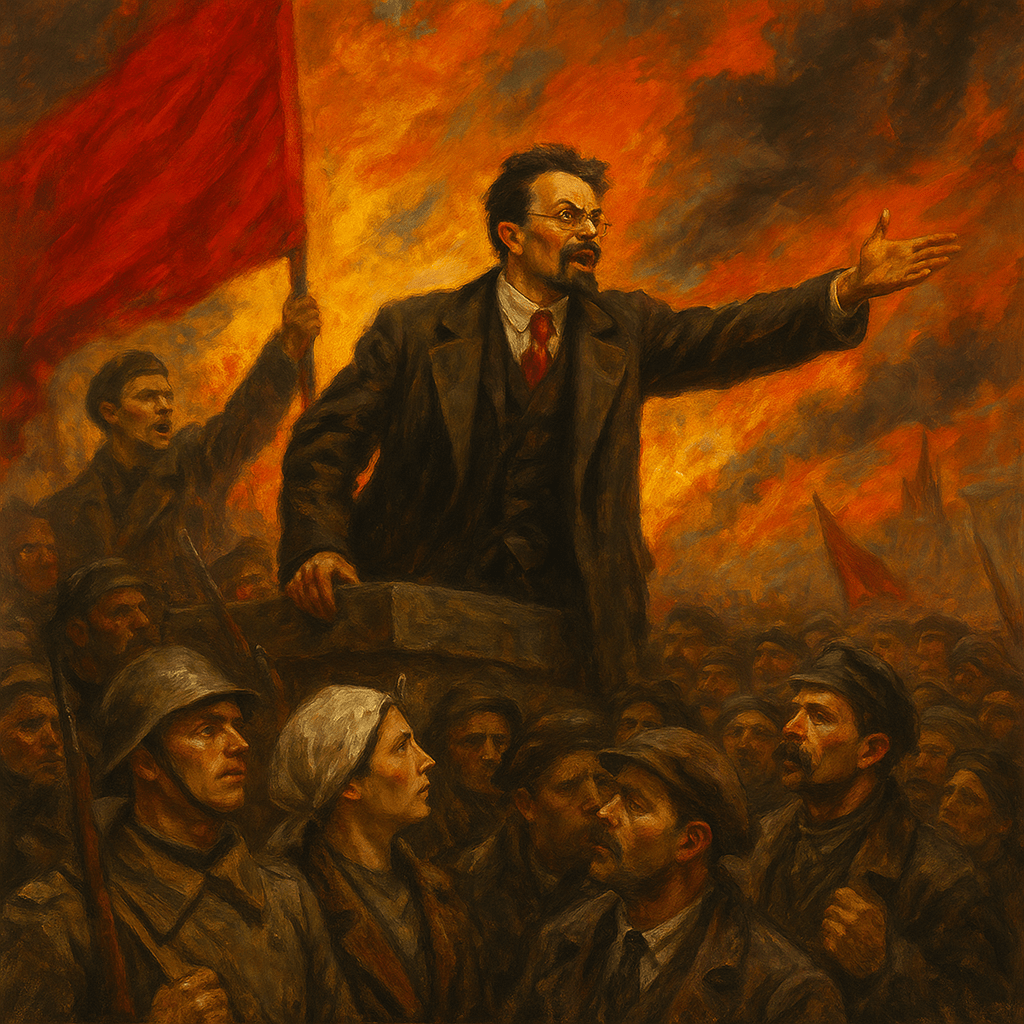
A militant reading of Trotsky’s classic that honors his eyewitness fire while exposing the seeds of Trotskyism and Western Marxism—reaffirming the Lenin–Stalin line: soviets as organs of power only through the disciplined vanguard, from dual power to October, from poetry to statecraft.
By Prince Kapone | Weaponized Information | Weaponized Intellects Book Review: October Revolution Series | October 2025
Introduction: Why Read Trotsky—And Why Refuse His Shadow
Leon Trotsky’s History of the Russian Revolution is the most vivid, ground-level chronicle of 1917 we possess—written by a central actor who helped steer the storm. Trotsky was a formidable revolutionary: a brilliant agitator, a tactician of insurrection, and later the chief organizer of the Red Army in a country encircled by imperialist bayonets. His literary power is undeniable; his pages crackle with the cadence of factory sirens, soldiers’ committees, and soviet halls learning to speak in the language of power. For anyone serious about revolution, this book is not optional reading. It is a living archive of how a ruling class fell and how workers and peasants learned, in motion, to rule.
Precisely because of its power, it demands a ruthless reading. Trotsky’s method—his tendency to romanticize spontaneity, to elevate motion over organization, and to universalize “permanent revolution” as prophecy—planted the seeds of what later hardened into Trotskyism and then into the academic fog of Western Marxism. That current would turn council forms into fetishes, “democracy” into a classless abstraction, and critique into a substitute for construction. We honor Trotsky’s service and talent; we reject the deviation that flowed from his blind spots.
Our standpoint is clear: we uphold Lenin and Stalin. Lenin’s genius was not only to read the moment but to build the instrument—the Party—that could transform crisis into state power. Stalin’s historical role was to harden that victory into survival and development under siege: to turn October’s electricity into an industrial grid. As Stalin himself acknowledged, Trotsky had merits; this book is one of them. But merit does not exempt method from criticism, and comradeship does not absolve errors that, if followed, would have left the revolution a poem instead of a government.
This review, then, is double-edged. It takes from Trotsky what is indispensable: the eyewitness detail, the mapping of class forces, the dramaturgy of a society in freefall. And it returns to him what must be refused: the substitution of mass effervescence for disciplined strategy; the migration from soviets-as-organs-of-power to soviets-as-symbols; the melancholy that mourns “betrayal” where revolution required consolidation. We read Trotsky to learn how the storm broke—and we read him critically to learn how the storm was captured, organized, and made to power the future.
I. The Historian of the Storm
Leon Trotsky begins The History of the Russian Revolution not as a chronicler but as a dramatist. He paints revolution as theater—masses rushing the stage, history cracking open under their boots, the ruling class trembling behind the curtain. It’s a thunderous opening, written with the cadence of a poet and the precision of a surgeon. But beneath the brilliance of his pen lurks the first hint of deviation: Trotsky writes of the revolution as if it were an act of nature rather than of organization. The people move, the old order falls, and the Bolsheviks arrive almost as spectators at their own play. It’s history stripped of its central protagonist—the Party.
To be fair, Trotsky’s instinct to center the masses was not wrong. No serious Marxist ever doubted that the people, not the great men, make history. Yet Trotsky’s version smells faintly of romance, not science. He calls revolution the “direct interference of the masses in historical events,” but interference is not victory, and spontaneity is not power. The Bolsheviks didn’t simply ride the wave—they built the damn ship, steered it through the storm, and armed the crew. Revolution is not a festival; it is organized war. Lenin knew that. Stalin embodied it. Trotsky, for all his genius, too often mistook motion for direction.
Still, there’s no denying the power of Trotsky’s prose. Every page brims with life. The czar’s ministers stumble like sleepwalkers, generals lie through telegrams, and workers seize factories with bare hands and full hearts. His sentences move like a marching column. And yet, as you read, you can feel the ground shift beneath you—the revolution begins to look less like a collective act of the proletariat led by its vanguard, and more like a spontaneous combustion of social forces, as though history itself were driven by emotion and will rather than by class contradictions disciplined into form. It is here, in his very method, that the embryo of Trotskyism first breathes.
What Trotsky captures is the electricity of revolution; what he misses is the wiring. He celebrates the explosion but not the detonator. In Trotsky’s telling, the Bolsheviks appear almost reluctantly thrust into leadership, as if the revolution needed only to be witnessed, not engineered. This tendency—to substitute passion for organization, to elevate the subjective above the objective—would later reappear in the thought of Western Marxists who mistook alienation for revolt and critique for praxis. From Paris to Berkeley, they would quote Trotsky’s lyricism and forget Lenin’s discipline.
But history is not poetry. It’s logistics, production, and political power. The proletariat doesn’t inherit the world through passion—it seizes it through preparation. Trotsky’s failure was not moral or intellectual; it was material. His method lacked the organizing principle that transformed the chaos of 1917 into a state capable of defending itself against twenty invading armies. Lenin and Stalin were not poets; they were engineers of power. They turned the storm into structure. Trotsky, meanwhile, remained the storm’s most gifted witness—brilliant, unyielding, and ultimately outside the command tent.
So when we read Trotsky today, we should do so with both admiration and caution. Admiration for the comrade who once stood shoulder to shoulder with Lenin in the crucible of history. Caution for the ideologue who, after Lenin’s death, mistook his own reflection for the revolution itself. He wrote with fire, but fire alone cannot build. It burns, it dazzles, and if not contained, it devours its own house. Trotsky’s book is both a monument and a mirror—magnificent in its truth about the revolution’s birth, dangerous in its blindness to how revolutions must grow up to survive.
II. The Soil Beneath the Storm
Trotsky begins his story of 1917 with an anatomy of old Russia—its feudal relics dressed in capitalist clothing, its peasants chained to land that no longer fed them, and its aristocrats too decadent to rule. Here Trotsky the historian earns his keep. His eye for contradiction is sharp; he sees how the uneven development of Russia—a peasantry dragged into modern industry by an autocracy still rooted in medieval soil—made revolution not only possible but inevitable. Yet his analysis, for all its dialectical sparkle, reveals a persistent weakness: he treats the contradictions of Russia’s social order as an almost geological accident, rather than as the deliberate outcome of imperialism and class struggle.
Lenin understood better. He saw in Russia’s unevenness not an irony of history, but a law of it. The imperialist system, he wrote, develops like a chain—each link connected, but not all of equal strength. The revolution breaks not at the strongest link, but at the weakest. Trotsky, however, could never quite accept that the backwardness of Russia was not a curse but an opening. He narrates the Russian tragedy as though it were a deviation from Europe’s proper course, a detour from “normal” capitalist development. In this subtle but decisive way, he reproduces the Eurocentrism that would later infect Western Marxism: the assumption that the road to socialism runs through the capitals of the West and that the periphery must wait its turn. The Bolsheviks proved otherwise.
In Trotsky’s hands, history becomes drama; in Lenin’s, it becomes strategy. Trotsky describes the misery of the peasantry and the brutality of Tsarism with vivid empathy, but the transition from description to direction is where he falters. He does not see how the revolutionary consciousness of the Russian working class was forged through the crucible of imperialist war and industrial exploitation—through the very contradictions of the system itself. Instead, he attributes the revolutionary outbreak to moral exhaustion and psychic revolt. It’s not that Trotsky ignores material forces; it’s that he subordinates them to his theory of “permanent revolution,” as if history itself were impatient, as if revolution were a matter of tempo rather than of social maturity.
Here lies the difference between Lenin’s revolutionary materialism and Trotsky’s romantic impatience. For Lenin, revolution had to be organized upon the objective collapse of the old order, guided by a disciplined party that could channel mass discontent into seizure of state power. For Trotsky, revolution hovered like a spirit above the world, always imminent, forever betrayed. His Russia is a tinderbox waiting for a spark; Lenin’s Russia is a factory where the workers have learned how to strike the flint.
To his credit, Trotsky exposes the decaying architecture of Tsarism and the corruption of its liberal opposition with forensic detail. The Duma liberals appear as what they were—bourgeois reformists terrified of the very masses they claimed to represent. But Trotsky’s contempt for them becomes so consuming that it spills over onto the very idea of gradual transformation itself. He paints history as a pendulum swinging from collapse to catastrophe, leaving little room for the long, grinding work of socialist construction. One can already sense the future polemicist, impatient with factories, plans, and five-year programs—impatient, in short, with the discipline of building socialism in one country.
Yet, in moments, Trotsky almost touches Lenin’s insight without realizing it. When he describes how industrialization uprooted millions of peasants, concentrating them into factories and cities where they became the backbone of revolutionary organization, he gestures toward the very material process that made the Bolsheviks possible. But he cannot bring himself to grant the Party its due. The Bolsheviks appear in his account as brilliant actors in a prewritten play, not as the authors of its script. He cannot admit that the discipline he derides as “bureaucratic” was in fact the only reason the revolution did not perish in its infancy.
History, however, is merciless to abstraction. The same “uneven development” that Trotsky treats as tragic irony became, under Lenin and Stalin, the very soil out of which socialism sprouted. Backwardness became advantage; isolation became strength. Where Trotsky saw Russia’s contradictions as obstacles to world revolution, the Bolsheviks saw them as the battlefield upon which to build it. The revolution did not wait for the advanced capitalist nations to mature—it turned the periphery into the vanguard of history. That is the real dialectic Trotsky never fully grasped: that revolution emerges not from the perfection of capitalism, but from its decay, and that the Party—not the tide of history—must turn crisis into power.
III. February’s Mirage: The Revolution Without Power
When Trotsky turns to the February Revolution, his writing catches fire. The frozen streets of Petrograd thaw into insurrection; soldiers mutiny, workers flood the factories, and the Tsar’s centuries-old rule collapses in a matter of days. It is one of the most stirring accounts in revolutionary literature, unmatched in its immediacy and drama. But this is also where Trotsky’s political weaknesses come into view most clearly. He mistakes the fall of the old regime for the rise of a new one, as though the destruction of oppression were itself the birth of freedom. The February Revolution toppled a throne, but it did not seize power. The soviets existed, but the state still belonged to the bourgeoisie. For Lenin, this was dual power—a contradiction to be resolved. For Trotsky, it was a stage to be romanticized.
Trotsky writes of the masses as if their very movement guarantees their destiny. He calls the soviets “the most flexible and honest organs of popular will ever created,” and he is right to celebrate their vitality. But in his hands, that vitality becomes myth. He treats the soviets not as class organs to be captured and led, but as the revolution itself in miniature—as though the people’s councils could stand without a Party spine. Here we see the embryonic form of what later became Trotskyism: a faith in self-activity divorced from the organizational question. His soviets float above the material terrain of power, as though the state could be abolished by enthusiasm alone.
Lenin understood the dual power differently. It was not a utopia of coexistence, but a temporary and deadly equilibrium between two irreconcilable forces—the bourgeoisie, armed with the state, and the proletariat, armed with consciousness and courage. It could not last; it had to be resolved in favor of one class or the other. Trotsky’s portrayal of this balance of forces tends toward fatalism. He marvels at the drama of revolution but recoils from the mechanics of power. In his narrative, the bourgeois Provisional Government is already doomed by its contradictions, and the Bolsheviks need only inherit what collapses. But revolutions do not bequeath power—they must take it.
Trotsky’s fascination with spontaneity blinds him to this law of seizure. He writes as though the uprising’s purity lay in its lack of leadership, as though the working class needed only to express itself to make history. It’s a beautiful sentiment—and a deadly one. Without the Bolshevik Party, the soviets would have withered into debating societies, the soldiers’ committees into demoralized mobs. Power abhors a vacuum; the bourgeoisie would have filled it. Lenin grasped that truth in April when he declared, “All power to the soviets.” Trotsky grasped only half of it: that the soviets must have power, but not that they must be led by the Party to wield it.
What makes Trotsky’s account compelling is also what makes it dangerous. He humanizes the revolution—hearing the voices of women textile workers, mutinous soldiers, and students who refused to salute officers. He resurrects the crowd as the true subject of history. But his empathy spills over into idealism. The masses appear as a single, unified moral force, untainted by contradiction, unburdened by confusion or class differentiation. He cannot quite face the hard Leninist truth that within “the people” there are classes, within classes there are vacillations, and within vacillations there must be discipline.
By narrating February as a moral awakening rather than a tactical opening, Trotsky creates a revolution without a center—a chorus without a conductor. The danger of this framework would reveal itself later in his politics: the endless call for “workers’ democracy” as an abstract virtue, divorced from the dictatorship of the proletariat as a concrete necessity. He forgets that democracy under capitalism is a mask, and that only the ruthless suppression of the old class can birth a new one. Stalin’s later insistence on socialist construction within one country—on the transformation of enthusiasm into infrastructure—was precisely the antidote to this kind of romantic fatalism.
Trotsky’s February is a revolution that begins everywhere and ends nowhere. Its participants move like lightning, but the bolt never strikes. In his telling, the masses rise, the autocracy falls, and history pauses in midair, waiting for a hero to declare its direction. It is the perfect parable of Trotsky’s politics: perpetual motion without resolution. The Leninist tradition, by contrast, knows that history does not pause—it must be seized, organized, and steered. The February Revolution was not the dawn of socialism; it was the last act of bourgeois rule. Only the October Revolution, born of the Party’s discipline and Lenin’s steel, transformed that mirage into material power.
IV. The Soviets and the Party: The Question of Power
By the time Trotsky reaches the period of “Dual Power,” his narrative begins to reveal not just his brilliance, but his blind spot. He writes of two governments existing side by side—the Provisional Government of the bourgeoisie, and the soviets of workers and soldiers—but he seems almost enchanted by the paradox, as if this tension were the essence of revolutionary vitality rather than a problem to be solved. For Lenin, dual power was an impossibility: a contradiction that could not coexist indefinitely. One class or the other had to rule. Trotsky, however, lingers in the contradiction, finding in its uncertainty a kind of tragic beauty. He loved revolution too much to let it end in governance.
Here we encounter the philosophical divide that would later harden into the rift between Leninism and Trotskyism. Lenin approached the soviets as organs of struggle and seizure; Trotsky treated them as embodiments of pure democracy. He wrote that they represented “the creative energy of the masses in its most direct form.” But history, as Marx taught, does not reward energy—it rewards organization. The soviets were not spontaneous expressions of the people’s will; they were arenas of class war. Within them fought Mensheviks, Socialist Revolutionaries, anarchists, and Bolsheviks, each with their own program. Without the disciplined intervention of the Party, the soviets would have been captured by reformists and strangled by indecision. Trotsky’s refusal to center the Party in this struggle betrays an early seed of what would later bloom into Western Marxism’s fixation on “democracy” without class content.
To grasp Trotsky’s error is not to dismiss his insight. His portrayal of the soviets captures something that sterile academic histories miss—the raw vitality of proletarian initiative, the way ordinary workers and soldiers learned to govern themselves in the midst of collapse. His pages breathe with the noise of factories turned into parliaments, barracks into debating halls. But what he cannot admit is that even the purest revolutionary impulse corrodes without a vanguard to guide it. The same soviets that electrified 1917 could, without the Party’s leadership, have devolved into the kind of “popular councils” that later disintegrated under Kerensky’s indecision. Spontaneity ignites revolution; organization sustains it.
Trotsky’s treatment of the Bolsheviks during this period borders on backhanded admiration. He praises their tactical acumen but insinuates that their discipline bordered on rigidity. He describes Lenin as a genius forever battling the dull inertia of his own comrades—Stalin, Kamenev, and others—who supposedly lagged behind the tempo of events. In this portrayal, the Party appears as a drag on the revolution’s momentum, a bureaucracy weighing down the will of the masses. This is a profound misreading. What Trotsky calls inertia was, in fact, Lenin’s greatest strength: the ability to resist premature action, to wait until the contradictions were ripe, and to strike with precision when the time came. It was precisely this patience, this refusal to mistake movement for victory, that separated Leninism from Trotsky’s romantic impulse to “permanent revolution.”
Every revolution faces the same temptation—to confuse participation with power. Trotsky succumbed to it. He mistook the soviets’ breadth for their depth, believing that the revolution’s strength lay in its inclusivity rather than in its class character. For Lenin and Stalin, the soviets were never ends in themselves; they were instruments of dictatorship—the dictatorship of the proletariat. Their task was not to debate endlessly but to expropriate decisively. Trotsky’s fetishization of “workers’ democracy” turned this iron necessity into an abstraction. It is no coincidence that later Western Marxists, cut off from real class struggle, would inherit this abstraction as dogma—turning “democracy” into a substitute for power, and critique into a substitute for revolution.
And yet, for all his theoretical wanderings, Trotsky captures something of the revolution’s pulse that no bureaucrat ever could. His writing trembles with the tension of a society at its breaking point. One can almost hear the shouts in the Petrograd Soviet, the endless debates over peace, land, and bread. His error was not in feeling too much, but in mistaking feeling for form. The proletariat’s will, no matter how fiery, is useless without a structure to contain and direct it. That structure was the Bolshevik Party—an organization that fused passion with planning, spontaneity with science, and revolution with statecraft.
The Lenin–Stalin line resolved the dual power that Trotsky could only admire. It transformed the soviets from organs of rebellion into organs of governance, consolidating the dictatorship of the proletariat against enemies within and without. Trotsky’s tragedy is that he could never make that leap—from movement to mastery, from witness to builder. He remained the historian of revolution, never its engineer. The Bolsheviks made history; Trotsky wrote it. And though his pen was mighty, it could not substitute for power.
V. The April Theses and the Battle for the Party’s Soul
When Lenin returned to Petrograd in April 1917, stepping off that sealed train like a ghost from exile, he detonated a political bomb. The April Theses cut through the fog of compromise that still hung over the revolution. No support for the Provisional Government. No illusions about the war. All power to the soviets. It was a moment of breathtaking clarity—the line of march for a movement still unsure of its direction. Trotsky’s account of this episode is among his finest, yet it is also one of his most revealing. As always, he praises Lenin’s genius, but he cannot resist the temptation to claim it for himself. “Lenin,” Trotsky writes, “arrived at the same conclusions I had reached long before.” In that single phrase lies the ideological arrogance that would later ripen into Trotskyism: the rewriting of Lenin through the mirror of one’s own vanity.
Trotsky portrays Lenin’s intervention as the sudden alignment of his own long-misunderstood “permanent revolution” with Bolshevik policy. He implies that history had finally caught up with his theory. But the resemblance between Lenin’s April line and Trotsky’s earlier formulations is superficial. Trotsky’s “permanent revolution” was a theory of continuous insurrection divorced from material consolidation, whereas Lenin’s April Theses were grounded in a ruthless analysis of concrete conditions. The war had shattered the old state apparatus, the soviets had emerged as embryonic organs of proletarian power, and the bourgeoisie was incapable of solving the agrarian or national questions. Lenin did not summon revolution by will; he read the moment scientifically and called for power because the conditions demanded it. Trotsky’s theory, by contrast, treats revolution as prophecy—an eternal summons to battle regardless of circumstance.
The distinction is not semantic; it is political. For Lenin, the seizure of power was a question of timing, preparation, and organization. For Trotsky, it was a matter of moral courage. Lenin built the machine; Trotsky (ever the writer) wrote the poem. The April Theses were not an echo of Trotsky’s old theory—they were its negation. They asserted that the proletariat, even in a backward country, could lead the peasantry to victory and build socialism under the dictatorship of its own class. Trotsky’s permanent revolution, meanwhile, looked beyond national boundaries, forever dependent on the intervention of the advanced capitalist world. Lenin’s strategy was rooted in Russia’s soil; Trotsky’s floated above it like incense.
Trotsky’s narrative of the Bolshevik reaction to the April Theses is sharp and vivid. He captures the bewilderment of the old guard—Kamenev, Stalin, and others—who initially balked at Lenin’s radical shift. He relishes these moments of doubt, casting himself retroactively as Lenin’s natural ally against a Party mired in “conservatism.” Yet this portrayal distorts more than it reveals. Those early hesitations were not betrayals but manifestations of disciplined caution. The Bolsheviks were not an army of fanatics; they were an organization of revolutionaries trained to weigh conditions carefully. Lenin’s brilliance lay not in abolishing that discipline but in harnessing it. He turned theoretical rupture into strategic consensus, transforming a minority into a majority. Trotsky’s later myth of “Lenin versus the Party” erases the very process that made Leninism a collective force rather than a cult of personality.
It is telling that Trotsky’s admiration for Lenin is always laced with tragedy. He writes of Lenin as though he were a lone prophet destined to be betrayed by lesser men. This tragic framing would become the emotional foundation of Trotskyism after Lenin’s death—the myth of purity lost to bureaucracy, of revolution betrayed by the Party itself. Yet Lenin’s leadership did not rest on purity; it rested on power. He understood that revolution requires not only clarity of vision but centralization of command. To transform a mass uprising into a socialist state, discipline must be absolute. The revolution cannot afford competing egos; it must have one will. That was Lenin’s genius and Stalin’s inheritance. Trotsky never accepted it.
In the April chapters, Trotsky stands at the edge of his own future contradiction. He grasps the need for the Party’s political leadership but cannot stomach its organizational logic. He celebrates Lenin’s clarity while mourning the death of spontaneity. He loves the idea of revolution more than the reality of ruling. In this sense, his tragedy is not personal but ideological: the eternal exile of a revolutionary who could narrate power but never wield it. The April Theses called the Bolsheviks to arms; Trotsky’s version calls the reader to reverie.
What Lenin did in April was to bring the revolution down from the clouds and root it in the soil of history. He transformed despair into direction, slogans into strategy, theory into command. It was the moment the revolution ceased to be a dream and became a plan. Trotsky’s failure to grasp that transformation—to see that the poetry of revolution must give way to the prose of governance—is what separates his legacy from Lenin’s and Stalin’s. The April Theses were not a vindication of Trotsky’s vision; they were its burial. The revolution would no longer be permanent—it would be victorious.
VI. Rearming the Revolution: Lenin Against the Liquidators
After April, Trotsky turns his attention to what he calls the “rearming” of the Bolshevik Party—the period when Lenin fought to clarify the Party’s line against opportunists, wavering allies, and internal confusion. Here Trotsky’s storytelling achieves the height of its craft: the streets of Petrograd echo with new slogans, soldiers pour into meetings demanding peace, and the Party transforms from a hunted sect into the nucleus of power. Yet beneath the beauty of his prose lies a fundamental misunderstanding of what was actually happening. Trotsky sees Lenin’s rearming not as the triumph of discipline over confusion, but as the victory of inspiration over inertia. He cannot admit that Lenin’s genius lay not in improvisation but in organization—in the methodical re-forging of a Party apparatus capable of directing a revolution, not just narrating one.
Trotsky describes the Bolsheviks during this period as “catching up” to the mood of the masses, as though the Party’s task were to follow the spontaneous energy of the people rather than to lead it. This inversion is the essence of Trotsky’s deviation. The Party, in his telling, is an echo chamber of popular feeling; in Lenin’s reality, it was the conductor of revolutionary energy. Lenin did not “rearm” the Party by attuning it to emotion but by sharpening its political consciousness—purging indecision, welding clarity, and turning revolutionary chaos into a disciplined offensive. The Bolsheviks did not chase the tide; they dammed and redirected it.
What Trotsky mistakes for bureaucratic slowness was in truth Lenin’s dialectical patience. While Trotsky marveled at the speed of events, Lenin watched the balance of forces. He knew that history does not reward haste but timing. The June and July crises, which Trotsky recounts with breathless intensity, exposed the dangers of premature insurrection. When uncoordinated demonstrations broke out, Lenin ordered restraint. The Party was not yet ready to seize power; to act then would have been to invite annihilation. Trotsky, ever the romantic, paints this discipline as a temporary capitulation to caution. But it was the difference between a revolution that survives and one that dies in glory. The Bolsheviks were not improvising—they were engineering.
Trotsky’s fascination with the “mass line” turns revolutionary science into sociology. He writes as if the Party’s success lay in its empathy with popular mood, as if revolution were a contest of rhetoric rather than a science of power. This attitude foreshadows what became of Western Marxism: a politics of commentary, forever analyzing consciousness but never seizing the means to change it. The Bolshevik “rearming,” in truth, was not an awakening of mass feeling but a crystallization of revolutionary leadership. Lenin transformed scattered discontent into a disciplined instrument—an army of workers and soldiers bound by principle, forged by theory, and tempered in struggle.
Trotsky’s own position within this process was, to put it politely, contradictory. He had only recently joined the Bolsheviks after years of sectarian hostility, and his account of this period quietly erases his own opportunism. He writes as though he had always been Lenin’s ideological twin, obscuring the years he spent denouncing Bolshevik centralism as authoritarian. Now, having entered the Party just in time for its triumph, he recasts himself as its natural heir. But history remembers otherwise: Lenin’s rearming of the Party was also a rearming against Trotsky’s earlier liquidations—his vacillations between Menshevism and revolutionary rhetoric. The irony is thick: the very organizational discipline Trotsky once mocked became the only mechanism by which his own theories could be momentarily realized.
What distinguished Lenin’s leadership during this period was his unshakeable faith in the Party as the instrument of the proletariat’s dictatorship. He understood that revolutions are not sustained by spontaneity or good intentions, but by structure. He built that structure ruthlessly. Cadres were trained, slogans refined, agitators disciplined. When the time came to move, the Bolsheviks moved as one body. This is the aspect of Leninism that Trotsky could never fully grasp—the unity of theory and organization. To him, discipline always risked stifling creativity. To Lenin and Stalin, discipline was the highest form of creativity: it transformed ideas into history.
By the end of Trotsky’s “rearming” chapters, the gulf between his interpretation and Lenin’s practice is unmistakable. Trotsky’s Party is a chorus of inspired revolutionaries finding their rhythm; Lenin’s Party is a war machine tuning its gears. The difference is not poetic—it is existential. Without Lenin’s strategic patience and insistence on centralization, the revolution would have burned out in July 1917, swallowed by repression and confusion. What Trotsky romanticizes as improvisation was in fact the most disciplined act of political engineering in modern history.
To “rearm” the Party, Lenin did not merely sharpen its ideas—he fortified its will. He taught the proletariat not only how to revolt but how to rule. That lesson, carried forward by Stalin through the industrialization of the Soviet Union, was the material continuation of Lenin’s April Theses: the transformation of revolutionary passion into state power. Trotsky, however, could never reconcile himself to this metamorphosis. He remained devoted to the revolution as moment, not as system—as thunder, not architecture. And so, while Lenin rearmed the Party for victory, Trotsky rearmed himself for exile.
VII. The July Crisis and the Discipline of Revolution
By July 1917, the revolution had entered its fever. The streets of Petrograd roared again—workers and soldiers demanding power, the Provisional Government teetering, and the Bolsheviks suddenly at the center of a storm they did not summon. Trotsky narrates these days like a novelist caught between awe and agitation. His prose surges with urgency; he captures the tension, the fear, the heroic confusion of a movement that seemed on the verge of victory yet faced annihilation. But Trotsky’s very brilliance as a storyteller betrays his weakness as a strategist. He cannot accept that restraint—discipline, timing, calculation—is as revolutionary as revolt itself. The July Days were not a lost opportunity; they were the test that separated revolutionaries from adventurists.
Trotsky’s account of the July Crisis glorifies the spontaneous surge of the masses while subtly faulting the Party for hesitating. He suggests that Lenin’s insistence on withdrawing the demonstrations and avoiding open confrontation with the state was an error of excessive caution. He implies that the Bolsheviks should have seized the moment, even if ill-prepared, even if isolated. In this, Trotsky reveals the romanticism that would define his politics forever—the conviction that revolution is a moral act rather than a material process. Lenin, by contrast, understood that insurrection is not a protest but a war; and wars are not won by impulse, they are won by logistics, intelligence, and command.
When the July demonstrations erupted, the Provisional Government still held the army, the railways, and the loyalty of key garrisons. The Bolsheviks, though rapidly growing, remained a minority in the soviets. To launch an uprising then would have meant suicide. Lenin saw it; Stalin saw it; Trotsky could not. He calls Lenin’s withdrawal from the demonstrations “an act of retreat,” but in truth it was an act of leadership. The Bolsheviks preserved their forces, regrouped, and emerged stronger when the Kornilov coup later exposed the true weakness of the bourgeois order. The Party’s refusal to confuse passion with power was precisely what allowed it to take power in October. Revolution is not a sprint; it is a siege.
Trotsky’s July chapters also reveal the beginnings of his lifelong misunderstanding of the Party’s role. He praises the Bolsheviks for “trusting the masses” but reproaches them for “failing to act.” Yet to trust the masses does not mean to surrender leadership. Lenin’s Party was not a mirror of the street; it was the compass. The July Days proved the necessity of centralized control. Had the Bolsheviks followed Trotsky’s logic, they would have burned the revolution in the first fire of its birth. Lenin’s withdrawal was not cowardice—it was the maturity of a movement that knew it was not yet ready to rule. History vindicated him.
The repression that followed—the arrests, the raids, the vilification of the Bolsheviks as “German agents”—marked the darkest moment of 1917. Trotsky himself was imprisoned; Lenin went underground. The bourgeoisie celebrated, convinced the revolution was over. Trotsky’s writing here drips with bitterness, and understandably so. But even in defeat, Lenin’s strategy was working. The Bolsheviks used the period of persecution to harden their ranks, refine their press, and expose the hypocrisy of their accusers. They emerged from the ordeal not weakened but purified. The Party’s underground existence forged the iron discipline that would carry it through October and beyond.
Trotsky cannot quite appreciate this dialectic. For him, the July repression is tragedy; for Lenin, it was education. The proletariat learned who its enemies were—the liberal bourgeoisie who had once posed as friends of democracy, the Mensheviks and Socialist Revolutionaries who traded revolutionary slogans for ministerial seats, the press that called for blood in the name of freedom. Lenin used the setback to teach the workers that dual power was an illusion. There could be no shared sovereignty between exploiters and exploited. Power must be taken in total, or it will be taken from you in total. This lesson, written in blood and exile, is what Stalin later institutionalized as the principle of socialist vigilance.
What Trotsky portrays as the revolution’s nadir was, in truth, its turning point. The July defeat exposed the limits of spontaneity and the absolute necessity of a disciplined Party rooted in theory and structure. It clarified what revolution required: a professional core capable of weathering repression and responding to crisis with unity, not panic. Trotsky saw only the ebb of the tide; Lenin saw the gathering of strength beneath it. When the moment returned—when the state cracked again in October—the Bolsheviks struck with surgical precision. The lessons of July became the strategy of victory.
In the end, Trotsky’s romantic account of July reveals more about himself than about the revolution. He is drawn to the grandeur of failure, to the pathos of struggle unfulfilled. He admires Lenin but cannot inhabit his logic. The Bolsheviks were preparing to win; Trotsky was preparing to write. The July Days were the crucible in which Leninism was tested and Trotskyism was born. One learned that power must be disciplined or perish; the other learned only how to mourn its loss. The revolution’s future belonged to those who could organize its fury—not merely feel it.
VIII. The Road to October: From Insurrection to State Power
As Trotsky’s chronicle nears October, his prose begins to thunder. Every page seems to pulse with inevitability—the rail strikes, the mutinies, the storming of garrisons. The old order totters; the soviets hum with expectation. Trotsky, who would later command the insurrection, writes this part with the authority of a man who was there, who could smell the gun oil on the rifles and feel the tension in the air. His descriptions are electric. Yet for all his brilliance, the same contradiction persists: Trotsky treats revolution as the culmination of momentum, not the triumph of organization. To him, October unfolds like destiny; to Lenin, it was the result of engineering. One sees the storm; the other built the ship that could sail it.
Trotsky’s narrative of the final days before October is haunted by a subtle fatalism. He writes as if the Bolsheviks were carried to power by history’s tide, not by their own strategic mastery. “The masses were ready,” he tells us, “and the Party merely gave them the signal.” But revolution is not semaphore—it is seizure. The October Revolution did not erupt because the people were ready; it succeeded because the Party was. The difference is decisive. The Mensheviks also had slogans; the Socialist Revolutionaries had numbers; but only the Bolsheviks had a plan. Lenin’s genius was not simply in understanding the moment, but in preparing for it long before it arrived—through propaganda, clandestine organization, and ruthless unity. Trotsky’s depiction of October as spontaneous uprising erases this labor, replacing strategy with spectacle.
To Trotsky, the Bolsheviks’ seizure of power is the heroic act that finally vindicates the spontaneity of the February masses. To Lenin, it was the dialectical resolution of all the contradictions that preceded it. Trotsky’s revolution is poetic; Lenin’s is surgical. The Bolshevik Central Committee’s decision to move on October 25 was not a leap of faith—it was a calculation of forces. The Petrograd garrison had declared for the soviets; the rail and telegraph systems were under revolutionary control; the masses were armed and the government isolated. Trotsky saw history in motion; Lenin saw the clock strike. That distinction—the difference between a visionary and a commander—is the whole story of 1917.
Trotsky cannot resist framing October as a morality play: the pure revolutionaries overthrowing the corrupt moderates, history cleansing itself in fire. He writes of the “creative energy of the people” with reverence, almost religious in tone. But revolution is not worship—it is work. It requires not just courage, but calculation; not just sacrifice, but structure. Trotsky’s account captures the ecstasy of the seizure of power but not its architecture. He offers us the roar of the guns at the Winter Palace, but not the supply chains, the communications, the preparation of cadres who made it possible. In this omission lies the essence of Trotsky’s idealism: he sees history as passion, not production.
What followed October, Trotsky glimpses but does not truly comprehend—the transformation of the Bolshevik Party from insurrectionary organization into governing power. He writes of the early decrees, of the jubilation and fear, but he treats the consolidation of power as almost secondary, as though it were a betrayal of the revolution’s purity. This attitude foreshadows the tragedy of his later politics: the belief that to institutionalize revolution is to corrupt it. Lenin and, later, Stalin understood otherwise. The revolution must not only destroy the old state—it must build a new one. The dictatorship of the proletariat is not a metaphor; it is the machinery of survival. Without it, socialism remains a sermon. Trotsky’s failure to grasp this dialectic doomed his later opposition to the Soviet state, which he came to see as bureaucratic degeneration rather than the inevitable hardening of revolutionary power against a hostile world.
Yet Trotsky’s eyewitness account remains invaluable. His description of the Bolsheviks on the eve of October—tired, hunted, but united—is a testament to the strength of collective discipline. Even when his theory falters, his testimony glows. He saw the Party at its most luminous, its unity forged in peril. But he could never accept that this unity required hierarchy, that the will of millions must be synthesized through the iron mechanism of command. Where Lenin saw necessity, Trotsky saw tragedy. Where Stalin later saw construction, Trotsky saw betrayal. In his heart, he was never reconciled to the revolution as power.
In this final act, Trotsky the historian writes himself into myth. He presents October as the apotheosis of revolutionary spontaneity, the vindication of his lifelong belief that history can be driven by sheer momentum. But in truth, October vindicated Lenin—the theorist who understood that revolution without a disciplined party is chaos, and socialism without a state is suicide. The triumph of 1917 was not the victory of passion over planning; it was the victory of planning forged through passion. Lenin’s genius was to turn movement into government. Stalin’s was to turn that government into survival. Trotsky’s was to immortalize both while misunderstanding them.
The lesson of October, obscured by Trotsky’s lyrical fog, is that revolution must learn to govern or perish. The Bolsheviks did not win because they were pure, or moral, or righteous—they won because they were organized, disciplined, and prepared to wield power without apology. Trotsky captured the lightning; Lenin built the grid. And it is upon that grid—the structure of the socialist state—that the working class of the twentieth century electrified history. Trotsky saw the flash. Lenin and Stalin kept the lights on.
IX. The Historian and the Heretic
When the dust of October settles, Trotsky closes his history with the confidence of a man convinced that the revolution’s essence was his own reflection. The History of the Russian Revolution ends not as an analysis of the Bolshevik seizure of power, but as a hymn to its purity—a purity he believed the Party later lost, a purity that only he could remember. His is the revolution as memory, not as construction. Trotsky writes as though the task of revolution were to remain eternal, unsatisfied, perpetually in flux. In this, he becomes the first great heretic of the socialist world he helped to build: a prophet who could not live in the temple once it was raised.
The contradiction in Trotsky’s work is not between his words and his deeds, but between his faith in history and his refusal to submit to its logic. He understood that revolutions are born of contradictions, yet he could not accept that their resolution demands closure—that the storm must become structure, that the sword must become plow. He glorified the moment of eruption and recoiled from the long labor of consolidation. This is the moral core of Trotskyism: the worship of revolution as an endless becoming, a refusal to govern in the name of remaining revolutionary. It is a politics of purity that, in the real world, leaves power to the enemy.
Lenin, by contrast, understood that power is the measure of truth. The Bolshevik Revolution was not a symbol—it was a state. It was built from the grain tax and the electrification plan, from the factory floor and the Red Army barracks, from the commissars’ decrees and the people’s endurance. Trotsky could not see the poetry in that. His revolution speaks in manifestos; Lenin’s speaks in factories. Stalin, inheriting that legacy, extended it into iron and steel—industrializing not just the economy but the revolution itself. Where Trotsky saw bureaucratization, Stalin saw survival. Where Trotsky cried betrayal, the Soviet Union built socialism under siege. History, that most ruthless dialectician, sided with the builders.
Trotsky’s legacy, however, cannot be dismissed. He remains one of the most brilliant minds to emerge from the revolutionary century. His pen exposed bourgeois hypocrisy, his intellect dissected capitalism with surgical precision, and his courage was beyond question. But courage and clarity are not enough. Without discipline, they dissolve into vanity. Trotsky never escaped the orbit of his own genius. Even in exile, hunted and isolated, he believed himself to be the conscience of the revolution—its living embodiment against the tyranny of reality. It is a beautiful image, but beauty is not power, and history is merciless to those who confuse the two.
The tragedy of Trotsky is not that he was defeated by Stalin, but that he was defeated by Leninism itself. The very logic he helped to unleash consumed his illusions. The dictatorship of the proletariat, once a phrase he wielded against reformists, became under Lenin and Stalin an institution that could not tolerate perpetual dissent disguised as purity. Trotsky mistook the necessary hardening of the revolution for its decay. But without that hardening, there would have been no Soviet Union to withstand imperial invasion, no beacon for anti-colonial struggles, no material foundation for the socialist experiments that reshaped the twentieth century. The revolution Trotsky romanticized was the one that would have perished in its infancy.
And yet, Trotsky’s book endures—because his writing captures the storm from within. He makes history breathe. Even as we expose his errors, we must recognize his craft. No bourgeois historian has ever matched his intimacy with the proletariat’s awakening or his capacity to convey the pulse of mass insurgency. But for Marxists, the measure of theory is not eloquence—it is effectiveness. The revolution cannot be written into existence; it must be organized. Trotsky wrote for eternity; Lenin and Stalin built for tomorrow. One left sentences; the others left states.
In the final accounting, The History of the Russian Revolution stands as both scripture and warning. It is a monument to a moment when history seemed to belong entirely to the oppressed, and a mirror reflecting the ideological pitfalls of detaching theory from power. Trotsky gave us the music of revolution but could not conduct its symphony. Lenin composed the score; Stalin orchestrated the performance. If Trotsky was the lightning, they were the grid—and without them, his brilliance would have flashed and vanished into darkness. The task of revolution is not to keep the storm alive but to harness it—to turn fury into form, and memory into machinery. That is the lesson Lenin left us, the lesson Stalin proved, and the lesson Trotsky could never learn.
 Weaponized Information
Leave a comment