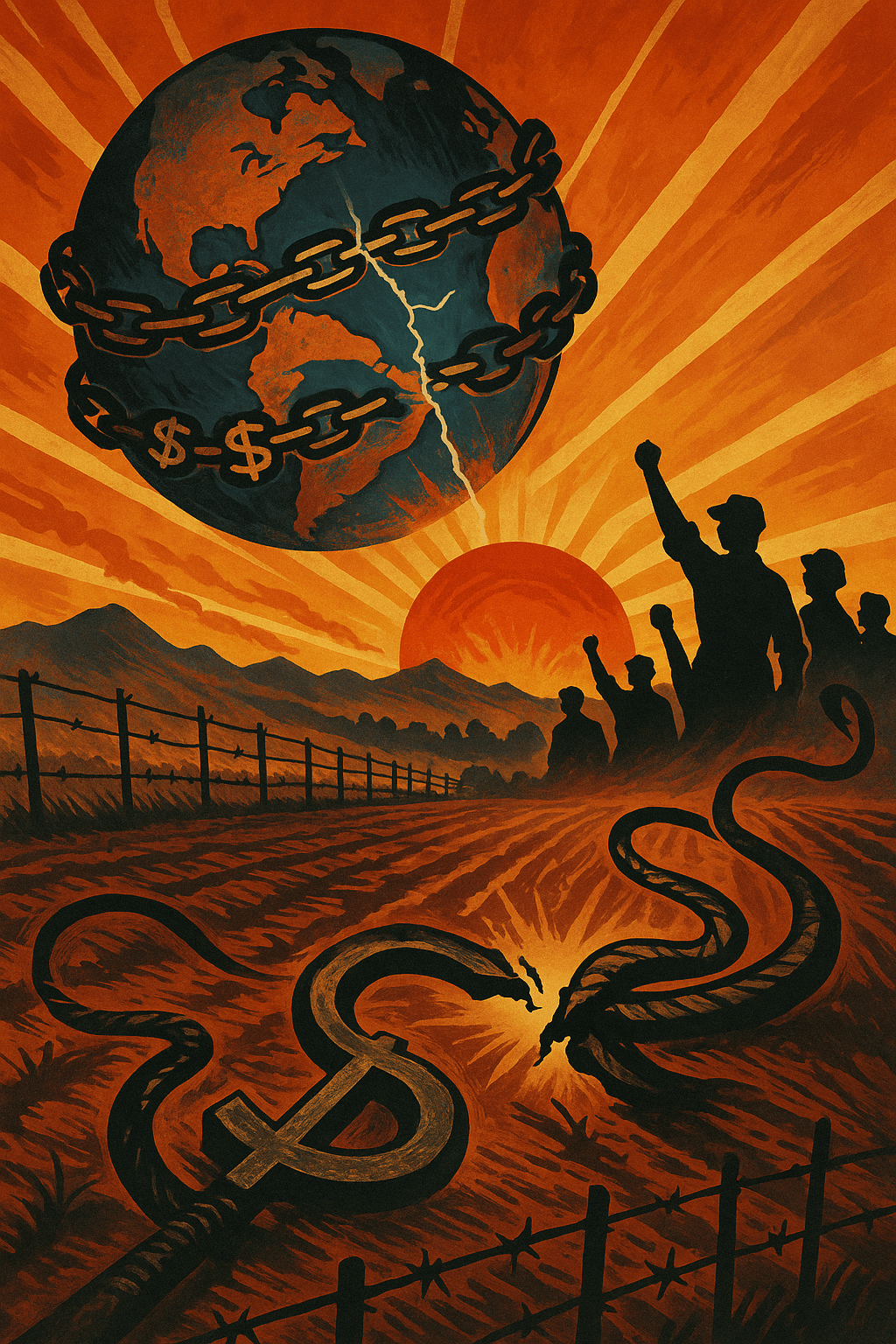
Empire built the dollar into a weapon and called it “the world economy.” Now, as China pries open new monetary space, the colonized world smells oxygen—and the old order smells smoke.
By Prince Kapone | Weaponized Information | October 2025
The Article, the Illusion, and the Quiet Violence of “Neutral” Language
On October 17, 2025, Yahoo Finance republished a Bloomberg report titled “China’s PBOC Vows Steps to Promote Use of Yuan Around the World.” Written by Tian Chen, the piece presents itself as a sterile market update: calm wording, procedural tone, and short declarative sentences that imply neutrality. Yet beneath this polished exterior, the article performs subtle ideological work. It frames China’s monetary policy as a technical adjustment in a frictionless marketplace, stripping the story of power, strategy, and the global struggle that gives it meaning.
The first narrative device is inevitability. By declaring that “the time is ripe” for wider yuan use, the article presents history as seasonal rather than political. This turn of phrase invites the reader to accept events as natural ripenings instead of conscious statecraft. Inevitable processes do not require motives, and if there are no motives, there are no interests to interrogate. The language does the disarming on behalf of the author.
The second device is the technocratic veil. Words such as “efficiency,” “predictability,” “openness,” and “transparency” function as ready-made certificates of legitimacy. These are not analytical descriptions; they are value-markers. Something is presumed rational simply because these words are attached to it. This tactic allows the author to sanctify policy moves without evaluating substance. The prose becomes a clearinghouse of unexamined virtue.
The third device is the weaponization of vagueness. The article notes unspecified measures to strengthen financial markets, bolster Hong Kong’s role, and support overseas yuan financing. But it never explains the methods, risks, or contested implications behind these decisions. Instead, the absence of detail is paired with a language of competence, as though withholding information were a sign of maturity rather than a means of shaping perception. Vagueness wrapped in confidence is a classic technique of narrative containment.
A fourth tactic appears in the article’s emotional register. Its tone is tranquil—no urgency, no conflict, no adversaries, no pressures. Monetary policy is portrayed as a clipboard exercise managed by calm professionals. This flattening removes struggle from the frame. Currency competition becomes a paperwork issue; global strategy becomes a scheduling note. In a world supposedly defined by market housekeeping, responsibility disappears into procedure, and power hides behind passive verbs.
The fifth device is selective silence. The article references the yuan’s internationalization while declining to mention the global context that makes such a move significant. By isolating China’s actions from the conditions surrounding them, the reader is left with motion but no map, decision but no dilemma. Silence here is not omission by accident—it is narrative design. The author chooses a world without antagonisms so that no one must be seen as resisting or contesting anything.
Finally, the text leans on repetition of softening keywords such as “support,” “enhance,” and “solidify.” These terms function like padded walls: they absorb tension and prevent sharper questions from emerging. It is ideological Novocain. By numbing the political nerve endings in the story, the prose helps the reader feel calm precisely where they should be alert.
What Bloomberg offers, then, is not neutral reporting but anesthetized storytelling. It suppresses the presence of struggle by excluding antagonists, motives, stakes, and consequences. It replaces analysis with atmosphere. It turns strategy into routine. This is how power launders itself in financial journalism: not by shouting, but by soothing. Not by lying outright, but by narrating half-truths in a tone that discourages curiosity. The propaganda is not in what is said—it is in what the language trains the reader not to notice.
The Facts Behind the Curtain
The Bloomberg piece tells us that the People’s Bank of China wants to make it easier for institutions at home and abroad to use the yuan. It says Beijing will “open up” its financial markets, make cross-border trade “more efficient,” and turn Shanghai and Hong Kong into premier hubs for global yuan activity. It also mentions that the PBOC has been setting stronger fixings to support the currency during a period of heightened trade tensions. These are the article’s chosen facts, packaged neatly and delivered without color, history, or consequence. They tell us what China claims it is doing, but nothing about the world in which these moves take place.
The omissions are louder than the sentences. The article never explains how the yuan actually functions in the global system, what barriers exist, or why a country would need its own currency to move more freely across borders in the first place. No mention is made of capital controls, or the structural limits that still shape on-shore (CNY) and offshore (CNH) markets. The story points to “opening” but avoids the question of what remains closed. It tells us about “global usage” but gives us no map of who uses the yuan today, at what scale, or against what obstacles.
To pull the camera back, we have to lay out the rest of the verifiable record. China has already set up 31 designated offshore renminbi clearing banks in 27 countries, giving the yuan legal and institutional presence far beyond its borders. (Federal Reserve) Yet despite this growing footprint, the yuan still lags behind the dollar, euro, and yen in overall global usage. (CEIC)
Inside China’s own system, there has been real movement. By mid-2024, 53% of China’s cross-border transactions were settled in yuan, up from roughly 40% just a few years ago. (Financial Times) The state has also built the Cross-Border Interbank Payment System (CIPS) to facilitate global settlement in yuan. (DBS) But growth in settlement does not mean the road is clear. Analysts point to capital-account restrictions, regulatory bottlenecks, and the entrenched dominance of the dollar as ongoing structural challenges. (Brookings)
When these facts are placed side by side, a different picture appears. The Bloomberg article shows us a snapshot; the wider record shows us the full landscape. The yuan is expanding, but slowly. It has landed in dozens of countries, but it is still climbing uphill. Policy announcements exist, but they are wrapped in restrictions, negotiations, and unfinished architecture. The article speaks of “opening,” but the reality is a long, contested process shaped by constraints the piece refuses to name.
What Bloomberg presents is a skeleton. The muscles, tendons, and heartbeat are missing. The omissions are not accidental—they strip the story of motion, scale, and contradiction. By limiting the frame to official quotes and pleasant buzzwords, the article avoids explaining what is actually happening in the global monetary arena. The facts exist, but only in fragments. It is our job to assemble them, because without the full picture, the reader is left with a shadow instead of a story.
The Dollar, the Whip, and the Revolt of the Earth
The facts are now on the table, and their meaning is unmistakable: this is not a story about “market efficiency” or “predictability.” This is a frontline in a global struggle over who has the right to breathe. The dollar is not merely a currency—it is an architecture of domination, a global enforcement mechanism that disciplines entire nations through sanctions, blockades, financial blackmail, and the quiet strangulation of development. For a century, the United States has used its monetary power the way an overseer uses a whip: to keep the world’s majority bent, compliant, and afraid. When Bloomberg reports on the yuan, it is not reporting on finance. It is guarding the plantation.
The yuan’s internationalization is treated as a curiosity in Western media because admitting its strategic meaning would expose the imperial order for what it is. The dollar is not strong because of “market confidence.” It is strong because it is backed by aircraft carriers, coups, sanctions, and the IMF. It is strong because nations that defy it are starved, invaded, or overthrown. It is strong because every barrel of oil, every global transaction, and every cross-border payment must kneel before New York and Washington. Bloomberg will not print that sentence, but the people of Iran, Cuba, Venezuela, Zimbabwe, and Iraq know it in their bones.
China’s attempt to expand the yuan is not an exotic financial experiment. It is a jailbreak. A post-revolutionary state, scarred by colonial invasion and shaped by socialist construction, is trying to carve breathing room into a world suffocated by a declining empire. China is not an imperialist power; it is a sovereign state with socialist roots and capitalist contradictions, navigating hostile terrain while refusing to bow. It builds currency swaps instead of invasions, infrastructure instead of coups, development zones instead of military bases. It does not occupy nations, topple governments, or send the CIA in through the back door. Its rise threatens the United States not because it wants to dominate the world, but because it refuses to be dominated by it.
That is why the silence in Bloomberg’s tone is so revealing. It must erase the stakes. It must pretend there is no contest. It must speak of “transparency,” “liquidity,” and “market openness” because it cannot speak of sovereignty, multipolarity, or liberation. It must frame China’s actions as technical adjustments rather than acts of defiance, because to admit the defiance is to admit the legitimacy of resistance. A chained world is never supposed to notice the sound of a blade sawing through iron.
The yuan’s slow advance—its clearing banks, its settlement systems, its offshore hubs—is the financial wing of a broader revolt. From Latin America to Africa to West Asia, nations are searching for any exit from the prison of dollar dependency. They want to trade without being choked. They want development without debtors’ shackles. They want sovereignty without asking permission from the empire that colonized them yesterday and sanctions them today. The yuan’s rise is therefore not just a Chinese project. It is a crack in the walls of the American century.
The global working class has no interest in a world where Washington controls the price of bread, the flow of fuel, and the circuits of investment. Every sanction is paid for by workers and peasants, not oligarchs. Every IMF diktat is enforced against the poor, not the rich. The dollar system is the economic dictatorship of a dying empire, and its collapse is not something to fear—it is something to hasten and replace. Multipolar finance is not yet socialism, but it breaks the monopoly that strangles the possibility of socialism.
This is the meaning Bloomberg cannot speak. Empire is in decline. The world is in motion. China’s currency push is one fracture in a larger break. What comes next will be decided by whether the forces of liberation can turn cracks into ruptures, and ruptures into foundations. Part IV now asks the only question that matters: what will the oppressed of the world do with this opening?
From Crack to Break: Organizing Against the Dollar’s Empire
The mask has slipped, and the terrain is clear. The dollar is not a currency but a command. The yuan’s emergence is not a curiosity but a breach. And now we stand at the threshold where analysis must become action. The question is no longer whether the old order is dying, but whether the forces of liberation will organize in time to bury it. The dollar’s supremacy will not collapse from “market trends.” It will collapse because the people of the world refuse to keep paying tribute to their own oppressors. Refusal, however, must be organized.
Across the Global South, this organization has already begun. The BRICS coalition is expanding currency settlement networks to escape the chokehold of U.S. clearing systems. In West Asia, states are openly trading in non-dollar currencies, defying a sanctions regime that once forced entire nations to choose between starvation and submission. In Africa, movements aligned with Pan-Africanist economic blocs are demanding development on sovereign terms, not IMF chains. In Latin America, ALBA and anti-IMF campaigns are resurfacing with renewed force, rejecting the return of Wall Street tutelage. These are the frontlines of a world learning to breathe without permission.
The Global North is slower to move, but cracks are spreading there as well. European farmers revolt against austerity; workers from France to the United States resist the erosion of life under neoliberal decay; anti-NATO and anti-sanctions movements challenge the logic of permanent militarism. The people can sense that the empire’s crisis is being balanced on their backs, and the patience of the working class is thinning.
Now the task is unity with direction. In the Global South, we must deepen support for financial sovereignty: local-currency trade, public banking, capital controls that defend development, and multipolar payment systems like CIPS that weaken the dollar’s chokehold. Popular movements must pressure states to reject IMF “assistance,” resist dollar-denominated debt, and link their struggles to the broader insurgency against U.S. monetary rule.
In the Global North, the mission is different but connected. Workers must expose and oppose their ruling class’s financial wars, which are carried out in their name but against their interests. This means building and joining anti-sanctions campaigns; backing organizations that fight U.S. militarism and NATO expansion; supporting internationalist media and research that break the monopoly of imperial narrative; and pressuring unions, city councils, and social movements to divest from the institutions enforcing financial strangulation around the world. Every municipal contract with a sanctions-enforcing bank is a battlefield. Every union vote against militarism is a fracture in the empire’s armor.
The dollar system will not fall through currency swaps alone. It will fall when the movements of the South and the insurgent forces of the North recognize themselves as part of one struggle: the struggle to end the economic dictatorship of a decaying empire and open the road to a world where sovereignty is shared and wealth is planned for human need, not private plunder. Multipolarity opens the door. Only organized people can walk through it.
We are living in a hinge of history. The empire is vulnerable, the periphery is rising, and the working class is stirring under the weight of crisis. What comes next depends on whether we act with clarity and discipline. The world has rehearsed resistance; now it must conduct it. The dollar’s world is breaking. It is time to help it break apart—and to build, in its place, an order that serves the many, not the few.
 Weaponized Information
Leave a comment