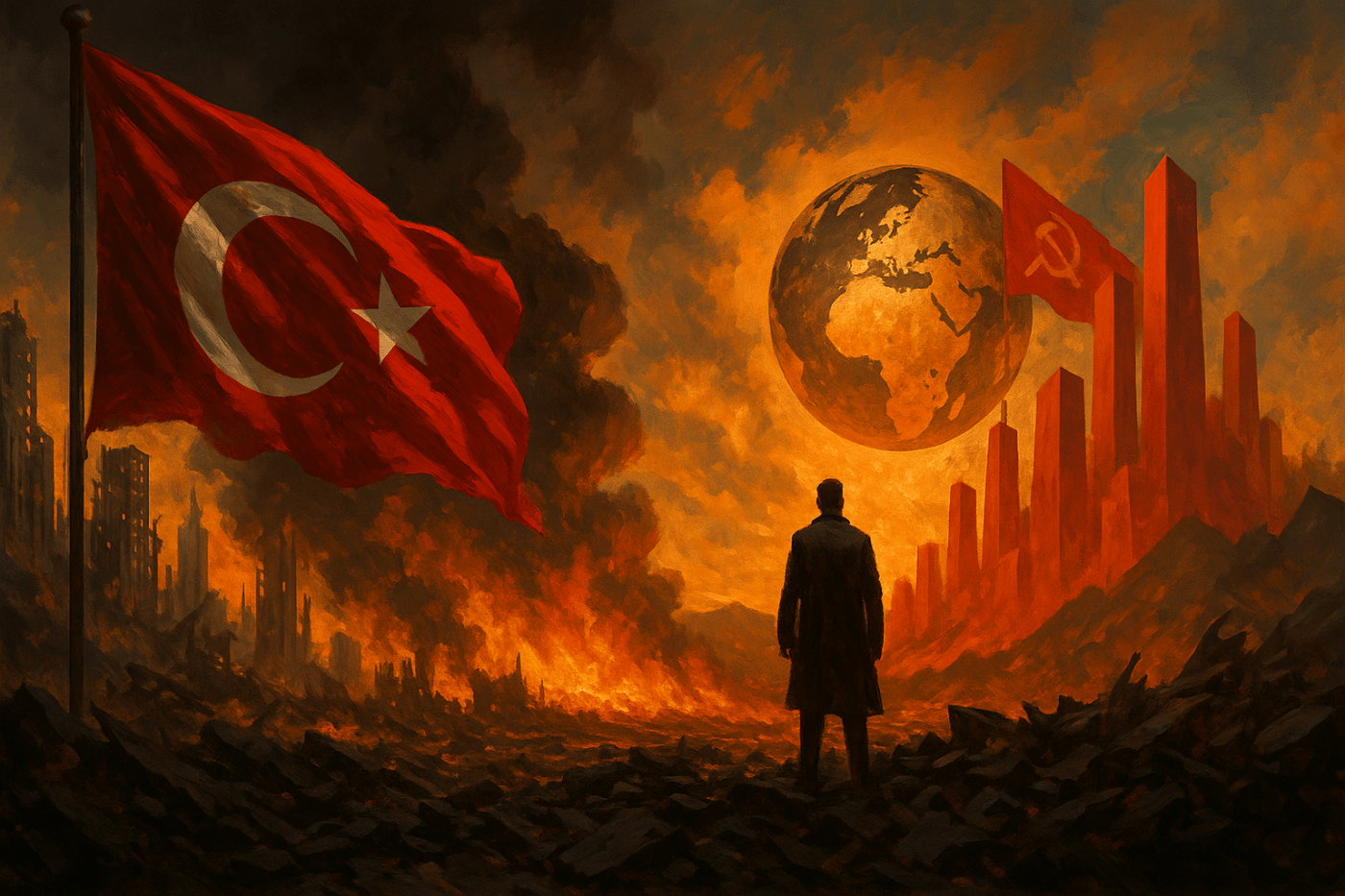
How Türkiye’s break with the West signals not merely a geopolitical realignment but a civilizational reorientation — one that exposes the contradictions of global capitalism and opens the path toward a new socialist world order.
By Prince Kapone | Weaponized Information | October 12, 2025
The Cracks in the Atlantic Wall
For seventy years, Türkiye stood guard at the southeastern flank of the U.S. empire. Its generals trained under NATO command, its security doctrine was written in Washington, and its economy was chained to Western capital. Turkish nationalism—once the ideological armor of the Atlantic alliance—defined itself by its hostility to communism, socialism, and every emancipatory current that challenged Western power. To be patriotic meant to be anti-Soviet. To be modern meant to be pro-Western. The flag of independence flew beneath the shadow of another’s empire.
But history moves dialectically, not linearly. In September 2025, Devlet Bahçeli, leader of the Nationalist Movement Party (MHP) and a pillar of Erdoğan’s governing coalition, called for a strategic alliance between Türkiye, Russia, and China to counter what he termed the “U.S.-Israel evil coalition.” For the first time since joining NATO in 1952, a major Turkish political force openly proposed a civilizational reorientation—from Atlanticism to Eurasianism, from the empire’s flank to the heart of the continent it once helped encircle.
To Western analysts, Bahçeli’s statement was “provocative.” To historians, it was inevitable. Every subordinate ally eventually reaches a point where obedience becomes untenable. Türkiye’s contradictions had been accumulating for decades: endless wars on its borders, economic dependence without development, sanctions for purchasing Russian arms, humiliation by the European Union, and a steady erosion of strategic trust. NATO’s “partnership” had become an instrument of discipline. The more Türkiye asserted its autonomy, the more the West treated it as a problem to be managed.
President Erdoğan responded to Bahçeli’s proposal with typical ambiguity: “Whatever is good, let it happen.” Beneath that cautious phrasing lies a deeper calculation. Erdoğan has mastered the art of political jujitsu—turning crises into leverage. He understands that signaling an eastern pivot strengthens Ankara’s bargaining power with the West. Yet even tactical ambiguity becomes strategic when the old order is dying. As the Atlantic system implodes under its own contradictions, Türkiye is no longer oscillating between two worlds—it is redefining the center of gravity itself.
For decades, Turkish nationalism marched under the NATO flag, conflating Western power with modernity itself. Now, that equation is breaking down. The so-called “right wing” of Turkish politics, long seen as reactionary and conservative, has begun to speak a language that sounds—ironically—like that of the historical left: sovereignty, multipolarity, anti-imperialism. The same slogans once used to justify repression against socialists and communists are being repurposed to denounce Western domination. Such is the irony of dialectics: when empire decays, even its former servants begin to sound revolutionary.
What we are witnessing in Türkiye is not simply a policy shift; it is the unraveling of an entire ideological architecture. The Atlantic Wall that once enclosed the global South—militarily, financially, and psychologically—is cracking from within. Türkiye’s Eurasian turn is both symptom and signal. It reveals how far the decay of Western hegemony has advanced, and how urgently new alliances are being forged to escape its gravitational pull. The same nationalist impulse that once served empire now seeks to bury it.
The Death of Atlanticism and the Rebirth of Sovereignty
Atlanticism was never just a military alliance; it was a theology — a faith in the eternal supremacy of the West. It fused NATO’s bombs, the IMF’s loans, and Hollywood’s illusions into a single worldview: that civilization itself flowed from Washington and Brussels. Under its banner, capital wore the mask of democracy, colonial plunder called itself “development,” and U.S. wars were baptized as “humanitarian interventions.” Türkiye, positioned at the edge of Europe and Asia, was enlisted as the empire’s sentinel — the janissary of modern imperialism. Its generals guarded NATO’s southern flank; its workers built export zones for Western investors; its politicians swore loyalty to the altar of the dollar.
But the empire that once promised prosperity delivered only dependency. Türkiye’s industrial base was hollowed out by privatization; its agriculture was dismantled by neoliberal reform; its economy became a conduit for foreign capital, not domestic development. Each IMF bailout chained Ankara more tightly to the discipline of global finance. Even its political sovereignty — the right to decide what to buy, whom to trade with, whom to arm — was policed by Washington. When Türkiye purchased Russia’s S-400 missile defense system, the U.S. imposed sanctions on a supposed “ally.” When it sought EU membership, Europe slammed the door shut. When it refused to join anti-Russia sanctions, it was threatened with economic isolation. This is not partnership — it is imperial tutelage.
The Atlantic project is collapsing under the weight of its own contradictions. The dollar, once a symbol of global confidence, has become a weapon of extortion. The IMF’s “rescue packages” now trigger riots, not gratitude. Western democracy lectures ring hollow in the age of Gaza and Guantánamo. As the unipolar system fragments, even its beneficiaries begin to defect. Türkiye’s ruling class is not rebelling out of virtue; it is rebelling out of survival. The imperial marketplace that once sustained peripheral elites is shrinking, and the costs of obedience now exceed its rewards.
In this vacuum, sovereignty reemerges — not as a romantic slogan, but as a material necessity. To govern, nations must reclaim control over their currency, their food, their energy, their production, and their security. What began as a slogan of the anti-colonial left is now being resurrected by the nationalist right. The very word “sovereignty,” once dismissed as archaic by neoliberal cosmopolitans, has become the political vocabulary of the twenty-first century. Across the Global South — from Caracas to Pretoria, from Riyadh to Ankara — the same realization echoes: no nation can survive under the dollar’s dictatorship.
This is the dialectic of imperial decline: as the capitalist core tightens control to preserve its privileges, the periphery revolts. Atlanticism’s strength was always its universality — the illusion that there was no outside to the West. That illusion is now shattered. The more Washington lectures about “democracy,” the more its allies seek autonomy. The more Europe moralizes about “human rights,” the more its double standards are exposed by its silence on genocide. What collapses first is not the empire’s army, but its legitimacy.
Türkiye’s drift from the Atlantic system marks more than a geopolitical recalibration. It signifies the beginning of a new political epoch — one in which sovereignty replaces globalization as the central organizing principle of international life. In rejecting the commands of its Western masters, Türkiye is rediscovering what the colonized world has always known: that freedom and dependency cannot coexist. The death of Atlanticism is not the end of history — it is the return of history itself.
The Dialectic of Delinking
The word “delinking” entered the political lexicon through the revolutionary economist Samir Amin, who used it to describe the strategic withdrawal of peripheral nations from the circuits of imperial accumulation. It does not mean isolation or autarky. It means recentring national development around internal needs rather than external dictates — reclaiming sovereignty over production, finance, and exchange. In Amin’s words, it is “the refusal to submit national development to the imperatives of globalized capitalism.” Today, that refusal has become a planetary tendency. The collapse of unipolarity has turned delinking from a theoretical option into a material necessity.
For Türkiye, delinking began not as an ideological project but as a defensive maneuver. The West weaponized the very arteries of the global economy — the dollar, SWIFT, supply chains, sanctions — transforming commerce into coercion. To survive, Ankara had to find new outlets for trade, new sources of credit, and new partners immune to Washington’s veto. What began as tactical diversification — energy from Russia, investment from China, currency swaps with Qatar — gradually evolved into a structural pivot. Türkiye discovered what every sanctioned nation has learned: economic sovereignty is impossible without political autonomy.
Here lies the dialectic: every step taken to shield a nation from imperial pressure forces it to reorganize production and trade along non-capitalist lines. Sanctions compel planning. Currency crises compel capital controls. Dependence on Western finance compels the creation of parallel institutions — BRICS banks, bilateral settlements, regional payment systems. Even when governments remain capitalist in class composition, the objective logic of survival pushes them toward state intervention, coordination, and long-term strategy. Delinking politicizes the economy. It transforms technocratic management into ideological struggle.
Amin warned that peripheral capitalism cannot reproduce itself without imperialism. Its ruling classes survive by mediating between foreign capital and domestic labor — collecting rent, enforcing austerity, and suppressing resistance. But when the imperial center can no longer guarantee accumulation, that comprador structure begins to rot. Inflation, unemployment, and debt crises erode the social base of the elites. What follows is a process both dangerous and pregnant with possibility: either authoritarian reaction, or the rise of popular movements capable of seizing and socializing the instruments of sovereignty.
Delinking, therefore, is not socialism — but it tends toward socialism, because it dismantles the infrastructure of capitalist dependence. Once a state nationalizes energy, reclaims currency control, or builds industry through public investment, it cannot easily revert to neoliberal subservience. Each measure of economic autonomy creates new social forces — workers, engineers, small producers — whose interests align with continued independence from foreign capital. Over time, the preservation of sovereignty demands the democratization of its control. Political freedom becomes the logical extension of economic self-determination.
This is the stage Türkiye now enters. Its trade routes are reorienting eastward, its currency policy experiments with independence, and its rhetoric of sovereignty grows louder with every Western provocation. The contradictions remain — a capitalist class still bound to profit, a leadership balancing between blocs — but the trajectory is unmistakable. Once delinking begins, the gravitational pull of the West weakens, and new possibilities for development emerge. The process is uneven, contradictory, and reversible — yet every crisis makes reversal less likely.
In this way, Türkiye’s realignment exemplifies a universal law of imperial decay: when the empire weaponizes interdependence, it teaches the world how to live without it. The more the West punishes disobedience, the more it accelerates the creation of alternatives — not only economic, but civilizational. Delinking thus becomes the global form of class struggle in the 21st century, waged not only by workers and peasants, but by entire nations reclaiming control over their destiny.
Multipolarity as Transitional Epoch
The imperialists speak of “rules-based order.” But what they mean are their rules, designed to preserve their order. For five centuries, that order rested on the premise that the world must orbit the West — economically, culturally, and militarily. To obey was modernity; to resist was barbarism. Yet today, the orbit is decaying. The gravitational pull of the West weakens, and new centers of gravity emerge across the global South. This is the essence of multipolarity — not a polite “balance of powers,” but the erosion of the imperial core’s monopoly on power itself.
Multipolarity is not a utopia. It is an interregnum — a transitional epoch between the death of unipolar empire and the birth of a new civilizational order. Within it, socialist, nationalist, and hybrid states coexist uneasily, each carving its own path through the wreckage of neoliberal globalization. China, Vietnam, and Cuba demonstrate the viability of socialist planning; Russia and Iran embody state-led capitalism with strategic autonomy; Türkiye and India experiment with multipronged nationalism, blending economic pragmatism with civilizational rhetoric. The diversity is real, but so is the convergence: all reject the West’s claim to universal guardianship. All seek to reclaim control over their historical trajectory.
At the center of this realignment stands China — the gravitational pole of the new epoch. While Washington exports sanctions, Beijing exports railways. While the U.S. demands obedience, China offers infrastructure and trade. Its rise did not follow the script of neoliberal orthodoxy; it followed the logic of socialist sovereignty — the state directing capital rather than being directed by it. Through the Belt and Road Initiative, China has quietly constructed the scaffolding of an alternative world system: ports in Africa, pipelines in Central Asia, industrial parks in Latin America, digital corridors across Eurasia. The project is not without contradictions, but its essence is clear — it rewires the arteries of global circulation away from imperial control.
In this sense, multipolarity is more than diplomacy; it is a mode of development. It signals the return of politics to the economy, the end of technocratic globalization, and the reemergence of planning as a legitimate instrument of progress. Even nations that remain capitalist in form are compelled to adopt socialist functions — public investment, resource nationalization, capital controls — to shield themselves from Western economic warfare. The logic of survival pushes them toward partial decommodification, toward sovereignty over markets. The more the empire collapses, the more its former satellites rediscover the necessity of state power.
For Türkiye, this global shift opens new possibilities. The same geography that once bound it to NATO now situates it at the crossroads of Eurasia’s integration — between Russia’s energy corridors, China’s infrastructure networks, and the Arab world’s markets. The country’s future no longer depends on Western approval, but on how deftly it navigates this emerging matrix of cooperation. In aligning with the East, Türkiye is not choosing ideology; it is choosing survival. Yet in doing so, it becomes a participant in a historical process that transcends its own intentions — the slow, uneven, but inexorable transition from imperial unipolarity to civilizational multipolarity.
This is why multipolarity must be understood dialectically. It is neither anti-capitalist by design nor pro-socialist by decree. It is a terrain — a battlefield of world-historical contradictions where the old logic of capitalist globalization confronts the embryonic forms of post-capitalist organization. The coexistence of capitalist and socialist states within a single framework is not equilibrium; it is tension. And within that tension lies the seed of transformation. For as the empire’s circuits of accumulation unravel, the only viable forms of development left are those rooted in sovereignty, cooperation, and planning — the very building blocks of socialism.
Multipolarity, therefore, is not the end of history’s struggle, but its resumption. It is the interregnum in which new worlds are conceived, new contradictions sharpen, and new possibilities emerge. In the ruins of Atlanticism, humanity is once again learning to build without masters.
The Coming Wave: From National Sovereignty to Popular Power
Every world crisis rewrites the rules of revolution. In the 20th century, imperialism imposed its contradictions through war and colonial occupation. In the 21st, it imposes them through debt, sanctions, and digital domination. But the result is the same: the global South bleeds so that the North may live. And as always, when the bloodletting becomes unbearable, the masses begin to move. What we are witnessing today is the early tremor of a global uprising — not yet coordinated, but increasingly synchronized — a wave of labor unrest, peasant resistance, and national self-assertion that signals the exhaustion of comprador capitalism.
The ruling classes of the South — the bankers, landlords, and political dynasties who mediate imperial plunder — are running out of lifelines. Their economies depend on Western credit; their currencies on the dollar; their legitimacy on illusions of endless growth. But the imperial core itself is collapsing under overproduction, inflation, and militarized chaos. When the master drowns, the servant cannot swim. The IMF’s chains are tightening, not loosening. Debt service now devours national budgets; imported inflation ravages food supplies; youth unemployment swells into revolt. The comprador bourgeoisie is losing control of the very societies it once pacified.
History has seen this pattern before. In Latin America’s “Pink Tide,” debt crises shattered neoliberal orthodoxy and brought workers and peasants to power. In Africa and Asia, resource nationalism and anti-imperialist populism arose from the ruins of structural adjustment. Each wave begins with reform and ends with confrontation. The ballot box becomes the battlefield; the slogan of sovereignty transforms into a demand for socialism. When the parliamentary road is blocked by coups, sanctions, or sabotage, the street resumes its historic role as the legislature of the oppressed.
This is the dialectic of the coming period. As nations delink from the West, the internal contradiction between the people and the comprador elite intensifies. The same economic crises that drive states toward sovereignty also drive their populations toward revolution. And once popular forces gain control of the state — by vote or by insurrection — they inject multipolarity with new content. It ceases to be merely an alliance of pragmatic sovereignties and becomes a social bloc of liberated nations, united not by convenience but by shared class interests: the abolition of dependency and the socialization of development.
We can already glimpse this horizon. In Bolivia, Venezuela, Cuba, Nicaragua, and beyond, the architecture of post-imperial cooperation is being built from below: local currencies, barter trade, regional energy grids, and cooperative food systems. In Africa and West Asia, resistance to neocolonialism is mutating into economic experimentation — public banks, state-led industrialization, and collective resource management. Each success story becomes a contagion of hope. When one nation proves it can feed its people without obeying Washington, others take note. Delinking becomes popular consciousness.
The next decade will decide whether this consciousness consolidates into a movement. The empire’s counteroffensive — coups, proxy wars, information warfare — will be fierce. But the material conditions favor the insurgent. Capitalism can no longer sustain its promises; imperialism can no longer enforce its illusions. The peoples of the global South have nothing left to lose but their debt. Their struggle will not only determine the fate of multipolarity, but of humanity itself. For in the battle between sovereignty and subjugation, between production for life and production for profit, lies the fate of civilization.
The tide is rising. Its form will vary — ballots in one country, barricades in another — but its direction is singular. The struggle for sovereignty is becoming the struggle for socialism. And when the masses seize the state, the map of multipolarity will no longer be drawn by presidents and diplomats, but by workers, peasants, and revolutionaries — the architects of the new world struggling to be born.
From Türkiye to the World: The Socialist Tendency of Sovereignty
Türkiye’s break with the West may appear, on the surface, as a maneuver of nationalist pragmatism — a middle power seeking leverage between great powers. But beneath the surface runs a deeper current. Every nation that delinks from the imperial system, even partially, becomes a laboratory of historical transformation. Each act of defiance against the dollar, each refusal to enforce Western sanctions, each assertion of policy autonomy chips away at the architecture of capitalist empire. Türkiye’s shift is therefore not an anomaly; it is a sign of the times. It is the symptom of a world that no longer believes in Western salvation.
That disbelief has revolutionary implications. The Western model of progress — privatize, liberalize, integrate — has exhausted its credibility. Its institutions are bankrupt, its currencies fragile, its wars unending. The multipolar world emerging in its place may still contain capitalist states, but its logic undermines capitalism’s global coherence. The law of value, once universal, begins to fracture as nations trade outside the dollar, plan their economies, and measure progress by sovereignty rather than profit. What arises is a socialist tendency within sovereignty itself — the gradual socialization of development as the condition for national survival.
China embodies this tendency most clearly. Its rise shattered the myth that capitalism and globalization are synonymous. By wielding the state as the instrument of accumulation, not its captive, China reintroduced planning, industrial policy, and long-term vision into the bloodstream of global economics. Its partnerships across Asia, Africa, and Latin America export not ideology but infrastructure, proving that growth can be achieved without submission to Western finance. And in the process, Beijing has created the gravitational field around which the rest of the world is reorienting. The more nations integrate with China, the more they internalize the logic of sovereign development — which is, at its core, a logic of socialism.
Türkiye’s Eurasian turn reflects this gravitational pull. Though its leadership is not socialist, its strategic orientation — cooperation with Russia, partnership with China, dialogue with Iran — places it within a political economy that rewards independence and punishes dependency. It is being drawn, willingly or not, into the orbit of a world no longer defined by capitalist unipolarity. Its break with Atlanticism signals the beginning of a broader process: the transformation of nationalism itself from a reactionary ideology of isolation into a revolutionary instrument of decolonization. In the new epoch, sovereignty is no longer the privilege of the strong; it is the weapon of the weak.
This is the dialectical irony of history: as the Western bourgeois order collapses, its most loyal allies inherit its crisis. To survive, they must repudiate the very system that created them. Türkiye, like many nations in the global South, is being compelled by necessity to rediscover what socialism once promised — not as doctrine, but as practice. As imperial markets shrink, as neoliberal globalization implodes, as popular pressures mount, the logic of planned and cooperative development will reassert itself. The road to national survival passes through the terrain of socialist reconstruction.
In this sense, multipolarity is not the antithesis of socialism; it is its precondition. It creates the material space for alternatives to emerge, the breathing room for revolutions to ripen. It fractures the monopoly of global capital, allowing societies to experiment again with paths not dictated by Wall Street or the Pentagon. The socialist tendency of sovereignty is not proclaimed in manifestos — it is produced by struggle, by necessity, by the contradictions of empire itself. The future will not be made in the salons of diplomats, but in the factories, fields, and movements of the world’s oppressed.
As Türkiye pivots eastward, it does more than reposition itself on the map. It marks a turning point in the long arc of history: the reawakening of the nations once buried beneath the rubble of empire. From Ankara to Caracas, from Johannesburg to Beijing, a new principle of world order is emerging — one that measures power not by domination, but by the capacity to resist it. Sovereignty has become the new name of revolution. And in its unfolding struggle, the seeds of socialism are once again being sown.
The age of empire is ending. The age of humanity is beginning.
 Weaponized Information
Leave a comment