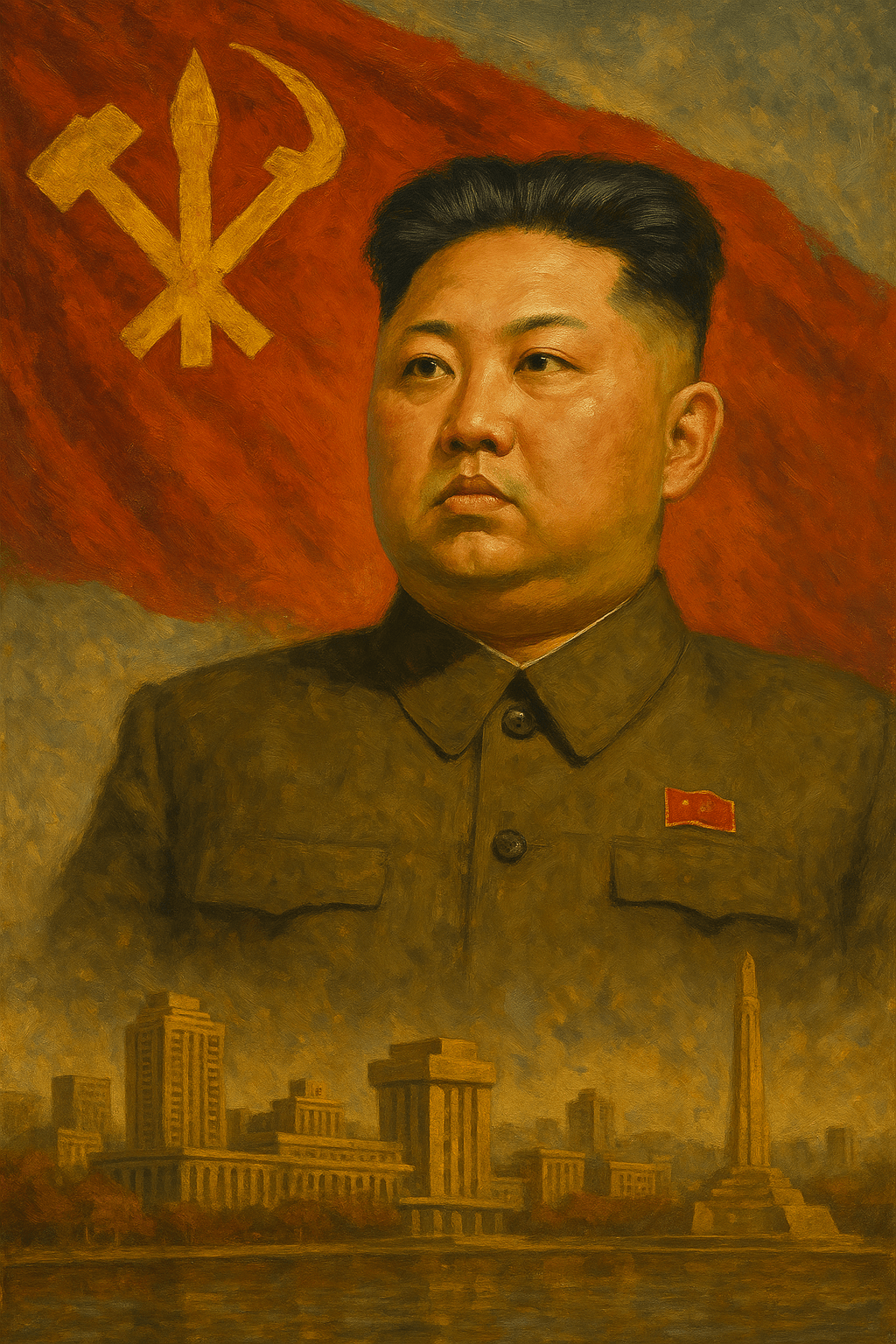
At the 80th anniversary of the Workers’ Party of Korea, Kim Jong Un reasserts the moral and political grammar of a revolution that endures by self-correction, unity, and defiance—transforming siege into pedagogy, hardship into method, and permanence into proof of socialism’s vitality.
By Prince Kapone | Weaponized Information | October 11, 2025
Pyongyang, October 10 — The Test of Time
The square in Pyongyang was dressed for a birthday, but the mood was audit, not nostalgia. Eighty years is a long time for any party, let alone one born in guerrilla camps and raised under embargo. Kim Jong Un called it a “sacred 80 years,” and you could hear why: this was not a museum tour; it was a balance sheet of a revolution that refused to be buried. The Workers’ Party of Korea was presented as a “new-type revolutionary party,” not because its banners are brighter, but because under permanent siege it kept the lights on, the factories turning, and the political line intact. Where other states measured success by quarterly profits, this one measured it by survival with dignity—“a dignified and powerful socialist state, faithful to the dreams and ideals of the people.”
The West loves to narrate the DPRK as anachronism, a relic misfiled by history. The speech turned that story inside out. Here, endurance is not a substitute for victory; endurance is the form victory takes when you are ringed by sanctions and surrounded by bases. “Maintaining the political power and defending the social system was a miracle itself,” Kim remarked, not as a boast but as a method: a society that learns to metabolize pressure turns blockade into pedagogy. In this telling, hardship is not a moral lesson handed down from on high; it is raw material for collective intelligence. The party line is tested in the furnace and revised in motion, what he called “scientific lines and policies” advanced “along the unchangeable track of socialism.” Dialectics here is not jargon; it is an engineering term—why the bridge still stands after a hundred storms.
What explains the staying power? Not myth, not a personality cult, but a stubborn algorithm repeated until it becomes muscle memory: “Together with the people.” The phrase threaded the speech like rebar. It was offered not as soft sentiment but as operating code: policy forged where workers live and peasants plant, rectified when it drifts, defended when it works. The Party—if we take Kim at his word—does not hover above the masses; it holds because it is held, because its program “encapsulated the people’s opinions and requirements.” There is a quiet insolence in that claim: while capitalist democracies outsource consent to advertising and polling, the WPK insists that legitimacy is measured by cohesion under stress. You can dislike the conclusion, but the premises are empirical: eight decades, one war that leveled the peninsula, a sanctions regime that would have snapped smaller nations in half—yet the scaffolding remains.
None of this came wrapped in triumphalism. The tone was almost workmanlike: name the threats, list the responses, tally the gains, warn of the rot that bureaucracy can seed if the Party forgets who it serves. The speech refused the easy lie that socialism means the end of contradiction. Instead, it took the Marxist view seriously: contradiction is permanent; the question is whether you manage it or it manages you. Here, the wager is plain. If the Party keeps its oath—“a people’s party that faithfully serves them”—then the next eighty years are not a miracle but a plan. If it forgets, the overlord style returns in red clothes, and history collects the debt with interest. For now, the ledger reads like this: an anvil nation that learned to turn blows into tools, a leadership that stakes its authority on whether the people can feel the difference in their hands. The audit, in other words, is not finished; it is ongoing—and that, more than the fireworks, is what made October 10 sound like a future being hammered into shape.
A New-Type Revolutionary Party
Kim Jong Un stood before a country that has lived under siege for most of its existence and called his organization a “new-type revolutionary party.” In his telling, the Workers’ Party of Korea is not simply an heirloom from 1945; it is a political invention forged by constraint. It learned to build industry without markets, defend sovereignty without allies, and sustain belief without permission. “From the days of building democracy,” he said, “to this day, the WPK has remained faithful to its responsibility and role as an engine of the revolution.” A party that survives without sponsorship becomes a laboratory of endurance, where every setback is recycled into method.
In Pyongyang’s vocabulary, “new-type” means more than innovation—it means adaptation under pressure. When the imperial order shut every door, the Party built doors of its own: cooperatives in the countryside, factories under embargo, satellites launched through sanctions. Kim described the result as “a genuine people’s country with absolute prestige and national strength,” a line that carries both pride and warning. Prestige, in this context, is not pomp but proof: proof that a small socialist state can remain upright while the capitalist world demands its knees. The WPK is defined not by how it governs in calm but by how it governs in siege.
That siege has become the crucible of theory. Where bourgeois parties change slogans every election, the WPK revises policy through what Kim calls “scientific lines and policies”—the steady experimentation of a system that cannot afford collapse. This is Marxism under extreme conditions, stripped of ornament and forced into empirical discipline. “By successfully leading the social transformation processes of several stages,” he said, the Party has verified “the righteousness of socialism and demonstrated its unique superiority and might.” In other words: the proof of the line is in the endurance.
To outside observers, such language sounds like obstinacy. Inside the frame of siege, it reads as continuity with purpose. The WPK’s authority does not rest on electoral arithmetic or capitalist growth curves; it rests on the fact that, after eighty years of bombardment—military, financial, ideological—it still commands a functioning state. That durability is not inertia. It is movement slowed to the tempo of survival. A revolution that cannot sprint learns to breathe differently, to live on less oxygen than the empires that surround it. The WPK’s “new type” is precisely this: a party whose longevity is its doctrine, whose doctrine is its ability to outlast the storm.
Siege as School — The Dialectic of Hardship
Kim’s speech treated history not as backdrop but as battlefield. Every page of the Workers’ Party’s existence reads like a chronicle of siege: colonial occupation, invasion, famine, isolation, embargo, nuclear blackmail. Where other nations might have perished, the DPRK learned to metabolize disaster. “The past 80 years were really complicated and arduous, yet worthwhile and glorious,” Kim said, folding contradiction into triumph. The hardships were not detours from the socialist road; they were the terrain itself. Siege became the school through which the revolution educated itself in the science of survival.
In the capitalist world, crisis is pathology — a malfunction to be outsourced or hidden. In the DPRK’s political grammar, crisis is dialectical. Each blow calls forth the structure capable of absorbing it. The Korean War carved the instinct for defense; sanctions produced the discipline of self-reliance; the collapse of the socialist bloc demanded ideological self-sufficiency; nuclear encirclement gave rise to deterrence as peace policy. “Maintaining the political power and defending the social system was a miracle itself,” Kim admitted, but it is a miracle explained by materialism: the system learned to feed on its contradictions. The blockade was transformed from a noose into a perimeter — a line within which socialism could develop on its own terms.
This inversion of adversity is what makes the WPK’s project incomprehensible to liberal eyes. The empire measures vitality by accumulation; the DPRK measures it by endurance. To remain standing after decades of coordinated strangulation is, in Kim’s logic, the empirical validation of his “scientific lines and policies.” Where the West asks “how long can they last,” Pyongyang asks “how much can we create with nothing?” Each hardship becomes a negative resource, an unwanted but indispensable teacher. As Kim put it, “We have cleared an untrodden path for their implementation, writing a history of epochal transformations.” The Party does not claim perfection; it claims motion — from one contradiction to the next, surviving by transforming.
Seen this way, the WPK’s history is not a relic of Cold War defiance but a laboratory in continuity. Its socialist project is less a straight line toward abundance than a spiral through adversity, turning external pressure into internal coherence. The dialectic runs clear: siege produced unity, unity produced resilience, and resilience produced the confidence to imagine development outside the capitalist world system. “A dignified and powerful socialist state,” Kim called it — one that made its own rules in a world that offered it none. The siege, in short, became its syllabus; the revolution, its ongoing exam.
Together With the People — The Engine of Permanence
Every revolution claims to speak for the people; few survive long enough to still mean it. Kim Jong Un’s refrain — “Together with the people” — ran through his address like the chorus of a song too costly to forget. It is not a metaphor, not even quite a slogan; it is the mechanism by which the Workers’ Party of Korea has kept its heart beating. “The history of working for the people, the history of relying on the strength of the people,” he said, “is precisely the factor behind all victory and glory our Party has won.” What reads as poetry in the Western press functions here as political anatomy. The Party’s durability lies in its refusal to stand above the masses; it breathes through them. It rules not by distance but by density — an intimacy between leadership and labor that turns policy into collective metabolism.
This is not populism. Populism flatters from a podium; the WPK organizes from within. Kim’s language of gratitude — “I express my warm gratitude to the delegates to the celebrations, who have come with proud fruits of their remarkable patriotic enthusiasm and strenuous labour struggle” — is less ceremony than report. It registers a transaction of trust: the Party lends vision, the people lend legitimacy. Their unity, he insists, is not a given but a practice, renewed daily in work brigades, local assemblies, and rectification campaigns. The phrase “Together with the people” names a continuous labor process, the real production line of socialism — not steel or satellites, but consent created through shared deprivation and pride.
This model offends liberal reason because it rejects representation as a commodity. Where Western democracy delegates power through distance, Juche socialism insists that authority evaporates when it drifts too far from its source. Hence Kim’s obsession with “ideological oneness and organizational unity.” It is not uniformity for its own sake but a survival code: a divided Party is a gift to the enemy. In his words, “A party that shares with them aspirations and ambitions, wisdom and strength, and sweets and bitters, can never disintegrate.” The line carries both tenderness and steel — affection fused with warning. The WPK lives only as long as that exchange of faith remains unbroken.
The speech’s emotional center was not patriotism but reciprocity. “I will always cherish love for the people and not neglect my obligation of requital,” Kim vowed, collapsing the distance between ruler and ruled into a single duty of care. This is the Party’s paradox: its power derives from its self-conception as servant. To Western ears it sounds paternal, but the subtext is structural — leadership as indebtedness, not entitlement. The revolution survives because it never completes itself; it remains permanently accountable to the class that birthed it. “It always remains as iron truth,” he said, “that our Party cannot exist apart from the people and that the Party is great as the people are great.” In that equation, there are no saints, only continuities — the people as engine, the Party as the machine they keep running.
Rectification as Revolution — The War Within
Even a party that claims to live through the people must reckon with the corrosion that comes with power. Kim Jong Un did not hide the danger. In his address he warned against the slow poison of bureaucracy, that quiet counter-revolution that creeps in through habit. Every revolution, he suggested, carries the seed of its own undoing; to preserve socialism, the Workers’ Party must fight a war on two fronts — against imperialism from without and against stagnation from within. “To ensure that the ranks of the Party and the revolution achieve ideological oneness and organizational unity—this was what our Party defined as a major key to advancing the revolutionary cause,” he recalled. The language was not celebratory; it was diagnostic. A revolutionary party that stops diagnosing itself becomes a state like any other.
Kim’s cure is rectification — a term that sounds bureaucratic until you grasp its revolutionary gravity. It means self-criticism as infrastructure, constant ideological maintenance as the price of survival. The WPK’s vitality, he insisted, depends on its willingness to purge the “slightest tendency towards separatism” before it metastasizes. Rectification is not confession; it is recalibration. It keeps politics in command by forcing the Party to prove that its words still match the world it governs. “By dint of its high efficiency and seasoned leadership,” he said, the Party has “led the effort for a revolutionary turn and upsurge in socialist construction.” The sentence doubles as warning: if efficiency ever replaces principle, the line breaks.
In capitalist systems, corruption is scandal until the next scandal; in a socialist system surrounded by enemies, it is existential. Kim’s insistence that the Party remain “among the people, not standing above them” is not sentimentality — it is self-defense. Bureaucracy is counter-revolution in embryo; arrogance is its first cry. To suppress that sound before it grows is the work of every cadre, every committee, every cell. This is why the DPRK’s internal campaigns — often caricatured as ritual — persist with religious regularity. They are the rituals of survival, the means by which a besieged state refuses to rot. In Kim’s dialectic, rectification is not retreat but renewal, the moment a revolutionary organism cleanses itself to keep fighting.
He ended the passage with something like a promise and a warning folded into one line: “Unperturbed even in the face of political upheavals, [the Party] preserved its ideological purity and organizational integrity.” The purity he speaks of is not theological but practical — clarity in a world designed to confuse, unity in an empire built to divide. The WPK, he implied, survives not because it avoids contradiction but because it keeps those contradictions in sight, naming them before they turn lethal. Rectification, in this sense, is revolution turned inward — the self-critique that keeps the socialist heartbeat from flatlining.
Science as Struggle — Politics in Command
Kim Jong Un’s invocation of “scientific lines and policies” might sound, to a liberal technocrat, like a pledge to efficiency. But in the vocabulary of Juche, science is not neutrality—it is struggle formalized. “In every period and at every stage of the revolution and construction,” he said, the Party has “put forth scientific lines and policies to overcome manifold challenges and advanced along the unchangeable track of socialism.” Science here does not mean laboratories insulated from politics; it means politics practiced with precision—hypothesis, experiment, correction. For the Workers’ Party of Korea, the laboratory is the nation itself. Each new line—economic, military, diplomatic—is an experiment in how to live under siege without surrendering socialism.
This is the practical face of dialectical materialism stripped of jargon. The scientific method, as Kim deploys it, is the art of learning from failure faster than your enemies can weaponize it. Mistakes are not hidden; they are metabolized. “By successfully leading the social transformation processes of several stages,” he reminded his audience, “it has built on this land a genuine people’s country with absolute prestige and national strength.” The proof of theory is the continued existence of the state. Western analysts dismiss this as circular, but it is a circle drawn in real blood: empirical confirmation by endurance.
In this framework, “science” becomes the opposite of technocracy. Technocracy is the worship of metrics detached from meaning. The WPK’s science is politics kept honest by evidence. Every policy is tested against the people’s capacity to survive it. If it deepens resilience, it is true; if it erodes unity, it is false. That is why Kim insists on politics as commander. Without ideological direction, planning degenerates into arithmetic—a bureaucracy shuffling numbers while the revolution rusts. “Politics is the commander,” Mao once said, and Kim repeats the principle without citation, through practice: statistics obey policy, not the reverse.
This kind of scientific socialism is alien to the market mind. In capitalism, theory bends to profit; in socialism under blockade, theory bends to necessity. The WPK’s line evolves because it must—sanctions, drought, pandemic, isolation—each a test case in the experiment of survival. To outsiders it looks like rigidity; inside, it feels like calibration. The “unchangeable track of socialism” Kim describes is not stasis but continuity of aim. The method remains even as its variables shift. Science as struggle means that knowledge itself becomes a weapon—organized, tested, and aimed at the persistence of the socialist project.
By the end of this section of his address, Kim’s words sounded less like a celebration than a lab report read aloud to history. The results are provisional, the trials ongoing, but the conclusion so far is clear: socialism, in its scientific form, is not a theory awaiting verification—it is a process verified each morning the flag still flies. In a world where empires falsify data to prove their permanence, the DPRK’s continued existence is, for Kim, the only experiment that matters, and so far the hypothesis still stands.
Independence Without Isolation — Juche in the Multipolar World
By the time Kim Jong Un turned to foreign affairs, the celebratory tone had hardened into steel. The Workers’ Party, he said, has “rendered a significant contribution to implementing the international cause for independence and justice.” The sentence landed like an anchor—independence and justice, not isolation and defiance. To the Western press this distinction will evaporate on arrival, but to those who listen in the language of anti-imperialism, the meaning is plain: sovereignty is not withdrawal. It is participation without subordination, cooperation without colonization. “Our Party and government are still coping with our adversaries’ ferocious political and military moves of pressure by pursuing harder-line policies, holding fast to firm principles and employing brave, unflinching countermeasures.” What the empire calls obstinacy, Kim calls equilibrium.
Juche, in this 2025 register, is no longer provincial nationalism. It is the diplomatic expression of dialectical independence—the belief that a nation can be fully itself and still part of a world remade on equal terms. The DPRK’s self-reliance is now flanked by a chorus of others: China, Russia, Cuba, Venezuela, the Global South’s resurging bloc of defiance. The speech’s timing—on the very week of renewed exchanges between Pyongyang and Beijing—was no coincidence. Kim presented his Party not as a hermit but as a node in a wider civilizational current against U.S. hegemony. The rhetoric of “friendship” and “solidarity” was not sentimentalism but geopolitics articulated through the grammar of the oppressed.
In this light, Juche’s evolution mirrors the world’s: what began as necessity under embargo has become a model for multipolar coordination. Every state learning to delink from Western finance, every government experimenting with alternative trade systems or parallel payment rails, echoes the logic the DPRK has practiced for decades—autonomy as survival, sovereignty as production. Kim called his country “a faithful member of the socialist forces and a bulwark for independence and justice.” The phrasing admits no hierarchy: to be faithful is not to follow but to stand firm; to be a bulwark is to absorb pressure so others may build.
There is an irony here that Kim does not hide. The country accused of isolation may be the first to articulate the etiquette of a world beyond isolation—the ethic of self-sufficient cooperation. In the architecture of multipolarity, small nations become the test cases of principle: can sovereignty coexist with solidarity? The DPRK’s answer, as rendered in this speech, is an unambiguous yes. “Our Republic’s international prestige,” he said, “is further increasing with each passing day.” Prestige again means survival that commands respect, not applause. The Party’s foreign policy is less about expansion than about endurance projected outward: a politics of standing one’s ground until the ground itself shifts.
If the previous section made science the method of survival, this one made independence its outward form. Each reinforces the other. Scientific socialism teaches the state to endure materially; sovereign diplomacy teaches it to endure politically. The result is not isolation but orbit—a small state circling the globe’s new gravitational centers without losing its own pull. Independence, in Kim’s cosmology, is the condition for genuine unity. A socialism that depends on empire is already lost; a socialism that breathes among equals may yet outlive the century.
The Moral Civilization of Socialism
After recounting wars, sanctions, and the constant balancing act of diplomacy, Kim Jong Un’s voice softened. The tone shifted from militant to moral, from ledger to scripture. Socialism, he argued, is not only a political economy—it is a civilization with its own ethics. “As we mark the 80th anniversary of our Party,” he said, “we are celebrating this historic holiday with a grand meeting and looking back once again upon the sacred 80 years.” Sacred not because the Party is holy, but because its endurance has turned sacrifice into tradition. “A dignified and powerful socialist state, faithful to the dreams and ideals of the people,” he called it—an invocation of virtue against a world drowning in cynicism.
Here the DPRK presents itself as the anti-thesis of capitalist modernity: a moral community forged through collective endurance. Its ethical language—duty, gratitude, self-reliance—grates against a global culture trained to measure value by consumption. In the North Korean idiom, freedom is not the right to choose between brands; it is the right to live without humiliation. “There has been no mistake or error in our Party’s lines because they encapsulated the people’s opinions and requirements,” Kim said, translating Marx’s critique of alienation into a language of service. Morality, in this frame, is not an ornament to politics; it is its essence. The Party’s legitimacy depends not on abundance but on dignity distributed.
This moral register exposes an uncomfortable truth for the capitalist world: its own moral vocabulary has collapsed. It exports humanitarian slogans while hoarding vaccines, preaches democracy while funding coups, cries freedom while jailing whistleblowers. Kim’s insistence that “our Party cannot exist apart from the people” reads, in this light, less as propaganda than as inversion—a declaration that the people cannot exist apart from morality. The moral civilization of socialism is not a museum of virtue; it is an economy of responsibility, where every citizen is debtor and creditor at once. Gratitude becomes a political relation, not a sermon.
“Let us advance with redoubled courage and confidence,” Kim urged, calling not for belief but for behavior. The Party’s ethical code is material: solidarity, discipline, labor. It is built into how a farmer tends a field, how a teacher instructs, how an engineer repurposes scarce steel. The West mocks these virtues as regimentation; the DPRK exalts them as the scaffolding of human decency. To keep faith with the people is not an abstraction—it is the collective will to work, to rebuild, to share what little there is. In that sense, the DPRK’s moral vision is neither medieval nor modern; it is revolutionary humanism re-armed for the twenty-first century.
As the world fragments into greed and despair, Kim’s appeal for “peace and well-being of our beloved people” lands with unexpected gravity. It is less about nationalism than about continuity of care. If capitalism represents the civilization of appetite, socialism here becomes the civilization of endurance—the refusal to abandon each other when nothing is guaranteed. This, Kim implied, is the real triumph of the Workers’ Party after eighty years: not survival alone, but survival with conscience. The moral civilization of socialism is not paradise achieved; it is the discipline to keep building one under siege.
Deterrence as Peace — The Security of Independence
When Kim Jong Un turned to national defense, the speech acquired a different register—cool, deliberate, almost mathematical. “In order to cope with the growing nuclear war threats by the U.S. imperialists,” he said, the Party had “to lead the people to make a new leap forward in socialist construction while simultaneously carrying on economic construction and build-up of the nuclear forces.” In a single sentence, he linked the bomb to the bread. Deterrence, in this cosmology, is not a deviation from socialism but its material condition. Without defense, there is no development; without power, no peace. What the empire calls militarism, Pyongyang calls insurance—the necessary armor for a people who have seen what happens when an empire believes it can strike without consequence.
In the West’s strategic lexicon, deterrence is a policy of fear. In the DPRK’s lexicon, it is a policy of memory. The country still remembers the firestorms of the Korean War, the threats of pre-emptive annihilation, the decades of sanctions meant to starve it into submission. Nuclear deterrence becomes the architecture of survival, the line between independence and invasion. Kim’s words are explicit: the socialist state cannot rely on international law enforced by imperialists; it must enforce its own peace. “Our Party has given a strong impetus to implementing the cause of building the country’s self-reliant defence capabilities.” Each missile test is less a gesture of aggression than an empirical demonstration that sovereignty has mass and trajectory.
To the liberal conscience, this logic seems fatalistic. But under the weight of history, it appears as symmetry: the weapons that once guaranteed Western supremacy now guarantee the small nations’ endurance. For Kim, deterrence is dialectical—a weapon that negates the monopoly of violence. It freezes the imperial appetite long enough for the domestic project to breathe. It allows the Party to devote its attention back to life: crops, factories, schools, housing. Deterrence as peace is the contradiction made functional. “Our Party has struggled under the uplifted banner of independence and socialism in any adversity,” Kim said, tying the gun barrel to the plow handle in the same gesture.
Inside this doctrine lies a moral inversion rarely acknowledged in Western debate. The DPRK’s arsenal, denounced as madness, is justified as compassion—the refusal to allow its people to be slaughtered again. The U.S. calls it provocation; Kim calls it obligation. The nation that cannot defend its children, he implies, forfeits its right to speak of civilization. Deterrence, then, is not a cult of power but the materialization of care. It is the paradox of a socialist morality that has learned to wield the instruments of annihilation in the name of survival.
By the close of this section, Kim’s tone was resolute but unsentimental. The nuclear age is permanent; so must be vigilance. The Party’s challenge is to ensure that the shield does not become the throne—that power remains a servant of peace, not its substitute. In this, the DPRK’s military doctrine mirrors its political one: self-defense as self-discipline. The missiles are only symbols; the real weapon is unity. “Long live the great Workers’ Party of Korea and the great Korean people!” he concluded—a line that fused nation and Party into a single defensive perimeter, the human wall that makes peace, however precarious, possible.
Eternal Revolution — The People as Inheritance
By the final stretch of Kim Jong Un’s address, the fireworks and pageantry faded into something quieter—a promise, almost a prayer. The leader turned from the vocabulary of defense to that of gratitude. “I will surely turn this country into a more affluent and beautiful land,” he said, “and into the best socialist paradise in the world, with belief in the people supporting our Party and by always becoming one in mind and body with them.” The line carried the rhythm of continuity more than prophecy. The future he invoked was not some distant utopia but the next iteration of the same struggle—the revolution extended forward through loyalty, labor, and remembrance.
Kim’s closing reflections reveal the philosophical hinge of his entire speech: revolution is not a moment; it is a metabolism. It eats the old, recycles the useful, and renews itself in each generation. The “sacred 80 years” are not an archive but a pulse still audible beneath the noise of embargo and propaganda. In his formulation, the Party’s immortality is conditional: it will live only as long as it remains among the people, as long as its leaders continue to “cherish love for the people and not neglect the obligation of requital.” Immortality is earned daily, through action and service.
To Western observers this may sound like ritualized devotion. In revolutionary terms it is a discipline—a feedback loop of gratitude and responsibility that keeps the socialist project alive. The “eternal revolution” Kim sketches is not permanent warfare or forced mobilization but perpetual renewal, the refusal to let victory harden into privilege. Each generation inherits not wealth but contradiction, the duty to resolve it in their own conditions. The leader’s voice softened only to emphasize the weight of that inheritance: “Thanks to the mind of the people who absolutely support and follow what the Party is determined to do while enduring all hardships, our Party has full confidence in all the work and firmly believes in victory.”
Here, history loops back on itself. The Party that once defined its mission as defending socialism now defines it as defending the moral relation between itself and the masses. The revolution continues not because conditions demand it, but because consciousness does. “A party that shares with them aspirations and ambitions, wisdom and strength, and sweets and bitters, can never disintegrate and does not lose vigour and vitality forever.” This is Kim’s dialectic in miniature: loyalty as praxis, service as ideology, continuity as proof. In the long arithmetic of socialism, the people are both origin and destination—the Party’s living equation.
When Kim closed with the benediction, “Long live the great Workers’ Party of Korea and the great Korean people,” the words were less anthem than formula: a mutual invocation binding ruler and ruled, past and future, power and faith. It was a closing that contained an opening—the invitation to remain in motion. The DPRK’s project, stripped of spectacle, reduces to this single proposition: that revolution is not a storm to be weathered, but the weather itself. In that climate, the Party’s age becomes irrelevant. What matters is the rhythm of renewal, the capacity to outlive despair by transforming it into duty. Eighty years on, the test of time continues—and the clock, for now, still ticks in red.
 Weaponized Information
Leave a comment