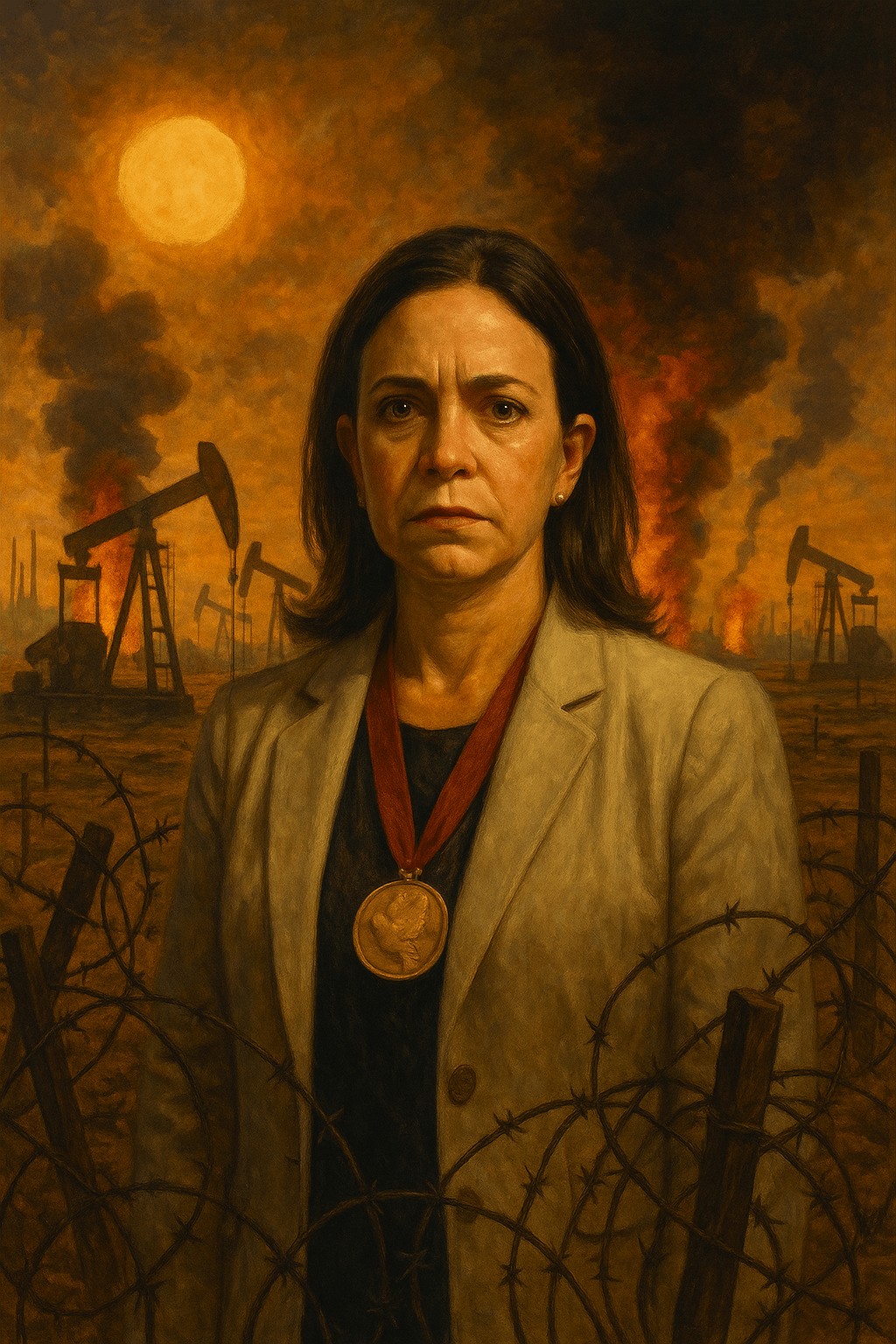
How the Nobel Peace Prize became another front in Washington’s hybrid war — turning coup plotters into saints of “democracy” and laundering regime change through the language of peace.
By Prince Kapone | Weaponized Information | October 10, 2025
The Empire’s Peace
They called it a victory for peace. Cameras flashed, diplomats smiled, and somewhere in Oslo a well-fed audience applauded as the Nobel Committee handed its golden seal of approval to María Corina Machado — a woman who once begged foreign armies to invade her own country. The press wasted no time dressing it up as moral theater: “a brave champion of democracy,” they wrote, as if history itself hadn’t been watching. To those of us outside the imperial echo chamber, it was hard not to laugh. This was peace, apparently — the kind of peace that only comes from Washington’s gun barrel.
Machado has never been a peacemaker. Her whole political career has been a project in sabotage — coups dressed up as campaigns, riots branded as revolutions, and sanctions rebranded as humanitarian concern. She cheered when U.S. banks froze Venezuela’s oil money, and she openly called for “chaos in the streets” to bring down her own government. Now she stands before the world as a symbol of virtue, shaking hands with the same Western elites who armed dictators and starved nations. That’s not irony; that’s imperial logic. The same system that once crowned Henry Kissinger and Barack Obama as peacemakers now rewards a Venezuelan oligarch for helping to destroy her country. The Nobel Peace Prize, once meant to honor human decency, has become the empire’s annual self-congratulation ceremony.
Let’s be honest — the Nobel Committee doesn’t give out prizes for peace; it gives out licenses for obedience. It is the moral division of NATO, laundering blood with bureaucracy. Every few years it picks someone who serves the empire’s narrative, slaps their name on a medal, and tells the world to clap. In 1973, they handed it to Kissinger while bombs still fell on Hanoi. In 2009, they gave it to Obama just as he escalated drone warfare. And now, in 2025, they hand it to Machado — a woman who dreams of a Venezuela run by ExxonMobil and guarded by the U.S. Marines. It’s a tradition at this point: murder in the morning, medal by night.
Empire’s idea of peace is the silence of the graveyard. They want calm markets, quiet streets, and a population too hungry to rebel. Their “democracy” is a system where the rich elect and the poor obey. Their “freedom” is the right of corporations to plunder without consequence. When they talk about peace, what they really mean is pacification — the management of resistance. And when they honor people like Machado, what they’re rewarding is loyalty to that project. The message is clear: serve the empire faithfully, and history will be rewritten in your favor.
But the people of Venezuela know better. They’ve lived through the sanctions, the sabotage, and the psychological warfare. They’ve watched their economy strangled, their hospitals deprived, their oil stolen — all in the name of “restoring democracy.” Yet they endure. They build, organize, and resist. They understand that peace isn’t something handed down by Oslo or Washington; it’s something forged through struggle, built from below, defended in the streets and the fields. It’s the peace of sovereignty, not submission — of dignity, not despair. And no medal minted in Europe can erase that truth.
So let them have their ceremony. Let them toast their false prophets and pin medals on their mercenaries. The empire’s peace will collapse under its own hypocrisy. Real peace — revolutionary peace — will come from those who have nothing left to lose but their chains, and everything to gain by breaking them.
The Peace Industry
Every empire needs its moral department — a place to convert conquest into compassion and war crimes into awards. For the United States and its European allies, that department has long been headquartered in Oslo. The Nobel Peace Prize is not the conscience of the world; it’s the empire’s PR firm. Every October, a handful of bureaucrats in suits decide which servant of empire will be crowned as the latest “defender of peace,” and the media dutifully repeats the script. It’s a ceremony of laundering — turning aggression into altruism, regime change into redemption.
Let’s not romanticize it. The Norwegian Nobel Committee is appointed by the Norwegian parliament, the same body that votes for NATO deployments and sanctions. Its members are politicians, not philosophers. The money that funds the prize — over eleven million Swedish kronor this year — comes from an investment portfolio worth nearly seven billion, managed by the Nobel Foundation and spread across hedge funds, corporate bonds, and real estate. The profits of exploitation are transformed into symbols of moral virtue. That’s not peace; that’s financial alchemy.
If we follow the history of the prize, the pattern is too clear to ignore. In 1973, Henry Kissinger was awarded the Peace Prize while the U.S. Air Force was still bombing Cambodia and Vietnam. Le Duc Tho, his co-recipient, had the dignity to refuse it. In 2009, Barack Obama received the same award for his “hopes” of peace — weeks before escalating wars in Afghanistan, Libya, and Yemen. In 2019, Ethiopia’s Abiy Ahmed was honored for reconciling with Eritrea, only to plunge his country into a genocidal war months later. The Nobel Committee doesn’t reward peace; it rewards alignment. It is a mechanism for moral authorization — for empire to sanctify itself through ritual and repetition.
When María Corina Machado’s name was announced this year, there was no surprise among those who understand the theater of imperial legitimacy. The same institutions that sanctioned Venezuela into crisis now reward the person who cheered it on. The same Europe that freezes Venezuelan assets now applauds the oligarch who demanded it. The same governments that armed Israel as it massacres Gaza are now lecturing the world about peace and human rights. This is not contradiction — it is continuity. Empire can only function by transforming its crimes into virtues and its collaborators into icons.
The Nobel Peace Prize was born out of Alfred Nobel’s guilt over inventing dynamite — an attempt to atone for the violence his fortune made possible. How fitting, then, that it survives as the moral arm of a system still living off the profits of destruction. Behind every prizewinner stands a bomb, a blockade, or a coup. The Committee has never challenged imperial power; it exists to disguise it. When the empire can no longer justify its wars, it decorates them. When it cannot win consent through truth, it manufactures virtue through ceremony. María Corina Machado is simply the latest product in that factory — a weapon of soft power, polished and presented as peace.
From Washington With Love
To understand why María Corina Machado is wearing a medal instead of standing trial, you have to trace her path — not through Caracas, but through Washington. Her political story has always been written in English, printed on U.S. letterhead, and funded by the same institutions that turned regime change into a foreign policy industry. She is not the author of her rise; she is its franchise.
Machado first appeared on the imperial radar during the 2002 coup attempt against Hugo Chávez. She was among those who signed the Carmona Decree, which dissolved the National Assembly and abolished Venezuela’s constitution in the name of “restoring democracy.” That coup failed because the people — workers, soldiers, barrio residents — flooded the streets to defend the revolution. But Washington never forgave Venezuela for surviving, and Machado became one of its most obedient instruments in the long war that followed.
By 2004 she had co-founded an NGO called Súmate, supposedly dedicated to “electoral transparency.” In reality it was a U.S.-funded opposition front, bankrolled by the National Endowment for Democracy and USAID. A U.S. embassy cable from that period describes Súmate as “a highly effective and well-organized opposition group.” Even the name was propaganda — “Join Up” — an invitation for Venezuelans to enlist in a foreign-directed political operation. The next year, she was welcomed into the Oval Office by President George W. Bush, who treated her not as a Venezuelan citizen but as a colonial liaison. Washington had found its perfect messenger: polished, photogenic, fluent in neoliberalism.
Her collaboration deepened as the empire’s strategy shifted from open coups to hybrid warfare. In 2013, at a meeting in Colombia attended by U.S. official Mark Feierstein and Colombian operatives tied to Álvaro Uribe, a “Strategic Plan for Venezuela” was drafted. It called explicitly to “create crisis situations in the streets” and, whenever possible, “cause deaths or injuries” to justify foreign intervention. Months later, Machado and her ally Leopoldo López launched La Salida — “The Exit.” Their plan was simple: paralyze the country, provoke bloodshed, and blame the government. Machado said it plainly: “We must create chaos in the streets until Maduro is ousted.” Dozens were killed in the resulting guarimbas. That wasn’t democracy in action; it was imported counterinsurgency.
None of this made her a pariah in the West. On the contrary, it made her a celebrity. She was interviewed on CNN, praised by think tanks, and welcomed by parliaments that treat regime-change operatives like freedom fighters. When Washington launched its economic siege on Venezuela — seizing billions in assets, sabotaging oil production, and starving the population through sanctions — Machado applauded. When Trump’s administration recognized the self-declared puppet Juan Guaidó, she called it “a new dawn for liberty.” And when the empire’s mercenaries failed to deliver, she demanded a “coalition of the willing” to intervene militarily. Her politics are simple: if Washington can’t rule Venezuela directly, it should rule it through her.
This is the woman the Nobel Committee now calls a “defender of peace.” A figure who has spent two decades trying to turn her homeland into a colony again. A politician whose every achievement has been paid for by a foreign government and measured in the suffering of her own people. The truth is that María Corina Machado doesn’t represent the Venezuelan people; she represents the global oligarchy that lives off their misery. She is the living embodiment of the comprador class — the ones who trade their nation’s sovereignty for a seat at the imperial banquet. When she smiles on the Nobel stage, it’s not Venezuela that’s being honored. It’s the empire itself, applauding its most faithful servant.
The Corporate Coup
Behind every one of Machado’s speeches about “freedom” and “democracy” lies the same old imperial equation: private profit equals public virtue. Her political program is not a mystery; it’s a manual for recolonization. Anya Parampil called it what it is — a corporate coup. It is the merger of U.S. foreign policy, Venezuelan oligarchy, and transnational capital, dressed in the costume of democracy. The goal was never to restore rights to the Venezuelan people, but to restore assets to the corporations that lost them when the Bolivarian Revolution took back control of the nation’s wealth.
After Hugo Chávez nationalized the oil industry and redirected its profits into social programs — building housing, funding education, and cutting poverty by more than half — Venezuela became a problem for empire. Not because it threatened U.S. security, but because it proved that another model was possible. In response, Washington unleashed its full-spectrum warfare: sanctions, sabotage, propaganda, and proxy politics. When open coups failed, it turned to “civil society” networks and “democracy promotion.” That’s where Machado and her kind came in — the smiling faces of counterrevolution, soft power in designer suits.
USAID’s Office of Transition Initiatives — a department whose name alone could be a parody — funneled millions of dollars into Machado’s orbit. The money moved through NGOs that pretended to be civic projects while acting as political vehicles for Washington’s agenda. One OTI insider even admitted it: “We gave them money. They were pulling people away from Chávez in a subtle manner.” Subtle enough for Western journalists to call them “community leaders,” but clear enough for Venezuelans to recognize what they were — agents of recolonization.
This network expanded into the party Voluntad Popular, co-founded by Machado’s ally Leopoldo López and later fronted by Juan Guaidó. The United States recognized it as the official opposition, not because of its popularity (which never exceeded single digits), but because it obeyed orders. When Trump’s administration stole Venezuela’s foreign reserves and handed control of Citgo — its U.S.-based oil subsidiary — to the opposition, Machado’s faction cheered. That wasn’t democracy; it was privatization through economic strangulation. The empire didn’t need to invade when it could suffocate the economy and reward those who applauded the suffering.
The same logic underpins her 2024 “Government Program,” published under the slogan Venezuela Tierra de Gracia — a title soaked in irony for a nation that has spent decades paying the price of imperial grace. The document is the clearest window yet into what her so-called “peace” really means. It reads like a World Bank memorandum fused with a colonial prospectus: promises of privatization, deregulation, IMF reintegration, and open bidding for Venezuela’s natural resources. The goal is not national recovery but national liquidation.
At its core, the program proposes the wholesale dismantling of the Venezuelan state — “a smaller and more efficient government,” “restructuring of public enterprises,” “incentivizing private investment” — the same euphemisms that gutted Latin America in the 1980s. It pledges to “divest the State” of “hundreds of inefficient enterprises,” invite foreign oil majors back into the Orinoco Belt, and “reintegrate into the international financial system.” In plain language: surrender sovereignty to Wall Street. Her advisers speak of “macroeconomic stabilization” — IMF code for austerity — and “opening to global markets,” meaning wage cuts, privatized health care, and the auctioning off of public infrastructure to foreign investors.
The plan’s social component is a eulogy for the Bolivarian welfare state. Health and education are to be “modernized” through voucher systems, insurance schemes, and public-private partnerships. Free schooling and universal healthcare — among the greatest gains of the Chávez era — are to be replaced with markets. Even food programs and pensions are reimagined as “private-sector opportunities.” In short, the same neoliberal architecture that condemned Latin America to dependency a generation ago is being rebuilt under the banner of “renewal.”
And yet, Machado calls this “peace.” A peace built on privatization, a peace purchased by dismantling what remains of the revolution. Her government plan envisions Venezuela not as a sovereign republic but as a corporate condominium, governed by technocrats, policed by financiers, and managed for export. It is the domestic counterpart of Washington’s foreign policy: a recolonized Venezuela tethered to the U.S. dollar and indebted to the IMF — a Venezuela “open for business” but closed to its own people.
Today, the Nobel Peace Prize completes the cycle. The same Western powers that sanctioned Venezuela into crisis now award a medal to the person who begged them to do it. The same banks that froze Venezuela’s assets now fund the foundation that pays her prize money. It’s poetic, in a morbid way — a circular economy of imperial morality. They loot nations in the name of democracy, then decorate their collaborators in the name of peace. It’s the political equivalent of laundering blood through velvet gloves.
Machado’s career, then, is not an anomaly but a symptom. She is what happens when the bourgeoisie of the periphery fuses with the bureaucracy of empire — when the local elite stops pretending to be national and becomes a subcontractor of foreign capital. Her peace is not the absence of war but the victory of privatization. Her democracy is not about votes but about markets. The real revolution she fights for is the restoration of neoliberal order, where oil is owned by corporations, the rich live behind walls, and the poor are told to be patient while freedom trickles down. That is the “peace” Oslo applauds.
But Venezuela’s revolution, battered as it may be, still lives. Its greatest victory is survival. Through blockade and blackouts, through coup attempts and propaganda campaigns, it has refused to die. The empire can manufacture its saints of subversion, but it cannot kill the memory of a people who learned to govern themselves. And that is what truly terrifies them: that peace might one day mean justice, not submission — sovereignty, not silence. For now, they hand out prizes to their loyal servants. But history keeps its own ledger, and it does not forget who stood with the empire and who stood with the people.
Peace as Counter-Insurgency
Every empire has its missionaries. Some carry rifles, others carry rhetoric. The Nobel Committee belongs to the second category — missionaries of moral anesthesia. Its job is not to stop wars but to manage how we perceive them; not to prevent violence but to make us feel civilized while it happens. In the age of technofascism, this is what peace has become: a psychological operation, a campaign to turn resistance into pathology and submission into virtue. When María Corina Machado receives a Peace Prize, it is not a mistake. It is the system congratulating itself for converting the language of liberation into the grammar of obedience.
Peace, in the imperial dictionary, does not mean the absence of conflict. It means the victory of those who write the laws, own the banks, and control the satellites. It means the silence that follows when rebellion has been crushed and poverty has been normalized. The empire speaks of peace the way a warden speaks of order — as a condition of containment. Its soldiers carry “rules of engagement”; its economists carry “structural adjustments.” The function is the same. Both discipline the poor, extract their labor, and guarantee that the world’s wealth continues to flow upward.
The Nobel Prize is one of the empire’s most efficient instruments of soft warfare. It manufactures moral consent. Each award is a headline, a curriculum insert, a history book rewritten in real time. Kissinger, Obama, and now Machado — three different faces of the same project: to convince the world that imperial domination can be benevolent. Behind the speeches and photo ops stands an army of think tanks, NGOs, and PR firms whose mission is to turn the crimes of empire into the duties of civilization. Their weapons are adjectives — “democratic,” “humanitarian,” “reformist” — each one calibrated to disguise occupation as outreach.
Machado’s Peace Prize fits this machinery perfectly. She is the “acceptable revolutionary” — rebellious enough to inspire headlines, obedient enough to protect capital. Her face on the Oslo stage is propaganda made flesh: proof that collaboration can be sanctified, that counterrevolution can be sold as courage. It’s the same formula used to rehabilitate the dictators of old — give them a Western education, wrap them in feminist slogans, and let them preach market salvation to the starving. What the bombs could not achieve, branding will.
This is how empire fights its modern wars. The drones and sanctions are only half the story. The other half is narrative control — the battle for legitimacy. Every economic blockade is paired with a press release about “restoring democracy.” Every coup is followed by a hashtag. Every crime is buried beneath an avalanche of moral language. The Nobel Peace Prize is the gold seal at the bottom of the press release, certifying that the operation was humanitarian all along.
But the oppressed have long memories. They know that peace imposed from above is just war by other means. They know that behind every “peace process” lies a program of privatization, behind every “transition” a transfer of power from the poor to the rich. The people of Venezuela have lived this reality. They’ve seen “dialogue” used as delay, “negotiations” used as sabotage, “human rights” used as pretext for siege. They understand that true peace cannot be gifted by those who profit from their suffering. It must be seized, organized, and defended — not in Oslo’s banquet halls, but in the barrios, the factories, and the fields.
So when the empire applauds Machado as a peacemaker, it is applauding itself — its propaganda machine, its financial architecture, its power to define reality. But beneath the polished rhetoric, another peace grows — a peace forged in resistance, built by those who refuse to kneel. It is the peace of the poor who refuse to die quietly, the peace of the colonized who learn to speak again in their own names. Against the empire’s counterfeit peace, they build something infinitely more dangerous: solidarity. And no prize, no propaganda, and no amount of imperial ceremony can neutralize that.
The Peace of the Living
Venezuela’s survival is a quiet miracle, the kind that empires pretend not to see. For more than two decades, it has endured everything the world’s most powerful nations could throw at it — economic siege, political sabotage, cyberattacks, mercenary invasions, and endless propaganda. And yet, the Bolivarian Revolution still breathes. Its pulse beats in the cooperatives, the community councils, the neighborhoods that still share what little they have. Its endurance is the real peace the empire fears — a peace born not of surrender but of collective defiance.
When the imperial news cycle declares Venezuela a “failed state,” what it really means is that Venezuela has refused to fail for Wall Street. The people have refused to privatize their dreams or sell their sovereignty to the highest bidder. That refusal — simple, stubborn, profoundly human — is what makes the empire rage. Because in a world where everything has a price, the act of standing firm is revolutionary. It exposes the lie that history belongs to the powerful. It reminds the world that empire’s peace is a kind of war, and the struggle of the poor is a kind of peace.
Jorge Arreaza once wrote, “Your coup d’état failed. Your brutal strategy crashed against the dignity of a free Venezuelan people.” Those words hang heavy with the weight of survival. The empire’s entire machine — its dollars, its drones, its diplomats — has failed to conquer a people who still believe in their own right to exist. That’s not utopia; that’s resilience. And it is more revolutionary than any speech delivered in a marble hall. Because it shows that even when they control the narrative, the colonizer cannot control the outcome.
This is the true meaning of Bolivarian peace: not the absence of conflict, but the presence of dignity. It is a peace that grows through struggle — through the workers who keep the lights on despite blockades, the farmers who rebuild the land after sanctions, the mothers who feed their children when the empire tries to starve them into submission. It is a peace made of persistence. A peace that refuses to let the poor disappear quietly into statistics. A peace that insists that sovereignty is not an award handed out in Oslo, but a living relationship between people and the land they defend.
The Nobel Committee cannot comprehend this peace because it cannot be monetized or mediated. It does not come with a logo or a donor’s plaque. It is not administered by NGOs or monitored by think tanks. It cannot be imposed by the IMF or secured by NATO. It grows from below — unpolished, unprofitable, ungovernable. It is the peace of those who have lost everything and yet still refuse to lose each other. It is the peace of the poor, the colonized, and the unbowed.
History is not written by awards but by endurance. And history will remember this: while the empire crowned a traitor, the Venezuelan people kept their revolution alive. While they handed medals to mercenaries, the poor continued to build schools, plant seeds, and care for one another. The world may applaud Machado today, but the future will applaud those who resisted her. Because the only peace worth fighting for is the peace of the living — not the silence of empire, but the song of a people who refused to die.
 Weaponized Information