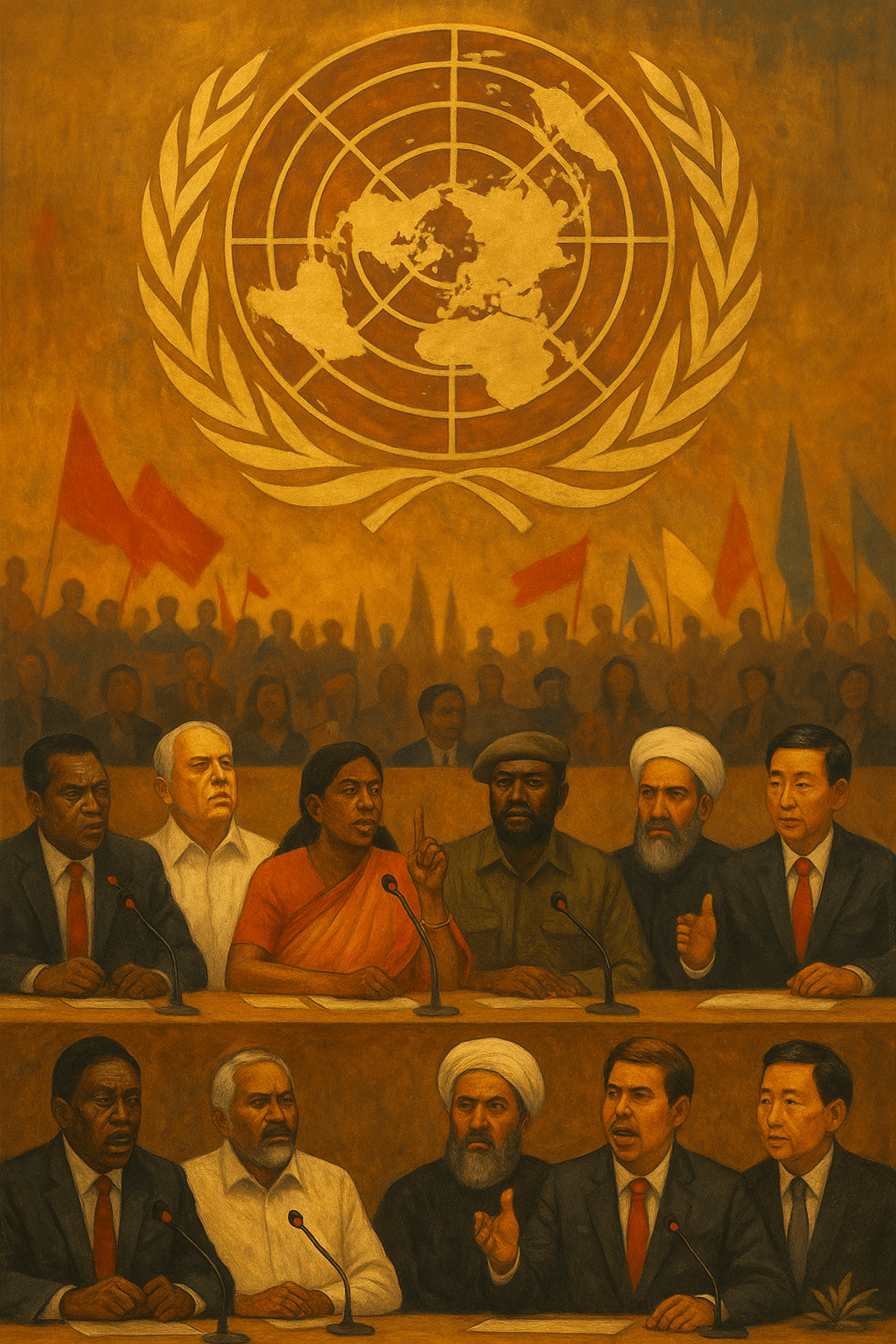
From Petro’s fire to the Sahel’s defiance, the Global South names the cracks in empire and the embryo of a new world
By Prince Kapone | Weaponized Information | September 28, 2025
Multipolarity at the Mic: Global South Interventions at UNGA80
New York dressed itself in the pomp of diplomacy this past week, but the music had changed. The so-called masters of the universe—those who for decades strutted onto this stage to lay down ultimatums—found themselves drowned out by a chorus from the South. Lula, Petro, Ramaphosa, Arce, Rodríguez, Traoré: different histories, different accents, but the same pulse beating through their speeches. They did not come begging for “assistance” or politely requesting “aid.” They came to announce the slow burial of the unipolar world.
It was striking to watch the West sit uncomfortably while the Global South spoke plainly about sanctions, blockades, and financial strangulation. These aren’t abstract debates about international law. They are the lived reality of millions who can’t get medicine because Washington has a veto on their economy, of farmers who see their harvest rot because some bureaucrat in Brussels slapped a tariff on survival. The leaders at that podium this year didn’t bother dressing this up. They called it what it is: economic warfare, colonialism in a suit and tie.
And Palestine—always Palestine—threaded through nearly every address. Not as a sidebar, but as the moral center of the entire week. When Petro demanded an international protection force for Palestinians, when Cuba denounced the genocide in Gaza, when Iran and Bolivia named the crimes directly, you could hear a different kind of legitimacy in the room. The West still pretends that Palestine is a “complex issue.” The South said: no, it’s a test of humanity. Either you side with freedom, or you line up behind the bulldozers.
Something else emerged between the lines, too: the architecture of an alternative. You can feel it in BRICS expanding, in South-South trade corridors opening, in Africa reclaiming its resources, in Latin America insisting on vivir bien rather than living under debt. These aren’t fully built institutions yet, but the outlines are visible. That’s why the imperial core is so nervous—because every tariff, every coup plot, every travel ban against these leaders is a desperate attempt to hold back what’s already breaking loose.
So don’t mistake this week for diplomatic theater. What happened in that hall was the public face of a deeper shift. The speeches were declarations of intent: to delink from a system designed to keep the South in chains, and to construct another grounded in dignity and sovereignty. The old order is rotting; the new one hasn’t yet taken full shape. But for the first time in decades, the podium at the UN became a place where the oppressed spoke not as victims, but as authors of a future the North can no longer write alone.
The Fire of Petro’s Voice
Gustavo Petro did not come to New York to play diplomat. He came to put the empire on trial. Standing there as the elected president of Colombia—a country once chained as Washington’s narco-protectorate—he turned the tables. He spoke not as client, but as accuser. He demanded that the United Nations authorize an international protection force for the Palestinian people, because, as he said plainly, “genocide is being broadcast in real time, and you do nothing.” The words landed like stones hurled through the glass walls of hypocrisy.
Petro’s speech carried the rage of Latin America’s long memory. He reminded the hall that Colombia has been a battlefield in the U.S. war on drugs, a war that turned peasant fields into killing zones and cities into graveyards. What was it all for? To launder profits for banks in Miami and cartels in power. Petro named the system: a war economy that feeds itself on oil, on cocaine, on weapons, and on lies. He cut straight to the marrow—if humanity wants to live, we must break from the machine that profits from death.
And yet, in the same breath, Petro lifted the horizon. He spoke of forests, rivers, oceans—the planet itself as a victim of imperial economics. Unlike the sterile language of climate “targets” that the West trots out, Petro framed ecology as the ground of liberation. Defend the Amazon, and you defend the lungs of the world. Break the addiction to fossil fuels and narcotics, and you break the cycle of empire. It was an invitation to imagine a politics rooted not in Wall Street’s numbers but in the earth itself.
The empire didn’t like it. Within days, Washington revoked his visa. Think about that: the president of a sovereign country, barred like a dissident. This is how fragile the unipolar order has become—so brittle that even words can pierce it. But Petro’s voice traveled further than U.S. immigration control could reach. His speech is already echoing through the barrios, the forests, the refugee camps. It was less a policy paper than a manifesto: Colombia will no longer kneel, and neither will the South.
Lula’s Steady Hand Against the Storm
Where Petro came like a storm, Lula came like the tide. Not rushing, not shouting, but rising steadily until no one in the hall could ignore the water at their feet. He has carried Brazil through dictatorship, through prison, through the knives of oligarchs and media barons, and now he stands again on the world stage with a message that is simple, almost obvious: democracy means nothing if hunger rules the table, sovereignty means nothing if the IMF holds the leash, and peace means nothing if the Security Council is a playground for a handful of powers.
Lula spoke of hunger like a crime, because it is. In a world of technological marvels and obscene wealth, children still die of starvation while bankers speculate on grain futures. He looked the assembly in the eye and told them this is not a technical problem; it is political robbery. He pointed to the structures—the debt regimes, the hoarding of technology, the barriers to trade—that guarantee the rich world eats first and the poor world fights over scraps. His call was blunt: reform or be swept away.
But Lula is not naïve. He knows the West will not reform itself out of charity. That’s why his words pointed toward BRICS, toward South-South solidarity, toward a development model that rejects the dictatorship of the dollar. It is not utopia—Brazil’s contradictions are many, its own ruling class often treacherous—but Lula’s presence signals that Latin America is not content to be the backyard of empire any longer. His voice, calm but unyielding, joined the chorus calling for a new international order where the South sets its own terms.
If Petro’s speech was a dagger, Lula’s was a drum. Patient, persistent, echoing long after he left the podium. A reminder that the struggle is not only about fire and fury, but also about the steady work of building, brick by brick, the institutions and alliances that can make multipolarity more than a slogan. The tide is rising, and Lula is telling the world it will not recede.
Ramaphosa and the African Verdict
When Cyril Ramaphosa stepped up, he did not waste time with flattery. He spoke plainly, like a worker at a union meeting who has seen the boss’ tricks too many times to be fooled again. Trade, he said, has been turned into a weapon. Sanctions, tariffs, embargoes—these are not tools of justice but of domination, designed to keep the South in its place. It was not the polished language of think tanks; it was the verdict of a continent that has watched its resources flow north for centuries while its people are told to be patient, to wait for “development” that never comes.
Ramaphosa called for a fairer global economy, one where rules are not written in Washington and enforced with aircraft carriers. He demanded that Africa’s voice be heard in the Security Council, that the UN itself stop being a colonial museum where the same five powers guard the keys. His insistence was not theatrical—it was grounded in Africa’s lived reality. Every tariff slapped on steel, every sanction against an African state, every IMF dictate is another chain on the wrists of a people already burdened with the legacy of empire.
But Ramaphosa also spoke of possibility. Africa is not waiting for permission to act. BRICS has become a lifeline, a platform for the continent to trade and build outside the chokehold of the dollar. The Sahel, standing defiant after breaking with Paris, embodies this spirit too. When Burkina Faso’s envoy spoke of sovereignty, when Niger’s representatives declared their right to chart their own path, it was not diplomatic filler. It was the announcement of a generation that refuses to be recolonized by debt or by drones.
The West will call it defiance. Africa calls it survival. Ramaphosa’s words, and those of the Sahelian leaders, placed the Global South’s cards face up on the table: Africa is not a charity case, not a battlefield for rival empires, but a continent ready to claim its seat in the new world being born. The verdict has been delivered; the question is whether the North can hear it before the floor beneath them gives way.
Bolivia Warns of the Coming Storm
Luis Arce did not mince words. He told the General Assembly that the world is teetering on the brink of a third world war, driven not by the needs of humanity but by the desperation of an empire trying to claw back its fading supremacy. From Gaza to Ukraine, from sanctions to blockades, he said, the pattern is unmistakable: war has become the preferred currency of the West. And while the bombs fall abroad, austerity and misery deepen at home, exposing the rot of a system that can only reproduce itself through violence.
Bolivia’s voice in that hall was not that of a major military power or a financial titan—it was the voice of a people who have lived the sharp end of neoliberal plunder. Arce reminded the assembly how Bolivia was nearly strangled by a coup only a few years ago, how its resources were auctioned off to satisfy foreign corporations, how its sovereignty was trampled in the name of “democracy.” To stand there and speak of vivir bien was itself a rebuke to the logic of endless accumulation that defines the capitalist-imperialist order.
He framed vivir bien not as a slogan but as an alternative civilizational path. To live well does not mean to consume endlessly, to compete for profit, or to wage wars for resources. It means to live in balance with Pachamama, to organize economies around social need, and to resist the hunger of capital that would devour the last forest and poison the last river. In that vision, Arce offered more than a critique—he offered a model of life beyond empire.
The Western delegations may have rolled their eyes, but for millions listening across the Andes and beyond, Arce’s words carried the weight of survival. As the empire tries to drag the planet into new conflagrations, Bolivia reminded the world that humanity has a choice: either we march blindly into the storm of imperial war, or we build another way of living that rejects the logic of death. That was Arce’s warning, and his invitation.
Iran at the Edge of Siege
Masoud Pezeshkian stood before the assembly with the voice of a man who knows what it means to govern under constant assault. He did not posture, he did not wave threats—he simply laid out the truth: Iran is punished not for crimes, but for refusing to kneel. Every sanction, every “snapback” mechanism, every financial noose thrown around Tehran’s neck is designed to break a people’s will to choose their own destiny. Yet here Iran stands, battered but unbroken, telling the world that sovereignty cannot be negotiated away.
He denounced the bombings in Gaza, the endless rain of missiles and bullets, and called out the United States and Israel by name. No diplomatic euphemisms, no hiding behind “regional instability.” Just clarity: genocide is unfolding, and the so-called defenders of democracy are the architects of the massacre. He reminded the hall that Iran has no nuclear weapons program, no desire to build one—what it does have is a refusal to surrender, and that refusal has been met with economic warfare that chokes children, not generals.
There was something haunting in his words: the recognition that sanctions are not a policy but a weapon of mass destruction. Medicines vanish, food prices spike, infrastructure decays, and the world is told this is “pressure.” The cruelty is the point. But even as he named this cruelty, Pezeshkian also spoke of dignity. Iran, he said, would never trade its independence for relief. Better hardship on its own feet than prosperity on its knees.
The hall listened, some in silence, some with scorn. But outside, across the streets of the Arab world and the neighborhoods of the South, those words carried another weight. They were not the speech of an isolated nation—they were the mirror of every people strangled by sanctions, from Cuba to Venezuela to Zimbabwe. At the edge of siege, Iran spoke not just for itself, but for a whole world tired of being disciplined by the whip of empire.
Cuba’s Unbroken Voice Against the Blockade
Cuba’s message to the General Assembly was as clear as the Caribbean sun: the blockade is not policy, it is cruelty. For more than six decades, Washington has tried to suffocate the Cuban Revolution, to starve the people into submission, to punish them for daring to build a society on their own terms. Rodríguez did not speak with the tone of a victim, but with the unflinching pride of a people who have resisted the longest economic war in modern history and who are still standing.
He reminded the assembly that the blockade does not just cripple Cuba’s economy—it violates international law, it denies children medicines, it punishes students, it robs entire generations of opportunity. Every year, the UN votes almost unanimously to demand its end, and every year Washington responds with arrogance, tightening the screws. That arrogance, Rodríguez said, is proof that the so-called “rules-based order” is nothing but the law of the strong over the weak.
Yet Cuba’s intervention was not only a denunciation—it was also a vision. Rodríguez called for a new international economic order, one that finally dismantles the colonial hierarchies baked into the IMF, the World Bank, and the dollar system. He situated Cuba alongside the wider Global South, linking the island’s struggle to the cries of Palestine, the sanctions against Iran and Venezuela, the coups in Africa, the debt burdens strangling dozens of countries. The Cuban message was simple: none of us are free until all of us break the chains of dependency.
The fact that Cuba, an island of just eleven million people under perpetual siege, continues to stand at the UN as a symbol of dignity speaks volumes. Its survival is a thorn in the side of empire, proof that even the harshest sanctions cannot extinguish the will of a people to be free. When Rodríguez denounced the blockade this week, it was not a ritual repetition—it was the reaffirmation of a struggle that has inspired movements across the South for more than sixty years. Cuba remains unbroken, and its call for a new economic order remains a compass for the multipolar world being born.
The Sahel Bloc: Burkina Faso, Mali, Niger
The Alliance of Sahel States arrived at the UN not as scattered voices, but as a bloc. Each delegation took the podium with its own history and grievances, yet all anchored themselves in the collective declaration of the AES. This is no longer the fragmented Sahel of yesterday—it is a confederation speaking with one tongue against neocolonial domination, even as each state sharpened its message with the steel of its own experience.
From Burkina Faso, Prime Minister Rimtalba Jean Emmanuel Ouédraogo set the tone. He affirmed that his country “fully subscribes to the declaration delivered on behalf of the Confederation of Sahel States (AES) in a spirit of renewal and rupture.” He denounced the stranglehold of the Security Council and demanded reform so that Africa could finally take its place as an equal. His words carried Sankara’s ghost: dignity, sovereignty, and the refusal to live forever as wards of foreign powers. Yet his demand was not for exit from the UN, but for its refoundation—a contradiction born of fighting for justice inside a system built to deny it.
Mali’s Abdoulaye Maïga spoke next, this time explicitly in the name of the AES. His intervention was perhaps the harshest. He accused Western states of sponsoring terrorism in the Sahel, even linking the conflict in Ukraine to the proliferation of weapons and drones that now fuel massacres in the desert. He called for “a profound refoundation of the multilateral system” with real African seats at the Security Council, and he announced the creation of a “Confederal Investment and Development Bank” to finance sovereignty projects. Maïga’s tone was accusatory, naming names, burning bridges. It gave clarity to the anger of the Sahel, though at the cost of narrowing the room for compromise.
Niger’s Prime Minister Ali Mahaman Lamine Zeine closed the AES interventions with a speech that blended accusation and program. He condemned “the information war, imported and sponsored terrorism,” and from the UN’s podium directly accused France of backing terrorism in the Sahel while waging economic war through sanctions and financial institutions. Yet alongside this fiery indictment, he laid out a development plan: food self-sufficiency, macroeconomic stability, a 7% growth target for 2025–2028, and resource sovereignty—“it is time that these riches benefit our people more directly.” He invited international investors for “win–win partnerships,” showing the double track: rejecting France while courting partners who respect Niger’s sovereignty.
Together, these speeches formed the Sahel’s verdict: the age of French tutelage is over, the Sahel will no longer serve as a colony in all but name. Yet within that defiance lies complexity—the appeal to the UN even as it is condemned, the denunciation of foreign plunder paired with calls for new investors, the tension between sovereignty and dependence. But the fact remains: the AES stood at the UN as a bloc, no longer begging, no longer fragmented, but declaring to the world that Africa’s heartland has chosen rupture over submission.
Venezuela: Yván Gil Speaks the Bolivarian Truth
At UNGA80 it was Foreign Minister Yván Gil, not Maduro, who carried Venezuela’s banner. His speech was long, historical, and sharp—beginning with Bolívar, colonial conquest, and centuries of resistance, before turning fire on the empire of today. “Venezuela speaks the truth to the world,” he declared, rooting the Bolivarian project in five centuries of struggle for equality, justice, and freedom. He invoked the liberating armies of Indigenous, Black, and mestizo peoples who fought from the Caribbean to Ayacucho, insisting that their legacy lives in the Venezuelan revolution of today.
Gil situated Chavismo within this lineage: a peaceful, democratic revolution inspired by Bolívar, driven by Hugo Chávez, and carried forward under Nicolás Maduro. He reminded the Assembly of Chávez’s battle to reclaim OPEC and to reassert Venezuela’s sovereignty over oil, and of the U.S. campaign—documented, he said, in 32 elections and countless plots—to crush this project. “The criminal aggression of the last decade,” Gil argued, aimed not at democracy but at stealing Venezuela’s natural wealth under the banner of regime change.
He laid out the catalogue of attacks: destabilization, assassination attempts, mercenary incursions, and above all the 1,042 sanctions strangling Venezuela’s economy. Now, he warned, comes “an absolutely illegal and totally immoral military threat” that violates the UN Charter and even U.S. law itself. This was not only a national grievance but a global one—another link in the chain that ties Iraq, Libya, Afghanistan, Iran, Cuba, and now Venezuela into a common story of imperial war and plunder.
Gil thanked the solidarity of CELAC, BRICS, and the Non-Aligned Movement, and he made clear that Venezuela will not be isolated. He linked his country’s struggle to Palestine—demanding an end to “the genocide of the Zionist regime of Israel”—to Cuba’s fight against the blockade, to Nicaragua, Belarus, North Korea, Eritrea, Iran, Zimbabwe. He saluted Russia’s resistance to “neonazism and Western militarism” and endorsed Xi Jinping’s vision of a community with a shared future. He reaffirmed support for Argentina’s claim to the Malvinas, Puerto Rico’s independence, and the Sahrawi cause. This was internationalism from the rostrum—naming allies, naming enemies, drawing a map of the South’s solidarity.
But Gil was not content with denunciation. He insisted that Venezuela is part of the “new multipolar world” already being born. He spoke of Petrocaribe, ALBA-TCP, UNASUR, and CELAC as seeds of that world, and he closed with words that resounded beyond Caracas: “Venezuela has not been, is not, and will never be a threat to any nation. Venezuela has been, is, and will always be hope in the construction of a new humanity… a world where colonialism, slavery, and exploitation disappear forever.”
The contradictions remain: a revolution besieged and battered, but also one accused of repression and crisis at home; a nation denouncing interference while searching for stability and partners abroad. Yet from the UN rostrum, Gil’s speech carried weight. It was not the voice of a government on its knees but of a people insisting on dignity, declaring that the Bolivarian project—however contested—is part of the great refusal of the South.
Russia at the Podium: Breaking the Encirclement
When Sergey Lavrov walked up to the microphone, he carried the posture of a state that refuses to bow. His speech was sharp, combative, drenched in the language of siege and resistance. He denounced NATO’s expansion not only in Europe but into Asia and the Pacific, describing it as a military ring being fastened around the globe. Russia, he said, has no intention of attacking NATO or the EU—that narrative is a fabrication—but any aggression against his country will be met with a “decisive response.” It was less diplomacy than warning, a reminder that Russia’s defiance is backed not just by words but by nuclear firepower.
Lavrov’s intervention went beyond Ukraine. He tied Moscow’s struggle to a larger map of coercion: sanctions, embargoes, and blockades weaponized to discipline half the planet. He argued that Russia’s own isolation was part of the same system that punishes Cuba, strangles Iran, and seeks to suffocate Venezuela. By positioning itself as another target of this arsenal, Russia presented its defiance as a common cause with the Global South. For many in the chamber, this was not empty rhetoric—sanctions are a shared wound, and Moscow’s insistence that they are a form of economic warfare found resonance.
But Russia’s speech also revealed its contradictions. It called for democratization of the UN Security Council, for more seats for Africa, Asia, and Latin America. Yet Russia remains a permanent member with a veto—an empire of yesterday claiming to champion the decolonized world of today. Its words were both invitation and assertion: an offer to stand against the United States, but also a reminder that Moscow still thinks in the language of great powers and spheres of influence.
Still, for the Global South, Russia’s defiance has consequences that cannot be dismissed. By breaking with the unipolar order, by withstanding the West’s attempt to erase it from the global system, Moscow has cracked open space that others can occupy. Whether one sees Russia as liberator or as another empire in decline, the fact remains: its resistance has accelerated the unraveling of a world run from Washington. And that unraveling, uneven and dangerous as it may be, is the very condition that allows multipolarity to be born.
China: The Builder’s Voice
If Russia’s intervention was a clenched fist, China’s was an open hand. Premier Li Qiang took the stage without theatrics, his tone calm, deliberate, and disarming. Yet beneath that calm was steel. He warned that unilateralism, protectionism, and a “Cold War mentality” are dragging the world toward stagnation and war. He did not name the United States, but every listener knew who he meant. Li’s words were crafted not for applause but for alignment—an invitation to the South to see in Beijing a partner, not a patron.
At the core of his speech was sovereignty. Every country, he said, large or small, has the right to choose its own path, and true multilateralism means treating all states as equals. That was a direct rebuke to the logic of regime change, sanctions, and interference that defines the U.S. model of “rules.” Where Washington punishes independence, China promised respect. It was a subtle but powerful echo of what the AES states, Cuba, and Bolivia had already told the Assembly: dignity begins with sovereignty.
Li Qiang also grounded his appeal in material promises. He spoke of expanding the Belt and Road Initiative, of financing development, of building roads, ports, and digital corridors where the IMF offers only debt shackles. He announced a China–UN development facility, a new sustainability center in Shanghai, and reiterated Beijing’s commitment to technology sharing. To Western ears, these may sound like token gestures. But to a Global South suffocating under austerity, even modest commitments stand in sharp contrast to the endless lectures and punishments doled out by the North.
China’s speech, like its strategy, was civilizational. Li spoke of mutual learning between cultures, of rejecting arrogance and embracing exchange. It was the language not of conquest but of coexistence. And yet, behind the gentle tones lies a rising power with its own contradictions—a socialist state with market forces operating within a Western-imposed capitalist-imperialist system, eager to secure resources and markets on its own terms. The South must be clear-eyed about that. But in the present conjuncture, Beijing’s offer of development without domination is a vital plank in the construction of multipolarity.
Together with Russia, China’s intervention revealed two poles of resistance: one hammering at the old order with force, the other sketching the scaffolding of a new one. For the nations of the South, the lesson is not to romanticize either pole but to seize the opening both create. Multipolarity is not a gift from Moscow or Beijing—it is a horizon that the South must build with its own hands, using the cracks in empire to lay foundations of sovereignty and solidarity.
The Embryo of a New World
By the time the gavel fell on this year’s Assembly, one thing was unmistakable: the unipolar order has lost its monopoly on the future. The West still controls the weapons, the banks, the headlines, but it no longer controls the imagination of humanity. From Petro’s fire to Lula’s tide, from Ramaphosa’s verdict to the AES defiance, from Arce’s vivir bien to Cuba’s unbroken denunciation, from Iran’s survival at the edge of siege to Venezuela’s warning of gunboats, and with Russia’s clenched fist and China’s builder’s hand—the chorus of the South declared that another world is not only possible, it is already being born in the cracks of empire.
The shared program was not delivered as a manifesto, but it rang clear across languages and continents. End the weaponization of trade, finance, and food. Tear down the system of sanctions that strangles the weak. Democratize global governance so that the Security Council is not a club of victors from a war fought eighty years ago. Defend Palestine, not as charity but as the test of whether humanity can stand against genocide. Build South–South institutions, banks, and currencies that free the world from the chokehold of the dollar. Reclaim resources, from Sahel uranium to Amazon forests, for the people who live on them. And construct a world where sovereignty is not a slogan but a lived reality.
This is not naïve. The contradictions are deep. Russia and China carry their own ambitions; Latin America’s left governments wrestle with oligarchs at home; Africa’s sovereigntists face coups, drones, and sanctions; Cuba and Venezuela endure economic war daily. Multipolarity itself is not socialism, not liberation—it is only the terrain on which liberation can be fought. But it is a terrain radically different from the suffocating unipolar world the U.S. has tried to enforce since 1991. In that difference lies possibility.
And here, inside the United States, that difference matters more than most of us realize. The working class of this empire has long been chained to the spoils of domination—cheap energy, imported goods, wages subsidized by plunder abroad. As the Global South breaks free, those subsidies will collapse. For the U.S. ruling class, this means crisis; for the U.S. working class, it means a crossroads. Either we cling to whiteness and empire, demanding new wars to preserve privileges that are already rotting—or we break with imperialism, and finally find common cause with the rest of the world’s exploited and oppressed.
Multipolarity cracks open that choice. It denies the ruling class the ability to dictate global terms, and it denies workers here the illusion that empire can save them. The socialist task in the U.S. is to seize that opening, to educate and organize, to show that our interests do not lie with Wall Street and the Pentagon, but with the barrios of Caracas, the townships of South Africa, the favelas of Brazil, and the streets of Gaza. The louder the Global South speaks, the clearer the mirror it holds up to us: the struggle against empire abroad is the struggle for liberation at home. The embryo of a new world has been named. Our duty is not only to defend it, but to join it.
 Weaponized Information
Leave a comment