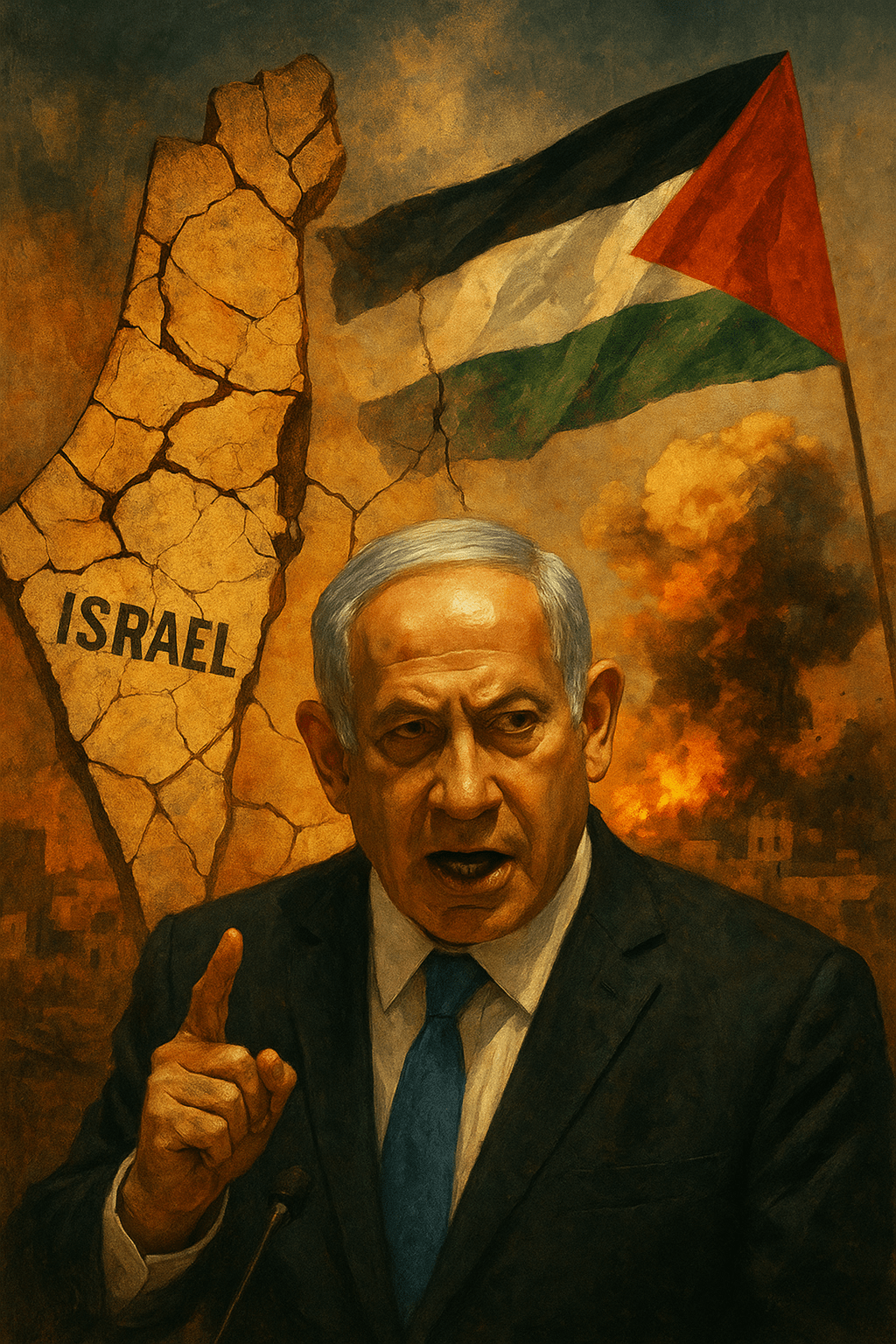
Netanyahu beats the war drum, Western allies hand out symbolic recognition, and the empire’s mirror begins to shatter
By Prince Kapone | Weaponized Information | September 22, 2025
Defiance as a Media Mirage
The latest entry in the imperialist news cycle comes from CNN, under the bylines of Dana Karni and Oren Liebermann. Its storyline is simple: Benjamin Netanyahu, armored with Washington’s blessing, is striking back at those impudent Western nations that dared to recognize Palestine. The plot is framed as though the recognition of Palestine were a petty domestic maneuver in Europe, while Netanyahu’s sabre-rattling is cast as righteous survival. The entire article reads like a script rehearsed countless times before: Israel, forever the aggrieved victim, bracing against the slander of the world, with the United States standing tall as its eternal shield.
To understand this narrative we must know the narrators. Karni and Liebermann do not float outside history: they are tethered to the institutions that feed them their perspectives. Liebermann, CNN’s man in Jerusalem, once reported from the Pentagon, a biographical fact that shapes how he interprets tanks and treaties—with the Pentagon’s spectacles still on his face. Karni, a long-time hand in Israeli political coverage, is fluent in the language of diplomatic chambers where elites set the boundaries of polite discourse. Neither are neutral chroniclers. They are brokers of elite consensus, translating the anxieties of Israel’s ruling class and Washington’s defense establishment into digestible sound bites for Western living rooms.
And CNN, their platform, is not a neutral conduit. Owned by Warner Bros. Discovery, dependent on advertising dollars from banks, weapons manufacturers, and tech monopolies, the network is part of the imperialist media apparatus. Its editorial line is not an accident but a business model: always align with the State Department’s horizon, always reinforce the fiction that U.S. power is natural and that Israeli expansion is unfortunate necessity rather than crime. It is the megaphone of empire dressed in the robes of journalism.
Look closely at the devices in play. The article frames recognition as “symbolic,” stripping it of weight before the reader can even consider its significance. Netanyahu is described as “defiant” and “emboldened,” language that dresses political maneuvering in the garb of courage. The settlements are mentioned only in passing, tucked into a sentence that normalizes their expansion without pause or outrage. Annexation is floated like a policy proposal on the table, not the erasure of another people’s claim to land. The Palestinian Authority appears only through the mouths of Netanyahu’s allies, who call for its dismantling, while Palestinians themselves are nowhere to be found in the narrative. Opposition figures in Israel are given voice to scold Netanyahu, but only to underscore the “crisis” he is managing, never to question the legitimacy of the occupation itself. These are not accidents of phrasing; they are techniques of storytelling that steer the reader’s perception, shrinking the horizon of what can be imagined, what can be questioned, and what can be condemned.
What emerges is less a news report than a crafted tale. The villains are unnamed “Western countries” acting rashly; the hero is Netanyahu, unbent by pressure; the indispensable ally is the United States, quietly standing guard. Palestine itself is relegated to scenery, a stage on which others act. This is how propaganda operates in polite company: not by screaming lies, but by arranging the furniture of language so the audience sits where empire wants them to sit.
The Facts Buried Beneath the Mirage
Strip away the fluff of CNN’s storytelling and what’s left is a thin skeleton of facts. Netanyahu told his cabinet that he would fight the recognition of Palestine at the United Nations and “other forums.” He thundered that a Palestinian state would “endanger Israel’s existence” and serve as “a prize for terrorism.” He bragged that settlements in the occupied West Bank have doubled and will keep growing. CNN reported that Trump and his team are standing firmly behind him, with Marco Rubio bragging about lobbying allies to block recognition. Even so, Britain, Canada, and Australia went ahead. Netanyahu’s far-right ministers Smotrich and Ben Gvir called for outright annexation and the dismantling of the Palestinian Authority. Opposition leader Yair Lapid scolded Netanyahu for landing Israel in its “worst diplomatic crisis.” That’s all CNN gives you: a list of elite voices, a few sound bites, and nothing of the actual ground beneath their feet.
The omissions are loud enough to rattle windows. United Nations resolutions (e.g., 465 in 1980) and 2334 in 2016 have declared settlements illegal for decades, demanding withdrawal that never comes. The International Court of Justice ruled in 2004 that the wall and the occupation itself violate international law. Amnesty International and Human Rights Watch have named the system for what it is: apartheid. Meanwhile, the bodies pile up. Gaza health officials say more than 65,000 people have been killed, most of them women and children. These facts aren’t inconvenient—they’re explosive. That’s why CNN tucks them out of sight, leaving only Netanyahu’s “defiance” on display.
And then there’s the verdict the empire’s scribes really don’t want you to hear. A recent UN Commission report states clearly: there are reasonable grounds to believe Israel is committing genocide in Gaza. Not “a tragedy,” not “a war gone too far”—genocide. The report catalogs mass killings, destruction of hospitals and maternity wards, conditions designed to destroy life, and the use of dehumanizing language by Israel’s leaders. Netanyahu, Gallant, Herzog—they called Palestinians “human animals,” invoked biblical orders of extermination, and then unleashed the bombs. The Commission didn’t stop at individual guilt; it said the Israeli state itself bears responsibility, and every other state has a legal duty to prevent and punish this crime. CNN, of course, found no space for this.
As for recognition, CNN flattens it to a footnote. Britain, Canada, Australia, and Portugal formally recognized Palestine, breaking with decades of excuses. They didn’t do it out of sudden conscience—they were pushed. In Britain, Labour MPs and ministers demanded recognition, joined by mass demonstrations across the country. Prime Minister Keir Starmer had promised to recognize Palestine if Israel refused a ceasefire and kept threatening annexation. Israel ignored him, so recognition went forward anyway. Yet even here, the limits are obvious: as the Washington Post notes, recognition doesn’t give Palestine a seat at the UN table. The United States still holds the veto card. Recognition is a crack in the wall, not the tearing down of it.
Beyond the North Atlantic, the ground is shifting. At least 144 countries—including many in Africa, Asia, Latin America, and some BRICS states—now formally recognize Palestine, signaling growing resistance against Western dominance. Meanwhile, Washington’s checkbook still bleeds green into Israel’s war chest. Nearly $3.8 billion a year in U.S. aid bankrolls the settlements, the bombs, the checkpoints, the whole machinery of occupation. That is the bedrock missing from CNN’s tale: the law, the casualties, the genocide finding, the grassroots pressure, the history of recognition, and the American subsidy that keeps it all humming.
History casts a long shadow, too. Beyond the North Atlantic, the ground is shifting. The Oslo Accords (Declaration of Principles, 1993) carved Palestine into fragments and called it peace. Trump’s “Deal of the Century” redrew maps to make annexation permanent. Back in 1988, the UN General Assembly already recognized Palestine’s statehood, but the empire treated it like a polite suggestion. CNN erases this history, presenting today’s recognition as a novelty instead of part of a decades-long struggle constantly undermined by the same powers now posturing as friends.
So what we have is not journalism but sleight of hand. The article reduces Palestine to a pawn, Israel to a victim, and Washington to a benevolent overseer. The facts it hides—the rulings, the bodies, the genocide report, the history—are what make the story real. Without them, the reader is trapped in a funhouse mirror where the colonizer looks brave, the colonized look absent, and empire looks eternal. Our task is to smash that mirror and hold up the truth.
When the Mirror Cracks: Reframing the Crisis
The glossy CNN story told us nothing new: Netanyahu puffing his chest, Washington nodding along, a handful of European governments daring to recognize Palestine, and endless chatter about “diplomatic crises.” But when you put the real facts on the table—the genocide report from the United Nations, the decades of rulings against the occupation, the mountain of bodies in Gaza, the billions in U.S. subsidy—a different picture comes into view. This isn’t a tale of defiance or symbolism. It’s the story of a settler project clinging to life support, and an imperial system that’s starting to wobble under the weight of its own lies.
Take the recognitions. On the surface, they look like progress. Britain, Canada, Australia, Portugal—countries that have covered for Israel for decades—suddenly wave the Palestinian flag. But scratch the paint and you see the trick. This is the Recognition Trap. They recognize Palestine without giving it power, without stopping the bombs, without stripping the U.S. of its veto. It’s recognition that changes nothing but buys those governments a little domestic peace. A piece of paper for Palestine, a pat on the back for themselves. That’s not liberation—it’s theater.
On the other side of the mirror, Israel answers not with retreat but with appetite. Annexation, they say, is the only “response.” But annexation here isn’t about lines on a map; it’s about crushing hope itself. Call it Annexation-as-Pacification. It is the act of declaring stolen land permanently theirs, of turning dispossession into law, of making sure that the idea of a Palestinian state is strangled before it can ever breathe. When CNN writes about annexation as if it were a policy option, it normalizes this endgame. It launders a war crime into a point of debate.
And what about the press? That’s where the real hustle takes place. Recognition is called “symbolic” before the ink is dry, Netanyahu is painted as “defiant,” and the settlements—illegal under every scrap of international law—are tucked into the story as background noise. Palestinians themselves barely appear. This is cognitive warfare, not journalism. It’s how empire shrinks our political imagination until genocide looks like a security dilemma and colonization looks like tough love.
But here’s the crack in the mirror: those recognitions, even if toothless, show something deeper. Washington can no longer whip every ally into line. Domestic movements, global outrage, and the bloodbath in Gaza forced their hands. What CNN calls a “diplomatic crisis” is really a crisis of imperialism. The unipolar order is fraying. Junior partners are breaking script, even if timidly, and that matters. It’s not salvation, but it’s a signal that the emperor’s grip is slipping.
From the ground, from the perspective of those living under bombs and checkpoints, the only sovereignty that matters is Anti-Imperialist Sovereignty. That means the power to govern, to rebuild, to live without occupation or siege. It’s not enough to be recognized on paper while the bulldozers and drones keep moving. Real sovereignty is fought for, not gifted in press conferences.
So what do we do with this moment? We recognize recognition for what it is—an opening, not a victory. We expose the Recognition Trap every time it appears, and we refuse to let annexation be normalized as policy. We use the crack in empire to widen the break: campaign against the corporations and banks that bankroll the occupation, demand the end of military aid, build solidarity committees that tie London and Ottawa to Gaza’s rubble. The point isn’t to cheer timid governments for catching up with reality; it’s to turn their hesitation into leverage and their theater into action.
This is the lesson: empire’s story is breaking down, but it won’t collapse on its own. We have to push. The Recognition Trap and Annexation-as-Pacification aren’t just clever phrases; they’re tools to read the moment clearly and act decisively. The mirror is cracked, comrades. Now it’s on us to smash it completely and walk through to the other side.
From Words to Struggle: A Call to the Global Working Class
Comrades, the mirror has cracked. We’ve seen through the story that CNN and its chorus keep singing. Now it’s time to turn recognition and outrage into power on the ground. This is not about waiting for politicians to grow a conscience. It’s about workers, students, migrants, and the colonized forcing history forward. Every move we make has to grow out of the contradictions already staring us in the face: recognition without teeth, annexation dressed up as “policy,” genocide condemned but still funded. That’s the ground we stand on, and that’s where our tactics must come from.
Cutting the lifelines. Israel’s war machine doesn’t run on courage or faith—it runs on contracts. Defense giants and the banks that fund them keep the bombs falling and the bulldozers humming. Our task is simple: choke those lifelines. Divestment campaigns in unions, universities, and city councils; noisy pickets outside weapons makers and their financiers; leaks and exposés that show the links between corporate offices in London or New York and the rubble of Gaza. Make the cost of complicity higher than the profit.
Direct aid, not charity. People in Gaza don’t need pity; they need fuel for ambulances, bandages, dialysis kits, food. Workers’ committees, student groups, and migrant associations can pool resources and send them directly to grassroots networks in Palestine. Keep it transparent, keep it fast, and keep it political: this is solidarity, not humanitarian branding. Every truck that rolls in with supplies is a crack in the wall of siege.
Expose the banks. Settler mortgages, land-theft projects, settlement roads—all of it passes through financial pipelines. That means our paychecks, our savings, our pensions are implicated. Organize withdrawal drives, public campaigns, and boycotts against banks underwriting the occupation. Put their names on flyers, confront their executives in public, make them sweat in front of their clients. They want quiet profit; we’ll give them loud shame.
Labor’s weapon. Ports, logistics, and transport are the arteries of empire. If dockers refuse to load weapons shipments, if truckers and warehouse workers slow the flow of goods, if tech workers refuse to code surveillance software, annexation becomes harder to enforce. Even one-day solidarity strikes send a message: occupation relies on global labor, and global labor can say no. That’s not rhetoric—it’s leverage.
Turn law into a weapon. The United Nations has already called this genocide. That’s not a moral statement; it’s a legal duty. Lawyers, law students, and rights groups can file cases, demand parliamentary hearings, and expose governments that violate their obligations. Every brief, every lawsuit, every petition is a reminder: complicity is not just immoral, it is criminal. Make them answer for it.
Fight the propaganda machine. If empire wages war with words, then our words must fight back. Build grassroots media cells—short videos, translated reports, street papers, teach-ins. Share testimonies from Gaza in workplaces and classrooms. Flood the feeds when Netanyahu’s lies go live. Teach our people how to decode propaganda so they don’t get played. Every poster, every share, every leaflet is a blow against the manufactured consent that keeps bombs falling.
Protect our own. The state will come after protesters, migrants, and workers who step out of line. Build legal defense funds, bail networks, and secure communication channels. Train folks in digital security and rapid-response tactics. Solidarity means not leaving anyone behind when the cops or the courts come knocking. Defense is not separate from offense—it is what keeps us standing for the next fight.
Internationalism in practice. The Global South has already moved: South Africa at the ICJ, BRICS+ pushing recognition, multipolar alliances refusing to bow. Our job in the imperial core is to link arms with them. Share resources, synchronize campaigns, and amplify their demands. Let’s build channels where comrades in Johannesburg, São Paulo, and Ramallah can talk directly with workers in Chicago or Manchester. That’s how multipolarism becomes more than geopolitics—it becomes class politics.
This is what we mean by building dual and contending power: weaving together solidarity committees, unions, mutual-aid networks, and grassroots media into something that can stare down the imperial system. It starts small: a picket, a fund drive, a study circle. It scales when we connect them and refuse to stop. The mirror is cracked, but it won’t shatter on its own. We—the workers, the colonized, the comrades—have to swing the hammer. Let’s get to it.
 Weaponized Information
Leave a comment