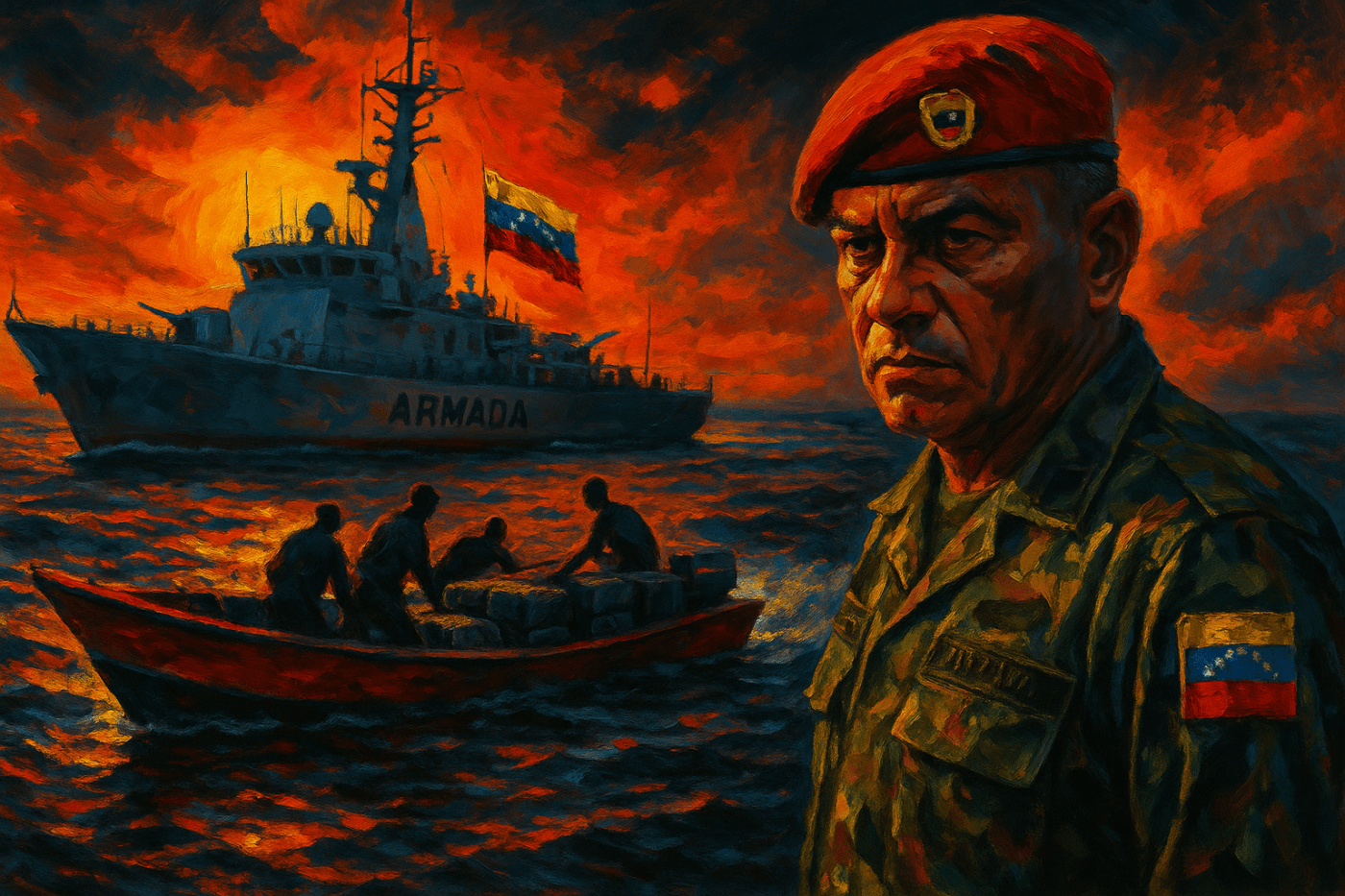
When the empire plants cocaine to frame a nation, silence from Western media is not omission but complicity. Venezuela’s interception of nearly four tons of Colombian cocaine tore the mask from a U.S. plot and affirmed the clarity of revolutionary truth.
By Prince Kapone | Weaponized Information | September 20, 2025
When the Empire Plants Cocaine, the People Reap Chains
The Venezuelan state stood before the world on September 17 and laid bare a familiar script of imperial treachery. Interior Minister Diosdado Cabello announced the capture of a Go Fast boat in Caribbean waters, carrying nearly four tons of cocaine—3,692 kilograms stuffed into one hundred sacks. But the story was not just about the seizure of drugs; it was about the seizure of a plot. According to Cabello, this was no ordinary trafficking bust but the unmasking of a falsa bandera, a false flag operation orchestrated by the United States Drug Enforcement Administration. The plan, he said, was to “plant” the cocaine onto a vessel with Venezuelan identification, parade the captured crew as Venezuelan nationals, and blast the headlines across the world: Venezuela is a narco-state. Washington would stand as judge, jury, and executioner.
This was not a whisper in the wind; it was a formal announcement, recorded, reported, and carried by the country’s press and allied outlets across Latin America and beyond. TeleSUR, Cubadebate, and ALBA Ciudad gave the numbers, the equipment, the detainees, the names. Venezuelanalysis, Orinoco Tribune, and Al Mayadeen carried the same into English, naming Levi Enrique López Batis as a DEA-linked operative, tracing the route back to Colombia’s La Guajira and Catatumbo, and recording the confession of a captured man known as Cirilo who tied the shipment to U.S. handlers. In other words, Venezuela was not crying wolf; it was presenting evidence of the wolf’s teeth, still bloodied from its last attack.
Here is the dialectic of power: the U.S. speaks of fighting drugs while shipping them, accuses Venezuela of trafficking while plotting to plant the proof. It bombs boats at sea, killing crew and incinerating evidence, while Venezuela intercepts, seizes, and arrests, bringing prisoners alive and respecting international protocols. One side calls itself civilized while practicing maritime assassination. The other, branded as outlaw, behaves with more legality than its accusers. What Cabello revealed was not an isolated scheme but the latest installment of an imperial tradition, where “narco-terrorism” is less a description of reality than a convenient alibi for intervention.
This is why the imperial press in New York, London, and Miami has kept silent on the announcement. They ran the U.S. narrative of “drug boats destroyed,” but when Venezuela produced its evidence of sabotage, the newsrooms looked away. Silence is itself a weapon. It is the soundproofing of empire’s crimes. Against that silence we raise our voices—not in balance, not in neutrality, but in affirmation. Because the truth, spoken from the other side, is that the empire tried to sow cocaine in Venezuela’s waters, and Venezuela tore up the plot by its roots.
From Gedeón to the DEA: A Lineage of Sabotage
What Venezuela exposed this September did not arrive out of nowhere. It belongs to a long and bloody lineage of imperial sabotage dressed up as law enforcement. The U.S. empire has always worn the mask of the “drug war” to conceal its deeper motives—control, destabilization, and the maintenance of hemispheric supremacy. From Plan Colombia’s billions in military aid to right-wing death squads, to the endless extraditions and secret flights of captured traffickers, Washington has treated narcotics not as a scourge to be eliminated but as a lever to move politics. Drugs are both the pretext and the payload, both the contraband and the cover story.
Venezuelans remember 2020, when mercenaries funded and trained on Colombian soil launched Operación Gedeón, an armed incursion that traced its routes through the same Caribbean waters Cabello identified in this latest plot. Back then, too, the fingerprints of the U.S. state apparatus were visible—contractors, handlers, and intelligence officers hovering just out of camera frame. The playbook has not changed: recruit locals, slip them false papers, frame them as traitors or criminals, and let the Western media chorus sing the refrain of “failed state” and “narco-regime.”
Meanwhile, the material record tells another story. In 2025 alone, Venezuela has seized more than sixty tons of cocaine—more than many of its neighbors combined—evidence not of complicity but of resistance. Yet Washington insists on branding the country as the source of a trade it profits from at home and abroad. To call Venezuela a narco-state while ignoring U.S. ports awash with Colombian cocaine is like accusing the lock of theft while the burglar walks free. The history is clear: the colonial powers have always projected their own crimes onto the colonized. Slavery was recast as “civilization,” invasions as “protection,” coups as “democracy.” Today, cocaine becomes the alibi for bombs in the Caribbean.
The lesson is simple. What happened with this seized boat is not an aberration but part of a lineage that stretches from Plan Colombia through Gedeón to Trump 2.0’s Caribbean theatrics. The empire sows lies with the same regularity that it sows death. Venezuela’s act of exposure is thus not just a local defense; it is a historical continuation of every anti-colonial struggle that has named the sabotage for what it is. By placing this latest false flag in that continuum, we see it clearly: not a scandal of one day, but the rhythm of empire itself.
The Story They Tell and the Silence They Keep
When the U.S. Navy bombs a boat in the Caribbean, the Western press rushes to file its copy. Reuters, AP, the Guardian—all have dutifully printed the official line: “drug traffickers neutralized,” “narco-boat destroyed,” “Trump says U.S. strikes again.” Death counts become tallies, explosions become footnotes, and the assumption of guilt hangs unquestioned over every smoldering hull. In this script, the United States is the noble enforcer, policing the seas against an endless tide of foreign vice. Venezuela is cast as the suspect nation, too corrupt, too criminal, too incapable to govern its own waters.
But when Caracas stepped forward with evidence of a false flag—four detainees with Venezuelan IDs planted to tell a ready-made story, nearly four tons of seized cocaine traced back to Colombia, a DEA agent named in the operation—what did the same outlets say? Nothing. Not a headline in New York, not a paragraph in London, not a whisper on CNN. They ran the imperial script to the letter, then closed the curtain before the rebuttal could be heard. Silence is not absence; it is a choice, a form of complicity. By erasing Venezuela’s announcement, corporate media did not just omit facts, they actively protected the credibility of Washington’s tale.
This is how narrative warfare works. The enemy is allowed to speak, endlessly, with microphones in every capital and headlines in every time zone. The colonized are either muted or mistranslated, their statements reduced to “denials,” their evidence recast as propaganda. A boat bombed by the U.S. is news; a boat seized by Venezuela is a non-event. The imperial voice is law, the oppressed voice is rumor. What we confront is not just biased journalism but a deliberate architecture of meaning, one where truth from the Other Side must be buried lest it shatter the illusion of moral authority.
By naming this silence, we expose it. By insisting on the Venezuelan account, we puncture the airtight chamber in which empire tells its story. And by doing so, we remind ourselves and our readers: the press of capital is not a neutral witness but an active participant in the war. Its omissions are as deadly as its lies.
Telling the Story from the Other Side
From Caracas, the picture looks very different than the sterile wire copy that circulates in New York or Madrid. On September 17, Interior Minister Diosdado Cabello announced that Venezuelan forces intercepted a speedboat carrying 3,680 kilograms of cocaine, stored in 100 sacks, along with a GPS device, two radios, and 2,400 liters of fuel. Four suspects were arrested, all carrying Venezuelan identification cards. According to Cabello, this was no coincidence but design: the detainees were meant to serve as props in a U.S. production, paraded before cameras as proof that Venezuela was the origin of the shipment.
Cabello named the alleged handler: Levi Enrique López Batis, described as a DEA agent and trafficker linked to Colombian networks operating in La Guajira. The minister also reported that detainees confessed the shipment was part of a “false flag operation” designed to incriminate Venezuela in international drug trafficking.
The Venezuelan press carried these details in full. TeleSUR and Cubadebate repeated the minister’s charge of a DEA “falsa bandera”; ALBA Ciudad and VTV broadcast the names, the tonnage, and the equipment. In English, Venezuelanalysis published the announcement alongside coverage of U.S. boat strikes, showing the competing narratives in real time. Orinoco Tribune amplified the claim that Washington’s objective was to brand Venezuela a narco-state to justify aggression. Al Mayadeen English called it exactly that: a false flag after a major seizure of cocaine. Even mainstream regional outlets such as El Universo and Swissinfo reported Cabello’s accusation of a “falso positivo” by the DEA.
Placed together, the evidence paints a clear picture: a U.S. intelligence network, operating through DEA channels, attempted to stage an operation that would tie tons of Colombian cocaine to Venezuelan identities and waters. The intent was to manufacture consent for further aggression—military, diplomatic, economic. What stopped it was not goodwill from Washington but the vigilance of Venezuelan authorities, who seized the shipment, captured the crew, and brought the story to light before the imperial press could script its version of events.
This is the story from the Other Side. It is not rumor, not speculation, but a narrative backed by seizures, confessions, routes, and records. It is the story the corporate press refused to carry, because to publish it would be to admit that empire is the trafficker, not the victim. And so the task falls to us: to affirm this truth, to weaponize it, and to ensure it circulates among the working class and the colonized, where clarity is the seed of resistance.
Why This Matters for the Global Class Struggle
The exposure of a false flag in the Caribbean is not a provincial scandal—it is a window into the machinery of empire. For Latin America, it lays bare once again how the so-called “war on drugs” has nothing to do with eliminating narcotics and everything to do with tightening U.S. military and political control. The cocaine itself, Cabello reminded the world, originated in Colombia. Yet the narrative Washington tried to engineer would blame Venezuela. This sleight of hand protects U.S. allies while criminalizing its enemies, ensuring that sovereignty is punished and servitude rewarded. For countries across the continent, the lesson is urgent: imperialism will weaponize any vice, any route, any tragedy to justify its encirclement.
For the multipolar world, the revelation strengthens the collective defense against hyper-imperialism. Cuba, Iran, China, and the Sahel states understand this script well—they have been cast as villains in the same global theater, branded terrorists, narco-regimes, or pirates to justify sanctions, blockades, or bombings. Venezuela’s refusal to be framed adds another brick to the wall of resistance, proving that imperial narratives can be intercepted and dismantled when revolutionary states speak with clarity and courage. The more that multipolar voices affirm each other, the harder it becomes for Washington to monopolize truth.
For the oppressed inside the United States, this incident is a mirror. The “drug war” that is exported abroad as pretext for naval strikes is the same ideology that has filled U.S. prisons with millions of Black, Brown, and poor people. Just as Washington tries to frame Venezuela with planted evidence, so too do police departments frame youth with planted drugs, fabricated reports, and coerced confessions. The colonial logic is seamless: what is practiced in Harlem or the Bronx is reproduced in the Caribbean and Latin America. By seeing the connection, the internal colonies of the U.S. can grasp that their struggle is bound up with Venezuela’s, that the same system is waging war on both fronts.
And finally, for the working class in the imperial core, the significance is simple: the empire lies to you. It lies about wars, about enemies, about drugs, about sovereignty. It lies not as an accident but as a system. Every headline that repeats Washington’s script without Venezuela’s reply is part of that lie. To recognize this is to refuse complicity. To spread the Other Side is to break the spell. This is why the exposure of one false flag matters not only for Venezuela, but for the entire global class struggle—it weakens the narrative armor of empire and strengthens the revolutionary truth of the oppressed.
 Weaponized Information
Leave a comment